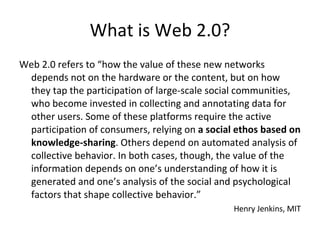
What is Web 2.0? Web 2.0 refers to “how the value of these new networks depends not on the hardware or the content, but on how they tap the participation of large-scale social communities, who become invested in collecting and annotating data for other users. Some of these platforms require the active participation of consumers, relying on  a social ethos based on knowledge-sharing . Others depend on automated analysis of collective behavior. In both cases, though, the value of the information depends on one’s understanding of how it is generated and one’s analysis of the social and psychological factors that shape collective behavior.”  Henry Jenkins, MIT
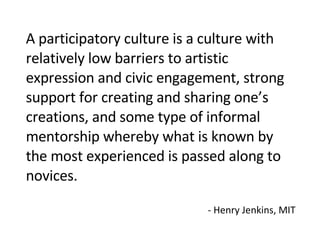
A participatory culture is a culture with relatively low barriers to artistic expression and civic engagement, strong support for creating and sharing one’s creations, and some type of informal mentorship whereby what is known by the most experienced is passed along to novices.  - Henry Jenkins, MIT
Research Questions How do Web 2.0 technologies support (or inhibit) the emergence and sustainability of a participatory culture?  Particularly, in what ways are such technologies used to share the cultural, creative, and intellectual products of its community members?  What conclusions can be made for learning organizations that may be interested in introducing Web 2.0 technologies to create a more participatory cultures?
Rationale If a cultural shift is indeed in progress as Jenkins suggests, understanding the particularities is essential. Growth of social software use by young people (will have greater impact on higher education institutions moving into the future) Address the speculation and hype
 
 
Overview Literature Review Design-based Research: Creating the Environment Research Methods & Analysis: Understand the ‘Who’ and ‘What’ of the communications over time (2+ years)  Implications: Tie back to Participatory Culture: Not only adoption and diffusion, but the extent to which it is used to share the cultural, creative, and intellectual products.
Literature Reviewed CSCL, Situated Learning, and Networked Learning Web 2.0 and ICTs Design and Design-based Research Diffusion, Change, and Innovation Historical & Cultural Context
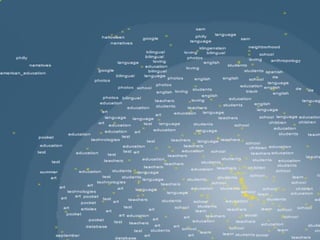
Methods Quantitative Method on Communication Data Data comparison between Web 1.0 and Web 2.0 systems The Who: Social Network Analysis, patterns of Communication over time The What: Latent Semantic Analysis Qualitative Method Participant Observation
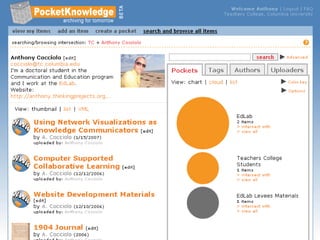
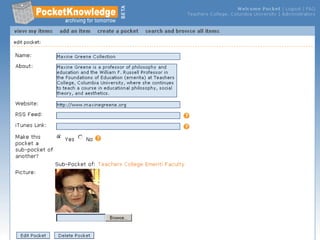
PocketKnowledge & Web 2.0 Design Patterns Individual users maintain high degree of control High level of community trust Non-authoritative information organization Playful attitude
 
PocketKnowledge & Web 2.0 Design Patterns Individual users maintain high degree of control High level of community trust Non-authoritative information organization Playful attitude
 
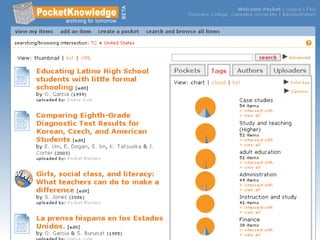
PocketKnowledge & Web 2.0 Design Patterns Individual users maintain high degree of control High level of community trust Non-authoritative information organization Playful attitude
 
PocketKnowledge & Web 2.0 Design Patterns Individual users maintain high degree of control High level of community trust Non-authoritative information organization Playful attitude
 
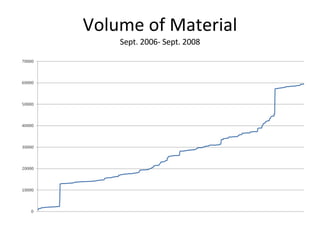
Volume of Material Sept. 2006- Sept. 2008
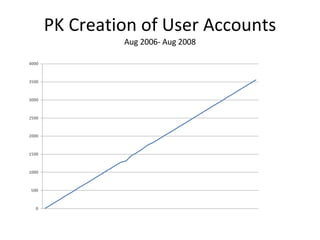
PK Creation of User Accounts Aug 2006- Aug 2008
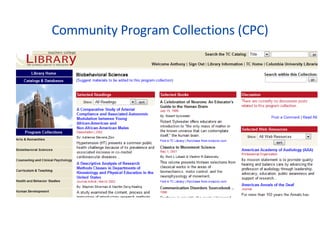
Community Program Collections (CPC)
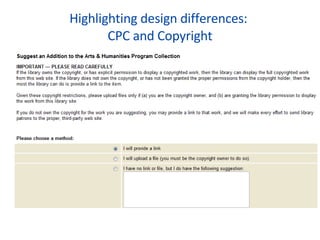
Highlighting design differences:  CPC and Copyright
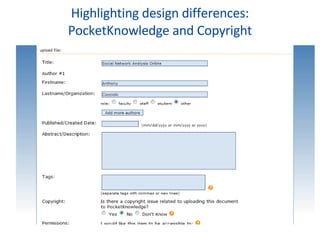
Highlighting design differences: PocketKnowledge and Copyright
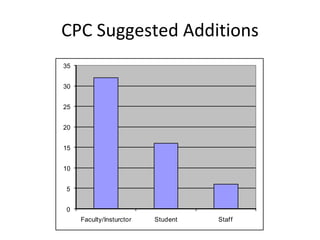
CPC Suggested Additions
 
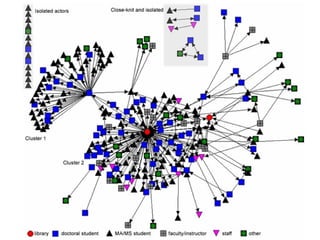
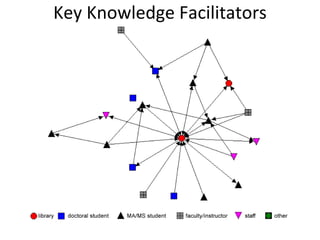
Key Knowledge Facilitators
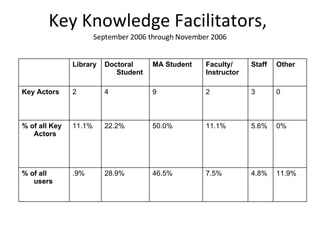
Key Knowledge Facilitators,  September 2006 through November 2006 Library Doctoral Student MA Student Faculty/ Instructor Staff Other Key Actors 2 4 9 2 3 0 % of all Key Actors 11.1% 22.2% 50.0% 11.1% 5.6% 0% % of all users .9% 28.9% 46.5% 7.5% 4.8% 11.9%
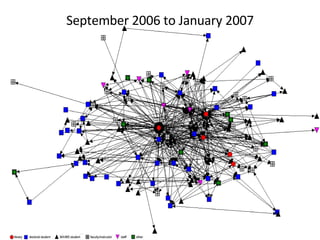
September 2006 to January 2007
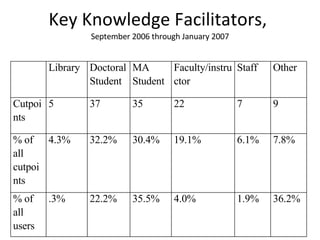
Key Knowledge Facilitators,  September 2006 through January 2007 Library Doctoral Student MA Student Faculty/instructor Staff Other Cutpoints 5 37 35 22 7 9 % of all cutpoints 4.3% 32.2% 30.4% 19.1% 6.1% 7.8% % of all users .3% 22.2% 35.5% 4.0% 1.9% 36.2%
Results 1) Community Program Collections design patterns discouraged student participation. 2) PocketKnolwedge was launched and it provided the ability for a radical interaction network to form (e.g., relative knowledge novices acting as key knowledge facilitators). 3) Over time, the PocketKnowledge interaction network became less radical as it started to be more expert oriented and take on consumptive tendencies.
 
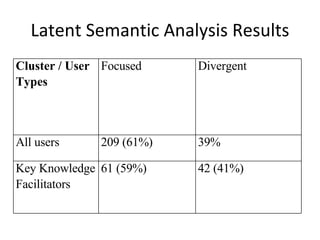
Latent Semantic Analysis Results Cluster / User Types Focused Divergent All users 209 (61%) 39% Key Knowledge Facilitators 61 (59%) 42 (41%)
 
Conclusions The resultant interaction network resembles a dialectic ranging from control (or the tendency of the system to provide affordances for replicating and reaffirming pre-existing institutional structures) to emancipation (or the tendency to break free from such structures and start something new)
Implications All technologies are situated in a social, political and legal culture Web 2.0 technologies are situated in specific contexts, the free expressions that the design affords are available, yet they will persist in adjacency and in tension with those elements that are expressions of pre-existing social, cultural, and political norms. Design affordances are not enough.
Interactivity is a property of the technology, while participation is a property of culture. Participatory culture is emerging as the culture absorbs and responds to the explosion of new media technologies that make it possible for average consumers to archive, annotate, appropriate, and recirculate media content in powerful new ways. A focus on expanding access to new technologies carries us only so far if we do not also foster the skills and cultural knowledge necessary to deploy those tools toward our own ends. - Henry Jenkins, MIT
Future Research Specific methods and interventions for using Web 2.0 tools to support participatory culture beyond simply design affordances. Explore if there are design affordances that can be used to support a more participatory culture? Other patterns not yet explored (statistical correlations between user interactions) Trying out findings in other Web 2.0 systems
Thank you. Anthony Cocciolo  cocciolo@tc.columbia.edu  www.thinkingprojects.org

Participatory Culture and Web 2.0 in Higher Education

  • 1.
  • 2.
  • 3.
    What is Web2.0? Web 2.0 refers to “how the value of these new networks depends not on the hardware or the content, but on how they tap the participation of large-scale social communities, who become invested in collecting and annotating data for other users. Some of these platforms require the active participation of consumers, relying on a social ethos based on knowledge-sharing . Others depend on automated analysis of collective behavior. In both cases, though, the value of the information depends on one’s understanding of how it is generated and one’s analysis of the social and psychological factors that shape collective behavior.” Henry Jenkins, MIT
  • 4.
    A participatory cultureis a culture with relatively low barriers to artistic expression and civic engagement, strong support for creating and sharing one’s creations, and some type of informal mentorship whereby what is known by the most experienced is passed along to novices. - Henry Jenkins, MIT
  • 5.
    Research Questions Howdo Web 2.0 technologies support (or inhibit) the emergence and sustainability of a participatory culture? Particularly, in what ways are such technologies used to share the cultural, creative, and intellectual products of its community members? What conclusions can be made for learning organizations that may be interested in introducing Web 2.0 technologies to create a more participatory cultures?
  • 6.
    Rationale If acultural shift is indeed in progress as Jenkins suggests, understanding the particularities is essential. Growth of social software use by young people (will have greater impact on higher education institutions moving into the future) Address the speculation and hype
  • 7.
  • 8.
  • 9.
    Overview Literature ReviewDesign-based Research: Creating the Environment Research Methods & Analysis: Understand the ‘Who’ and ‘What’ of the communications over time (2+ years) Implications: Tie back to Participatory Culture: Not only adoption and diffusion, but the extent to which it is used to share the cultural, creative, and intellectual products.
  • 10.
    Literature Reviewed CSCL,Situated Learning, and Networked Learning Web 2.0 and ICTs Design and Design-based Research Diffusion, Change, and Innovation Historical & Cultural Context
  • 11.
    Methods Quantitative Methodon Communication Data Data comparison between Web 1.0 and Web 2.0 systems The Who: Social Network Analysis, patterns of Communication over time The What: Latent Semantic Analysis Qualitative Method Participant Observation
  • 12.
    PocketKnowledge & Web2.0 Design Patterns Individual users maintain high degree of control High level of community trust Non-authoritative information organization Playful attitude
  • 13.
  • 14.
    PocketKnowledge & Web2.0 Design Patterns Individual users maintain high degree of control High level of community trust Non-authoritative information organization Playful attitude
  • 15.
  • 16.
    PocketKnowledge & Web2.0 Design Patterns Individual users maintain high degree of control High level of community trust Non-authoritative information organization Playful attitude
  • 17.
  • 18.
    PocketKnowledge & Web2.0 Design Patterns Individual users maintain high degree of control High level of community trust Non-authoritative information organization Playful attitude
  • 19.
  • 20.
    Volume of MaterialSept. 2006- Sept. 2008
  • 21.
    PK Creation ofUser Accounts Aug 2006- Aug 2008
  • 22.
  • 23.
  • 24.
    Highlighting design differences:PocketKnowledge and Copyright
  • 25.
  • 26.
  • 27.
  • 28.
    Key Knowledge Facilitators, September 2006 through November 2006 Library Doctoral Student MA Student Faculty/ Instructor Staff Other Key Actors 2 4 9 2 3 0 % of all Key Actors 11.1% 22.2% 50.0% 11.1% 5.6% 0% % of all users .9% 28.9% 46.5% 7.5% 4.8% 11.9%
  • 29.
    September 2006 toJanuary 2007
  • 30.
    Key Knowledge Facilitators, September 2006 through January 2007 Library Doctoral Student MA Student Faculty/instructor Staff Other Cutpoints 5 37 35 22 7 9 % of all cutpoints 4.3% 32.2% 30.4% 19.1% 6.1% 7.8% % of all users .3% 22.2% 35.5% 4.0% 1.9% 36.2%
  • 31.
    Results 1) CommunityProgram Collections design patterns discouraged student participation. 2) PocketKnolwedge was launched and it provided the ability for a radical interaction network to form (e.g., relative knowledge novices acting as key knowledge facilitators). 3) Over time, the PocketKnowledge interaction network became less radical as it started to be more expert oriented and take on consumptive tendencies.
  • 32.
  • 33.
    Latent Semantic AnalysisResults Cluster / User Types Focused Divergent All users 209 (61%) 39% Key Knowledge Facilitators 61 (59%) 42 (41%)
  • 34.
  • 35.
    Conclusions The resultantinteraction network resembles a dialectic ranging from control (or the tendency of the system to provide affordances for replicating and reaffirming pre-existing institutional structures) to emancipation (or the tendency to break free from such structures and start something new)
  • 36.
    Implications All technologiesare situated in a social, political and legal culture Web 2.0 technologies are situated in specific contexts, the free expressions that the design affords are available, yet they will persist in adjacency and in tension with those elements that are expressions of pre-existing social, cultural, and political norms. Design affordances are not enough.
  • 37.
    Interactivity is aproperty of the technology, while participation is a property of culture. Participatory culture is emerging as the culture absorbs and responds to the explosion of new media technologies that make it possible for average consumers to archive, annotate, appropriate, and recirculate media content in powerful new ways. A focus on expanding access to new technologies carries us only so far if we do not also foster the skills and cultural knowledge necessary to deploy those tools toward our own ends. - Henry Jenkins, MIT
  • 38.
    Future Research Specificmethods and interventions for using Web 2.0 tools to support participatory culture beyond simply design affordances. Explore if there are design affordances that can be used to support a more participatory culture? Other patterns not yet explored (statistical correlations between user interactions) Trying out findings in other Web 2.0 systems
  • 39.
    Thank you. AnthonyCocciolo cocciolo@tc.columbia.edu www.thinkingprojects.org