Health is
Our Concern
Approach to child with URTI
Dr. Raheel Ahmed Shaikh
FCPS Pediatrics
Children Hospital, Chandka Medical College Larkana
Introduction
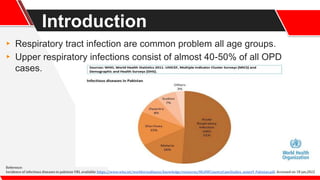
▸ Respiratory tract infection are common problem all age groups.
▸ Upper respiratory infections consist of almost 40-50% of all OPD
cases.
Reference:
Incidence of infectious diseases in pakistan URL available: https://www.who.int/workforcealliance/knowledge/resources/MLHWCountryCaseStudies_annex9_Pakistan.pdf. Accessed on 18 jan,2022
THE RESPIRATORY SYSTEM
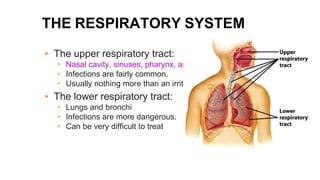
▸ The upper respiratory tract:
▹ Nasal cavity, sinuses, pharynx, and larynx
▹ Infections are fairly common.
▹ Usually nothing more than an irritation
▸ The lower respiratory tract:
▹ Lungs and bronchi
▹ Infections are more dangerous.
▹ Can be very difficult to treat
Symptoms
▸ Fever
▸ Coryza
▸ Cough
▸ Breathlessness
▸ Stridor/Wheze
▸ Chest Pain
▸ Cynosis
▸ Convulsion
▸ Lethargic
▸ Dec intake/ refuse to feed
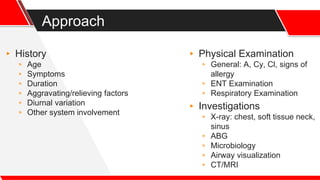
Approach
▸ History
▹ Age
▹ Symptoms
▹ Duration
▹ Aggravating/relieving factors
▹ Diurnal variation
▹ Other system involvement
▸ Physical Examination
▹ General: A, Cy, Cl, signs of
allergy
▹ ENT Examination
▹ Respiratory Examination
▸ Investigations
▹ X-ray: chest, soft tissue neck,
sinus
▹ ABG
▹ Microbiology
▹ Airway visualization
▹ CT/MRI
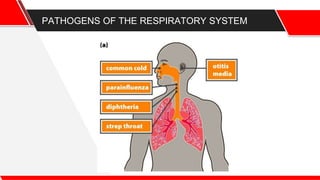
PATHOGENS OF THE RESPIRATORY SYSTEM
CommonCold
▸ Naso-pharyngitis = Common
cold.
▸ Essentially Viral infection of the
nose & throat.
▸ Characterized by rhinorrhea
and nasal obstruction.
▸ Etiology
RHV, RSV, MPV, coronavirus,
adenovirus.
▸ Assessment (S &S):
1. Younger child
▹ Fever, sneezing, irritability, vomiting
2. Older child
▹ Dryness & irritation of nose & throat,
sneezing, cough & muscular aches.
▸ Usually no need of
investigations.
PCR/ serology
▸ Complications of
nasopharyngitis:
▹ Otitis media
▹ Lower respiratory tract infection
▹ Older child may develop sinusitis
▹ Acute exacerbation of asthma
CommonCold
▸ Treatment: symptomatic
▹ Adequate hydration (warm
fluids)
▹ Antimicrobial agents>>no
▹ Cough: Honey (5-10ml in >1
year), 1st generation histamine
▹ Fever: NSAID (Acetaminophen)
▹ Nasal obstruction: topical
adregenic agents, saline nasal
drops and irrigation
▹ Rhinorrhea: 1st generation
histamine, ipratopium bromide
▹ Antivairal: Ribavirin for RSV
(immunocompromised),
neuroamidease inhibitor
(oseltamivir, zanamavir) for
influenza virus
▸ Prophylactic antibiotics DO
NOT
▹ Shorten duration
▹ Prevent sinusitis/OM/Pneumonia
▹ Reduce Symptoms
CommonCold
▸ Prevention:
▹ Hand wash
▹ Avoid touching nose, mouth, eye
▹ Alcohol sanitizer usage
▹ Avoid crowded area
▹ Zinc can reduce sympyoms
▹ No role of vit C, vit D
AllergicRhinitis
▸ 20% population
▸ Ch: by nasal congestion, itching,
sneezing, and discharge
▸ Hx
▹ Seasonality
▹ Hx of atopy
▹ Exposure to parental smoking,
pets, nuts, dust mite, carpets
bedding
▸ Examination
▹ Mouth breathing
▹ Postnasal drip
▹ Cough
▹ Nose rubbing
▹ Suborbital venous congestion
▹ Watery red eyes
▸ Investigation
▹ Skin prick test for specific
antigens
▹ S. Ig E measurement
▸ Tx
▹ Allergen avoidance
▹ Symptomic: Antihistamines,
montelukast, intanasal
steroids.
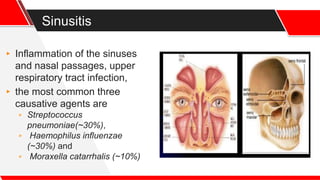
Sinusitis
▸ Inflammation of the sinuses
and nasal passages, upper
respiratory tract infection,
▸ the most common three
causative agents are
▹ Streptococcus
pneumoniae(~30%),
▹ Haemophilus influenzae
(~30%) and
▹ Moraxella catarrhalis (~10%)
▸ Types:
▹ Acute : symptoms >10 days <1month
▹ Subacute: 1-3 month
▹ Chronic: >3month (90days)
▸ Predisposing factors
▹ Viral infections, School age sibling, Allergic rhinitis, Expose to
tobacco smoke, Immunodeficiency
▹ CF, PCD, GERD, Cleft palate
Sinusitis
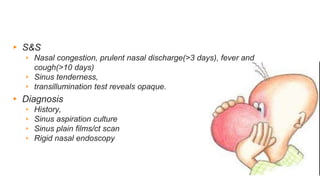
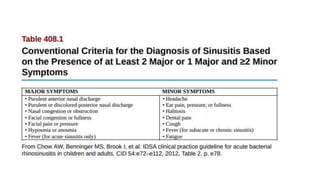
▸ S&S
▹ Nasal congestion, prulent nasal discharge(>3 days), fever and
cough(>10 days)
▹ Sinus tenderness,
▹ transillumination test reveals opaque.
▸ Diagnosis
▹ History,
▹ Sinus aspiration culture
▹ Sinus plain films/ct scan
▹ Rigid nasal endoscopy
Sinusitis
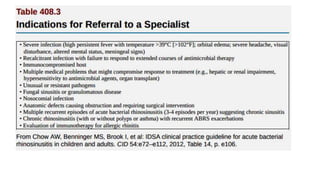
▸ Treatment
▹ Antibiotics
▹ Amoxycillin/ cefuroxime/ co-amoxiclav/
Macrolide
▸ If severe/ failure to 1st line
▹ Iv Ceftriaxone/Cefotaxime or
oral Cefpodoxime
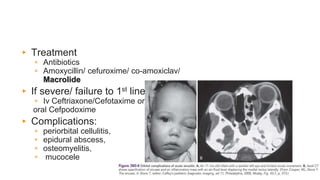
▸ Complications:
▹ periorbital cellulitis,
▹ epidural abscess,
▹ osteomyelitis,
▹ mucocele
Pharyngitis
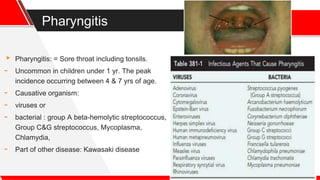
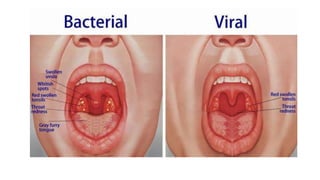
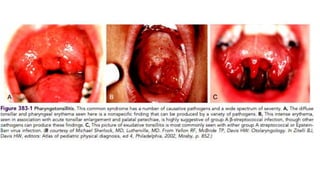
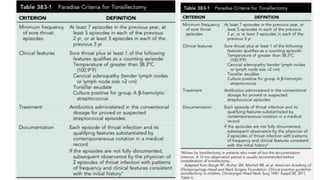
▸ Pharyngitis: = Sore throat including tonsils.
- Uncommon in children under 1 yr. The peak
incidence occurring between 4 & 7 yrs of age.
- Causative organism:
- viruses or
- bacterial : group A beta-hemolytic streptococcus,
Group C&G streptococcus, Mycoplasma,
Chlamydia,
- Part of other disease: Kawasaki disease
Pharyngitis
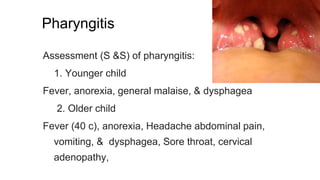
Assessment (S &S) of pharyngitis:
1. Younger child
Fever, anorexia, general malaise, & dysphagea
2. Older child
Fever (40 c), anorexia, Headache abdominal pain,
vomiting, & dysphagea, Sore throat, cervical
adenopathy,
Management of Pharyngitis
▸ A throat culture:
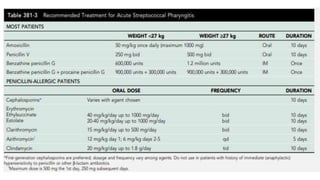
- Antibiotic medicine is needed if streptococcus found to be the causative organism.
- Oral amoxicillin for 10 days. Or Benzathine pencillin G IM once.
- No special treatment if caused by a virus.
- Do not smoke around this child.
- . Introduce soft foods or warm soups.
- Give this child 6 to 8 glasses of liquids like water and fruit juices each day.
- Run a cool mist humidifier in the child's room.
- If this child is 8 years or older, have him gargle with a mixture of 1 teaspoon salt in 1
cup warm water.
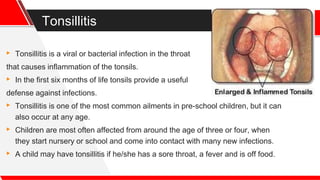
Tonsillitis
▸ Tonsillitis is a viral or bacterial infection in the throat
that causes inflammation of the tonsils.
▸ In the first six months of life tonsils provide a useful
defense against infections.
▸ Tonsillitis is one of the most common ailments in pre-school children, but it can
also occur at any age.
▸ Children are most often affected from around the age of three or four, when
they start nursery or school and come into contact with many new infections.
▸ A child may have tonsillitis if he/she has a sore throat, a fever and is off food.
Advice and treatment:
▸ Encourage bed rest.
▸ Introduce soft liquid diet according to the child's preferences.
▸ Provide cool mist atmosphere to keep the mucous membranes moist
during periods of mouth breathing.
▸ Warm saline gargles & paracetamol are useful to promote comfort.
▸ If antibiotics are prescribed, counsel the child's parents regarding
the necessity of completing the treatment period
▸ The controversy of tonsillectomy:
▸ Surgical removal of chronic tonsillitis (tonsillectomy) is controversial.
Generally, tonsils should not removed before 3 or 4 yrs of age.
Stridor
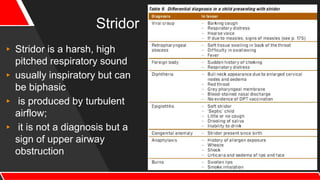
▸ Stridor is a harsh, high
pitched respiratory sound
▸ usually inspiratory but can
be biphasic
▸ is produced by turbulent
airflow;
▸ it is not a diagnosis but a
sign of upper airway
obstruction
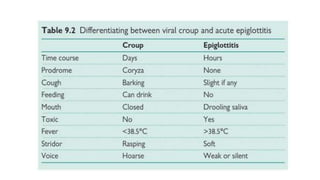
Viral croup/ laryngotreacheobronchitis
▸ the most common form of acute upper respiratory
obstruction
▸ Mucosal inflamation affecting anywhere from nose to lower
airway
▸ The term laryngotracheobronchitis refers to viral infection of
the glottic and subglottic regions.
▸ Common organisms; parainfluenza virus75%, influenza
virus, RSV
▸ Age 6m to 6y.
▸ family members might have mild respiratory illnesses
Viral croup/ laryngotreacheobronchitis
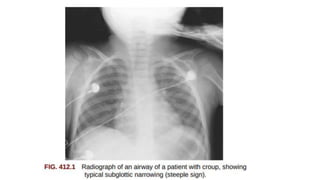
▸ characteristic barking cough, hoarseness, and
inspiratory stridor.
▸ child may prefer to sit up in bed or be held upright
▸ Physical examination can reveal a hoarse voice,
coryza, normal to moderately inflamed pharynx, and a
slightly increased respiratory rate
▸ Hypoxia and low oxygen saturation are seen only when
complete airway obstruction is imminent.
▸ The child who is hypoxic, cyanotic, pale, or obtunded
needs immediate airway management
Viral croup
Diagnosis
Mild croup is characterized by:
■ fever
■ a hoarse voice
■ a barking or hacking cough
■ stridor that is heard only when the child is
agitated.
Severe croup is characterized additionally
by:
■ stridor even when the child is at rest
■ rapid breathing and lower chest indrawing
■ cyanosis or oxygen saturation ≤ 90%.
Treatment
Mild croup can be managed at home with
supportive care, including encouraging oral fluids,
breastfeeding or feeding, as appropriate.
A child with severe croup should be
admitted to hospital.
Steroid treatment: Give one dose of oral
dexamethasone (0.6 mg/kg), If available, use
nebulized budesonide at 2 mg
Adrenaline: give the child nebulized adrenaline (2 ml of
1:1000solution). If this is effective, repeat as often as
every hour
Intubation and/or tracheostomy
Oxygen, Antibiotic treatment (not effective),
Supportive care, Monitoring
Epiglottitis (Supraglottitis)
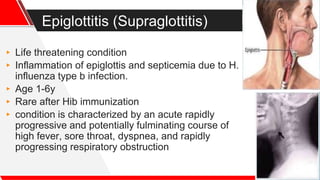
▸ Life threatening condition
▸ Inflammation of epiglottis and septicemia due to H.
influenza type b infection.
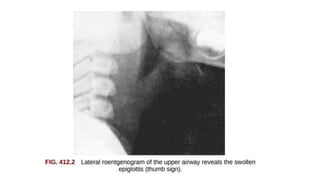
▸ Age 1-6y
▸ Rare after Hib immunization
▸ condition is characterized by an acute rapidly
progressive and potentially fulminating course of
high fever, sore throat, dyspnea, and rapidly
progressing respiratory obstruction
Epiglottitis (Supraglottitis)
Clinical features
▸ the otherwise healthy child suddenly develops a sore
throat and fever
▸ Within a matter of hours, the patient appears toxic,
swallowing is difficult, and breathing is labored.
▸ Other: Drooling, neck hyperextended, tripod position,
stidor
▸ A brief period of air hunger with restlessness may be
followed by rapidly increasing cyanosis and coma
▸ cherry red, swollen epiglottis by laryngoscopy
Epiglottitis
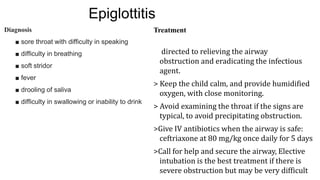
Diagnosis
■ sore throat with difficulty in speaking
■ difficulty in breathing
■ soft stridor
■ fever
■ drooling of saliva
■ difficulty in swallowing or inability to drink
Treatment
directed to relieving the airway
obstruction and eradicating the infectious
agent.
> Keep the child calm, and provide humidified
oxygen, with close monitoring.
> Avoid examining the throat if the signs are
typical, to avoid precipitating obstruction.
>Give IV antibiotics when the airway is safe:
ceftriaxone at 80 mg/kg once daily for 5 days
>Call for help and secure the airway, Elective
intubation is the best treatment if there is
severe obstruction but may be very difficult
Indications for rifampin prophylaxis
▸ for all household members include
▹ a child within the home who is younger than 4 yr of age and
incompletely immunized,
▹ younger than 12 mo of age and has not completed the primary
vaccination series,
▹ or immunocompromised.
▸ Dose: (20 mg/kg orally once a day for 4 days;
maximum dose: 600 mg)
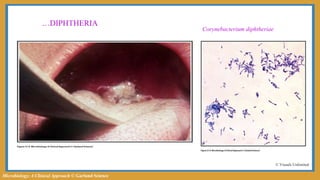
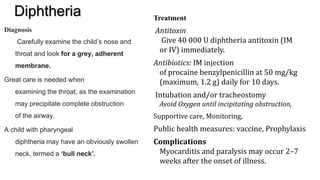
DIPHTHERIA
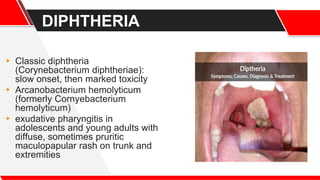
▸ Classic diphtheria
(Corynebacterium diphtheriae):
slow onset, then marked toxicity
▸ Arcanobacterium hemolyticum
(formerly Cornyebacterium
hemolyticum)
▸ exudative pharyngitis in
adolescents and young adults with
diffuse, sometimes pruritic
maculopapular rash on trunk and
extremities
Microbiology: A Clinical Approach © Garland Science
…DIPHTHERIA
© Visuals Unlimited
Corynebacterium diphtheriae
Diphtheria
Diagnosis
Carefully examine the child’s nose and
throat and look for a grey, adherent
membrane.
Great care is needed when
examining the throat, as the examination
may precipitate complete obstruction
of the airway.
A child with pharyngeal
diphtheria may have an obviously swollen
neck, termed a ‘bull neck’.
Treatment
Antitoxin
Give 40 000 U diphtheria antitoxin (IM
or IV) immediately.
Antibiotics: IM injection
of procaine benzylpenicillin at 50 mg/kg
(maximum, 1.2 g) daily for 10 days.
Intubation and/or tracheostomy
Avoid Oxygen until incipitating obstruction,
Supportive care, Monitoring,
Public health measures: vaccine, Prophylaxis
Complications
Myocarditis and paralysis may occur 2–7
weeks after the onset of illness.
Diphtheria
PROPHYLAXIS:
▸ Asymptomatic case contacts:
▹ All house hold contacts or those who come in contact with
secretions
▹ Macrolide for 7 days or I/M penicillin single dose
▹ Age appropriate vaccination
▸ Asymptomatic carriers: Macrolide for 7 days
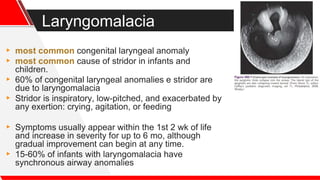
Laryngomalacia
▸ most common congenital laryngeal anomaly
▸ most common cause of stridor in infants and
children.
▸ 60% of congenital laryngeal anomalies e stridor are
due to laryngomalacia
▸ Stridor is inspiratory, low-pitched, and exacerbated by
any exertion: crying, agitation, or feeding
▸ Symptoms usually appear within the 1st 2 wk of life
and increase in severity for up to 6 mo, although
gradual improvement can begin at any time.
▸ 15-60% of infants with laryngomalacia have
synchronous airway anomalies
▸ DIAGNOSIS
▹ primarily based on symptoms
▹ confirmed by flexible laryngoscopy
▹ complete bronchoscopy for moderate to severe obstruction.
▸ TREATMENT
▹ Expectant observation- resolve spontaneously
▹ surgical intervention via supraglattoplasty
▹ For progressive respiratory distress, cyanosis, or failure to
thrive.
URTI.pptx

URTI.pptx

  • 2.
  • 3.
    Approach to childwith URTI Dr. Raheel Ahmed Shaikh FCPS Pediatrics Children Hospital, Chandka Medical College Larkana
  • 4.
    Introduction ▸ Respiratory tractinfection are common problem all age groups. ▸ Upper respiratory infections consist of almost 40-50% of all OPD cases. Reference: Incidence of infectious diseases in pakistan URL available: https://www.who.int/workforcealliance/knowledge/resources/MLHWCountryCaseStudies_annex9_Pakistan.pdf. Accessed on 18 jan,2022
  • 5.
    THE RESPIRATORY SYSTEM ▸The upper respiratory tract: ▹ Nasal cavity, sinuses, pharynx, and larynx ▹ Infections are fairly common. ▹ Usually nothing more than an irritation ▸ The lower respiratory tract: ▹ Lungs and bronchi ▹ Infections are more dangerous. ▹ Can be very difficult to treat
  • 6.
    Symptoms ▸ Fever ▸ Coryza ▸Cough ▸ Breathlessness ▸ Stridor/Wheze ▸ Chest Pain ▸ Cynosis ▸ Convulsion ▸ Lethargic ▸ Dec intake/ refuse to feed
  • 7.
    Approach ▸ History ▹ Age ▹Symptoms ▹ Duration ▹ Aggravating/relieving factors ▹ Diurnal variation ▹ Other system involvement ▸ Physical Examination ▹ General: A, Cy, Cl, signs of allergy ▹ ENT Examination ▹ Respiratory Examination ▸ Investigations ▹ X-ray: chest, soft tissue neck, sinus ▹ ABG ▹ Microbiology ▹ Airway visualization ▹ CT/MRI
  • 8.
    PATHOGENS OF THERESPIRATORY SYSTEM
  • 9.
    CommonCold ▸ Naso-pharyngitis =Common cold. ▸ Essentially Viral infection of the nose & throat. ▸ Characterized by rhinorrhea and nasal obstruction. ▸ Etiology RHV, RSV, MPV, coronavirus, adenovirus. ▸ Assessment (S &S): 1. Younger child ▹ Fever, sneezing, irritability, vomiting 2. Older child ▹ Dryness & irritation of nose & throat, sneezing, cough & muscular aches. ▸ Usually no need of investigations. PCR/ serology ▸ Complications of nasopharyngitis: ▹ Otitis media ▹ Lower respiratory tract infection ▹ Older child may develop sinusitis ▹ Acute exacerbation of asthma
  • 10.
    CommonCold ▸ Treatment: symptomatic ▹Adequate hydration (warm fluids) ▹ Antimicrobial agents>>no ▹ Cough: Honey (5-10ml in >1 year), 1st generation histamine ▹ Fever: NSAID (Acetaminophen) ▹ Nasal obstruction: topical adregenic agents, saline nasal drops and irrigation ▹ Rhinorrhea: 1st generation histamine, ipratopium bromide ▹ Antivairal: Ribavirin for RSV (immunocompromised), neuroamidease inhibitor (oseltamivir, zanamavir) for influenza virus ▸ Prophylactic antibiotics DO NOT ▹ Shorten duration ▹ Prevent sinusitis/OM/Pneumonia ▹ Reduce Symptoms
  • 11.
    CommonCold ▸ Prevention: ▹ Handwash ▹ Avoid touching nose, mouth, eye ▹ Alcohol sanitizer usage ▹ Avoid crowded area ▹ Zinc can reduce sympyoms ▹ No role of vit C, vit D
  • 12.
    AllergicRhinitis ▸ 20% population ▸Ch: by nasal congestion, itching, sneezing, and discharge ▸ Hx ▹ Seasonality ▹ Hx of atopy ▹ Exposure to parental smoking, pets, nuts, dust mite, carpets bedding ▸ Examination ▹ Mouth breathing ▹ Postnasal drip ▹ Cough ▹ Nose rubbing ▹ Suborbital venous congestion ▹ Watery red eyes ▸ Investigation ▹ Skin prick test for specific antigens ▹ S. Ig E measurement ▸ Tx ▹ Allergen avoidance ▹ Symptomic: Antihistamines, montelukast, intanasal steroids.
  • 13.
    Sinusitis ▸ Inflammation ofthe sinuses and nasal passages, upper respiratory tract infection, ▸ the most common three causative agents are ▹ Streptococcus pneumoniae(~30%), ▹ Haemophilus influenzae (~30%) and ▹ Moraxella catarrhalis (~10%)
  • 14.
    ▸ Types: ▹ Acute: symptoms >10 days <1month ▹ Subacute: 1-3 month ▹ Chronic: >3month (90days) ▸ Predisposing factors ▹ Viral infections, School age sibling, Allergic rhinitis, Expose to tobacco smoke, Immunodeficiency ▹ CF, PCD, GERD, Cleft palate
  • 15.
    Sinusitis ▸ S&S ▹ Nasalcongestion, prulent nasal discharge(>3 days), fever and cough(>10 days) ▹ Sinus tenderness, ▹ transillumination test reveals opaque. ▸ Diagnosis ▹ History, ▹ Sinus aspiration culture ▹ Sinus plain films/ct scan ▹ Rigid nasal endoscopy
  • 17.
    Sinusitis ▸ Treatment ▹ Antibiotics ▹Amoxycillin/ cefuroxime/ co-amoxiclav/ Macrolide ▸ If severe/ failure to 1st line ▹ Iv Ceftriaxone/Cefotaxime or oral Cefpodoxime ▸ Complications: ▹ periorbital cellulitis, ▹ epidural abscess, ▹ osteomyelitis, ▹ mucocele
  • 19.
    Pharyngitis ▸ Pharyngitis: =Sore throat including tonsils. - Uncommon in children under 1 yr. The peak incidence occurring between 4 & 7 yrs of age. - Causative organism: - viruses or - bacterial : group A beta-hemolytic streptococcus, Group C&G streptococcus, Mycoplasma, Chlamydia, - Part of other disease: Kawasaki disease
  • 21.
    Pharyngitis Assessment (S &S)of pharyngitis: 1. Younger child Fever, anorexia, general malaise, & dysphagea 2. Older child Fever (40 c), anorexia, Headache abdominal pain, vomiting, & dysphagea, Sore throat, cervical adenopathy,
  • 22.
    Management of Pharyngitis ▸A throat culture: - Antibiotic medicine is needed if streptococcus found to be the causative organism. - Oral amoxicillin for 10 days. Or Benzathine pencillin G IM once. - No special treatment if caused by a virus. - Do not smoke around this child. - . Introduce soft foods or warm soups. - Give this child 6 to 8 glasses of liquids like water and fruit juices each day. - Run a cool mist humidifier in the child's room. - If this child is 8 years or older, have him gargle with a mixture of 1 teaspoon salt in 1 cup warm water.
  • 24.
    Tonsillitis ▸ Tonsillitis isa viral or bacterial infection in the throat that causes inflammation of the tonsils. ▸ In the first six months of life tonsils provide a useful defense against infections. ▸ Tonsillitis is one of the most common ailments in pre-school children, but it can also occur at any age. ▸ Children are most often affected from around the age of three or four, when they start nursery or school and come into contact with many new infections. ▸ A child may have tonsillitis if he/she has a sore throat, a fever and is off food.
  • 26.
    Advice and treatment: ▸Encourage bed rest. ▸ Introduce soft liquid diet according to the child's preferences. ▸ Provide cool mist atmosphere to keep the mucous membranes moist during periods of mouth breathing. ▸ Warm saline gargles & paracetamol are useful to promote comfort. ▸ If antibiotics are prescribed, counsel the child's parents regarding the necessity of completing the treatment period ▸ The controversy of tonsillectomy: ▸ Surgical removal of chronic tonsillitis (tonsillectomy) is controversial. Generally, tonsils should not removed before 3 or 4 yrs of age.
  • 28.
    Stridor ▸ Stridor isa harsh, high pitched respiratory sound ▸ usually inspiratory but can be biphasic ▸ is produced by turbulent airflow; ▸ it is not a diagnosis but a sign of upper airway obstruction
  • 29.
    Viral croup/ laryngotreacheobronchitis ▸the most common form of acute upper respiratory obstruction ▸ Mucosal inflamation affecting anywhere from nose to lower airway ▸ The term laryngotracheobronchitis refers to viral infection of the glottic and subglottic regions. ▸ Common organisms; parainfluenza virus75%, influenza virus, RSV ▸ Age 6m to 6y. ▸ family members might have mild respiratory illnesses
  • 30.
    Viral croup/ laryngotreacheobronchitis ▸characteristic barking cough, hoarseness, and inspiratory stridor. ▸ child may prefer to sit up in bed or be held upright ▸ Physical examination can reveal a hoarse voice, coryza, normal to moderately inflamed pharynx, and a slightly increased respiratory rate ▸ Hypoxia and low oxygen saturation are seen only when complete airway obstruction is imminent. ▸ The child who is hypoxic, cyanotic, pale, or obtunded needs immediate airway management
  • 32.
    Viral croup Diagnosis Mild croupis characterized by: ■ fever ■ a hoarse voice ■ a barking or hacking cough ■ stridor that is heard only when the child is agitated. Severe croup is characterized additionally by: ■ stridor even when the child is at rest ■ rapid breathing and lower chest indrawing ■ cyanosis or oxygen saturation ≤ 90%. Treatment Mild croup can be managed at home with supportive care, including encouraging oral fluids, breastfeeding or feeding, as appropriate. A child with severe croup should be admitted to hospital. Steroid treatment: Give one dose of oral dexamethasone (0.6 mg/kg), If available, use nebulized budesonide at 2 mg Adrenaline: give the child nebulized adrenaline (2 ml of 1:1000solution). If this is effective, repeat as often as every hour Intubation and/or tracheostomy Oxygen, Antibiotic treatment (not effective), Supportive care, Monitoring
  • 33.
    Epiglottitis (Supraglottitis) ▸ Lifethreatening condition ▸ Inflammation of epiglottis and septicemia due to H. influenza type b infection. ▸ Age 1-6y ▸ Rare after Hib immunization ▸ condition is characterized by an acute rapidly progressive and potentially fulminating course of high fever, sore throat, dyspnea, and rapidly progressing respiratory obstruction
  • 34.
    Epiglottitis (Supraglottitis) Clinical features ▸the otherwise healthy child suddenly develops a sore throat and fever ▸ Within a matter of hours, the patient appears toxic, swallowing is difficult, and breathing is labored. ▸ Other: Drooling, neck hyperextended, tripod position, stidor ▸ A brief period of air hunger with restlessness may be followed by rapidly increasing cyanosis and coma ▸ cherry red, swollen epiglottis by laryngoscopy
  • 37.
    Epiglottitis Diagnosis ■ sore throatwith difficulty in speaking ■ difficulty in breathing ■ soft stridor ■ fever ■ drooling of saliva ■ difficulty in swallowing or inability to drink Treatment directed to relieving the airway obstruction and eradicating the infectious agent. > Keep the child calm, and provide humidified oxygen, with close monitoring. > Avoid examining the throat if the signs are typical, to avoid precipitating obstruction. >Give IV antibiotics when the airway is safe: ceftriaxone at 80 mg/kg once daily for 5 days >Call for help and secure the airway, Elective intubation is the best treatment if there is severe obstruction but may be very difficult
  • 38.
    Indications for rifampinprophylaxis ▸ for all household members include ▹ a child within the home who is younger than 4 yr of age and incompletely immunized, ▹ younger than 12 mo of age and has not completed the primary vaccination series, ▹ or immunocompromised. ▸ Dose: (20 mg/kg orally once a day for 4 days; maximum dose: 600 mg)
  • 39.
    DIPHTHERIA ▸ Classic diphtheria (Corynebacteriumdiphtheriae): slow onset, then marked toxicity ▸ Arcanobacterium hemolyticum (formerly Cornyebacterium hemolyticum) ▸ exudative pharyngitis in adolescents and young adults with diffuse, sometimes pruritic maculopapular rash on trunk and extremities
  • 40.
    Microbiology: A ClinicalApproach © Garland Science …DIPHTHERIA © Visuals Unlimited Corynebacterium diphtheriae
  • 41.
    Diphtheria Diagnosis Carefully examine thechild’s nose and throat and look for a grey, adherent membrane. Great care is needed when examining the throat, as the examination may precipitate complete obstruction of the airway. A child with pharyngeal diphtheria may have an obviously swollen neck, termed a ‘bull neck’. Treatment Antitoxin Give 40 000 U diphtheria antitoxin (IM or IV) immediately. Antibiotics: IM injection of procaine benzylpenicillin at 50 mg/kg (maximum, 1.2 g) daily for 10 days. Intubation and/or tracheostomy Avoid Oxygen until incipitating obstruction, Supportive care, Monitoring, Public health measures: vaccine, Prophylaxis Complications Myocarditis and paralysis may occur 2–7 weeks after the onset of illness.
  • 42.
    Diphtheria PROPHYLAXIS: ▸ Asymptomatic casecontacts: ▹ All house hold contacts or those who come in contact with secretions ▹ Macrolide for 7 days or I/M penicillin single dose ▹ Age appropriate vaccination ▸ Asymptomatic carriers: Macrolide for 7 days
  • 43.
    Laryngomalacia ▸ most commoncongenital laryngeal anomaly ▸ most common cause of stridor in infants and children. ▸ 60% of congenital laryngeal anomalies e stridor are due to laryngomalacia ▸ Stridor is inspiratory, low-pitched, and exacerbated by any exertion: crying, agitation, or feeding ▸ Symptoms usually appear within the 1st 2 wk of life and increase in severity for up to 6 mo, although gradual improvement can begin at any time. ▸ 15-60% of infants with laryngomalacia have synchronous airway anomalies
  • 44.
    ▸ DIAGNOSIS ▹ primarilybased on symptoms ▹ confirmed by flexible laryngoscopy ▹ complete bronchoscopy for moderate to severe obstruction. ▸ TREATMENT ▹ Expectant observation- resolve spontaneously ▹ surgical intervention via supraglattoplasty ▹ For progressive respiratory distress, cyanosis, or failure to thrive.