Common laboratory testing and
diagnostic
Dr. Rima Das.
B.A.M.S. (Mum); PGDEMS (Pune); DACLS, DIHM, DDM (Pune);
FPC (M.U.H.S; Nashik).
Consulting Preventive Cardiologist.
1
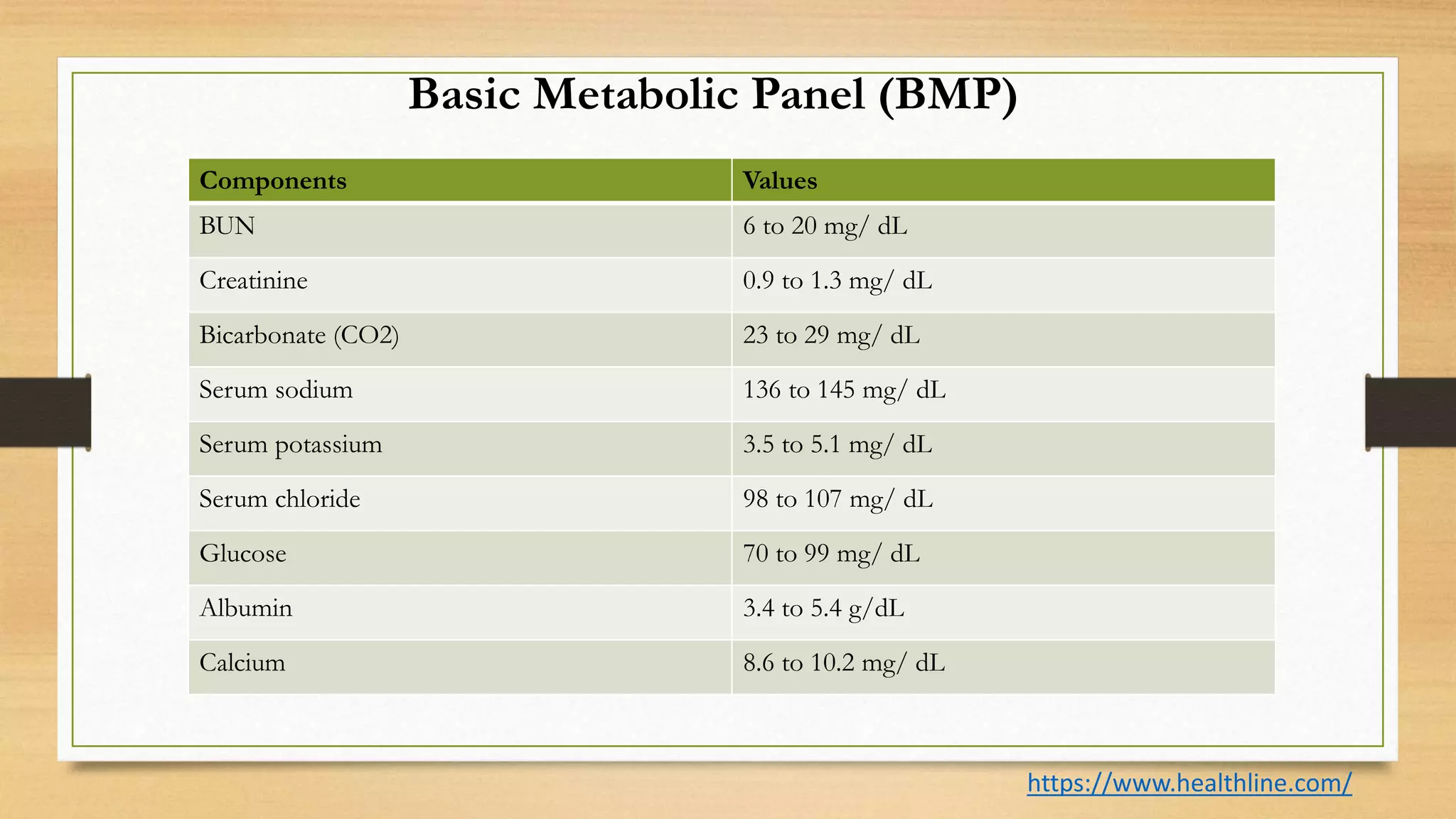
Components Values
BUN 6 to 20 mg/ dL
Creatinine 0.9 to 1.3 mg/ dL
Bicarbonate (CO2) 23 to 29 mg/ dL
Serum sodium 136 to 145 mg/ dL
Serum potassium 3.5 to 5.1 mg/ dL
Serum chloride 98 to 107 mg/ dL
Glucose 70 to 99 mg/ dL
Albumin 3.4 to 5.4 g/dL
Calcium 8.6 to 10.2 mg/ dL
Basic Metabolic Panel (BMP)
https://www.healthline.com/
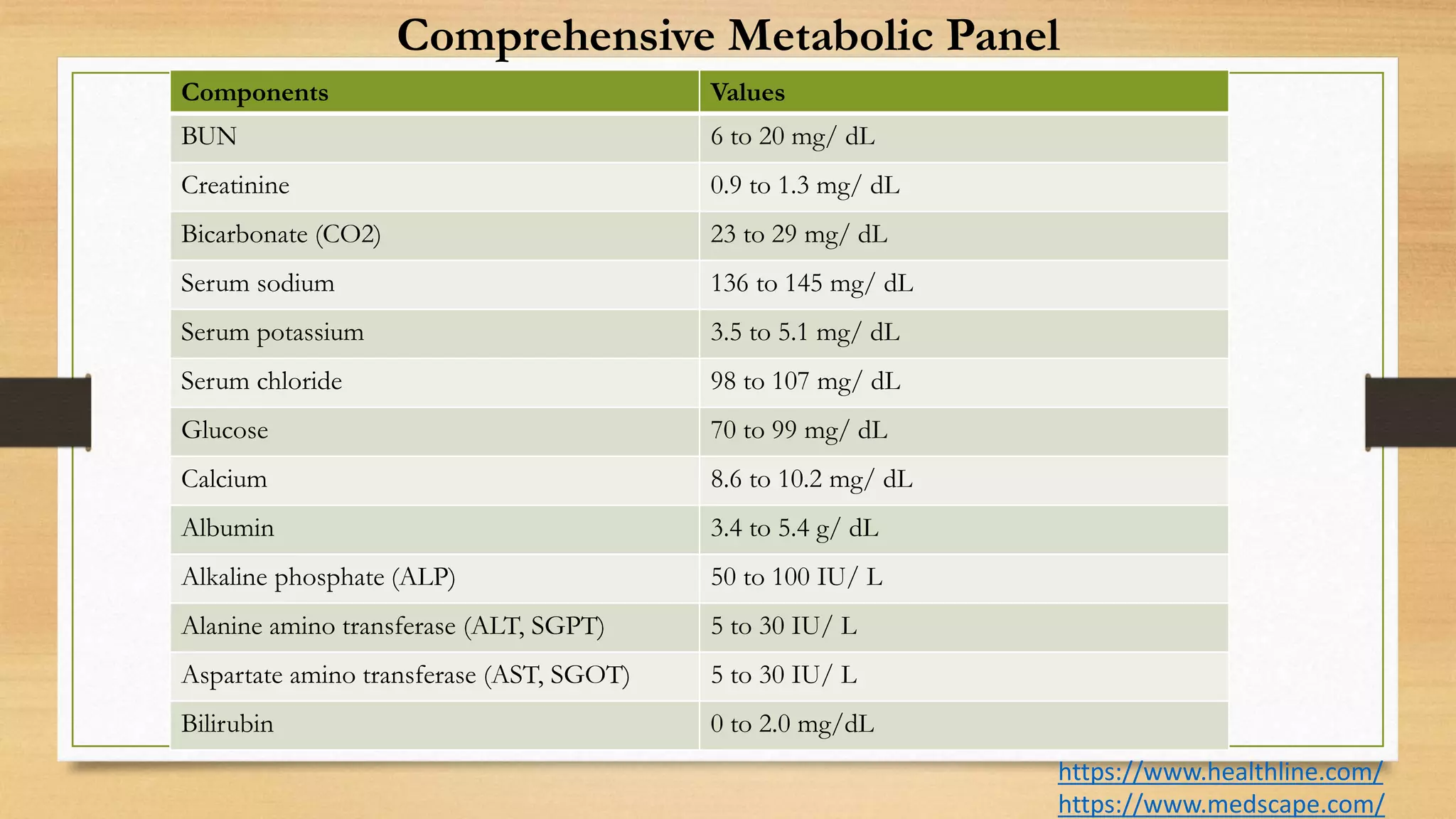
Comprehensive Metabolic Panel
Components Values
BUN 6 to 20 mg/ dL
Creatinine 0.9 to 1.3 mg/ dL
Bicarbonate (CO2) 23 to 29 mg/ dL
Serum sodium 136 to 145 mg/ dL
Serum potassium 3.5 to 5.1 mg/ dL
Serum chloride 98 to 107 mg/ dL
Glucose 70 to 99 mg/ dL
Calcium 8.6 to 10.2 mg/ dL
Albumin 3.4 to 5.4 g/ dL
Alkaline phosphate (ALP) 50 to 100 IU/ L
Alanine amino transferase (ALT, SGPT) 5 to 30 IU/ L
Aspartate amino transferase (AST, SGOT) 5 to 30 IU/ L
Bilirubin 0 to 2.0 mg/dL
https://www.medscape.com/
https://www.healthline.com/
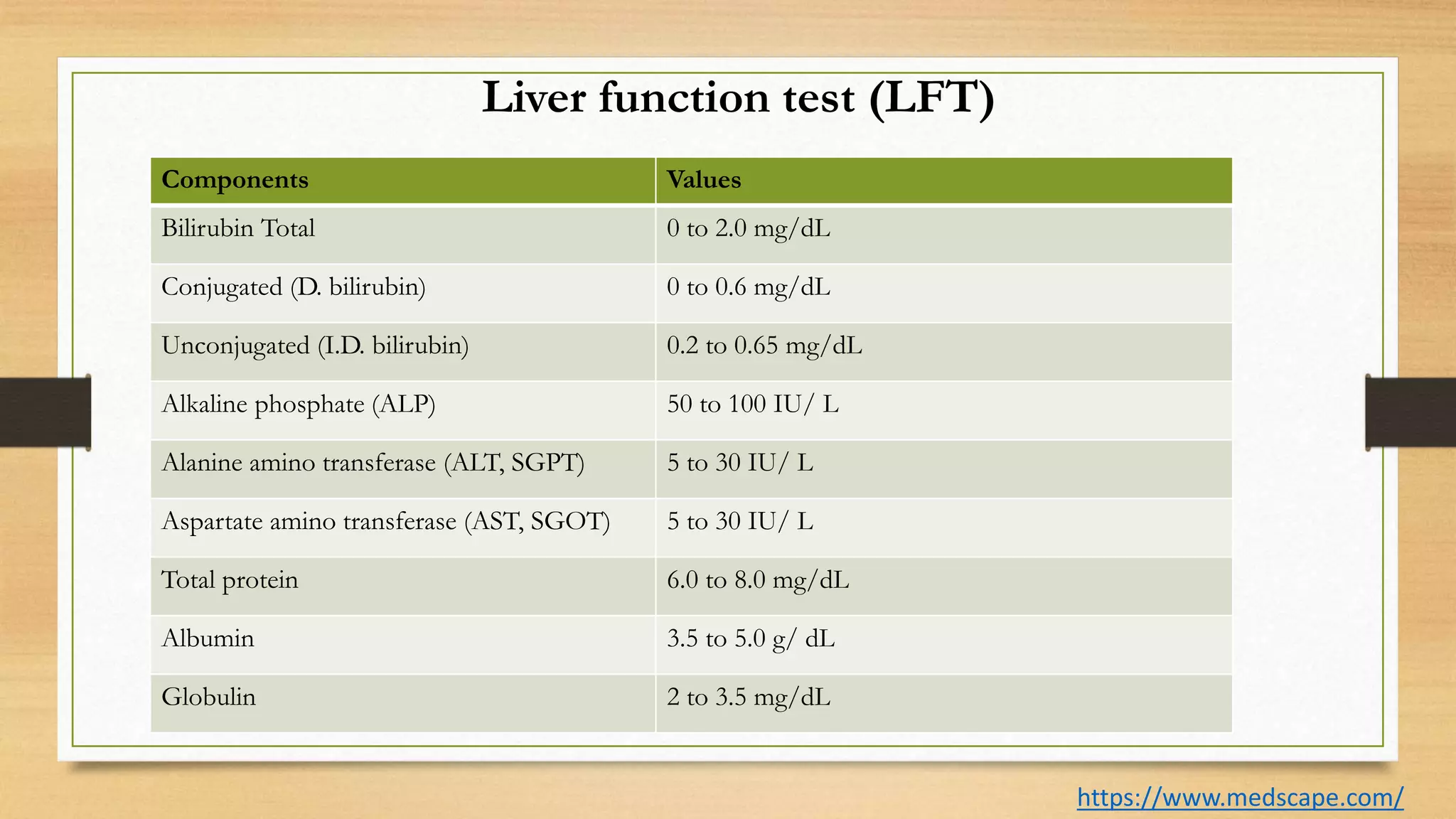
Liver function test (LFT)
Components Values
Bilirubin Total 0 to 2.0 mg/dL
Conjugated (D. bilirubin) 0 to 0.6 mg/dL
Unconjugated (I.D. bilirubin) 0.2 to 0.65 mg/dL
Alkaline phosphate (ALP) 50 to 100 IU/ L
Alanine amino transferase (ALT, SGPT) 5 to 30 IU/ L
Aspartate amino transferase (AST, SGOT) 5 to 30 IU/ L
Total protein 6.0 to 8.0 mg/dL
Albumin 3.5 to 5.0 g/ dL
Globulin 2 to 3.5 mg/dL
https://www.medscape.com/
Renal/ Kidney function test (RFT/ KFT)
Components Values
BUN 6 to 20 mg/ dL
Creatinine 0.9 to 1.3 mg/ dL
Uric acid 3.0 to 7.0 mg/ dL
Creatinine clearance 90 to 130 ml/ min
Ammonia 20 to 60 ug/ dl
BUN / Creat Ratio 10:1 to 20:1
https://www.medscape.com/
Lipid panel
Components Values
Total cholesterol Under 200 mg/ dl
HDL Men: 35 to 65 mg/ dl
Women: 35 to 80 mg/ dl
LDL Less than 100 mg/ dl
People with heart disease or diabetes or poorly controlled risk factors:
Less than 70 mg/ dl
Triglycerides Less than 150 mg/ dl
https://www.heart.org/
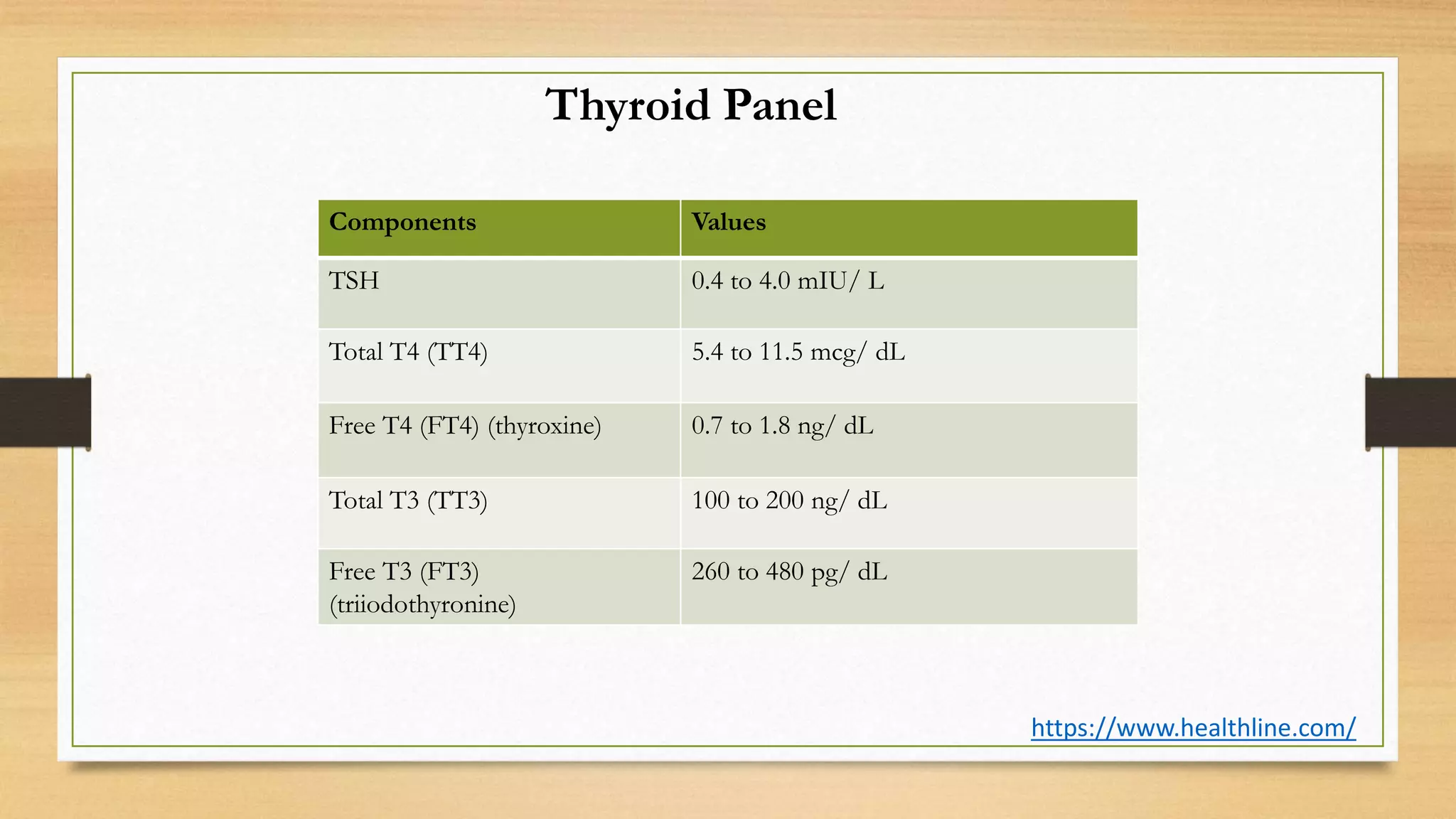
Thyroid Panel
Components Values
TSH 0.4 to 4.0 mIU/ L
Total T4 (TT4) 5.4 to 11.5 mcg/ dL
Free T4 (FT4) (thyroxine) 0.7 to 1.8 ng/ dL
Total T3 (TT3) 100 to 200 ng/ dL
Free T3 (FT3)
(triiodothyronine)
260 to 480 pg/ dL
https://www.healthline.com/
Components Values
Men
Values
Women
Red blood cells 4.4 to 5.8 million/ ml 3.9 to 5.2 million/ ml
White blood test 3500 to 10,500/ ml 3500 to 10,500/ ml
Platelets 150,000 to 450,000/ ml 150,000 to 450,000/ ml
Hemoglobin (Hb) 13.2 to 16.6 g/ 100 ml 11.6 to 15.0 g/ 100 ml
Hematocrit 38.3 to 48.6% 35.5 to 44.9%
MCH 27 to 32 pg (picograms) 27 to 32 pg
MCHC 28 to 36 g/ 100 ml 28 to 36 g/ 100 ml
MCV 80 to 94 fl (femotolitres) 80 to 94 fl (femotolitres)
Complete Blood Count (CBC)
https://www.healthline.com/
https://www.mayoclinic.org/
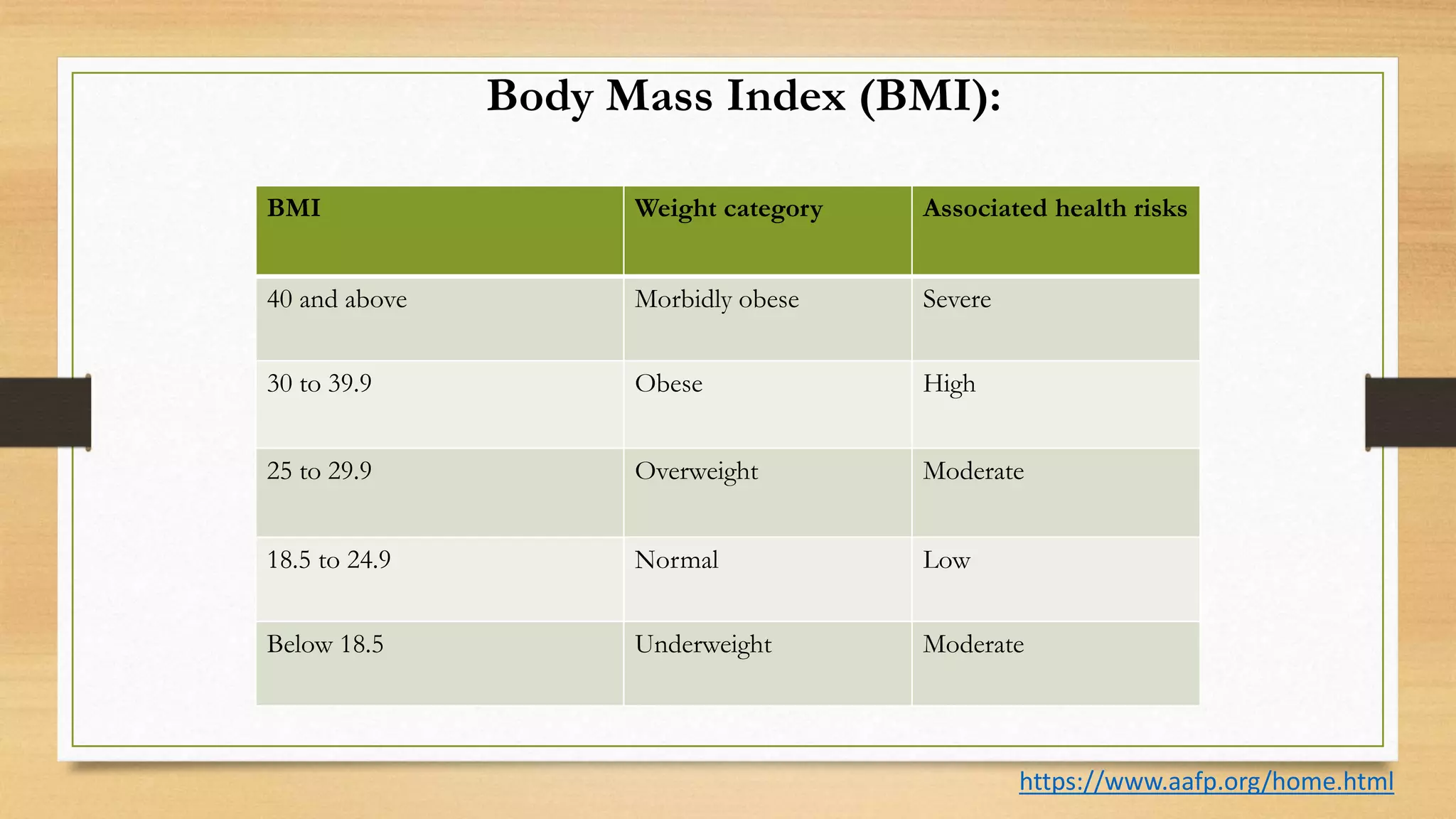
Body Mass Index (BMI):
BMI Weight category Associated health risks
40 and above Morbidly obese Severe
30 to 39.9 Obese High
25 to 29.9 Overweight Moderate
18.5 to 24.9 Normal Low
Below 18.5 Underweight Moderate
https://www.aafp.org/home.html
DiabeticTesting:
Components Values – Normal Values - Prediabetes
Fasting Blood Sugar (FBS) 70 to 100 mg/ dl 100 to 125 mg/ dl
Post Prandial Blood Sugar (PPBS) 80 to 140 mg/ dl 140 to 200 mg/dl
Random Blood Sugar (RBS) 70 to 200 mg/dl < 200 mg/dl
Glucose Tolerance Test (GTT) 75 to 140 mg/ dl 140 to 199 mg/dl
Glycated hemoglobin (HbA1c) 4 to 5.6% 5.7 to 6.4%
https://www.mayoclinic.org/
https://www.medscape.com/
https://www.diabetes.org/
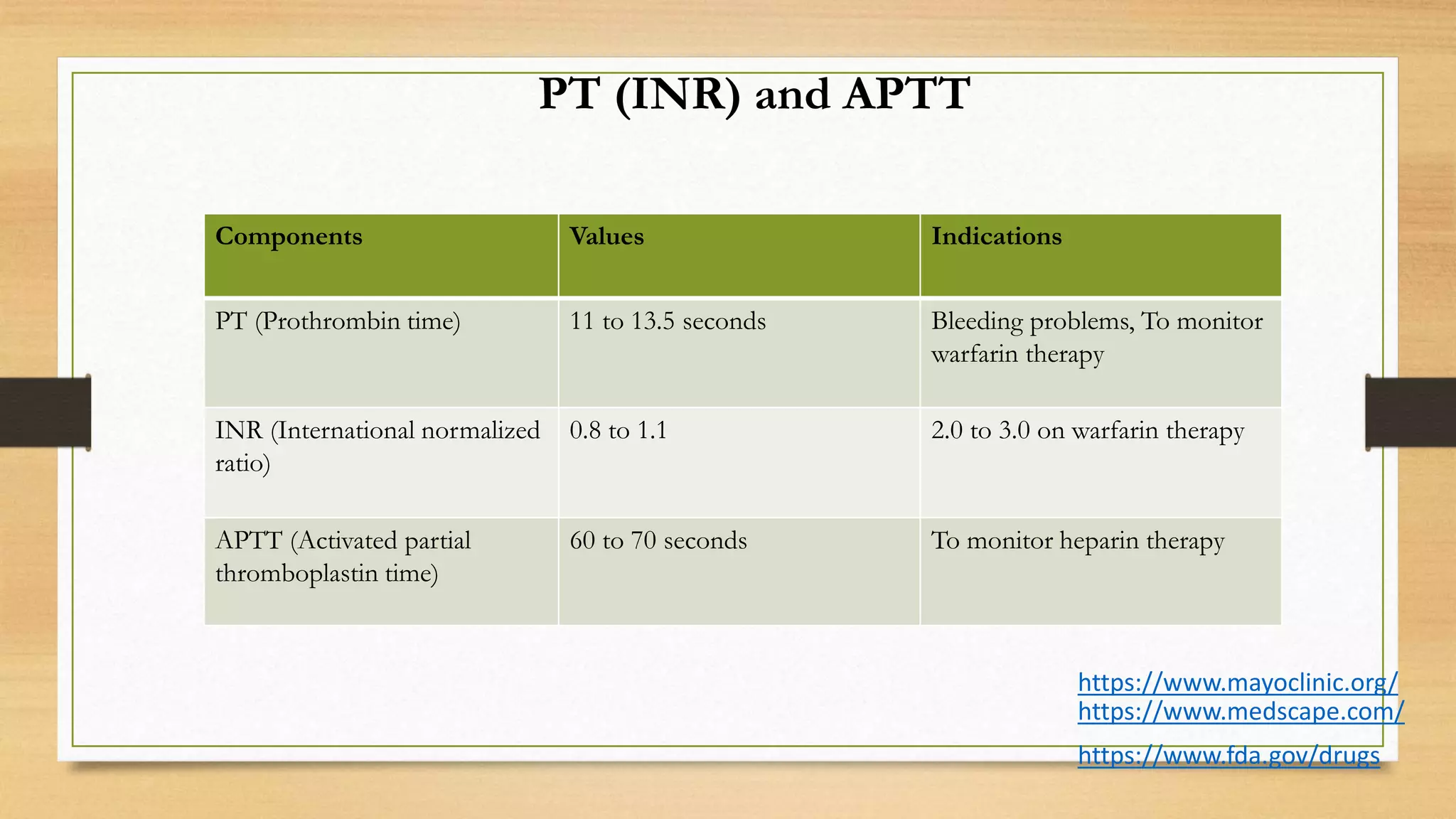
Components Values Indications
PT (Prothrombin time) 11 to 13.5 seconds Bleeding problems, To monitor
warfarin therapy
INR (International normalized
ratio)
0.8 to 1.1 2.0 to 3.0 on warfarin therapy
APTT (Activated partial
thromboplastin time)
60 to 70 seconds To monitor heparin therapy
PT (INR) and APTT
https://www.fda.gov/drugs
https://www.medscape.com/
https://www.mayoclinic.org/
https://www.medscape.com/
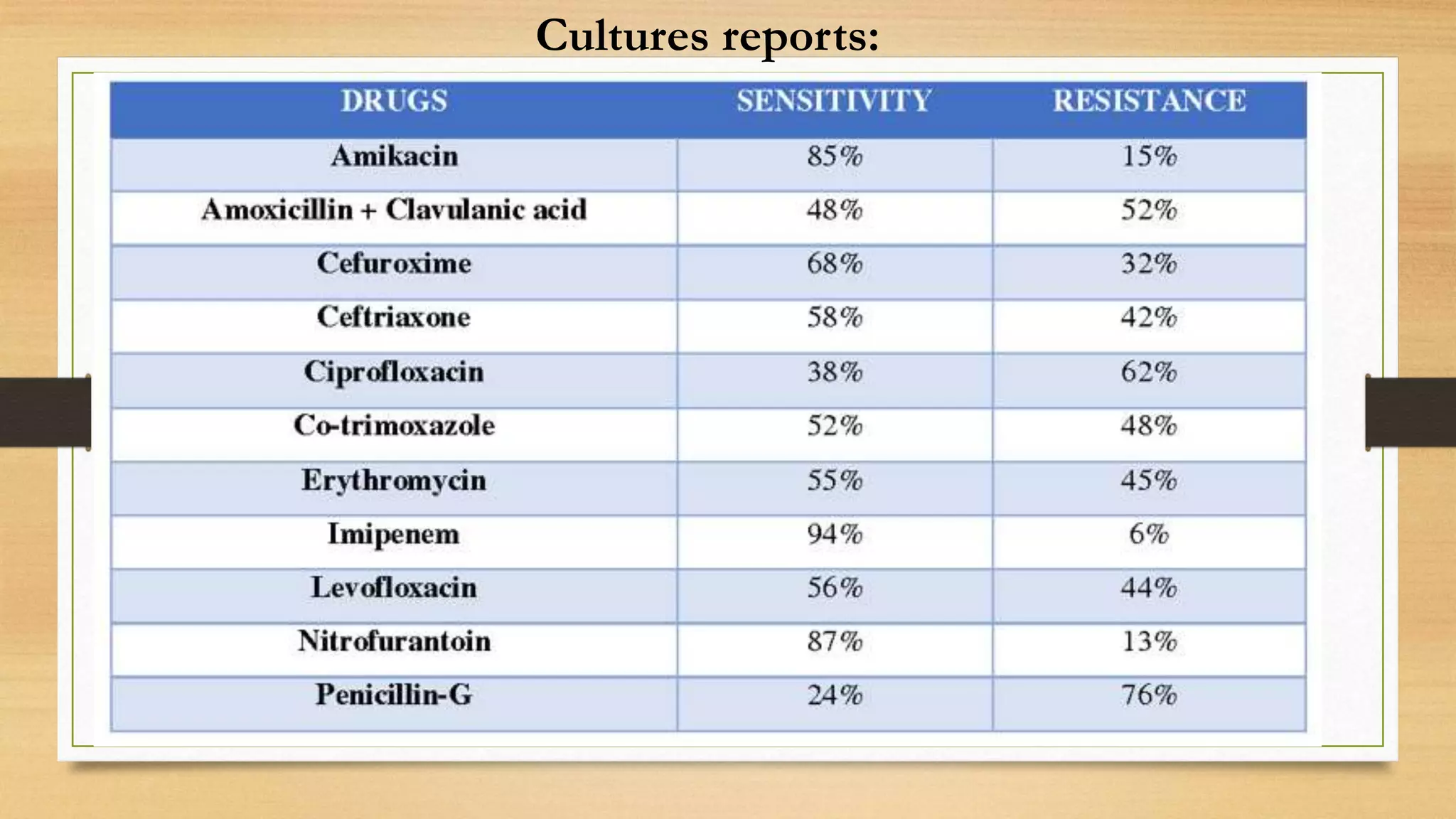
Cultures reports:
PulmonaryFunction test (PFT):
https://www.aafp.org/home.html
Blood pressure readings:
Category of hypertension Readings
Normal </ = 120/ 80 mmHg
Elevated 120-129/ < 80 mmHg
Stage 1 hypertension 130-139/ 80-89 mmHg
Stage 2 hypertension > 140/ 90 mmHg
Hypertension urgency >/ = 180/ 120 mmHg with no evidence of target
organ damage
Hypertension emergency >/ = 220/ 120 mmHg with evidence of target organ
damage
Hypotension < 90/60 mmHg
White coat hypertension BP level elevated in clinical setting and normal at home
Masked hypertension BP level elevated at home and normal in clinical setting
https://www.aafp.org/home.html
Common EKG findings:
Rhythm abnormality Rate abnormality
P wave abnormality Sinus rhythm/ tachycardia/ bradycardia/ arrythmias
Deep/ Pathological Q wave Left/ Right bundle branch block (LBBB/ RBBB)
Prolonged/ Shortened QT interval Complete block
ST segment elevation/ depression Conduction delay
Non-specific ST changes Premature ventricular/ atrial contractions
T wave inversion Atrial/ Ventricular tachycardia/ fibrillation
Left/ Right axis deviation Atrial/ Ventricular flutter
https://www.heart.org/
Common Echo findings:
Wall abnormality Valvular abnormality
Left/ right ventricular hypertrophy Aortic/ Mitral stenosis (AS/ MS)
Cardiomyopathy Aortic/ Mitral regurgitation (AR/ MR)
Motion wall abnormality Mitral valve prolapse (MVP)
Ejection fraction (EF): 60%- 70% Coarctation of aorta
Blockages – LM (left main)/ LAD (left anterior
descending)/ LCX (Left circumflex)/ RCA (right
coronary artery)
Aortic/ Mitral insufficiency
https://www.heart.org/
Stress test findings:
Components Findings
Exercise time Upto 15 mins on treadmill
Heart rate (Before and after exercise) After exercise HR will be higher than before exercise
Blood pressure (Before and after exercise) After exercise BP will be higher than before exercise
ECG findings As discussed (Usually positive/ negative ischemic changes, ST
segment depression/ elevation greater than/ equal to 1mm)
Echo findings As discussed
Oxygen saturation Should not drop below 95%
Termination criteria Chest pain, shortness of breath, fatigue
Indications To assess exercise tolerance, chronic chest pain, heart failure
Contraindications Acute recent MI, Uncontrolled arrhythmias, Severe PH, Severe
hypertension (> 200/110 mmHg)
https://www.heart.org/
Thank you!

Common laboratory tests and diagnostics

  • 1.
    Common laboratory testingand diagnostic Dr. Rima Das. B.A.M.S. (Mum); PGDEMS (Pune); DACLS, DIHM, DDM (Pune); FPC (M.U.H.S; Nashik). Consulting Preventive Cardiologist. 1
  • 2.
    Components Values BUN 6to 20 mg/ dL Creatinine 0.9 to 1.3 mg/ dL Bicarbonate (CO2) 23 to 29 mg/ dL Serum sodium 136 to 145 mg/ dL Serum potassium 3.5 to 5.1 mg/ dL Serum chloride 98 to 107 mg/ dL Glucose 70 to 99 mg/ dL Albumin 3.4 to 5.4 g/dL Calcium 8.6 to 10.2 mg/ dL Basic Metabolic Panel (BMP) https://www.healthline.com/
  • 3.
    Comprehensive Metabolic Panel ComponentsValues BUN 6 to 20 mg/ dL Creatinine 0.9 to 1.3 mg/ dL Bicarbonate (CO2) 23 to 29 mg/ dL Serum sodium 136 to 145 mg/ dL Serum potassium 3.5 to 5.1 mg/ dL Serum chloride 98 to 107 mg/ dL Glucose 70 to 99 mg/ dL Calcium 8.6 to 10.2 mg/ dL Albumin 3.4 to 5.4 g/ dL Alkaline phosphate (ALP) 50 to 100 IU/ L Alanine amino transferase (ALT, SGPT) 5 to 30 IU/ L Aspartate amino transferase (AST, SGOT) 5 to 30 IU/ L Bilirubin 0 to 2.0 mg/dL https://www.medscape.com/ https://www.healthline.com/
  • 4.
    Liver function test(LFT) Components Values Bilirubin Total 0 to 2.0 mg/dL Conjugated (D. bilirubin) 0 to 0.6 mg/dL Unconjugated (I.D. bilirubin) 0.2 to 0.65 mg/dL Alkaline phosphate (ALP) 50 to 100 IU/ L Alanine amino transferase (ALT, SGPT) 5 to 30 IU/ L Aspartate amino transferase (AST, SGOT) 5 to 30 IU/ L Total protein 6.0 to 8.0 mg/dL Albumin 3.5 to 5.0 g/ dL Globulin 2 to 3.5 mg/dL https://www.medscape.com/
  • 5.
    Renal/ Kidney functiontest (RFT/ KFT) Components Values BUN 6 to 20 mg/ dL Creatinine 0.9 to 1.3 mg/ dL Uric acid 3.0 to 7.0 mg/ dL Creatinine clearance 90 to 130 ml/ min Ammonia 20 to 60 ug/ dl BUN / Creat Ratio 10:1 to 20:1 https://www.medscape.com/
  • 6.
    Lipid panel Components Values Totalcholesterol Under 200 mg/ dl HDL Men: 35 to 65 mg/ dl Women: 35 to 80 mg/ dl LDL Less than 100 mg/ dl People with heart disease or diabetes or poorly controlled risk factors: Less than 70 mg/ dl Triglycerides Less than 150 mg/ dl https://www.heart.org/
  • 7.
    Thyroid Panel Components Values TSH0.4 to 4.0 mIU/ L Total T4 (TT4) 5.4 to 11.5 mcg/ dL Free T4 (FT4) (thyroxine) 0.7 to 1.8 ng/ dL Total T3 (TT3) 100 to 200 ng/ dL Free T3 (FT3) (triiodothyronine) 260 to 480 pg/ dL https://www.healthline.com/
  • 8.
    Components Values Men Values Women Red bloodcells 4.4 to 5.8 million/ ml 3.9 to 5.2 million/ ml White blood test 3500 to 10,500/ ml 3500 to 10,500/ ml Platelets 150,000 to 450,000/ ml 150,000 to 450,000/ ml Hemoglobin (Hb) 13.2 to 16.6 g/ 100 ml 11.6 to 15.0 g/ 100 ml Hematocrit 38.3 to 48.6% 35.5 to 44.9% MCH 27 to 32 pg (picograms) 27 to 32 pg MCHC 28 to 36 g/ 100 ml 28 to 36 g/ 100 ml MCV 80 to 94 fl (femotolitres) 80 to 94 fl (femotolitres) Complete Blood Count (CBC) https://www.healthline.com/ https://www.mayoclinic.org/
  • 9.
    Body Mass Index(BMI): BMI Weight category Associated health risks 40 and above Morbidly obese Severe 30 to 39.9 Obese High 25 to 29.9 Overweight Moderate 18.5 to 24.9 Normal Low Below 18.5 Underweight Moderate https://www.aafp.org/home.html
  • 10.
    DiabeticTesting: Components Values –Normal Values - Prediabetes Fasting Blood Sugar (FBS) 70 to 100 mg/ dl 100 to 125 mg/ dl Post Prandial Blood Sugar (PPBS) 80 to 140 mg/ dl 140 to 200 mg/dl Random Blood Sugar (RBS) 70 to 200 mg/dl < 200 mg/dl Glucose Tolerance Test (GTT) 75 to 140 mg/ dl 140 to 199 mg/dl Glycated hemoglobin (HbA1c) 4 to 5.6% 5.7 to 6.4% https://www.mayoclinic.org/ https://www.medscape.com/ https://www.diabetes.org/
  • 11.
    Components Values Indications PT(Prothrombin time) 11 to 13.5 seconds Bleeding problems, To monitor warfarin therapy INR (International normalized ratio) 0.8 to 1.1 2.0 to 3.0 on warfarin therapy APTT (Activated partial thromboplastin time) 60 to 70 seconds To monitor heparin therapy PT (INR) and APTT https://www.fda.gov/drugs https://www.medscape.com/ https://www.mayoclinic.org/
  • 12.
  • 13.
  • 14.
  • 15.
    Blood pressure readings: Categoryof hypertension Readings Normal </ = 120/ 80 mmHg Elevated 120-129/ < 80 mmHg Stage 1 hypertension 130-139/ 80-89 mmHg Stage 2 hypertension > 140/ 90 mmHg Hypertension urgency >/ = 180/ 120 mmHg with no evidence of target organ damage Hypertension emergency >/ = 220/ 120 mmHg with evidence of target organ damage Hypotension < 90/60 mmHg White coat hypertension BP level elevated in clinical setting and normal at home Masked hypertension BP level elevated at home and normal in clinical setting https://www.aafp.org/home.html
  • 16.
    Common EKG findings: Rhythmabnormality Rate abnormality P wave abnormality Sinus rhythm/ tachycardia/ bradycardia/ arrythmias Deep/ Pathological Q wave Left/ Right bundle branch block (LBBB/ RBBB) Prolonged/ Shortened QT interval Complete block ST segment elevation/ depression Conduction delay Non-specific ST changes Premature ventricular/ atrial contractions T wave inversion Atrial/ Ventricular tachycardia/ fibrillation Left/ Right axis deviation Atrial/ Ventricular flutter https://www.heart.org/
  • 17.
    Common Echo findings: Wallabnormality Valvular abnormality Left/ right ventricular hypertrophy Aortic/ Mitral stenosis (AS/ MS) Cardiomyopathy Aortic/ Mitral regurgitation (AR/ MR) Motion wall abnormality Mitral valve prolapse (MVP) Ejection fraction (EF): 60%- 70% Coarctation of aorta Blockages – LM (left main)/ LAD (left anterior descending)/ LCX (Left circumflex)/ RCA (right coronary artery) Aortic/ Mitral insufficiency https://www.heart.org/
  • 18.
    Stress test findings: ComponentsFindings Exercise time Upto 15 mins on treadmill Heart rate (Before and after exercise) After exercise HR will be higher than before exercise Blood pressure (Before and after exercise) After exercise BP will be higher than before exercise ECG findings As discussed (Usually positive/ negative ischemic changes, ST segment depression/ elevation greater than/ equal to 1mm) Echo findings As discussed Oxygen saturation Should not drop below 95% Termination criteria Chest pain, shortness of breath, fatigue Indications To assess exercise tolerance, chronic chest pain, heart failure Contraindications Acute recent MI, Uncontrolled arrhythmias, Severe PH, Severe hypertension (> 200/110 mmHg) https://www.heart.org/
  • 19.