CLINICAL CHEMISTRY
INTRODUCTION
BLOOD ANALYSIS
Unit .1 Lec.No 1.
Clinical Chemistry
Dr.K.Parameswari, Dept of Chemistry
Clinical Chemistry
Do you want a footer?
 Clinical chemistry (also known as chemical
pathology, clinical biochemistry or medical
biochemistry) is the area of clinical pathology that
is generally concerned with analysis of bodily fluids
for diagnostic and therapeutic (healing) purposes
Types of Measurements in Chemistry
Do you want a footer?
 Qualitative measurement relies on words (some,
many, none, pale) to tell us quality.
 The liver enzymes are high.
 Quantitative measurement relies primarily on
numbers as the main unit of analysis.
 The blood glucose is 100mg/ml.
Do you want a footer?
Blood Analysis
Do you want a footer?
 Hemoglobin
 WBC
 Glucose
 Lipid Profile
 Platelet count
 Salicylate level
 Muscle enzyme tests (CPK aldolase)
 Liver enzyme tests (SGOT SGPT) bilirubin alkaline
(Electrolytes)
 Thyroid
Hemoglobin
 Hb is the iron containing coloring matter of RBC
If the count is low -
chronic inflammation(inflammation is a body process that
can result in pain swelling warmth or redness)
Low hematocrit and hemoglobin counts may be signs that
your medication is causing a loss of blood from your
stomach and passing through your bowel. Low counts
also may indicate a decrease in red blood cell production.
bone marrow problem
If the count is more –
blood volume increase
in case of smoking
high altitude
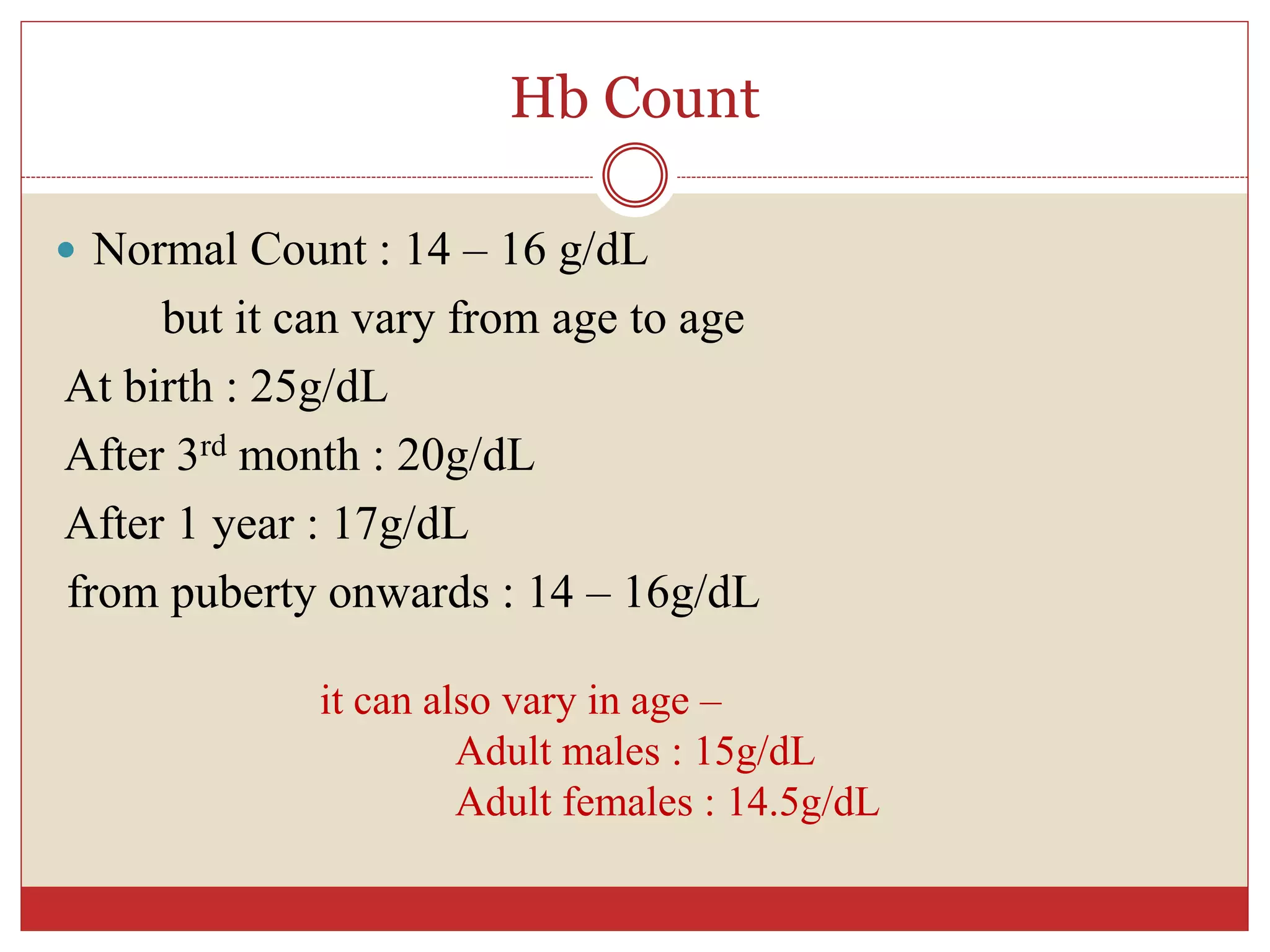
Hb Count
 Normal Count : 14 – 16 g/dL
but it can vary from age to age
At birth : 25g/dL
After 3rd month : 20g/dL
After 1 year : 17g/dL
from puberty onwards : 14 – 16g/dL
it can also vary in age –
Adult males : 15g/dL
Adult females : 14.5g/dL
WBC
 WBC tests measure the number of white blood cells
present. When you have an infection your body makes
more white blood cells. Some medications can decrease
the number of white blood cells which could increase
your chances of getting an infection
Normal Values
 total count(TC)-
 4000 – 11000/cu mm of blood differential count(DC)-
% Absolute
volume/cu mm
of blood
neutrophils 50-70 3000-6000
eosinophils 2-4 150-450
basophils 0-1 0-100
monocytes 2-6 200-600
lymphocytes 20-30 1500-2700
SIGNIFICANS
 If the count is less-
o may be due to some medications
o decrease count indicate more prone for infection
If the count is more-
o disease in bone marrow
o disorder in immune system
o acute lymphocytic leukemia
o acute myelogenous leukemia(AML)
Significance
 If the count is less- (thrombocytopenia)
more bleeding
TB
infections and other disease
If the count is more- (thrombocytosis)
allergic conditions
hemorrhage
bone fracture
rheumatic fever
trauma
Examples of Measuring Biochemicals:
Do you want a footer?
 Blood glucose, or blood sugar levels indicate how the
body handles glucose.
 Measuring glucose levels after fasting can help diagnose
diabetes or hypoglycemia (low blood sugar).
 Cardiac enzyme levels indicate the health of heart
muscles.
 Measuring cardiac enzymes can help the doctor determine if
the patient has had a heart attack, when the episode occurred
and how severe it was.
Glucose in the Blood
Glucose Test Person without
diabetes
Person with diabetes
Fasting Test 70-110mg/dL > 140mg/dL
2 hours after eating <110mg/dL > 200mg/dL
Category Systolic reading
(mmHg)
Diastolic reading
(mmHg
Follow-up recommendation
Optimal 120 80 Recheck in two years
Normal 130 85 Recheck in 2 years
High Normal 130-139 85-89 Recheck in one year
Hypertension
Stage 1 (Mild)
140-159 90-99 Confirm within two months
Hypertension
Stage 2
(Moderate)
160-179 100-109 Evaluate within one month
Hypertension
Stage 3
(Severe)
179 109 Evaluate immediately or within one
week depending on situation
CHOLESTEROL
A fatty substance found only in animal foods.
It is also made by our bodies.
Small amounts are needed by the body for essential functions.
Excessive cholesterol forms a fatty plaque, which sticks to the
inside of our arteries and can cause heart disease.
GOOD AND BAD CHOLESTEROL
 LDL “bad” cholesterol
 Carries cholesterol around in the blood
 Forms plaque in the arteries
 Increases risk of heart disease
 HDL “good” cholesterol
 Carries cholesterol to liver and out of body
 Helps avoid plaque and heart disease
MORE FATS IN THE BLOOD
 Triglycerides
 A fat that circulates in blood and increases risk of heart
disease
 Lipid profile
 Total cholesterol, LDL, HDL, triglycerides.
 Gives a picture of the balance between good and bad
cholesterol and other fats
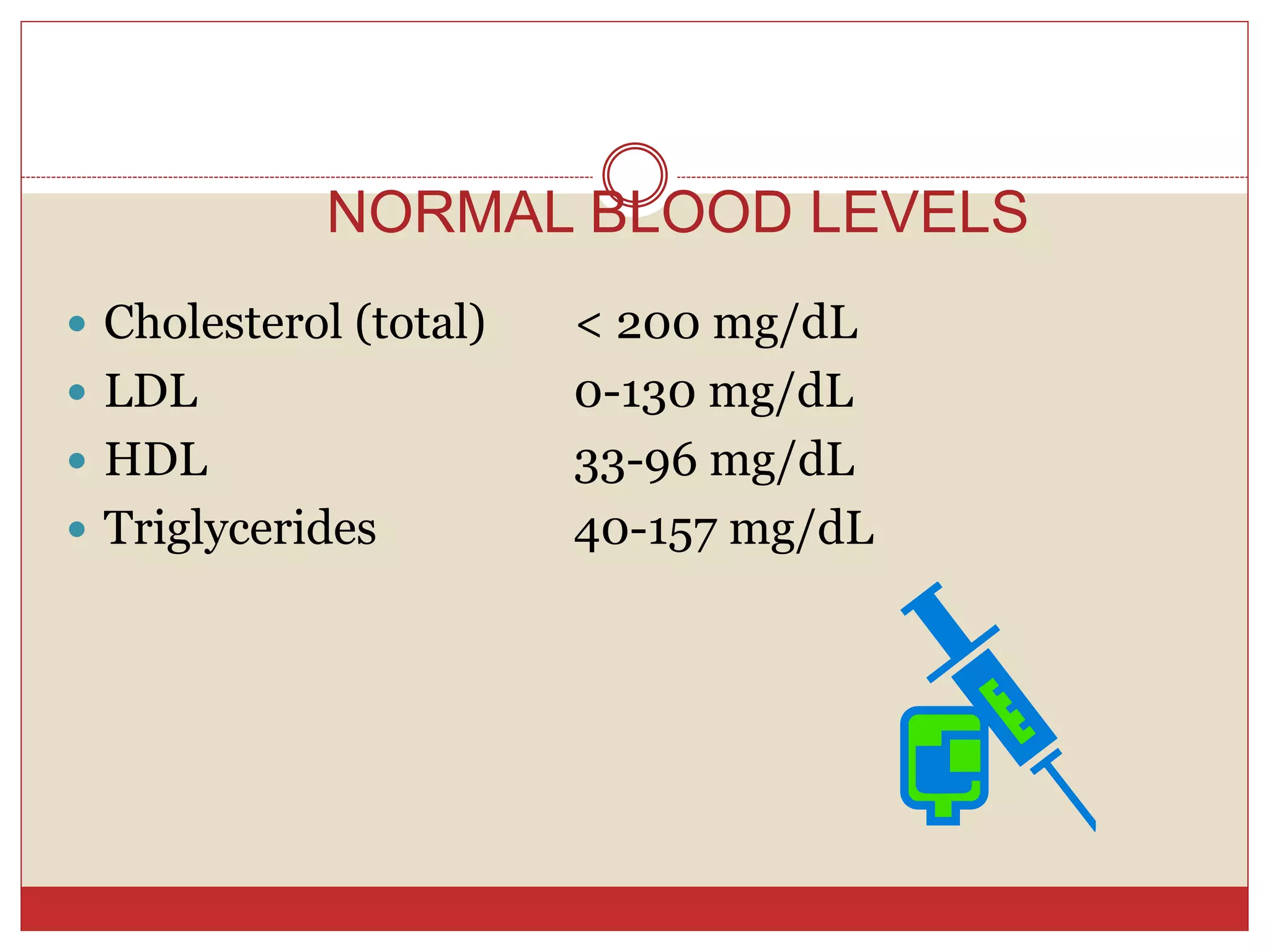
NORMAL BLOOD LEVELS
 Cholesterol (total) < 200 mg/dL
 LDL 0-130 mg/dL
 HDL 33-96 mg/dL
 Triglycerides 40-157 mg/dL
Platelet count
 This test measures the number of "sticky" cells or platelets
that help the blood to clot (aspirin and some other
medications make the platelets less "sticky"). If the
number of platelets is low you could have too much
bleeding. Some powerful arthritis medications in rare
instances lower the platelet count.
Normal Value
2,50,000/cu mm of blood
range- 2,00,000 – 4,00,000/cu mm of blood
Salicylate level
 This measures the amount of salicylate in the blood to
find out if enough is being absorbed to reduce
inflammation (salicylate is the main ingredient in aspirin
and some other NSAIDs (nonsteroidal
antiinflammatory drugs)). This is a helpful test for
people who are taking large doses of these medications for
a long time. High salicylate levels can be harmful with or
without such symptoms as ringing in the ears nausea
vomiting or even fever
Do you want a footer?
 These include:
 Electrolyte (K (proper func of nerve, muscle,
heart), Na (kidney, adrenal gland)
 Enzymes creatinine (kidney function), billurubin
(jaundice)
 Albumin (main protein made by liver, antibody
fighting disease)
Liver Function Tests
Thyroid Panel
Do you want a footer?
 Thyroid Panel: to help evaluate thyroid function and
diagnose thyroid disease.
 Commonly includes TSH, T4, T3
 The thyroid gland is an important organ that
regulates body metabolism. It is located in the front of
the neck just below the voice box.
 It secretes two main thyroid hormones – thyroxine (T4)
and triiodothyronine (T3).
 These hormones allow the body to use energy. If you have
too little of these hormones, you have not used the possible
energy and are tired.
 So, if the mechanisms are working badly, patient is feeling
tired, they could be suffering from hypothyroidism.
The Thyroid and Pituatary Glands
Do you want a footer?
 Together these two glands work to regulate
metabolism. So, if the patient is always tired, a
Thyroid Panel may be ordered to assess hormone
levels.
Enzyme Panels
Do you want a footer?
 Enzymes Panel – enzymes are in all cells. Enzymes
are released into the blood by organs that are
damaged or diseased. The type of enzyme released
can indicate which organ is affected; heart, liver,
pancreas, even bone.
 There are Cardiac Enzyme Panels, Liver Enzyme Panels, etc.,
which are measuring the amount of different enzymes released
by the particular organ being investigated.
DO YOU KNOW your
Do you want a footer?
HB
WBC
Glucose Level
Lipid Profile ……etc
Know to have better Health

clinical chemistry - blood Analysis

  • 1.
    CLINICAL CHEMISTRY INTRODUCTION BLOOD ANALYSIS Unit.1 Lec.No 1. Clinical Chemistry Dr.K.Parameswari, Dept of Chemistry
  • 2.
    Clinical Chemistry Do youwant a footer?  Clinical chemistry (also known as chemical pathology, clinical biochemistry or medical biochemistry) is the area of clinical pathology that is generally concerned with analysis of bodily fluids for diagnostic and therapeutic (healing) purposes
  • 3.
    Types of Measurementsin Chemistry Do you want a footer?  Qualitative measurement relies on words (some, many, none, pale) to tell us quality.  The liver enzymes are high.  Quantitative measurement relies primarily on numbers as the main unit of analysis.  The blood glucose is 100mg/ml.
  • 4.
    Do you wanta footer?
  • 5.
    Do you wanta footer?
  • 6.
    Do you wanta footer?
  • 7.
    Do you wanta footer?
  • 8.
    Blood Analysis Do youwant a footer?  Hemoglobin  WBC  Glucose  Lipid Profile  Platelet count  Salicylate level  Muscle enzyme tests (CPK aldolase)  Liver enzyme tests (SGOT SGPT) bilirubin alkaline (Electrolytes)  Thyroid
  • 9.
    Hemoglobin  Hb isthe iron containing coloring matter of RBC If the count is low - chronic inflammation(inflammation is a body process that can result in pain swelling warmth or redness) Low hematocrit and hemoglobin counts may be signs that your medication is causing a loss of blood from your stomach and passing through your bowel. Low counts also may indicate a decrease in red blood cell production. bone marrow problem
  • 10.
    If the countis more – blood volume increase in case of smoking high altitude
  • 11.
    Hb Count  NormalCount : 14 – 16 g/dL but it can vary from age to age At birth : 25g/dL After 3rd month : 20g/dL After 1 year : 17g/dL from puberty onwards : 14 – 16g/dL it can also vary in age – Adult males : 15g/dL Adult females : 14.5g/dL
  • 12.
    WBC  WBC testsmeasure the number of white blood cells present. When you have an infection your body makes more white blood cells. Some medications can decrease the number of white blood cells which could increase your chances of getting an infection
  • 13.
    Normal Values  totalcount(TC)-  4000 – 11000/cu mm of blood differential count(DC)- % Absolute volume/cu mm of blood neutrophils 50-70 3000-6000 eosinophils 2-4 150-450 basophils 0-1 0-100 monocytes 2-6 200-600 lymphocytes 20-30 1500-2700
  • 14.
    SIGNIFICANS  If thecount is less- o may be due to some medications o decrease count indicate more prone for infection If the count is more- o disease in bone marrow o disorder in immune system o acute lymphocytic leukemia o acute myelogenous leukemia(AML)
  • 15.
    Significance  If thecount is less- (thrombocytopenia) more bleeding TB infections and other disease If the count is more- (thrombocytosis) allergic conditions hemorrhage bone fracture rheumatic fever trauma
  • 16.
    Examples of MeasuringBiochemicals: Do you want a footer?  Blood glucose, or blood sugar levels indicate how the body handles glucose.  Measuring glucose levels after fasting can help diagnose diabetes or hypoglycemia (low blood sugar).  Cardiac enzyme levels indicate the health of heart muscles.  Measuring cardiac enzymes can help the doctor determine if the patient has had a heart attack, when the episode occurred and how severe it was.
  • 17.
    Glucose in theBlood Glucose Test Person without diabetes Person with diabetes Fasting Test 70-110mg/dL > 140mg/dL 2 hours after eating <110mg/dL > 200mg/dL
  • 18.
    Category Systolic reading (mmHg) Diastolicreading (mmHg Follow-up recommendation Optimal 120 80 Recheck in two years Normal 130 85 Recheck in 2 years High Normal 130-139 85-89 Recheck in one year Hypertension Stage 1 (Mild) 140-159 90-99 Confirm within two months Hypertension Stage 2 (Moderate) 160-179 100-109 Evaluate within one month Hypertension Stage 3 (Severe) 179 109 Evaluate immediately or within one week depending on situation
  • 19.
    CHOLESTEROL A fatty substancefound only in animal foods. It is also made by our bodies. Small amounts are needed by the body for essential functions. Excessive cholesterol forms a fatty plaque, which sticks to the inside of our arteries and can cause heart disease.
  • 20.
    GOOD AND BADCHOLESTEROL  LDL “bad” cholesterol  Carries cholesterol around in the blood  Forms plaque in the arteries  Increases risk of heart disease  HDL “good” cholesterol  Carries cholesterol to liver and out of body  Helps avoid plaque and heart disease
  • 21.
    MORE FATS INTHE BLOOD  Triglycerides  A fat that circulates in blood and increases risk of heart disease  Lipid profile  Total cholesterol, LDL, HDL, triglycerides.  Gives a picture of the balance between good and bad cholesterol and other fats
  • 22.
    NORMAL BLOOD LEVELS Cholesterol (total) < 200 mg/dL  LDL 0-130 mg/dL  HDL 33-96 mg/dL  Triglycerides 40-157 mg/dL
  • 23.
    Platelet count  Thistest measures the number of "sticky" cells or platelets that help the blood to clot (aspirin and some other medications make the platelets less "sticky"). If the number of platelets is low you could have too much bleeding. Some powerful arthritis medications in rare instances lower the platelet count. Normal Value 2,50,000/cu mm of blood range- 2,00,000 – 4,00,000/cu mm of blood
  • 24.
    Salicylate level  Thismeasures the amount of salicylate in the blood to find out if enough is being absorbed to reduce inflammation (salicylate is the main ingredient in aspirin and some other NSAIDs (nonsteroidal antiinflammatory drugs)). This is a helpful test for people who are taking large doses of these medications for a long time. High salicylate levels can be harmful with or without such symptoms as ringing in the ears nausea vomiting or even fever
  • 25.
    Do you wanta footer?  These include:  Electrolyte (K (proper func of nerve, muscle, heart), Na (kidney, adrenal gland)  Enzymes creatinine (kidney function), billurubin (jaundice)  Albumin (main protein made by liver, antibody fighting disease) Liver Function Tests
  • 26.
    Thyroid Panel Do youwant a footer?  Thyroid Panel: to help evaluate thyroid function and diagnose thyroid disease.  Commonly includes TSH, T4, T3  The thyroid gland is an important organ that regulates body metabolism. It is located in the front of the neck just below the voice box.  It secretes two main thyroid hormones – thyroxine (T4) and triiodothyronine (T3).  These hormones allow the body to use energy. If you have too little of these hormones, you have not used the possible energy and are tired.  So, if the mechanisms are working badly, patient is feeling tired, they could be suffering from hypothyroidism.
  • 27.
    The Thyroid andPituatary Glands Do you want a footer?  Together these two glands work to regulate metabolism. So, if the patient is always tired, a Thyroid Panel may be ordered to assess hormone levels.
  • 28.
    Enzyme Panels Do youwant a footer?  Enzymes Panel – enzymes are in all cells. Enzymes are released into the blood by organs that are damaged or diseased. The type of enzyme released can indicate which organ is affected; heart, liver, pancreas, even bone.  There are Cardiac Enzyme Panels, Liver Enzyme Panels, etc., which are measuring the amount of different enzymes released by the particular organ being investigated.
  • 29.
    DO YOU KNOWyour Do you want a footer? HB WBC Glucose Level Lipid Profile ……etc Know to have better Health