COMMON FORMATIVE ASSESSMENTS
MAKE A DIFFERENCE
Robert Landry,Teacher, Ebarb High School, Sabine Parish
Angela Peery, Consultant
drangelapeery.com
LEARNING GOALS
 Understand the role of common formative assessments in the
context of a school-wide literacy effort and a regular cycle of data
collection
 Examine a common formative assessment and the resulting data
 Practice creating assessment items (traditional selected response,
evidence-based selected response, and constructed response)
aligned to a standard
CONTEXT
Why and how we
began the work…
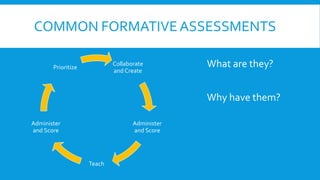
COMMON FORMATIVEASSESSMENTS
What are they?
Why have them?
Collaborate
and Create
Administer
and Score
Teach
Administer
and Score
Prioritize
SAMPLES
CREATING ITEMS
 Traditional selected response
 Evidence-based selected response
 Short constructed response
 Long constructed response
PRACTICE
RI. 9-10. 3
Analyze how the author unfolds an analysis or series of
ideas or events, including the order in which the points
are made, how they are introduced and developed, and
the connections that are drawn between them.
PRACTICE
Work independently or collaboratively.
Design several items that align with the passage about
teacher tenure.
QUESTIONS?
CONTACT INFORMATION
Robert Landry landryr@sabine.k12.la.us
Angela Peery drangelapeery@gmail.com

Common Formative Assessments Make a Difference

  • 1.
    COMMON FORMATIVE ASSESSMENTS MAKEA DIFFERENCE Robert Landry,Teacher, Ebarb High School, Sabine Parish Angela Peery, Consultant drangelapeery.com
  • 2.
    LEARNING GOALS  Understandthe role of common formative assessments in the context of a school-wide literacy effort and a regular cycle of data collection  Examine a common formative assessment and the resulting data  Practice creating assessment items (traditional selected response, evidence-based selected response, and constructed response) aligned to a standard
  • 3.
    CONTEXT Why and howwe began the work…
  • 4.
    COMMON FORMATIVEASSESSMENTS What arethey? Why have them? Collaborate and Create Administer and Score Teach Administer and Score Prioritize
  • 5.
  • 6.
    CREATING ITEMS  Traditionalselected response  Evidence-based selected response  Short constructed response  Long constructed response
  • 7.
    PRACTICE RI. 9-10. 3 Analyzehow the author unfolds an analysis or series of ideas or events, including the order in which the points are made, how they are introduced and developed, and the connections that are drawn between them.
  • 8.
    PRACTICE Work independently orcollaboratively. Design several items that align with the passage about teacher tenure.
  • 9.
  • 10.
    CONTACT INFORMATION Robert Landrylandryr@sabine.k12.la.us Angela Peery drangelapeery@gmail.com

Editor's Notes

  • #2 We will each briefly introduce ourselves and direct them to the microsite where the conference handouts are located as a reminder.
  • #3 The slides follow the handout fairly closely. These goals appear at the top of p. 1 of the first PDF handout (named F045 CFAs Make a Difference 1). Either one of us can present this slide.
  • #4 Angela describes the overall literacy efforts of the district and school and the assessment/data collection cycle.
  • #5 Angela presents this slide. Define CFA. Discuss how area of focus (prioritize step) was chosen and how CFAs (pre and post) were created collaboratively. The unwrapped standards on p. 1 of the handout will be recommended as focus/priority areas for teams wanting to do similar work.
  • #6 Robert starts talking through the sample CFAs, discusses the process used, and shares information about the data collection and instructional strategies used to address student weaknesses. In the handout, the CFAs included are “Yawns Are Contagious Among Wolves Just Like Humans and Dogs” and “Cliff Dwellers.” Angela can pull the PDF up on-screen as necessary. We need to be sure to mention how/where to find passages and how we often struggled to create the “just right” item/question. We also need to cite pre/post data so we can urge the audience to try this process to boost achievement. We can also reference the 2nd handout (PDF) that was uploaded – this handout consists of student work samples. Robert may want to talk with the audience about how students did and what the team learned from student performance.
  • #7 Angela presents this slide – briefly defines/describes each type of item, referencing the examples Robert just went over as needed.
  • #8 Robert leads the discussion of how to analyze/unwrap this standard prior to creating items.
  • #9 As time allows, participants will create items that go with the provided passage. (The passage is from procon.org). Ideally, each participant will create three items: one traditional selected response, one evidence-based selected response, and one constructed response. We may have to shorten this segment depending on time remaining.
  • #10 As time allows, answer questions.
  • #11 Thank them for coming.