Teaching and Learning Forum
Murdoch University
February 2013
The Importance of Action Research in
Teacher Education Programs
Gregory Hine, Ph.D.
Your task
In your own teaching and leadership role, think of
something that could be considered a:
o Problem
o Issue
o Concern
o Opportunity
Up until now, this ‘phenomenon’ has been resistant to a
solutions-based approach, and you would like to find a
workable way forward.
Keep this phenomenon in mind for later on
What is Action Research?
 A process of systematic inquiry that seeks to improve social
issues affecting the lives of everyday people
 Through repeated cycles of planning, observing, and reflecting,
individuals and groups engaged in action research can
implement changes required for social improvement
 A collaborative process carried out by those with a shared
concern
 These collaborative efforts help develop practical ideas to assist
with the pursuit of worthwhile human purposes
How is Action Research Applicable to
Education?
The process of studying a school situation to understand and
improve the quality of the educative process
Provides practitioners with new knowledge and understanding
about how to improve educational practices or resolve significant
problems in classrooms and schools
Benefits
facilitating the professional development of educators
increasing teacher empowerment
bridging the gap between research and practice
The Action Research Process
(1)
Figure 1: Action Research Helix (adapted from Stringer,
2004, p. 4).
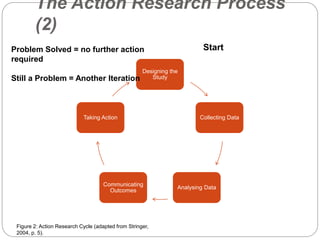
The Action Research Process
(2)
Designing the
Study
Collecting Data
Analysing Data
Communicating
Outcomes
Taking Action
Figure 2: Action Research Cycle (adapted from Stringer,
2004, p. 5).
StartProblem Solved = no further action
required
Still a Problem = Another Iteration
ED6765: Action Research in
Education
The Summer Intensive
Theory
Focusing on the problem
Drafting a Research Proposal
Follow Up Days
March: ‘Refresher’, Trustworthiness, Ethnographic
Interviewing
May: ‘Refresher’, Coding Techniques, Generating
Meaning
Assessments
1) Research Proposal
2) Progress Report
3) Inquiry Self-Audit
4) Summative Report
Examples of Projects
Finding a way of reducing the ongoing, negative social interactions on
the playground at lunchtime
Finding ways to improve the profile of Professional Development at the
College
Finding ways to increase the engagement of high-functioning students
in mathematical tasks.
Finding ways to improve Upper School retreat programs so that they
are meaningful, challenging and fulfilling for the students
Finding a way to more effectively engage in pastoral practices for first-
year university students
Finding ways to enable teachers to make a smooth transition back to
work after maternity leave
Common Caveats
o Lack of clarity/focus for project
o Managing time constraints
o Presumed knowledge of solution
o Using Action Learning
It’s Time to Share
What would you like to investigate?
Happy researching

Action research in_teacher_education_t___l_2013

  • 1.
    Teaching and LearningForum Murdoch University February 2013 The Importance of Action Research in Teacher Education Programs Gregory Hine, Ph.D.
  • 2.
    Your task In yourown teaching and leadership role, think of something that could be considered a: o Problem o Issue o Concern o Opportunity Up until now, this ‘phenomenon’ has been resistant to a solutions-based approach, and you would like to find a workable way forward. Keep this phenomenon in mind for later on
  • 3.
    What is ActionResearch?  A process of systematic inquiry that seeks to improve social issues affecting the lives of everyday people  Through repeated cycles of planning, observing, and reflecting, individuals and groups engaged in action research can implement changes required for social improvement  A collaborative process carried out by those with a shared concern  These collaborative efforts help develop practical ideas to assist with the pursuit of worthwhile human purposes
  • 4.
    How is ActionResearch Applicable to Education? The process of studying a school situation to understand and improve the quality of the educative process Provides practitioners with new knowledge and understanding about how to improve educational practices or resolve significant problems in classrooms and schools Benefits facilitating the professional development of educators increasing teacher empowerment bridging the gap between research and practice
  • 5.
    The Action ResearchProcess (1) Figure 1: Action Research Helix (adapted from Stringer, 2004, p. 4).
  • 6.
    The Action ResearchProcess (2) Designing the Study Collecting Data Analysing Data Communicating Outcomes Taking Action Figure 2: Action Research Cycle (adapted from Stringer, 2004, p. 5). StartProblem Solved = no further action required Still a Problem = Another Iteration
  • 7.
    ED6765: Action Researchin Education The Summer Intensive Theory Focusing on the problem Drafting a Research Proposal Follow Up Days March: ‘Refresher’, Trustworthiness, Ethnographic Interviewing May: ‘Refresher’, Coding Techniques, Generating Meaning Assessments 1) Research Proposal 2) Progress Report 3) Inquiry Self-Audit 4) Summative Report
  • 8.
    Examples of Projects Findinga way of reducing the ongoing, negative social interactions on the playground at lunchtime Finding ways to improve the profile of Professional Development at the College Finding ways to increase the engagement of high-functioning students in mathematical tasks. Finding ways to improve Upper School retreat programs so that they are meaningful, challenging and fulfilling for the students Finding a way to more effectively engage in pastoral practices for first- year university students Finding ways to enable teachers to make a smooth transition back to work after maternity leave
  • 9.
    Common Caveats o Lackof clarity/focus for project o Managing time constraints o Presumed knowledge of solution o Using Action Learning
  • 10.
    It’s Time toShare What would you like to investigate? Happy researching