OPTIMIZING EXISTING ROOFTOP UNIT EFFICIENCY 
A Study Focused on Cold Climate Conditions 
Mark Hancock, P.E. | 
Center for Energy & Environment 
Webinar: November 12, 2014
Pg. 2
Pg. 3
Pg. 4 
Current Field Research Projects 
In Progress 
•Improved Effectiveness of Commercial ERVs 
•Condensing Boiler Optimization 
•Optimized Operation of Pool Facilities 
•Reducing Commercial Building Duct Leakage 
•Multi-Family Building Envelope Aerosol Sealing 
•Effective Ventilation in Multi-Family Buildings 
•Secondhand Smoke Exposure in Vehicles 
•DOE Building America | Retrofit Water Heating 
•DOE Building America | Combi-System Measure Guidelines 
•DOE Building America | Combustion Safety Guidelines 
•DOE Building America | Demonstration House 
2013-14 Archived Webinars & Upcoming Publications 
•Window Retrofit Technologies 
•Large Building Air Leakage 
•Tankless Water Heaters 
•Heat Pump Water Heaters in MN 
•Optimization of Existing RTUs 
•Combi Systems
Pg. 5 
Current Field Research Projects 
In Progress 
•Improved Effectiveness of Commercial ERVs 
•Condensing Boiler Optimization 
•Optimized Operation of Pool Facilities 
•Reducing Commercial Building Duct Leakage 
•Multi-Family Building Envelope Aerosol Sealing 
•Effective Ventilation in Multi-Family Buildings 
•Secondhand Smoke Exposure in Vehicles 
•DOE Building America | Retrofit Water Heating 
•DOE Building America | Combi-System Measure Guidelines 
•DOE Building America | Combustion Safety Guidelines 
•DOE Building America | Demonstration House 
2013-14 Archived Webinars & Upcoming Publications 
•Window Retrofit Technologies 
•Large Building Air Leakage 
•Tankless Water Heaters 
•Heat Pump Water Heaters in MN 
•Optimization of Existing RTUs 
•Combi Systems
Pg. 6 
Current Field Research Projects 
In Progress 
•Improved Effectiveness of Commercial ERVs 
•Condensing Boiler Optimization 
•Optimized Operation of Pool Facilities 
•Reducing Commercial Building Duct Leakage 
•Multi-Family Building Envelope Aerosol Sealing 
•Effective Ventilation in Multi-Family Buildings 
•Secondhand Smoke Exposure in Vehicles 
•DOE Building America | Retrofit Water Heating 
•DOE Building America | Combi-System Measure Guidelines 
•DOE Building America | Combustion Safety Guidelines 
•DOE Building America | Demonstration House 
2013-14 Archived Webinars & Upcoming Publications 
•Window Retrofit Technologies 
•Large Building Air Leakage 
•Tankless Water Heaters 
•Heat Pump Water Heaters in MN 
•Optimization of Existing RTUs 
•Combi Systems
Pg. 7 
Current Field Research Projects 
In Progress 
•Improved Effectiveness of Commercial ERVs 
•Condensing Boiler Optimization 
•Optimized Operation of Pool Facilities 
•Reducing Commercial Building Duct Leakage 
•Multi-Family Building Envelope Aerosol Sealing 
•Effective Ventilation in Multi-Family Buildings 
•Secondhand Smoke Exposure in Vehicles 
•DOE Building America | Retrofit Water Heating 
•DOE Building America | Combi-System Measure Guidelines 
•DOE Building America | Combustion Safety Guidelines 
•DOE Building America | Demonstration House 
2013-14 Archived Webinars & Upcoming Publications 
•Window Retrofit Technologies 
•Large Building Air Leakage 
•Tankless Water Heaters 
•Heat Pump Water Heaters in MN 
•Optimization of Existing RTUs 
•Combi Systems
Pg. 8 
Current Field Research Projects 
In Progress 
•Improved Effectiveness of Commercial ERVs 
•Condensing Boiler Optimization 
•Optimized Operation of Pool Facilities 
•Reducing Commercial Building Duct Leakage 
•Multi-Family Building Envelope Aerosol Sealing 
•Effective Ventilation in Multi-Family Buildings 
•Secondhand Smoke Exposure in Vehicles 
•DOE Building America | Retrofit Water Heating 
•DOE Building America | Combi-System Measure Guidelines 
•DOE Building America | Combustion Safety Guidelines 
•DOE Building America | Demonstration House 
2013-14 Archived Webinars & Upcoming Publications 
•Window Retrofit Technologies 
•Large Building Air Leakage 
•Tankless Water Heaters 
•Heat Pump Water Heaters in MN 
•Optimization of Existing RTUs 
•Combi Systems
Pg. 9 
Current Field Research Projects 
In Progress 
•Improved Effectiveness of Commercial ERVs 
•Condensing Boiler Optimization 
•Optimized Operation of Pool Facilities 
•Reducing Commercial Building Duct Leakage 
•Multi-Family Building Envelope Aerosol Sealing 
•Effective Ventilation in Multi-Family Buildings 
•Secondhand Smoke Exposure in Vehicles 
•DOE Building America | Retrofit Water Heating 
•DOE Building America | Combi-System Measure Guidelines 
•DOE Building America | Combustion Safety Guidelines 
•DOE Building America | Demonstration House 
2013-14 Archived Webinars & Upcoming Publications 
•Window Retrofit Technologies 
•Large Building Air Leakage 
•Tankless Water Heaters* 
•Heat Pump Water Heaters in MN 
•Optimization of Existing RTUs 
•Combi Systems
Pg. 10 
Today’s Presenter 
•With CEE since 1987 
•Specializes in existing building commissioning and HVAC field diagnostics 
•Former program director for the Public Buildings Enhanced Energy Efficiency Program (2009 – 2014) 
Mark Hancock, P.E. Director of Engineering Services
Pg. 11 
This project was supported by a grant from the Minnesota Department of Commerce through the Conservation Applied Research and Development (CARD) program.
OPTIMIZING EXISTING ROOFTOP UNIT EFFICIENCY 
A Study Focused on Cold Climate Conditions 
Mark Hancock, P.E. | 
Center for Energy & Environment 
Webinar: November 12, 2014
Pg. 13 
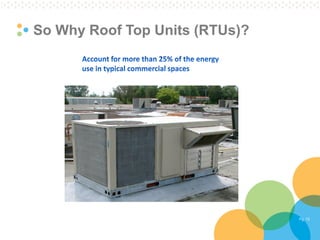
So Why Roof Top Units (RTUs)?
Pg. 14 
RTU Market 
•46% of all commercial space conditioned by RTU’s 
•2.7 billion ft2 of commercial retail floor space (CBECS 2003) 
•Wide variety of applications 
•Office 
•Commercial 
•Manufacturing 
•Industrial 
•Warehouse 
•Retail 
•Medical
Pg. 15 
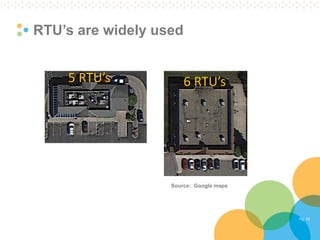
RTU’s are widely used 
Source: Google maps 
5 RTU’s 
6 RTU’s
Pg. 16 
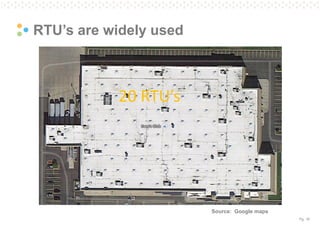
RTU’s are widely used 
Source: Google maps 
20 RTU’s
Pg. 17 
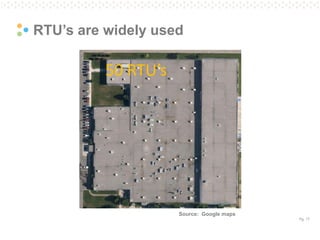
RTU’s are widely used 
Source: Google maps 
50 RTU’s
Pg. 18 
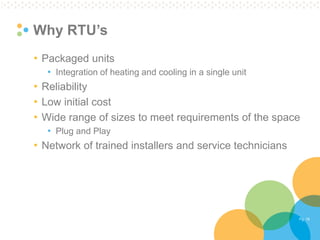
Why RTU’s 
•Packaged units 
•Integration of heating and cooling in a single unit 
•Reliability 
•Low initial cost 
•Wide range of sizes to meet requirements of the space 
•Plug and Play 
•Network of trained installers and service technicians
Pg. 19 
The evolution of a Cell phone
Pg. 20 
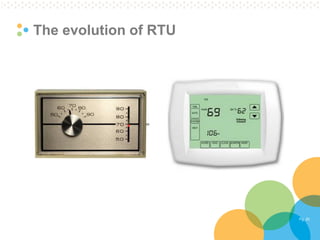
The evolution of RTU
Pg. 21 
What’s the problem with RTU? 
•Generally RTUs operate inefficiently 
•Standard efficiency 
•Constant speed 
•No options for advanced controls 
•Lack of maintenance 
•Compacted design results in challenges for control 
•Stand alone control 
•Settings conflict with neighboring RTU 
•Schedules (if used) don’t match space requirements 
•Often over sized 
•Pick and place from manufacture
Pg. 22 
Goals of our study 
•Evaluate advanced RTU control strategies 
•For efficiency 
•For cost effectiveness 
•For large scale delivery for CIP offering 
•Confirm savings found by other projects 
•Small projects in very different climates 
•What are the savings in Minnesota? 
•Collect performance data 
•Target 60 RTUs 
•Collect data that spans MN winter and summer conditions
Pg. 23 
The Optimization Packages 
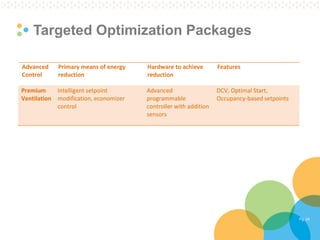
•Premium Ventilation 
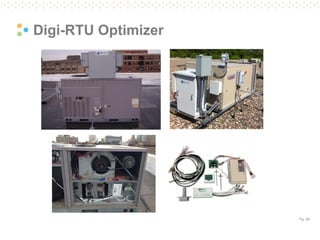
•Digi-RTU Optimizer 
•Catalyst Optimizer
Pg. 24 
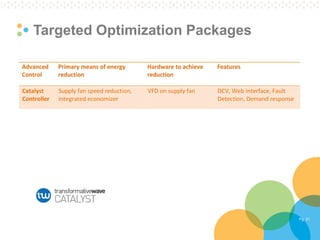
Targeted Optimization Packages
Pg. 25 
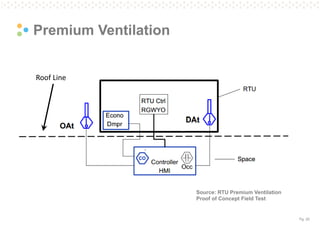
Premium Ventilation 
Source: RTU Premium Ventilation Proof of Concept Field Test 
2 
Roof Line
Pg. 26 
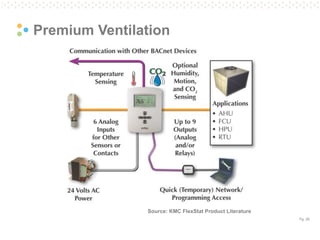
Premium Ventilation 
Source: KMC FlexStat Product Literature
Pg. 27 
Targeted Optimization Packages
Pg. 28 
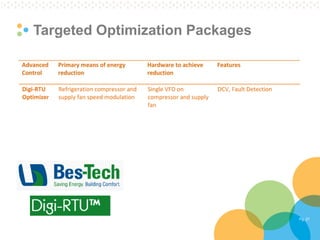
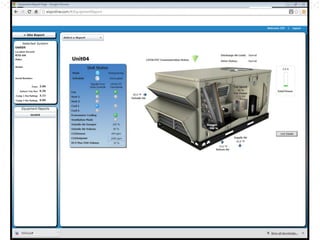
Digi-RTU Optimizer
Pg. 29 
Standard Operation
Pg. 30 
Variable speed control
Pg. 31 
Targeted Optimization Packages
Pg. 32 
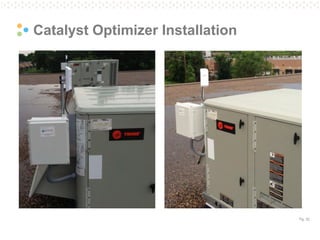
Catalyst Optimizer Installation
Pg. 33
Pg. 34 
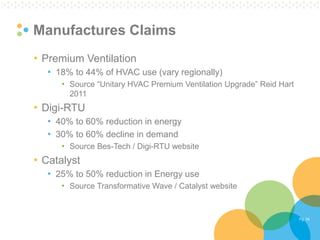
Manufactures Claims 
•Premium Ventilation 
•18% to 44% of HVAC use (vary regionally) 
•Source “Unitary HVAC Premium Ventilation Upgrade” Reid Hart 2011 
•Digi-RTU 
•40% to 60% reduction in energy 
•30% to 60% decline in demand 
•Source Bes-Tech / Digi-RTU website 
•Catalyst 
•25% to 50% reduction in Energy use 
•Source Transformative Wave / Catalyst website
Pg. 35 
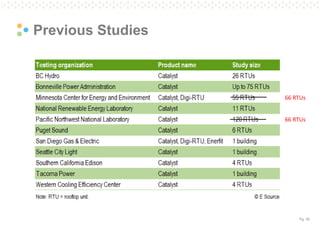
Previous Studies 
66 RTUs 
66 RTUs
Pg. 36 
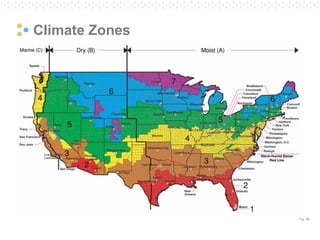
Climate Zones
Pg. 37 
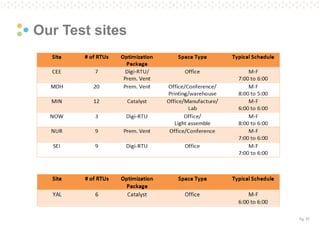
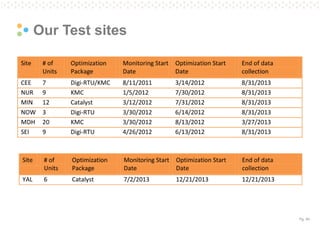
Our Test sites
Pg. 38 
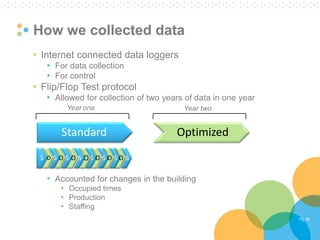
How we collected data 
•Internet connected data loggers 
•For data collection 
•For control 
•Flip/Flop Test protocol 
•Allowed for collection of two years of data in one year 
•Accounted for changes in the building 
•Occupied times 
•Production 
•Staffing 
Standard 
Optimized 
S 
S 
O 
S 
S 
O 
S 
S 
S 
S 
O 
O 
O 
O 
O 
Year one 
Year two
Pg. 39 
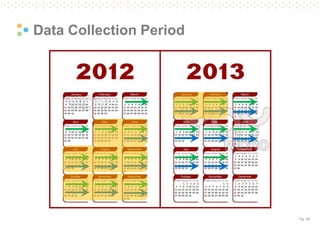
Data Collection Period
Pg. 40 
Our Test sites
Pg. 41 
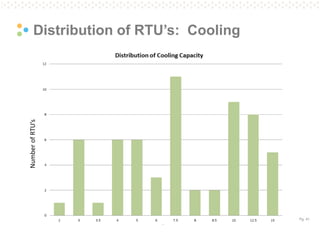
Distribution of RTU’s: Cooling 
Number of RTU’s
Pg. 42 
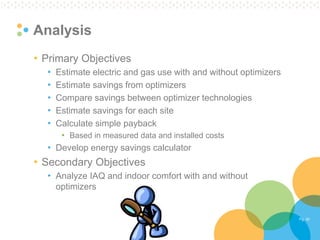
Analysis 
•Primary Objectives 
•Estimate electric and gas use with and without optimizers 
•Estimate savings from optimizers 
•Compare savings between optimizer technologies 
•Estimate savings for each site 
•Calculate simple payback 
•Based in measured data and installed costs 
•Develop energy savings calculator 
•Secondary Objectives 
•Analyze IAQ and indoor comfort with and without optimizers
Pg. 43 
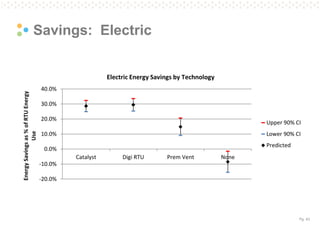
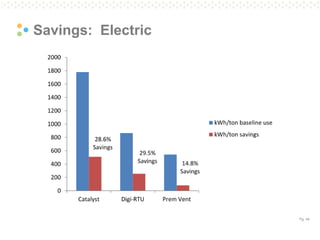
Savings: Electric
Pg. 44 
Savings: Electric
Pg. 45 
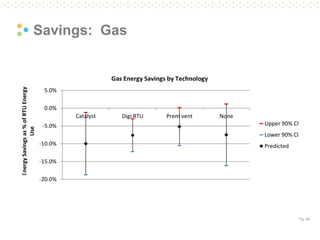
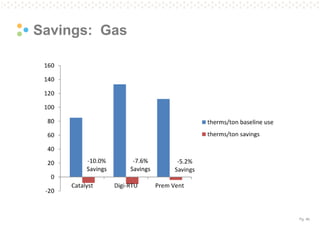
Savings: Gas
Pg. 46 
Savings: Gas
Pg. 47 
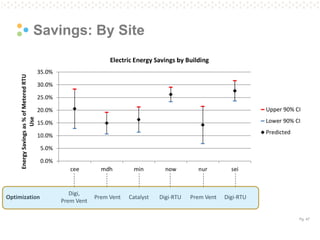
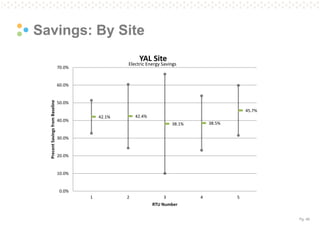
Savings: By Site 
Digi, Prem Vent 
Prem Vent 
Catalyst 
Digi-RTU 
Prem Vent 
Digi-RTU 
Optimization
Pg. 48 
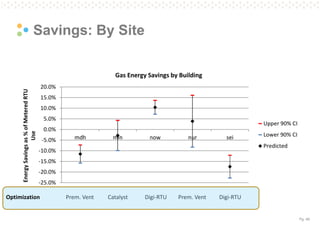
Savings: By Site
Pg. 49 
Savings: By Site 
Digi-RTU 
Digi-RTU 
Prem. Vent 
Catalyst 
Prem. Vent 
Optimization
Pg. 50 
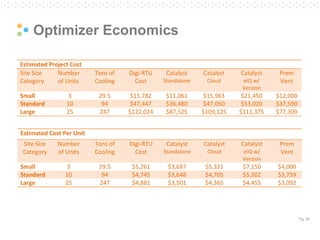
Optimizer Economics
Pg. 51 
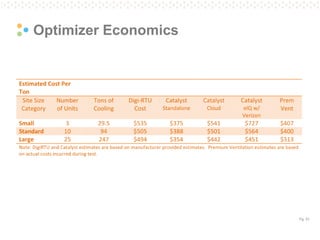
Optimizer Economics
Pg. 52 
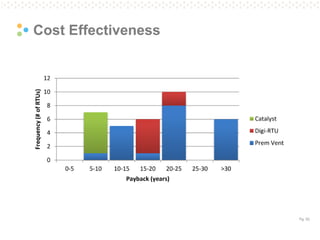
Cost Effectiveness
Pg. 53 
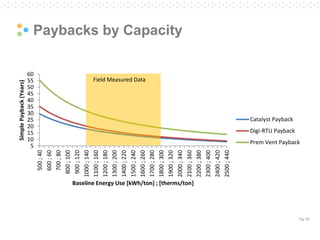
Paybacks by Capacity 
Field Measured Data
Pg. 54 
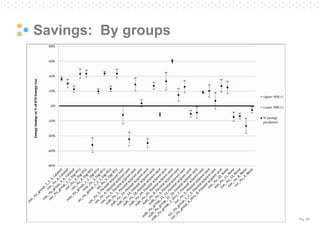
Savings: By groups
Pg. 55 
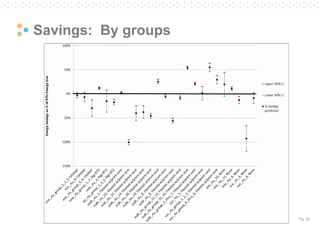
Savings: By groups
Pg. 56 
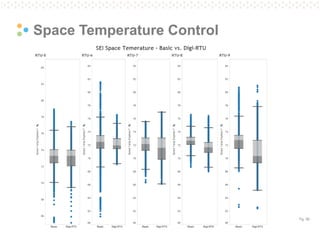
Space Temperature Control
Pg. 57 
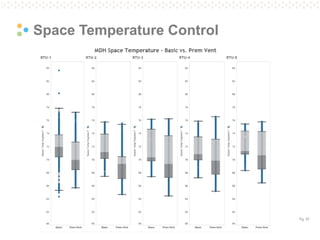
Space Temperature Control
Pg. 58 
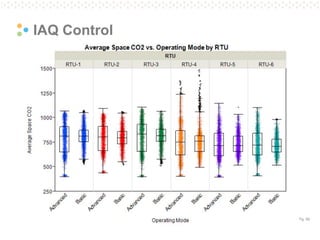
IAQ Control
Pg. 59 
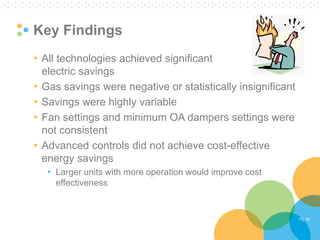
Key Findings 
•All technologies achieved significant electric savings 
•Gas savings were negative or statistically insignificant 
•Savings were highly variable 
•Fan settings and minimum OA dampers settings were not consistent 
•Advanced controls did not achieve cost-effective energy savings 
•Larger units with more operation would improve cost effectiveness
Pg. 60 
Key Findings 
•Control Units were affected by Optimizers 
•Best optimizer for a space depends on situation 
•“One size does not fit all” 
•Market is rapidly expanding 
•New innovation 
•Product maturity 
•Contractor support critical to success of products 
•Products tested had issues with MN Climate (Zone 6)
Mark Hancock | 612.335.5861 mhancock@mncee.org
Question & Answer 
Webinar Archive Link: 
http://www.mncee.org/Innovation-Exchange/Resource-Center/
Pg. 63

Optimizing Existing Rooftop Unit Energy Efficiency

  • 1.
    OPTIMIZING EXISTING ROOFTOPUNIT EFFICIENCY A Study Focused on Cold Climate Conditions Mark Hancock, P.E. | Center for Energy & Environment Webinar: November 12, 2014
  • 2.
  • 3.
  • 4.
    Pg. 4 CurrentField Research Projects In Progress •Improved Effectiveness of Commercial ERVs •Condensing Boiler Optimization •Optimized Operation of Pool Facilities •Reducing Commercial Building Duct Leakage •Multi-Family Building Envelope Aerosol Sealing •Effective Ventilation in Multi-Family Buildings •Secondhand Smoke Exposure in Vehicles •DOE Building America | Retrofit Water Heating •DOE Building America | Combi-System Measure Guidelines •DOE Building America | Combustion Safety Guidelines •DOE Building America | Demonstration House 2013-14 Archived Webinars & Upcoming Publications •Window Retrofit Technologies •Large Building Air Leakage •Tankless Water Heaters •Heat Pump Water Heaters in MN •Optimization of Existing RTUs •Combi Systems
  • 5.
    Pg. 5 CurrentField Research Projects In Progress •Improved Effectiveness of Commercial ERVs •Condensing Boiler Optimization •Optimized Operation of Pool Facilities •Reducing Commercial Building Duct Leakage •Multi-Family Building Envelope Aerosol Sealing •Effective Ventilation in Multi-Family Buildings •Secondhand Smoke Exposure in Vehicles •DOE Building America | Retrofit Water Heating •DOE Building America | Combi-System Measure Guidelines •DOE Building America | Combustion Safety Guidelines •DOE Building America | Demonstration House 2013-14 Archived Webinars & Upcoming Publications •Window Retrofit Technologies •Large Building Air Leakage •Tankless Water Heaters •Heat Pump Water Heaters in MN •Optimization of Existing RTUs •Combi Systems
  • 6.
    Pg. 6 CurrentField Research Projects In Progress •Improved Effectiveness of Commercial ERVs •Condensing Boiler Optimization •Optimized Operation of Pool Facilities •Reducing Commercial Building Duct Leakage •Multi-Family Building Envelope Aerosol Sealing •Effective Ventilation in Multi-Family Buildings •Secondhand Smoke Exposure in Vehicles •DOE Building America | Retrofit Water Heating •DOE Building America | Combi-System Measure Guidelines •DOE Building America | Combustion Safety Guidelines •DOE Building America | Demonstration House 2013-14 Archived Webinars & Upcoming Publications •Window Retrofit Technologies •Large Building Air Leakage •Tankless Water Heaters •Heat Pump Water Heaters in MN •Optimization of Existing RTUs •Combi Systems
  • 7.
    Pg. 7 CurrentField Research Projects In Progress •Improved Effectiveness of Commercial ERVs •Condensing Boiler Optimization •Optimized Operation of Pool Facilities •Reducing Commercial Building Duct Leakage •Multi-Family Building Envelope Aerosol Sealing •Effective Ventilation in Multi-Family Buildings •Secondhand Smoke Exposure in Vehicles •DOE Building America | Retrofit Water Heating •DOE Building America | Combi-System Measure Guidelines •DOE Building America | Combustion Safety Guidelines •DOE Building America | Demonstration House 2013-14 Archived Webinars & Upcoming Publications •Window Retrofit Technologies •Large Building Air Leakage •Tankless Water Heaters •Heat Pump Water Heaters in MN •Optimization of Existing RTUs •Combi Systems
  • 8.
    Pg. 8 CurrentField Research Projects In Progress •Improved Effectiveness of Commercial ERVs •Condensing Boiler Optimization •Optimized Operation of Pool Facilities •Reducing Commercial Building Duct Leakage •Multi-Family Building Envelope Aerosol Sealing •Effective Ventilation in Multi-Family Buildings •Secondhand Smoke Exposure in Vehicles •DOE Building America | Retrofit Water Heating •DOE Building America | Combi-System Measure Guidelines •DOE Building America | Combustion Safety Guidelines •DOE Building America | Demonstration House 2013-14 Archived Webinars & Upcoming Publications •Window Retrofit Technologies •Large Building Air Leakage •Tankless Water Heaters •Heat Pump Water Heaters in MN •Optimization of Existing RTUs •Combi Systems
  • 9.
    Pg. 9 CurrentField Research Projects In Progress •Improved Effectiveness of Commercial ERVs •Condensing Boiler Optimization •Optimized Operation of Pool Facilities •Reducing Commercial Building Duct Leakage •Multi-Family Building Envelope Aerosol Sealing •Effective Ventilation in Multi-Family Buildings •Secondhand Smoke Exposure in Vehicles •DOE Building America | Retrofit Water Heating •DOE Building America | Combi-System Measure Guidelines •DOE Building America | Combustion Safety Guidelines •DOE Building America | Demonstration House 2013-14 Archived Webinars & Upcoming Publications •Window Retrofit Technologies •Large Building Air Leakage •Tankless Water Heaters* •Heat Pump Water Heaters in MN •Optimization of Existing RTUs •Combi Systems
  • 10.
    Pg. 10 Today’sPresenter •With CEE since 1987 •Specializes in existing building commissioning and HVAC field diagnostics •Former program director for the Public Buildings Enhanced Energy Efficiency Program (2009 – 2014) Mark Hancock, P.E. Director of Engineering Services
  • 11.
    Pg. 11 Thisproject was supported by a grant from the Minnesota Department of Commerce through the Conservation Applied Research and Development (CARD) program.
  • 12.
    OPTIMIZING EXISTING ROOFTOPUNIT EFFICIENCY A Study Focused on Cold Climate Conditions Mark Hancock, P.E. | Center for Energy & Environment Webinar: November 12, 2014
  • 13.
    Pg. 13 SoWhy Roof Top Units (RTUs)?
  • 14.
    Pg. 14 RTUMarket •46% of all commercial space conditioned by RTU’s •2.7 billion ft2 of commercial retail floor space (CBECS 2003) •Wide variety of applications •Office •Commercial •Manufacturing •Industrial •Warehouse •Retail •Medical
  • 15.
    Pg. 15 RTU’sare widely used Source: Google maps 5 RTU’s 6 RTU’s
  • 16.
    Pg. 16 RTU’sare widely used Source: Google maps 20 RTU’s
  • 17.
    Pg. 17 RTU’sare widely used Source: Google maps 50 RTU’s
  • 18.
    Pg. 18 WhyRTU’s •Packaged units •Integration of heating and cooling in a single unit •Reliability •Low initial cost •Wide range of sizes to meet requirements of the space •Plug and Play •Network of trained installers and service technicians
  • 19.
    Pg. 19 Theevolution of a Cell phone
  • 20.
    Pg. 20 Theevolution of RTU
  • 21.
    Pg. 21 What’sthe problem with RTU? •Generally RTUs operate inefficiently •Standard efficiency •Constant speed •No options for advanced controls •Lack of maintenance •Compacted design results in challenges for control •Stand alone control •Settings conflict with neighboring RTU •Schedules (if used) don’t match space requirements •Often over sized •Pick and place from manufacture
  • 22.
    Pg. 22 Goalsof our study •Evaluate advanced RTU control strategies •For efficiency •For cost effectiveness •For large scale delivery for CIP offering •Confirm savings found by other projects •Small projects in very different climates •What are the savings in Minnesota? •Collect performance data •Target 60 RTUs •Collect data that spans MN winter and summer conditions
  • 23.
    Pg. 23 TheOptimization Packages •Premium Ventilation •Digi-RTU Optimizer •Catalyst Optimizer
  • 24.
    Pg. 24 TargetedOptimization Packages
  • 25.
    Pg. 25 PremiumVentilation Source: RTU Premium Ventilation Proof of Concept Field Test 2 Roof Line
  • 26.
    Pg. 26 PremiumVentilation Source: KMC FlexStat Product Literature
  • 27.
    Pg. 27 TargetedOptimization Packages
  • 28.
    Pg. 28 Digi-RTUOptimizer
  • 29.
    Pg. 29 StandardOperation
  • 30.
    Pg. 30 Variablespeed control
  • 31.
    Pg. 31 TargetedOptimization Packages
  • 32.
    Pg. 32 CatalystOptimizer Installation
  • 33.
  • 34.
    Pg. 34 ManufacturesClaims •Premium Ventilation •18% to 44% of HVAC use (vary regionally) •Source “Unitary HVAC Premium Ventilation Upgrade” Reid Hart 2011 •Digi-RTU •40% to 60% reduction in energy •30% to 60% decline in demand •Source Bes-Tech / Digi-RTU website •Catalyst •25% to 50% reduction in Energy use •Source Transformative Wave / Catalyst website
  • 35.
    Pg. 35 PreviousStudies 66 RTUs 66 RTUs
  • 36.
  • 37.
    Pg. 37 OurTest sites
  • 38.
    Pg. 38 Howwe collected data •Internet connected data loggers •For data collection •For control •Flip/Flop Test protocol •Allowed for collection of two years of data in one year •Accounted for changes in the building •Occupied times •Production •Staffing Standard Optimized S S O S S O S S S S O O O O O Year one Year two
  • 39.
    Pg. 39 DataCollection Period
  • 40.
    Pg. 40 OurTest sites
  • 41.
    Pg. 41 Distributionof RTU’s: Cooling Number of RTU’s
  • 42.
    Pg. 42 Analysis •Primary Objectives •Estimate electric and gas use with and without optimizers •Estimate savings from optimizers •Compare savings between optimizer technologies •Estimate savings for each site •Calculate simple payback •Based in measured data and installed costs •Develop energy savings calculator •Secondary Objectives •Analyze IAQ and indoor comfort with and without optimizers
  • 43.
  • 44.
  • 45.
  • 46.
  • 47.
    Pg. 47 Savings:By Site Digi, Prem Vent Prem Vent Catalyst Digi-RTU Prem Vent Digi-RTU Optimization
  • 48.
  • 49.
    Pg. 49 Savings:By Site Digi-RTU Digi-RTU Prem. Vent Catalyst Prem. Vent Optimization
  • 50.
  • 51.
  • 52.
    Pg. 52 CostEffectiveness
  • 53.
    Pg. 53 Paybacksby Capacity Field Measured Data
  • 54.
    Pg. 54 Savings:By groups
  • 55.
    Pg. 55 Savings:By groups
  • 56.
    Pg. 56 SpaceTemperature Control
  • 57.
    Pg. 57 SpaceTemperature Control
  • 58.
    Pg. 58 IAQControl
  • 59.
    Pg. 59 KeyFindings •All technologies achieved significant electric savings •Gas savings were negative or statistically insignificant •Savings were highly variable •Fan settings and minimum OA dampers settings were not consistent •Advanced controls did not achieve cost-effective energy savings •Larger units with more operation would improve cost effectiveness
  • 60.
    Pg. 60 KeyFindings •Control Units were affected by Optimizers •Best optimizer for a space depends on situation •“One size does not fit all” •Market is rapidly expanding •New innovation •Product maturity •Contractor support critical to success of products •Products tested had issues with MN Climate (Zone 6)
  • 61.
    Mark Hancock |612.335.5861 mhancock@mncee.org
  • 62.
    Question & Answer Webinar Archive Link: http://www.mncee.org/Innovation-Exchange/Resource-Center/
  • 63.