Emerging Low Energy Air Conditioning
Technologies
Jonathan Woolley
Western Cooling Efficiency Center
University of California, Davis
Mission
“To accelerate the development and
commercialization of efficient heating,
cooling, and energy distribution
solutions through stakeholder
engagement, innovation, research,
development, education, and outreach.”
Affiliates and Partners
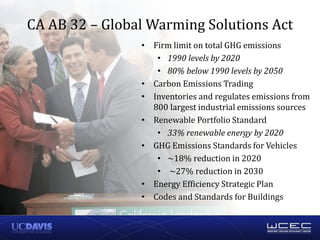
CA AB 32 – Global Warming Solutions Act
• Firm limit on total GHG emissions
• 1990 levels by 2020
• 80% below 1990 levels by 2050
• Carbon Emissions Trading
• Inventories and regulates emissions from
800 largest industrial emissions sources
• Renewable Portfolio Standard
• 33% renewable energy by 2020
• GHG Emissions Standards for Vehicles
• ~18% reduction in 2020
• ~27% reduction in 2030
• Energy Efficiency Strategic Plan
• Codes and Standards for Buildings
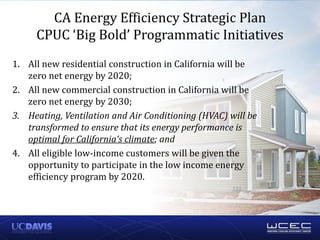
CA Energy Efficiency Strategic Plan
CPUC ‘Big Bold’ Programmatic Initiatives
1. All new residential construction in California will be
zero net energy by 2020;
2. All new commercial construction in California will be
zero net energy by 2030;
3. Heating, Ventilation and Air Conditioning (HVAC) will be
transformed to ensure that its energy performance is
optimal for California‘s climate; and
4. All eligible low-income customers will be given the
opportunity to participate in the low income energy
efficiency program by 2020.
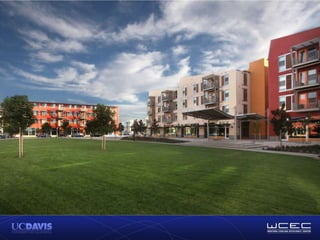
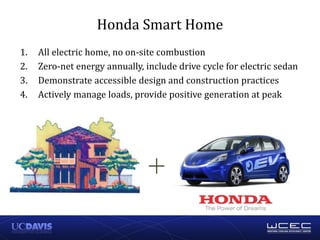
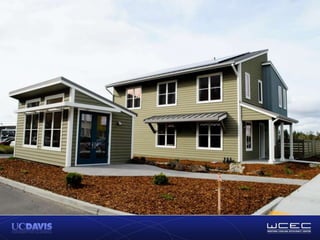
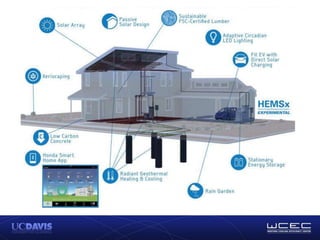
Honda Smart Home
1. All electric home, no on-site combustion
2. Zero-net energy annually, include drive cycle for electric sedan
3. Demonstrate accessible design and construction practices
4. Actively manage loads, provide positive generation at peak
+
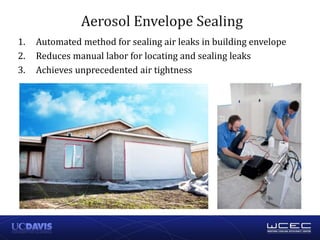
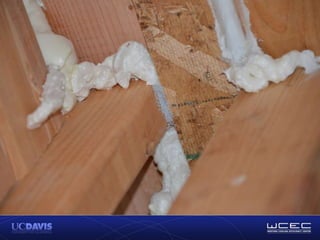
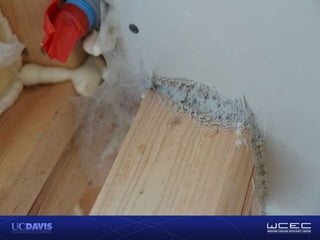
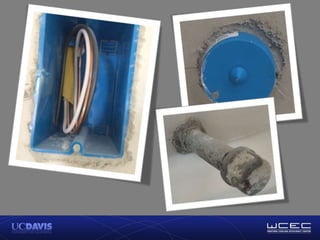
1. Automated method for sealing air leaks in building envelope
2. Reduces manual labor for locating and sealing leaks
3. Achieves unprecedented air tightness
Aerosol Envelope-Sealing Real Time Performance
0
500
1000
1500
2000
2500
3000
3500
4000
4500
5000
0 20 40 60 80 100 120
Leakage
Flowrate
at
50
Pa
[CFM]
Elapsed Time [Minutes]
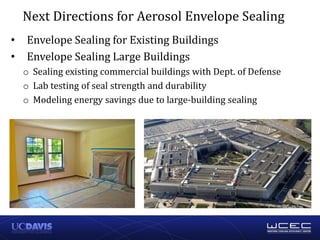
• Envelope Sealing for Existing Buildings
• Envelope Sealing Large Buildings
o Sealing existing commercial buildings with Dept. of Defense
o Lab testing of seal strength and durability
o Modeling energy savings due to large-building sealing
Next Directions for Aerosol Envelope Sealing
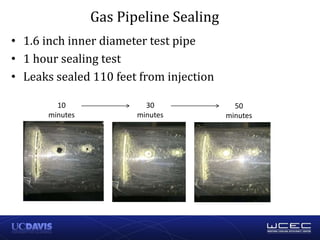
• 1.6 inch inner diameter test pipe
• 1 hour sealing test
• Leaks sealed 110 feet from injection
Gas Pipeline Sealing
10
minutes
30
minutes
50
minutes
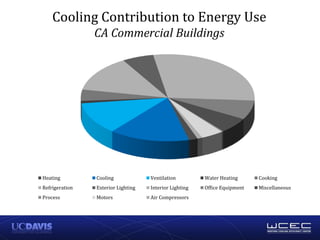
Cooling Contribution to Energy Use
CA Commercial Buildings
Heating Cooling Ventilation Water Heating Cooking
Refrigeration Exterior Lighting Interior Lighting Office Equipment Miscellaneous
Process Motors Air Compressors
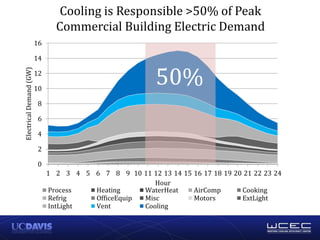
Cooling is Responsible >50% of Peak
Commercial Building Electric Demand
0
2
4
6
8
10
12
14
16
1 2 3 4 5 6 7 8 9 10 11 12 13 14 15 16 17 18 19 20 21 22 23 24
Electrical
Demand
(GW)
Hour
Process Heating WaterHeat AirComp Cooking
Refrig OfficeEquip Misc Motors ExtLight
IntLight Vent Cooling
50%
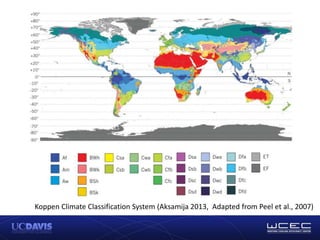
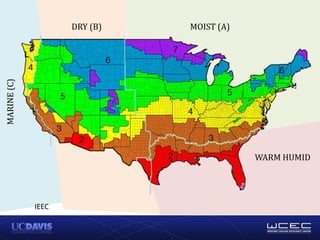
Koppen Climate Classification System (Aksamija 2013, Adapted from Peel et al., 2007)
MARINE
(C)
DRY (B) MOIST (A)
WARM HUMID
IEEC
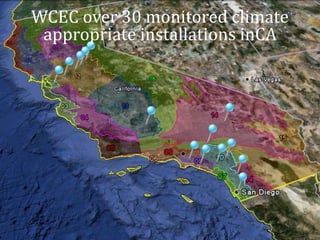
WCEC over 30 monitored climate
appropriate installations inCA
Climate Appropriate HVAC delivers
major energy savings
• Laboratory test for Munters EPX 5000 DOAS indicates
20% savings for whole building HVAC peak demand. Field
evaluation confirms major savings.
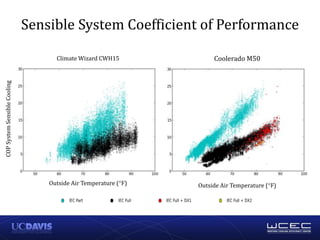
• Side-by-Side field evaluation of Climate Wizard & Coolerado
achieves COP=15+ at peak, COP=25+ at part load
• Field evaluations for DualCool as new installation and retrofit show
40% energy savings at peak, consistent with laboratory testing.
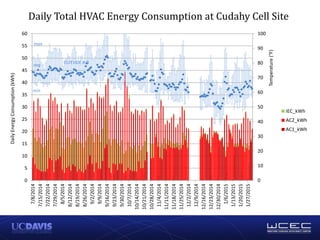
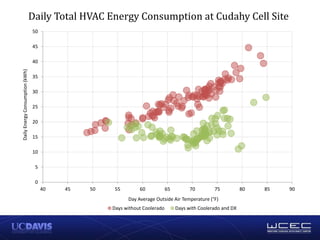
• Indirect evaporative cooling for small data centers measures
40-70% daily kWh savings
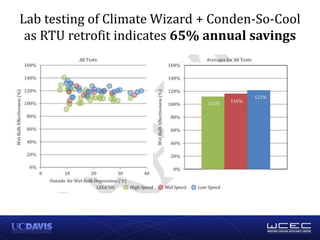
• Laboratory test of Climate Wizard + RTU shows 65% savings for
annual cooling energy consumption 85% savings at part load
• Condenser pre-cooling can reduce peak demand by as much as
27%, and deployed in conjunction with variable speed fan and
compressor operation promises 38% savings.
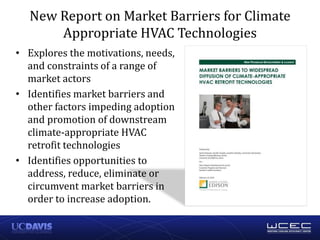
New Report on Market Barriers for Climate
Appropriate HVAC Technologies
• Explores the motivations, needs,
and constraints of a range of
market actors
• Identifies market barriers and
other factors impeding adoption
and promotion of downstream
climate-appropriate HVAC
retrofit technologies
• Identifies opportunities to
address, reduce, eliminate or
circumvent market barriers in
order to increase adoption.
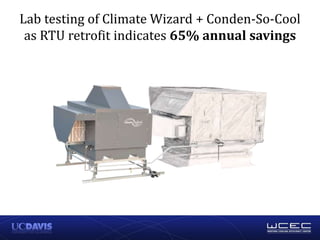
Lab testing of Climate Wizard + Conden-So-Cool
as RTU retrofit indicates 65% annual savings
Lab testing of Climate Wizard + Conden-So-Cool
as RTU retrofit indicates 65% annual savings
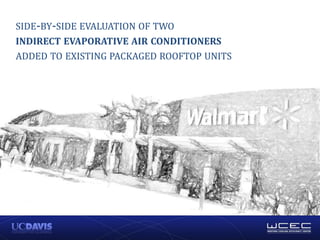
SIDE-BY-SIDE EVALUATION OF TWO
INDIRECT EVAPORATIVE AIR CONDITIONERS
ADDED TO EXISTING PACKAGED ROOFTOP UNITS
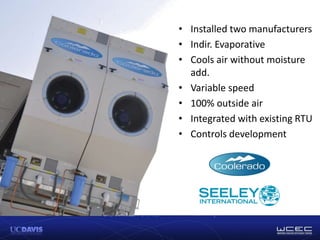
• Installed two manufacturers
• Indir. Evaporative
• Cools air without moisture
add.
• Variable speed
• 100% outside air
• Integrated with existing RTU
• Controls development
Climate Wizard CWH15 Coolerado M50
COP
System
Sensible
Cooling
Outside Air Temperature (°F) Outside Air Temperature (°F)
Sensible System Coefficient of Performance
INDIRECT EVAPORATIVE COOLING FOR
SMALL DATA CENTERS
(CELL TOWER SITES)
Daily Total HVAC Energy Consumption at Cudahy Cell Site
0
10
20
30
40
50
60
70
80
90
100
0
5
10
15
20
25
30
35
40
45
50
55
60 7/8/2014
7/15/2014
7/22/2014
7/29/2014
8/5/2014
8/12/2014
8/19/2014
8/26/2014
9/2/2014
9/9/2014
9/16/2014
9/23/2014
9/30/2014
10/7/2014
10/14/2014
10/21/2014
10/28/2014
11/4/2014
11/11/2014
11/18/2014
11/25/2014
12/2/2014
12/9/2014
12/16/2014
12/23/2014
12/30/2014
1/6/2015
1/13/2015
1/20/2015
1/27/2015
Temperature
(°F)
Daily
Energy
Consumption
(kWh)
IEC_kWh
AC2_kWh
AC1_kWh
OUTSIDE AIR
max
min
avg
Daily Total HVAC Energy Consumption at Cudahy Cell Site
0
5
10
15
20
25
30
35
40
45
50
40 45 50 55 60 65 70 75 80 85 90
Daily
Energy
Consumption
(kWh)
Day Average Outside Air Temperature (°F)
Days without Coolerado Days with Coolerado and DX
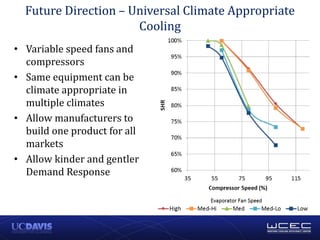
Future Direction – Universal Climate Appropriate
Cooling
• Variable speed fans and
compressors
• Same equipment can be
climate appropriate in
multiple climates
• Allow manufacturers to
build one product for all
markets
• Allow kinder and gentler
Demand Response
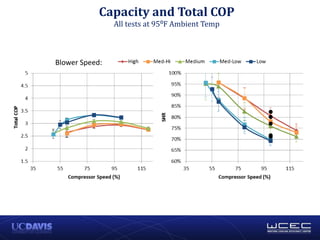
Capacity and Total COP
All tests at 95⁰F Ambient Temp
Blower Speed:
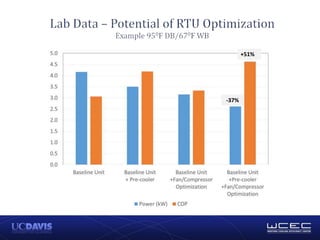
+51%
-37%
Jonathan woolley talk

Jonathan woolley talk

  • 1.
    Emerging Low EnergyAir Conditioning Technologies Jonathan Woolley Western Cooling Efficiency Center University of California, Davis
  • 2.
    Mission “To accelerate thedevelopment and commercialization of efficient heating, cooling, and energy distribution solutions through stakeholder engagement, innovation, research, development, education, and outreach.”
  • 3.
  • 5.
    CA AB 32– Global Warming Solutions Act • Firm limit on total GHG emissions • 1990 levels by 2020 • 80% below 1990 levels by 2050 • Carbon Emissions Trading • Inventories and regulates emissions from 800 largest industrial emissions sources • Renewable Portfolio Standard • 33% renewable energy by 2020 • GHG Emissions Standards for Vehicles • ~18% reduction in 2020 • ~27% reduction in 2030 • Energy Efficiency Strategic Plan • Codes and Standards for Buildings
  • 6.
    CA Energy EfficiencyStrategic Plan CPUC ‘Big Bold’ Programmatic Initiatives 1. All new residential construction in California will be zero net energy by 2020; 2. All new commercial construction in California will be zero net energy by 2030; 3. Heating, Ventilation and Air Conditioning (HVAC) will be transformed to ensure that its energy performance is optimal for California‘s climate; and 4. All eligible low-income customers will be given the opportunity to participate in the low income energy efficiency program by 2020.
  • 7.
    Honda Smart Home 1.All electric home, no on-site combustion 2. Zero-net energy annually, include drive cycle for electric sedan 3. Demonstrate accessible design and construction practices 4. Actively manage loads, provide positive generation at peak +
  • 11.
    1. Automated methodfor sealing air leaks in building envelope 2. Reduces manual labor for locating and sealing leaks 3. Achieves unprecedented air tightness
  • 13.
    Aerosol Envelope-Sealing RealTime Performance 0 500 1000 1500 2000 2500 3000 3500 4000 4500 5000 0 20 40 60 80 100 120 Leakage Flowrate at 50 Pa [CFM] Elapsed Time [Minutes]
  • 17.
    • Envelope Sealingfor Existing Buildings • Envelope Sealing Large Buildings o Sealing existing commercial buildings with Dept. of Defense o Lab testing of seal strength and durability o Modeling energy savings due to large-building sealing Next Directions for Aerosol Envelope Sealing
  • 18.
    • 1.6 inchinner diameter test pipe • 1 hour sealing test • Leaks sealed 110 feet from injection Gas Pipeline Sealing 10 minutes 30 minutes 50 minutes
  • 19.
    Cooling Contribution toEnergy Use CA Commercial Buildings Heating Cooling Ventilation Water Heating Cooking Refrigeration Exterior Lighting Interior Lighting Office Equipment Miscellaneous Process Motors Air Compressors
  • 20.
    Cooling is Responsible>50% of Peak Commercial Building Electric Demand 0 2 4 6 8 10 12 14 16 1 2 3 4 5 6 7 8 9 10 11 12 13 14 15 16 17 18 19 20 21 22 23 24 Electrical Demand (GW) Hour Process Heating WaterHeat AirComp Cooking Refrig OfficeEquip Misc Motors ExtLight IntLight Vent Cooling 50%
  • 21.
    Koppen Climate ClassificationSystem (Aksamija 2013, Adapted from Peel et al., 2007)
  • 22.
    MARINE (C) DRY (B) MOIST(A) WARM HUMID IEEC
  • 26.
    WCEC over 30monitored climate appropriate installations inCA
  • 27.
    Climate Appropriate HVACdelivers major energy savings • Laboratory test for Munters EPX 5000 DOAS indicates 20% savings for whole building HVAC peak demand. Field evaluation confirms major savings. • Side-by-Side field evaluation of Climate Wizard & Coolerado achieves COP=15+ at peak, COP=25+ at part load • Field evaluations for DualCool as new installation and retrofit show 40% energy savings at peak, consistent with laboratory testing. • Indirect evaporative cooling for small data centers measures 40-70% daily kWh savings • Laboratory test of Climate Wizard + RTU shows 65% savings for annual cooling energy consumption 85% savings at part load • Condenser pre-cooling can reduce peak demand by as much as 27%, and deployed in conjunction with variable speed fan and compressor operation promises 38% savings.
  • 28.
    New Report onMarket Barriers for Climate Appropriate HVAC Technologies • Explores the motivations, needs, and constraints of a range of market actors • Identifies market barriers and other factors impeding adoption and promotion of downstream climate-appropriate HVAC retrofit technologies • Identifies opportunities to address, reduce, eliminate or circumvent market barriers in order to increase adoption.
  • 29.
    Lab testing ofClimate Wizard + Conden-So-Cool as RTU retrofit indicates 65% annual savings
  • 30.
    Lab testing ofClimate Wizard + Conden-So-Cool as RTU retrofit indicates 65% annual savings
  • 31.
    SIDE-BY-SIDE EVALUATION OFTWO INDIRECT EVAPORATIVE AIR CONDITIONERS ADDED TO EXISTING PACKAGED ROOFTOP UNITS
  • 32.
    • Installed twomanufacturers • Indir. Evaporative • Cools air without moisture add. • Variable speed • 100% outside air • Integrated with existing RTU • Controls development
  • 34.
    Climate Wizard CWH15Coolerado M50 COP System Sensible Cooling Outside Air Temperature (°F) Outside Air Temperature (°F) Sensible System Coefficient of Performance
  • 35.
    INDIRECT EVAPORATIVE COOLINGFOR SMALL DATA CENTERS (CELL TOWER SITES)
  • 36.
    Daily Total HVACEnergy Consumption at Cudahy Cell Site 0 10 20 30 40 50 60 70 80 90 100 0 5 10 15 20 25 30 35 40 45 50 55 60 7/8/2014 7/15/2014 7/22/2014 7/29/2014 8/5/2014 8/12/2014 8/19/2014 8/26/2014 9/2/2014 9/9/2014 9/16/2014 9/23/2014 9/30/2014 10/7/2014 10/14/2014 10/21/2014 10/28/2014 11/4/2014 11/11/2014 11/18/2014 11/25/2014 12/2/2014 12/9/2014 12/16/2014 12/23/2014 12/30/2014 1/6/2015 1/13/2015 1/20/2015 1/27/2015 Temperature (°F) Daily Energy Consumption (kWh) IEC_kWh AC2_kWh AC1_kWh OUTSIDE AIR max min avg
  • 37.
    Daily Total HVACEnergy Consumption at Cudahy Cell Site 0 5 10 15 20 25 30 35 40 45 50 40 45 50 55 60 65 70 75 80 85 90 Daily Energy Consumption (kWh) Day Average Outside Air Temperature (°F) Days without Coolerado Days with Coolerado and DX
  • 38.
    Future Direction –Universal Climate Appropriate Cooling • Variable speed fans and compressors • Same equipment can be climate appropriate in multiple climates • Allow manufacturers to build one product for all markets • Allow kinder and gentler Demand Response
  • 39.
    Capacity and TotalCOP All tests at 95⁰F Ambient Temp Blower Speed:
  • 40.

Editor's Notes

  • #18 Modeling results based on sealing apartment from 0.4 CFM50/ft2 envelope area to 0.2 CFM50/ft2 envelope area (ASHRAE Standard)
  • #20 Note that heating in California is primarily gas fired, so this covers the electric energy use in commercial buildings.
  • #21 Problems: Cooling and ventilation are 25% of the electrical consumption in commercial buildings in CA Cooling (and ventilation) account for almost 50% of the peak electrical demand for commercial buildings in CA Rooftop units serve 50%-70% of the floor area for commercial buildings in CA Load Factor for Cooling 7% Residential 22% Commercial DX Cooling + High outdoor temperatures = Peak kW Highest cooling load Lowest cooling capacity Highest power Western Climates Large diurnal temperature swings Low outdoor humidity Opportunity for thermal storage Various evaporative cooling technologies
  • #25 Invite manufacturers to develop the next generation of rooftop packaged units that are climate appropriate, and leverage technologies that have long been academically proven to move far beyond federal energy efficiency standards for rooftop air conditioners. Targets rooftop packaged units (RTUs) 3 – 30 ton capacity Invites manufacturers to design and commercialize climate appropriate rooftop packaged air conditioners Targets rooftop packaged units (RTUs) 3 – 30 ton capacity Performance requirements to achieve 40% energy use and demand savings Likely to require some evaporative cooling Must provide some dehumidification Manufacturers incentivized by utility commitment to provide rebates, and by large retailers’ interest in Challenge Two point laboratory performance test to qualify Ground-up design or accessorized conventional systems allowed Laboratory testing and data-analysis under WCEC observation Systems that introduce more than 120 cfm/ton are only credited for cooling additional air from return air temperature supply air temperature. Systems that cannot be ARI listed with 0% outdoor air are rated capacity at WCC Peak conditions No use of R-22 Fault detection and diagnostics Soft response to voltage droop Minimum 500-unit annual production capability
  • #27 UC Davis monitored installations throughout California
  • #32 - Establish need and market for retrofit
  • #36 - Establish need and market for retrofit