Rebecca Olson
Neighborhood Energy Connection
Dave Bohac
Center for Energy and Environment
Duluth Energy Design Conference
2/24/2016
This project was supported in part by a grant from the Minnesota Department of Commerce, Division of
Energy Resources through the Conservation Applied Research and Development (CARD) program.
Research Update:
Continuing Education
In accordance with the Department of Labor and
Industry’s statute 326.0981, Subd. 11,
“This educational offering is recognized by the
Minnesota Department of Labor and Industry as
satisfying 1.5 hours of credit toward Building
Officials and Residential Contractors continuing
education requirements.”
For additional continuing education approvals,
please see your credit tracking card.
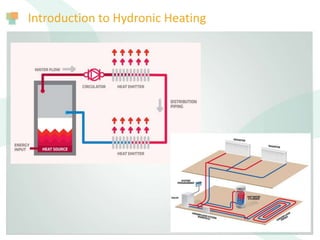
Introduction to Hydronic Heating
• Non-condensing vs. condensing
– Conventional boiler: condensation of combustion gases can rust out
heat exchanger
– Condensing boiler: condensation of combustion gases is optimum for
efficiency
• Difference in return temperature requirement
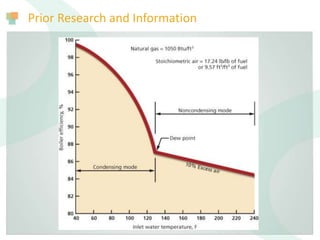
– In order to get combustion gases to condense, the return water
temperature needs to be below ~130°
• Radiator types
– Radiator types and size play a significant role in the ΔT between
supply and return temps.
• Issues with replacement from one to other
– It’s important to optimize efficiency when replacing a
conventional boiler with a condensing boiler based on the
above factors
Hydronic Heating in MN
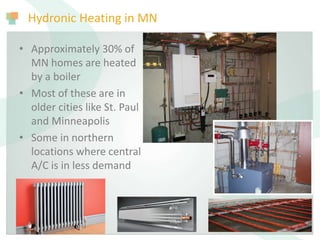
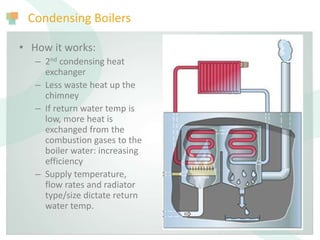
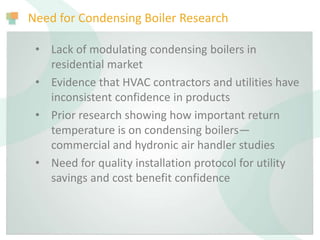
• Approximately 30% of
MN homes are heated
by a boiler
• Most of these are in
older cities like St. Paul
and Minneapolis
• Some in northern
locations where central
A/C is in less demand
Condensing Boilers
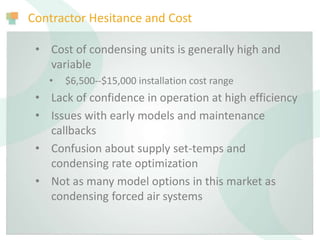
• How it works:
– 2nd condensing heat
exchanger
– Less waste heat up the
chimney
– If return water temp is
low, more heat is
exchanged from the
combustion gases to the
boiler water: increasing
efficiency
– Supply temperature,
flow rates and radiator
type/size dictate return
water temp.
Need for Condensing Boiler Research
• Lack of modulating condensing boilers in
residential market
• Evidence that HVAC contractors and utilities have
inconsistent confidence in products
• Prior research showing how important return
temperature is on condensing boilers—
commercial and hydronic air handler studies
• Need for quality installation protocol for utility
savings and cost benefit confidence
Contractor Hesitance and Cost
• Cost of condensing units is generally high and
variable
• $6,500--$15,000 installation cost range
• Lack of confidence in operation at high efficiency
• Issues with early models and maintenance
callbacks
• Confusion about supply set-temps and
condensing rate optimization
• Not as many model options in this market as
condensing forced air systems
Condensing Boiler Rebates in MN
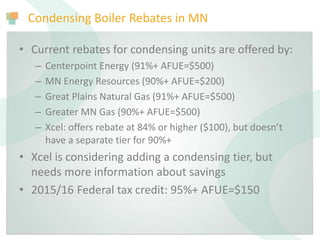
• Current rebates for condensing units are offered by:
– Centerpoint Energy (91%+ AFUE=$500)
– MN Energy Resources (90%+ AFUE=$200)
– Great Plains Natural Gas (91%+ AFUE=$500)
– Greater MN Gas (90%+ AFUE=$500)
– Xcel: offers rebate at 84% or higher ($100), but doesn’t
have a separate tier for 90%+
• Xcel is considering adding a condensing tier, but
needs more information about savings
• 2015/16 Federal tax credit: 95%+ AFUE=$150
Prior Research and Information
• Conclusions:
– Return water temp is a primary factor
– Flow rates can influence return water temperature
– Outdoor reset needs to be installed and set-up
properly
– Needed more info pertaining to MN housing
stock, radiator types, and climate as well as more
field implementation guidelines
• Building America—Butcher/Arena
• Commercial Boiler study—CEE Russ Landry
• ASHRAE Handbook
Prior Research and Information
Research Project Structure
• Field and Market research
• Existing condensing boiler monitoring
• Draft retro-commissioning activities
• Monitor savings after retro-commissioning
• Development of Quality Installation Protocol for
Utility rebates based on savings from retro-
commissioning
• Work with contractors to install condensing
boilers in homes using QI protocol
• Information dissemination through webinars,
presentations and published reports
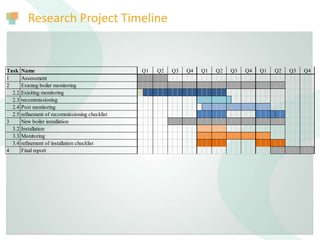
Research Project Timeline

Task Name
1 Assessment
2 Existing boiler monitoring
2.2 Exisiting monitoring
2.3 recommissioning
2.4 Post monitoring
2.5 refinement of recommissioning checklist
3 New boiler installation
3.2 Installation
3.3 Monitoring
3.4 refinement of installation checklist
4 Final report
Q1 Q2 Q3 Q4 Q1 Q2 Q3 Q4 Q1 Q2 Q3 Q4
Market Research Structure
• Interview HVAC contractors about installation
• Procedures
• Pricing
• Barriers
• Incidence
• Interview homeowners about performance
• Comfort
• Maintenance
• Issues
• Interview Utilities about rebate development and
rationale
Early Market Research Results
• Interview HVAC contractors about installation
• 2 companies interviewed so far
• Low volume of boiler replacements and even lower volume of condensing
• Some hesitation on cost vs. performance
• Costs seem to be inconsistent with equipment and labor details
• Plan to interview at least 5 more contractors
• Interview homeowners about performance of existing condensing
Boiler
• Comfort is very high in existing sites
• Maintenance does not seem to be an issue with any of the sites
• Most sites relied on contractor to choose model
• All 6 residents said they would recommend condensing system to others
• Interview Utilities about rebate development and rationale
• Preliminary discussion with Xcel indicates they are worried about cost
effectiveness.
• They may be getting high installation cost estimates, and not have a lot of
confidence in the efficiency
Field Research Phase I
• Characterization of Typical MN households
• Based on aggregate consumption data from existing programs
• Participant solicitation/selection
• 6 sites chosen with existing modulating condensing boilers
installed within the last 5 years
• Sites have varied heating loads and construction characteristics
• All homes have cast iron radiators
• Some have other convector types, (i.e. baseboard, in-floor, low mass)
• 3 sites have indirect water heaters
• Monitoring
• Gas usage
• Supply and return water temperature
• Flow rates
• Condensation rate
Field Research Phase I
• 1st half of 2015/2016 heating season, monitor as
installed
• Make minor changes to optimize efficiency
• Adjust supply temp
• Optimize turn-down ratio
• Maybe adjust flow rates
• 2nd half of 2015/2016 heating season, monitor after
adjustments
• Measure savings from 1st half to 2nd half
• Develop draft quality installation protocol
Site Selection Criteria
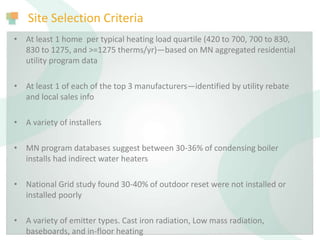
• At least 1 home per typical heating load quartile (420 to 700, 700 to 830,
830 to 1275, and >=1275 therms/yr)—based on MN aggregated residential
utility program data
• At least 1 of each of the top 3 manufacturers—identified by utility rebate
and local sales info
• A variety of installers
• MN program databases suggest between 30-36% of condensing boiler
installs had indirect water heaters
• National Grid study found 30-40% of outdoor reset were not installed or
installed poorly
• A variety of emitter types. Cast iron radiation, Low mass radiation,
baseboards, and in-floor heating
Site Selection and Recruitment
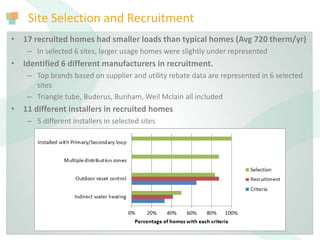
• 17 recruited homes had smaller loads than typical homes (Avg 720 therm/yr)
– In selected 6 sites, larger usage homes were slightly under represented
• Identified 6 different manufacturers in recruitment.
– Top brands based on supplier and utility rebate data are represented in 6 selected
sites
– Triangle tube, Buderus, Bunham, Weil Mclain all included
• 11 different installers in recruited homes
– 5 different installers in selected sites
Monitoring Set-up
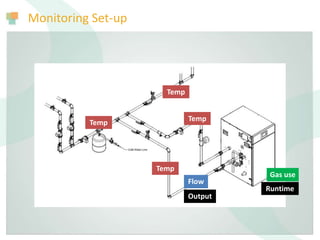
Gas use
Flow
Temp
Temp
Output
Temp
Temp
Runtime
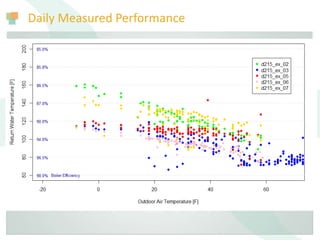
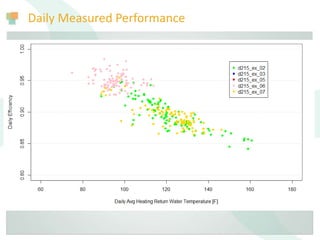
Daily Measured Performance
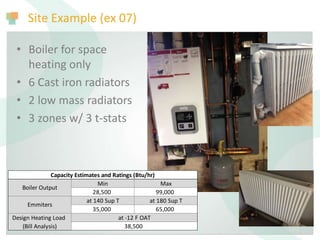
Site Example (ex 07)
• Boiler for space
heating only
• 6 Cast iron radiators
• 2 low mass radiators
• 3 zones w/ 3 t-stats
Min Max
28,500 99,000
at 140 Sup T at 180 Sup T
35,000 65,000
Capacity Estimates and Ratings (Btu/hr)
Boiler Output
Emmiters
Design Heating Load
(Bill Analysis)
at -12 F OAT
38,500
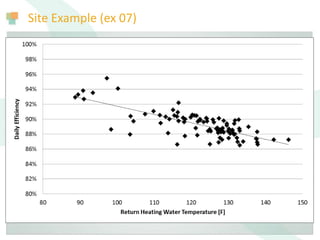
Site Example (ex 07)
Supply Temperature Optimization
• Calculate or estimate the home heating load
• Calculate or estimate the emitter capacity
• Minimize the supply water temperature so
that the house load can still be met
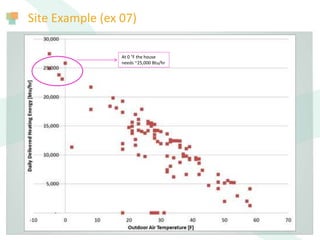
Site Example (ex 07)
At 0 °F the house
needs ~25,000 Btu/hr
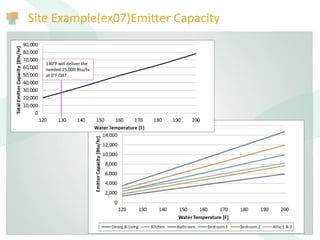
Site Example(ex07)Emitter Capacity
130°F will deliver the
needed 25,000 Btu/hr
at 0°F OAT.
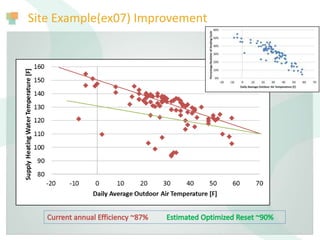
Site Example(ex07) Improvement
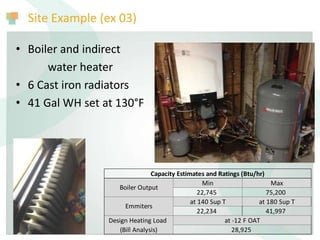
Site Example (ex 03)
• Boiler and indirect
water heater
• 6 Cast iron radiators
• 41 Gal WH set at 130°F
Min Max
22,745 75,200
at 140 Sup T at 180 Sup T
22,234 41,997
Design Heating Load
(Bill Analysis)
at -12 F OAT
28,925
Capacity Estimates and Ratings (Btu/hr)
Boiler Output
Emmiters
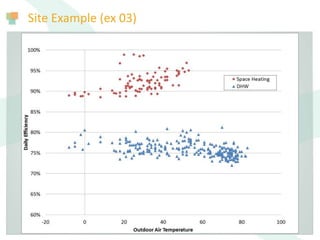
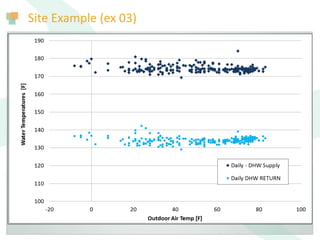
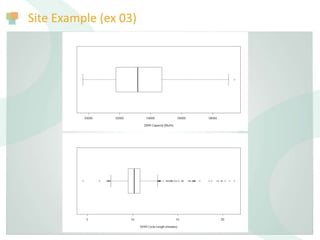
Site Example (ex 03)
Retro-Commissioning Plan
• Lower Supply Temperature
– Determine reasonable level to still meet load, but lower
return temp. to optimize efficiency
• Adjust overall Reset Curve
– Maximum supply temperature output at -12° vs. default of
0°
– This will lower the slope of the curve making more points
along the curve in the condensing mode
• Potentially adjust DHW Supply
– Based on lower efficiencies of indirect tanks as well as
indications of unused capacity
• Potentially reduce pump speed
– Some sites have very high pump speeds that contribute to
lower temp. drops between supply and return water
Field Research, Phase II
• Select 7-9 homes looking to replace non-condensing
boiler with condensing boiler
• Use similar solicitation and selection criteria to
Phase I
• Work with contractors to install new boiler in
accordance with draft QI protocol in selected sites
• Monitoring
• Gas usage
• Supply and return water temperature
• Flow rates
• Condensation rate
• Measure efficiency and compare to Phase I to
estimate potential savings associated with QI
protocol
Dissemination Plan
• Hold several webinars and live presentations
about project findings
• Work with contractors involved in interviews as
well as installations to adopt QI protocol and
hone in on pricing
• Work with WX agencies to determine assessment
protocol for condensing boiler work scope
• Work with gas utilities not currently offering
rebates for mod cons to implement rebate with
QI protocol required
• Publish final research report and send out with
DER newsletters etc.
THANKS
This project was supported in part by a grant from the Minnesota Department of
Commerce, Division of Energy Resources through the Conservation Applied
Research and Development (CARD) program.
Dave Bohac
Director of Research
Center for Energy and Environment
dbohac@mncee.org
612-802-1697
Rebecca Olson
Residential Energy Program Director
Neighborhood Energy Connection
rebeccao@thenec.org
651-789-5705

Condensing Boiler Optimization

  • 1.
    Rebecca Olson Neighborhood EnergyConnection Dave Bohac Center for Energy and Environment Duluth Energy Design Conference 2/24/2016 This project was supported in part by a grant from the Minnesota Department of Commerce, Division of Energy Resources through the Conservation Applied Research and Development (CARD) program. Research Update:
  • 2.
    Continuing Education In accordancewith the Department of Labor and Industry’s statute 326.0981, Subd. 11, “This educational offering is recognized by the Minnesota Department of Labor and Industry as satisfying 1.5 hours of credit toward Building Officials and Residential Contractors continuing education requirements.” For additional continuing education approvals, please see your credit tracking card.
  • 3.
  • 4.
    Introduction to HydronicHeating • Non-condensing vs. condensing – Conventional boiler: condensation of combustion gases can rust out heat exchanger – Condensing boiler: condensation of combustion gases is optimum for efficiency • Difference in return temperature requirement – In order to get combustion gases to condense, the return water temperature needs to be below ~130° • Radiator types – Radiator types and size play a significant role in the ΔT between supply and return temps. • Issues with replacement from one to other – It’s important to optimize efficiency when replacing a conventional boiler with a condensing boiler based on the above factors
  • 5.
    Hydronic Heating inMN • Approximately 30% of MN homes are heated by a boiler • Most of these are in older cities like St. Paul and Minneapolis • Some in northern locations where central A/C is in less demand
  • 6.
    Condensing Boilers • Howit works: – 2nd condensing heat exchanger – Less waste heat up the chimney – If return water temp is low, more heat is exchanged from the combustion gases to the boiler water: increasing efficiency – Supply temperature, flow rates and radiator type/size dictate return water temp.
  • 7.
    Need for CondensingBoiler Research • Lack of modulating condensing boilers in residential market • Evidence that HVAC contractors and utilities have inconsistent confidence in products • Prior research showing how important return temperature is on condensing boilers— commercial and hydronic air handler studies • Need for quality installation protocol for utility savings and cost benefit confidence
  • 8.
    Contractor Hesitance andCost • Cost of condensing units is generally high and variable • $6,500--$15,000 installation cost range • Lack of confidence in operation at high efficiency • Issues with early models and maintenance callbacks • Confusion about supply set-temps and condensing rate optimization • Not as many model options in this market as condensing forced air systems
  • 9.
    Condensing Boiler Rebatesin MN • Current rebates for condensing units are offered by: – Centerpoint Energy (91%+ AFUE=$500) – MN Energy Resources (90%+ AFUE=$200) – Great Plains Natural Gas (91%+ AFUE=$500) – Greater MN Gas (90%+ AFUE=$500) – Xcel: offers rebate at 84% or higher ($100), but doesn’t have a separate tier for 90%+ • Xcel is considering adding a condensing tier, but needs more information about savings • 2015/16 Federal tax credit: 95%+ AFUE=$150
  • 10.
    Prior Research andInformation • Conclusions: – Return water temp is a primary factor – Flow rates can influence return water temperature – Outdoor reset needs to be installed and set-up properly – Needed more info pertaining to MN housing stock, radiator types, and climate as well as more field implementation guidelines • Building America—Butcher/Arena • Commercial Boiler study—CEE Russ Landry • ASHRAE Handbook
  • 11.
    Prior Research andInformation
  • 12.
    Research Project Structure •Field and Market research • Existing condensing boiler monitoring • Draft retro-commissioning activities • Monitor savings after retro-commissioning • Development of Quality Installation Protocol for Utility rebates based on savings from retro- commissioning • Work with contractors to install condensing boilers in homes using QI protocol • Information dissemination through webinars, presentations and published reports
  • 13.
    Research Project Timeline TaskName 1 Assessment 2 Existing boiler monitoring 2.2 Exisiting monitoring 2.3 recommissioning 2.4 Post monitoring 2.5 refinement of recommissioning checklist 3 New boiler installation 3.2 Installation 3.3 Monitoring 3.4 refinement of installation checklist 4 Final report Q1 Q2 Q3 Q4 Q1 Q2 Q3 Q4 Q1 Q2 Q3 Q4
  • 14.
    Market Research Structure •Interview HVAC contractors about installation • Procedures • Pricing • Barriers • Incidence • Interview homeowners about performance • Comfort • Maintenance • Issues • Interview Utilities about rebate development and rationale
  • 15.
    Early Market ResearchResults • Interview HVAC contractors about installation • 2 companies interviewed so far • Low volume of boiler replacements and even lower volume of condensing • Some hesitation on cost vs. performance • Costs seem to be inconsistent with equipment and labor details • Plan to interview at least 5 more contractors • Interview homeowners about performance of existing condensing Boiler • Comfort is very high in existing sites • Maintenance does not seem to be an issue with any of the sites • Most sites relied on contractor to choose model • All 6 residents said they would recommend condensing system to others • Interview Utilities about rebate development and rationale • Preliminary discussion with Xcel indicates they are worried about cost effectiveness. • They may be getting high installation cost estimates, and not have a lot of confidence in the efficiency
  • 16.
    Field Research PhaseI • Characterization of Typical MN households • Based on aggregate consumption data from existing programs • Participant solicitation/selection • 6 sites chosen with existing modulating condensing boilers installed within the last 5 years • Sites have varied heating loads and construction characteristics • All homes have cast iron radiators • Some have other convector types, (i.e. baseboard, in-floor, low mass) • 3 sites have indirect water heaters • Monitoring • Gas usage • Supply and return water temperature • Flow rates • Condensation rate
  • 17.
    Field Research PhaseI • 1st half of 2015/2016 heating season, monitor as installed • Make minor changes to optimize efficiency • Adjust supply temp • Optimize turn-down ratio • Maybe adjust flow rates • 2nd half of 2015/2016 heating season, monitor after adjustments • Measure savings from 1st half to 2nd half • Develop draft quality installation protocol
  • 18.
    Site Selection Criteria •At least 1 home per typical heating load quartile (420 to 700, 700 to 830, 830 to 1275, and >=1275 therms/yr)—based on MN aggregated residential utility program data • At least 1 of each of the top 3 manufacturers—identified by utility rebate and local sales info • A variety of installers • MN program databases suggest between 30-36% of condensing boiler installs had indirect water heaters • National Grid study found 30-40% of outdoor reset were not installed or installed poorly • A variety of emitter types. Cast iron radiation, Low mass radiation, baseboards, and in-floor heating
  • 19.
    Site Selection andRecruitment • 17 recruited homes had smaller loads than typical homes (Avg 720 therm/yr) – In selected 6 sites, larger usage homes were slightly under represented • Identified 6 different manufacturers in recruitment. – Top brands based on supplier and utility rebate data are represented in 6 selected sites – Triangle tube, Buderus, Bunham, Weil Mclain all included • 11 different installers in recruited homes – 5 different installers in selected sites
  • 20.
  • 21.
  • 22.
  • 23.
    Site Example (ex07) • Boiler for space heating only • 6 Cast iron radiators • 2 low mass radiators • 3 zones w/ 3 t-stats Min Max 28,500 99,000 at 140 Sup T at 180 Sup T 35,000 65,000 Capacity Estimates and Ratings (Btu/hr) Boiler Output Emmiters Design Heating Load (Bill Analysis) at -12 F OAT 38,500
  • 24.
  • 25.
    Supply Temperature Optimization •Calculate or estimate the home heating load • Calculate or estimate the emitter capacity • Minimize the supply water temperature so that the house load can still be met
  • 26.
    Site Example (ex07) At 0 °F the house needs ~25,000 Btu/hr
  • 27.
    Site Example(ex07)Emitter Capacity 130°Fwill deliver the needed 25,000 Btu/hr at 0°F OAT.
  • 28.
  • 29.
    Site Example (ex03) • Boiler and indirect water heater • 6 Cast iron radiators • 41 Gal WH set at 130°F Min Max 22,745 75,200 at 140 Sup T at 180 Sup T 22,234 41,997 Design Heating Load (Bill Analysis) at -12 F OAT 28,925 Capacity Estimates and Ratings (Btu/hr) Boiler Output Emmiters
  • 30.
  • 31.
  • 32.
  • 33.
    Retro-Commissioning Plan • LowerSupply Temperature – Determine reasonable level to still meet load, but lower return temp. to optimize efficiency • Adjust overall Reset Curve – Maximum supply temperature output at -12° vs. default of 0° – This will lower the slope of the curve making more points along the curve in the condensing mode • Potentially adjust DHW Supply – Based on lower efficiencies of indirect tanks as well as indications of unused capacity • Potentially reduce pump speed – Some sites have very high pump speeds that contribute to lower temp. drops between supply and return water
  • 34.
    Field Research, PhaseII • Select 7-9 homes looking to replace non-condensing boiler with condensing boiler • Use similar solicitation and selection criteria to Phase I • Work with contractors to install new boiler in accordance with draft QI protocol in selected sites • Monitoring • Gas usage • Supply and return water temperature • Flow rates • Condensation rate • Measure efficiency and compare to Phase I to estimate potential savings associated with QI protocol
  • 35.
    Dissemination Plan • Holdseveral webinars and live presentations about project findings • Work with contractors involved in interviews as well as installations to adopt QI protocol and hone in on pricing • Work with WX agencies to determine assessment protocol for condensing boiler work scope • Work with gas utilities not currently offering rebates for mod cons to implement rebate with QI protocol required • Publish final research report and send out with DER newsletters etc.
  • 36.
    THANKS This project wassupported in part by a grant from the Minnesota Department of Commerce, Division of Energy Resources through the Conservation Applied Research and Development (CARD) program. Dave Bohac Director of Research Center for Energy and Environment dbohac@mncee.org 612-802-1697 Rebecca Olson Residential Energy Program Director Neighborhood Energy Connection rebeccao@thenec.org 651-789-5705

Editor's Notes

  • #19 Clean this up with the next slide
  • #20 Clean this up with the next slide
  • #23 Comment on the fact that the heating efficiencies from these boilers are actually pretty good annual efficiencies in the 85-95% range. In our 6 sites were haven’t seen the horror case of a 96% afue boiler running at below 80%
  • #25 We’d like to boost all Efficiencies to the 93% range as in the lowest return water temp range
  • #26 Can boost those efficiencies by reducing the supply water temp How do we do that? We need: - House load (NEAT Manual J utility bills) - Emitter capacity (we are developing a form) - Set the supply temperature at the min temperature (reset curve) needed to meet the houses need with the emitters it has installed
  • #28 This is supply water temp. We will need to provide a way to estimate this without monitoring
  • #29 We estimate a 3% annual improvement in efficiency by making this simple change. We also note that the runtime of this boiler rarely exceeds 50% of the day. That means the boiler is currently cycling on/off and there is still sufficient room to reduce the output of the boiler without worrying about meeting the house load. Keep in mind that this boiler is already starting off with a good installation ~87% annual efficiency. A condensing boiler with a poor installation would have much greater room for improvement.
  • #31 Note this is thermal efficiency for the water heater. DOES NOT include tank losses. Space efficiency >>> water heating efficiency Side: the few near 100% space heating days are around x-mas when the family was out of town or a week so water heating was just tank losses…
  • #33 Hot water capacity is about 53,000 Btu/hr Typical 40 gal gas water heaters have a capacity of 30,000-40,000 btu/hr, so this site also has more capacity than a typical water heater The average runtime is about 10 minutes. There are relatively few long draws. That means most of the events are just firing to reheat from a small tank temp drop, and aren’t responding to large hot water events. All runtimes are below 25 min. THE overall point is. THERE IS ROOM TO REDUCE WATER HEATING CAPACITY. Current the site is at about 75% dhw efficiency and 90% space heating efficiency -> annual combined efficiently around 88%. Boosting the DHW efficiency up to 85% would increase the annual efficiency 2-3%. These are small increases, but they show that potentially the problem isn’t as great as we considered and the there are steps to be taken to reach the desired efficiencies.