SUPPORTING ENERGY DESIGN
PERFORMANCE THRU CODE COMPLIANCE
Commercial Energy Codes Support Program Pilot
Russ Landry, PE, CEE
Megan Hoye, CEE
Tim Manz, City of Blaine
AIA Minnesota Convention | 2016
Pg. 2
This project is supported by a grant from the MN Department of
Commerce, Division of Energy Resources through the Conservation
Applied Research and Development (CARD) program.
Pg. 3
What We Will Cover
• Introduction
• MN Commercial Energy Code Paths
• Key Energy Code Items & Documentation
• Project Team Support & Available Tools
Pg. 4
Introduction:
Pilot Support Program Findings & 3 Key
Takeaways
Pg. 5
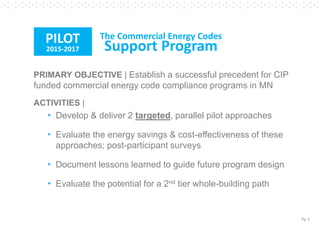
PRIMARY OBJECTIVE | Establish a successful precedent for CIP
funded commercial energy code compliance programs in MN
ACTIVITIES |
• Develop & deliver 2 targeted, parallel pilot approaches
• Evaluate the energy savings & cost-effectiveness of these
approaches; post-participant surveys
• Document lessons learned to guide future program design
• Evaluate the potential for a 2nd tier whole-building path
The Commercial Energy Codes
Support ProgramPILOT
2015-2017
Pg. 6
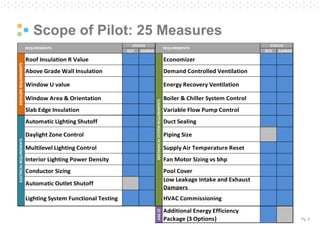
Scope of Pilot: 25 Measures
IECC ASHRAE IECC ASHRAE
Roof Insulation R Value Economizer
Above Grade Wall Insulation Demand Controlled Ventilation
Window U value Energy Recovery Ventilation
Window Area & Orientation Boiler & Chiller System Control
Slab Edge Insulation Variable Flow Pump Control
Automatic Lighting Shutoff Duct Sealing
Daylight Zone Control Piping Size
Multilevel Lighting Control Supply Air Temperature Reset
Interior Lighting Power Density Fan Motor Sizing vs bhp
Conductor Sizing Pool Cover
Automatic Outlet Shutoff
Low Leakage Intake and Exhaust
Dampers
Lighting System Functional Testing HVAC Commissioning
Add.EE
Additional Energy Efficiency
Package (3 Options)
REQUIREMENTS
STATUS
MECHANICALSYSTEMREQUIREMENTS
ENVELOPEREQUIREMENTSELECTRICALREQUIREMENTS
REQUIREMENTS
STATUS
Pg. 7
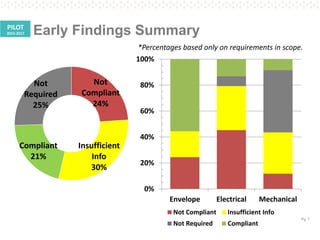
Early Findings SummaryPILOT
2015-2017
Not
Compliant
24%
Insufficient
Info
30%
Compliant
21%
Not
Required
25%
0%
20%
40%
60%
80%
100%
Envelope Electrical Mechanical
Not Compliant Insufficient Info
Not Required Compliant
*Percentages based only on requirements in scope.
Pg. 8
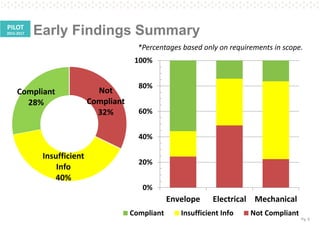
PILOT
2015-2017
0%
20%
40%
60%
80%
100%
Envelope Electrical Mechanical
Compliant Insufficient Info Not Compliant
*Percentages based only on requirements in scope.
Not
Compliant
32%
Insufficient
Info
40%
Compliant
28%
Early Findings Summary
Pg. 9
Before you get full up…
Pg. 10
If nothing else: 3 Takeaways
1. Compliance paths are important:
pick 1 & pick it early
Pg. 11
If nothing else: 3 Takeaways
1. Compliance paths are important:
pick 1 & pick it early
2. Think user-friendliness on the
documentation:
update documentation protocols in key areas
Pg. 12
If nothing else: 3 Takeaways
1. Compliance paths are important:
pick 1 & pick it early
2. Think user-friendliness on the
documentation:
update documentation protocols in key areas
3. Many tools:
Know which resources to use when
Pg. 13
Minnesota Energy Code Paths:
Basic Structure & Key Deciding Factors
Pg. 14
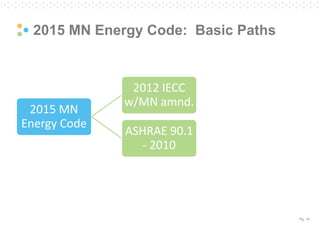
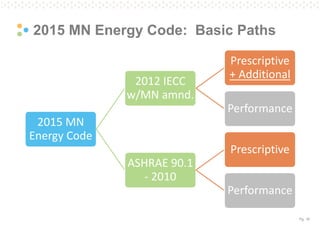
2015 MN Energy Code: Basic Paths
2015 MN
Energy Code
2012 IECC
w/MN amnd.
ASHRAE 90.1
- 2010
Pg. 15
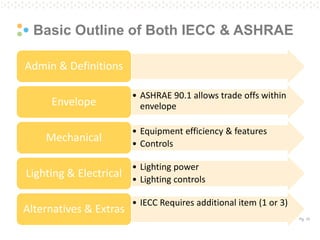
Basic Outline of Both IECC & ASHRAE
Admin & Definitions
• ASHRAE 90.1 allows trade offs within
envelopeEnvelope
• Equipment efficiency & features
• Controls
Mechanical
• Lighting power
• Lighting controls
Lighting & Electrical
• IECC Requires additional item (1 or 3)
Alternatives & Extras
Pg. 16
2015 MN Energy Code: Basic Paths
2015 MN
Energy Code
2012 IECC
w/MN amnd.
Prescriptive
+ Additional
Performance
ASHRAE 90.1
- 2010
Prescriptive
Performance
Pg. 17
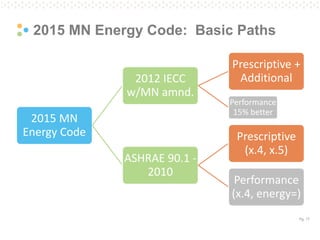
2015 MN Energy Code: Basic Paths
2015 MN
Energy Code
2012 IECC
w/MN amnd.
Prescriptive +
Additional
Performance
15% better
ASHRAE 90.1 -
2010
Prescriptive
(x.4, x.5)
Performance
(x.4, energy=)
Pg. 18
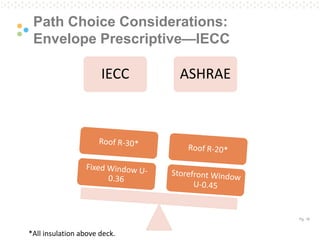
Path Choice Considerations:
Envelope Prescriptive—IECC
IECC ASHRAE
*All insulation above deck.
Pg. 19
Path Choice Considerations:
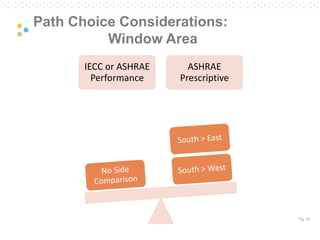
Window Area
IECC or ASHRAE
Performance
ASHRAE
Prescriptive
Pg. 20
Path Choice Considerations:
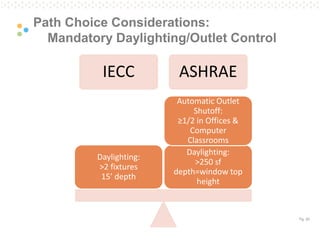
Mandatory Daylighting/Outlet Control
IECC ASHRAE
Daylighting:
>250 sf
depth=window top
height
Automatic Outlet
Shutoff:
≄1/2 in Offices &
Computer
Classrooms
Daylighting:
>2 fixtures
15’ depth
Pg. 21
Path Choice Considerations:
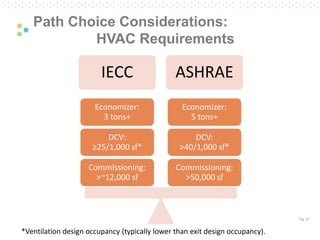
HVAC Requirements
IECC ASHRAE
Commissioning:
>50,000 sf
DCV:
>40/1,000 sf*
Economizer:
5 tons+
Commissioning:
>~12,000 sf
DCV:
≄25/1,000 sf*
Economizer:
3 tons+
*Ventilation design occupancy (typically lower than exit design occupancy).
Pg. 22
Path Choice Considerations:
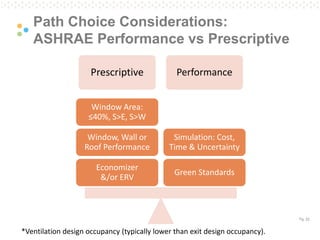
ASHRAE Performance vs Prescriptive
Prescriptive Performance
Green Standards
Simulation: Cost,
Time & Uncertainty
Economizer
&/or ERV
Window, Wall or
Roof Performance
Window Area:
≤40%, S>E, S>W
*Ventilation design occupancy (typically lower than exit design occupancy).
Pg. 23
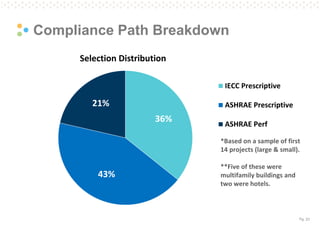
Compliance Path Breakdown
36%
43%
21%
Selection Distribution
IECC Prescriptive
ASHRAE Prescriptive
ASHRAE Perf
*Based on a sample of first
14 projects (large & small).
**Five of these were
multifamily buildings and
two were hotels.
Pg. 24
Key Code Items & Documentation
A detailed look
Pg. 25
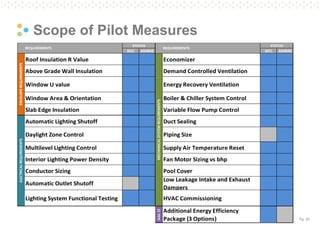
Scope of Pilot Measures
IECC ASHRAE IECC ASHRAE
Roof Insulation R Value Economizer
Above Grade Wall Insulation Demand Controlled Ventilation
Window U value Energy Recovery Ventilation
Window Area & Orientation Boiler & Chiller System Control
Slab Edge Insulation Variable Flow Pump Control
Automatic Lighting Shutoff Duct Sealing
Daylight Zone Control Piping Size
Multilevel Lighting Control Supply Air Temperature Reset
Interior Lighting Power Density Fan Motor Sizing vs bhp
Conductor Sizing Pool Cover
Automatic Outlet Shutoff
Low Leakage Intake and Exhaust
Dampers
Lighting System Functional Testing HVAC Commissioning
Add.EE
Additional Energy Efficiency
Package (3 Options)
REQUIREMENTS
STATUS
MECHANICALSYSTEMREQUIREMENTS
ENVELOPEREQUIREMENTSELECTRICALREQUIREMENTS
REQUIREMENTS
STATUS
Pg. 26
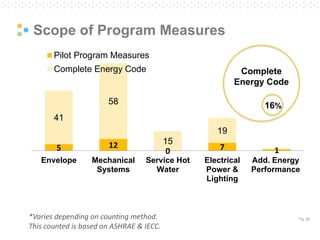
Scope of Program Measures
*Varies depending on counting method.
This counted is based on ASHRAE & IECC.
5 12
0 7 1
41
58
15
19
Envelope Mechanical
Systems
Service Hot
Water
Electrical
Power &
Lighting
Add. Energy
Performance
Pilot Program Measures
Complete Energy Code
16%
Complete
Energy Code
Pg. 27
Gatekeepers
Pg. 28
Gatekeepers
Primary liaison between client, contractors,
and documentation
Broad over-sight while not expert on all
project aspects
Pg. 29
0%
20%
40%
60%
80%
100%
Roof Insulation
R Value
Above Grade
Wall Insulation
Window U
Value
Window Area &
Orientation
Slab Edge
Insulation
Compliant Not Required Insufficient Info Not Compliant
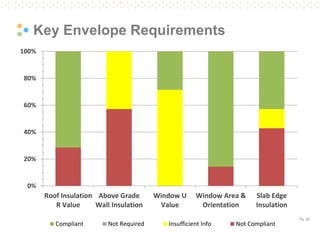
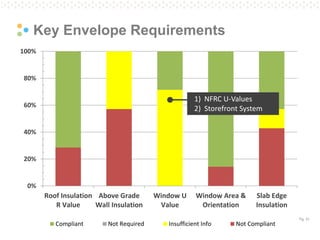
Key Envelope Requirements
Pg. 30
0%
20%
40%
60%
80%
100%
Roof Insulation
R Value
Above Grade
Wall Insulation
Window U
Value
Window Area &
Orientation
Slab Edge
Insulation
Compliant Not Required Insufficient Info Not Compliant
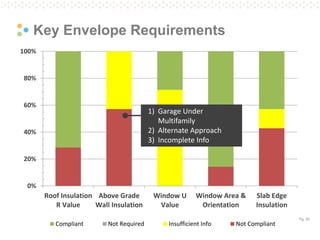
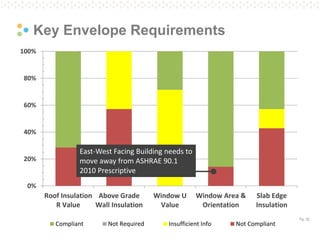
Key Envelope Requirements
1) Garage Under
Multifamily
2) Alternate Approach
3) Incomplete Info
Pg. 31
0%
20%
40%
60%
80%
100%
Roof Insulation
R Value
Above Grade
Wall Insulation
Window U
Value
Window Area &
Orientation
Slab Edge
Insulation
Compliant Not Required Insufficient Info Not Compliant
Key Envelope Requirements
1) NFRC U-Values
2) Storefront System
Pg. 32
0%
20%
40%
60%
80%
100%
Roof Insulation
R Value
Above Grade
Wall Insulation
Window U
Value
Window Area &
Orientation
Slab Edge
Insulation
Compliant Not Required Insufficient Info Not Compliant
Key Envelope Requirements
East-West Facing Building needs to
move away from ASHRAE 90.1
2010 Prescriptive
Pg. 33
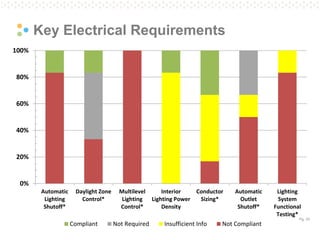
Key Electrical Requirements
0%
20%
40%
60%
80%
100%
Automatic
Lighting
Shutoff*
Daylight Zone
Control*
Multilevel
Lighting
Control*
Interior
Lighting Power
Density
Conductor
Sizing*
Automatic
Outlet
Shutoff*
Lighting
System
Functional
Testing*
Compliant Not Required Insufficient Info Not Compliant
Pg. 34
0%
20%
40%
60%
80%
100%
Automatic
Lighting
Shutoff*
Daylight Zone
Control*
Multilevel
Lighting
Control*
Interior
Lighting Power
Density
Conductor
Sizing*
Automatic
Outlet
Shutoff*
Lighting
System
Functional
Testing*
Compliant Not Required Insufficient Info Not Compliant
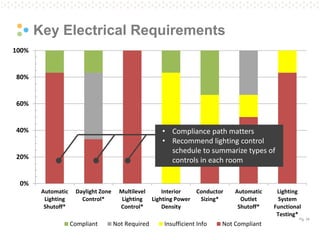
Key Electrical Requirements
• Compliance path matters
• Recommend lighting control
schedule to summarize types of
controls in each room
Pg. 35
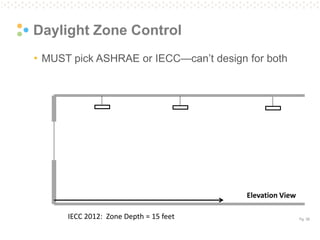
Daylight Zone Control
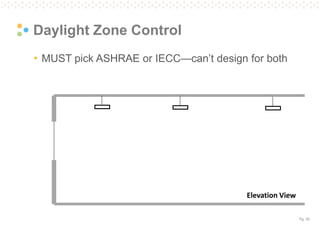
• MUST pick ASHRAE or IECC—can’t design for both
Elevation View
Pg. 36
Daylight Zone Control
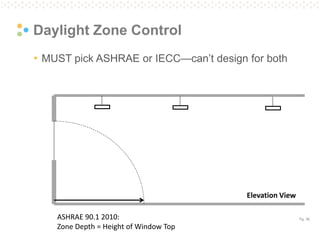
• MUST pick ASHRAE or IECC—can’t design for both
ASHRAE 90.1 2010:
Zone Depth = Height of Window Top
Elevation View
Pg. 37
Daylight Zone Control
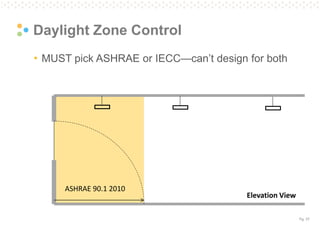
• MUST pick ASHRAE or IECC—can’t design for both
ASHRAE 90.1 2010
Elevation View
Pg. 38
Daylight Zone Control
• MUST pick ASHRAE or IECC—can’t design for both
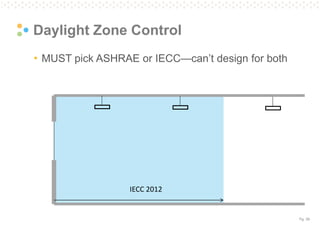
IECC 2012: Zone Depth = 15 feet
Elevation View
Pg. 39
Daylight Zone Control
• MUST pick ASHRAE or IECC—can’t design for both
IECC 2012
Pg. 40
Daylight Zone Control
• MUST pick ASHRAE or IECC—can’t design for both
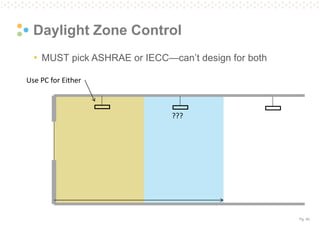
Use PC for Either
???
Pg. 41
Room Room Type
Daylighting
Controls (Y/N)
Automatic Off
Controls (OS, Timer)
Multi-Tier Control Type
(Dim, DS, other) Description
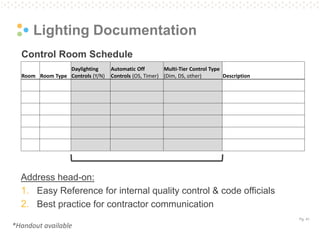
Lighting Documentation
Address head-on:
1. Easy Reference for internal quality control & code officials
2. Best practice for contractor communication
*Handout available
Control Room Schedule
Pg. 42
0%
20%
40%
60%
80%
100%
Automatic
Lighting
Shutoff*
Daylight Zone
Control*
Multilevel
Lighting
Control*
Interior
Lighting Power
Density
Conductor
Sizing*
Automatic
Outlet
Shutoff*
Lighting
System
Functional
Testing*
Compliant Not Required Insufficient Info Not Compliant
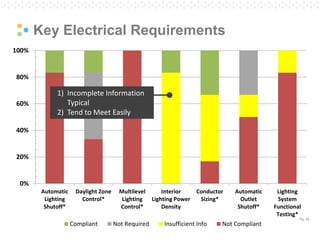
Key Electrical Requirements
1) Incomplete Information
Typical
2) Tend to Meet Easily
Pg. 43
0%
20%
40%
60%
80%
100%
Automatic
Lighting
Shutoff*
Daylight Zone
Control*
Multilevel
Lighting
Control*
Interior
Lighting Power
Density
Conductor
Sizing*
Automatic
Outlet
Shutoff*
Lighting
System
Functional
Testing*
Compliant Not Required Insufficient Info Not Compliant
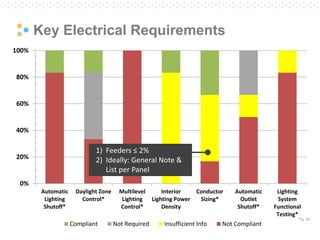
Key Electrical Requirements
1) Feeders ≤ 2%
2) Ideally: General Note &
List per Panel
Pg. 44
0%
20%
40%
60%
80%
100%
Automatic
Lighting
Shutoff*
Daylight Zone
Control*
Multilevel
Lighting
Control*
Interior
Lighting Power
Density
Conductor
Sizing*
Automatic
Outlet
Shutoff*
Lighting
System
Functional
Testing*
Compliant Not Required Insufficient Info Not Compliant
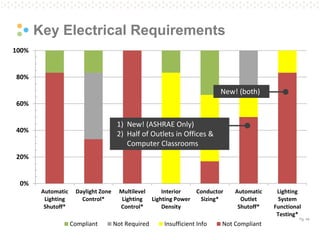
Key Electrical Requirements
1) New! (ASHRAE Only)
2) Half of Outlets in Offices &
Computer Classrooms
New! (both)
Pg. 45
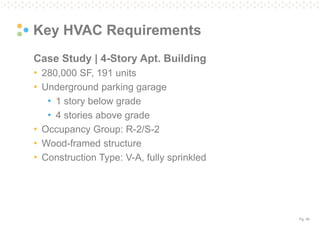
Key HVAC Requirements
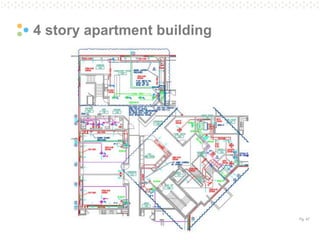
Case Study | 4-Story Apt. Building
• 280,000 SF, 191 units
• Underground parking garage
• 1 story below grade
• 4 stories above grade
• Occupancy Group: R-2/S-2
• Wood-framed structure
• Construction Type: V-A, fully sprinkled
Pg. 46
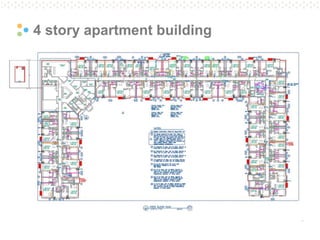
4 story apartment building
Pg. 47
4 story apartment building
Pg. 48
4 story apartment building
Pg. 49
4 story apartment building
Pg. 50
4 story apartment building
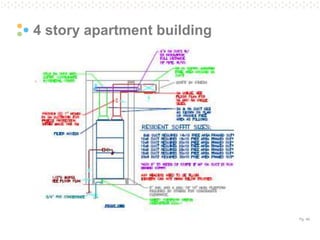
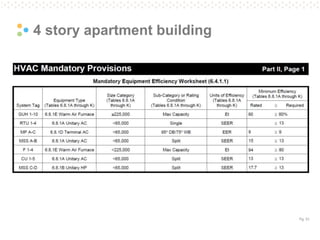
Plan Review Comments:
Since the building is designed to ANSI/ASHRAE/IES
Standard 90.1-2010, remove all sections that reference
the International Energy Conservation Code (IECC),
replace with references to ANSI/ASHRAE/IES Standard
90.1-2010, and submit the following forms:
a. HVAC Compliance Forms
b. Service Water Heating Compliance Forms
Note: COMcheck compliance forms may be submitted
as an alternate to the above forms.
Pg. 51
4 story apartment building
Pg. 52
4 story apartment building
Pg. 53
4 story apartment building
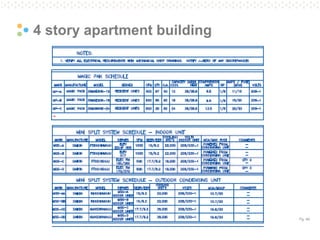
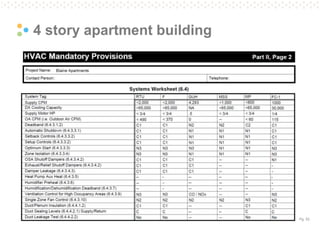
Plan Review Comments:
Section 6.4.3.3.2 of Standard 90.1-2010 requires a
programmable thermostat (or comparable energy
management system) for the HVAC system(s) capable of
seven different daily schedules, and it shall be capable of
automatically starting the daily start time in order to bring
each space to the desired occupied temperature
immediately prior to scheduled occupancy.
Pg. 54
4 story apartment building
Response:
Programmable thermostat in each unit will be Honeywell
VisionPro 8000.
Pg. 55
4 story apartment building
Plan Review Comments:
Section 6.4.3.4 of Standard 90.1-2010 requires outdoor air
intakes and exhausts (with exceptions) to be provided with
ā€œultra low-leakage motorized dampersā€ with a maximum
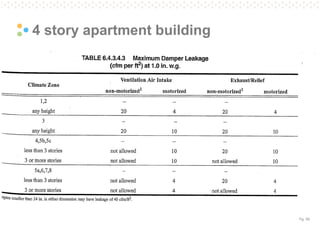
leakage rate of 4 cfm/sq. ft. per AMCA 500D. Table
6.4.3.4.3 does not allow non-motorized dampers for
buildings >3 stories). Provide motorized dampers on all 4
inch fresh air/ventilation intakes for Magic Paks and all
other fresh air/ventilation intakes in building.
*AMCA: Air Movement & Control Association
Pg. 58
4 story apartment building
Pg. 59
4 story apartment building
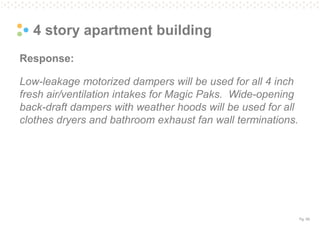
Response:
Low-leakage motorized dampers will be used for all 4 inch
fresh air/ventilation intakes for Magic Paks. Wide-opening
back-draft dampers with weather hoods will be used for all
clothes dryers and bathroom exhaust fan wall terminations.
Pg. 60
4 story apartment building
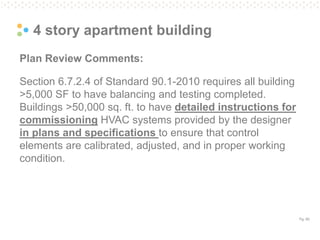
Plan Review Comments:
Section 6.7.2.4 of Standard 90.1-2010 requires all building
>5,000 SF to have balancing and testing completed.
Buildings >50,000 sq. ft. to have detailed instructions for
commissioning HVAC systems provided by the designer
in plans and specifications to ensure that control
elements are calibrated, adjusted, and in proper working
condition.
Pg. 61
4 story apartment building
Response:
Commissioning document will be provided under separate
cover letter as an addendum to the project.
Pg. 62
4 story apartment building
Plan Review Comments:
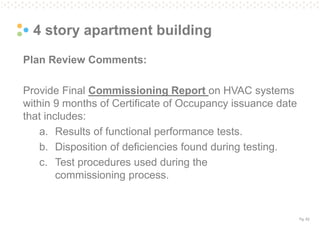
Provide Final Commissioning Report on HVAC systems
within 9 months of Certificate of Occupancy issuance date
that includes:
a. Results of functional performance tests.
b. Disposition of deficiencies found during testing.
c. Test procedures used during the
commissioning process.
Pg. 63
4 story apartment building
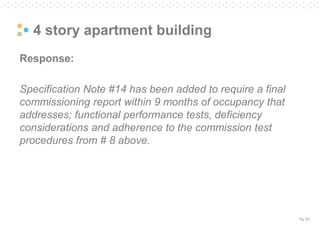
Response:
Specification Note #14 has been added to require a final
commissioning report within 9 months of occupancy that
addresses; functional performance tests, deficiency
considerations and adherence to the commission test
procedures from # 8 above.
Pg. 64
Project Team Resources:
Tools & Technical Support Options
Pg. 65
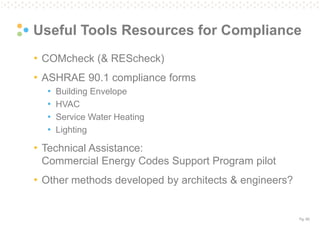
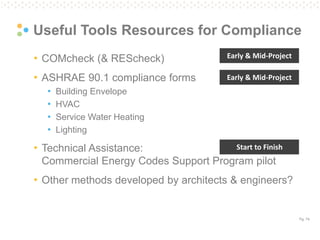
Useful Tools Resources for Compliance
• COMcheck (& REScheck)
• ASHRAE 90.1 compliance forms
• Building Envelope
• HVAC
• Service Water Heating
• Lighting
• Technical Assistance:
Commercial Energy Codes Support Program pilot
• Other methods developed by architects & engineers?
Pg. 66
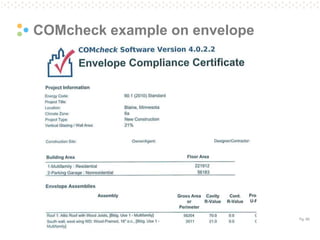
COMcheck example on envelope
Pg. 67
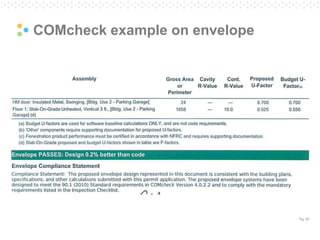
COMcheck example on envelope
Pg. 68
Pg. 69
Pg. 70
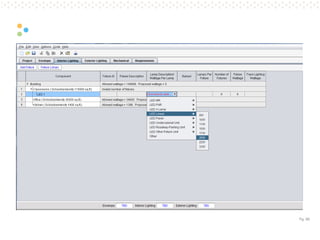
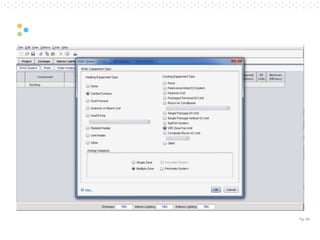
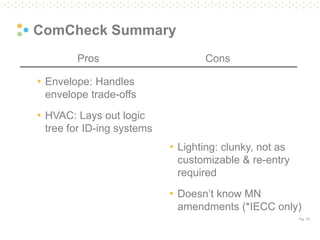
ComCheck Summary
Pros Cons
• Envelope: Handles
envelope trade-offs
• HVAC: Lays out logic
tree for ID-ing systems
• Lighting: clunky, not as
customizable & re-entry
required
• Doesn’t know MN
amendments (*IECC only)
Pg. 71
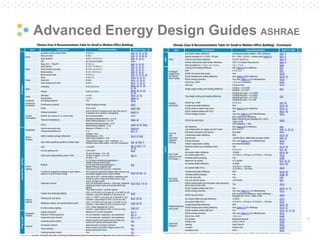
Advanced Energy Design Guides ASHRAE
Pg. 72
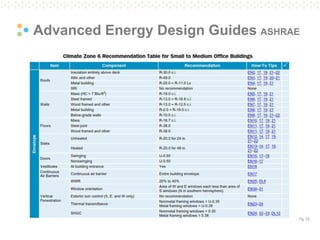
Advanced Energy Design Guides ASHRAE
Pg. 73
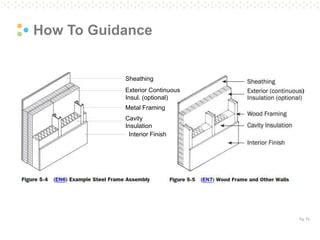
How To Guidance
Sheathing
Metal Framing
Cavity
Insulation
Interior Finish
Exterior Continuous
Insul. (optional)
Pg. 74
Useful Tools Resources for Compliance
• COMcheck (& REScheck)
• ASHRAE 90.1 compliance forms
• Building Envelope
• HVAC
• Service Water Heating
• Lighting
• Technical Assistance:
Commercial Energy Codes Support Program pilot
• Other methods developed by architects & engineers?
Early & Mid-Project
Start to Finish
Early & Mid-Project
Pg. 75
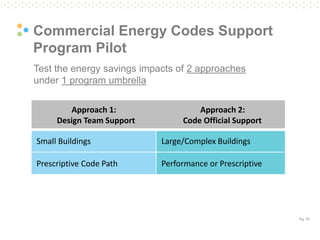
Test the energy savings impacts of 2 approaches
under 1 program umbrella
Commercial Energy Codes Support
Program Pilot
Approach 1: Approach 2:
Design Team Support Code Official Support
Small Buildings Large/Complex Buildings
Prescriptive Code Path Performance or Prescriptive
Pg. 77
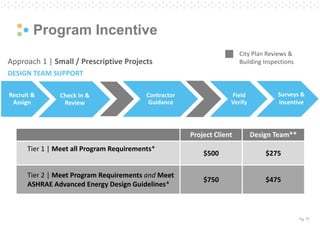
Program Incentive
Recruit &
Assign
Check In &
Review
Contractor
Guidance
Field
Verify
Approach 1 | Small / Prescriptive Projects
DESIGN TEAM SUPPORT
Surveys &
Incentive
Project Client Design Team**
Tier 1 | Meet all Program Requirements*
$500 $275
Tier 2 | Meet Program Requirements and Meet
ASHRAE Advanced Energy Design Guidelines*
$750 $475
City Plan Reviews &
Building Inspections
Pg. 78
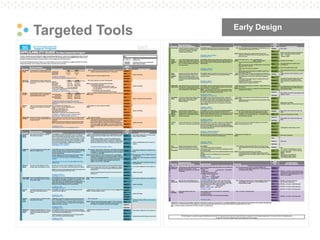
Targeted Tools Early Design
Pg. 79
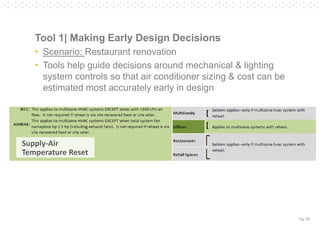
Tool 1| Making Early Design Decisions
• Scenario: Restaurant renovation
• Tools help guide decisions around mechanical & lighting
system controls so that air conditioner sizing & cost can be
estimated most accurately early in design
Supply-Air
Temperature Reset
Pg. 80
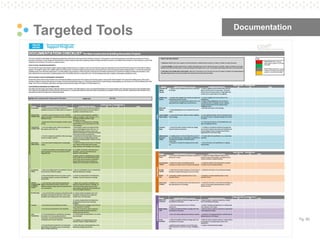
Targeted Tools Documentation
Pg. 81
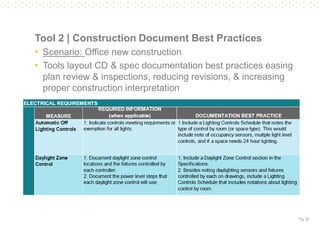
Tool 2 | Construction Document Best Practices
• Scenario: Office new construction
• Tools layout CD & spec documentation best practices easing
plan review & inspections, reducing revisions, & increasing
proper construction interpretation
Pg. 83
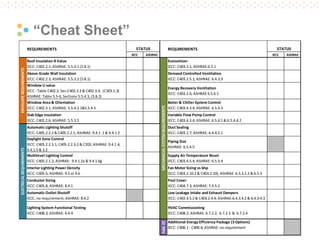
ā€œCheat Sheetā€
IECC ASHRAE IECC ASHRAE
Roof Insulation R Value
IECC: C402.2.1; ASHRAE: 5.5.3.1 (5.8.1)
Economizer
IECC: C403.3.1; ASHRAE:6.5.1
Above Grade Wall Insulation
IECC: C402.2.3; ASHRAE: 5.5.3.2 (5.8.1)
Demand Controlled Ventilation
IECC: C403.2.5.1; ASHRAE: 6.4.3.9
Window U value
IECC : Table C402.3, Sec:C402.3.3 & C402.3.4, (C303.1.3)
ASHRAE: Table 5.5-6, Sections 5.5.4.3, (5.8.2)
Energy Recovery Ventilation
IECC: C403.2.6; ASHRAE 6.5.6.1
Window Area & Orientation
IECC: C402.3.1; ASHRAE: 5.5.4.2.1&5.5.4.5
Boiler & Chiller System Control
IECC: C403.4.3.4; ASHRAE: 6.5.4.3
Slab Edge Insulation
IECC: C402.2.6; ASHRAE: 5.5.3.5
Variable Flow Pump Control
IECC: C403.4.3.4; ASHRAE: 6.5.4.1 & 6.5.4.4.2
Automatic Lighting Shutoff
IECC: C405.2.2.2 & C405.2.2.1; ASHRAE: 9.4.1 .1 & 9.4.1.2
Duct Sealing
IECC: C403.2.7; ASHRAE: 6.4.4.2.1
Daylight Zone Control
IECC: C405.2.2.3.1, C405.2.2.3.2 & C202; ASHRAE: 9.4.1.4,
9.4.1.5 & 3.2
Piping Size
ASHRAE: 6.5.4.5
Multilevel Lighting Control
IECC: C405.2.1.2; ASHRAE: 9.4.1.2a & 9.4.1.6g
Supply Air Temperature Reset
IECC: C403.4.5.4; ASHRAE: 6.5.3.4
Interior Lighting Power Density
IECC: C405.5; ASHRAE: 9.5 or 9.6
Fan Motor Sizing vs bhp
IECC: C403.2.10.2 & C403.2.10); ASHRAE: 6.5.3.1.2 & 6.5.3
Conductor Sizing
IECC: C405.8; ASHRAE: 8.4.1
Pool Cover
IECC: C404.7.3; ASHRAE: 7.4.5.2
Automatic Outlet Shutoff
IECC: no requirement; ASHRAE: 8.4.2
Low Leakage Intake and Exhaust Dampers
IECC: C402.4.5.2 & C403.2.4.4; ASHRAE:6.4.3.4.2 & 6.4.3.4.3
Lighting System Functional Testing
IECC: C408.3; ASHRAE: 9.4.4
HVAC Commissioning
IECC: C408.2; ASHRAE: 6.7.2.2, 6.7.2.3 & 6.7.2.4
Status Legend:
Add.EE
Additional Energy Efficiency Package (3 Options)
IECC: C406.1 - C406.4; ASHRAE: no requirement
REQUIREMENTS STATUS
ENVELOPEREQUIREMENTSELECTRICALREQUIREMENTS
MECHANICALSYSTEMREQUIREMENTS
REQUIREMENTS STATUS
Pg. 84
3 Takeaways!
1. Compliance paths are important:
pick 1 & pick it early
2. Think user-friendliness on the
documentation:
update documentation protocols in key areas
3. Many tools:
Know which resources to use when
Russ Landry P.E. LEED AP | CEE, Senior Mechanical
Engineer rlandry@mncee.org
Megan Hoye LEED AP | CEE, Engagement Manager
mhoye@mncee.org
Tim Manz | City of Blaine, Senior Building Inspector
tmanz@ci.blaine.mn.us

Supporting energy design performance thru code compliance

  • 1.
    SUPPORTING ENERGY DESIGN PERFORMANCETHRU CODE COMPLIANCE Commercial Energy Codes Support Program Pilot Russ Landry, PE, CEE Megan Hoye, CEE Tim Manz, City of Blaine AIA Minnesota Convention | 2016
  • 2.
    Pg. 2 This projectis supported by a grant from the MN Department of Commerce, Division of Energy Resources through the Conservation Applied Research and Development (CARD) program.
  • 3.
    Pg. 3 What WeWill Cover • Introduction • MN Commercial Energy Code Paths • Key Energy Code Items & Documentation • Project Team Support & Available Tools
  • 4.
    Pg. 4 Introduction: Pilot SupportProgram Findings & 3 Key Takeaways
  • 5.
    Pg. 5 PRIMARY OBJECTIVE| Establish a successful precedent for CIP funded commercial energy code compliance programs in MN ACTIVITIES | • Develop & deliver 2 targeted, parallel pilot approaches • Evaluate the energy savings & cost-effectiveness of these approaches; post-participant surveys • Document lessons learned to guide future program design • Evaluate the potential for a 2nd tier whole-building path The Commercial Energy Codes Support ProgramPILOT 2015-2017
  • 6.
    Pg. 6 Scope ofPilot: 25 Measures IECC ASHRAE IECC ASHRAE Roof Insulation R Value Economizer Above Grade Wall Insulation Demand Controlled Ventilation Window U value Energy Recovery Ventilation Window Area & Orientation Boiler & Chiller System Control Slab Edge Insulation Variable Flow Pump Control Automatic Lighting Shutoff Duct Sealing Daylight Zone Control Piping Size Multilevel Lighting Control Supply Air Temperature Reset Interior Lighting Power Density Fan Motor Sizing vs bhp Conductor Sizing Pool Cover Automatic Outlet Shutoff Low Leakage Intake and Exhaust Dampers Lighting System Functional Testing HVAC Commissioning Add.EE Additional Energy Efficiency Package (3 Options) REQUIREMENTS STATUS MECHANICALSYSTEMREQUIREMENTS ENVELOPEREQUIREMENTSELECTRICALREQUIREMENTS REQUIREMENTS STATUS
  • 7.
    Pg. 7 Early FindingsSummaryPILOT 2015-2017 Not Compliant 24% Insufficient Info 30% Compliant 21% Not Required 25% 0% 20% 40% 60% 80% 100% Envelope Electrical Mechanical Not Compliant Insufficient Info Not Required Compliant *Percentages based only on requirements in scope.
  • 8.
    Pg. 8 PILOT 2015-2017 0% 20% 40% 60% 80% 100% Envelope ElectricalMechanical Compliant Insufficient Info Not Compliant *Percentages based only on requirements in scope. Not Compliant 32% Insufficient Info 40% Compliant 28% Early Findings Summary
  • 9.
    Pg. 9 Before youget full up…
  • 10.
    Pg. 10 If nothingelse: 3 Takeaways 1. Compliance paths are important: pick 1 & pick it early
  • 11.
    Pg. 11 If nothingelse: 3 Takeaways 1. Compliance paths are important: pick 1 & pick it early 2. Think user-friendliness on the documentation: update documentation protocols in key areas
  • 12.
    Pg. 12 If nothingelse: 3 Takeaways 1. Compliance paths are important: pick 1 & pick it early 2. Think user-friendliness on the documentation: update documentation protocols in key areas 3. Many tools: Know which resources to use when
  • 13.
    Pg. 13 Minnesota EnergyCode Paths: Basic Structure & Key Deciding Factors
  • 14.
    Pg. 14 2015 MNEnergy Code: Basic Paths 2015 MN Energy Code 2012 IECC w/MN amnd. ASHRAE 90.1 - 2010
  • 15.
    Pg. 15 Basic Outlineof Both IECC & ASHRAE Admin & Definitions • ASHRAE 90.1 allows trade offs within envelopeEnvelope • Equipment efficiency & features • Controls Mechanical • Lighting power • Lighting controls Lighting & Electrical • IECC Requires additional item (1 or 3) Alternatives & Extras
  • 16.
    Pg. 16 2015 MNEnergy Code: Basic Paths 2015 MN Energy Code 2012 IECC w/MN amnd. Prescriptive + Additional Performance ASHRAE 90.1 - 2010 Prescriptive Performance
  • 17.
    Pg. 17 2015 MNEnergy Code: Basic Paths 2015 MN Energy Code 2012 IECC w/MN amnd. Prescriptive + Additional Performance 15% better ASHRAE 90.1 - 2010 Prescriptive (x.4, x.5) Performance (x.4, energy=)
  • 18.
    Pg. 18 Path ChoiceConsiderations: Envelope Prescriptive—IECC IECC ASHRAE *All insulation above deck.
  • 19.
    Pg. 19 Path ChoiceConsiderations: Window Area IECC or ASHRAE Performance ASHRAE Prescriptive
  • 20.
    Pg. 20 Path ChoiceConsiderations: Mandatory Daylighting/Outlet Control IECC ASHRAE Daylighting: >250 sf depth=window top height Automatic Outlet Shutoff: ≄1/2 in Offices & Computer Classrooms Daylighting: >2 fixtures 15’ depth
  • 21.
    Pg. 21 Path ChoiceConsiderations: HVAC Requirements IECC ASHRAE Commissioning: >50,000 sf DCV: >40/1,000 sf* Economizer: 5 tons+ Commissioning: >~12,000 sf DCV: ≄25/1,000 sf* Economizer: 3 tons+ *Ventilation design occupancy (typically lower than exit design occupancy).
  • 22.
    Pg. 22 Path ChoiceConsiderations: ASHRAE Performance vs Prescriptive Prescriptive Performance Green Standards Simulation: Cost, Time & Uncertainty Economizer &/or ERV Window, Wall or Roof Performance Window Area: ≤40%, S>E, S>W *Ventilation design occupancy (typically lower than exit design occupancy).
  • 23.
    Pg. 23 Compliance PathBreakdown 36% 43% 21% Selection Distribution IECC Prescriptive ASHRAE Prescriptive ASHRAE Perf *Based on a sample of first 14 projects (large & small). **Five of these were multifamily buildings and two were hotels.
  • 24.
    Pg. 24 Key CodeItems & Documentation A detailed look
  • 25.
    Pg. 25 Scope ofPilot Measures IECC ASHRAE IECC ASHRAE Roof Insulation R Value Economizer Above Grade Wall Insulation Demand Controlled Ventilation Window U value Energy Recovery Ventilation Window Area & Orientation Boiler & Chiller System Control Slab Edge Insulation Variable Flow Pump Control Automatic Lighting Shutoff Duct Sealing Daylight Zone Control Piping Size Multilevel Lighting Control Supply Air Temperature Reset Interior Lighting Power Density Fan Motor Sizing vs bhp Conductor Sizing Pool Cover Automatic Outlet Shutoff Low Leakage Intake and Exhaust Dampers Lighting System Functional Testing HVAC Commissioning Add.EE Additional Energy Efficiency Package (3 Options) REQUIREMENTS STATUS MECHANICALSYSTEMREQUIREMENTS ENVELOPEREQUIREMENTSELECTRICALREQUIREMENTS REQUIREMENTS STATUS
  • 26.
    Pg. 26 Scope ofProgram Measures *Varies depending on counting method. This counted is based on ASHRAE & IECC. 5 12 0 7 1 41 58 15 19 Envelope Mechanical Systems Service Hot Water Electrical Power & Lighting Add. Energy Performance Pilot Program Measures Complete Energy Code 16% Complete Energy Code
  • 27.
  • 28.
    Pg. 28 Gatekeepers Primary liaisonbetween client, contractors, and documentation Broad over-sight while not expert on all project aspects
  • 29.
    Pg. 29 0% 20% 40% 60% 80% 100% Roof Insulation RValue Above Grade Wall Insulation Window U Value Window Area & Orientation Slab Edge Insulation Compliant Not Required Insufficient Info Not Compliant Key Envelope Requirements
  • 30.
    Pg. 30 0% 20% 40% 60% 80% 100% Roof Insulation RValue Above Grade Wall Insulation Window U Value Window Area & Orientation Slab Edge Insulation Compliant Not Required Insufficient Info Not Compliant Key Envelope Requirements 1) Garage Under Multifamily 2) Alternate Approach 3) Incomplete Info
  • 31.
    Pg. 31 0% 20% 40% 60% 80% 100% Roof Insulation RValue Above Grade Wall Insulation Window U Value Window Area & Orientation Slab Edge Insulation Compliant Not Required Insufficient Info Not Compliant Key Envelope Requirements 1) NFRC U-Values 2) Storefront System
  • 32.
    Pg. 32 0% 20% 40% 60% 80% 100% Roof Insulation RValue Above Grade Wall Insulation Window U Value Window Area & Orientation Slab Edge Insulation Compliant Not Required Insufficient Info Not Compliant Key Envelope Requirements East-West Facing Building needs to move away from ASHRAE 90.1 2010 Prescriptive
  • 33.
    Pg. 33 Key ElectricalRequirements 0% 20% 40% 60% 80% 100% Automatic Lighting Shutoff* Daylight Zone Control* Multilevel Lighting Control* Interior Lighting Power Density Conductor Sizing* Automatic Outlet Shutoff* Lighting System Functional Testing* Compliant Not Required Insufficient Info Not Compliant
  • 34.
    Pg. 34 0% 20% 40% 60% 80% 100% Automatic Lighting Shutoff* Daylight Zone Control* Multilevel Lighting Control* Interior LightingPower Density Conductor Sizing* Automatic Outlet Shutoff* Lighting System Functional Testing* Compliant Not Required Insufficient Info Not Compliant Key Electrical Requirements • Compliance path matters • Recommend lighting control schedule to summarize types of controls in each room
  • 35.
    Pg. 35 Daylight ZoneControl • MUST pick ASHRAE or IECC—can’t design for both Elevation View
  • 36.
    Pg. 36 Daylight ZoneControl • MUST pick ASHRAE or IECC—can’t design for both ASHRAE 90.1 2010: Zone Depth = Height of Window Top Elevation View
  • 37.
    Pg. 37 Daylight ZoneControl • MUST pick ASHRAE or IECC—can’t design for both ASHRAE 90.1 2010 Elevation View
  • 38.
    Pg. 38 Daylight ZoneControl • MUST pick ASHRAE or IECC—can’t design for both IECC 2012: Zone Depth = 15 feet Elevation View
  • 39.
    Pg. 39 Daylight ZoneControl • MUST pick ASHRAE or IECC—can’t design for both IECC 2012
  • 40.
    Pg. 40 Daylight ZoneControl • MUST pick ASHRAE or IECC—can’t design for both Use PC for Either ???
  • 41.
    Pg. 41 Room RoomType Daylighting Controls (Y/N) Automatic Off Controls (OS, Timer) Multi-Tier Control Type (Dim, DS, other) Description Lighting Documentation Address head-on: 1. Easy Reference for internal quality control & code officials 2. Best practice for contractor communication *Handout available Control Room Schedule
  • 42.
    Pg. 42 0% 20% 40% 60% 80% 100% Automatic Lighting Shutoff* Daylight Zone Control* Multilevel Lighting Control* Interior LightingPower Density Conductor Sizing* Automatic Outlet Shutoff* Lighting System Functional Testing* Compliant Not Required Insufficient Info Not Compliant Key Electrical Requirements 1) Incomplete Information Typical 2) Tend to Meet Easily
  • 43.
    Pg. 43 0% 20% 40% 60% 80% 100% Automatic Lighting Shutoff* Daylight Zone Control* Multilevel Lighting Control* Interior LightingPower Density Conductor Sizing* Automatic Outlet Shutoff* Lighting System Functional Testing* Compliant Not Required Insufficient Info Not Compliant Key Electrical Requirements 1) Feeders ≤ 2% 2) Ideally: General Note & List per Panel
  • 44.
    Pg. 44 0% 20% 40% 60% 80% 100% Automatic Lighting Shutoff* Daylight Zone Control* Multilevel Lighting Control* Interior LightingPower Density Conductor Sizing* Automatic Outlet Shutoff* Lighting System Functional Testing* Compliant Not Required Insufficient Info Not Compliant Key Electrical Requirements 1) New! (ASHRAE Only) 2) Half of Outlets in Offices & Computer Classrooms New! (both)
  • 45.
    Pg. 45 Key HVACRequirements Case Study | 4-Story Apt. Building • 280,000 SF, 191 units • Underground parking garage • 1 story below grade • 4 stories above grade • Occupancy Group: R-2/S-2 • Wood-framed structure • Construction Type: V-A, fully sprinkled
  • 46.
    Pg. 46 4 storyapartment building
  • 47.
    Pg. 47 4 storyapartment building
  • 48.
    Pg. 48 4 storyapartment building
  • 49.
    Pg. 49 4 storyapartment building
  • 50.
    Pg. 50 4 storyapartment building Plan Review Comments: Since the building is designed to ANSI/ASHRAE/IES Standard 90.1-2010, remove all sections that reference the International Energy Conservation Code (IECC), replace with references to ANSI/ASHRAE/IES Standard 90.1-2010, and submit the following forms: a. HVAC Compliance Forms b. Service Water Heating Compliance Forms Note: COMcheck compliance forms may be submitted as an alternate to the above forms.
  • 51.
    Pg. 51 4 storyapartment building
  • 52.
    Pg. 52 4 storyapartment building
  • 53.
    Pg. 53 4 storyapartment building Plan Review Comments: Section 6.4.3.3.2 of Standard 90.1-2010 requires a programmable thermostat (or comparable energy management system) for the HVAC system(s) capable of seven different daily schedules, and it shall be capable of automatically starting the daily start time in order to bring each space to the desired occupied temperature immediately prior to scheduled occupancy.
  • 54.
    Pg. 54 4 storyapartment building Response: Programmable thermostat in each unit will be Honeywell VisionPro 8000.
  • 55.
    Pg. 55 4 storyapartment building Plan Review Comments: Section 6.4.3.4 of Standard 90.1-2010 requires outdoor air intakes and exhausts (with exceptions) to be provided with ā€œultra low-leakage motorized dampersā€ with a maximum leakage rate of 4 cfm/sq. ft. per AMCA 500D. Table 6.4.3.4.3 does not allow non-motorized dampers for buildings >3 stories). Provide motorized dampers on all 4 inch fresh air/ventilation intakes for Magic Paks and all other fresh air/ventilation intakes in building. *AMCA: Air Movement & Control Association
  • 56.
    Pg. 58 4 storyapartment building
  • 57.
    Pg. 59 4 storyapartment building Response: Low-leakage motorized dampers will be used for all 4 inch fresh air/ventilation intakes for Magic Paks. Wide-opening back-draft dampers with weather hoods will be used for all clothes dryers and bathroom exhaust fan wall terminations.
  • 58.
    Pg. 60 4 storyapartment building Plan Review Comments: Section 6.7.2.4 of Standard 90.1-2010 requires all building >5,000 SF to have balancing and testing completed. Buildings >50,000 sq. ft. to have detailed instructions for commissioning HVAC systems provided by the designer in plans and specifications to ensure that control elements are calibrated, adjusted, and in proper working condition.
  • 59.
    Pg. 61 4 storyapartment building Response: Commissioning document will be provided under separate cover letter as an addendum to the project.
  • 60.
    Pg. 62 4 storyapartment building Plan Review Comments: Provide Final Commissioning Report on HVAC systems within 9 months of Certificate of Occupancy issuance date that includes: a. Results of functional performance tests. b. Disposition of deficiencies found during testing. c. Test procedures used during the commissioning process.
  • 61.
    Pg. 63 4 storyapartment building Response: Specification Note #14 has been added to require a final commissioning report within 9 months of occupancy that addresses; functional performance tests, deficiency considerations and adherence to the commission test procedures from # 8 above.
  • 62.
    Pg. 64 Project TeamResources: Tools & Technical Support Options
  • 63.
    Pg. 65 Useful ToolsResources for Compliance • COMcheck (& REScheck) • ASHRAE 90.1 compliance forms • Building Envelope • HVAC • Service Water Heating • Lighting • Technical Assistance: Commercial Energy Codes Support Program pilot • Other methods developed by architects & engineers?
  • 64.
  • 65.
  • 66.
  • 67.
  • 68.
    Pg. 70 ComCheck Summary ProsCons • Envelope: Handles envelope trade-offs • HVAC: Lays out logic tree for ID-ing systems • Lighting: clunky, not as customizable & re-entry required • Doesn’t know MN amendments (*IECC only)
  • 69.
    Pg. 71 Advanced EnergyDesign Guides ASHRAE
  • 70.
    Pg. 72 Advanced EnergyDesign Guides ASHRAE
  • 71.
    Pg. 73 How ToGuidance Sheathing Metal Framing Cavity Insulation Interior Finish Exterior Continuous Insul. (optional)
  • 72.
    Pg. 74 Useful ToolsResources for Compliance • COMcheck (& REScheck) • ASHRAE 90.1 compliance forms • Building Envelope • HVAC • Service Water Heating • Lighting • Technical Assistance: Commercial Energy Codes Support Program pilot • Other methods developed by architects & engineers? Early & Mid-Project Start to Finish Early & Mid-Project
  • 73.
    Pg. 75 Test theenergy savings impacts of 2 approaches under 1 program umbrella Commercial Energy Codes Support Program Pilot Approach 1: Approach 2: Design Team Support Code Official Support Small Buildings Large/Complex Buildings Prescriptive Code Path Performance or Prescriptive
  • 74.
    Pg. 77 Program Incentive Recruit& Assign Check In & Review Contractor Guidance Field Verify Approach 1 | Small / Prescriptive Projects DESIGN TEAM SUPPORT Surveys & Incentive Project Client Design Team** Tier 1 | Meet all Program Requirements* $500 $275 Tier 2 | Meet Program Requirements and Meet ASHRAE Advanced Energy Design Guidelines* $750 $475 City Plan Reviews & Building Inspections
  • 75.
  • 76.
    Pg. 79 Tool 1|Making Early Design Decisions • Scenario: Restaurant renovation • Tools help guide decisions around mechanical & lighting system controls so that air conditioner sizing & cost can be estimated most accurately early in design Supply-Air Temperature Reset
  • 77.
    Pg. 80 Targeted ToolsDocumentation
  • 78.
    Pg. 81 Tool 2| Construction Document Best Practices • Scenario: Office new construction • Tools layout CD & spec documentation best practices easing plan review & inspections, reducing revisions, & increasing proper construction interpretation
  • 79.
    Pg. 83 ā€œCheat Sheetā€ IECCASHRAE IECC ASHRAE Roof Insulation R Value IECC: C402.2.1; ASHRAE: 5.5.3.1 (5.8.1) Economizer IECC: C403.3.1; ASHRAE:6.5.1 Above Grade Wall Insulation IECC: C402.2.3; ASHRAE: 5.5.3.2 (5.8.1) Demand Controlled Ventilation IECC: C403.2.5.1; ASHRAE: 6.4.3.9 Window U value IECC : Table C402.3, Sec:C402.3.3 & C402.3.4, (C303.1.3) ASHRAE: Table 5.5-6, Sections 5.5.4.3, (5.8.2) Energy Recovery Ventilation IECC: C403.2.6; ASHRAE 6.5.6.1 Window Area & Orientation IECC: C402.3.1; ASHRAE: 5.5.4.2.1&5.5.4.5 Boiler & Chiller System Control IECC: C403.4.3.4; ASHRAE: 6.5.4.3 Slab Edge Insulation IECC: C402.2.6; ASHRAE: 5.5.3.5 Variable Flow Pump Control IECC: C403.4.3.4; ASHRAE: 6.5.4.1 & 6.5.4.4.2 Automatic Lighting Shutoff IECC: C405.2.2.2 & C405.2.2.1; ASHRAE: 9.4.1 .1 & 9.4.1.2 Duct Sealing IECC: C403.2.7; ASHRAE: 6.4.4.2.1 Daylight Zone Control IECC: C405.2.2.3.1, C405.2.2.3.2 & C202; ASHRAE: 9.4.1.4, 9.4.1.5 & 3.2 Piping Size ASHRAE: 6.5.4.5 Multilevel Lighting Control IECC: C405.2.1.2; ASHRAE: 9.4.1.2a & 9.4.1.6g Supply Air Temperature Reset IECC: C403.4.5.4; ASHRAE: 6.5.3.4 Interior Lighting Power Density IECC: C405.5; ASHRAE: 9.5 or 9.6 Fan Motor Sizing vs bhp IECC: C403.2.10.2 & C403.2.10); ASHRAE: 6.5.3.1.2 & 6.5.3 Conductor Sizing IECC: C405.8; ASHRAE: 8.4.1 Pool Cover IECC: C404.7.3; ASHRAE: 7.4.5.2 Automatic Outlet Shutoff IECC: no requirement; ASHRAE: 8.4.2 Low Leakage Intake and Exhaust Dampers IECC: C402.4.5.2 & C403.2.4.4; ASHRAE:6.4.3.4.2 & 6.4.3.4.3 Lighting System Functional Testing IECC: C408.3; ASHRAE: 9.4.4 HVAC Commissioning IECC: C408.2; ASHRAE: 6.7.2.2, 6.7.2.3 & 6.7.2.4 Status Legend: Add.EE Additional Energy Efficiency Package (3 Options) IECC: C406.1 - C406.4; ASHRAE: no requirement REQUIREMENTS STATUS ENVELOPEREQUIREMENTSELECTRICALREQUIREMENTS MECHANICALSYSTEMREQUIREMENTS REQUIREMENTS STATUS
  • 80.
    Pg. 84 3 Takeaways! 1.Compliance paths are important: pick 1 & pick it early 2. Think user-friendliness on the documentation: update documentation protocols in key areas 3. Many tools: Know which resources to use when
  • 81.
    Russ Landry P.E.LEED AP | CEE, Senior Mechanical Engineer rlandry@mncee.org Megan Hoye LEED AP | CEE, Engagement Manager mhoye@mncee.org Tim Manz | City of Blaine, Senior Building Inspector tmanz@ci.blaine.mn.us

Editor's Notes

  • #2Ā Bridget = Beginning to Lending Center & Policy section Judy = Lending Center through the IX
  • #3Ā In MN energy savings are based on code as a baseline (to date) Competitive grant process… we were awarded because there was a state compliance analysis that showed 90% compliance, but didn’t look at energy the energy impact of the 10% of requirements that were non-compliant.
  • #6Ā Mention timeline here too (3 year project)
  • #7Ā -touch on each code section -focus on new, most challenging, and most impactful requirements -determined based on interviews with code officials outside of MN & professional interviews inside MN -determined also by potential energy impact (initial analysis)
  • #8Ā -Electrical most noncompliant -electrical and mechanical often are lacking information -many projects to date have not been design build
  • #9Ā -Electrical most noncompliant -electrical and mechanical often are lacking information -many projects to date have not been design build
  • #26Ā -touch on each code section -focus on new, most challenging, and most impactful requirements -determined based on interviews with code officials outside of MN & professional interviews inside MN -determined also by potential energy impact (initial analysis)
  • #27Ā *Step through 1-2 examples?? Economizers are STILL a problem, need them at smaller sizes.; Daylight zone controls; conductor sizer While it looks complex behind the scenes… *Note so many requirements under Mechanical: this section in particular has to account for a greater variety of system type/design, sizing, & exceptions/application (dependent variables) where in the other sections, many requirements are apply more frequently in projects (particularly within a NC and renovation buckets) -Approach 1 participants will have 2 tools -- NC & Reno. -Approach 2 will use feedback forms for city code officials, which will be customized to the project feedback that needs to be shared. *Numbers are from Approach 1 *Cummulatively, the 14% of the code that we are looking at could affect the energy design of our 4 building types between 2.5% and 22%. This depends on many factors, list of which is building use type and mechanical system design.
  • #30Ā Some requirements are pushing teams to lean towards performance based paths Ask Russ about his comment here on other things we have learned (ultra low leakage dampers and duct leakage – I feel like we have really only learned stuff about the former thus far) *Economizer: 3 ton and above for IECC, don’t need it until 5 tons for ASHRAE
  • #31Ā Some requirements are pushing teams to lean towards performance based paths Ask Russ about his comment here on other things we have learned (ultra low leakage dampers and duct leakage – I feel like we have really only learned stuff about the former thus far) *Economizer: 3 ton and above for IECC, don’t need it until 5 tons for ASHRAE
  • #32Ā Some requirements are pushing teams to lean towards performance based paths Ask Russ about his comment here on other things we have learned (ultra low leakage dampers and duct leakage – I feel like we have really only learned stuff about the former thus far) *Economizer: 3 ton and above for IECC, don’t need it until 5 tons for ASHRAE
  • #33Ā Some requirements are pushing teams to lean towards performance based paths Ask Russ about his comment here on other things we have learned (ultra low leakage dampers and duct leakage – I feel like we have really only learned stuff about the former thus far) *Economizer: 3 ton and above for IECC, don’t need it until 5 tons for ASHRAE
  • #34Ā Some requirements are pushing teams to lean towards performance based paths Ask Russ about his comment here on other things we have learned (ultra low leakage dampers and duct leakage – I feel like we have really only learned stuff about the former thus far) *Economizer: 3 ton and above for IECC, don’t need it until 5 tons for ASHRAE
  • #35Ā Some requirements are pushing teams to lean towards performance based paths Ask Russ about his comment here on other things we have learned (ultra low leakage dampers and duct leakage – I feel like we have really only learned stuff about the former thus far) *Economizer: 3 ton and above for IECC, don’t need it until 5 tons for ASHRAE
  • #43Ā Some requirements are pushing teams to lean towards performance based paths Ask Russ about his comment here on other things we have learned (ultra low leakage dampers and duct leakage – I feel like we have really only learned stuff about the former thus far) *Economizer: 3 ton and above for IECC, don’t need it until 5 tons for ASHRAE
  • #44Ā Some requirements are pushing teams to lean towards performance based paths Ask Russ about his comment here on other things we have learned (ultra low leakage dampers and duct leakage – I feel like we have really only learned stuff about the former thus far) *Economizer: 3 ton and above for IECC, don’t need it until 5 tons for ASHRAE
  • #45Ā Some requirements are pushing teams to lean towards performance based paths Ask Russ about his comment here on other things we have learned (ultra low leakage dampers and duct leakage – I feel like we have really only learned stuff about the former thus far) *Economizer: 3 ton and above for IECC, don’t need it until 5 tons for ASHRAE
  • #76Ā *add label column on the left -Targeted approaches: participants, building type & size, need for controls -partner cities -targeting smaller buildings
  • #77Ā -This was code officials in 6 states and 11 cities within those states. -Submission documentation was primary area that was flagged as needing improvement/support *Note, the code officials noted envelope as as large of a problem or larger than mechanical and lighting. This has not been our experience to date, so this may speak to the fact that they are more comfortable or proficient in the building code and envelop space, and less so in mechanical and lighting/electrical – may not have a complete pervue to make this assessment.
  • #78Ā -mention Tier 2 (50% ASHRAE Design Guides) -approach 1: only projects in 7-county metro
  • #79Ā (Describe how the tools provides broad guidelines for early design decisions) Walk through a made up/real scenario of how this part of the tool is helpful *This tool is quite unique for Minnesota (Climate zone, equipment types here, types of buildings being built here/volume trends) Climate specific: envelope, economizer, OA temperature *We have one for New Construction and one for Renovations *Could be created as even more targeted tools, focusing on just one or two building use types, etc.
  • #80Ā (Describe how the tools provides broad guidelines for early design decisions) Walk through a made up/real scenario of how this part of the tool is helpful
  • #86Ā -summer of 2016 meeting (prep for triennial -winter 2017 (after interim report)