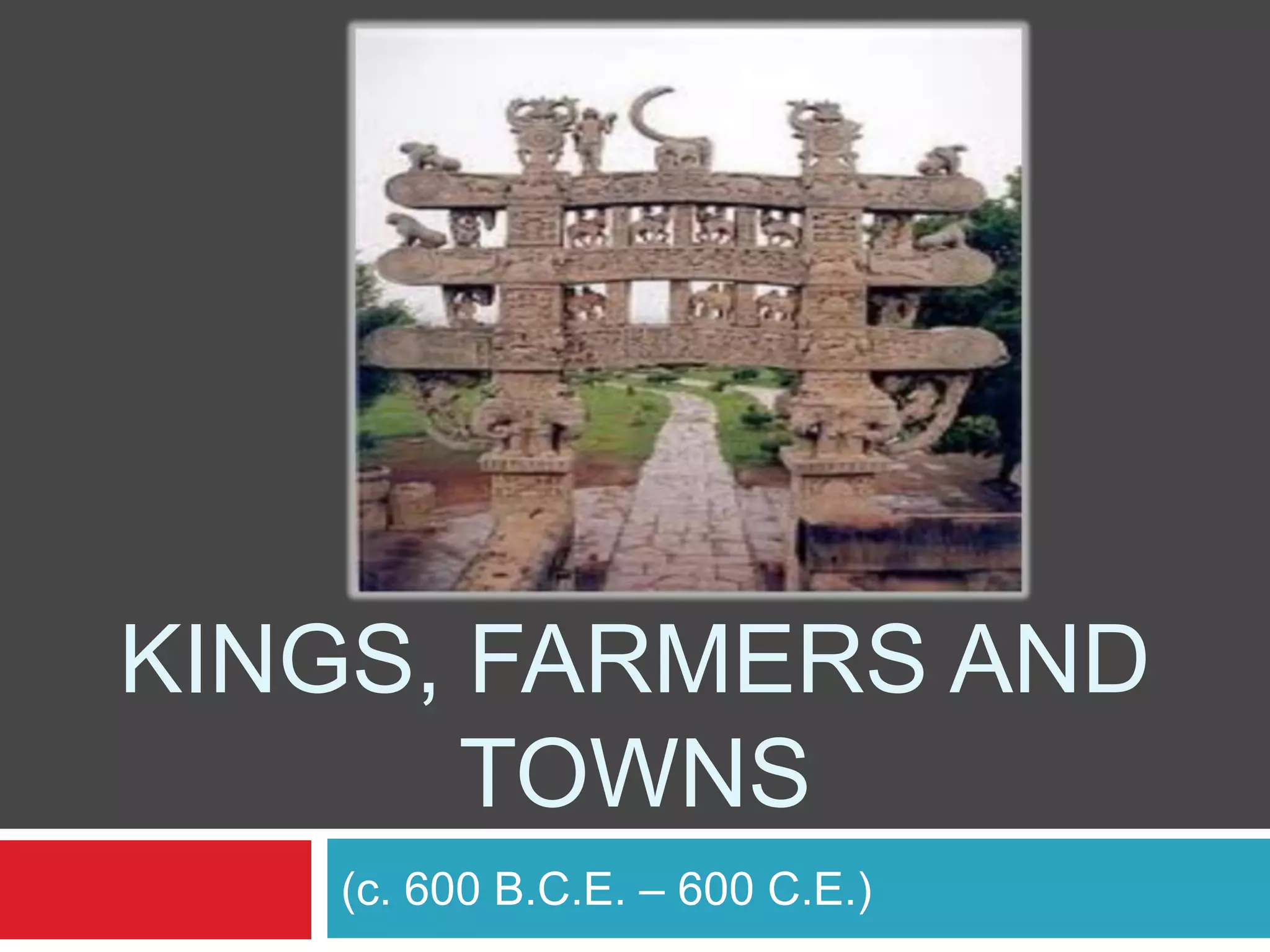
KINGS, FARMERS AND
       TOWNS
   (c. 600 B.C.E. – 600 C.E.)
INTRODUCTION
   Several developments too place in different
    parts of the subcontinent during the long
    span of 1,500 years following the end of the
    Harappan civilization.
   Also mentioned in Rigveda was composed
    by people living along the Indus and its
    tributaries.
    Agricultural settlements emerged in north
    India, the Deccan Plateau, and parts of
    Karnataka.
   Evidence of pastoral settlements has been
    found in the Deccan and further south.
   New modes of disposal of the dead,
    including the making of elaborate stone
    structures known as megaliths, emerged in
    central and south India from the first
    millennium BCE.
    In many cases, the dead were buried with a
PRINCEP AND PIYADASSI
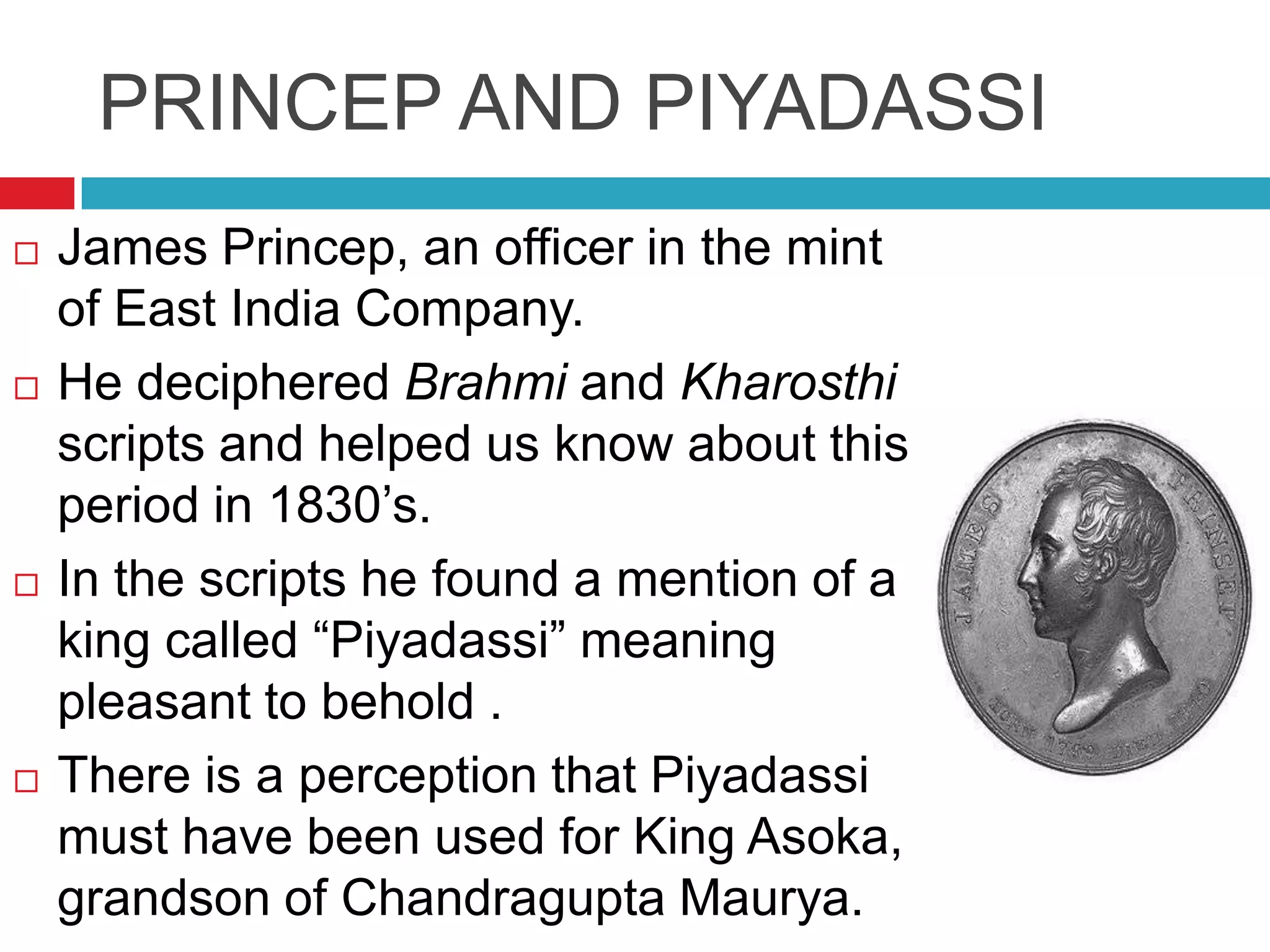
   James Princep, an officer in the mint
    of East India Company.
   He deciphered Brahmi and Kharosthi
    scripts and helped us know about this
    period in 1830’s.
   In the scripts he found a mention of a
    king called “Piyadassi” meaning
    pleasant to behold .
   There is a perception that Piyadassi
    must have been used for King Asoka,
    grandson of Chandragupta Maurya.
THE EARLIEST STATES
•The Sixteen Mahajanpadas
•First Among Sixteen: Magadha
The Sixteen Mahajanpadas
   Mentioned in Buddhists and Jainist
    texts.
   included- Vajji, Magadha, Koshala,
    Kuru, Panchala, Gandhara and
    Avanti.
   Some mahajanpadas ware ruled by
    a group of kings deciding about
    utilization of resources in the
    kingdom- called sanghas/ganas.
   Each mahajanpada had its own
    capital.
First amongst the sixteen :
Magadha
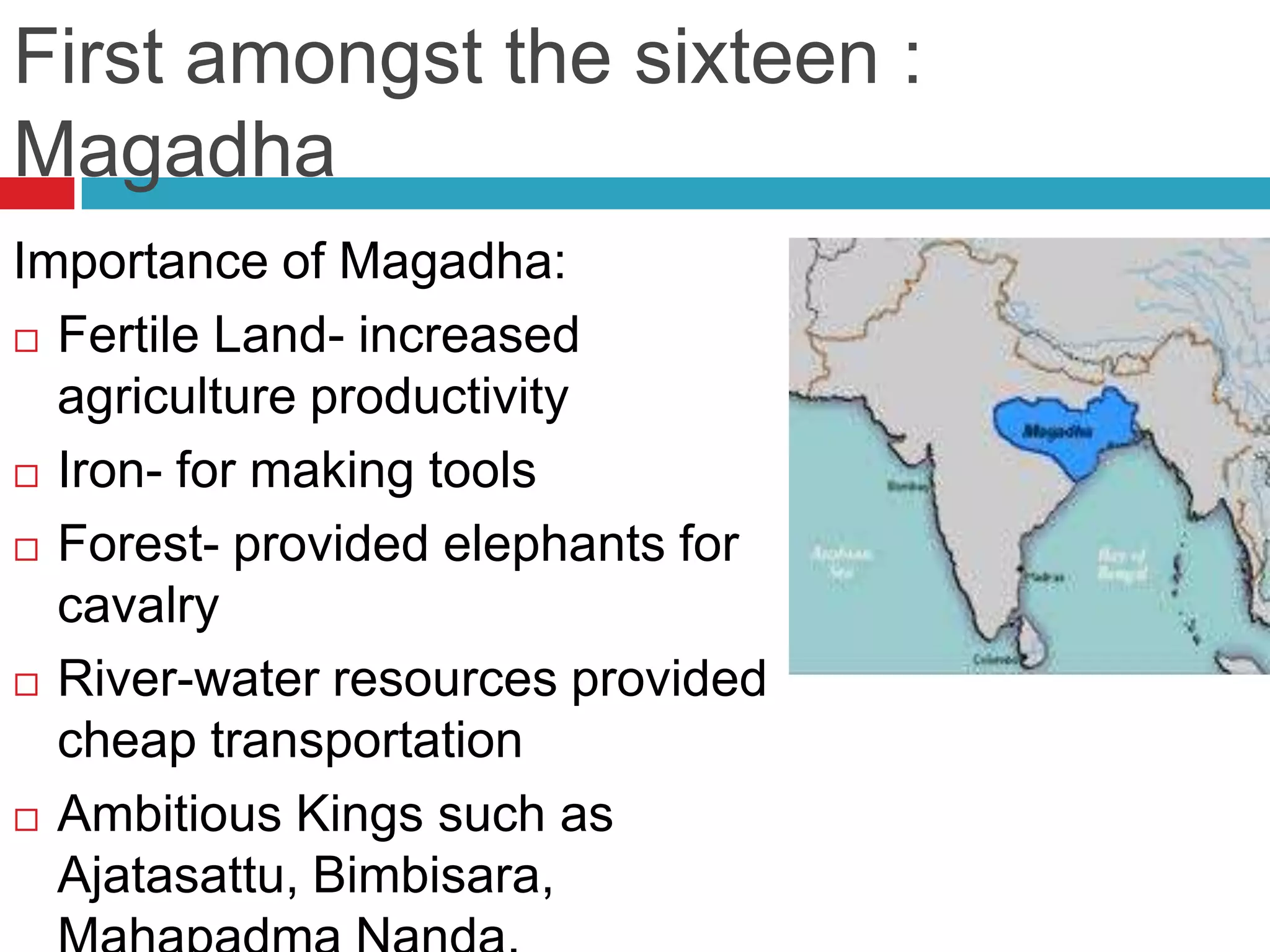
Importance of Magadha:
 Fertile Land- increased

  agriculture productivity
 Iron- for making tools

 Forest- provided elephants for

  cavalry
 River-water resources provided

  cheap transportation
 Ambitious Kings such as

  Ajatasattu, Bimbisara,
AN EARLY EMPIRE
• Finding about the Mauryas
• Administrating the empire

• How important was the empire?
Finding about the Mauryas
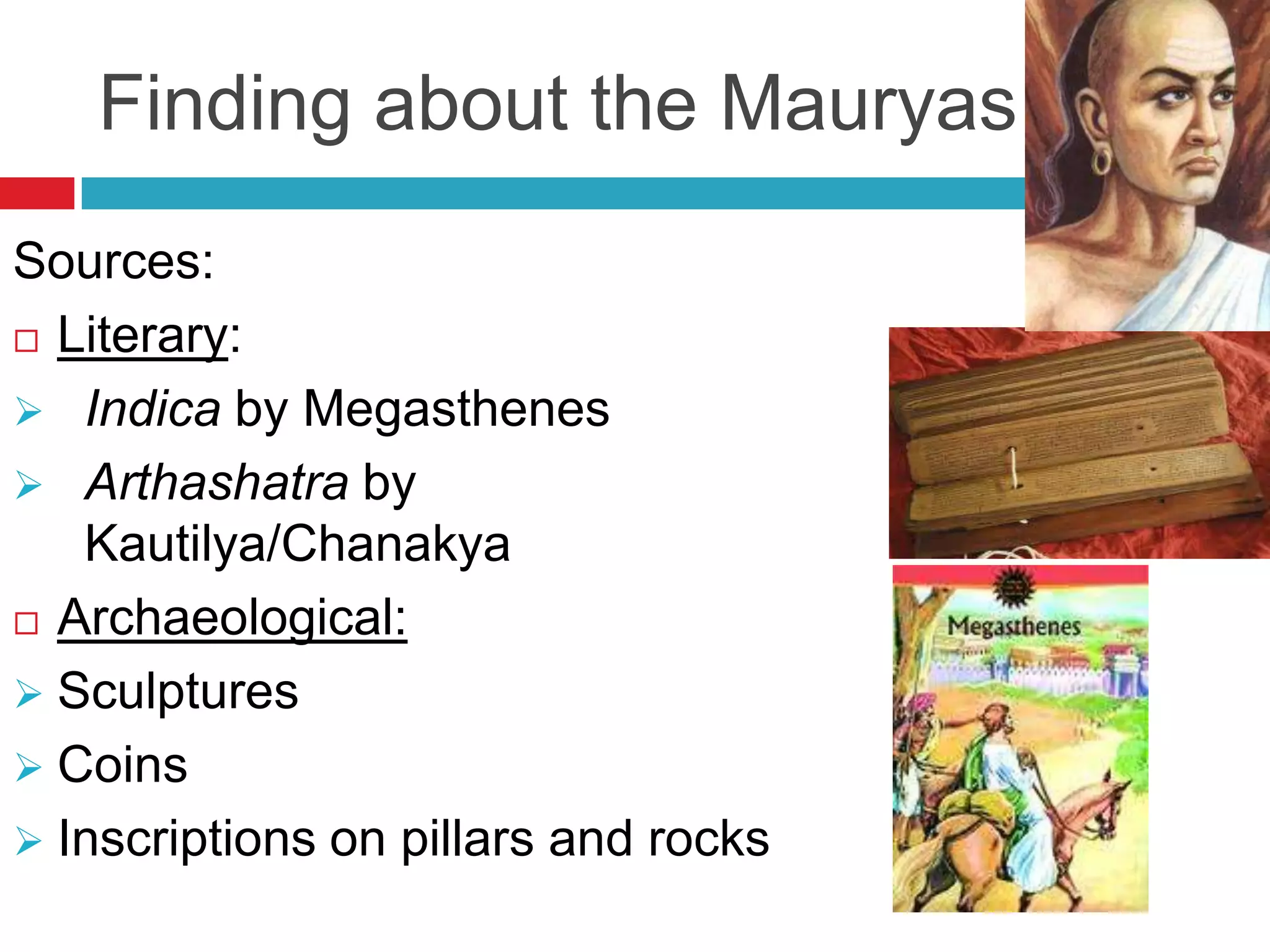
Sources:
 Literary:

 Indica by Megasthenes
 Arthashatra by
   Kautilya/Chanakya
 Archaeological:

 Sculptures
 Coins
 Inscriptions on pillars and rocks
Administrating the empire
   Five major political centres-
    Taxila, Tosali, Ujjayni,
    Suvaranagiri, Pataliputra
    (TTUSP)
   Megesthenes mentioned of a
    committee with six sub-
    committees for co-ordinating
    resources for military
    activities.
   Asoka spead the message of
    dhamma to hold the empire
How important was the
empire?
   Two points- one in favor ; one against
   It is the first empire to be found in Indian
    history, so has a great importance.
   But it hardly lasted for 150 years.
   A debate still going among historians
    regarding the same.
NEW NOTIONS OF
KINGSHIP
•Chiefs and kings in South
•Divine Kings
Chiefs and kings in South

   Chiefdoms of the Cholas
    Cheras and Pandyas
    emerged.
   Chiefs- received goods from
    the villagers
   Kings- collected taxes.
Divine Kings
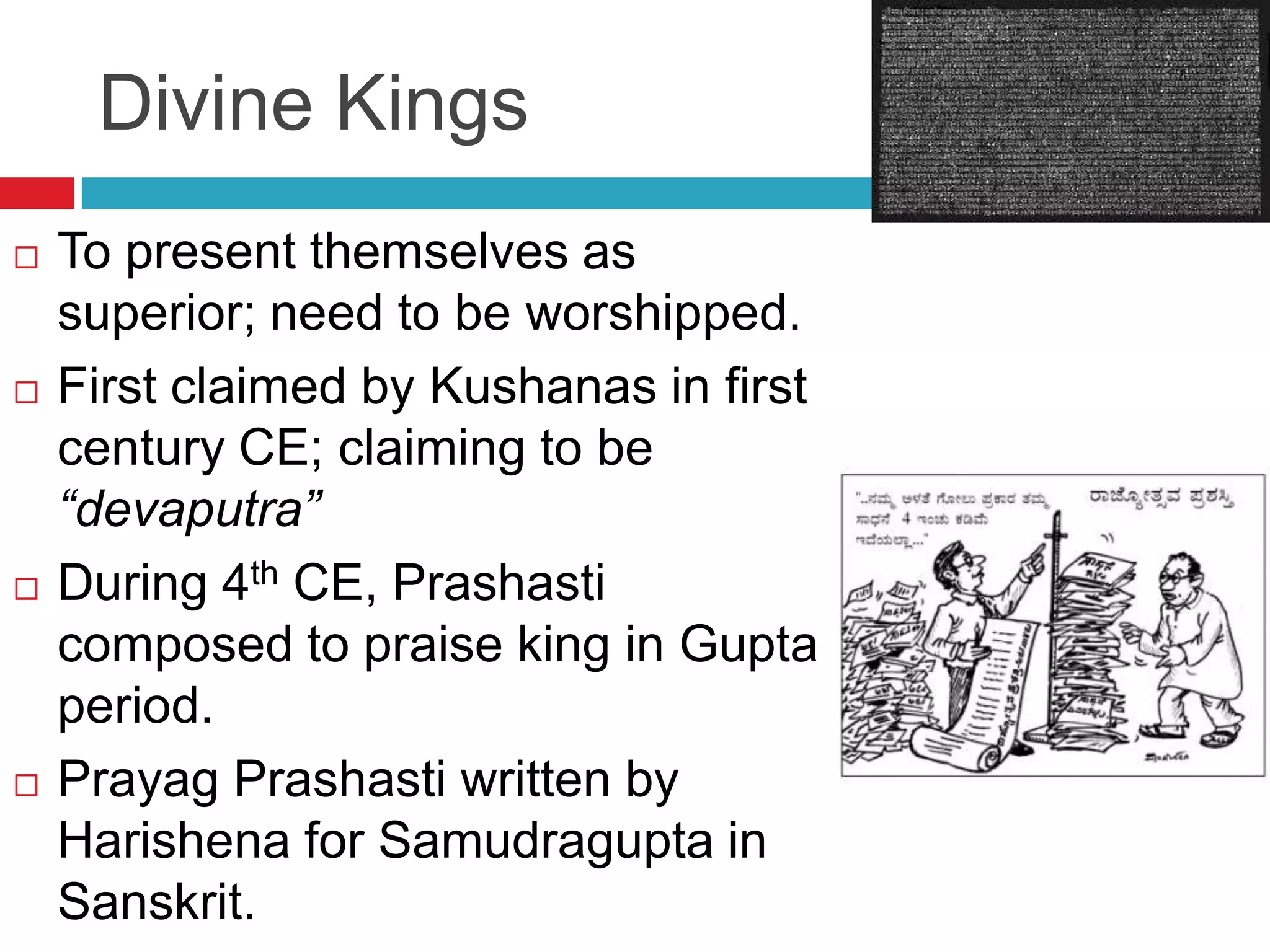
   To present themselves as
    superior; need to be worshipped.
   First claimed by Kushanas in first
    century CE; claiming to be
    “devaputra”
   During 4th CE, Prashasti
    composed to praise king in Gupta
    period.
   Prayag Prashasti written by
    Harishena for Samudragupta in
    Sanskrit.
CHANGING COUNTRYSIDE
•Popular perceptions of kings
•Strategies for increasing production

•Difference in rural society

•Land grants and new rural elites
Popular Perceptions of Kings
   No accounts by people
    about their kings
   From oral folk tales such as
    “Panchatantra” and
    “Gandatindu Jataka” were
    lately written in Pali in first
    millennium CE.
   One story depicts about a
    wicked king collecting taxes;
    leading people to hide & live
    in forest.
Strategies for increasing
      production
   Another way to meet the
    growing demand of taxes was
    to increase crop production
   Iron-plough share was used to
    turn alluvial soil in areas with
    high rainfall.
   Semi arid Region i.e Punjab,
    Rajasthan- did not adopt this
    technique till 20th C.
   Hilly terrain practiced hoe
    agriculture.
   Irrigation through wells and
    tanks; canals were less
Differences in rural society
   Gahapati- term used in Pali texts meaning
    head or master of the household.
   In Tamil literature: Sangam texts- differences
    on the basis of resource accessibility.
              Vellalar – Land ownwers
                Uzahwar – Ploughman
                  Adimai – Slaves
Land grants and new rural elites
   Land grant sources : Copper plates
    have been excavated, maybe a symbol
    certifying the details of the land.
   Prabhavati Gupta- daughter of
    Chandragupta II (Chandragupta Vikram
    Aditya)- married in Vakatakas.
   Legal texts suggest that women don’t
    have independent access to resources
    such as land, but evidences have been
    found that she has granted land.
   Other reasons for Land grants:
•   Strategy to increase agriculture area
•   Win allies- used to strengthen political
    power.
•   To project themselves as supermen;
    they are superior, have some authority.
TOWNS AND TRADE
• New cities
• Urban populations: Elites and craftsperson

•Trade in the subcontinent and beyond

•Coins and Kings
New cities


   Pataliputra- riverine route town
   Ujjayini- land route town
   Puhar- sea route town (near coast)
   Mathura- commercial, cultural and political
    activities centre
Urban Population: Elites and
    craftsperson
   Elites lived in fortified cities.
   Artefacts excavated
    include:Fine pottery bowls,
    dishes,
    Ornaments,Tools,Weapons,Ve
    ssels,Figurines,
   Emerging occupations
    included: Weavers,
    black/goldsmiths, merchants,
    traders, potters, carpenters.
   Role of guilds has also been
Trade in the subcontinent and
beyond.
   India had contact with
    countries on the eastern side
    along with Bay of Bengal as
    well as on the western side
    with North Africa, West Asia
    and some parts of Europe as
    well.
   Successful merchants were
    called masattuvan in Tamil
    and setthis and satthavahas
    in Prakrit.
   Wide range of goods was
Coins and Kings
   Exchange of goods took place
    through coinage.
   Punched mark coins of copper
    and silver.
   Coins had inscriptions, pictorial
    representations, etc. which was
    issued by kings.
   First gold coin were issued in first
    century CE by Kushanas ;
    vertically identical in weight to
    those issued by contemporary
    Roman emperors.
   Historians suggest of link with
    Roman Empire as well.
BACK TO BASICS:
How Are Inscriptions Deciphered?
•Deciphering Brahmi
•How Kharosthi was read?

•Historical evidence from inscriptions
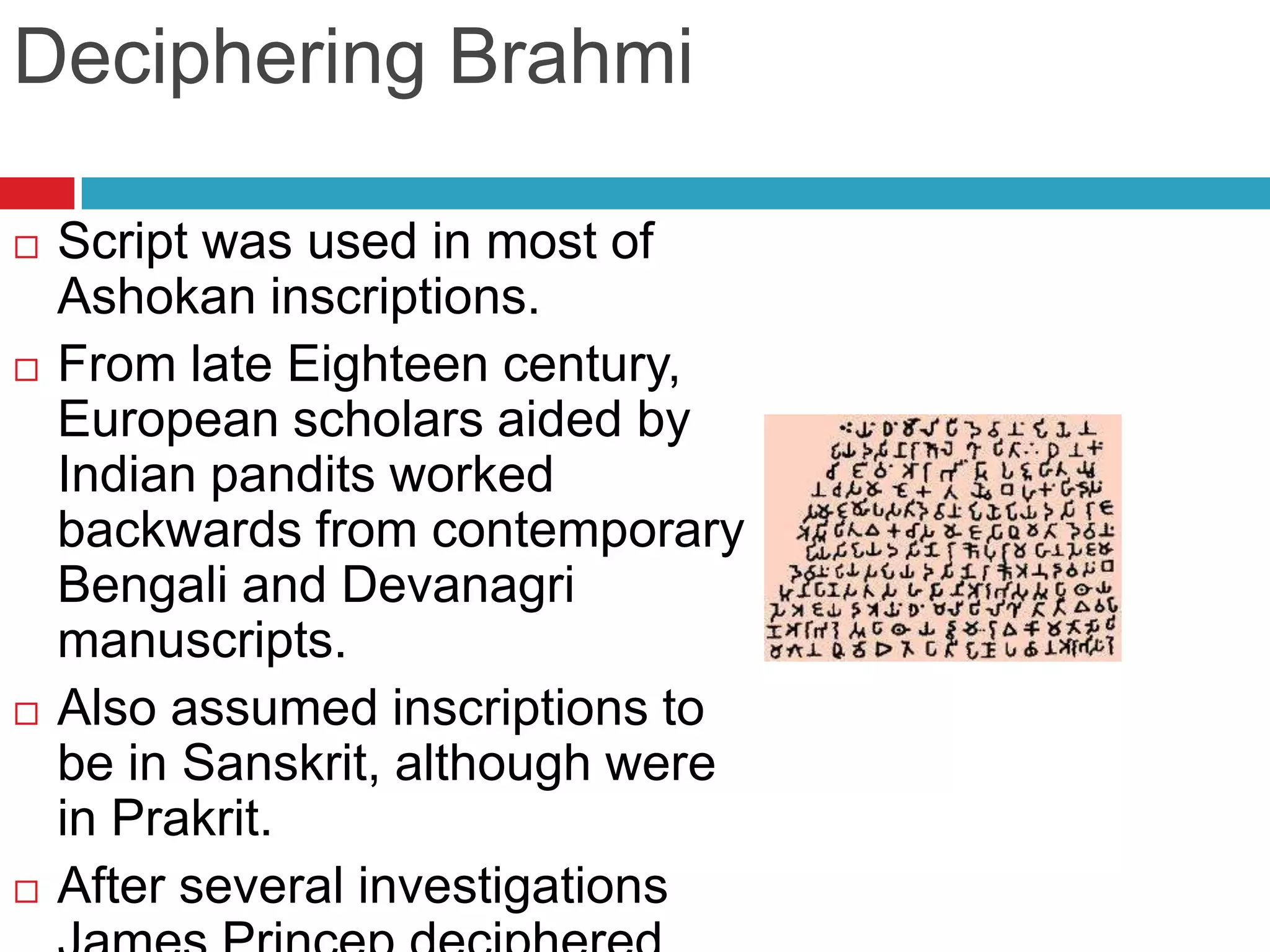
Deciphering Brahmi

   Script was used in most of
    Ashokan inscriptions.
   From late Eighteen century,
    European scholars aided by
    Indian pandits worked
    backwards from contemporary
    Bengali and Devanagri
    manuscripts.
   Also assumed inscriptions to
    be in Sanskrit, although were
    in Prakrit.
   After several investigations
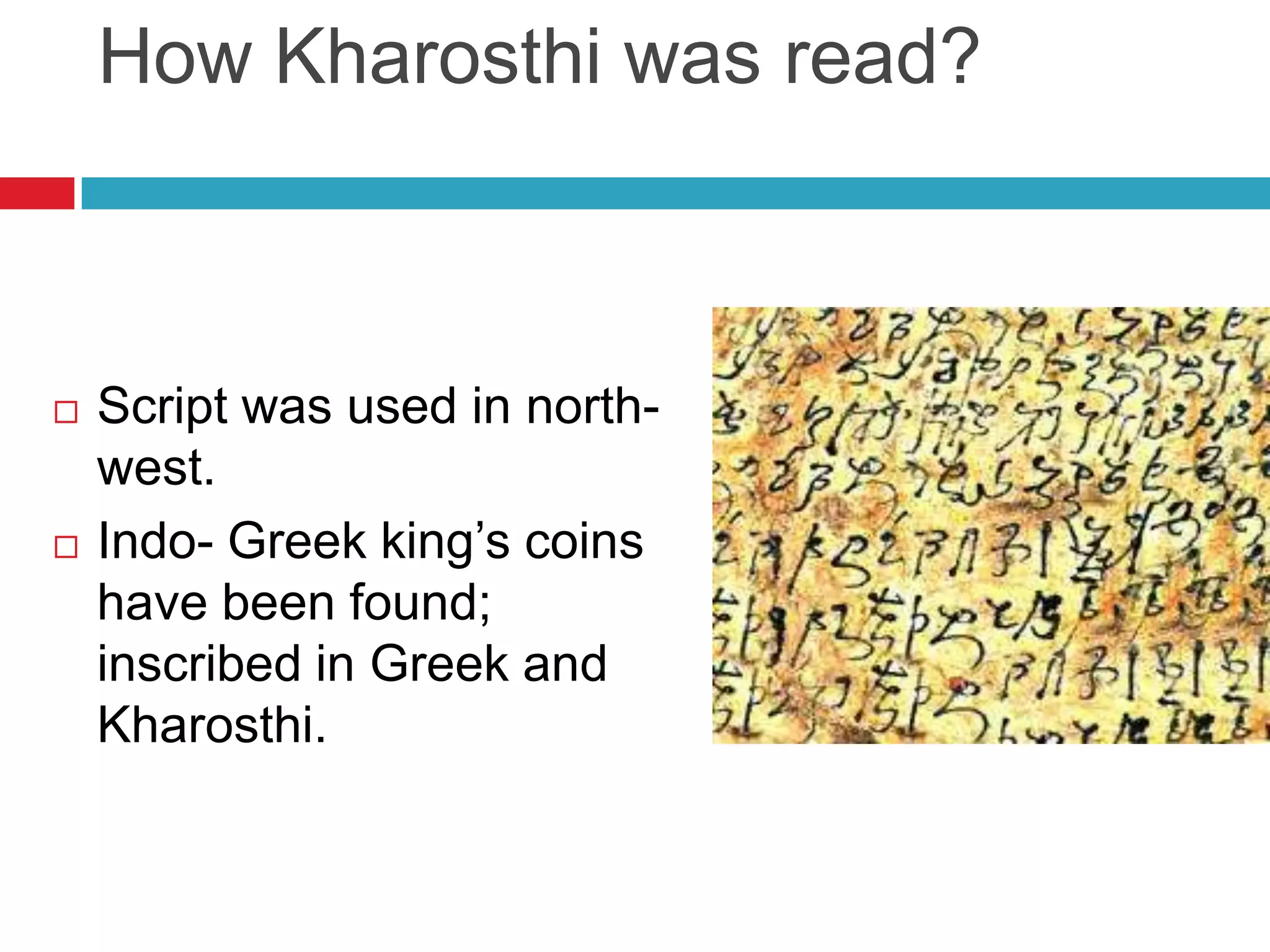
How Kharosthi was read?


   Script was used in north-
    west.
   Indo- Greek king’s coins
    have been found;
    inscribed in Greek and
    Kharosthi.
Historical evidence from
    inscriptions

   Ashoka mentioned with
    different names in
    inscriptions, such as-
    “devanampiya”- beloved of
    the gods, “piyadassi” –
    peasant behold.
   After examining, all these
    names refer to Ashoka.
THE LIMITATION OF INSCRIPTIONAL
EVIDENCE


    Missing Letters
    Unclear
    Certain things not
     mentioned
    Not properly deciphered
Thank
You!!
 Made By: Ekta Arora
         Shifa C.
 Nicholson

Kings, Farmers and Towns

  • 1.
    KINGS, FARMERS AND TOWNS (c. 600 B.C.E. – 600 C.E.)
  • 2.
    INTRODUCTION  Several developments too place in different parts of the subcontinent during the long span of 1,500 years following the end of the Harappan civilization.  Also mentioned in Rigveda was composed by people living along the Indus and its tributaries.  Agricultural settlements emerged in north India, the Deccan Plateau, and parts of Karnataka.  Evidence of pastoral settlements has been found in the Deccan and further south.  New modes of disposal of the dead, including the making of elaborate stone structures known as megaliths, emerged in central and south India from the first millennium BCE.  In many cases, the dead were buried with a
  • 3.
    PRINCEP AND PIYADASSI  James Princep, an officer in the mint of East India Company.  He deciphered Brahmi and Kharosthi scripts and helped us know about this period in 1830’s.  In the scripts he found a mention of a king called “Piyadassi” meaning pleasant to behold .  There is a perception that Piyadassi must have been used for King Asoka, grandson of Chandragupta Maurya.
  • 4.
    THE EARLIEST STATES •TheSixteen Mahajanpadas •First Among Sixteen: Magadha
  • 5.
    The Sixteen Mahajanpadas  Mentioned in Buddhists and Jainist texts.  included- Vajji, Magadha, Koshala, Kuru, Panchala, Gandhara and Avanti.  Some mahajanpadas ware ruled by a group of kings deciding about utilization of resources in the kingdom- called sanghas/ganas.  Each mahajanpada had its own capital.
  • 6.
    First amongst thesixteen : Magadha Importance of Magadha:  Fertile Land- increased agriculture productivity  Iron- for making tools  Forest- provided elephants for cavalry  River-water resources provided cheap transportation  Ambitious Kings such as Ajatasattu, Bimbisara,
  • 7.
    AN EARLY EMPIRE •Finding about the Mauryas • Administrating the empire • How important was the empire?
  • 8.
    Finding about theMauryas Sources:  Literary:  Indica by Megasthenes  Arthashatra by Kautilya/Chanakya  Archaeological:  Sculptures  Coins  Inscriptions on pillars and rocks
  • 9.
    Administrating the empire  Five major political centres- Taxila, Tosali, Ujjayni, Suvaranagiri, Pataliputra (TTUSP)  Megesthenes mentioned of a committee with six sub- committees for co-ordinating resources for military activities.  Asoka spead the message of dhamma to hold the empire
  • 10.
    How important wasthe empire?  Two points- one in favor ; one against  It is the first empire to be found in Indian history, so has a great importance.  But it hardly lasted for 150 years.  A debate still going among historians regarding the same.
  • 11.
    NEW NOTIONS OF KINGSHIP •Chiefsand kings in South •Divine Kings
  • 12.
    Chiefs and kingsin South  Chiefdoms of the Cholas Cheras and Pandyas emerged.  Chiefs- received goods from the villagers  Kings- collected taxes.
  • 13.
    Divine Kings  To present themselves as superior; need to be worshipped.  First claimed by Kushanas in first century CE; claiming to be “devaputra”  During 4th CE, Prashasti composed to praise king in Gupta period.  Prayag Prashasti written by Harishena for Samudragupta in Sanskrit.
  • 14.
    CHANGING COUNTRYSIDE •Popular perceptionsof kings •Strategies for increasing production •Difference in rural society •Land grants and new rural elites
  • 15.
    Popular Perceptions ofKings  No accounts by people about their kings  From oral folk tales such as “Panchatantra” and “Gandatindu Jataka” were lately written in Pali in first millennium CE.  One story depicts about a wicked king collecting taxes; leading people to hide & live in forest.
  • 16.
    Strategies for increasing production  Another way to meet the growing demand of taxes was to increase crop production  Iron-plough share was used to turn alluvial soil in areas with high rainfall.  Semi arid Region i.e Punjab, Rajasthan- did not adopt this technique till 20th C.  Hilly terrain practiced hoe agriculture.  Irrigation through wells and tanks; canals were less
  • 17.
    Differences in ruralsociety  Gahapati- term used in Pali texts meaning head or master of the household.  In Tamil literature: Sangam texts- differences on the basis of resource accessibility. Vellalar – Land ownwers Uzahwar – Ploughman Adimai – Slaves
  • 18.
    Land grants andnew rural elites  Land grant sources : Copper plates have been excavated, maybe a symbol certifying the details of the land.  Prabhavati Gupta- daughter of Chandragupta II (Chandragupta Vikram Aditya)- married in Vakatakas.  Legal texts suggest that women don’t have independent access to resources such as land, but evidences have been found that she has granted land.  Other reasons for Land grants: • Strategy to increase agriculture area • Win allies- used to strengthen political power. • To project themselves as supermen; they are superior, have some authority.
  • 19.
    TOWNS AND TRADE •New cities • Urban populations: Elites and craftsperson •Trade in the subcontinent and beyond •Coins and Kings
  • 20.
    New cities  Pataliputra- riverine route town  Ujjayini- land route town  Puhar- sea route town (near coast)  Mathura- commercial, cultural and political activities centre
  • 21.
    Urban Population: Elitesand craftsperson  Elites lived in fortified cities.  Artefacts excavated include:Fine pottery bowls, dishes, Ornaments,Tools,Weapons,Ve ssels,Figurines,  Emerging occupations included: Weavers, black/goldsmiths, merchants, traders, potters, carpenters.  Role of guilds has also been
  • 22.
    Trade in thesubcontinent and beyond.  India had contact with countries on the eastern side along with Bay of Bengal as well as on the western side with North Africa, West Asia and some parts of Europe as well.  Successful merchants were called masattuvan in Tamil and setthis and satthavahas in Prakrit.  Wide range of goods was
  • 23.
    Coins and Kings  Exchange of goods took place through coinage.  Punched mark coins of copper and silver.  Coins had inscriptions, pictorial representations, etc. which was issued by kings.  First gold coin were issued in first century CE by Kushanas ; vertically identical in weight to those issued by contemporary Roman emperors.  Historians suggest of link with Roman Empire as well.
  • 24.
    BACK TO BASICS: HowAre Inscriptions Deciphered? •Deciphering Brahmi •How Kharosthi was read? •Historical evidence from inscriptions
  • 25.
    Deciphering Brahmi  Script was used in most of Ashokan inscriptions.  From late Eighteen century, European scholars aided by Indian pandits worked backwards from contemporary Bengali and Devanagri manuscripts.  Also assumed inscriptions to be in Sanskrit, although were in Prakrit.  After several investigations
  • 26.
    How Kharosthi wasread?  Script was used in north- west.  Indo- Greek king’s coins have been found; inscribed in Greek and Kharosthi.
  • 27.
    Historical evidence from inscriptions  Ashoka mentioned with different names in inscriptions, such as- “devanampiya”- beloved of the gods, “piyadassi” – peasant behold.  After examining, all these names refer to Ashoka.
  • 28.
    THE LIMITATION OFINSCRIPTIONAL EVIDENCE  Missing Letters  Unclear  Certain things not mentioned  Not properly deciphered
  • 29.
    Thank You!! Made By:Ekta Arora Shifa C. Nicholson