
Colonial Society
ThemesFamily & community life in New England & Chesapeake Bay
Colonial economy & politics
History of ideas:
Enlightenment & the Great Awakening
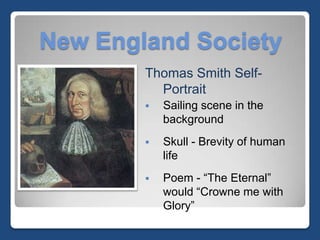
New England SocietyThomas Smith Self-PortraitSailing scene in the background
Skull - Brevity of human life
Poem - “The Eternal” would “Crowne me with Glory”New England SocietyEducationTowns with more than 50 households were required to appoint teachers
Harvard College was founded in 1636 to train ministersNew England SocietyEducation & LiteracyAbout 90% of adult white men & 40% of adult white women could sign their names
No more than 50% in other colonies
In England, only about 33% could read & writeNew England SocietyCommunity LifeCentered around the Meeting House
Homes were close to one another
Led to a high population density in town center
Created an atmosphere of “watchfulness”
Supported the overall goal of a “city upon a hill” without dissent
Easy to help one another & work together
New England SocietyFamily LifeFamily Organization
Father - Head of the family
Mother - Manage the household
Children - Provide a labor force
Stability
80% of children reach adulthood
Life expectancy - Men: 65New England SocietyPunishmentsConvicted criminals were exposed to public ridicule
Meant to serve as a warning to others
Chesapeake SocietyTobacco cultivation dominated the region
Large profits could be made, but prices fluctuated
Indentured servants & slaves were common on the plantationsChesapeake SocietyCommunity LifeCentered around large plantation homes
Homes were spread out & situated along the banks of rivers or streams
Led to a low population density – about 6 people per sq. mile
Chesapeake SocietyFamily LifeChaotic
50% of children reach adulthood
Life expectancy - Men: 48
Complex householdsIndentured ServantsHeadright SystemVirginia Company awarded 50 acres to anyone who paid a servant’s travel costs
Between 1630-1700 – 110,000 migrated from England to the  Chesapeake Bay
Up to 90% were indentured servants

Colonial Society