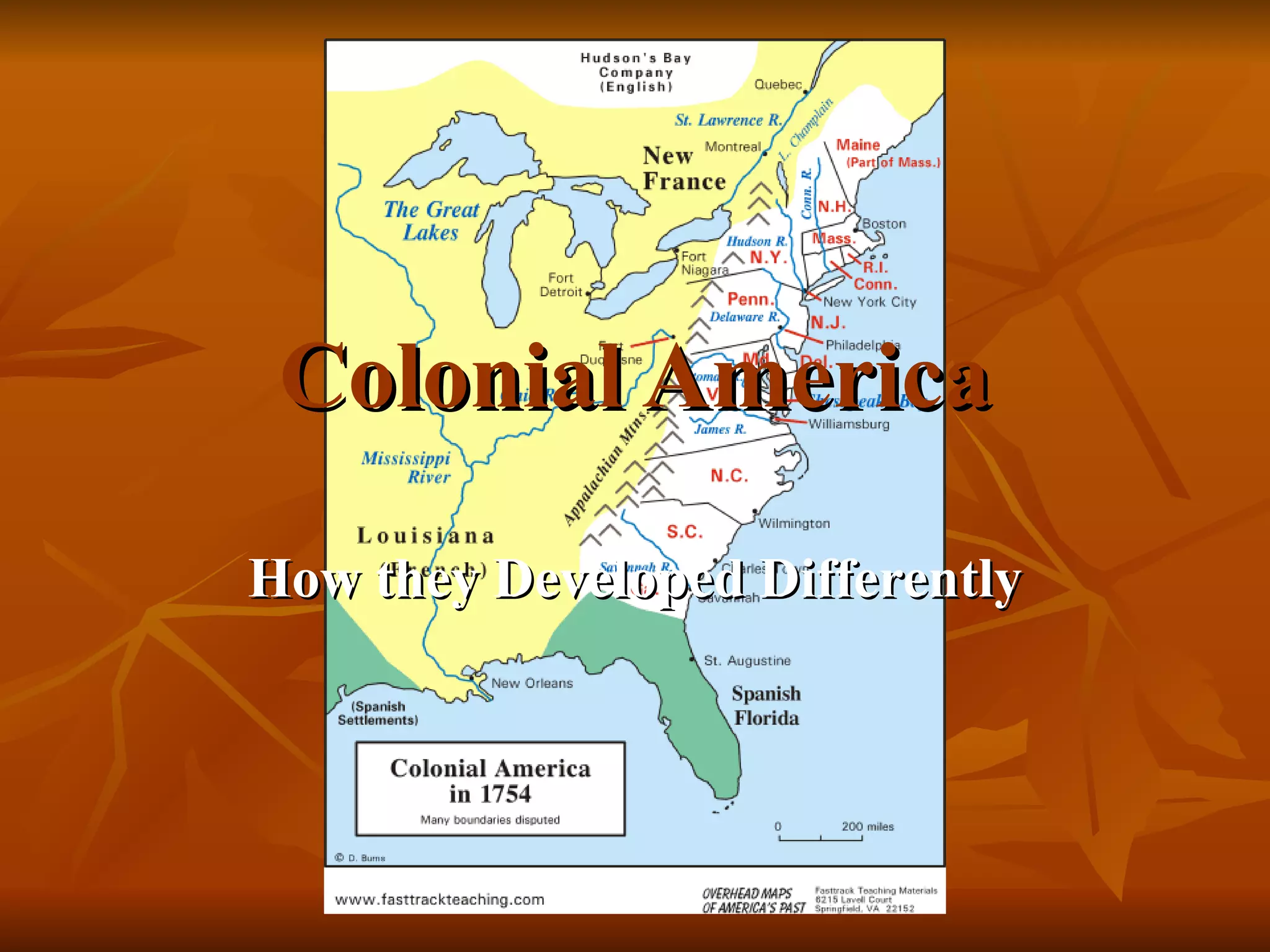
Colonial America How they Developed Differently
Mercantilist System  Colonies exist as a market for home-country's goods and a supplier of raw materials  All trade with other nations needs to go through the home-country. Series of Navigation Acts began in 1651  All trade had to be on English or colonial ships Enumerated products (tobacco, sugar, indigo, cotton, etc.) could be shipped only to England or another English colony Certain English-made goods (gunpowder, silk) were subsidized to undercut European competitors
Mercantilist System In general, the colonies prospered with the Navigation Acts and cities like Philadelphia, New York, and Boston grew, though some tobacco and rice planters complained  Some Americans viewed the mercantilist laws as excessive and were sometimes ignored. James II responded by removing New England's charter in 1688 and establishing the Dominion of New England, a royal province that ignored previous land grants and outlawed town meetings.
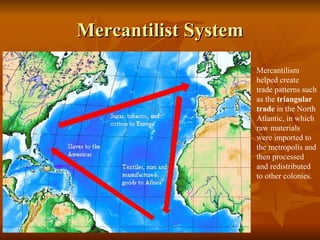
Mercantilist System Mercantilism helped create trade patterns such as the  triangular trade  in the North Atlantic, in which raw materials were imported to the metropolis and then processed and redistributed to other colonies.
Glorious Revolution of 1688  Fearing persecution, Protestants in Parliament carried out a bloodless coup, fearing that James II would return England to Catholicism. James daughter Mary and her husband William of Orange were enthroned. John Locke's  Two Treatises on Government  argued that power flows from the consent of the governed, not from God and that citizens have inalienable natural rights (life, liberty, property) Revolts in Massachusetts, Maryland, and New York asserted the right of voluntary allegiance to the crown and self-government England entered a period of  salutary neglect  towards the colonies, effectively allowing the colonies to grow in wealth, population, and self-government
Four Major Regions Plantation South Middle Colonies New England Frontier
Plantation South  Tidewater region featured wide coastal plain, wide rivers, and rich soil particularly well-suited to tobacco farming.  Large plantations became economically more successful as soil was exhausted, leading to self-sufficing economic units.  As indentured servants became harder to obtain (and retain), demand for slaves increased (400,000) in colonies by 1776
Plantation South Only children of planters were educated and higher education was only for those who could afford it.  Plantation owners became the leading economic, political, and social forces of the South. Democracy limited to wealthy landowners.
Middle Colonies  Three large rivers (Hudson, Delaware, and Susquehanna) flowed north to south and served as trade paths.  Large numbers of immigrants Dutch in Hudson Valley Germans in Pennsylvania Scotch-Irish in Pennsylvania
New England 95% English immigrants, most from villages  Came in groups and settled in self-governing towns. New England town meeting as center of power at first, but shifted to selectmen in time. Occupations included farming (scarce labor, tough conditions), fishing, and commerce Shipbuilding became major supplement to fishing and trade Slavery, rum and the triangular trade with West Indies and Africa brought economic wealth to New England
Backcountry/Frontier  Large families, exhausted soil encouraged westward movement  Religious dissenters, immigrants, and criminals all found "refuge" in the West. Vigorous spirit of democracy and emphasis on individual freedom  Strenuous objection to any governmental interference in daily life Anti-aristocratic tradition and resentment of urban areas
Growth of Colonial Assemblies  Following the lead of the Whigs who had established limits on the power of the crown with the Glorious Revolution, American colonial assemblies sought to limit royal authority and assert local control over Taxes appointment of local officials setting the governor's salary In fact, the assemblies were elitist rather than democratic, with rich men standing for office, though most property-owning men had the right to vote.
Growth of Colonial Assemblies Following the Glorious Revolution, mobs often exerted local control in defiance of both the governor and the local assembly. British policy of  salutary neglect  allowed local control to grow as the crown focused on trade and military issues. Later, when the British tried to re-assert the powers in mercantilist policies, they found strong colonial resistance.

Colonial America

  • 1.
    Colonial America Howthey Developed Differently
  • 2.
    Mercantilist System Colonies exist as a market for home-country's goods and a supplier of raw materials All trade with other nations needs to go through the home-country. Series of Navigation Acts began in 1651 All trade had to be on English or colonial ships Enumerated products (tobacco, sugar, indigo, cotton, etc.) could be shipped only to England or another English colony Certain English-made goods (gunpowder, silk) were subsidized to undercut European competitors
  • 3.
    Mercantilist System Ingeneral, the colonies prospered with the Navigation Acts and cities like Philadelphia, New York, and Boston grew, though some tobacco and rice planters complained Some Americans viewed the mercantilist laws as excessive and were sometimes ignored. James II responded by removing New England's charter in 1688 and establishing the Dominion of New England, a royal province that ignored previous land grants and outlawed town meetings.
  • 4.
    Mercantilist System Mercantilismhelped create trade patterns such as the triangular trade in the North Atlantic, in which raw materials were imported to the metropolis and then processed and redistributed to other colonies.
  • 5.
    Glorious Revolution of1688 Fearing persecution, Protestants in Parliament carried out a bloodless coup, fearing that James II would return England to Catholicism. James daughter Mary and her husband William of Orange were enthroned. John Locke's Two Treatises on Government argued that power flows from the consent of the governed, not from God and that citizens have inalienable natural rights (life, liberty, property) Revolts in Massachusetts, Maryland, and New York asserted the right of voluntary allegiance to the crown and self-government England entered a period of salutary neglect towards the colonies, effectively allowing the colonies to grow in wealth, population, and self-government
  • 6.
    Four Major RegionsPlantation South Middle Colonies New England Frontier
  • 7.
    Plantation South Tidewater region featured wide coastal plain, wide rivers, and rich soil particularly well-suited to tobacco farming. Large plantations became economically more successful as soil was exhausted, leading to self-sufficing economic units. As indentured servants became harder to obtain (and retain), demand for slaves increased (400,000) in colonies by 1776
  • 8.
    Plantation South Onlychildren of planters were educated and higher education was only for those who could afford it. Plantation owners became the leading economic, political, and social forces of the South. Democracy limited to wealthy landowners.
  • 9.
    Middle Colonies Three large rivers (Hudson, Delaware, and Susquehanna) flowed north to south and served as trade paths. Large numbers of immigrants Dutch in Hudson Valley Germans in Pennsylvania Scotch-Irish in Pennsylvania
  • 10.
    New England 95%English immigrants, most from villages Came in groups and settled in self-governing towns. New England town meeting as center of power at first, but shifted to selectmen in time. Occupations included farming (scarce labor, tough conditions), fishing, and commerce Shipbuilding became major supplement to fishing and trade Slavery, rum and the triangular trade with West Indies and Africa brought economic wealth to New England
  • 11.
    Backcountry/Frontier Largefamilies, exhausted soil encouraged westward movement Religious dissenters, immigrants, and criminals all found "refuge" in the West. Vigorous spirit of democracy and emphasis on individual freedom Strenuous objection to any governmental interference in daily life Anti-aristocratic tradition and resentment of urban areas
  • 12.
    Growth of ColonialAssemblies Following the lead of the Whigs who had established limits on the power of the crown with the Glorious Revolution, American colonial assemblies sought to limit royal authority and assert local control over Taxes appointment of local officials setting the governor's salary In fact, the assemblies were elitist rather than democratic, with rich men standing for office, though most property-owning men had the right to vote.
  • 13.
    Growth of ColonialAssemblies Following the Glorious Revolution, mobs often exerted local control in defiance of both the governor and the local assembly. British policy of salutary neglect allowed local control to grow as the crown focused on trade and military issues. Later, when the British tried to re-assert the powers in mercantilist policies, they found strong colonial resistance.