Location and Climate
Early Inhabitants
Early settlement
The Relation between the Natives
and the New Settlers
Religion
Economy
outlines
Government
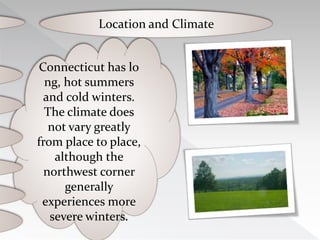
Connecticut has lo
ng, hot summers
and cold winters.
The climate does
not vary greatly
from place to place,
although the
northwest corner
generally
experiences more
severe winters.
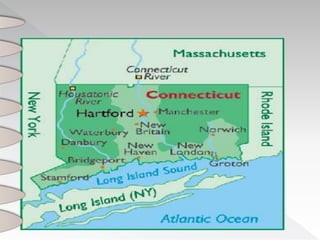
Location and Climate
1614 1633 1636 1637 1638 1639
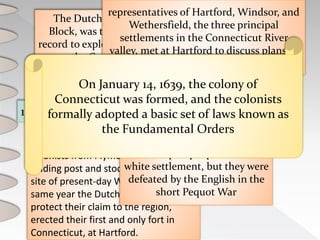
The Dutch navigator, Adriaen
Block, was the first European of
record to explore the area, sailing up
the Connecticut River
colonists from Plymouth built a
trading post and stockade near the
site of present-day Windsor. That
same year the Dutch, anxious to
protect their claim to the region,
erected their first and only fort in
Connecticut, at Hartford.
The largest migration occurred when
a well-known minister, Thomas
Hooker, led about 100 colonists from
Newtown (now Cambridge,
Massachusetts) to settle at Hartford
The Pequot people resisted
white settlement, but they were
defeated by the English in the
short Pequot War
representatives of Hartford, Windsor, and
Wethersfield, the three principal
settlements in the Connecticut River
valley, met at Hartford to discuss plans to
unite the settlements into a single colony
On January 14, 1639, the colony of
Connecticut was formed, and the colonists
formally adopted a basic set of laws known as
the Fundamental Orders
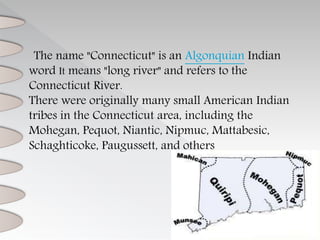
The name "Connecticut" is an Algonquian Indian
word It means "long river" and refers to the
Connecticut River.
There were originally many small American Indian
tribes in the Connecticut area, including the
Mohegan, Pequot, Niantic, Nipmuc, Mattabesic,
Schaghticoke, Paugussett, and others
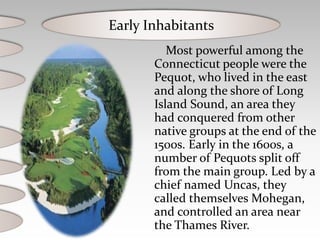
Most powerful among the
Connecticut people were the
Pequot, who lived in the east
and along the shore of Long
Island Sound, an area they
had conquered from other
native groups at the end of the
1500s. Early in the 1600s, a
number of Pequots split off
from the main group. Led by a
chief named Uncas, they
called themselves Mohegan,
and controlled an area near
the Thames River.
Early Inhabitants
Most of the Native Americans were generally
friendly to the colonists. Some native groups
invited the English to settle nearby, hoping for
trade and for allies against the aggressive
Pequots, who dominated the area. Settlers
purchased land from the native people, and
though whites often encroached on native
territory, disputes were usually settled without
violence.
Connecticut is known as the constitution state and the name refers
to the fundamental order of 1638 – 1639 . these fundamental
represent the frame work for the first formal government written by
the representative body in Connecticut after the fundamental
orders Connecticut was granted governmental authority by king
Charles II of England through the Connecticut charter of 1662.
Separate brands of the government didn’t exist during the period and the
general assembley acted as the supreme authority .
In colony’s early years , the government could not serve Connecticut teams .
thus , for 20 years the governorship often rotated between John Hayurs and
Edward Hopkim both of them were from Hartford .
George Wyllys , Thomas Wells and John Wesster are Harford men , sat in the
governor chair for brief period in the 1640s and the 1650s .
The fundamental orders Framed by
Hooker, Ludlow, John Haynes, and
others, the laws provided for a self-
governing colony whose inhabitants
were to owe their allegiance to the
colony rather than to England
Congregationalism was established by
law as the official religion of the
Connecticut and New Haven colonies
when the colonies were founded in the
17th century. It remained the official
religion until the 1818 constitution was
adopted. The congregation of each
church was its own governing body,
and there was nearly complete
independence of all outside
ecclesiastical control.
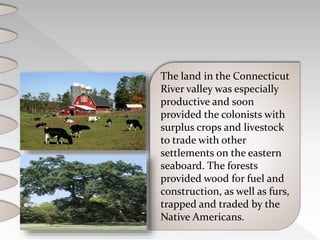
The land in the Connecticut
River valley was especially
productive and soon
provided the colonists with
surplus crops and livestock
to trade with other
settlements on the eastern
seaboard. The forests
provided wood for fuel and
construction, as well as furs,
trapped and traded by the
Native Americans.
About Connecticut Colony .

About Connecticut Colony .

  • 2.
    Location and Climate EarlyInhabitants Early settlement The Relation between the Natives and the New Settlers Religion Economy outlines Government
  • 4.
    Connecticut has lo ng,hot summers and cold winters. The climate does not vary greatly from place to place, although the northwest corner generally experiences more severe winters. Location and Climate
  • 5.
    1614 1633 16361637 1638 1639 The Dutch navigator, Adriaen Block, was the first European of record to explore the area, sailing up the Connecticut River colonists from Plymouth built a trading post and stockade near the site of present-day Windsor. That same year the Dutch, anxious to protect their claim to the region, erected their first and only fort in Connecticut, at Hartford. The largest migration occurred when a well-known minister, Thomas Hooker, led about 100 colonists from Newtown (now Cambridge, Massachusetts) to settle at Hartford The Pequot people resisted white settlement, but they were defeated by the English in the short Pequot War representatives of Hartford, Windsor, and Wethersfield, the three principal settlements in the Connecticut River valley, met at Hartford to discuss plans to unite the settlements into a single colony On January 14, 1639, the colony of Connecticut was formed, and the colonists formally adopted a basic set of laws known as the Fundamental Orders
  • 6.
    The name "Connecticut"is an Algonquian Indian word It means "long river" and refers to the Connecticut River. There were originally many small American Indian tribes in the Connecticut area, including the Mohegan, Pequot, Niantic, Nipmuc, Mattabesic, Schaghticoke, Paugussett, and others
  • 7.
    Most powerful amongthe Connecticut people were the Pequot, who lived in the east and along the shore of Long Island Sound, an area they had conquered from other native groups at the end of the 1500s. Early in the 1600s, a number of Pequots split off from the main group. Led by a chief named Uncas, they called themselves Mohegan, and controlled an area near the Thames River. Early Inhabitants
  • 8.
    Most of theNative Americans were generally friendly to the colonists. Some native groups invited the English to settle nearby, hoping for trade and for allies against the aggressive Pequots, who dominated the area. Settlers purchased land from the native people, and though whites often encroached on native territory, disputes were usually settled without violence.
  • 9.
    Connecticut is knownas the constitution state and the name refers to the fundamental order of 1638 – 1639 . these fundamental represent the frame work for the first formal government written by the representative body in Connecticut after the fundamental orders Connecticut was granted governmental authority by king Charles II of England through the Connecticut charter of 1662. Separate brands of the government didn’t exist during the period and the general assembley acted as the supreme authority . In colony’s early years , the government could not serve Connecticut teams . thus , for 20 years the governorship often rotated between John Hayurs and Edward Hopkim both of them were from Hartford . George Wyllys , Thomas Wells and John Wesster are Harford men , sat in the governor chair for brief period in the 1640s and the 1650s . The fundamental orders Framed by Hooker, Ludlow, John Haynes, and others, the laws provided for a self- governing colony whose inhabitants were to owe their allegiance to the colony rather than to England
  • 10.
    Congregationalism was establishedby law as the official religion of the Connecticut and New Haven colonies when the colonies were founded in the 17th century. It remained the official religion until the 1818 constitution was adopted. The congregation of each church was its own governing body, and there was nearly complete independence of all outside ecclesiastical control.
  • 11.
    The land inthe Connecticut River valley was especially productive and soon provided the colonists with surplus crops and livestock to trade with other settlements on the eastern seaboard. The forests provided wood for fuel and construction, as well as furs, trapped and traded by the Native Americans.