Colonial MarylandMichael Mezzancello and Lauren Yoia
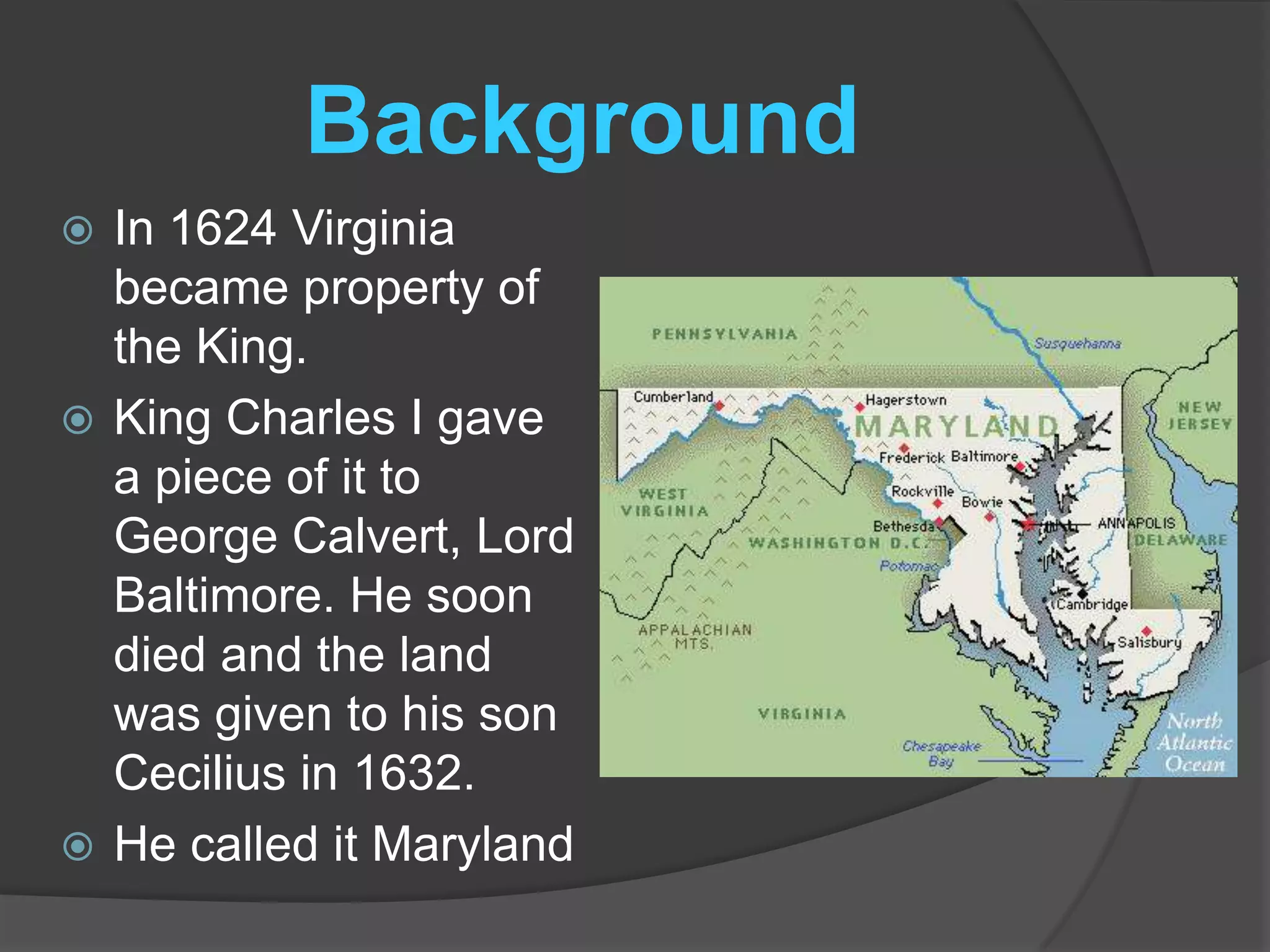
BackgroundIn 1624 Virginia became property of the King.King Charles I gave a piece of it to George Calvert, Lord Baltimore. He soon died and the land was given to his son Cecilius in 1632. He called it Maryland
The Assembly BeganAll freemen, both landholders and artisans, came together to form their Assembly by which they framed a body of laws that would later be sent to be reviewed by the proprietor (Lord Baltimore)
Self Government EstablishedAt first was refusedThe Assembly rejected the code of laws sent over by Lord BaltimoreLord Baltimore gave his brother authority to approve of the laws made by the people.
ReligionThe Church of England was recognized by law as the State ChurchThis church was supported by general taxation.Maryland was founded for the purpose of providing religious toleration of England's Roman Catholic minority. Parliament later reversed that policy and discouraged the practice of Catholicism in Maryland. Due to immigration patterns, Catholics have not been a majority in Maryland since early Colonial times.
ValuesReligious freedom The colony was a shelter for Roman Catholics fleeing religious prosecution from their King. Lord Baltimore gave the colony religious freedom to attract other settlers.
EntertainmentThe family in colonial Maryland was a person's main source of entertainment and learning. Mothers and fathers taught their children to read in order to read the Bible and, for boys, to attend school. In farming families, there was a unity during the annual harvest, when the entire family would stop their schooling and domestic chores to help bring in the year's crops.
FamilyChildren became employed as apprentices as early as 7.Families were often large so that children could help the family economically when the parents reached old age. Many of the people were farmers or worked in a skilled trade. Candle makers, blacksmiths and tavern owners were among the professions available.The father was always the head of the home.Young girls helped their mothers with domestic chores instead of working with their father.
Social StructureSocial life centered around the owners of the great plantations.The slave was a body-servant to his master or plantation owner, living a life of satisfaction in his hut with his family. Among this class we find mechanics and artisans, trained for the various duties about the plantation.
EducationEducation became increasingly important. Children were expected to know how to read and write, and boys were taught Latin in grammar school. Puritan families realized that education could help the family become economically stable, and often sent their sons to higher educational institutions.
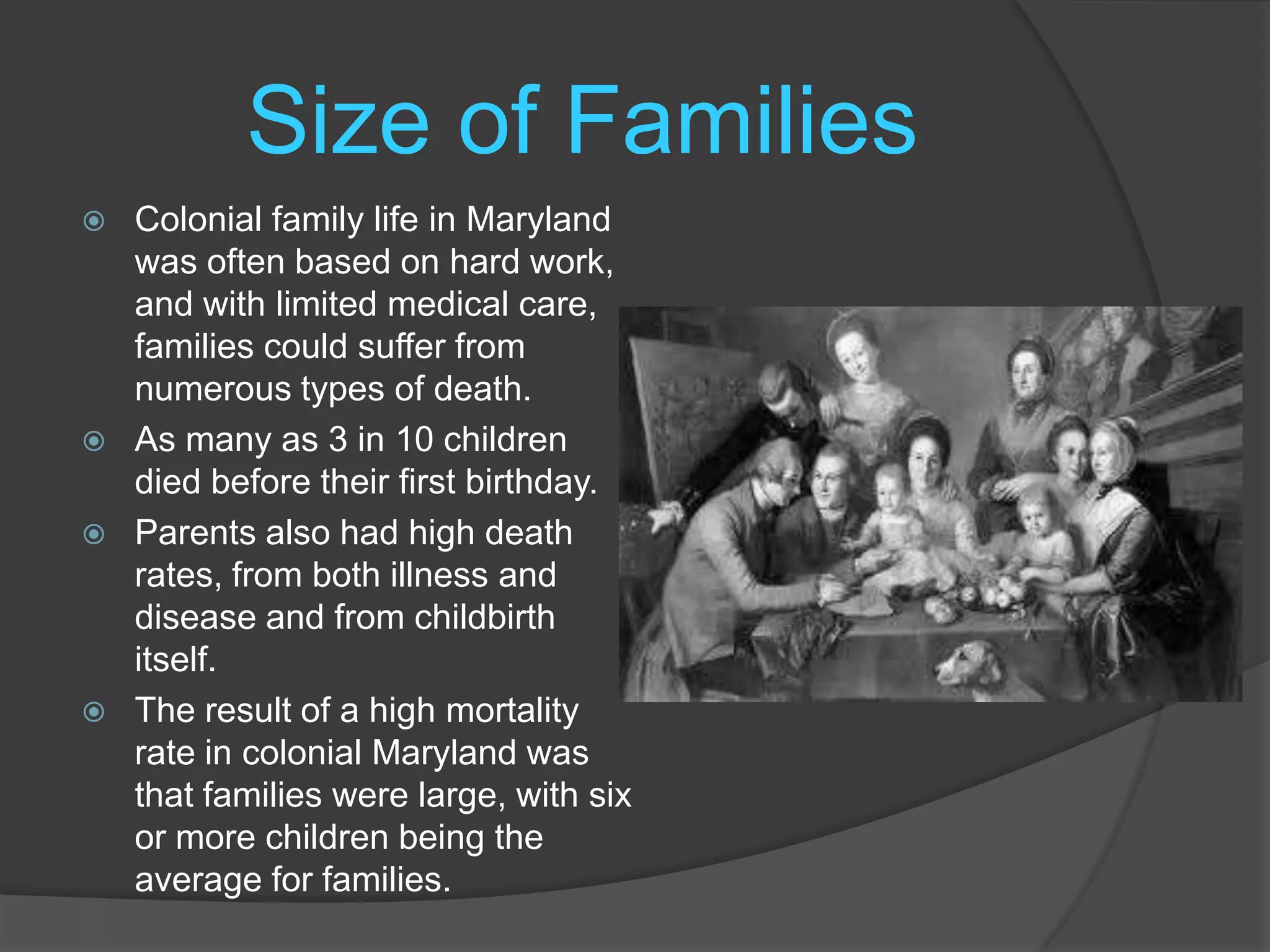
Size of FamiliesColonial family life in Maryland was often based on hard work, and with limited medical care, families could suffer from numerous types of death. As many as 3in 10 children died before their first birthday. Parents also had high death rates, from both illness and disease and from childbirth itself.The result of a high mortality rate in colonial Maryland was that families were large, with six or more children being the average for families.
Sourceshttp://wiki.answers.com/Q/What_were_the_religions_in_colonial_Marylandhttp://colonialancestors.com/md/proprietary.htmhttp://en.wikipedia.org/wiki/History_of_Marylandhttp://www.allabouthistory.org/colonial-life-in-america.htmhttp://colonialancestors.com/md/proprietary.htm

Colonial maryland

  • 1.
  • 2.
    BackgroundIn 1624 Virginiabecame property of the King.King Charles I gave a piece of it to George Calvert, Lord Baltimore. He soon died and the land was given to his son Cecilius in 1632. He called it Maryland
  • 3.
    The Assembly BeganAllfreemen, both landholders and artisans, came together to form their Assembly by which they framed a body of laws that would later be sent to be reviewed by the proprietor (Lord Baltimore)
  • 4.
    Self Government EstablishedAtfirst was refusedThe Assembly rejected the code of laws sent over by Lord BaltimoreLord Baltimore gave his brother authority to approve of the laws made by the people.
  • 5.
    ReligionThe Church ofEngland was recognized by law as the State ChurchThis church was supported by general taxation.Maryland was founded for the purpose of providing religious toleration of England's Roman Catholic minority. Parliament later reversed that policy and discouraged the practice of Catholicism in Maryland. Due to immigration patterns, Catholics have not been a majority in Maryland since early Colonial times.
  • 6.
    ValuesReligious freedom Thecolony was a shelter for Roman Catholics fleeing religious prosecution from their King. Lord Baltimore gave the colony religious freedom to attract other settlers.
  • 7.
    EntertainmentThe family incolonial Maryland was a person's main source of entertainment and learning. Mothers and fathers taught their children to read in order to read the Bible and, for boys, to attend school. In farming families, there was a unity during the annual harvest, when the entire family would stop their schooling and domestic chores to help bring in the year's crops.
  • 8.
    FamilyChildren became employedas apprentices as early as 7.Families were often large so that children could help the family economically when the parents reached old age. Many of the people were farmers or worked in a skilled trade. Candle makers, blacksmiths and tavern owners were among the professions available.The father was always the head of the home.Young girls helped their mothers with domestic chores instead of working with their father.
  • 9.
    Social StructureSocial lifecentered around the owners of the great plantations.The slave was a body-servant to his master or plantation owner, living a life of satisfaction in his hut with his family. Among this class we find mechanics and artisans, trained for the various duties about the plantation.
  • 10.
    EducationEducation became increasinglyimportant. Children were expected to know how to read and write, and boys were taught Latin in grammar school. Puritan families realized that education could help the family become economically stable, and often sent their sons to higher educational institutions.
  • 11.
    Size of FamiliesColonialfamily life in Maryland was often based on hard work, and with limited medical care, families could suffer from numerous types of death. As many as 3in 10 children died before their first birthday. Parents also had high death rates, from both illness and disease and from childbirth itself.The result of a high mortality rate in colonial Maryland was that families were large, with six or more children being the average for families.
  • 12.