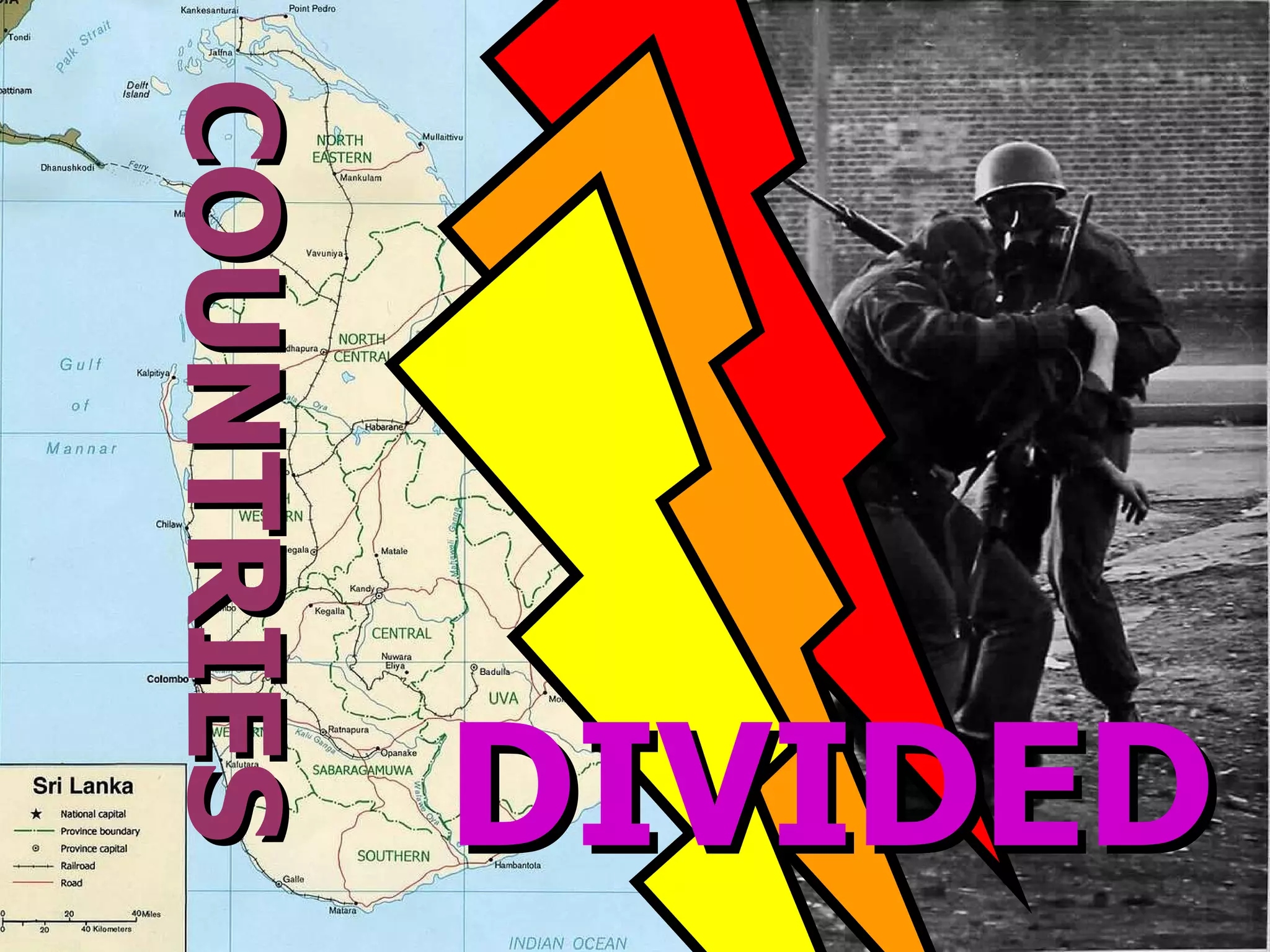
COUNTRIES DIVIDED
NORTHERN  IRELAND
 
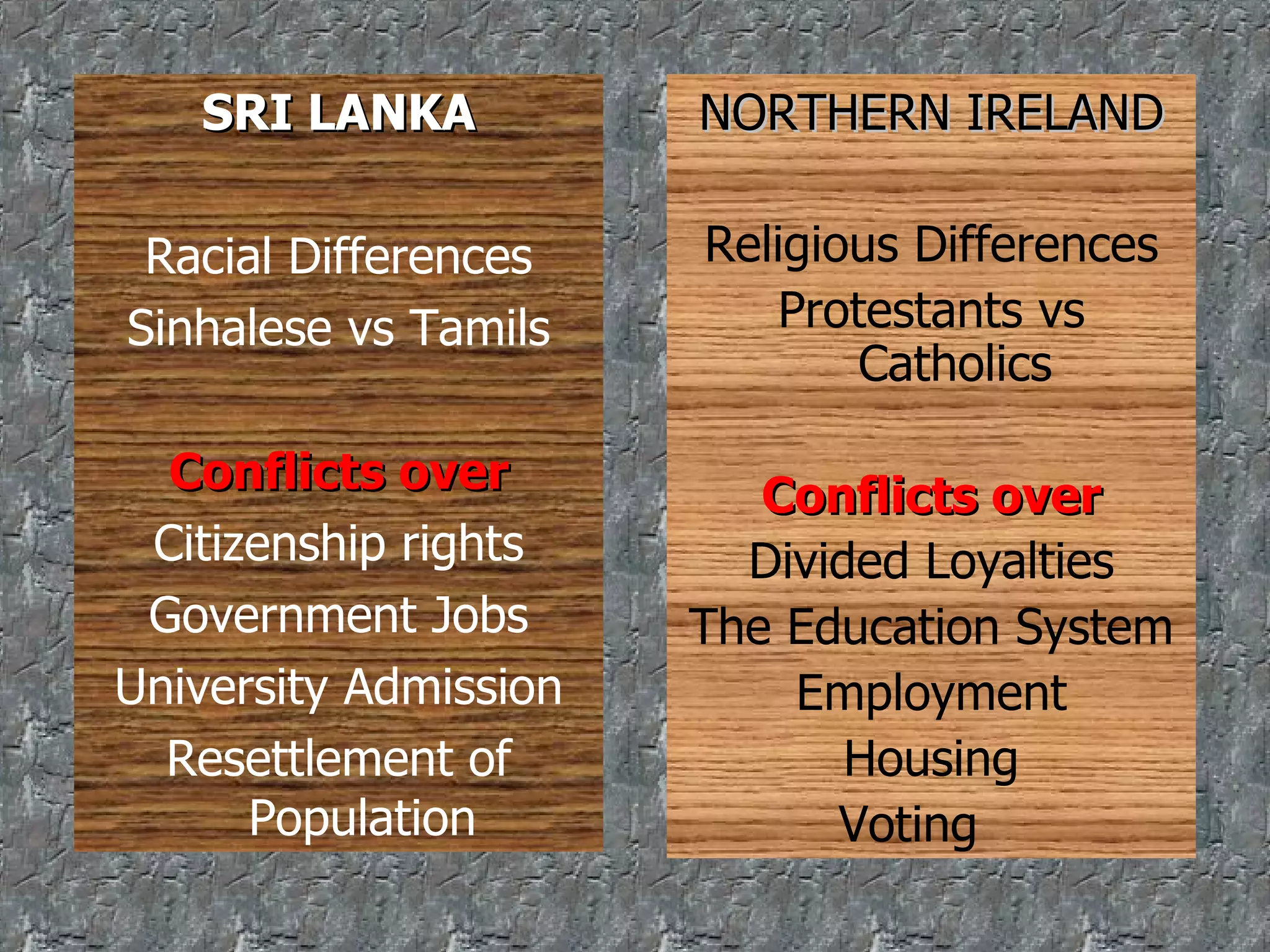
SRI LANKA Racial Differences Sinhalese vs Tamils Conflicts over Citizenship rights Government Jobs University Admission Resettlement of Population NORTHERN IRELAND Religious Differences Protestants vs Catholics Conflicts over Divided Loyalties The Education System Employment Housing Voting
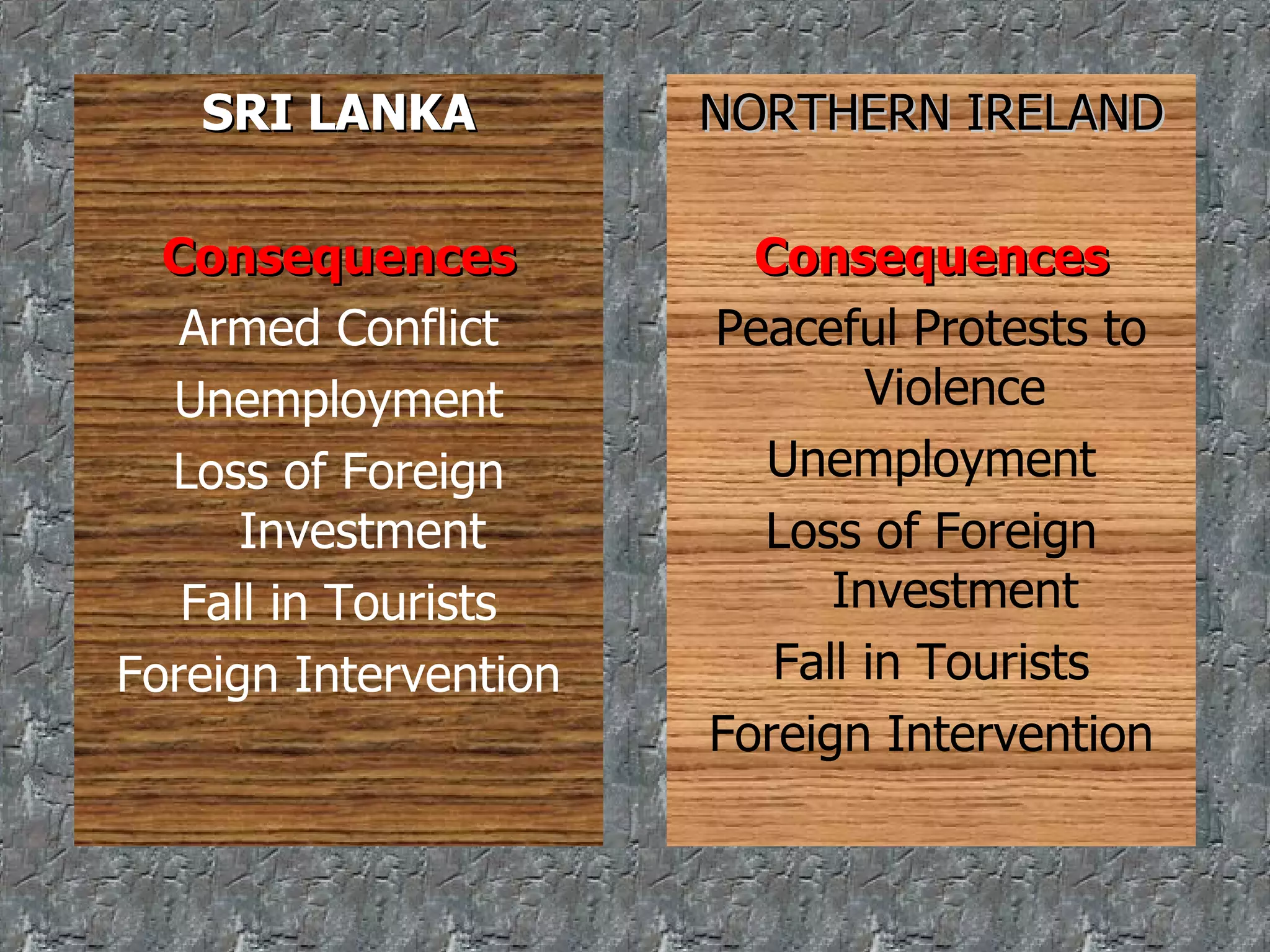
SRI LANKA Consequences Armed Conflict Unemployment Loss of Foreign Investment Fall in Tourists Foreign Intervention NORTHERN IRELAND Consequences Peaceful Protests to Violence Unemployment Loss of Foreign Investment Fall in Tourists Foreign Intervention
 
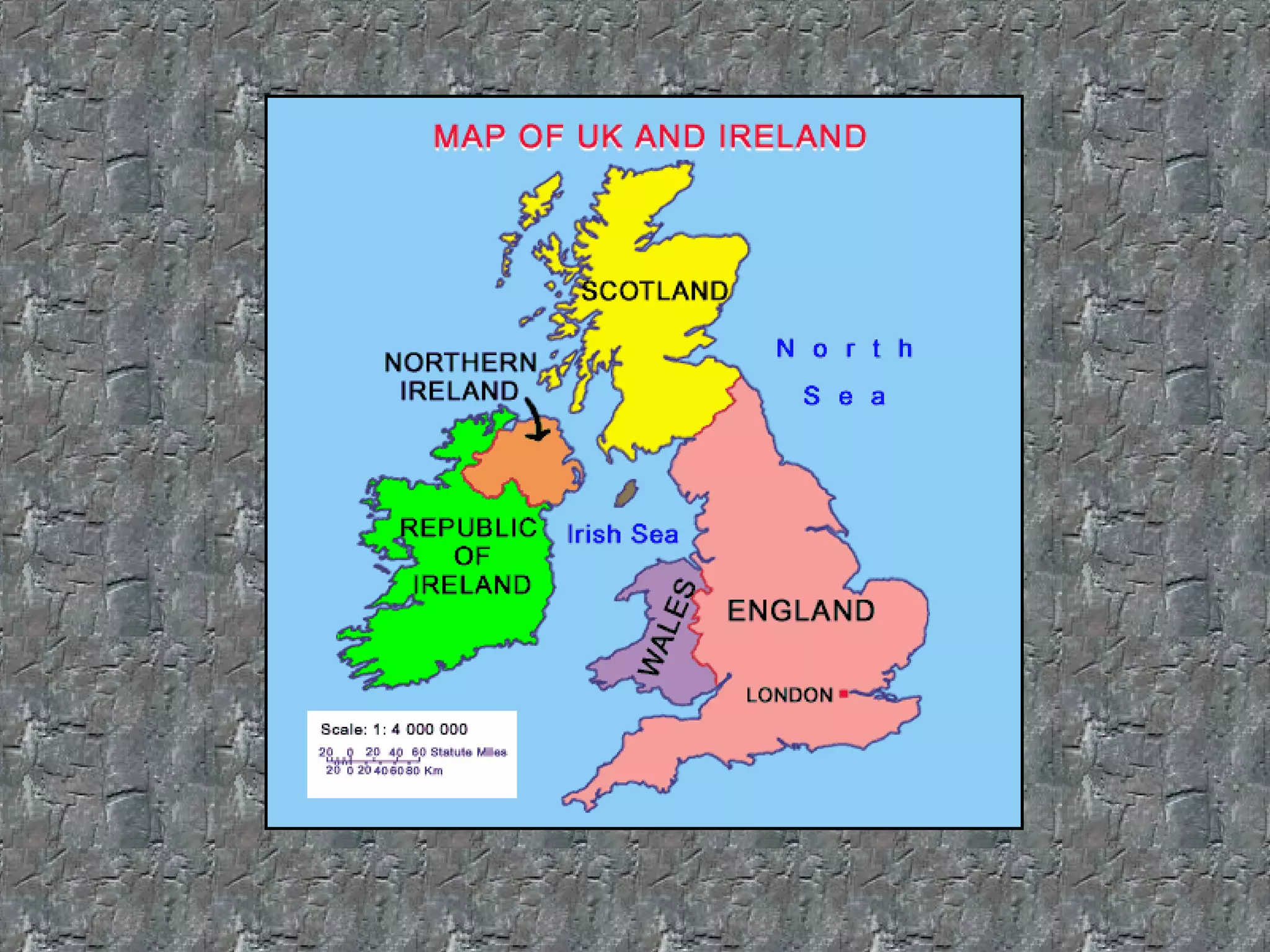
HISTORY OF N.I . United Kingdom and Republic of Ireland UK : BRITAIN  England, Scotland, Wales  and N.I. Let’s tour Britain & London
HISTORY OF N.I . Before 12 th  century In the 12 th  century 1690 1800
12 TH  CENTURY Before 12 th  century N.I. & Republic of Ireland = IRELAND In the 12 th  century Ireland conquered and colonised by England
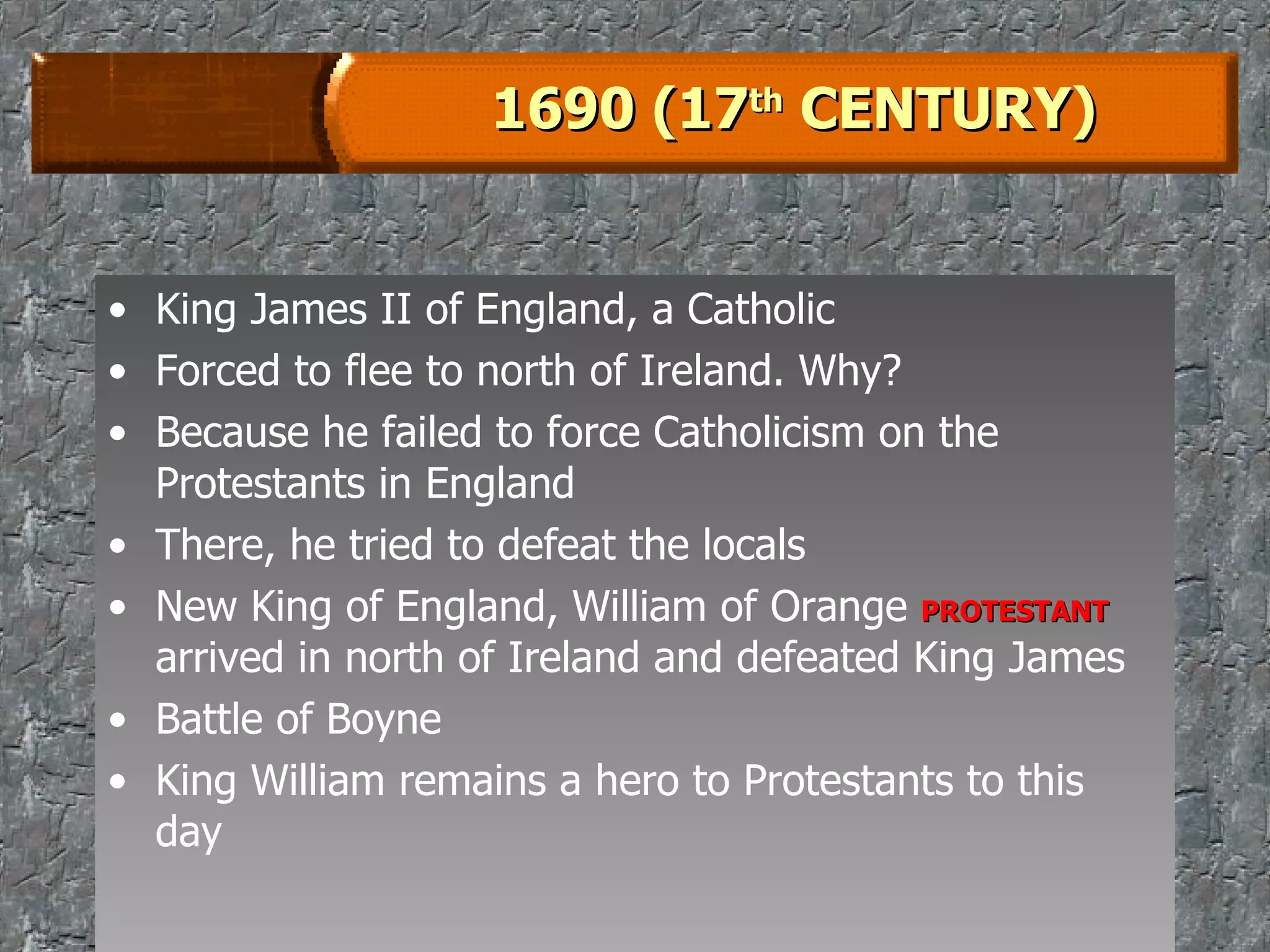
1690 (17 th  CENTURY) King James II of England, a Catholic Forced to flee to north of Ireland. Why? Because he failed to force Catholicism on the Protestants in England There, he tried to defeat the locals New King of England, William of Orange  PROTESTANT  arrived in north of Ireland and defeated King James Battle of Boyne King William remains a hero to Protestants to this day
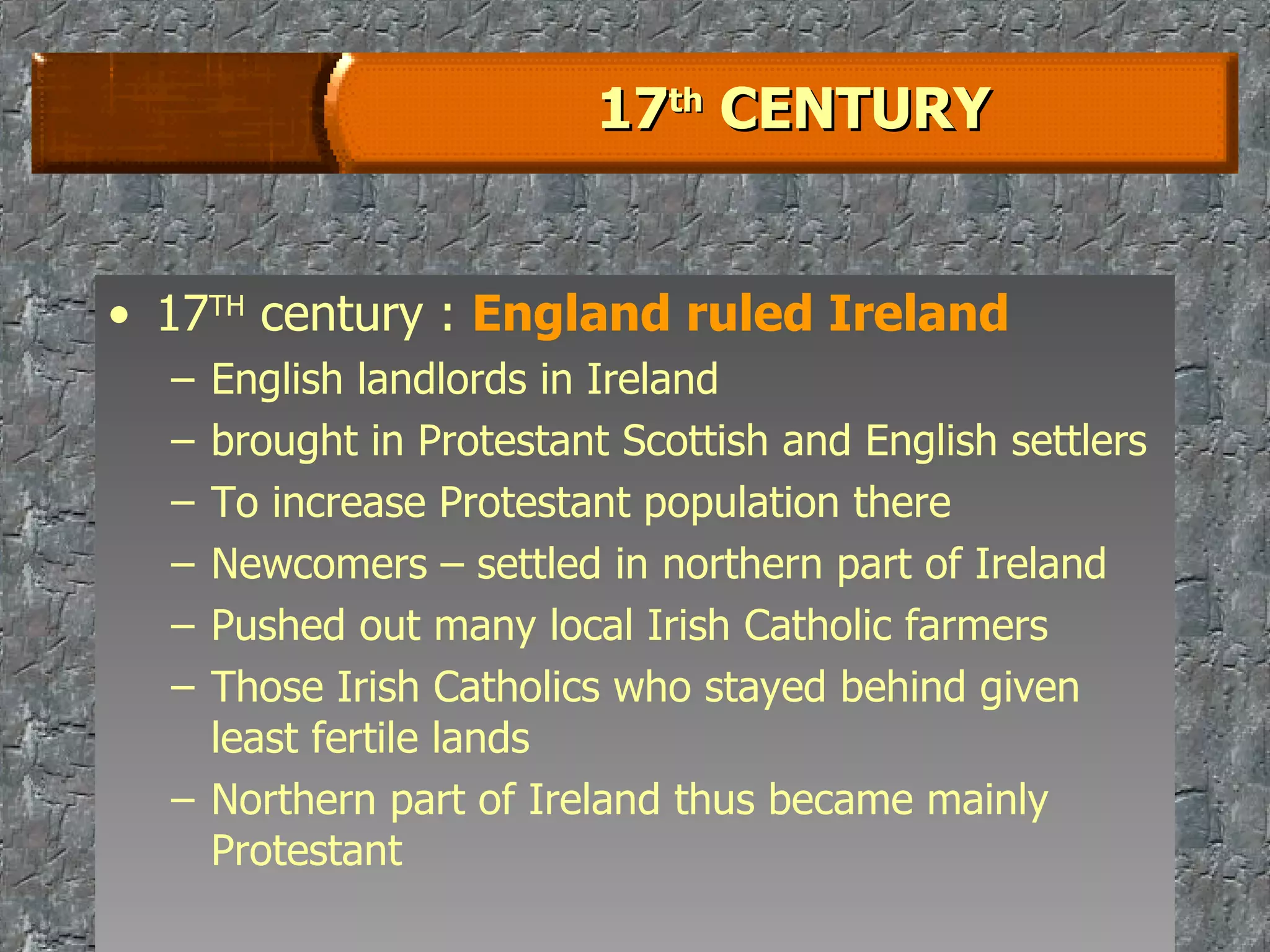
17 th  CENTURY 17 TH  century :  England ruled Ireland English landlords in Ireland  brought in Protestant Scottish and English settlers To increase Protestant population there Newcomers – settled in northern part of Ireland Pushed out many local Irish Catholic farmers Those Irish Catholics who stayed behind given least fertile lands Northern part of Ireland thus became mainly Protestant
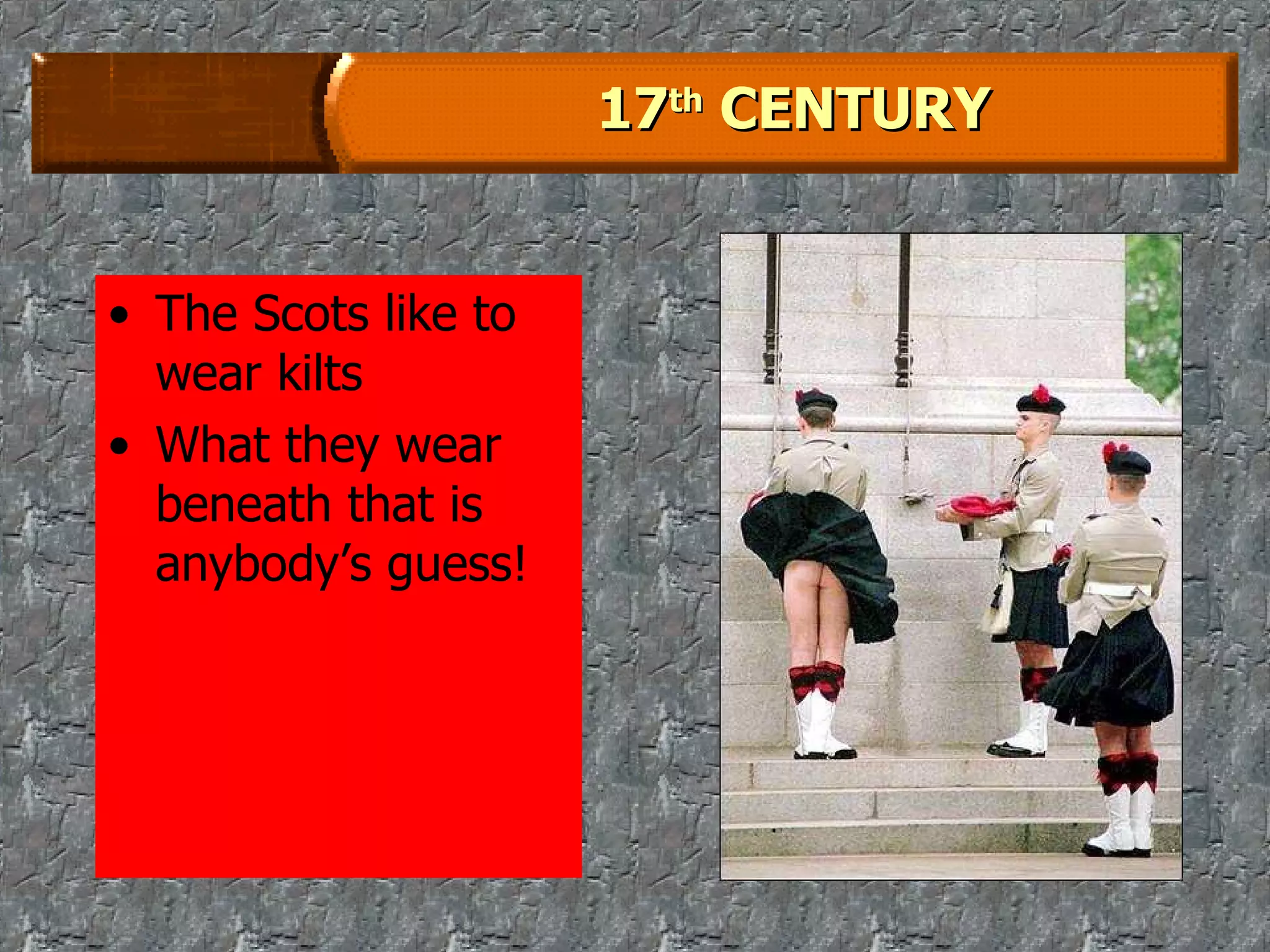
17 th  CENTURY The Scots like to wear kilts What they wear beneath that is anybody’s guess!
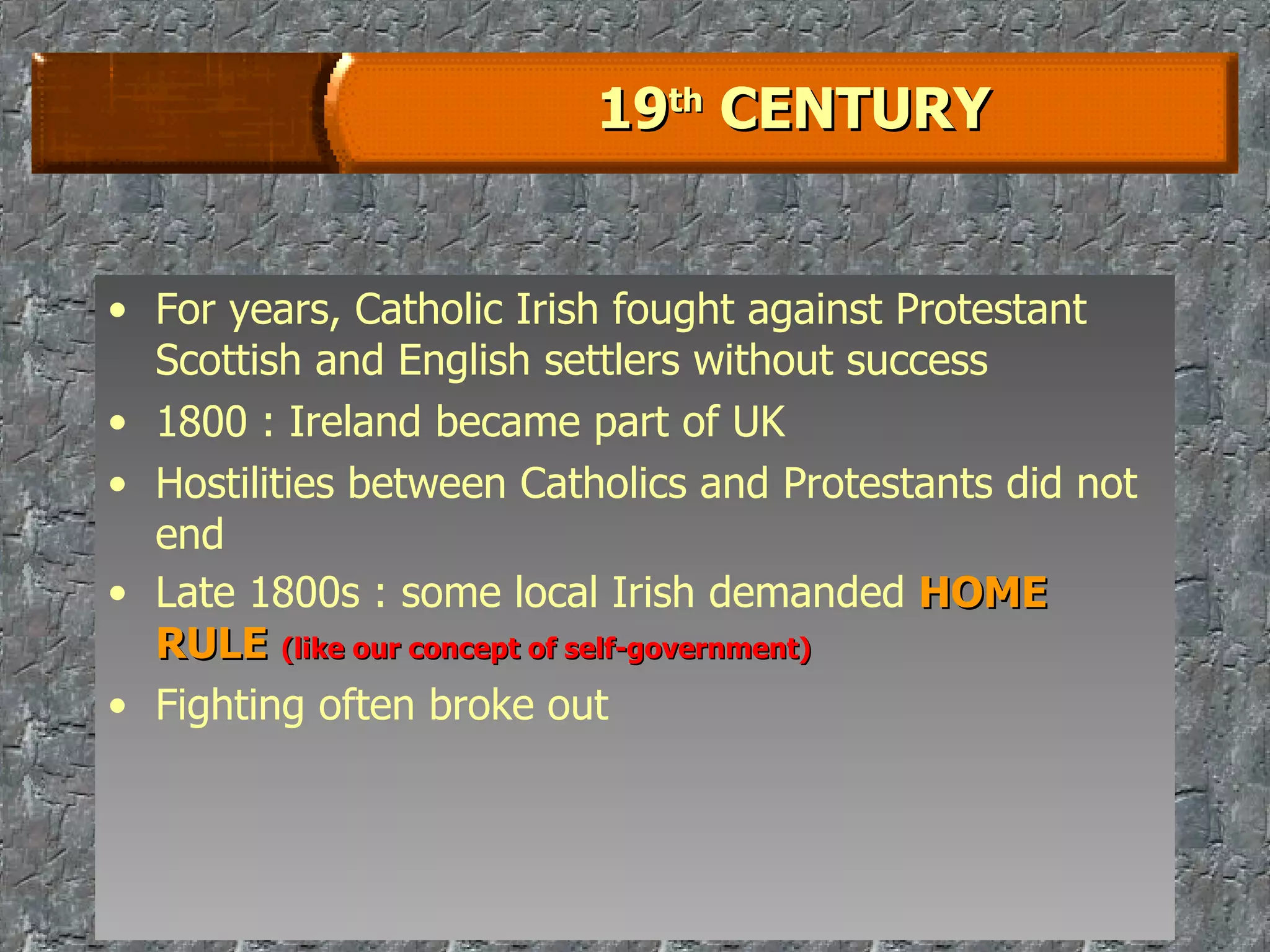
19 th  CENTURY For years, Catholic Irish fought against Protestant Scottish and English settlers without success 1800 : Ireland became part of UK Hostilities between Catholics and Protestants did not end Late 1800s : some local Irish demanded  HOME RULE   (like our concept of self-government) Fighting often broke out
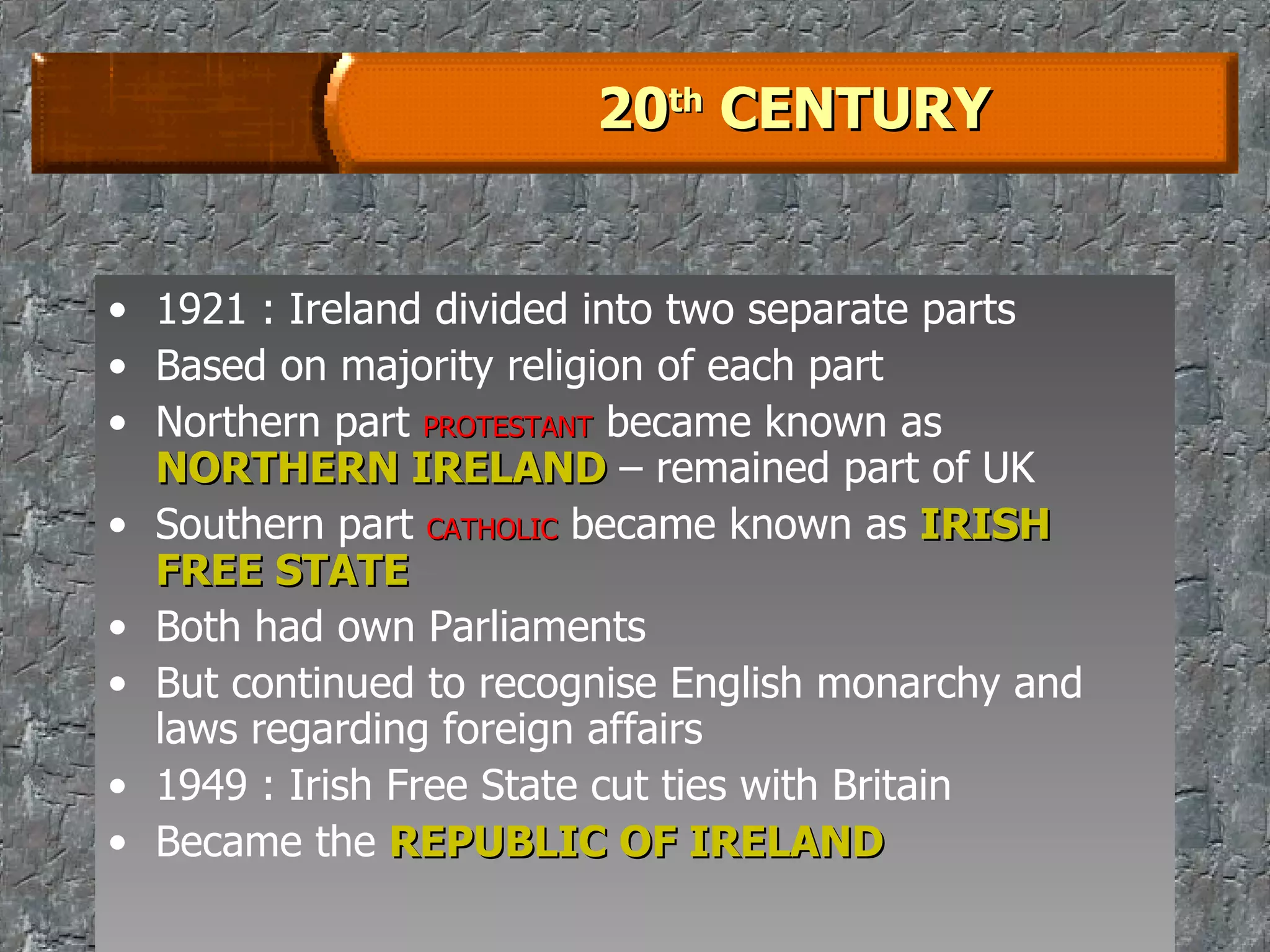
20 th  CENTURY 1921 : Ireland divided into two separate parts Based on majority religion of each part Northern part  PROTESTANT  became known as  NORTHERN IRELAND  – remained part of UK Southern part  CATHOLIC  became known as  IRISH FREE STATE Both had own Parliaments But continued to recognise English monarchy and laws regarding foreign affairs 1949 : Irish Free State cut ties with Britain Became the  REPUBLIC OF IRELAND
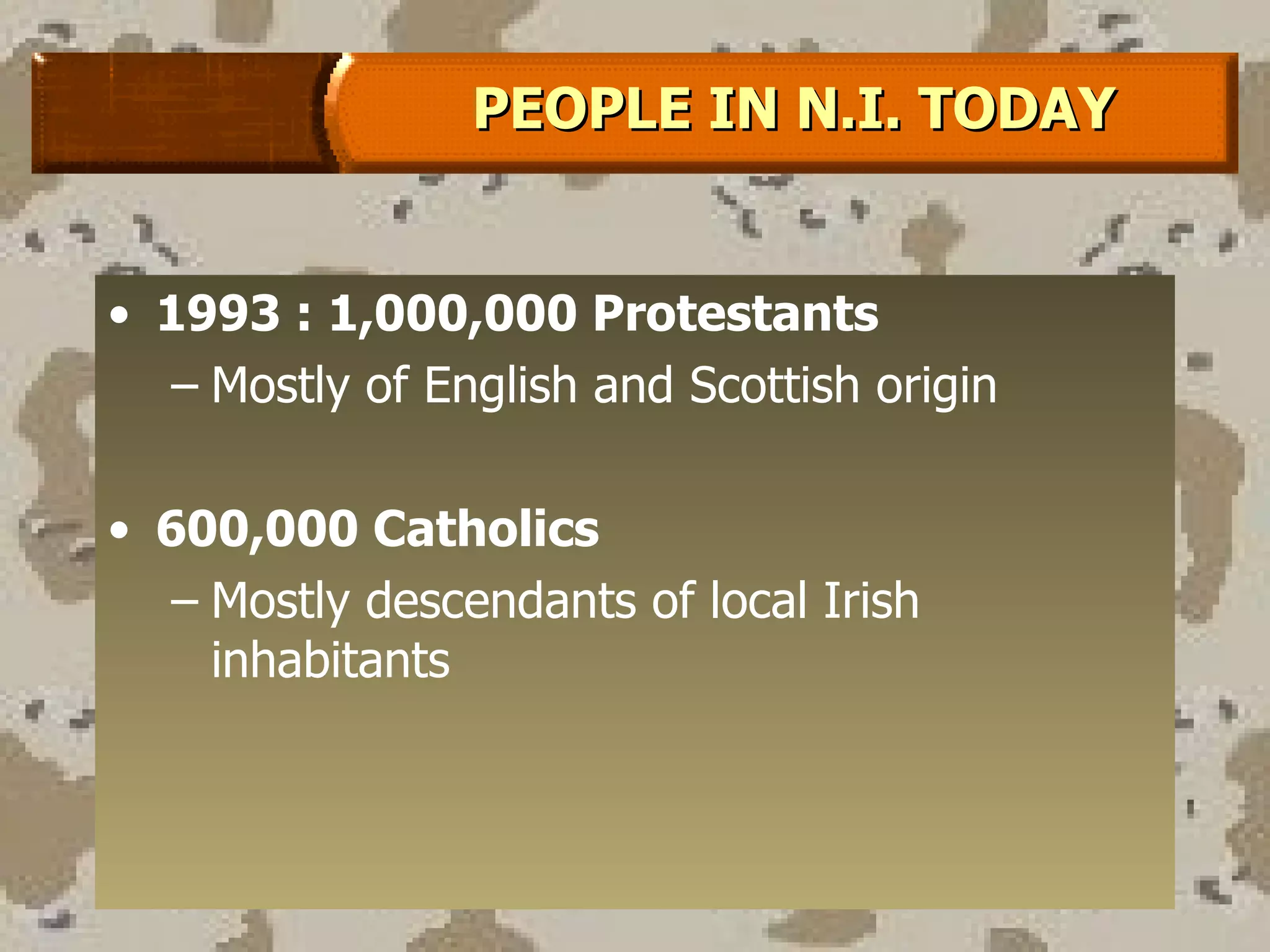
1993 : 1,000,000 Protestants Mostly of English and Scottish origin 600,000 Catholics Mostly descendants of local Irish inhabitants  PEOPLE IN N.I. TODAY
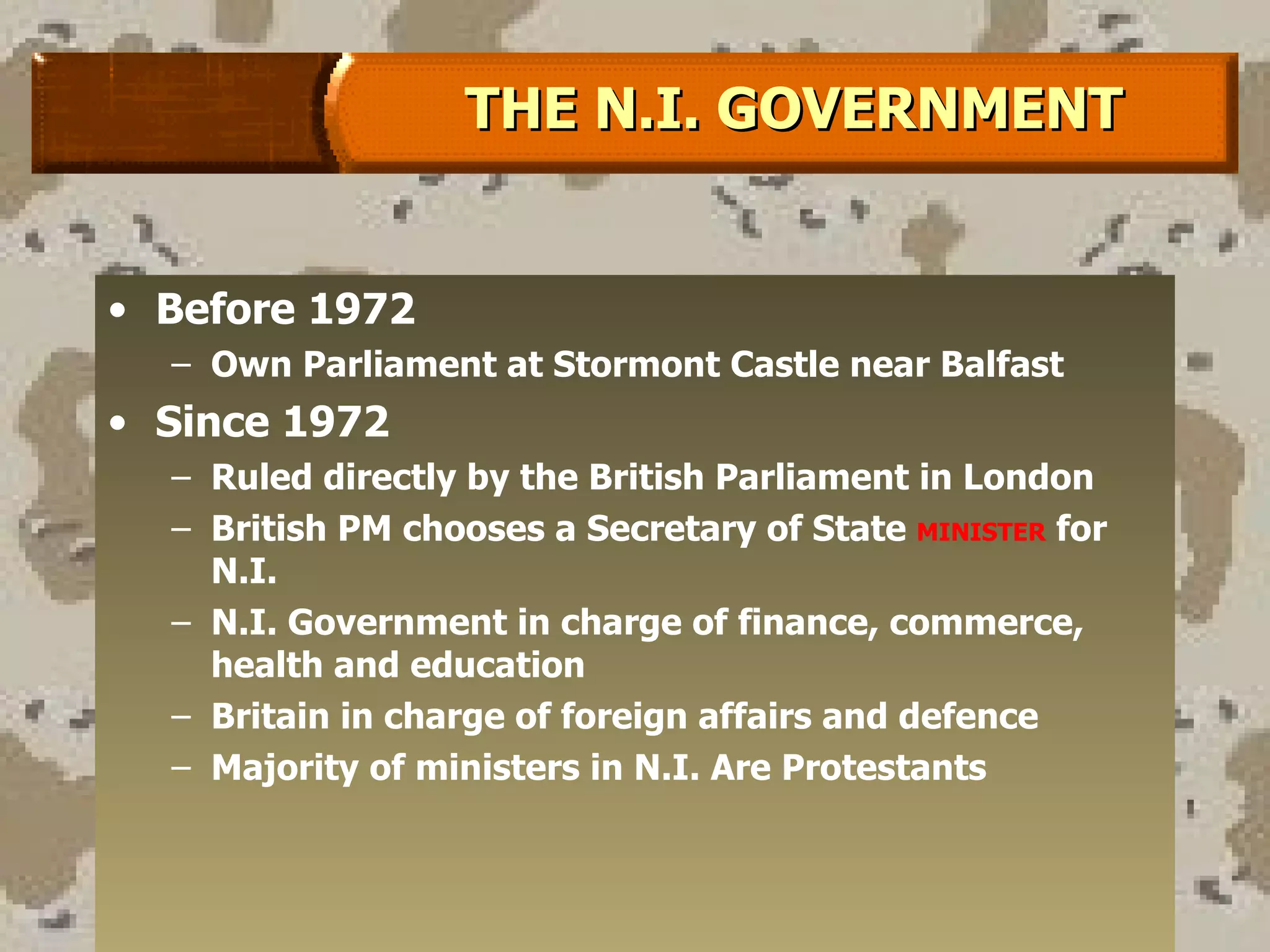
Before 1972 Own Parliament at Stormont Castle near Balfast Since 1972 Ruled directly by the British Parliament in London British PM chooses a Secretary of State  MINISTER  for N.I. N.I. Government in charge of finance, commerce, health and education Britain in charge of foreign affairs and defence Majority of ministers in N.I. Are Protestants  THE N.I. GOVERNMENT
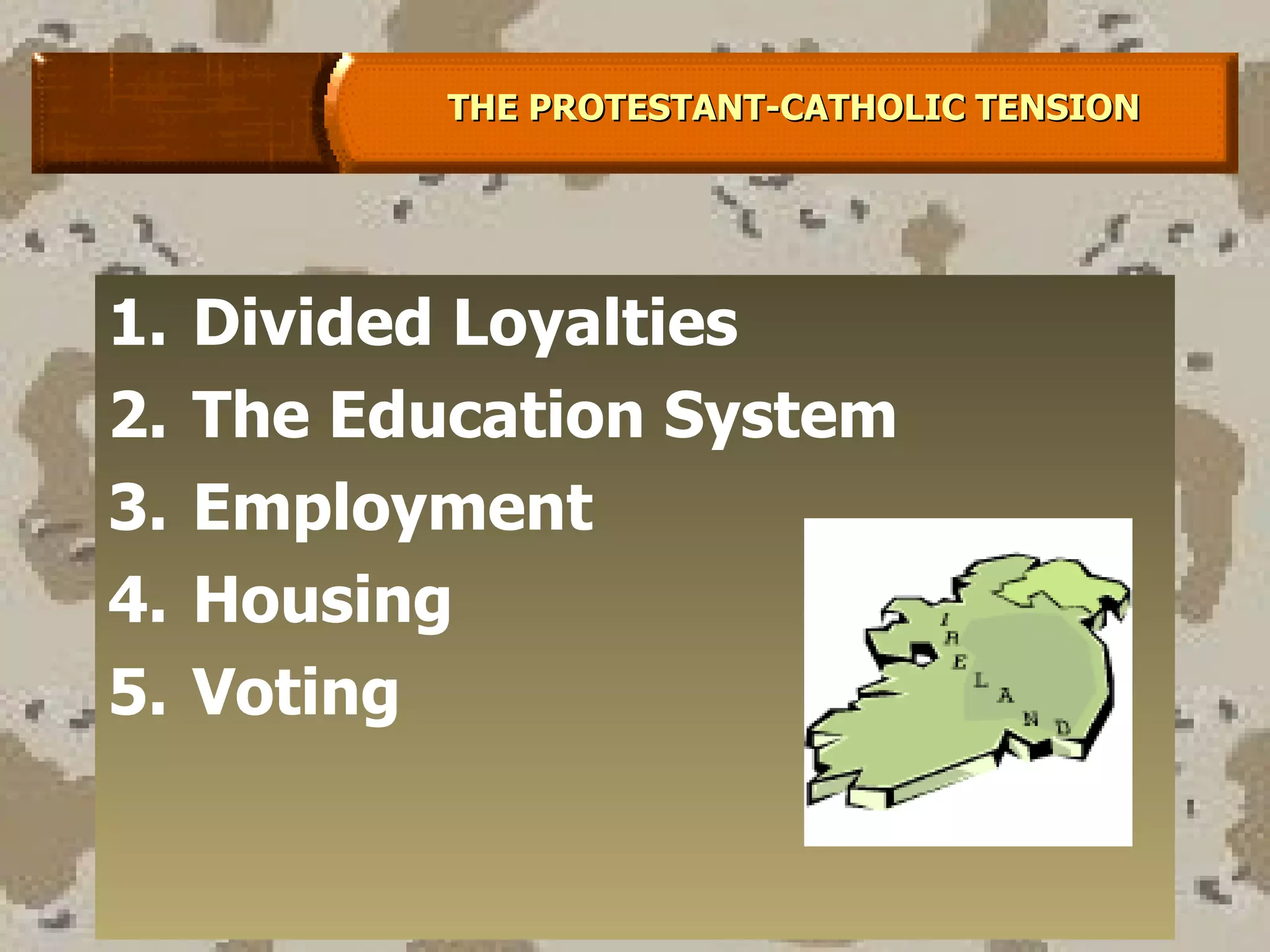
Divided Loyalties The Education System Employment Housing Voting THE PROTESTANT-CATHOLIC TENSION
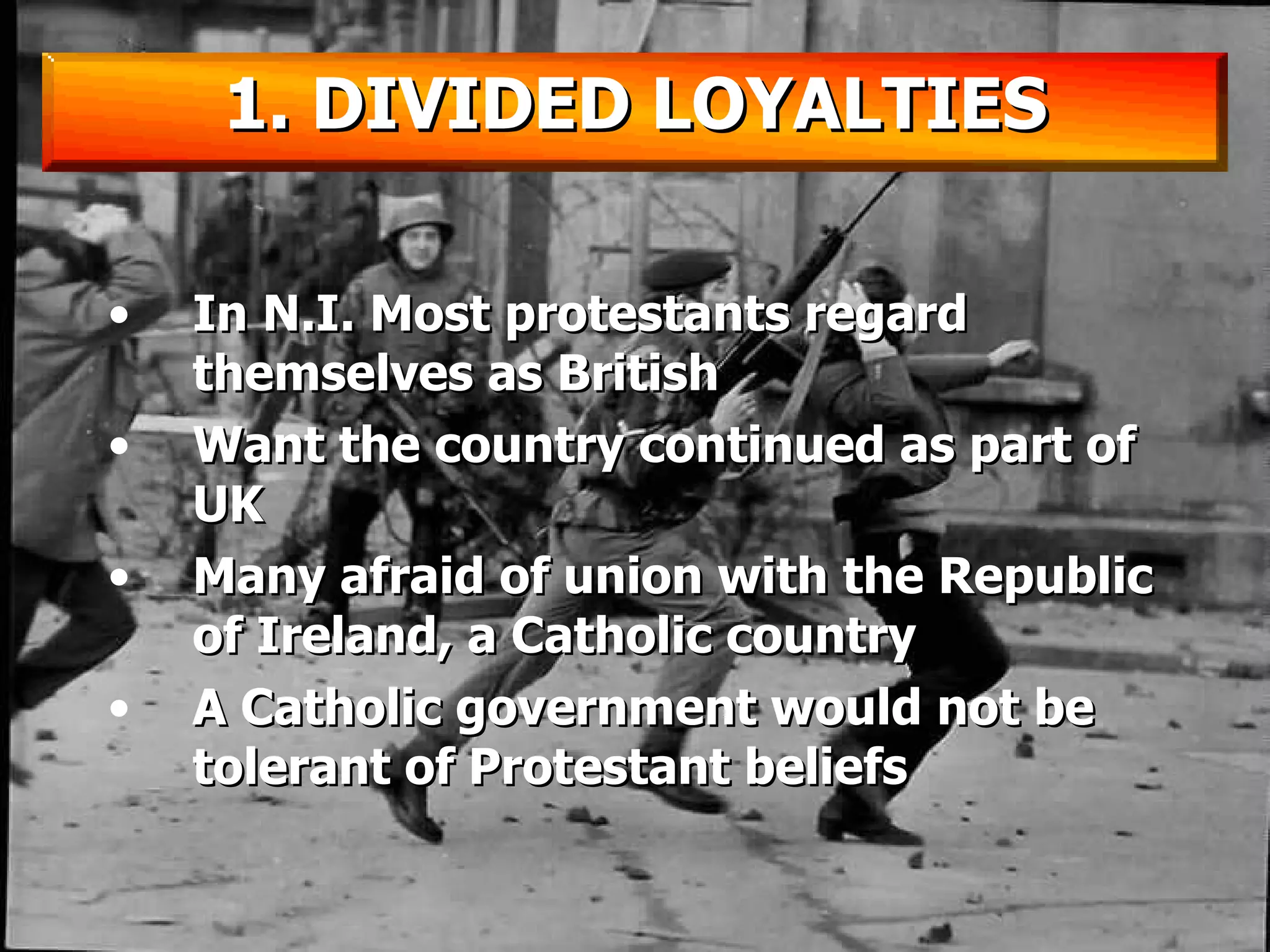
In N.I. Most protestants regard themselves as British Want the country continued as part of UK Many afraid of union with the Republic of Ireland, a Catholic country A Catholic government would not be tolerant of Protestant beliefs 1. DIVIDED LOYALTIES
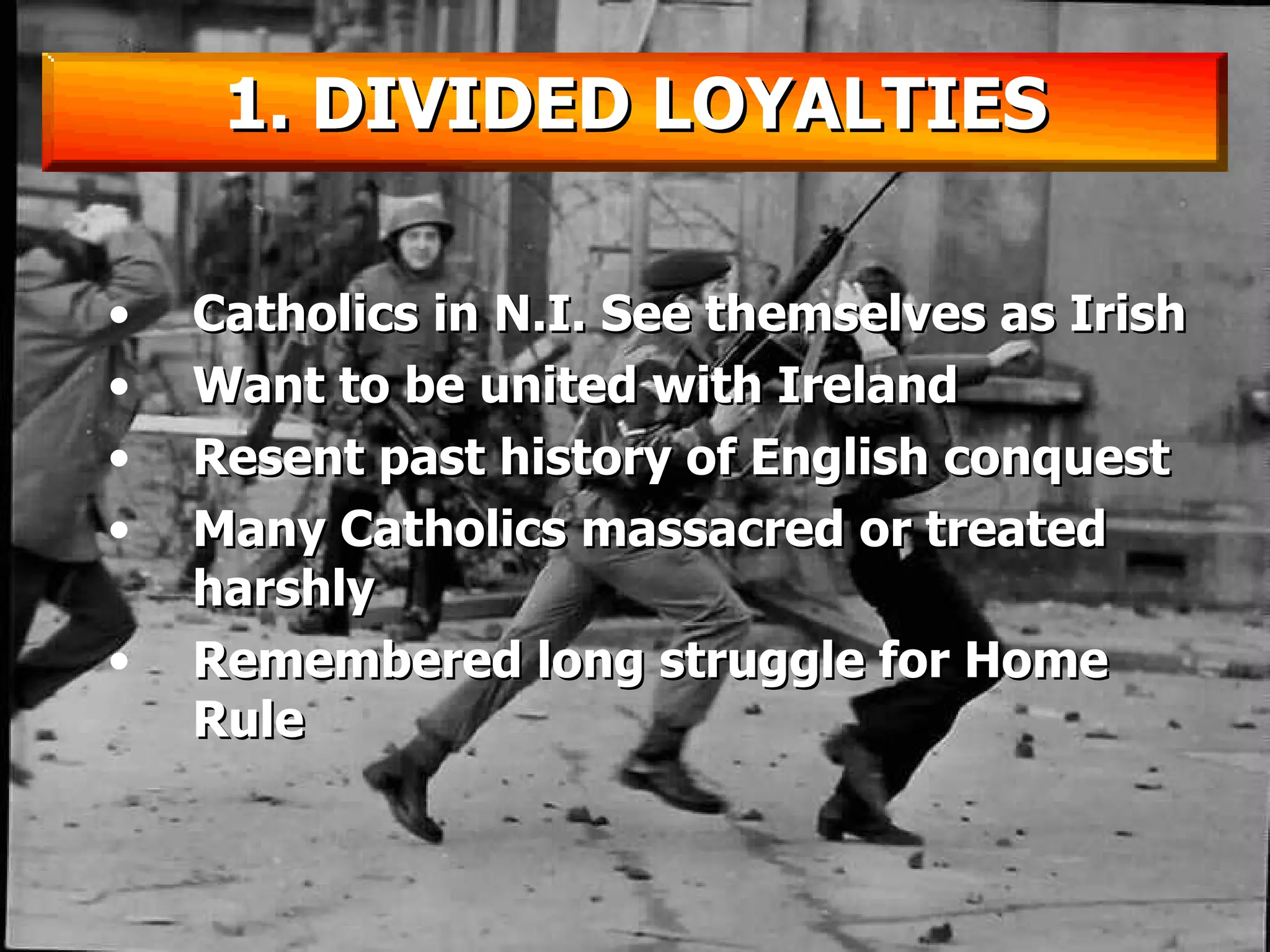
Catholics in N.I. See themselves as Irish Want to be united with Ireland Resent past history of English conquest Many Catholics massacred or treated harshly Remembered long struggle for Home Rule 1. DIVIDED LOYALTIES
Protestants – celebrate annv of battle of Boyne as a mark of protestant dominance Usually march through Catholic residential areas This sense of loyalty to different countries make them intolerant of each other 1. DIVIDED LOYALTIES
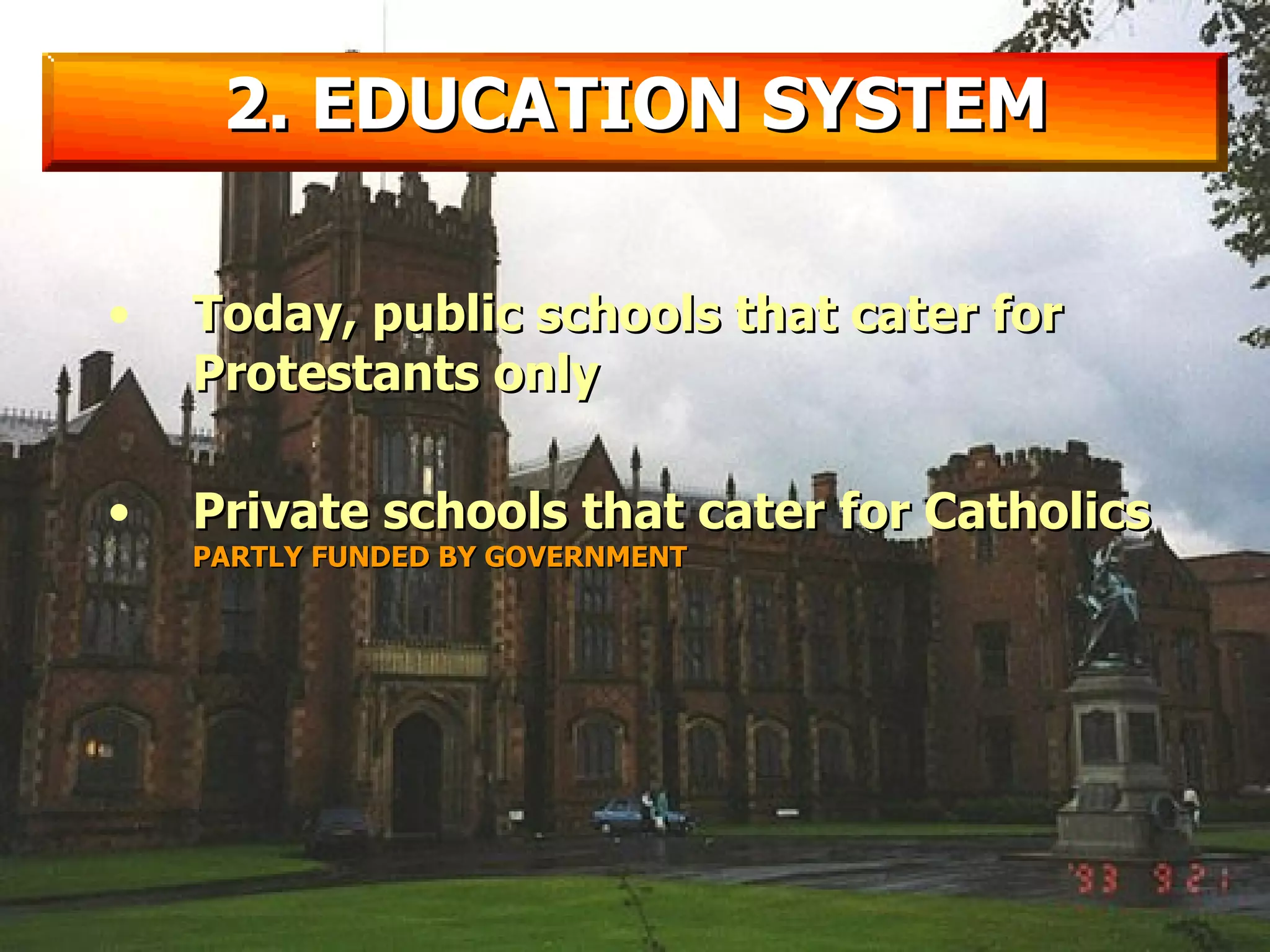
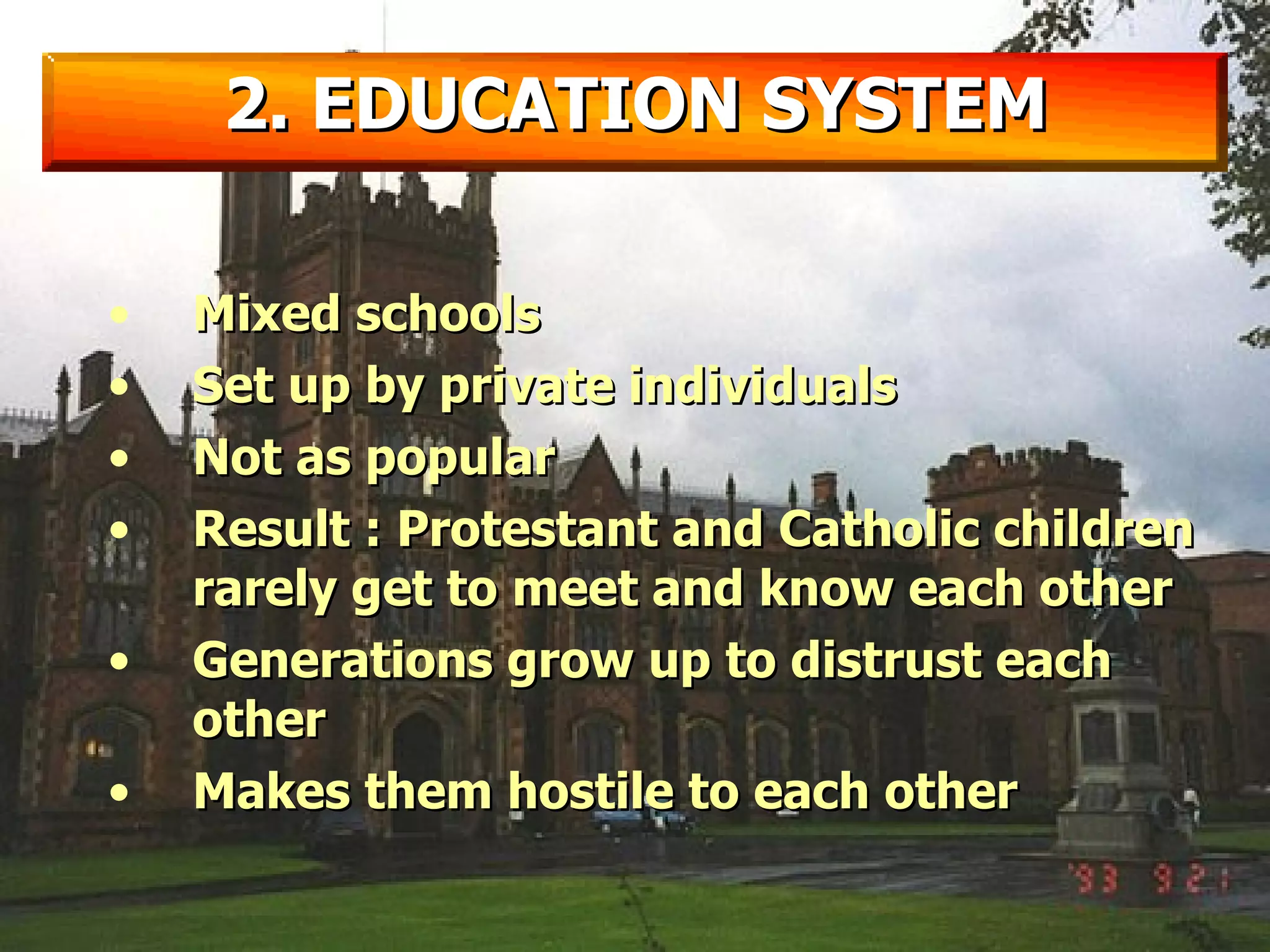
Today, public schools that cater for Protestants only Private schools that cater for Catholics  PARTLY FUNDED BY GOVERNMENT 2. EDUCATION SYSTEM
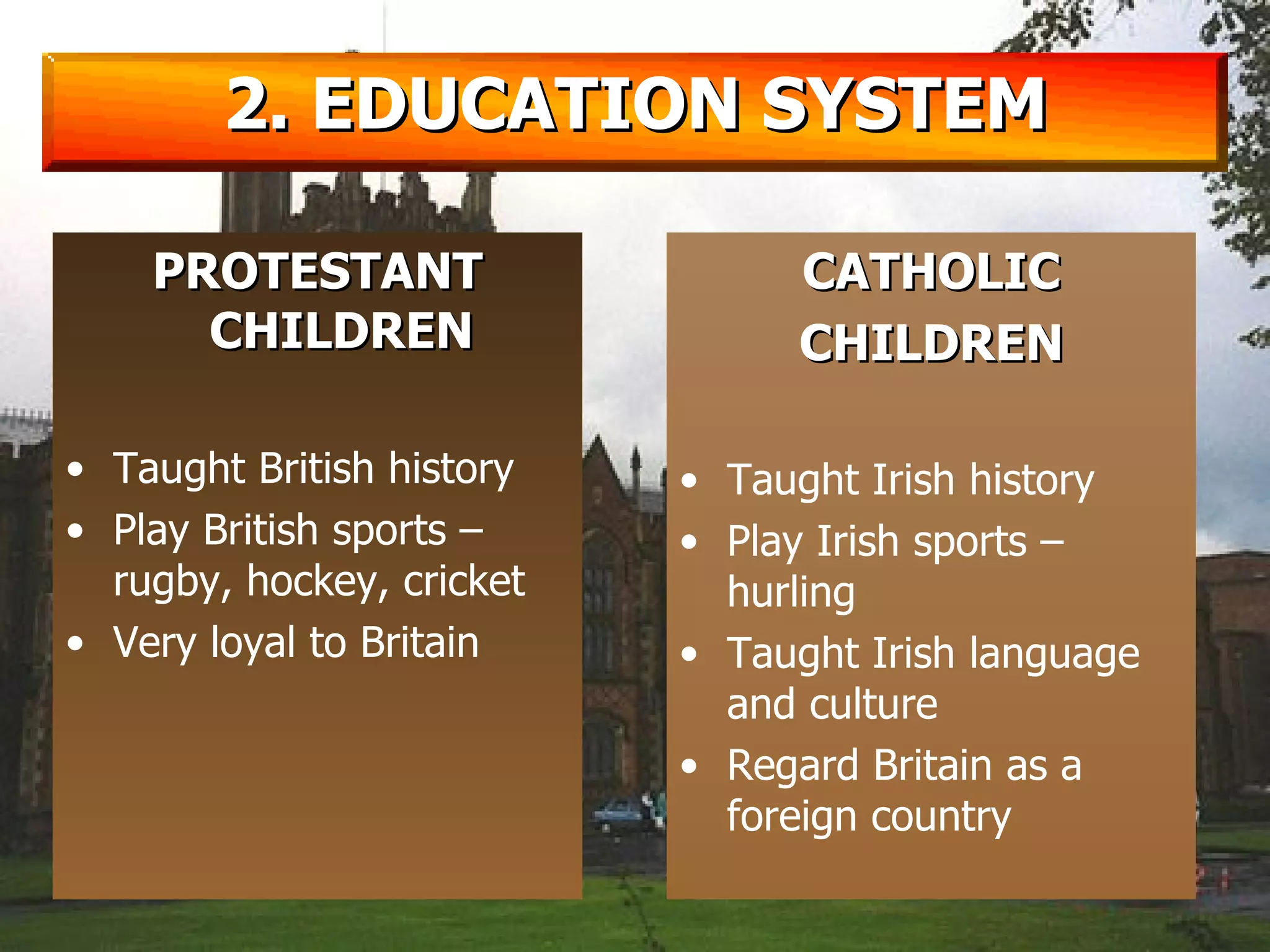
2. EDUCATION SYSTEM PROTESTANT CHILDREN Taught British history Play British sports – rugby, hockey, cricket Very loyal to Britain CATHOLIC CHILDREN Taught Irish history Play Irish sports – hurling Taught Irish language and culture Regard Britain as a foreign country
2. EDUCATION SYSTEM Mixed schools Set up by private individuals Not as popular Result : Protestant and Catholic children rarely get to meet and know each other Generations grow up to distrust each other Makes them hostile to each other
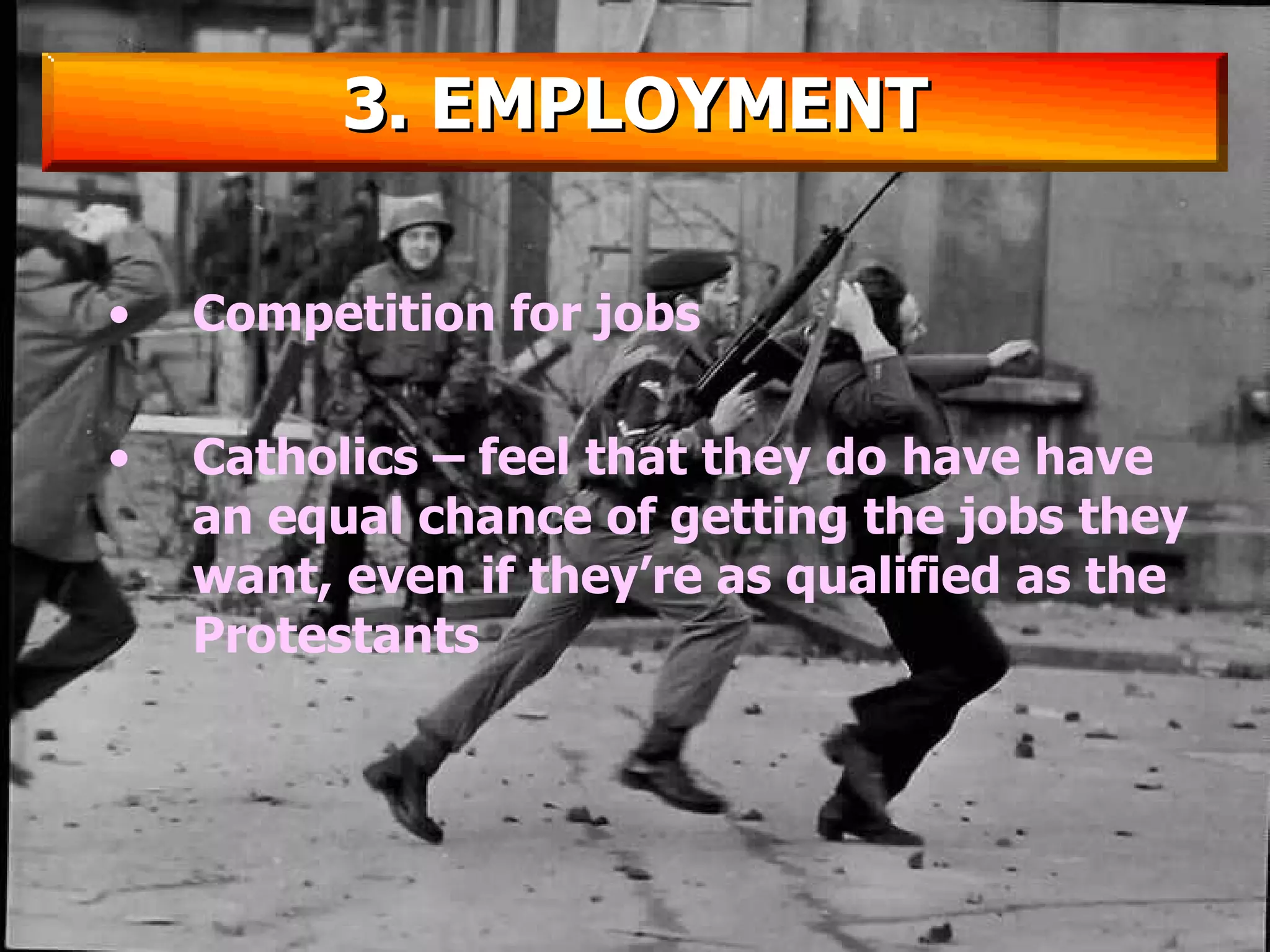
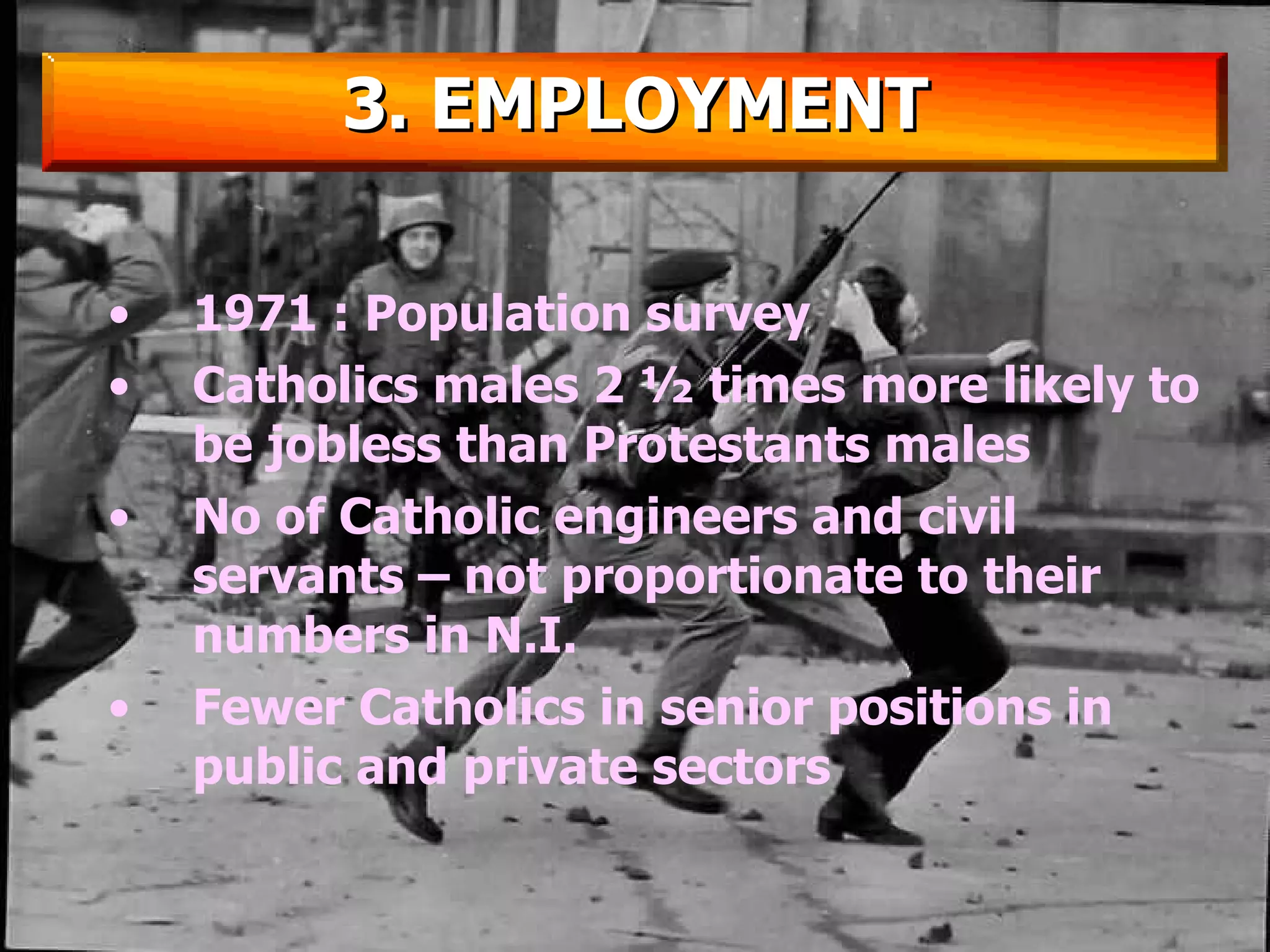
Competition for jobs Catholics – feel that they do have have an equal chance of getting the jobs they want, even if they’re as qualified as the Protestants 3. EMPLOYMENT
1971 : Population survey Catholics males 2 ½ times more likely to be jobless than Protestants males No of Catholic engineers and civil servants – not proportionate to their numbers in N.I. Fewer Catholics in senior positions in public and private sectors 3. EMPLOYMENT
Grievance : Provision of public housing by city councils  PARTLY PAID FOR BY GOVT Councils comprise largely Protestants Catholics often delayed in getting public housing 1968 : 71% of local houses in Dungannon given to Protestants but 53% of the people there were Catholics 4. HOUSING
Catholics frustrated – shortage of houses means they have to wait many years before getting own house Thus find provision of housing unfair 4. HOUSING
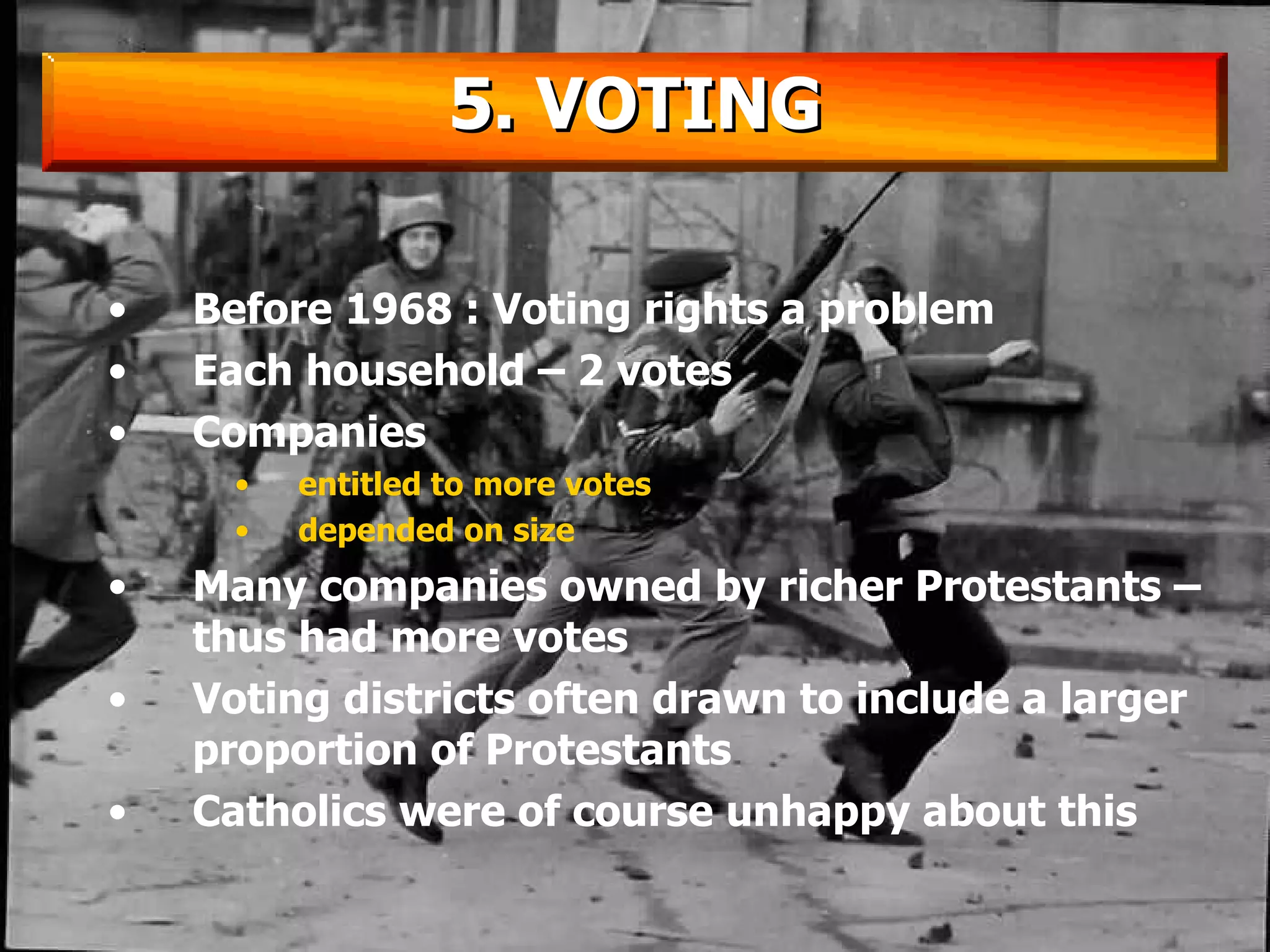
Before 1968 : Voting rights a problem Each household – 2 votes Companies  entitled to more votes  depended on size Many companies owned by richer Protestants – thus had more votes Voting districts often drawn to include a larger proportion of Protestants Catholics were of course unhappy about this 5. VOTING
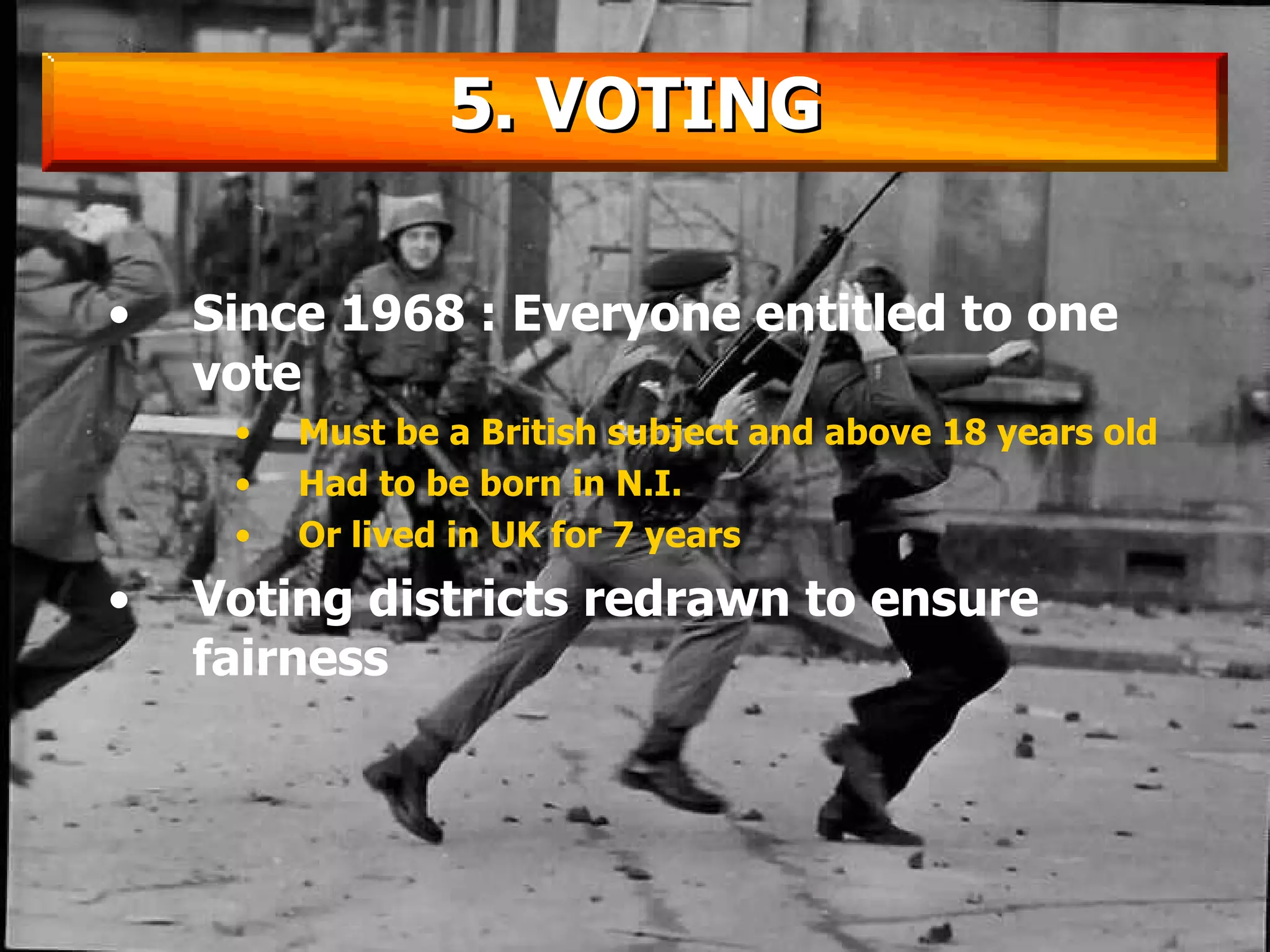
Since 1968 : Everyone entitled to one vote Must be a British subject and above 18 years old Had to be born in N.I.  Or lived in UK for 7 years Voting districts redrawn to ensure fairness 5. VOTING
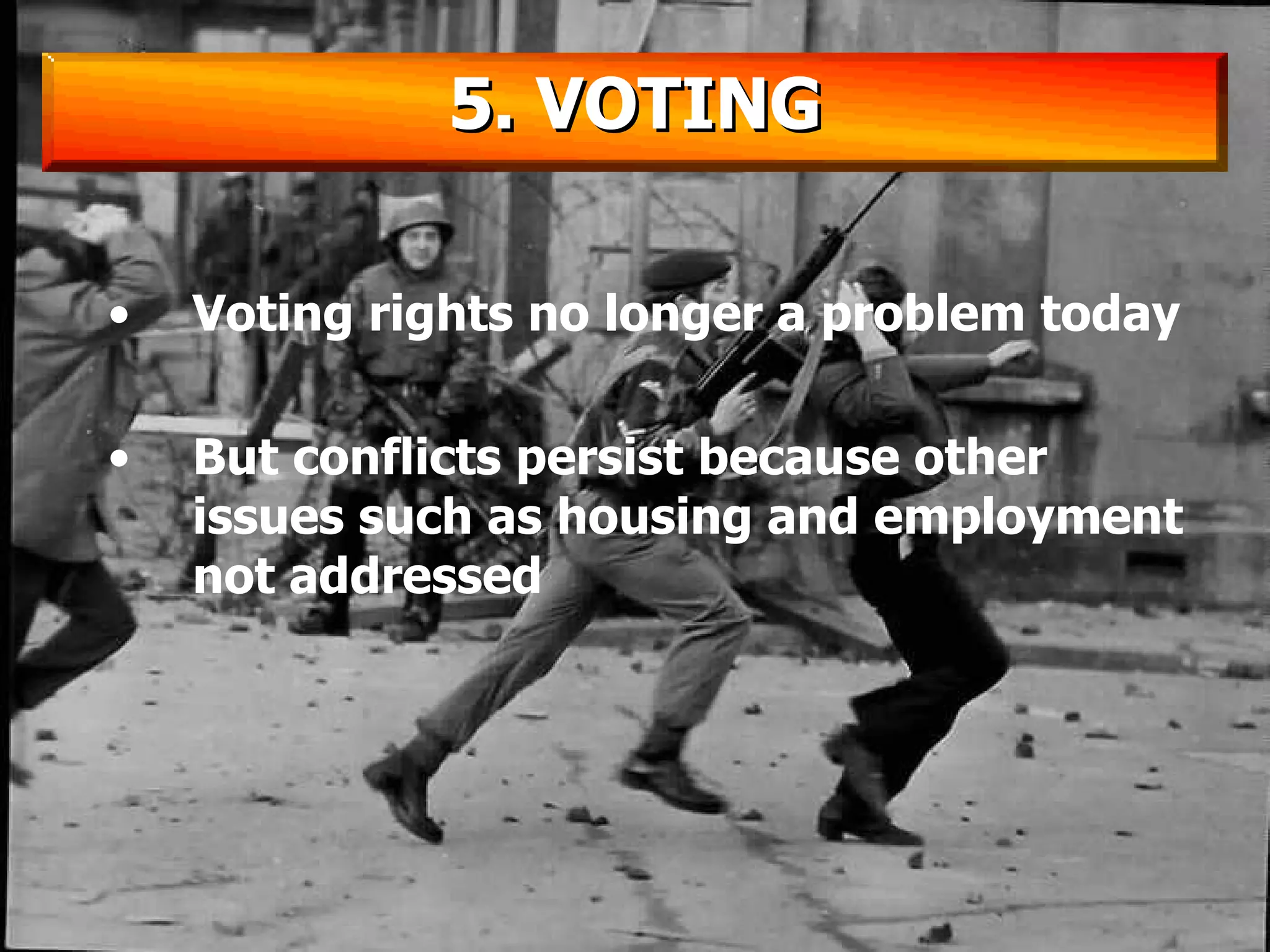
Voting rights no longer a problem today But conflicts persist because other issues such as housing and employment not addressed 5. VOTING
VIDEO CLIP : CAUSES OF THE CONFLICT
CONSEQUENCES How did the Catholics make their demands? Effects of the Protestant-Catholic Conflict Conclusion

Ch3 ni pt1

  • 1.
  • 2.
  • 3.
  • 4.
    SRI LANKA RacialDifferences Sinhalese vs Tamils Conflicts over Citizenship rights Government Jobs University Admission Resettlement of Population NORTHERN IRELAND Religious Differences Protestants vs Catholics Conflicts over Divided Loyalties The Education System Employment Housing Voting
  • 5.
    SRI LANKA ConsequencesArmed Conflict Unemployment Loss of Foreign Investment Fall in Tourists Foreign Intervention NORTHERN IRELAND Consequences Peaceful Protests to Violence Unemployment Loss of Foreign Investment Fall in Tourists Foreign Intervention
  • 6.
  • 7.
    HISTORY OF N.I. United Kingdom and Republic of Ireland UK : BRITAIN England, Scotland, Wales and N.I. Let’s tour Britain & London
  • 8.
    HISTORY OF N.I. Before 12 th century In the 12 th century 1690 1800
  • 9.
    12 TH CENTURY Before 12 th century N.I. & Republic of Ireland = IRELAND In the 12 th century Ireland conquered and colonised by England
  • 10.
    1690 (17 th CENTURY) King James II of England, a Catholic Forced to flee to north of Ireland. Why? Because he failed to force Catholicism on the Protestants in England There, he tried to defeat the locals New King of England, William of Orange PROTESTANT arrived in north of Ireland and defeated King James Battle of Boyne King William remains a hero to Protestants to this day
  • 11.
    17 th CENTURY 17 TH century : England ruled Ireland English landlords in Ireland brought in Protestant Scottish and English settlers To increase Protestant population there Newcomers – settled in northern part of Ireland Pushed out many local Irish Catholic farmers Those Irish Catholics who stayed behind given least fertile lands Northern part of Ireland thus became mainly Protestant
  • 12.
    17 th CENTURY The Scots like to wear kilts What they wear beneath that is anybody’s guess!
  • 13.
    19 th CENTURY For years, Catholic Irish fought against Protestant Scottish and English settlers without success 1800 : Ireland became part of UK Hostilities between Catholics and Protestants did not end Late 1800s : some local Irish demanded HOME RULE (like our concept of self-government) Fighting often broke out
  • 14.
    20 th CENTURY 1921 : Ireland divided into two separate parts Based on majority religion of each part Northern part PROTESTANT became known as NORTHERN IRELAND – remained part of UK Southern part CATHOLIC became known as IRISH FREE STATE Both had own Parliaments But continued to recognise English monarchy and laws regarding foreign affairs 1949 : Irish Free State cut ties with Britain Became the REPUBLIC OF IRELAND
  • 15.
    1993 : 1,000,000Protestants Mostly of English and Scottish origin 600,000 Catholics Mostly descendants of local Irish inhabitants PEOPLE IN N.I. TODAY
  • 16.
    Before 1972 OwnParliament at Stormont Castle near Balfast Since 1972 Ruled directly by the British Parliament in London British PM chooses a Secretary of State MINISTER for N.I. N.I. Government in charge of finance, commerce, health and education Britain in charge of foreign affairs and defence Majority of ministers in N.I. Are Protestants THE N.I. GOVERNMENT
  • 17.
    Divided Loyalties TheEducation System Employment Housing Voting THE PROTESTANT-CATHOLIC TENSION
  • 18.
    In N.I. Mostprotestants regard themselves as British Want the country continued as part of UK Many afraid of union with the Republic of Ireland, a Catholic country A Catholic government would not be tolerant of Protestant beliefs 1. DIVIDED LOYALTIES
  • 19.
    Catholics in N.I.See themselves as Irish Want to be united with Ireland Resent past history of English conquest Many Catholics massacred or treated harshly Remembered long struggle for Home Rule 1. DIVIDED LOYALTIES
  • 20.
    Protestants – celebrateannv of battle of Boyne as a mark of protestant dominance Usually march through Catholic residential areas This sense of loyalty to different countries make them intolerant of each other 1. DIVIDED LOYALTIES
  • 21.
    Today, public schoolsthat cater for Protestants only Private schools that cater for Catholics PARTLY FUNDED BY GOVERNMENT 2. EDUCATION SYSTEM
  • 22.
    2. EDUCATION SYSTEMPROTESTANT CHILDREN Taught British history Play British sports – rugby, hockey, cricket Very loyal to Britain CATHOLIC CHILDREN Taught Irish history Play Irish sports – hurling Taught Irish language and culture Regard Britain as a foreign country
  • 23.
    2. EDUCATION SYSTEMMixed schools Set up by private individuals Not as popular Result : Protestant and Catholic children rarely get to meet and know each other Generations grow up to distrust each other Makes them hostile to each other
  • 24.
    Competition for jobsCatholics – feel that they do have have an equal chance of getting the jobs they want, even if they’re as qualified as the Protestants 3. EMPLOYMENT
  • 25.
    1971 : Populationsurvey Catholics males 2 ½ times more likely to be jobless than Protestants males No of Catholic engineers and civil servants – not proportionate to their numbers in N.I. Fewer Catholics in senior positions in public and private sectors 3. EMPLOYMENT
  • 26.
    Grievance : Provisionof public housing by city councils PARTLY PAID FOR BY GOVT Councils comprise largely Protestants Catholics often delayed in getting public housing 1968 : 71% of local houses in Dungannon given to Protestants but 53% of the people there were Catholics 4. HOUSING
  • 27.
    Catholics frustrated –shortage of houses means they have to wait many years before getting own house Thus find provision of housing unfair 4. HOUSING
  • 28.
    Before 1968 :Voting rights a problem Each household – 2 votes Companies entitled to more votes depended on size Many companies owned by richer Protestants – thus had more votes Voting districts often drawn to include a larger proportion of Protestants Catholics were of course unhappy about this 5. VOTING
  • 29.
    Since 1968 :Everyone entitled to one vote Must be a British subject and above 18 years old Had to be born in N.I. Or lived in UK for 7 years Voting districts redrawn to ensure fairness 5. VOTING
  • 30.
    Voting rights nolonger a problem today But conflicts persist because other issues such as housing and employment not addressed 5. VOTING
  • 31.
    VIDEO CLIP :CAUSES OF THE CONFLICT
  • 32.
    CONSEQUENCES How didthe Catholics make their demands? Effects of the Protestant-Catholic Conflict Conclusion