3
https://www.google.com/se
arch?q=pics+of+interview
V E E I
W
T
R
N
I
I N E W
I
V
R
E
T
https://www.google.com/search?q=pic
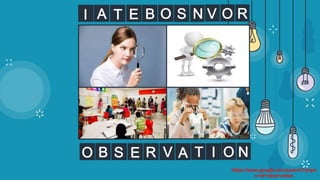
s+of+observation
5
https://www.google.com/search?q=
pics+of+survey
Y R E
S
V
U
S U Y
E
V
R
6
T T S E
T E S T
7
https://www.google.com/search?q=pics+of+survey
https://www.google.c
om/search?q=pics+o
f+experimentation
M R X I
P
E
N
T
E E
E X E N
M
I
R
E
P T
8
INTERVIEW
TEST
OBSERVATION
SURVEY
WAYS OF COLLECTING
DATA
EXPERIMENT
QUESTIONNAIRE
9
DATA COLLECTION
DATA COLLECTION
 It is a systematic process of gathering and measuring
information on variables of interest in an established
fashion that enables one to answer stated research
questions, test hypotheses and evaluate outcomes
 It allows you to gain first-hand knowledge and insights
into your research problem
10
DATA COLLECTION
Methods of Data Collection
❖ 1. Primary Data Collection uses surveys,
interviews, questionnaires, tests, observations,
checklist and rating scales
❖ 2. Secondary Data Collection is conducted in
obtaining information in journals, books annuals,
reports, websites, and other publications available
for public use.
11
DATA COLLECTION
Techniques of Data Collection
1. SURVEY is a data-gathering technique that
makes you obtain facts or information about the
subject or object of the research through the data
gathering instruments.
12
DATA COLLECTION
Techniques of Data Collection
⊹ a. Questionnaire is a series of questions to
elicit information that is distributed and filled in by the
respondents under the supervision of the investigator
or interviewer.
Conducting survey makes use of the following
instruments:
13
DATA COLLECTION
Techniques of Data Collection
1. STRUCTURED employs close-ended
questions
Structures of a questionnaire
 Closed Form/Open Ended gives the
respondents the ability to respond in their
own words.
14
DATA COLLECTION
Techniques of Data Collection
2. UNSTRUCTURED uses open-ended
questions
3. SEMI-STRUCTURED consists of close-ended open-
ended questions
 Closed Form/Open ended allows the
respondents choose from the given
alternatives
15
DATA COLLECTION
Techniques of Data Collection
⊹ b. Interview it involves a verbal communication
between the researcher and the respondents.
Since the researchers are doing quantitative
research, it is expected that responses have
numerical value either it is nominal or ordinal in
form.
16
DATA COLLECTION
Techniques of Data Collection
⊹ 2. TEST are used for measuring various skills,
types of personality, achievement, performance
and some which describe characteristics. It is
also used to develop to measure specific
knowledge, skill or cognitive ability.
17
DATA COLLECTION
Techniques of Data Collection
⊹ Two kinds of TESTS
⊹ a. STANDARDIZED TEST is any form of test that (1)
requires all test takers to answer the same questions,
or a selection of questions in the same way, and that
(2) is scored in a “standard” or consistent manner,
which makes it possible to compare the relative
performance of individual students or groups of
students.
18
DATA COLLECTION
Techniques of Data Collection
⊹ b. NON-STANDARDIZED TEST is an
assessment that considers an individual's
performance, and does not produce scores that
allow us to compare that performance to another's.
It allows us to obtain specific information about the
student, and this can be in different formats.
19
DATA COLLECTION
Techniques of Data Collection
⊹ 3. EXPERIMENT is defined as a scientific method
of collecting data and attempts to determine a cause
and effect relationship between two or more
variables. It has treatment, interventions and
condition.
20
DATA COLLECTION
Techniques of Data Collection
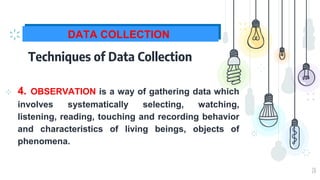
⊹ 4. OBSERVATION is a way of gathering data which
involves systematically selecting, watching,
listening, reading, touching and recording behavior
and characteristics of living beings, objects of
phenomena.
21
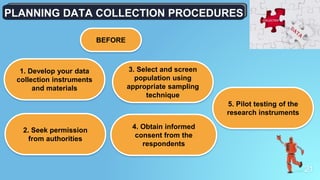
PLANNING DATA COLLECTION PROCEDURES
1. Develop your data
collection instruments
and materials
2. Seek permission
from authorities
3. Select and screen
population using
appropriate sampling
technique
4. Obtain informed
consent from the
respondents
5. Pilot testing of the
research instruments
BEFORE
22
PLANNING DATA COLLECTION PROCEDURES
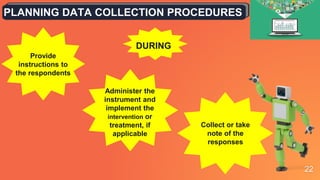
Provide
instructions to
the respondents
Administer the
instrument and
implement the
intervention or
treatment, if
applicable
DURING
Collect or take
note of the
responses
23
PLANNING DATA COLLECTION PROCEDURES
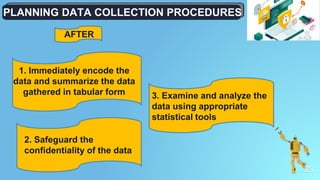
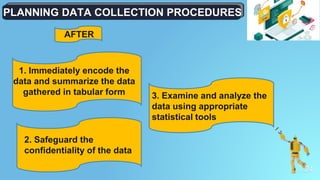
1. Immediately encode the
data and summarize the data
gathered in tabular form
2. Safeguard the
confidentiality of the data
3. Examine and analyze the
data using appropriate
statistical tools
AFTER
24
PLANNING DATA COLLECTION PROCEDURES
1. Immediately encode the
data and summarize the data
gathered in tabular form
2. Safeguard the
confidentiality of the data
3. Examine and analyze the
data using appropriate
statistical tools
AFTER
“
Thank you very
much!
25

Research-Instrument data collection for research

  • 3.
  • 4.
  • 5.
  • 6.
    6 T T SE T E S T
  • 7.
  • 8.
  • 9.
    9 DATA COLLECTION DATA COLLECTION It is a systematic process of gathering and measuring information on variables of interest in an established fashion that enables one to answer stated research questions, test hypotheses and evaluate outcomes  It allows you to gain first-hand knowledge and insights into your research problem
  • 10.
    10 DATA COLLECTION Methods ofData Collection ❖ 1. Primary Data Collection uses surveys, interviews, questionnaires, tests, observations, checklist and rating scales ❖ 2. Secondary Data Collection is conducted in obtaining information in journals, books annuals, reports, websites, and other publications available for public use.
  • 11.
    11 DATA COLLECTION Techniques ofData Collection 1. SURVEY is a data-gathering technique that makes you obtain facts or information about the subject or object of the research through the data gathering instruments.
  • 12.
    12 DATA COLLECTION Techniques ofData Collection ⊹ a. Questionnaire is a series of questions to elicit information that is distributed and filled in by the respondents under the supervision of the investigator or interviewer. Conducting survey makes use of the following instruments:
  • 13.
    13 DATA COLLECTION Techniques ofData Collection 1. STRUCTURED employs close-ended questions Structures of a questionnaire  Closed Form/Open Ended gives the respondents the ability to respond in their own words.
  • 14.
    14 DATA COLLECTION Techniques ofData Collection 2. UNSTRUCTURED uses open-ended questions 3. SEMI-STRUCTURED consists of close-ended open- ended questions  Closed Form/Open ended allows the respondents choose from the given alternatives
  • 15.
    15 DATA COLLECTION Techniques ofData Collection ⊹ b. Interview it involves a verbal communication between the researcher and the respondents. Since the researchers are doing quantitative research, it is expected that responses have numerical value either it is nominal or ordinal in form.
  • 16.
    16 DATA COLLECTION Techniques ofData Collection ⊹ 2. TEST are used for measuring various skills, types of personality, achievement, performance and some which describe characteristics. It is also used to develop to measure specific knowledge, skill or cognitive ability.
  • 17.
    17 DATA COLLECTION Techniques ofData Collection ⊹ Two kinds of TESTS ⊹ a. STANDARDIZED TEST is any form of test that (1) requires all test takers to answer the same questions, or a selection of questions in the same way, and that (2) is scored in a “standard” or consistent manner, which makes it possible to compare the relative performance of individual students or groups of students.
  • 18.
    18 DATA COLLECTION Techniques ofData Collection ⊹ b. NON-STANDARDIZED TEST is an assessment that considers an individual's performance, and does not produce scores that allow us to compare that performance to another's. It allows us to obtain specific information about the student, and this can be in different formats.
  • 19.
    19 DATA COLLECTION Techniques ofData Collection ⊹ 3. EXPERIMENT is defined as a scientific method of collecting data and attempts to determine a cause and effect relationship between two or more variables. It has treatment, interventions and condition.
  • 20.
    20 DATA COLLECTION Techniques ofData Collection ⊹ 4. OBSERVATION is a way of gathering data which involves systematically selecting, watching, listening, reading, touching and recording behavior and characteristics of living beings, objects of phenomena.
  • 21.
    21 PLANNING DATA COLLECTIONPROCEDURES 1. Develop your data collection instruments and materials 2. Seek permission from authorities 3. Select and screen population using appropriate sampling technique 4. Obtain informed consent from the respondents 5. Pilot testing of the research instruments BEFORE
  • 22.
    22 PLANNING DATA COLLECTIONPROCEDURES Provide instructions to the respondents Administer the instrument and implement the intervention or treatment, if applicable DURING Collect or take note of the responses
  • 23.
    23 PLANNING DATA COLLECTIONPROCEDURES 1. Immediately encode the data and summarize the data gathered in tabular form 2. Safeguard the confidentiality of the data 3. Examine and analyze the data using appropriate statistical tools AFTER
  • 24.
    24 PLANNING DATA COLLECTIONPROCEDURES 1. Immediately encode the data and summarize the data gathered in tabular form 2. Safeguard the confidentiality of the data 3. Examine and analyze the data using appropriate statistical tools AFTER
  • 25.