
 Religion in Historical Perspective
 Sociological Perspectives on Religion
 Types of Religious Organization
 Trends in Religion in the United States
 Religion in the Future
   How does religion affect society as a
    whole (does it divide/unite)? How does
    it affect social institutions like:
    › Marriages, Political Structures, Economy
 How does religion, as a social institution,
  affect the wellbeing of individuals?
 What does it mean to be „religious‟?
  How does one define and measure
  religiosity?
   Religiosity is the extent to which a person
    does one or more of the following:
    › (1) believes in and “feels” or experiences
      certain aspects of religion
    › (2) becomes involved in religious activities
      such as attending church or reading sacred
      texts
    › (3) believes in the teachings of the church,
    › (4) lives in accordance with those teachings
      and beliefs.
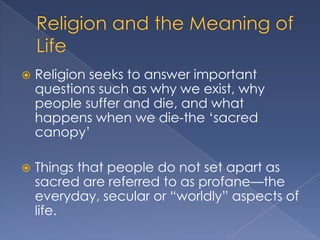
   Religion seeks to answer important
    questions such as why we exist, why
    people suffer and die, and what
    happens when we die-the „sacred
    canopy‟

   Things that people do not set apart as
    sacred are referred to as profane—the
    everyday, secular or “worldly” aspects of
    life.
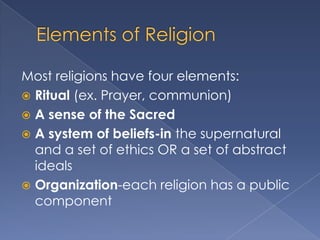
Most religions have four elements:
 Ritual (ex. Prayer, communion)
 A sense of the Sacred
 A system of beliefs-in the supernatural
  and a set of ethics OR a set of abstract
  ideals
 Organization-each religion has a public
  component
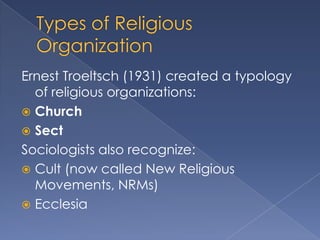
Ernest Troeltsch (1931) created a typology
  of religious organizations:
 Church
 Sect
Sociologists also recognize:
 Cult (now called New Religious
  Movements, NRMs)
 Ecclesia
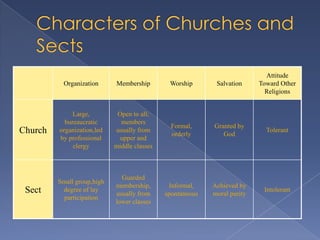
Attitude
           Organization     Membership        Worship       Salvation     Toward Other
                                                                            Religions


              Large,         Open to all;
           bureaucratic       members
                                               Formal,     Granted by
Church   organization,led   usually from
                                               orderly        God
                                                                            Tolerant
         by professional      upper and
              clergy        middle classes


                              Guarded
         Small group,high
                            membership,       Informal,    Achieved by
 Sect     degree of lay
                            usually from     spontaneous   moral purity
                                                                           Intolerant
           participation
                            lower classes
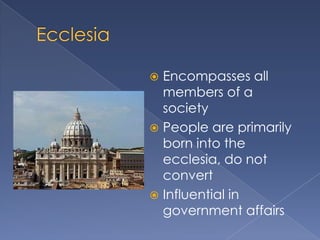
 Encompasses all
  members of a
  society
 People are primarily
  born into the
  ecclesia, do not
  convert
 Influential in
  government affairs
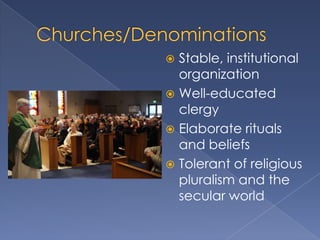
 Stable, institutional
  organization
 Well-educated
  clergy
 Elaborate rituals
  and beliefs
 Tolerant of religious
  pluralism and the
  secular world
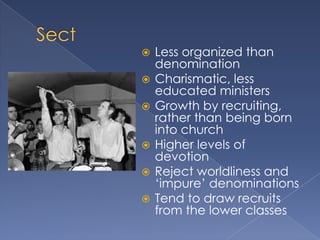
   Less organized than
    denomination
   Charismatic, less
    educated ministers
   Growth by recruiting,
    rather than being born
    into church
   Higher levels of
    devotion
   Reject worldliness and
    „impure‟ denominations
   Tend to draw recruits
    from the lower classes
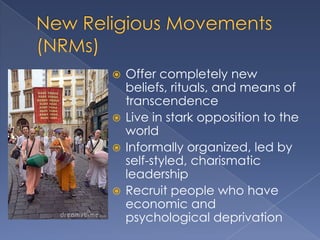
 Offer completely new
  beliefs, rituals, and means of
  transcendence
 Live in stark opposition to the
  world
 Informally organized, led by
  self-styled, charismatic
  leadership
 Recruit people who have
  economic and
  psychological deprivation
 Simple supernaturalism - the belief that
  supernatural forces affect people's lives
  positively or negatively.
 Animism - the belief that plants, animals,
  and elements of the natural world are
  endowed with spirits that impact events in
  society.
 Theism - belief in a God or Gods.
 Transcendent idealism - belief in sacred
  principles of thought and conduct, such as
  truth, justice, life and tolerance for others.
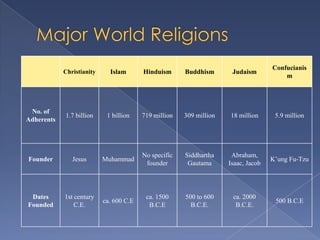
Confucianis
            Christianity     Islam       Hinduism      Buddhism       Judaism
                                                                                        m


 No. of
            1.7 billion     1 billion    719 million   309 million   18 million      5.9 million
Adherents


                                         No specific   Siddhartha     Abraham,
Founder        Jesus       Muhammad                                                 K’ung Fu-Tzu
                                          founder       Gautama      Isaac, Jacob


 Dates      1st century                   ca. 1500     500 to 600     ca. 2000
                           ca. 600 C.E                                               500 B.C.E
Founded         C.E.                       B.C.E         B.C.E.        B.C.E.
 Diverse-85 denominations with atleast
  50,000 members *
 Positive slant of religion-heaven, personal
  blessings, etc. due to „religious
  marketplace‟
 Freedom from Anticlericalism-Americans do
  not have bitter feelings towards priests as
  protectors of the status quo
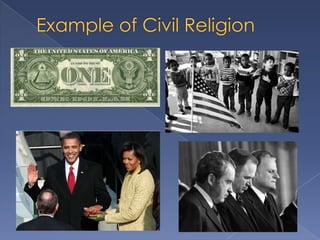
 Civil religion-God is frequently invoked in
  American rituals, symbols, etc, with little
  reference to which God/beliefs
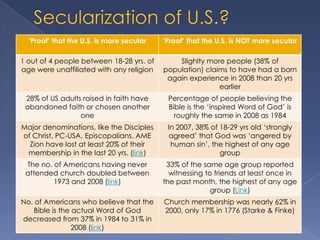
‘Proof’ that the U.S. is more secular   ‘Proof’ that the U.S. is NOT more secular

1 out of 4 people between 18-28 yrs. of       Slighlty more people (38% of
age were unaffiliated with any religion   population) claims to have had a born
                                           again experience in 2008 than 20 yrs
                                                          earlier
 28% of US adults raised in faith have     Percentage of people believing the
 abandoned faith or chosen another         Bible is the „inspired Word of God‟ is
                 one                         roughly the same in 2008 as 1984
Major denominations, like the Disciples    In 2007, 38% of 18-29 yrs old „strongly
of Christ, PC-USA, Episcopalians, AME      agreed‟ that God was „angered by
  Zion have lost at least 20% of their      human sin‟, the highest of any age
 membership in the last 20 yrs. (link)                     group
 The no. of Americans having never         33% of the same age group reported
 attended church doubled between            witnessing to friends at least once in
         1973 and 2008 (link)             the past month, the highest of any age
                                                         group (Link)
No. of Americans who believe that the     Church membership was nearly 62% in
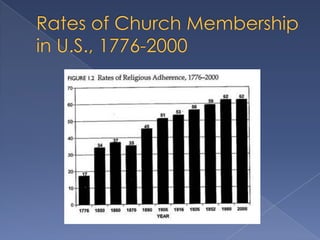
   Bible is the actual Word of God        2000, only 17% in 1776 (Starke & Finke)
decreased from 37% in 1984 to 31% in
                2008 (link)
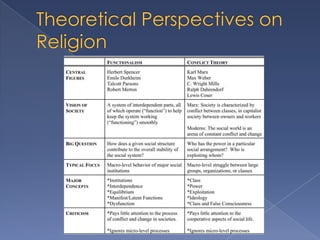
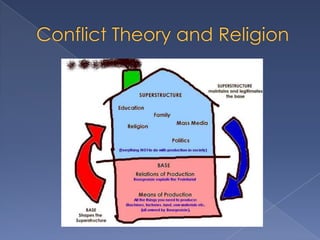
 Religion is the „opiate of the masses‟
  according to Karl Marx-a way for the
  elites to reinforce the oppression of the
  lower classes
 Later conflict theorists point to the use of
  religion to justify racism, sexism, and
  oppression of homosexuals
 Focus on the „hereafter‟ blinds people to
  current oppression
 Religion serves as a reference group to
  help people define themselves.
 People are socialized into certain roles
  (ex. Being reverent during communion)
  through group expectations
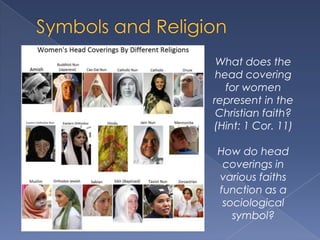
 People attach sacred meaning to
  symbols
What does the
 head covering
   for women
represent in the
 Christian faith?
(Hint: 1 Cor. 11)

How do head
 coverings in
various faiths
function as a
 sociological
   symbol?
 Max Weber studied the attitudes of
  Protestants and Catholics in Western Europe
  towards work and this life in late 19th
  century
 He discovered that Protestants, particularly
  Calvnists, developed a rational worldview
  of hard work and thrift that propelled their
  economic activities
 Protestant Ethic spread to America, to non-
  Calvinists
    › Example: Ben Franklin is famous for his quote “A
     penny saved is a penny earned”
 Modern evangelical leaders often
  express their belief that economic
  freedom and Bible are compatible
 Jerry Falwell once stated:
    › “God is in favor of freedom, property, ownership,
      competition, diligence, work and acquisition. All of this is
      taught in the Word of God, in both the Old and New
      Testaments”
   Pat Robertson
    › ”…Communism and capitalism in their most extreme, secular
      manifestations are equally doomed to failure,….free
      enterprise is the economic system most nearly meeting
      humanity‟s God-given need for freedom”.
 Religion is a „social glue‟ that binds
  people with sacred rituals
 Religion upholds basic social norms
 Legitimates governmental authority
 Religion is a balm for the oppressed and
  marginalized
But also dysfunctional….
 Prevents social change
 Enhances political conflict
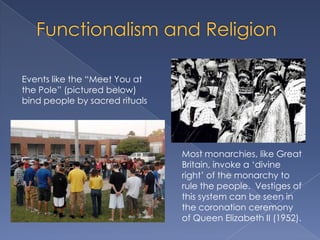
Events like the “Meet You at
the Pole” (pictured below)
bind people by sacred rituals


                                Most monarchies, like Great
                                Britain, invoke a „divine
                                right‟ of the monarchy to
                                rule the people. Vestiges of
                                this system can be seen in
                                the coronation ceremony
                                of Queen Elizabeth II (1952).
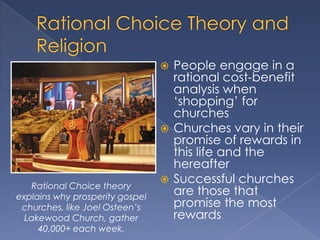
 People engage in a
                                   rational cost-benefit
                                   analysis when
                                   „shopping‟ for
                                   churches
                                  Churches vary in their
                                   promise of rewards in
                                   this life and the
                                   hereafter
                                  Successful churches
   Rational Choice theory
explains why prosperity gospel
                                   are those that
 churches, like Joel Osteen’s      promise the most
  Lakewood Church, gather          rewards
     40,000+ each week.
 Secularization theory, which believed
  that modernization, democratization,
  and globalization would decreased the
  need for faith, has been debunked
 Worldwide surge of fundamentalism(s)
  across religious traditions
 Religious devotion will increasingly be
  coupled with religious tolerance
 Polarization of beliefs within traditions

Religion

  • 2.
     Religion inHistorical Perspective  Sociological Perspectives on Religion  Types of Religious Organization  Trends in Religion in the United States  Religion in the Future
  • 3.
    How does religion affect society as a whole (does it divide/unite)? How does it affect social institutions like: › Marriages, Political Structures, Economy  How does religion, as a social institution, affect the wellbeing of individuals?  What does it mean to be „religious‟? How does one define and measure religiosity?
  • 4.
    Religiosity is the extent to which a person does one or more of the following: › (1) believes in and “feels” or experiences certain aspects of religion › (2) becomes involved in religious activities such as attending church or reading sacred texts › (3) believes in the teachings of the church, › (4) lives in accordance with those teachings and beliefs.
  • 5.
    Religion seeks to answer important questions such as why we exist, why people suffer and die, and what happens when we die-the „sacred canopy‟  Things that people do not set apart as sacred are referred to as profane—the everyday, secular or “worldly” aspects of life.
  • 6.
    Most religions havefour elements:  Ritual (ex. Prayer, communion)  A sense of the Sacred  A system of beliefs-in the supernatural and a set of ethics OR a set of abstract ideals  Organization-each religion has a public component
  • 7.
    Ernest Troeltsch (1931)created a typology of religious organizations:  Church  Sect Sociologists also recognize:  Cult (now called New Religious Movements, NRMs)  Ecclesia
  • 8.
    Attitude Organization Membership Worship Salvation Toward Other Religions Large, Open to all; bureaucratic members Formal, Granted by Church organization,led usually from orderly God Tolerant by professional upper and clergy middle classes Guarded Small group,high membership, Informal, Achieved by Sect degree of lay usually from spontaneous moral purity Intolerant participation lower classes
  • 9.
     Encompasses all members of a society  People are primarily born into the ecclesia, do not convert  Influential in government affairs
  • 10.
     Stable, institutional organization  Well-educated clergy  Elaborate rituals and beliefs  Tolerant of religious pluralism and the secular world
  • 11.
    Less organized than denomination  Charismatic, less educated ministers  Growth by recruiting, rather than being born into church  Higher levels of devotion  Reject worldliness and „impure‟ denominations  Tend to draw recruits from the lower classes
  • 12.
     Offer completelynew beliefs, rituals, and means of transcendence  Live in stark opposition to the world  Informally organized, led by self-styled, charismatic leadership  Recruit people who have economic and psychological deprivation
  • 13.
     Simple supernaturalism- the belief that supernatural forces affect people's lives positively or negatively.  Animism - the belief that plants, animals, and elements of the natural world are endowed with spirits that impact events in society.  Theism - belief in a God or Gods.  Transcendent idealism - belief in sacred principles of thought and conduct, such as truth, justice, life and tolerance for others.
  • 14.
    Confucianis Christianity Islam Hinduism Buddhism Judaism m No. of 1.7 billion 1 billion 719 million 309 million 18 million 5.9 million Adherents No specific Siddhartha Abraham, Founder Jesus Muhammad K’ung Fu-Tzu founder Gautama Isaac, Jacob Dates 1st century ca. 1500 500 to 600 ca. 2000 ca. 600 C.E 500 B.C.E Founded C.E. B.C.E B.C.E. B.C.E.
  • 15.
     Diverse-85 denominationswith atleast 50,000 members *  Positive slant of religion-heaven, personal blessings, etc. due to „religious marketplace‟  Freedom from Anticlericalism-Americans do not have bitter feelings towards priests as protectors of the status quo  Civil religion-God is frequently invoked in American rituals, symbols, etc, with little reference to which God/beliefs
  • 19.
    ‘Proof’ that theU.S. is more secular ‘Proof’ that the U.S. is NOT more secular 1 out of 4 people between 18-28 yrs. of Slighlty more people (38% of age were unaffiliated with any religion population) claims to have had a born again experience in 2008 than 20 yrs earlier 28% of US adults raised in faith have Percentage of people believing the abandoned faith or chosen another Bible is the „inspired Word of God‟ is one roughly the same in 2008 as 1984 Major denominations, like the Disciples In 2007, 38% of 18-29 yrs old „strongly of Christ, PC-USA, Episcopalians, AME agreed‟ that God was „angered by Zion have lost at least 20% of their human sin‟, the highest of any age membership in the last 20 yrs. (link) group The no. of Americans having never 33% of the same age group reported attended church doubled between witnessing to friends at least once in 1973 and 2008 (link) the past month, the highest of any age group (Link) No. of Americans who believe that the Church membership was nearly 62% in Bible is the actual Word of God 2000, only 17% in 1776 (Starke & Finke) decreased from 37% in 1984 to 31% in 2008 (link)
  • 25.
     Religion isthe „opiate of the masses‟ according to Karl Marx-a way for the elites to reinforce the oppression of the lower classes  Later conflict theorists point to the use of religion to justify racism, sexism, and oppression of homosexuals  Focus on the „hereafter‟ blinds people to current oppression
  • 27.
     Religion servesas a reference group to help people define themselves.  People are socialized into certain roles (ex. Being reverent during communion) through group expectations  People attach sacred meaning to symbols
  • 28.
    What does the head covering for women represent in the Christian faith? (Hint: 1 Cor. 11) How do head coverings in various faiths function as a sociological symbol?
  • 29.
     Max Weberstudied the attitudes of Protestants and Catholics in Western Europe towards work and this life in late 19th century  He discovered that Protestants, particularly Calvnists, developed a rational worldview of hard work and thrift that propelled their economic activities  Protestant Ethic spread to America, to non- Calvinists › Example: Ben Franklin is famous for his quote “A penny saved is a penny earned”
  • 31.
     Modern evangelicalleaders often express their belief that economic freedom and Bible are compatible  Jerry Falwell once stated: › “God is in favor of freedom, property, ownership, competition, diligence, work and acquisition. All of this is taught in the Word of God, in both the Old and New Testaments”  Pat Robertson › ”…Communism and capitalism in their most extreme, secular manifestations are equally doomed to failure,….free enterprise is the economic system most nearly meeting humanity‟s God-given need for freedom”.
  • 32.
     Religion isa „social glue‟ that binds people with sacred rituals  Religion upholds basic social norms  Legitimates governmental authority  Religion is a balm for the oppressed and marginalized But also dysfunctional….  Prevents social change  Enhances political conflict
  • 33.
    Events like the“Meet You at the Pole” (pictured below) bind people by sacred rituals Most monarchies, like Great Britain, invoke a „divine right‟ of the monarchy to rule the people. Vestiges of this system can be seen in the coronation ceremony of Queen Elizabeth II (1952).
  • 34.
     People engagein a rational cost-benefit analysis when „shopping‟ for churches  Churches vary in their promise of rewards in this life and the hereafter  Successful churches Rational Choice theory explains why prosperity gospel are those that churches, like Joel Osteen’s promise the most Lakewood Church, gather rewards 40,000+ each week.
  • 35.
     Secularization theory,which believed that modernization, democratization, and globalization would decreased the need for faith, has been debunked  Worldwide surge of fundamentalism(s) across religious traditions  Religious devotion will increasingly be coupled with religious tolerance  Polarization of beliefs within traditions

Editor's Notes

  • #36 80% of people in the world claim that religion is important to them, 60% in industrialized nationsNearly 60% of the members of the United Church of Christ believe in evolution, less than 20% of the members of the Assemblies of God21% of Southern Baptists believe that abortion should be illegal in all circusmstances, 3% of the UCC membershipJames Davison Hunter, author of “Culture Wars” suggests that religious groups are uniting together on common political groups, regardless of actual beliefs. It is very common to see progressive Protestants, for example, united with secular humanist on a pro-choice agenda as it is for evangelicals, orthodox Jews, and conservative Catholics to unite in pro-life lobbying groups.