Introduction
Cold storagefacility for perishable products under
controlled conditions
A cold storage unit incorporates a refrigeration system
to maintain the desired room environmental conditions
4.
Classification
Based onstorage conditions
Short term or temporary (7-10 days)
Long term (6-8 months)
Frozen storage (years)
Specific considerations
Uniformtemperatures
Length of air blow and impingement on stored products
Effect of relative humidity
Effect of air movement
Controlling ventilation systems, if necessary.
Product entering temperature
Expected duration of storage
Required product outdoor temperature
Transportation in and storage area
7.
Cold storage design
1.Selection of site
2. Orientation and building form
3. Size
4. Space requirement
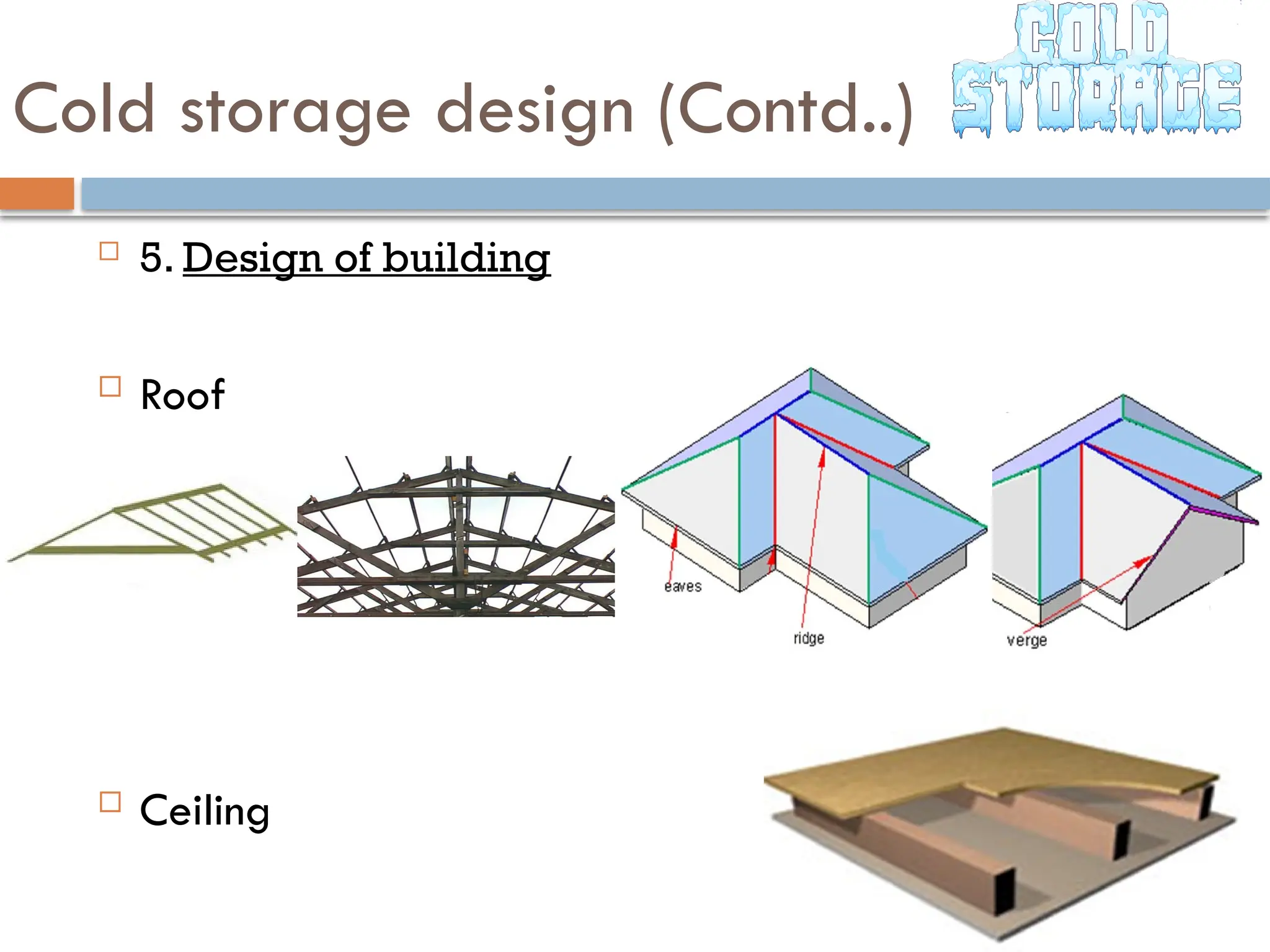
5. Design of building
6. Thermal insulation
7. Refrigeration system for cold store
8. Heat Load calculation
8.
Cold storage design(Contd..)
1. Selection of site
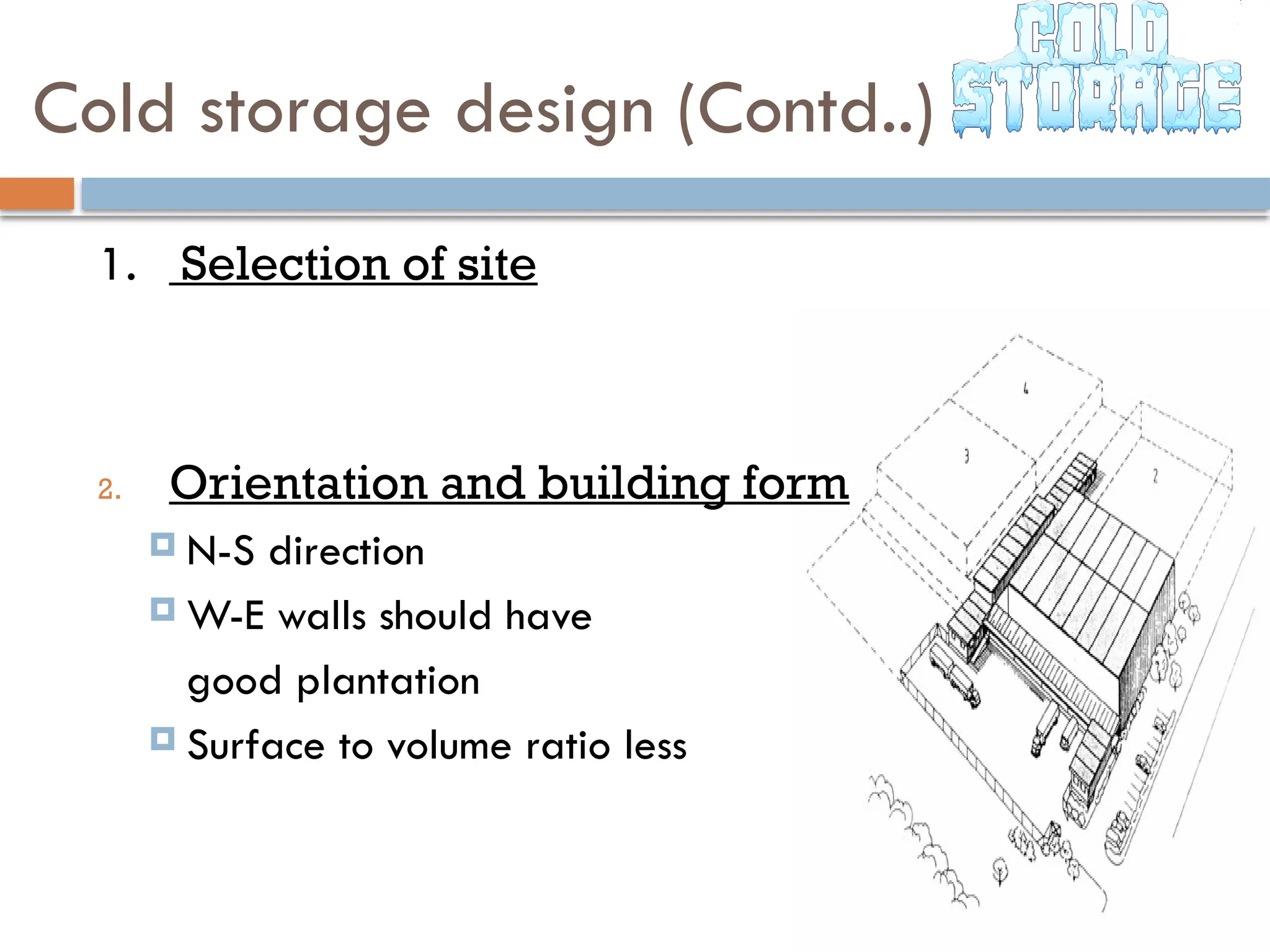
2. Orientation and building form
N-S direction
W-E walls should have
good plantation
Surface to volume ratio less
9.
Cold storage design(Contd..)
3. Size
Volume of product to store
Product containers (boxes, hampers, buckets)
Volume required per container
Space for mechanical or manual operation
Lateral and head space
Available site space
10.
Cold storage design(Contd..)
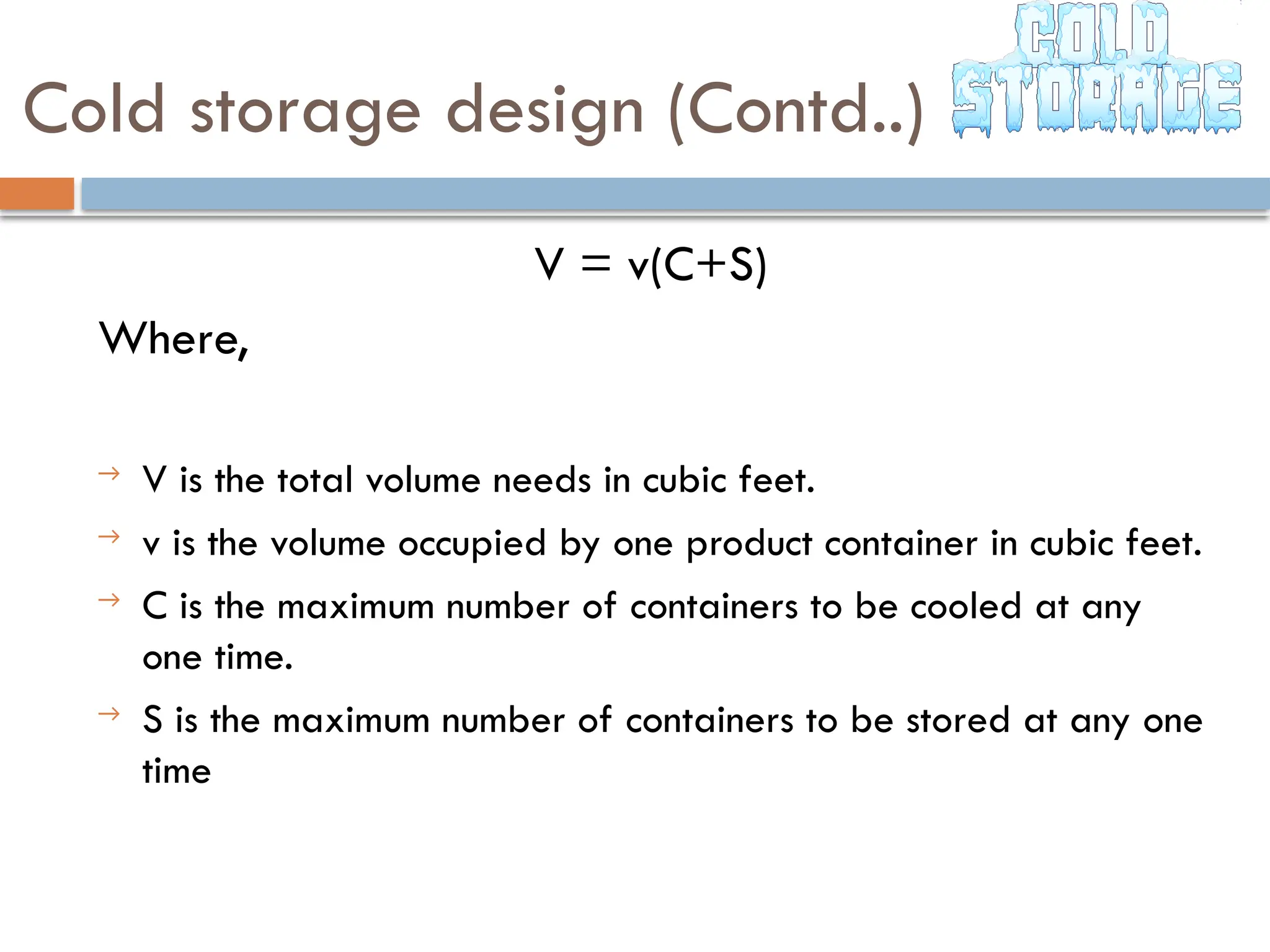
V = v(C+S)
Where,
→ V is the total volume needs in cubic feet.
→ v is the volume occupied by one product container in cubic feet.
→ C is the maximum number of containers to be cooled at any
one time.
→ S is the maximum number of containers to be stored at any one
time
11.
Cold storage design(Contd..)
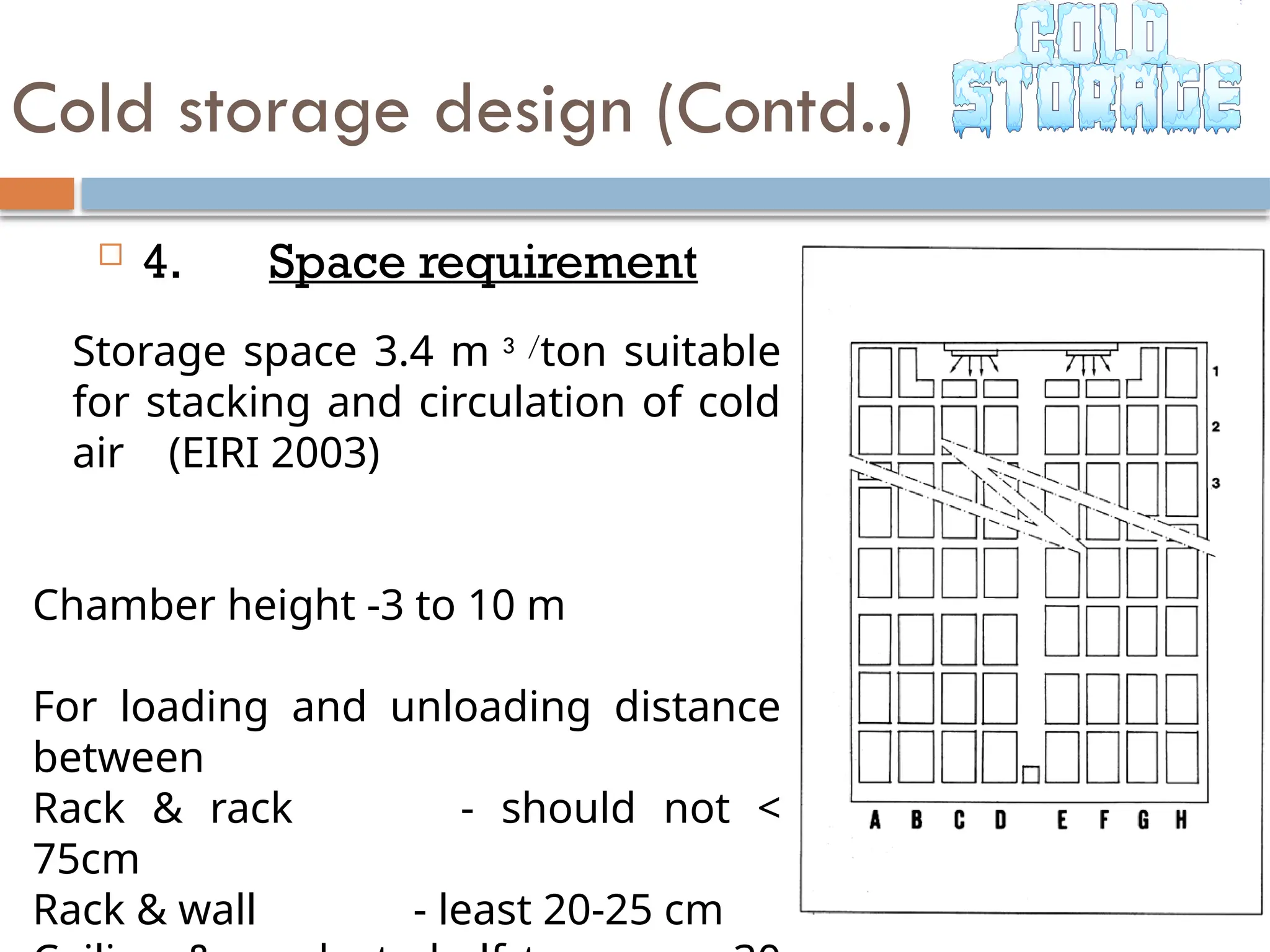
4. Space requirement
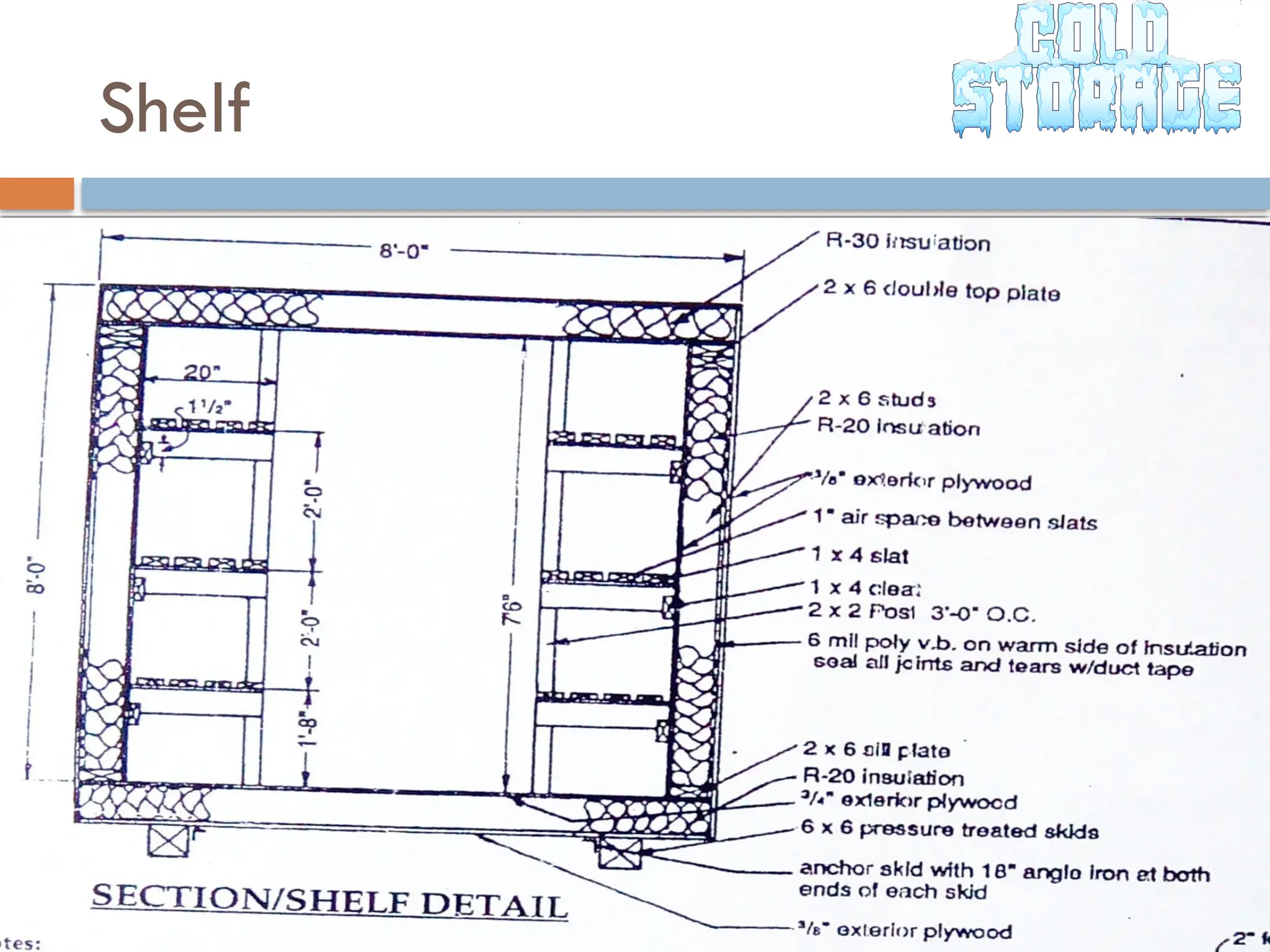
Storage space 3.4 m 3 /
ton suitable
for stacking and circulation of cold
air (EIRI 2003)
Chamber height -3 to 10 m
For loading and unloading distance
between
Rack & rack - should not <
75cm
Rack & wall - least 20-25 cm
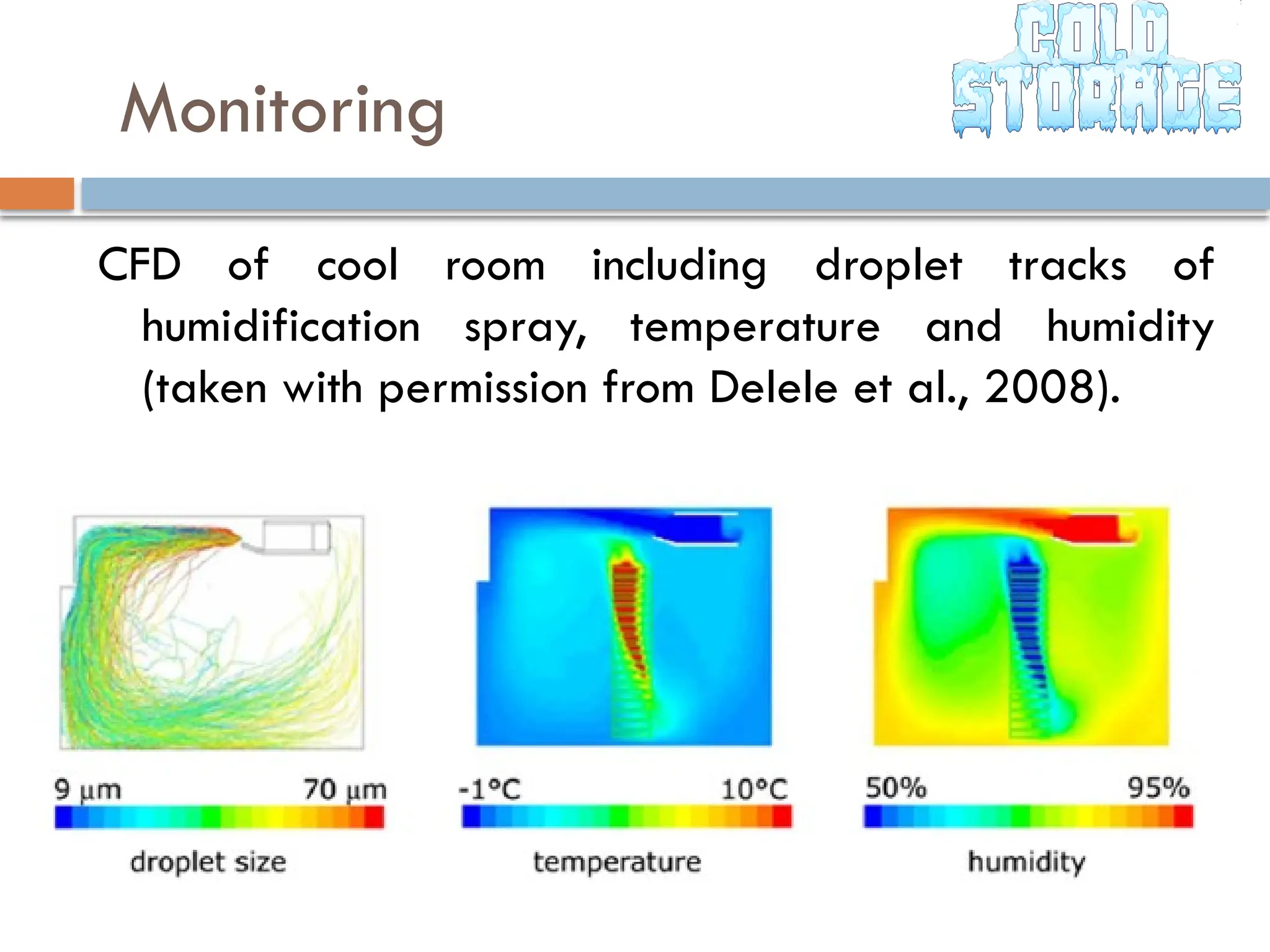
Monitoring
CFD of coolroom including droplet tracks of
humidification spray, temperature and humidity
(taken with permission from Delele et al., 2008).
23.
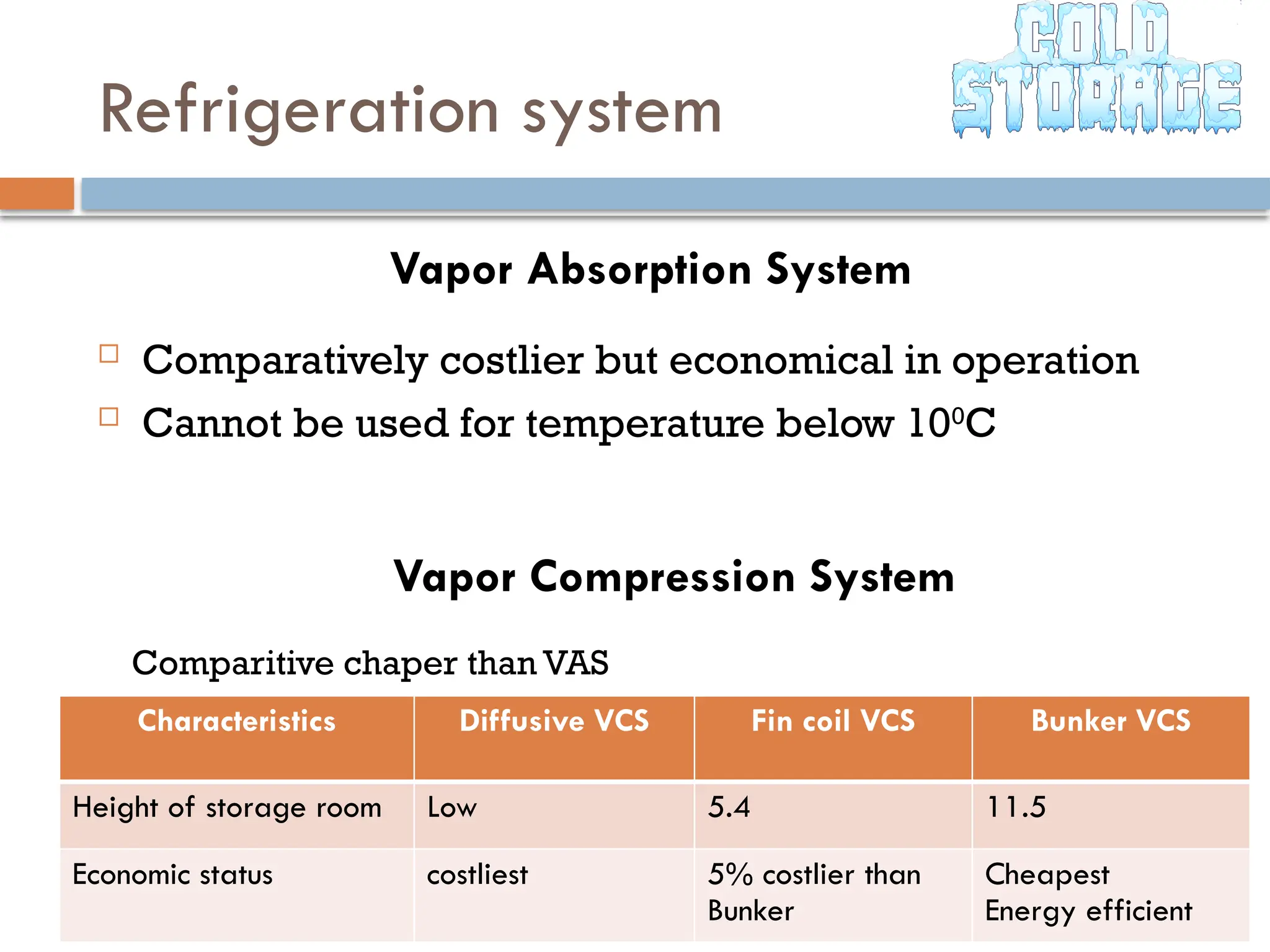
Vapor Absorption System
Comparatively costlier but economical in operation
Cannot be used for temperature below 100
C
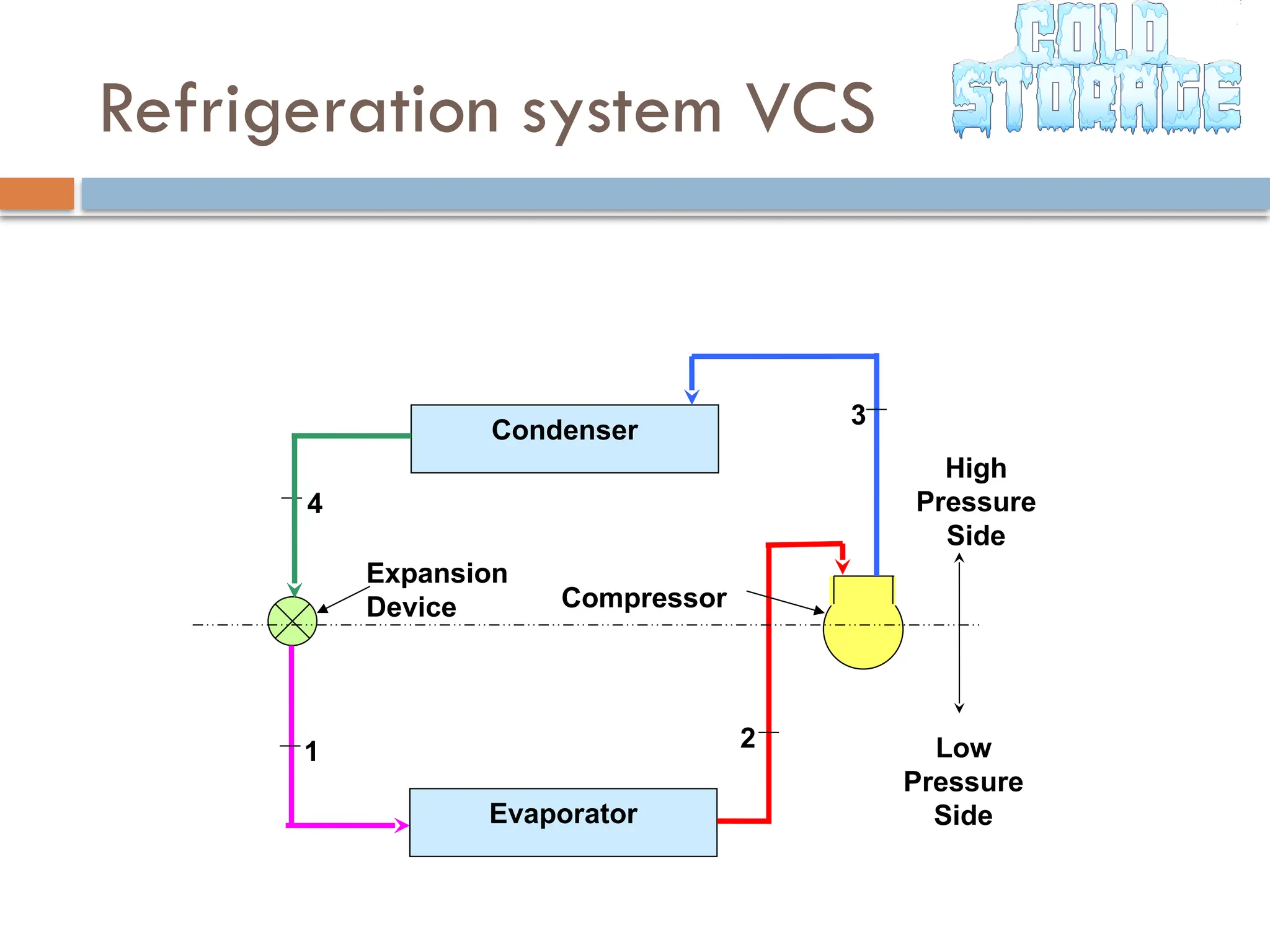
Vapor Compression System
Comparitive chaper than VAS
Characteristics Diffusive VCS Fin coil VCS Bunker VCS
Height of storage room Low 5.4 11.5
Economic status costliest 5% costlier than
Bunker
Cheapest
Energy efficient
Refrigeration system
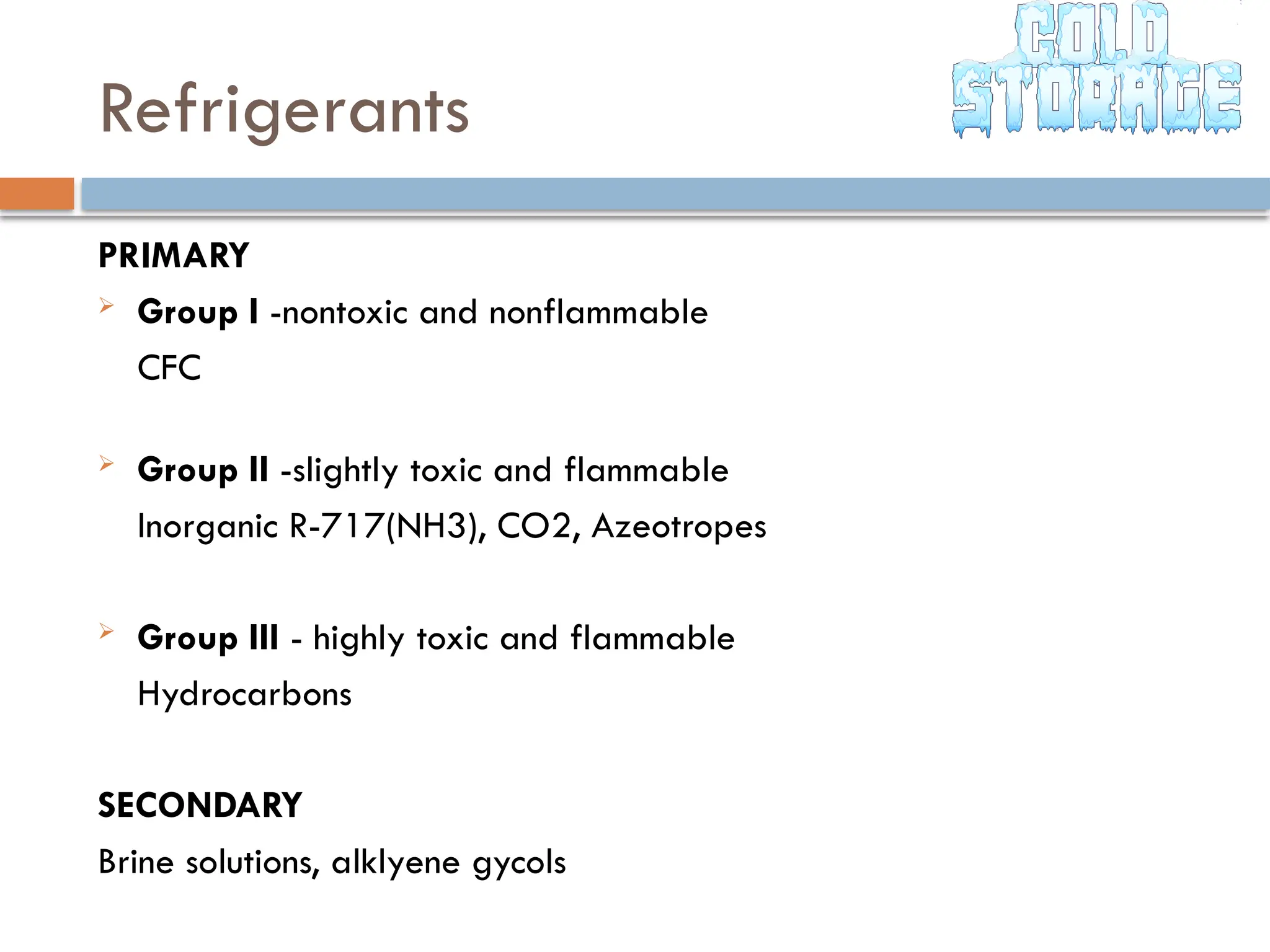
Refrigerants
PRIMARY
Group I-nontoxic and nonflammable
CFC
Group II -slightly toxic and flammable
Inorganic R-717(NH3), CO2, Azeotropes
Group III - highly toxic and flammable
Hydrocarbons
SECONDARY
Brine solutions, alklyene gycols
28.
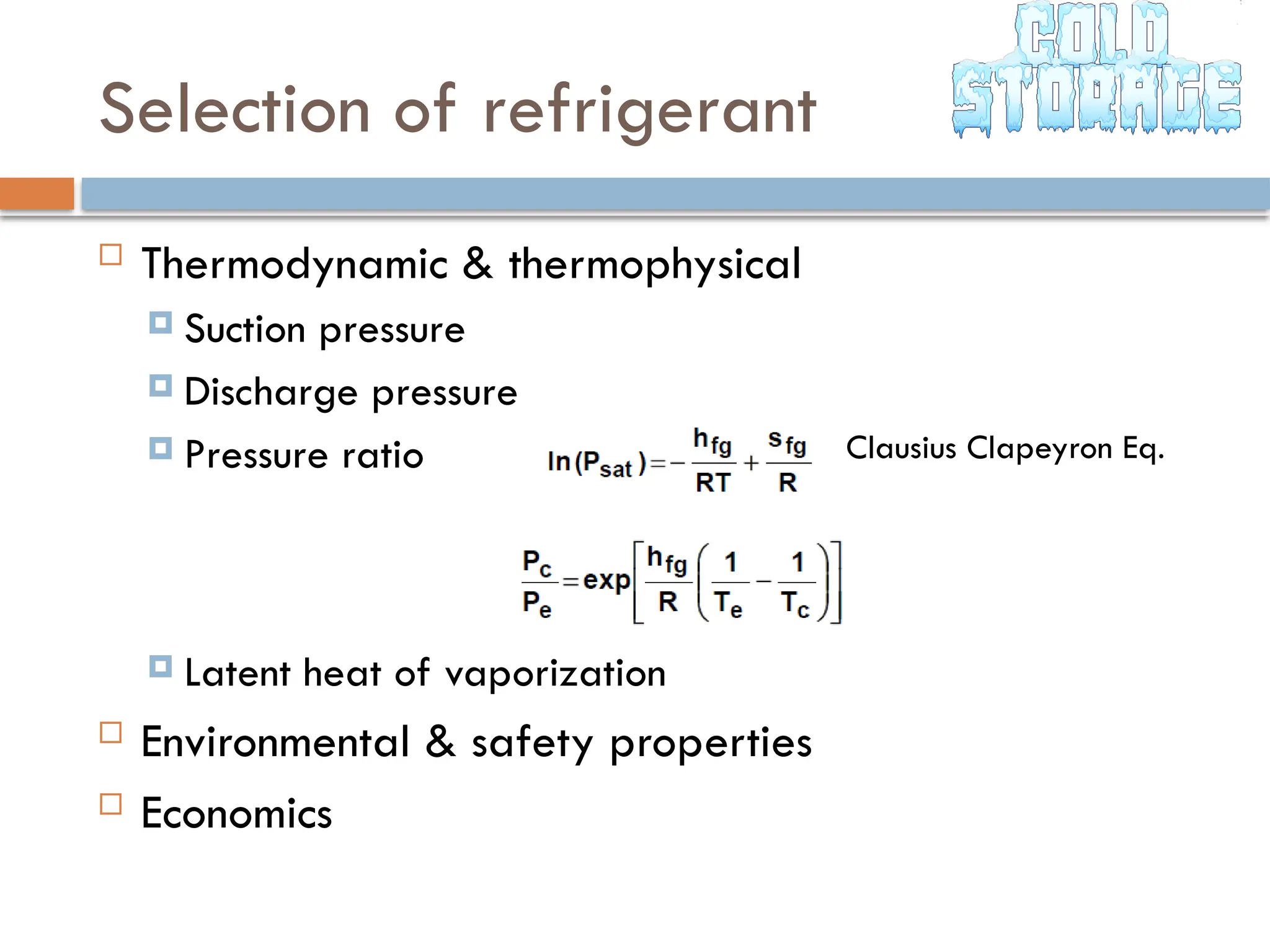
Selection of refrigerant
Thermodynamic & thermophysical
Suction pressure
Discharge pressure
Pressure ratio
Latent heat of vaporization
Environmental & safety properties
Economics
Clausius Clapeyron Eq.
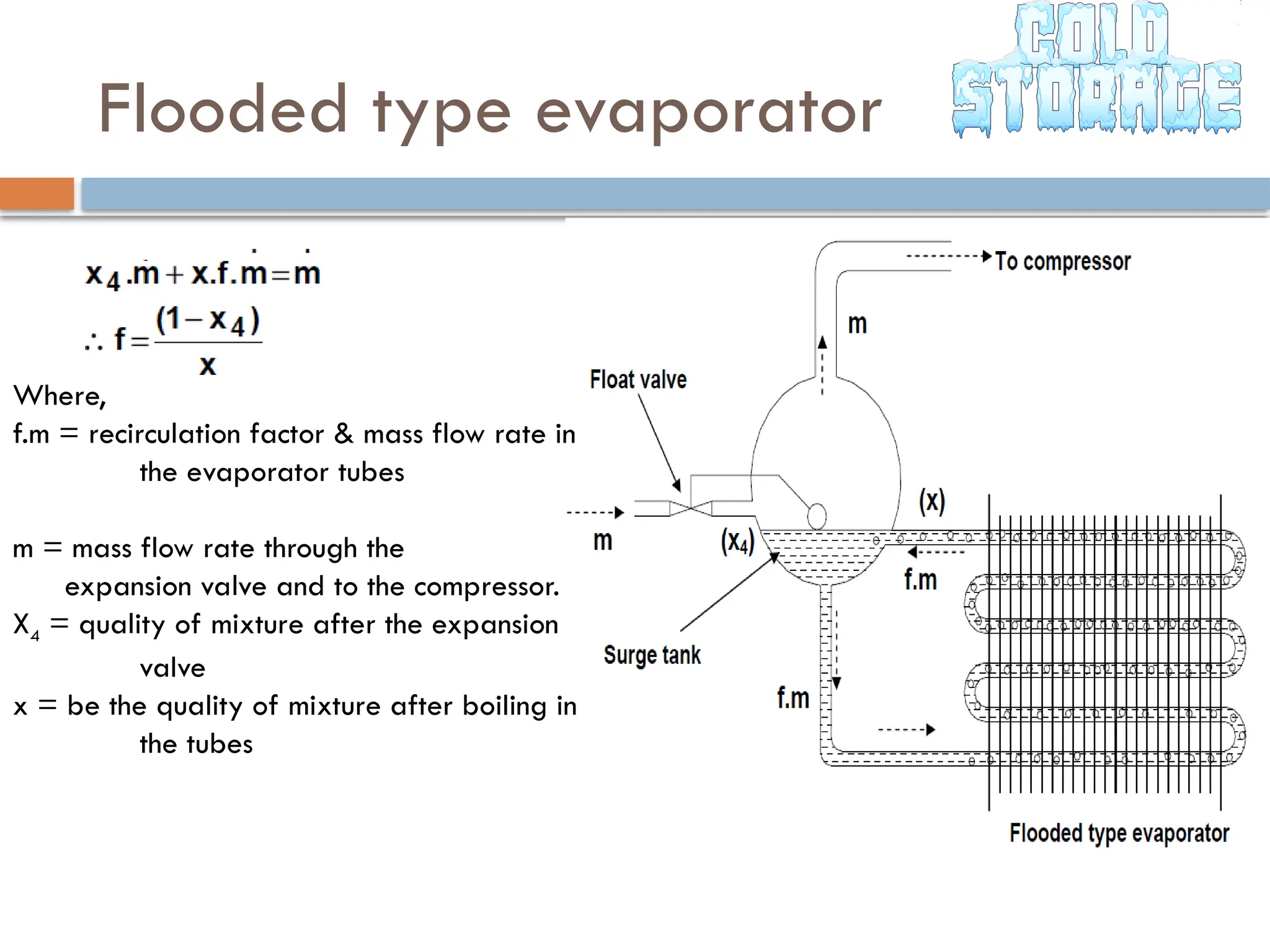
Flooded type evaporator
Where,
f.m= recirculation factor & mass flow rate in
the evaporator tubes
m = mass flow rate through the
expansion valve and to the compressor.
X4 = quality of mixture after the expansion
valve
x = be the quality of mixture after boiling in
the tubes
31.
Heat load calculation
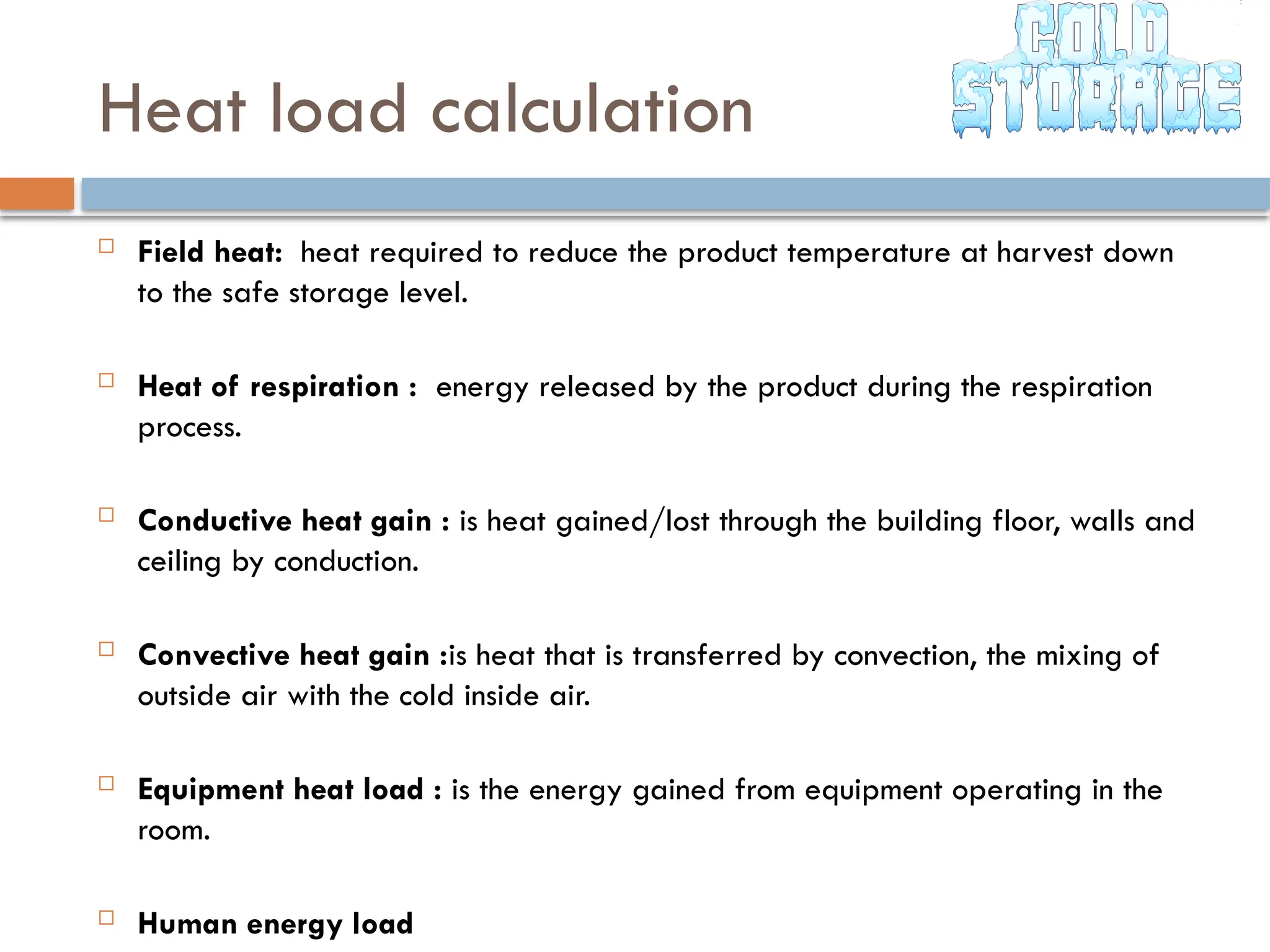
Field heat: heat required to reduce the product temperature at harvest down
to the safe storage level.
Heat of respiration : energy released by the product during the respiration
process.
Conductive heat gain : is heat gained/lost through the building floor, walls and
ceiling by conduction.
Convective heat gain :is heat that is transferred by convection, the mixing of
outside air with the cold inside air.
Equipment heat load : is the energy gained from equipment operating in the
room.
Human energy load
32.
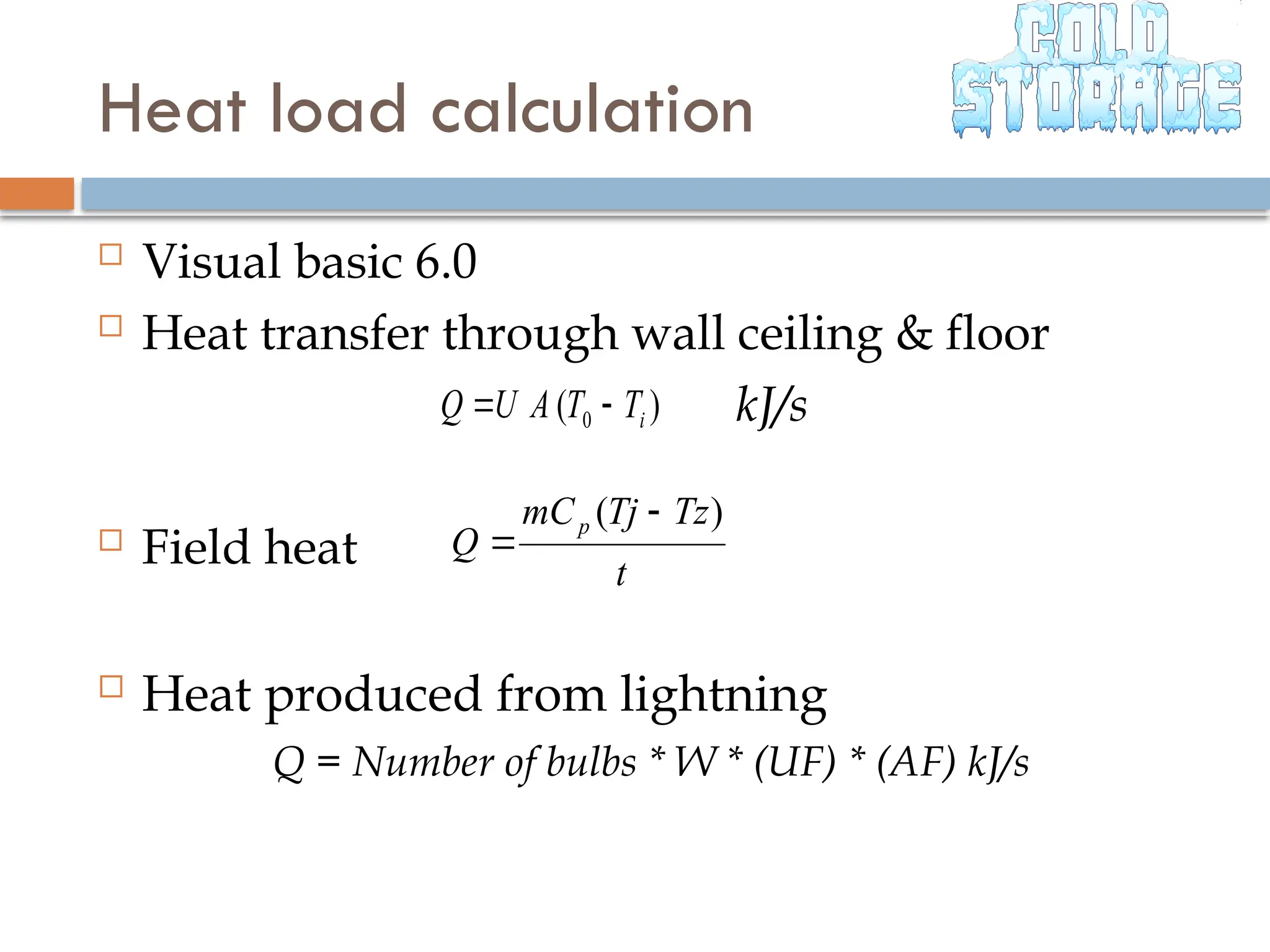
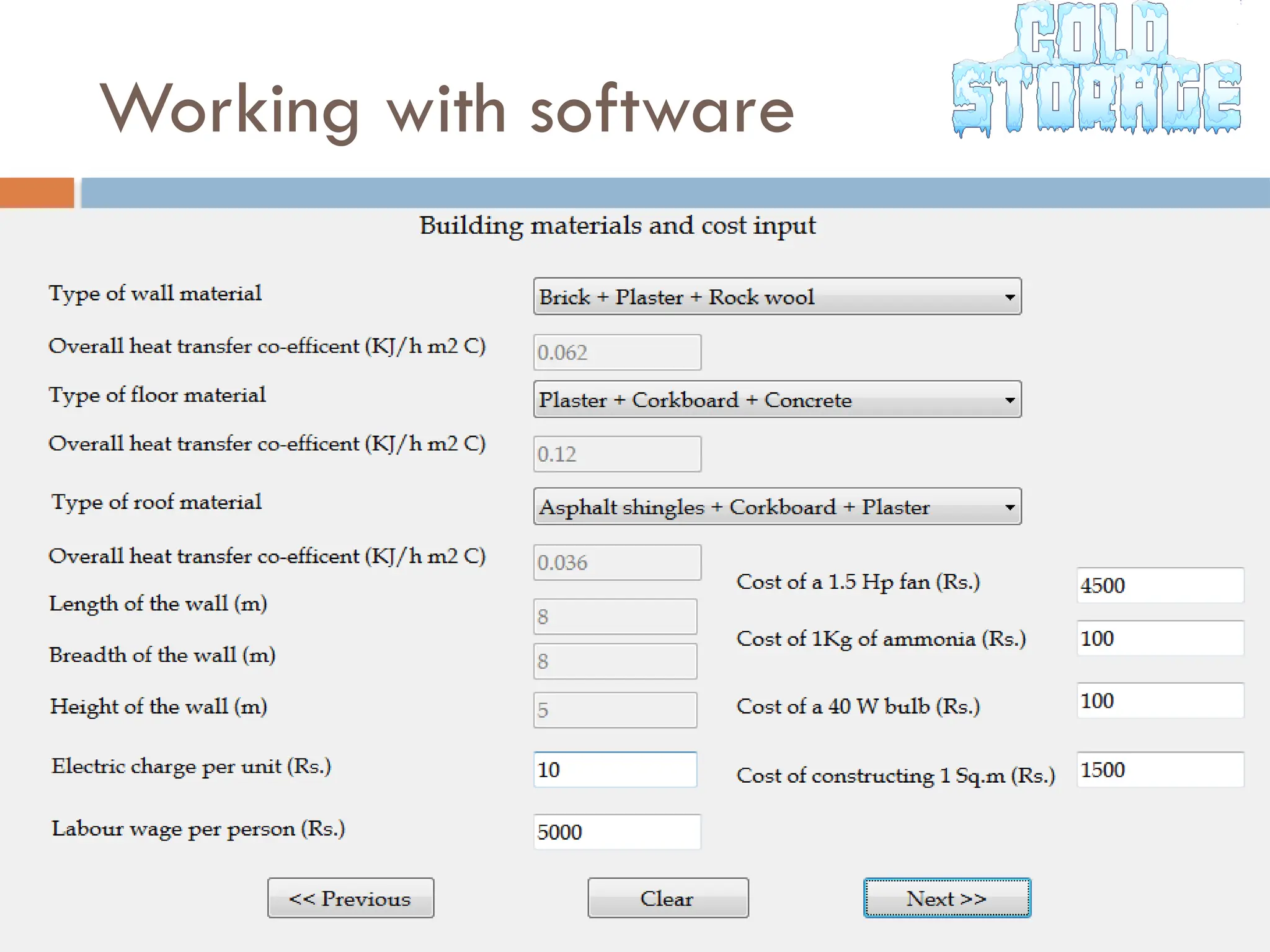
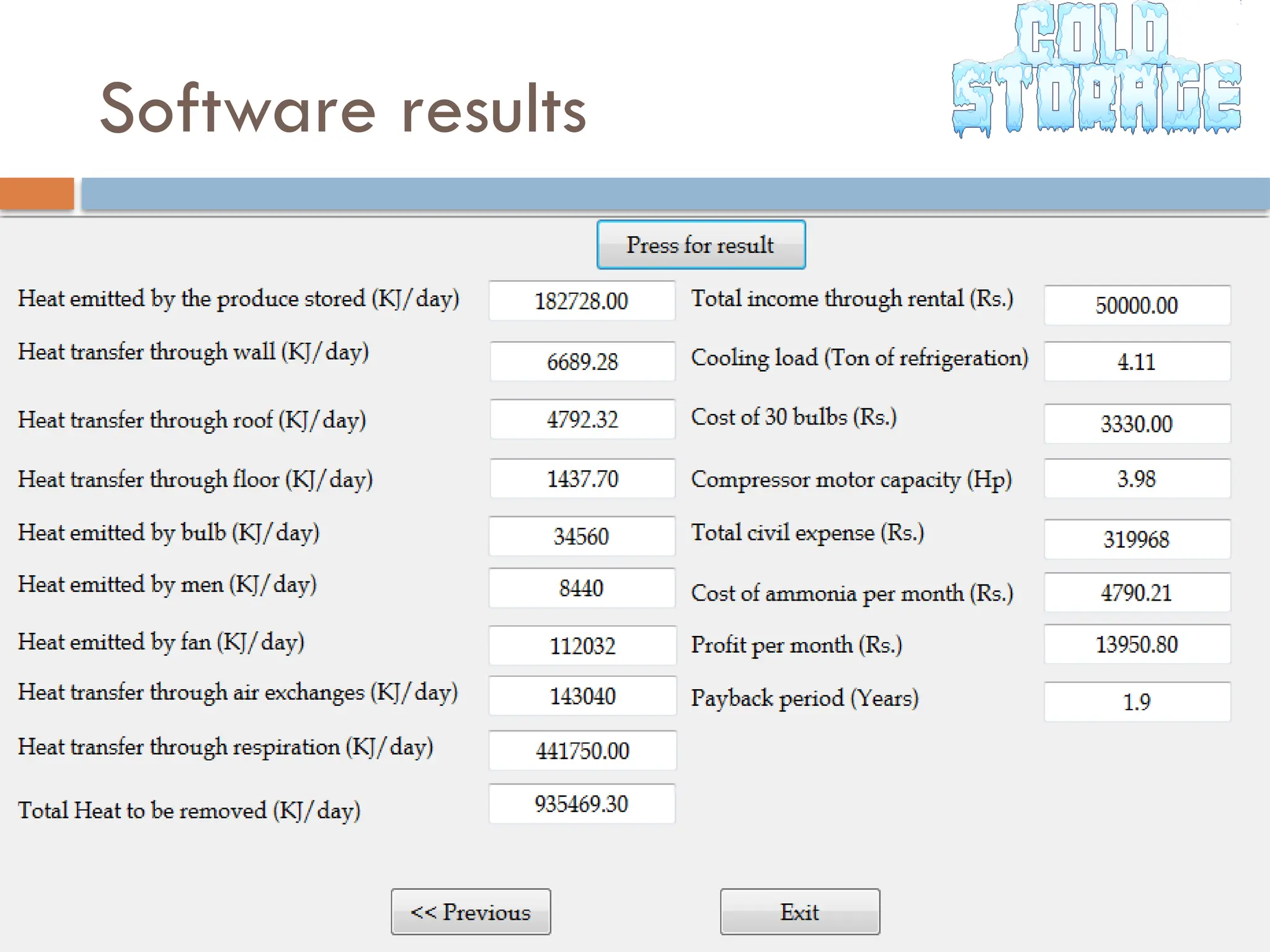
Visual basic6.0
Heat transfer through wall ceiling & floor
kJ/s
Field heat
Heat produced from lightning
Q = Number of bulbs * W * (UF) * (AF) kJ/s
)
( 0 i
T
T
A
U
Q
t
Tz
Tj
mC
Q
p )
(
Heat load calculation
33.
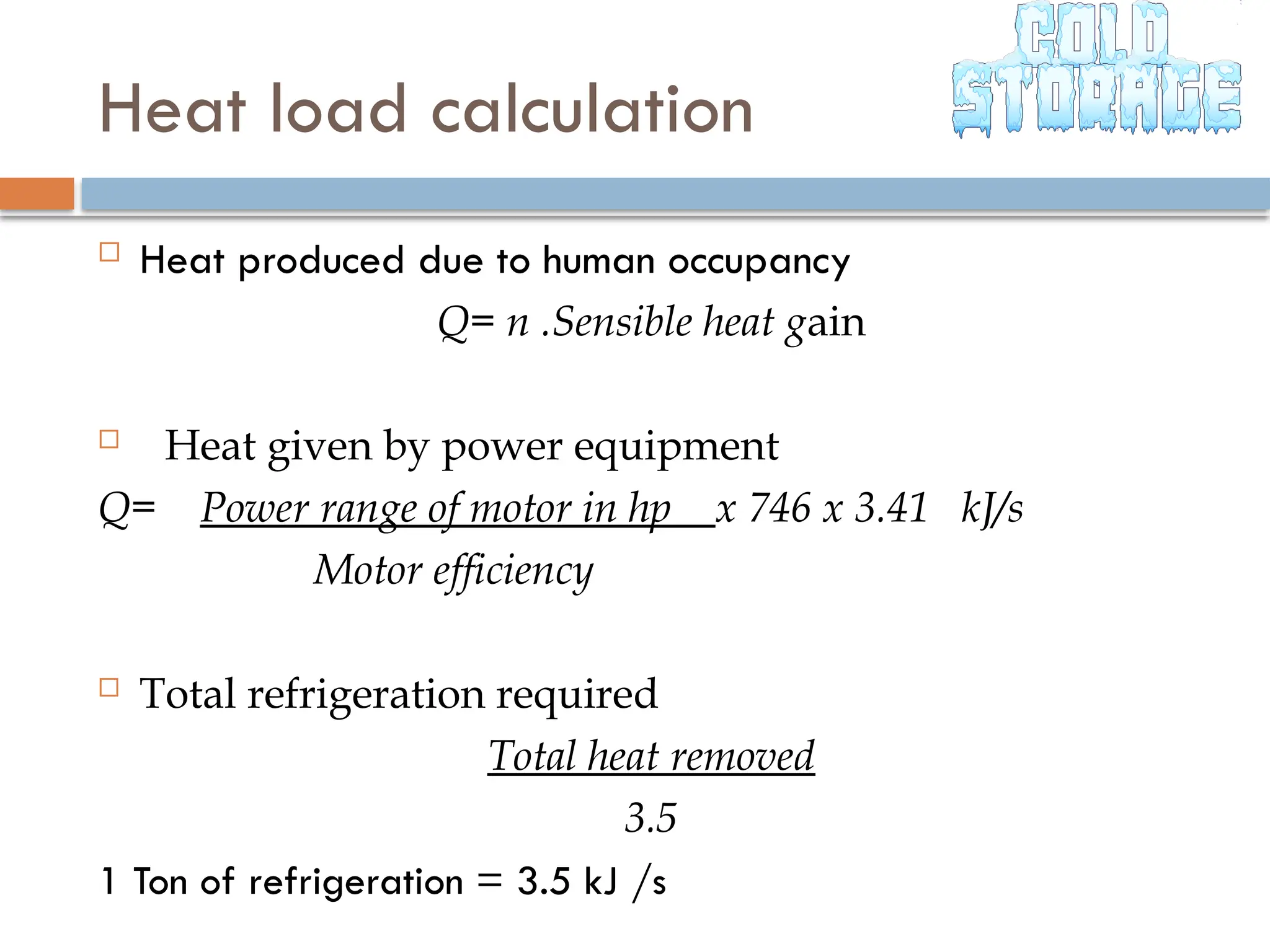
Heat produceddue to human occupancy
Q= n .Sensible heat gain
Heat given by power equipment
Q= Power range of motor in hp x 746 x 3.41 kJ/s
Motor efficiency
Total refrigeration required
Total heat removed
3.5
1 Ton of refrigeration = 3.5 kJ /s
Heat load calculation
#8 N-s long wall light color paint at south wall reduces 11 C compared with dark
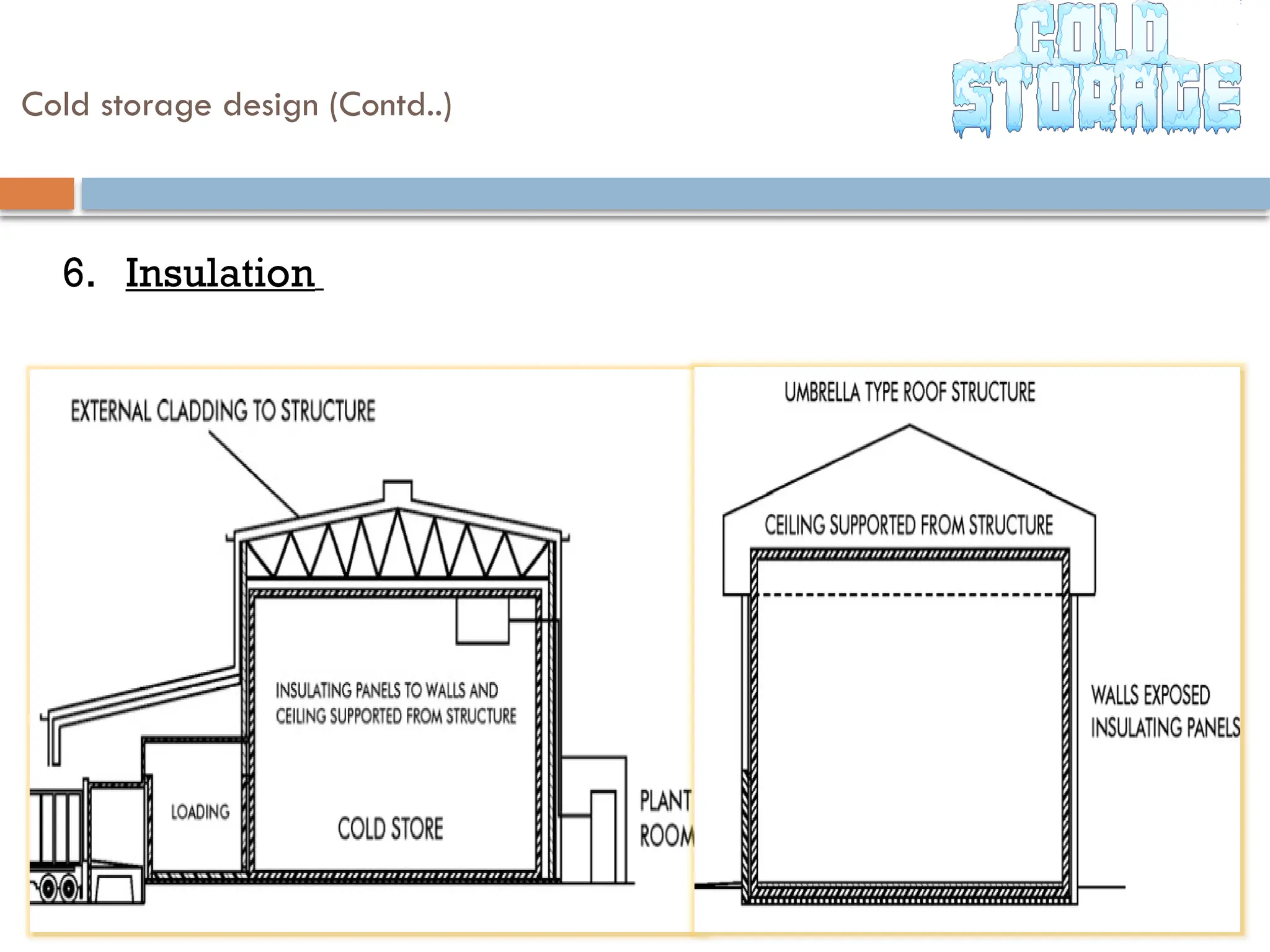
#12 Dark flat roof 42 C warmer it is essential that laps and joints at ridges, verge and eaves be sealed and bedded closely .Also ventilation should be provided,
Most pitched roof are built with steel, timber or concrete fames with purlins carrying sheet materials such as steel, asbestos or aluminium
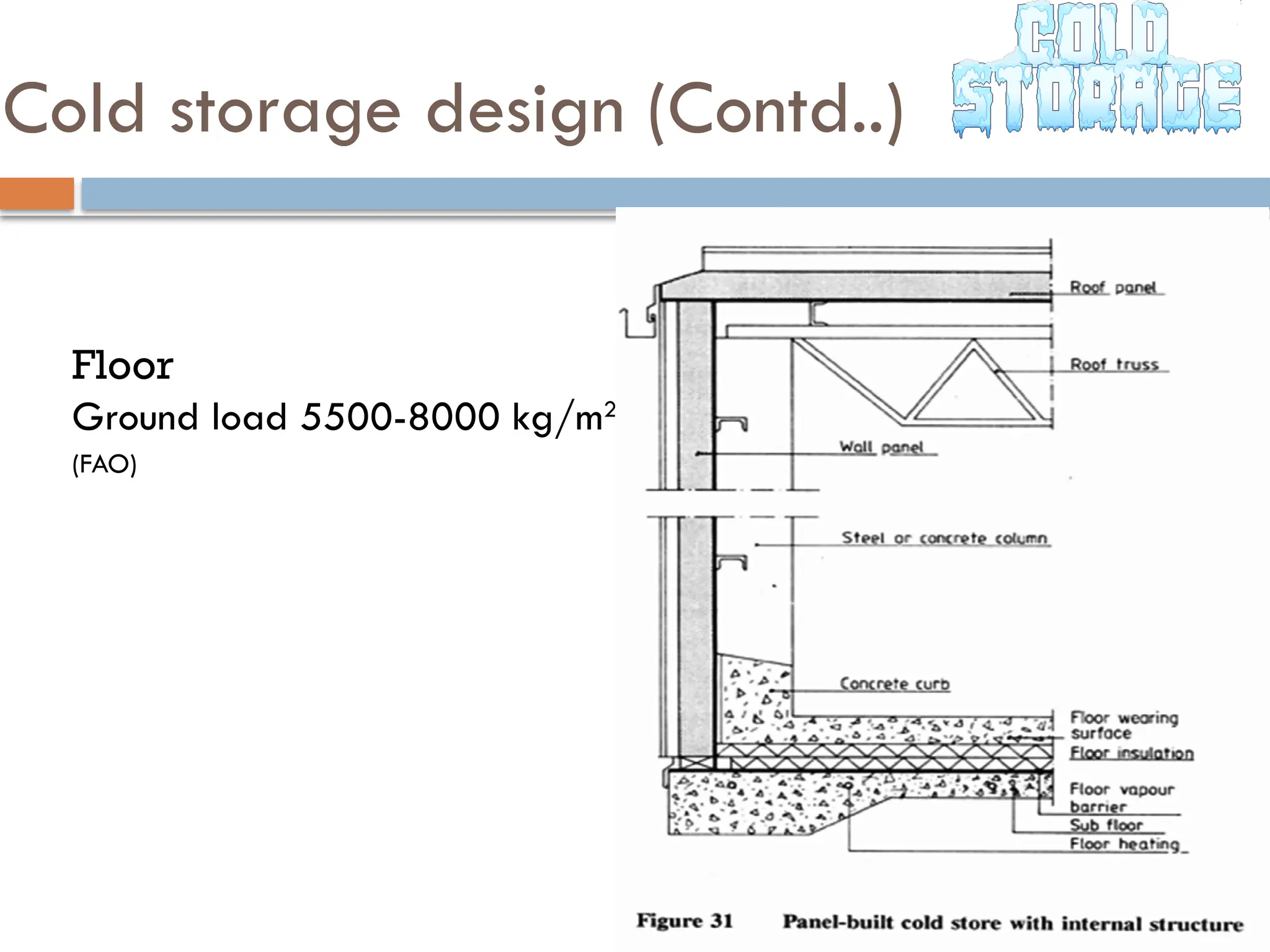
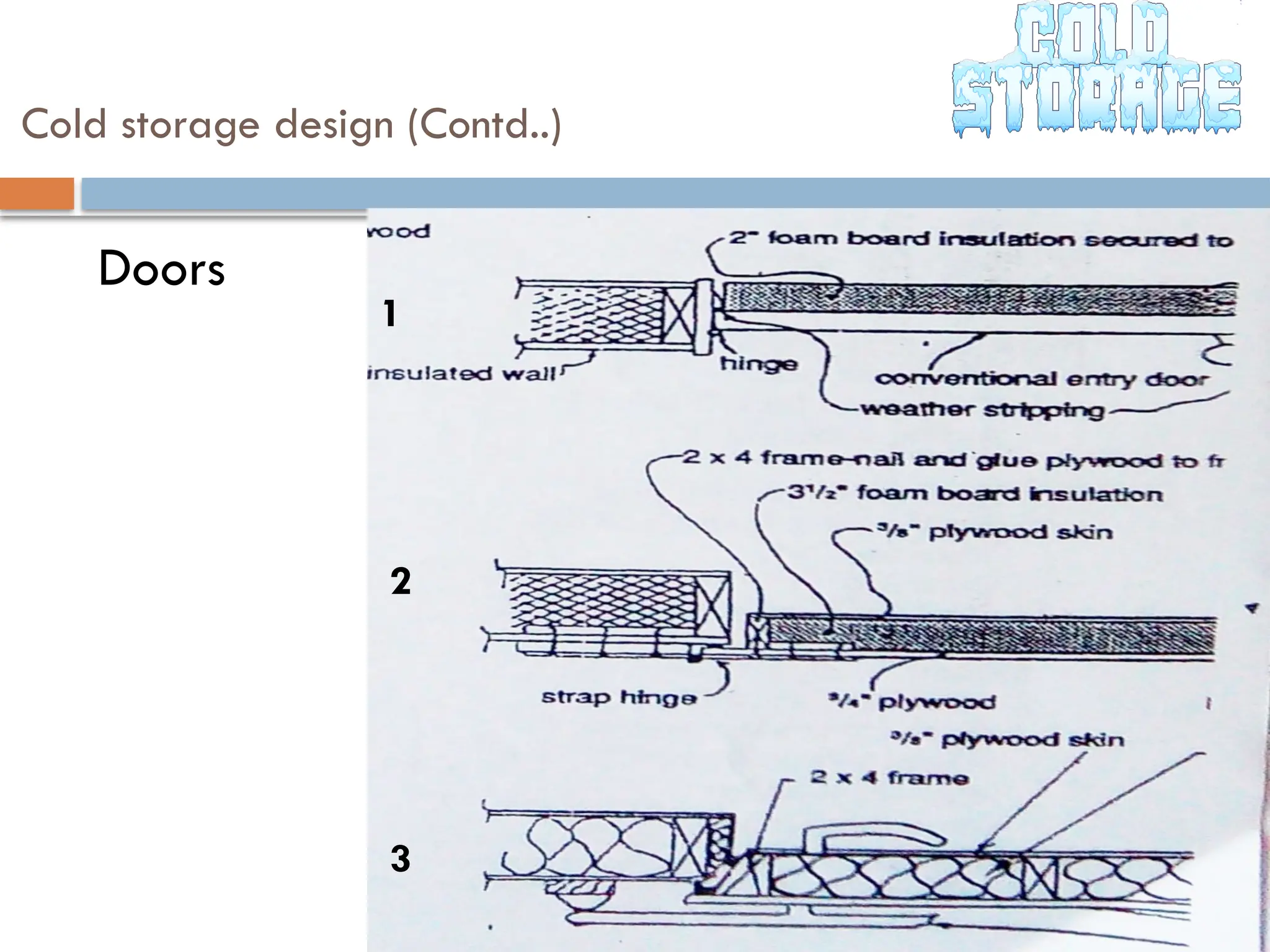
#13 Refrigerated facilities held above freezing need no special under-floor treatment. floor wearing surface is a concrete slab cast on the floor insulation with a thickness 100-150mm
Determining thickenss U is necessarily determined
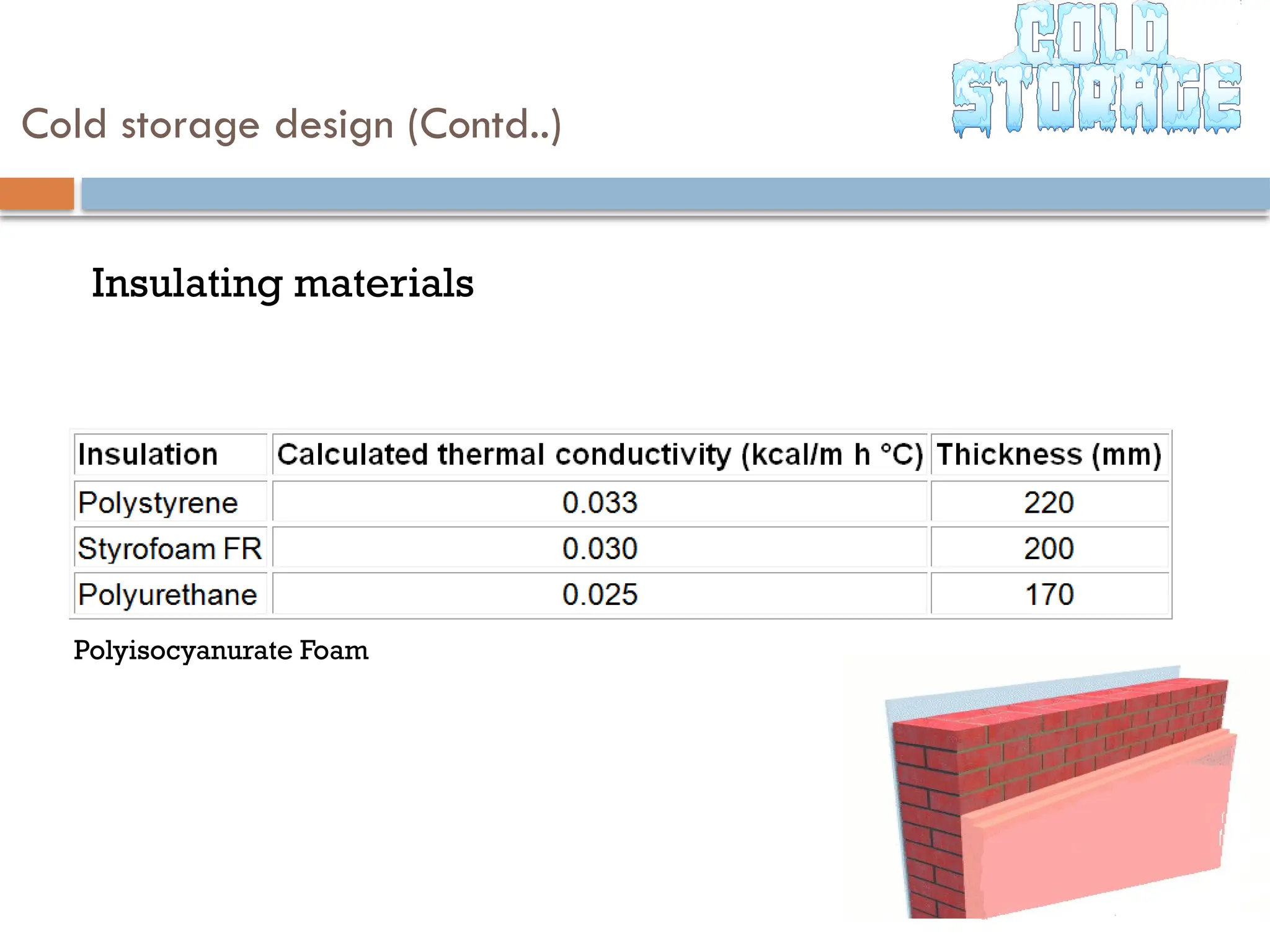
#17 thermal conductance should not exceed 0. 15 kcal/m2h°C for cold stores Plaster pervious-but insulation should be impervious
Because of its lower thermal conductivity value the thickness required for Polyurethane Foam will be less thus allowing more storing space inside
Density double than Expanded PS, not eaten by rats & insects
Polyisocyanurate Foam- fire safe
#19 Enrgy consumption incrases dramatically as thermal conductivity of wet insulation inc by 32 times
#28 Sat pressure above atm for air or moisture ingresion and ease in leak detection
Condensor temp discharge pressure low for light w compressor, condensor
Pressure ration small high volumetric efficiency, low power consumprtion
Latent heat of vaporization mass flow rate per unit cooling capacity will be small
Environ-ODP, toxic, gwp,flammability, chemical stability, miscibility
#30 f-= Mass flow rate of evaporator to compressor
#32 UF = Use factor is 0.5 for industries
AF = Allowance factor is 1.25 for fluorescent tubes
W = Wattage of bulb used, i.e., 65 W