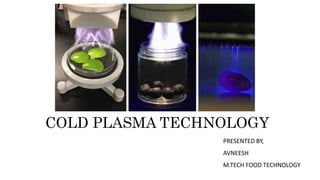
COLD PLASMA TECHNOLOGY
PRESENTED BY,
AVNEESH
M.TECH FOOD TECHNOLOGY
INTRODUCTION
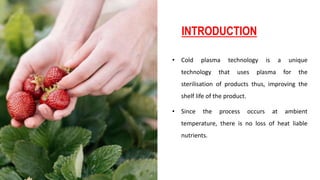
• Cold plasma technology is a unique
technology that uses plasma for the
sterilisation of products thus, improving the
shelf life of the product.
• Since the process occurs at ambient
temperature, there is no loss of heat liable
nutrients.
Cold plasma technology
• Cold plasma Technology is novel, non-thermal food
processing technology that uses energetic and reactive
gases to inactivate contaminating microbes in food products
like meat, poultry, fruits, vegetables, etc.
• The primary modes of action are due to UV light and
reactivate chemical products of the cold plasma ionisation
process.
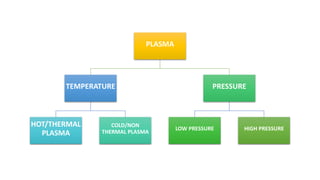
PLASMA
TEMPERATURE
HOT/THERMAL
PLASMA
COLD/NON
THERMAL PLASMA
PRESSURE
LOW PRESSURE HIGH PRESSURE
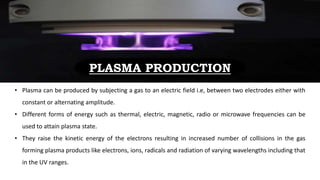
PLASMA PRODUCTION
• Plasma can be produced by subjecting a gas to an electric field i.e, between two electrodes either with
constant or alternating amplitude.
• Different forms of energy such as thermal, electric, magnetic, radio or microwave frequencies can be
used to attain plasma state.
• They raise the kinetic energy of the electrons resulting in increased number of collisions in the gas
forming plasma products like electrons, ions, radicals and radiation of varying wavelengths including that
in the UV ranges.
PRINCIPLE
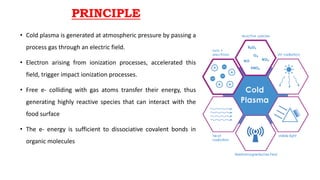
• Cold plasma is generated at atmospheric pressure by passing a
process gas through an electric field.
• Electron arising from ionization processes, accelerated this
field, trigger impact ionization processes.
• Free e- colliding with gas atoms transfer their energy, thus
generating highly reactive species that can interact with the
food surface
• The e- energy is sufficient to dissociative covalent bonds in
organic molecules
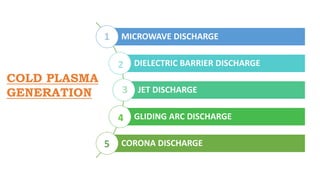
MICROWAVE DISCHARGE
DIELECTRIC BARRIER DISCHARGE
JET DISCHARGE
GLIDING ARC DISCHARGE
CORONA DISCHARGE
COLD PLASMA
GENERATION
1
2
3
4
5
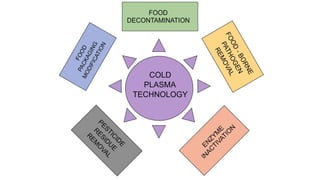
APPLICATIONS
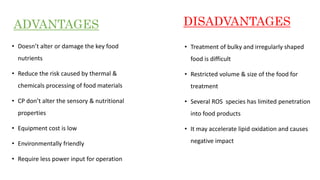
• Doesn’t alter or damage the key food
nutrients
• Reduce the risk caused by thermal &
chemicals processing of food materials
• CP don’t alter the sensory & nutritional
properties
• Equipment cost is low
• Environmentally friendly
• Require less power input for operation
• Treatment of bulky and irregularly shaped
food is difficult
• Restricted volume & size of the food for
treatment
• Several ROS species has limited penetration
into food products
• It may accelerate lipid oxidation and causes
negative impact
ADVANTAGES DISADVANTAGES
GENERAL CONCLUSION
• The cold plasma technology is gaining interest among researchers as a promising non thermal
technology.
• The economic trait of cold plasma and the mechanisms of inactivation is still not clear since it produces
75 species and there are more than thousands chemical reaction happening at Nano, micro, mil and
second time scale.
• There is a great necessity for further study, so that CP could be a break through technology for future
food preservation. Still many opportunities remain to be harnessed for further research and
development in order to meet the demand of plasma technology application in food sector.
• In that fact, cold plasma can be versatile technology with great potential to benefit the areas of food
industry.
COLD PLASMA TECHNOLOGY by AVNEESH

COLD PLASMA TECHNOLOGY by AVNEESH

  • 1.
    COLD PLASMA TECHNOLOGY PRESENTEDBY, AVNEESH M.TECH FOOD TECHNOLOGY
  • 2.
    INTRODUCTION • Cold plasmatechnology is a unique technology that uses plasma for the sterilisation of products thus, improving the shelf life of the product. • Since the process occurs at ambient temperature, there is no loss of heat liable nutrients.
  • 3.
    Cold plasma technology •Cold plasma Technology is novel, non-thermal food processing technology that uses energetic and reactive gases to inactivate contaminating microbes in food products like meat, poultry, fruits, vegetables, etc. • The primary modes of action are due to UV light and reactivate chemical products of the cold plasma ionisation process.
  • 4.
  • 5.
    PLASMA PRODUCTION • Plasmacan be produced by subjecting a gas to an electric field i.e, between two electrodes either with constant or alternating amplitude. • Different forms of energy such as thermal, electric, magnetic, radio or microwave frequencies can be used to attain plasma state. • They raise the kinetic energy of the electrons resulting in increased number of collisions in the gas forming plasma products like electrons, ions, radicals and radiation of varying wavelengths including that in the UV ranges.
  • 6.
    PRINCIPLE • Cold plasmais generated at atmospheric pressure by passing a process gas through an electric field. • Electron arising from ionization processes, accelerated this field, trigger impact ionization processes. • Free e- colliding with gas atoms transfer their energy, thus generating highly reactive species that can interact with the food surface • The e- energy is sufficient to dissociative covalent bonds in organic molecules
  • 7.
    MICROWAVE DISCHARGE DIELECTRIC BARRIERDISCHARGE JET DISCHARGE GLIDING ARC DISCHARGE CORONA DISCHARGE COLD PLASMA GENERATION 1 2 3 4 5
  • 8.
  • 10.
    • Doesn’t alteror damage the key food nutrients • Reduce the risk caused by thermal & chemicals processing of food materials • CP don’t alter the sensory & nutritional properties • Equipment cost is low • Environmentally friendly • Require less power input for operation • Treatment of bulky and irregularly shaped food is difficult • Restricted volume & size of the food for treatment • Several ROS species has limited penetration into food products • It may accelerate lipid oxidation and causes negative impact ADVANTAGES DISADVANTAGES
  • 11.
    GENERAL CONCLUSION • Thecold plasma technology is gaining interest among researchers as a promising non thermal technology. • The economic trait of cold plasma and the mechanisms of inactivation is still not clear since it produces 75 species and there are more than thousands chemical reaction happening at Nano, micro, mil and second time scale. • There is a great necessity for further study, so that CP could be a break through technology for future food preservation. Still many opportunities remain to be harnessed for further research and development in order to meet the demand of plasma technology application in food sector. • In that fact, cold plasma can be versatile technology with great potential to benefit the areas of food industry.