Presented by
Adarsh M.Kalla
16-P-DE-03
Plasma technology
Introduction
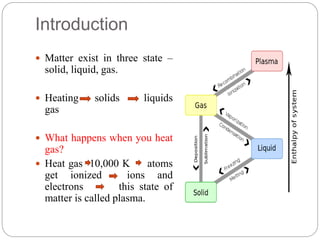
 Matter exist in three state –
solid, liquid, gas.
 Heating solids liquids
gas
 What happens when you heat
gas?
 Heat gas 10,000 K atoms
get ionized ions and
electrons this state of
matter is called plasma.
 E.g. hydrogen has 1 electron
 To free one electron from H atom you should have energy of
order 13.6 eV
 e фi = 13.6eV
 E= electron charge, фi = ionization potential
 Atom = ion + e- + radicals + radiations of varying wavelength
including that in UV rays
 I would say typical energy for atoms to be ionized are about
10eV or higher.
 In terms of temperature we call it as “average K.E of atom”.
 Average K.E of atom= 3/2 KBT
 T= temp of gas
 KB = boltzman constant (1.38 x10⁻²³ J/K)
 In plasmas KBT is generally called as temperature of plasma.
 If you put T =10,000 K
 KBT is around 1eV
 In plasma temperature is said in eV.
 So 1eV temp corresponds = 10,000 K
 And for 10eV =….?
 So issue is you require a temperature of 10,000 K to ionize
a gas.
 This is substantially a higher temperature and difficult thing to
do.
 So people found another medium to produce plasma’s by which
our nature also produces in atmosphere and process is called
photoionization.
Plasma physics
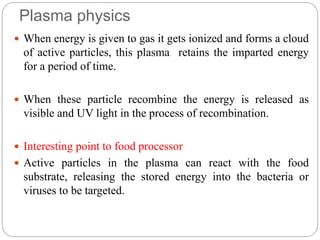
 When energy is given to gas it gets ionized and forms a cloud
of active particles, this plasma retains the imparted energy
for a period of time.
 When these particle recombine the energy is released as
visible and UV light in the process of recombination.
 Interesting point to food processor
 Active particles in the plasma can react with the food
substrate, releasing the stored energy into the bacteria or
viruses to be targeted.
Types of plasma
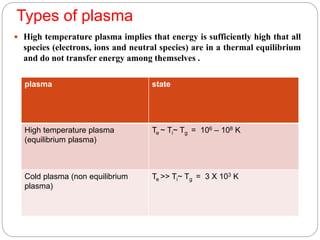
 High temperature plasma implies that energy is sufficiently high that all
species (electrons, ions and neutral species) are in a thermal equilibrium
and do not transfer energy among themselves .
plasma state
High temperature plasma
(equilibrium plasma)
Te ~ Ti~ Tg = 106 – 108 K
Cold plasma (non equilibrium
plasma)
Te ˃˃ Ti~ Tg = 3 X 10³ K
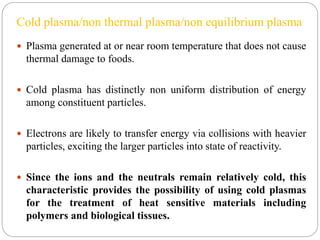
Cold plasma/non thermal plasma/non equilibrium plasma
 Plasma generated at or near room temperature that does not cause
thermal damage to foods.
 Cold plasma has distinctly non uniform distribution of energy
among constituent particles.
 Electrons are likely to transfer energy via collisions with heavier
particles, exciting the larger particles into state of reactivity.
 Since the ions and the neutrals remain relatively cold, this
characteristic provides the possibility of using cold plasmas
for the treatment of heat sensitive materials including
polymers and biological tissues.
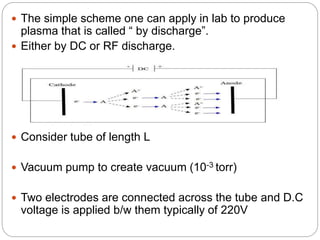
 The simple scheme one can apply in lab to produce
plasma that is called “ by discharge”.
 Either by DC or RF discharge.
 Consider tube of length L
 Vacuum pump to create vacuum (10-3 torr)
 Two electrodes are connected across the tube and D.C
voltage is applied b/w them typically of 220V
 In the tube where you are filling a gas, the temp is at
room temp.
 Electron are pulled towards anode, by the electric
field and they move until they collide with neutral
atom.
 Distance it travels b/w collision is called mean free
path. (λ=40cm)
 In this process they attain enough K.E.
 It causes brisk ionization and electrons are
produced.
 This is “D.C. break down of a gas”
Plasma generation
 Low atmospheric cold plasma-
 The voltage required to ionize gas is low, therefore require less,
power to generate antimicrobially active plasmas.
 by DC discharge, RF discharge and dielectric barrier discharge
 Atmospheric cold plasma-
 All food commodities cannot tolerate vacuum conditions.
 So some are operated at atmosphere pressure they do not require
air-tight vacuum chambers and are simpler to build.
 But difficulty for ionization.
 And at atm press greater voltage is required between electrodes of
the same spacing.
 by corona discharge, dielectric barrier discharge, atmospheric
pressure plasma jet and microwave pumped plasma
Gasses used in plasma technology
 The gas may be simply a air or nitrogen, or it may be a mixture
containing some proportion of noble gases, such as helium,
argon, or neon.
 The other mixture of gases used are N2/N2O, N2/O2, Ar/O2,
He/O2, He/N2, and He/O2/H2O
 The efficiency of operating gas enhances when oxygen is added
to them.
 Deng et al. (2006) evaluated various operating gas and
concluded that primary factor for microbial inactivation is
reactive oxygen species such as O, O3, OH, NO, NO2 species.
 Due to their high reactivity, they can react with almost all cell
components and contribute for the food quality and microbial
inactivation process.
Mechanism of cold plasma
 There are three primary mechanisms by which cold plasma
inactivates microbes (Moisan et al., 2002).
 1) The chemical interaction of radicals, reactive species, or
charged particles with cell membranes.
 2) Damage to membranes and internal cellular components by
UV radiation.
 3) DNA strands may be broken by UV generated during
recombination of the plasma species.
“While on a given commodity, one mode of action may be
more significant than another”
Application of cold plasma
 Attractive features are their low temperature property, and high
efficiency of microbial inactivation, which make them ideal for
use in the application of food industry.
 surface decontamination,
 dry disinfection of food surfaces (like meat, poultry, dairy
and freshly harvested horticultural produce),
 granular and particulate foods (grains, herbs and spices)
and sprouted seeds.
 surface sterilization of packaging material and also their
functional modification for imparting desired properties
Cereal industry
 Brown rice is less desirable due to its poor cooking and eating
qualities. Plasma processing can used to modify the properties of
brown rice.
 Chen et al., (2012) reported that plasma treatment allowed water
to be easily absorbed by the brown rice kernel during soaking. It
reduced cooking time, and the cooked brown rice had a soft
texture and was easier to chew.
 Sarangapani et al., (2015) reported that low pressure cold
plasma increased the water uptake ratio of parboiled rice and also
reduced the cooking time up to 8 min. Textural properties were
improved after treatment.
Dairy industry
 Song et al. (2009) investigated the influence of atmospheric
pressure plasma, he inoculated the sliced cheese with Listeria
monocytogenes and reported that microbial log reduction
increased with increases of input power and plasma exposure time.
 Segat et al. (2015) reported that atmospheric pressure cold plasma
can be successfully applied to selectively modify the protein
structure and therefore, improve whey protein isolate functionality.
 Gurol et al. (2012) evaluated the capability of cold plasma for
killing of E. coli in milk at different fat contents. A significant 54
% reduction in the population of E. coli cells after only 3 min was
observed regardless of the fat content of the milk.
 Korachi et al., (2015) investigated the biochemical changes
of whole raw milk samples by application of cold plasma.
And reported that Plasma treatment showed non significant
changes to the lipid composition of raw milk.
Meat and poultry industry
 Plasma treatment is able to prolong the shelf life of porcine with
regard to microbiological contamination and shows potential to
decontaminate the fresh pork.
 Rod et al., 2012 Atm pressure plasma treatment on ready-to-eat
meat was performed using a DBD plasma device inoculated with
Listeria innocua. Highest inactivation rates on ready-to-eat meat
with 1.5 to 1.6 log cfu/g were observed after treatments for 20 s
 Plasmas generated at atmospheric pressure offer a
possible decontamination method for poultry
products
 This method was used for decontamination of
chicken skin and muscle inoculated with L.
innocua. The higher values of AC voltage,
excitation frequency, and the presence of oxygen
in the carrier gas resulted in the greatest
inactivation efficiency.
Fruits and vegetable industry
 Plasma is the promising technology used in fruit and vegetable
processing industry.
 Plasma processing is capable of reducing microbial populations
on produce surfaces.
 Critzer et al. (2007) investigated the effect of plasma on apples,
cantaloupe, and lettuce, respectively. An approximate of 3 log
cfu/g reduction was observed with E. coli on apples after
exposure for 2 min, and similar levels of reduction were achieved
with Salmonella and L. monocytogenes on cantaloupe and lettuce,
respectively, after 3 min of exposure to plasma.
 Kovacevic et al. (2015) studied the effect of cold atmospheric gas
plasma on anthocyanins and color in pomegranate juice. In
comparison to untreated pomegranate juice, plasma treatments
showed higher anthocyanin content (21–35 %).
Packaging industry
 plasma processing, thrives the packaging industry with three
unique abilities:
(1) To remove all unwanted organic contaminants,
(2) Surface treating, or activating a material to gain an increased
wettability quality, and
(3) the deposition of substrates onto a material, adding desired new
qualities.
 The ability to maintain a lower temperature provides an
opportunity to easily sterilize heat sensitive packaging.
 Provides molecular cleanliness as plasma bombards the surface of
a substrate, and reactive particles chip away the organic material
 Lei et al., (2014) evaluated the effect of plasma on polyethylene
terephthalate and polypropylene films. Results showed that the
surface hydrophilicity and roughness of films increased. In
addition, antimicrobial activities were investigated and the results
indicated that the inhibition ratios against B. subtilis and E. coli
reached almost 100 % while the inhibition ratios against S. aureus
were lower than 85 %.
 Lee et al., (2015) reported that Plasma treatment doesn’t induces
changes in optical properties, color characteristics, surface
temperatures, tensile strengths, and deformation strains.
Limitations
 plasma processing causes increase in oxidation of lipids and
peroxide value, because radicals are capable of oxidizing lipid
molecules.
 It causes decreases in firmness of fruits.
 The plasma processing also affects the color properties of fruits.
The decrease in L*, a* and b* was observed for strawberries
treated with cold atmospheric plasma (Misra et al. 2014a).
 It is not possible to be used for inactivation of endogenous
enzymes which are present intact in the whole fruits because
plasma effect is a surface phenomenon.
Conclusion
 The low temperature or non thermal food processing
technologies have came into lime light in last decade
years.
 Plasma technology is a unique and effective no
thermal technology that minimizes the thermal effects
on nutritional and sensory quality parameters of food.
This technology provides high efficacy, preservation,
and does not introduce toxicity to the medium.
Plasma technology

Plasma technology

  • 1.
  • 2.
    Introduction  Matter existin three state – solid, liquid, gas.  Heating solids liquids gas  What happens when you heat gas?  Heat gas 10,000 K atoms get ionized ions and electrons this state of matter is called plasma.
  • 3.
     E.g. hydrogenhas 1 electron  To free one electron from H atom you should have energy of order 13.6 eV  e фi = 13.6eV  E= electron charge, фi = ionization potential  Atom = ion + e- + radicals + radiations of varying wavelength including that in UV rays  I would say typical energy for atoms to be ionized are about 10eV or higher.  In terms of temperature we call it as “average K.E of atom”.  Average K.E of atom= 3/2 KBT  T= temp of gas  KB = boltzman constant (1.38 x10⁻²³ J/K)  In plasmas KBT is generally called as temperature of plasma.
  • 4.
     If youput T =10,000 K  KBT is around 1eV  In plasma temperature is said in eV.  So 1eV temp corresponds = 10,000 K  And for 10eV =….?  So issue is you require a temperature of 10,000 K to ionize a gas.  This is substantially a higher temperature and difficult thing to do.  So people found another medium to produce plasma’s by which our nature also produces in atmosphere and process is called photoionization.
  • 5.
    Plasma physics  Whenenergy is given to gas it gets ionized and forms a cloud of active particles, this plasma retains the imparted energy for a period of time.  When these particle recombine the energy is released as visible and UV light in the process of recombination.  Interesting point to food processor  Active particles in the plasma can react with the food substrate, releasing the stored energy into the bacteria or viruses to be targeted.
  • 6.
    Types of plasma High temperature plasma implies that energy is sufficiently high that all species (electrons, ions and neutral species) are in a thermal equilibrium and do not transfer energy among themselves . plasma state High temperature plasma (equilibrium plasma) Te ~ Ti~ Tg = 106 – 108 K Cold plasma (non equilibrium plasma) Te ˃˃ Ti~ Tg = 3 X 10³ K
  • 7.
    Cold plasma/non thermalplasma/non equilibrium plasma  Plasma generated at or near room temperature that does not cause thermal damage to foods.  Cold plasma has distinctly non uniform distribution of energy among constituent particles.  Electrons are likely to transfer energy via collisions with heavier particles, exciting the larger particles into state of reactivity.  Since the ions and the neutrals remain relatively cold, this characteristic provides the possibility of using cold plasmas for the treatment of heat sensitive materials including polymers and biological tissues.
  • 8.
     The simplescheme one can apply in lab to produce plasma that is called “ by discharge”.  Either by DC or RF discharge.  Consider tube of length L  Vacuum pump to create vacuum (10-3 torr)  Two electrodes are connected across the tube and D.C voltage is applied b/w them typically of 220V
  • 9.
     In thetube where you are filling a gas, the temp is at room temp.  Electron are pulled towards anode, by the electric field and they move until they collide with neutral atom.  Distance it travels b/w collision is called mean free path. (λ=40cm)  In this process they attain enough K.E.  It causes brisk ionization and electrons are produced.  This is “D.C. break down of a gas”
  • 10.
    Plasma generation  Lowatmospheric cold plasma-  The voltage required to ionize gas is low, therefore require less, power to generate antimicrobially active plasmas.  by DC discharge, RF discharge and dielectric barrier discharge  Atmospheric cold plasma-  All food commodities cannot tolerate vacuum conditions.  So some are operated at atmosphere pressure they do not require air-tight vacuum chambers and are simpler to build.  But difficulty for ionization.  And at atm press greater voltage is required between electrodes of the same spacing.  by corona discharge, dielectric barrier discharge, atmospheric pressure plasma jet and microwave pumped plasma
  • 11.
    Gasses used inplasma technology  The gas may be simply a air or nitrogen, or it may be a mixture containing some proportion of noble gases, such as helium, argon, or neon.  The other mixture of gases used are N2/N2O, N2/O2, Ar/O2, He/O2, He/N2, and He/O2/H2O  The efficiency of operating gas enhances when oxygen is added to them.  Deng et al. (2006) evaluated various operating gas and concluded that primary factor for microbial inactivation is reactive oxygen species such as O, O3, OH, NO, NO2 species.  Due to their high reactivity, they can react with almost all cell components and contribute for the food quality and microbial inactivation process.
  • 12.
    Mechanism of coldplasma  There are three primary mechanisms by which cold plasma inactivates microbes (Moisan et al., 2002).  1) The chemical interaction of radicals, reactive species, or charged particles with cell membranes.  2) Damage to membranes and internal cellular components by UV radiation.  3) DNA strands may be broken by UV generated during recombination of the plasma species. “While on a given commodity, one mode of action may be more significant than another”
  • 13.
    Application of coldplasma  Attractive features are their low temperature property, and high efficiency of microbial inactivation, which make them ideal for use in the application of food industry.  surface decontamination,  dry disinfection of food surfaces (like meat, poultry, dairy and freshly harvested horticultural produce),  granular and particulate foods (grains, herbs and spices) and sprouted seeds.  surface sterilization of packaging material and also their functional modification for imparting desired properties
  • 14.
    Cereal industry  Brownrice is less desirable due to its poor cooking and eating qualities. Plasma processing can used to modify the properties of brown rice.  Chen et al., (2012) reported that plasma treatment allowed water to be easily absorbed by the brown rice kernel during soaking. It reduced cooking time, and the cooked brown rice had a soft texture and was easier to chew.  Sarangapani et al., (2015) reported that low pressure cold plasma increased the water uptake ratio of parboiled rice and also reduced the cooking time up to 8 min. Textural properties were improved after treatment.
  • 15.
    Dairy industry  Songet al. (2009) investigated the influence of atmospheric pressure plasma, he inoculated the sliced cheese with Listeria monocytogenes and reported that microbial log reduction increased with increases of input power and plasma exposure time.  Segat et al. (2015) reported that atmospheric pressure cold plasma can be successfully applied to selectively modify the protein structure and therefore, improve whey protein isolate functionality.  Gurol et al. (2012) evaluated the capability of cold plasma for killing of E. coli in milk at different fat contents. A significant 54 % reduction in the population of E. coli cells after only 3 min was observed regardless of the fat content of the milk.
  • 16.
     Korachi etal., (2015) investigated the biochemical changes of whole raw milk samples by application of cold plasma. And reported that Plasma treatment showed non significant changes to the lipid composition of raw milk.
  • 17.
    Meat and poultryindustry  Plasma treatment is able to prolong the shelf life of porcine with regard to microbiological contamination and shows potential to decontaminate the fresh pork.  Rod et al., 2012 Atm pressure plasma treatment on ready-to-eat meat was performed using a DBD plasma device inoculated with Listeria innocua. Highest inactivation rates on ready-to-eat meat with 1.5 to 1.6 log cfu/g were observed after treatments for 20 s
  • 18.
     Plasmas generatedat atmospheric pressure offer a possible decontamination method for poultry products  This method was used for decontamination of chicken skin and muscle inoculated with L. innocua. The higher values of AC voltage, excitation frequency, and the presence of oxygen in the carrier gas resulted in the greatest inactivation efficiency.
  • 19.
    Fruits and vegetableindustry  Plasma is the promising technology used in fruit and vegetable processing industry.  Plasma processing is capable of reducing microbial populations on produce surfaces.  Critzer et al. (2007) investigated the effect of plasma on apples, cantaloupe, and lettuce, respectively. An approximate of 3 log cfu/g reduction was observed with E. coli on apples after exposure for 2 min, and similar levels of reduction were achieved with Salmonella and L. monocytogenes on cantaloupe and lettuce, respectively, after 3 min of exposure to plasma.  Kovacevic et al. (2015) studied the effect of cold atmospheric gas plasma on anthocyanins and color in pomegranate juice. In comparison to untreated pomegranate juice, plasma treatments showed higher anthocyanin content (21–35 %).
  • 20.
    Packaging industry  plasmaprocessing, thrives the packaging industry with three unique abilities: (1) To remove all unwanted organic contaminants, (2) Surface treating, or activating a material to gain an increased wettability quality, and (3) the deposition of substrates onto a material, adding desired new qualities.  The ability to maintain a lower temperature provides an opportunity to easily sterilize heat sensitive packaging.  Provides molecular cleanliness as plasma bombards the surface of a substrate, and reactive particles chip away the organic material
  • 21.
     Lei etal., (2014) evaluated the effect of plasma on polyethylene terephthalate and polypropylene films. Results showed that the surface hydrophilicity and roughness of films increased. In addition, antimicrobial activities were investigated and the results indicated that the inhibition ratios against B. subtilis and E. coli reached almost 100 % while the inhibition ratios against S. aureus were lower than 85 %.  Lee et al., (2015) reported that Plasma treatment doesn’t induces changes in optical properties, color characteristics, surface temperatures, tensile strengths, and deformation strains.
  • 22.
    Limitations  plasma processingcauses increase in oxidation of lipids and peroxide value, because radicals are capable of oxidizing lipid molecules.  It causes decreases in firmness of fruits.  The plasma processing also affects the color properties of fruits. The decrease in L*, a* and b* was observed for strawberries treated with cold atmospheric plasma (Misra et al. 2014a).  It is not possible to be used for inactivation of endogenous enzymes which are present intact in the whole fruits because plasma effect is a surface phenomenon.
  • 23.
    Conclusion  The lowtemperature or non thermal food processing technologies have came into lime light in last decade years.  Plasma technology is a unique and effective no thermal technology that minimizes the thermal effects on nutritional and sensory quality parameters of food. This technology provides high efficacy, preservation, and does not introduce toxicity to the medium.