DONE BY
GROUP 5
COMPANY OVERVIEW
• Pepsi was introduced in the year 1965 with the merger of
Pepsi-Cola company and Frito-Lay.
• It was originally created and developed in 1893 by Caleb
Bradham and introduced as Brad's Drink, it was renamed
as Pepsi-Cola in 1898, and then shortened to Pepsi in
1961.
• Since then the company has expanded its namesake
product Pepsi to a broader range of food and beverage
brands.
• Pepsi-Cola First created as a refreshing and energizing
tonic, today Pepsi-Cola is one of the world’s most iconic
and recognized consumer brands.
• COMPANY’S MISSION - “CREATE MORE SMILES WITH
EVERY SIP AND EVERY BITE’’.
• COMPANY’S VISION – ‘’ BE THE GLOBAL LEADER IN
CONVENIENT FOODS AND BEVERAGES BY WINNING
WITH PURPOSE’’.
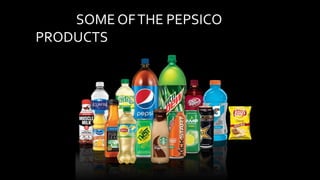
SOME OFTHE PEPSICO
PRODUCTS
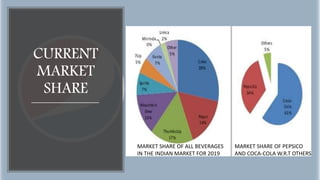
CURRENT
MARKET
SHARE
MARKET SHARE OF ALL BEVERAGES
IN THE INDIAN MARKET FOR 2019
MARKET SHARE OF PEPSICO
AND COCA-COLA W.R.T OTHERS
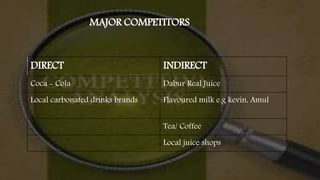
MAJOR COMPETITORS
DIRECT INDIRECT
Coca - Cola Dabur Real Juice
Local carbonated drinks brands Flavoured milk e.g kevin, Amul
Tea/ Coffee
Local juice shops
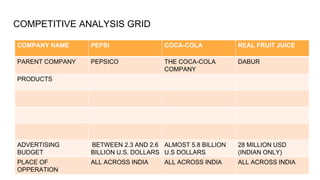
COMPETITIVE ANALYSIS GRID
COMPANY NAME PEPSI COCA-COLA REAL FRUIT JUICE
PARENT COMPANY PEPSICO THE COCA-COLA
COMPANY
DABUR
PRODUCTS
ADVERTISING
BUDGET
BETWEEN 2.3 AND 2.6
BILLION U.S. DOLLARS
ALMOST 5.8 BILLION
U.S DOLLARS
28 MILLION USD
(INDIAN ONLY)
PLACE OF
OPPERATION
ALL ACROSS INDIA ALL ACROSS INDIA ALL ACROSS INDIA
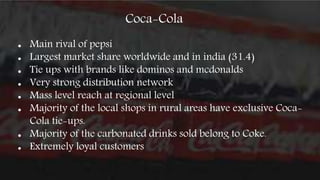
● Main rival of pepsi
● Largest market share worldwide and in india (31.4)
● Tie ups with brands like dominos and mcdonalds
● Very strong distribution network
● Mass level reach at regional level
● Majority of the local shops in rural areas have exclusive Coca-
Cola tie-ups.
● Majority of the carbonated drinks sold belong to Coke.
● Extremely loyal customers
Coca-Cola
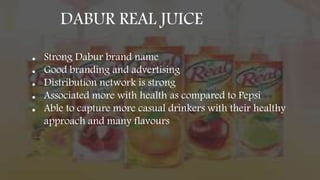
DABUR REAL JUICE
● Strong Dabur brand name
● Good branding and advertising
● Distribution network is strong
● Associated more with health as compared to Pepsi
● Able to capture more casual drinkers with their healthy
approach and many flavours
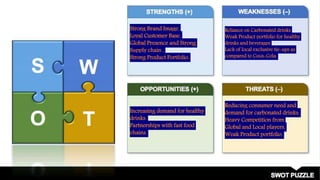
Strong Brand Image.
Loyal Customer Base.
Global Presence and Strong
Supply chain .
Strong Product Portfolio.
Reliance on Carbonated drinks
Weak Product portfolio for healthy
drinks and beverages
Lack of local exclusive tie-ups as
compared to Coca-Cola.
Increasing demand for healthy
drinks.
Partnerships with fast food
chains.
Reducing consumer need and
demand for carbonated drinks.
Heavy Competition from
Global and Local players.
Weak Product portfolio.
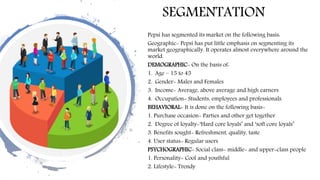
SEGMENTATION
Pepsi has segmented its market on the following basis:
Geographic- Pepsi has put little emphasis on segmenting its
market geographically. It operates almost everywhere around the
world.
DEMOGRAPHIC- On the basis of:
1. Age – 15 to 45
2. Gender- Males and Females
3. Income- Average, above average and high earners
4. Occupation- Students, employees and professionals.
BEHAVIORAL- It is done on the following basis-
1. Purchase occasion- Parties and other get together
2. Degree of loyalty-‘Hard core loyals’ and ‘soft core loyals’
3. Benefits sought- Refreshment, quality, taste
4. User status- Regular users
PSYCHOGRAPHIC- Social class- middle- and upper-class people
1. Personality- Cool and youthful
2. Lifestyle- Trendy
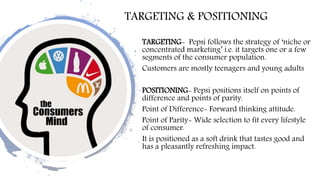
TARGETING & POSITIONING
TARGETING- Pepsi follows the strategy of ‘niche or
concentrated marketing’ i.e. it targets one or a few
segments of the consumer population.
Customers are mostly teenagers and young adults
POSITIONING- Pepsi positions itself on points of
difference and points of parity.
Point of Difference- Forward thinking attitude.
Point of Parity- Wide selection to fit every lifestyle
of consumer.
It is positioned as a soft drink that tastes good and
has a pleasantly refreshing impact.
PRODUCT
It is a carbonated soft drink manufactured by PepsiCo.
Levels of product:
-Core Benefit- To quench thirst and provide refreshment.
-Actual product- Is the soft drink itself.
Product features- provides refreshment through strong
carbonation and strong caffeine.
Branding: PepsiCo classifies its brands into three categories: Fun for
You, Good for You, and Better for You. Pepsi comes under the
‘Fun for You’ category.
Powerful brand with a strong equity
SKU’s: Glass bottles of 200ml,300ml,
PET bottles
Cans of 250ml and 330ml.
Packaging: Packaging includes compliance with food safety regulations,
freshness and quality of the product, environmental
sustainability, affordability, and consumer preferences, including
convenience.
Plans to make packaging 100% recyclable and biodegradable.
Labeling: Labeling on cans and bottles is done in regional Indian languages in an
attempt to attract local consumers.
PROMOTION
Advertising is Pepsi’s primary tactic for
marketing communications. For
example, the company is popularly
known for using celebrity endorsers to
promote its products on TV, radio, print
media, and online media. They
launched various campaigns and some
of the popular ones are
• Yehi hai right choice
• Dil maange more
• Oh yes abhi
• Har ghoot mein swag hai
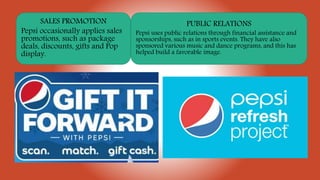
SALES PROMOTION
Pepsi occasionally applies sales
promotions, such as package
deals, discounts, gifts and Pop
display.
PUBLIC RELATIONS
Pepsi uses public relations through financial assistance and
sponsorships, such as in sports events. They have also
sponsored various music and dance programs, and this has
helped build a favorable image.
PLACEMENT
The Pepsi beverage has been placed across the country in every type of
outlet from small roadside shops to large supermarkets. PepsiCo uses a
global network for distributing its products to consumers. Venues for
distribution and sale are considered in this element of the marketing
mix. PepsiCo’s places for distribution are as follows:
1. Retailers
2. Online merchandisers
Most PepsiCo products are available at retailers, such as supermarkets,
grocery stores, and convenience stores. However, customers can access
PepsiCo-licensed merchandise like tumblers and t-shirts through
retailers and their websites. Based on this element of the marketing mix,
PepsiCo’s places for distributing its products are mostly non-online
retailers.
price
•
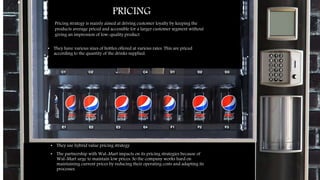
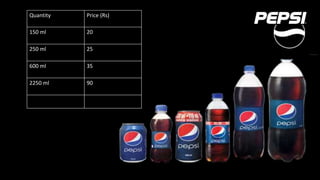
• They have various sizes of bottles offered at various rates. This are priced
according to the quantity of the drinks supplied.
• They use hybrid value pricing strategy
• The partnership with Wal-Mart impacts on its pricing strategies because of
Wal-Mart urge to maintain low prices. So the company works hard on
maintaining current prices by reducing their operating costs and adapting its
processes.
PRICING
Pricing strategy is mainly aimed at driving customer loyalty by keeping the
products average priced and accessible for a larger customer segment without
giving an impression of low-quality product
Quantity Price (Rs)
150 ml 20
250 ml 25
600 ml 35
2250 ml 90
RECOMMENDATIONS
• Should increase reach to regional level
• More offers to the retailors to convince them to sell Pepsi
exclusively.
• New products in the category of health like ( new diet Pepsi)
• Should increase visibility in the market like coca cola.
• Tie-ups with fast food chains. For example Coca-Colas tie-
up with Domino's
GATHERINGS FROM RETAILER VISITS
 Most of the local retailers have exclusive tie-up with Coca-Cola to distribute their products. We
noticed that 4 out of 6 local shops had Coca-Cola as the exclusive product.
 The shops that do have Pepsi, Stockpile weekly in the following way
 24 bottles of 600ml in one cart (10-15 carts kept for the week)
1.2 Ltr 12 bottles
2lt 9 bottles
Company offers - 1 cart purchase gets 2-3 bottles Aquafina free.
There is less in-store promotion due to good brand name and marketing by Pepsi itself.
SOURCE – Aggarwal Departmental Store, Shiv Shakti General Store.
SOURCES
FOR OUR
DATA
Primary Sources - Aggarwal Departmental
Store, Shiv Shakti General Store. Bakers Best
and Sweet Temptations Bakery in Ansal
Plaza
Secondary Sources -
https://www.ukessays.com/essays/marketing/
analysis-of-pepsi-co-in-india-marketing-
essay.php
https://www.slideshare.net/AshishPandey27
7/report-on-pepsico-india-market-
research-analysis
https://www.forbes.com/sites/panosmourdou
koutas/2019/07/13/pepsi-beats-coke-again/
https://www.statista.com/topics/1503/pepsic
o/
THANK YOU

Marketing

  • 1.
  • 2.
    COMPANY OVERVIEW • Pepsiwas introduced in the year 1965 with the merger of Pepsi-Cola company and Frito-Lay. • It was originally created and developed in 1893 by Caleb Bradham and introduced as Brad's Drink, it was renamed as Pepsi-Cola in 1898, and then shortened to Pepsi in 1961. • Since then the company has expanded its namesake product Pepsi to a broader range of food and beverage brands. • Pepsi-Cola First created as a refreshing and energizing tonic, today Pepsi-Cola is one of the world’s most iconic and recognized consumer brands. • COMPANY’S MISSION - “CREATE MORE SMILES WITH EVERY SIP AND EVERY BITE’’. • COMPANY’S VISION – ‘’ BE THE GLOBAL LEADER IN CONVENIENT FOODS AND BEVERAGES BY WINNING WITH PURPOSE’’.
  • 3.
  • 4.
    CURRENT MARKET SHARE MARKET SHARE OFALL BEVERAGES IN THE INDIAN MARKET FOR 2019 MARKET SHARE OF PEPSICO AND COCA-COLA W.R.T OTHERS
  • 5.
    MAJOR COMPETITORS DIRECT INDIRECT Coca- Cola Dabur Real Juice Local carbonated drinks brands Flavoured milk e.g kevin, Amul Tea/ Coffee Local juice shops
  • 6.
    COMPETITIVE ANALYSIS GRID COMPANYNAME PEPSI COCA-COLA REAL FRUIT JUICE PARENT COMPANY PEPSICO THE COCA-COLA COMPANY DABUR PRODUCTS ADVERTISING BUDGET BETWEEN 2.3 AND 2.6 BILLION U.S. DOLLARS ALMOST 5.8 BILLION U.S DOLLARS 28 MILLION USD (INDIAN ONLY) PLACE OF OPPERATION ALL ACROSS INDIA ALL ACROSS INDIA ALL ACROSS INDIA
  • 7.
    ● Main rivalof pepsi ● Largest market share worldwide and in india (31.4) ● Tie ups with brands like dominos and mcdonalds ● Very strong distribution network ● Mass level reach at regional level ● Majority of the local shops in rural areas have exclusive Coca- Cola tie-ups. ● Majority of the carbonated drinks sold belong to Coke. ● Extremely loyal customers Coca-Cola
  • 8.
    DABUR REAL JUICE ●Strong Dabur brand name ● Good branding and advertising ● Distribution network is strong ● Associated more with health as compared to Pepsi ● Able to capture more casual drinkers with their healthy approach and many flavours
  • 9.
    Strong Brand Image. LoyalCustomer Base. Global Presence and Strong Supply chain . Strong Product Portfolio. Reliance on Carbonated drinks Weak Product portfolio for healthy drinks and beverages Lack of local exclusive tie-ups as compared to Coca-Cola. Increasing demand for healthy drinks. Partnerships with fast food chains. Reducing consumer need and demand for carbonated drinks. Heavy Competition from Global and Local players. Weak Product portfolio.
  • 11.
    SEGMENTATION Pepsi has segmentedits market on the following basis: Geographic- Pepsi has put little emphasis on segmenting its market geographically. It operates almost everywhere around the world. DEMOGRAPHIC- On the basis of: 1. Age – 15 to 45 2. Gender- Males and Females 3. Income- Average, above average and high earners 4. Occupation- Students, employees and professionals. BEHAVIORAL- It is done on the following basis- 1. Purchase occasion- Parties and other get together 2. Degree of loyalty-‘Hard core loyals’ and ‘soft core loyals’ 3. Benefits sought- Refreshment, quality, taste 4. User status- Regular users PSYCHOGRAPHIC- Social class- middle- and upper-class people 1. Personality- Cool and youthful 2. Lifestyle- Trendy
  • 12.
    TARGETING & POSITIONING TARGETING-Pepsi follows the strategy of ‘niche or concentrated marketing’ i.e. it targets one or a few segments of the consumer population. Customers are mostly teenagers and young adults POSITIONING- Pepsi positions itself on points of difference and points of parity. Point of Difference- Forward thinking attitude. Point of Parity- Wide selection to fit every lifestyle of consumer. It is positioned as a soft drink that tastes good and has a pleasantly refreshing impact.
  • 14.
    PRODUCT It is acarbonated soft drink manufactured by PepsiCo. Levels of product: -Core Benefit- To quench thirst and provide refreshment. -Actual product- Is the soft drink itself. Product features- provides refreshment through strong carbonation and strong caffeine. Branding: PepsiCo classifies its brands into three categories: Fun for You, Good for You, and Better for You. Pepsi comes under the ‘Fun for You’ category. Powerful brand with a strong equity SKU’s: Glass bottles of 200ml,300ml, PET bottles Cans of 250ml and 330ml. Packaging: Packaging includes compliance with food safety regulations, freshness and quality of the product, environmental sustainability, affordability, and consumer preferences, including convenience. Plans to make packaging 100% recyclable and biodegradable. Labeling: Labeling on cans and bottles is done in regional Indian languages in an attempt to attract local consumers.
  • 15.
    PROMOTION Advertising is Pepsi’sprimary tactic for marketing communications. For example, the company is popularly known for using celebrity endorsers to promote its products on TV, radio, print media, and online media. They launched various campaigns and some of the popular ones are • Yehi hai right choice • Dil maange more • Oh yes abhi • Har ghoot mein swag hai
  • 16.
    SALES PROMOTION Pepsi occasionallyapplies sales promotions, such as package deals, discounts, gifts and Pop display. PUBLIC RELATIONS Pepsi uses public relations through financial assistance and sponsorships, such as in sports events. They have also sponsored various music and dance programs, and this has helped build a favorable image.
  • 17.
    PLACEMENT The Pepsi beveragehas been placed across the country in every type of outlet from small roadside shops to large supermarkets. PepsiCo uses a global network for distributing its products to consumers. Venues for distribution and sale are considered in this element of the marketing mix. PepsiCo’s places for distribution are as follows: 1. Retailers 2. Online merchandisers Most PepsiCo products are available at retailers, such as supermarkets, grocery stores, and convenience stores. However, customers can access PepsiCo-licensed merchandise like tumblers and t-shirts through retailers and their websites. Based on this element of the marketing mix, PepsiCo’s places for distributing its products are mostly non-online retailers.
  • 18.
    price • • They havevarious sizes of bottles offered at various rates. This are priced according to the quantity of the drinks supplied. • They use hybrid value pricing strategy • The partnership with Wal-Mart impacts on its pricing strategies because of Wal-Mart urge to maintain low prices. So the company works hard on maintaining current prices by reducing their operating costs and adapting its processes. PRICING Pricing strategy is mainly aimed at driving customer loyalty by keeping the products average priced and accessible for a larger customer segment without giving an impression of low-quality product
  • 19.
    Quantity Price (Rs) 150ml 20 250 ml 25 600 ml 35 2250 ml 90
  • 20.
    RECOMMENDATIONS • Should increasereach to regional level • More offers to the retailors to convince them to sell Pepsi exclusively. • New products in the category of health like ( new diet Pepsi) • Should increase visibility in the market like coca cola. • Tie-ups with fast food chains. For example Coca-Colas tie- up with Domino's
  • 21.
    GATHERINGS FROM RETAILERVISITS  Most of the local retailers have exclusive tie-up with Coca-Cola to distribute their products. We noticed that 4 out of 6 local shops had Coca-Cola as the exclusive product.  The shops that do have Pepsi, Stockpile weekly in the following way  24 bottles of 600ml in one cart (10-15 carts kept for the week) 1.2 Ltr 12 bottles 2lt 9 bottles Company offers - 1 cart purchase gets 2-3 bottles Aquafina free. There is less in-store promotion due to good brand name and marketing by Pepsi itself. SOURCE – Aggarwal Departmental Store, Shiv Shakti General Store.
  • 23.
    SOURCES FOR OUR DATA Primary Sources- Aggarwal Departmental Store, Shiv Shakti General Store. Bakers Best and Sweet Temptations Bakery in Ansal Plaza Secondary Sources - https://www.ukessays.com/essays/marketing/ analysis-of-pepsi-co-in-india-marketing- essay.php https://www.slideshare.net/AshishPandey27 7/report-on-pepsico-india-market- research-analysis https://www.forbes.com/sites/panosmourdou koutas/2019/07/13/pepsi-beats-coke-again/ https://www.statista.com/topics/1503/pepsic o/
  • 24.