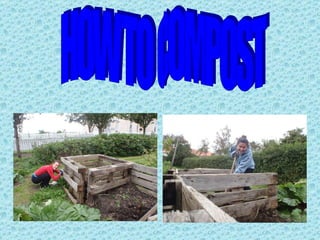
HOW TO COMPOST
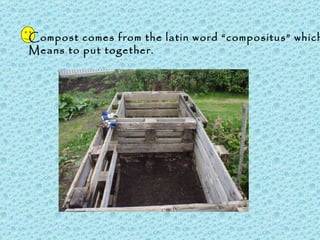
Compost comes from the latin word “compositus” which  Means to put together.
Why compost? It´s an easy way to recycle your kitchen and yard wastes It´s environmentally friendly, the amount of methane  Produced is very low Compost is a nutrient filled food product which will help Improve your soil structure Compost improves your soils condition and your plants  And flowers will love it. It helps reduce landfill wastes
A good compost is formed by 3 componants: AIR:   The composting microbes will not do their work without  It. There should be plenty of air passageways throughout Your heap. Your pile will stink without it. Water:   Too much water will slow the process down and make It stink. The ideal is like a wrung-out sponge Food:   -  Browns:  Provide Carbondioxide -  Greens:  Provide Nitrogine
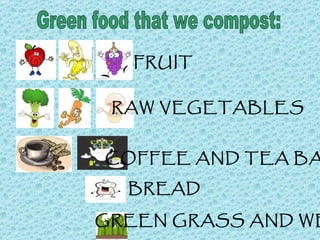
Green food that we compost: FRUIT RAW VEGETABLES COFFEE AND TEA BAGS BREAD GREEN GRASS AND WEED
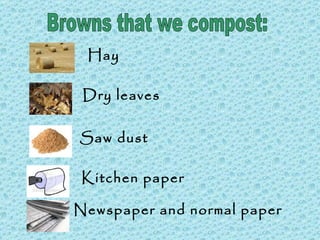
Browns that we compost: Hay Dry leaves Saw dust Kitchen paper Newspaper and normal paper
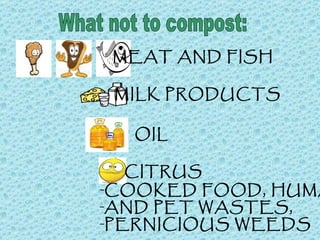
What not to compost: MEAT AND FISH MILK PRODUCTS OIL CITRUS COOKED FOOD, HUMAN AND PET WASTES,  PERNICIOUS WEEDS
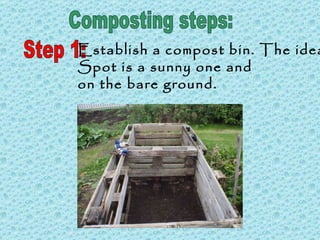
Composting steps: Step 1: Establish a compost bin. The ideal  Spot is a sunny one and  on the bare ground.
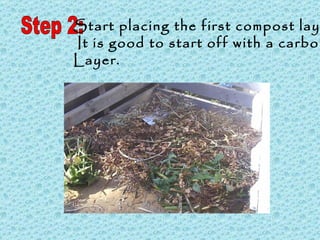
Step 2: Start placing the first compost layer. It is good to start off with a carbon  Layer.
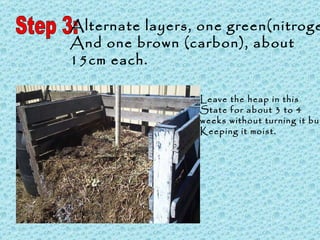
Step 3: Alternate layers, one green(nitrogen) And one brown (carbon), about 15cm each. Leave the heap in this State for about 3 to 4  weeks without turning it but  Keeping it moist.
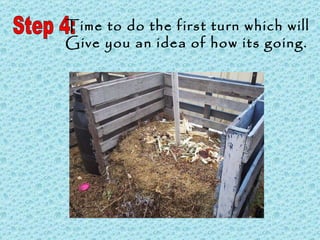
Step 4: Time to do the first turn which will  Give you an idea of how its going.
Tips: If you see that the heaps is too moist Add more brown products -If you see that it is too dry add more Green products -The ideal is that compost heap is like a Wrung-out sponge -Temperature when composting is of  70 degrees, when heap is ready it is of The same outside temperature -Turn heap every 1 to 2 weeks
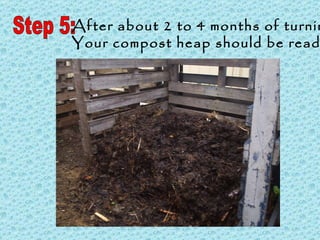
Step 5: After about 2 to 4 months of turning Your compost heap should be ready
How do you know its ready? The temperature should be no longer hot, if  It´s close to outside temperature its ideal -Through its aspect, it should have a dark  Brown colour, with a crumbly texture When all the materials are no longer  Recognisable.

Compost

  • 1.
  • 2.
    Compost comes fromthe latin word “compositus” which Means to put together.
  • 3.
    Why compost? It´san easy way to recycle your kitchen and yard wastes It´s environmentally friendly, the amount of methane Produced is very low Compost is a nutrient filled food product which will help Improve your soil structure Compost improves your soils condition and your plants And flowers will love it. It helps reduce landfill wastes
  • 4.
    A good compostis formed by 3 componants: AIR: The composting microbes will not do their work without It. There should be plenty of air passageways throughout Your heap. Your pile will stink without it. Water: Too much water will slow the process down and make It stink. The ideal is like a wrung-out sponge Food: - Browns: Provide Carbondioxide - Greens: Provide Nitrogine
  • 5.
    Green food thatwe compost: FRUIT RAW VEGETABLES COFFEE AND TEA BAGS BREAD GREEN GRASS AND WEED
  • 6.
    Browns that wecompost: Hay Dry leaves Saw dust Kitchen paper Newspaper and normal paper
  • 7.
    What not tocompost: MEAT AND FISH MILK PRODUCTS OIL CITRUS COOKED FOOD, HUMAN AND PET WASTES, PERNICIOUS WEEDS
  • 8.
    Composting steps: Step1: Establish a compost bin. The ideal Spot is a sunny one and on the bare ground.
  • 9.
    Step 2: Startplacing the first compost layer. It is good to start off with a carbon Layer.
  • 10.
    Step 3: Alternatelayers, one green(nitrogen) And one brown (carbon), about 15cm each. Leave the heap in this State for about 3 to 4 weeks without turning it but Keeping it moist.
  • 11.
    Step 4: Timeto do the first turn which will Give you an idea of how its going.
  • 12.
    Tips: If yousee that the heaps is too moist Add more brown products -If you see that it is too dry add more Green products -The ideal is that compost heap is like a Wrung-out sponge -Temperature when composting is of 70 degrees, when heap is ready it is of The same outside temperature -Turn heap every 1 to 2 weeks
  • 13.
    Step 5: Afterabout 2 to 4 months of turning Your compost heap should be ready
  • 14.
    How do youknow its ready? The temperature should be no longer hot, if It´s close to outside temperature its ideal -Through its aspect, it should have a dark Brown colour, with a crumbly texture When all the materials are no longer Recognisable.