ALLs Mentor Groups
Planning
2nd
March 2015
doreen.mjukes@gmail.com
leytia.leota@xtra.co.nz
davis.vision@xtra.co.nz
What are we aiming
to do?
Build understanding of
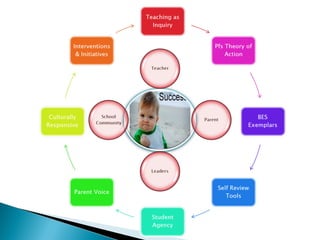
Theory of Action: Two expected
outcomes
1) Accelerate a group of target
students.
2) Curriculum and achievement action
plan. 
Ensure your intervention is –
additional to classroom programme
a minimum of 4x 30min sessions weekly
15 weeks
supported by adequate release for the
intervention Teacher a Tier Two intervention
supported by regular SIT meetings with
intervention teacher
 
Intervention Considers:
relevant theory & research (Professional Readings sourced
from MOE / TKI Site / Other)
known levers of change (Theory of Action)
key messages from Evaluation and Planning days
what each student knows & can do & accounts for their
identity, language & culture
identified pathways of progress using the LLP (& ELLP) for
each learner– to change the trajectory of achievement 
acceleration
planned steps across 15 weeks
explicit foci
overt instruction that will be used
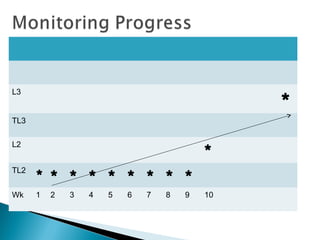
L3
*
TL3
L2
*
TL2
* * * * * * * * *
Wk 1 2 3 4 5 6 7 8 9 10
Built in review:
on-going monitoring of students’ progress during
the intervention
on-going engagement with student and whanau
voice
Will be based on:
The learners
Teacher strengths/role
Physical resources
How it fits in with other literacy interventions
Role of parents, family, whanau
Organisational considerations
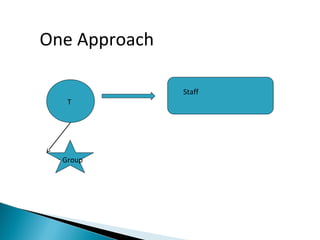
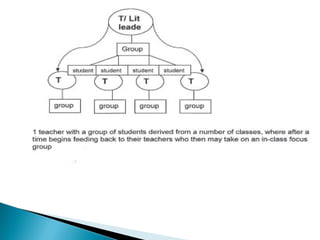
T
Staff
GroupGroup
One Approach
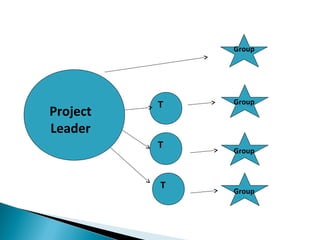
T
T
T
Group
Group
Group
Group
Project
Leader
 Advantages:
 Less noise and disruptions
 Student confidence levels rise – risk taking
 Positive feelings
 Disadvantages:
 Space
 Disruption for classroom teachers
 Students miss classroom experiences
 Older children may be reluctant
 “Withdrawal programmes can help
them (students) get their bearings
away from the pressures of the regular
classroom. These programmes give
students the benefits of one-on-one or
small group language instruction and
offer them an opportunity to ask
questions.”
 Ashworth, 2000, p.96
 Advantages:
 Students feel part of classroom teaching and learning
 ALL teacher is seen as part of everyday classroom teaching
 No other teaching space required
 Other students may benefit
 Disadvantages
 Becomes replacement rather than supplementary
 May always need to be at the same time of the day
 Competing noise may be difficult for some students
 Supplementary ‘NOT’ replacement.
 Data driven.
 Metacognition
 Dose and Density.
 Student agency.
 School led and driven.
 Pedagogically sound.
 Culturally responsive.
 Innovative – based on sound ideas.
 Iterative inquiry
 Implementing a system of support plan.
 Curriculum and Achievement Map

Alls day 1 mentor session

  • 1.
    ALLs Mentor Groups Planning 2nd March2015 doreen.mjukes@gmail.com leytia.leota@xtra.co.nz davis.vision@xtra.co.nz
  • 2.
    What are weaiming to do?
  • 4.
    Build understanding of Theoryof Action: Two expected outcomes 1) Accelerate a group of target students. 2) Curriculum and achievement action plan. 
  • 5.
    Ensure your interventionis – additional to classroom programme a minimum of 4x 30min sessions weekly 15 weeks supported by adequate release for the intervention Teacher a Tier Two intervention supported by regular SIT meetings with intervention teacher  
  • 6.
    Intervention Considers: relevant theory& research (Professional Readings sourced from MOE / TKI Site / Other) known levers of change (Theory of Action) key messages from Evaluation and Planning days what each student knows & can do & accounts for their identity, language & culture identified pathways of progress using the LLP (& ELLP) for each learner– to change the trajectory of achievement  acceleration planned steps across 15 weeks explicit foci overt instruction that will be used
  • 7.
    L3 * TL3 L2 * TL2 * * ** * * * * * Wk 1 2 3 4 5 6 7 8 9 10
  • 8.
    Built in review: on-goingmonitoring of students’ progress during the intervention on-going engagement with student and whanau voice
  • 9.
    Will be basedon: The learners Teacher strengths/role Physical resources How it fits in with other literacy interventions Role of parents, family, whanau Organisational considerations
  • 10.
  • 11.
  • 13.
     Advantages:  Lessnoise and disruptions  Student confidence levels rise – risk taking  Positive feelings  Disadvantages:  Space  Disruption for classroom teachers  Students miss classroom experiences  Older children may be reluctant
  • 14.
     “Withdrawal programmescan help them (students) get their bearings away from the pressures of the regular classroom. These programmes give students the benefits of one-on-one or small group language instruction and offer them an opportunity to ask questions.”  Ashworth, 2000, p.96
  • 15.
     Advantages:  Studentsfeel part of classroom teaching and learning  ALL teacher is seen as part of everyday classroom teaching  No other teaching space required  Other students may benefit  Disadvantages  Becomes replacement rather than supplementary  May always need to be at the same time of the day  Competing noise may be difficult for some students
  • 17.
     Supplementary ‘NOT’replacement.  Data driven.  Metacognition  Dose and Density.  Student agency.  School led and driven.  Pedagogically sound.  Culturally responsive.  Innovative – based on sound ideas.  Iterative inquiry  Implementing a system of support plan.  Curriculum and Achievement Map

Editor's Notes

  • #2 DAY ONE- SESSION TWO
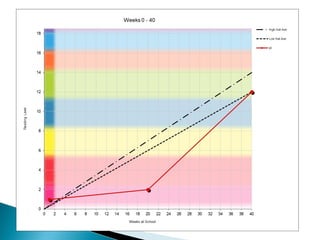
  • #4 This is what we are aiming to do – we are interrupting the pattern of progress and aiming for a steeper trajectory of progress. We may not get to national expectations in the 15 weeks but the child is ontrack to get there now rather than flling further and further behind.
  • #8 Need to be thinking about how you will monitor progress during the course of the intervention – don’t want to get to 15 weeks and then realise that there is been minimal or no impact.
  • #9 Discuss and talk about how you are going to do this?
  • #10 Learners – one class or a number of classes Teachers – classroom teacher or someone else who doesn’t have classroom teaching responsibilities Physical resources – is there room in the classroom for two teachers to work effectively, noise issues especially if ELLs are a part of the group, is there a suitable room to work in if not in classroom. How it fits with other things – e.g RR, Rainbow Reading how is there going to be communication and collaborative approach between two interventions. Organisation: timetabling especially Intermediate schools, if out of classroom different times so as not to always miss the same thing, remember supplementary not replacement
  • #18 Student agency- knowing the learner, metacognitely rich, integration of formative assessment, DATS, active engagement