A Perfect Match: Blended 
Learning and Student 
Engagement 
A Case Study on the Importance of Student Engagment 
in a Blended, First-Year Composition Class
A Perfect Match… 
Background 
Kwantlen Polytechnic Institution is… 
• Open admission* 
• Teaching intensive 
• Actively recruiting international students** 
*Students are accepted based on completion of a high-school diploma, GED, or mature-student status, as opposed to being 
accepted based on academic achievement. Students attending open-admission institutions are sometimes unprepared for the 
rigour of university study, as opposed to students attending selective-entry institutions. 
**BC Ministry of Advanced Education has made international recruitment part of mandate for post-secondary institutions, which 
compounds the issue of catering to students perhaps unprepared for the rigour of university in courses such as Academic Writing, 
where communication in English is essential.
A Perfect Match… 
Background 
Focus of case study is ENGL 1100… 
• a first-year composition course 
• required by most degree programs in the 
institution 
• articulated with all equivalent composition 
courses in BC, which also tend to be required 
courses
A Perfect Match 
Issues… 
• ENGL 1100 often seen as a “problem course” 
• Required course = learners often reluctant 
• Appropriate placement (a variety of prerequisites = lack of consistency) 
• Failure rate usually 30-40% (failure = below 60% or “C”) 
• Many students retake course (sometimes two and three times) 
• Active recruitment of international students compounds challenge 
(particularly in a course where communication in English is essential) 
• Can create a bottleneck for students (4th-year students still taking 1st 
year requirements)
A Perfect Match 
Previous Research…. 
Informal Research: 
• Surveys administered over several years indicate students 
find the blended environment more engaging than either 
fully face-to-face or fully online courses. 
Formal research: 
• Results of an action research study surveyed successful 
students from four sections of ENGL 1100 indicated 91.5% 
of surveyed students believed the blended environment 
contributed to their success in the course
A Perfect Match 
Two Central Reasons for failure in ENGL 
1100: 
• Inappropriate placement (students 
do not have language skills 
appropriate for university-level writing) 
• Students simply do not submit 
assignments
A Perfect Match 
Student reluctance to enroll in blended 
courses.. 
• Because KPU offers so few courses in 
blended format that students are unfamiliar 
with learning environment; 
• Courses are labeled “partially online” and 
institutional research reports KPU students 
tend to avoid any course with “online” 
label; 
• Negative experience with high school 
online courses, which are self-paced.
A Perfect Match 
Subject of case study was an 
ENGL 1100 course not 
labeled “partially online”; 
Student expectation would 
have been for a fully face-to- 
face class.
RESEARCH QUESTION 
To what extent can a blended 
environment help students typical of 
open-admission universities succeed in 
a required, first-year composition 
course?
Methodological Approach 
Mixed Methods study employing Case 
Study/Action Research approach: 
• 16 students responded to a nine-question survey 
• Attendance patterns for face-to-face classes (both 
optional and mandatory) collected 
• Online activity reports collected 
• Student success rates collected and collated.
A Perfect Match 
This case study was a second iteration of 
an Action Research project completed 
in June, 2013. 
The focus of this iteration was a specific 
group of students in one anomalous 
section of the course over a fourteen-week 
semester.
A Perfect Match 
Regular classes at KPU meet twice a week 
for eighty minutes; blended classes meet 
once a week for eighty minutes. 
Students in this section were offered the 
following choice: they could learn the 
material online or they could attend an 
optional face-to-face class each week 
where they would be taught the same 
material in a classroom.
A Perfect Match 
In other words, students had 
access to a fully blended course, 
but had the option of attending 
additional face-to-face classes 
to review material offered online.
A Perfect Match 
Student attendance patterns were 
observed in both the optional and 
mandatory classes over a fourteen-week 
semester. 
Initial enrolment was 23, but 6 withdrew 
over the course of the semester, so 
enrollment dropped to seventeen 
students.
ATTENDANCE PATTTERNS FOR OPTIONAL AND 
MANDATORY FACE-TO-FACE CLASSES 
• 10 (of 23 original) students attended 
the first three optional classes; 
• Attendance of the optional class 
dropped off sharply after week 3 as 
students became more confident with 
the online portion of the class; 
• Attendance for the optional classes 
was 2 or 3 students each week.
Student Survey Responses 
(administered in week ten) 
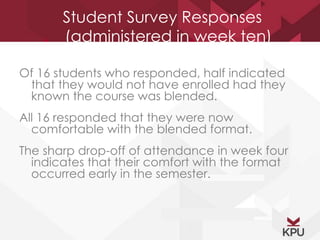
Of 16 students who responded, half indicated 
that they would not have enrolled had they 
known the course was blended. 
All 16 responded that they were now 
comfortable with the blended format. 
The sharp drop-off of attendance in week four 
indicates that their comfort with the format 
occurred early in the semester.
Student Survey Responses 
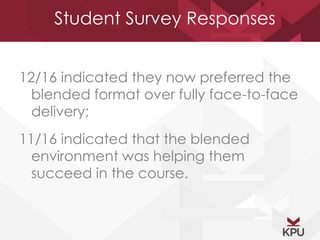
12/16 indicated they now preferred the 
blended format over fully face-to-face 
delivery; 
11/16 indicated that the blended 
environment was helping them 
succeed in the course.
Student Survey Responses 
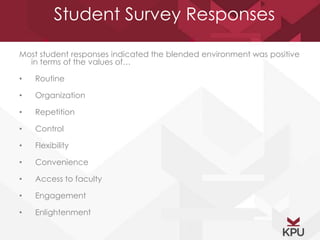
Most student responses indicated the blended environment was positive 
in terms of the values of… 
• Routine 
• Organization 
• Repetition 
• Control 
• Flexibility 
• Convenience 
• Access to faculty 
• Engagement 
• Enlightenment
Student Survey Responses 
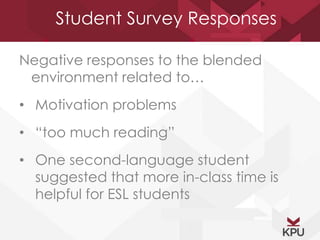
Negative responses to the blended 
environment related to… 
• Motivation problems 
• “too much reading” 
• One second-language student 
suggested that more in-class time is 
helpful for ESL students
A Perfect Match 
Final Student Grades
A/B: EXCELLENT/GOOD: 6 STUDENTS 
• All attended every mandatory class; 
• 5/6 viewed online lessons, most several times 
• 1/6 viewed online lessons sporadically for the first 
half of the semester, but consistently in last half (as 
concepts became more challenging) 
• For first writing assignment, 6/6 received 
“satisfactory,” “good,” or “excellent” grades 
(C+/B/B+/A-)
C/C+: SATISFACTORY: 5 STUDENTS 
4/5 attended every mandatory class 
5/5 viewed every online lesson, most 
several times 
Significantly, though all 5 students 
ultimately succeeded in the course, 
each received “unsatisfactory” and 
“failing” grades (C-/D/F) on their first 
writing assignment
C-/D: UNSATISFACTORY: 2 STUDENTS 
• 1 /2 attended all mandatory classes 
and viewed all online lessons 
• 1 /2 missed 3 weeks of mandatory 
face-to-face classes, but viewed all 
online lessons.
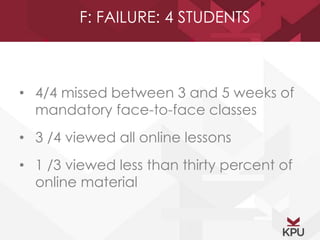
F: FAILURE: 4 STUDENTS 
• 4/4 missed between 3 and 5 weeks of 
mandatory face-to-face classes 
• 3 /4 viewed all online lessons 
• 1 /3 viewed less than thirty percent of 
online material
A Perfect Match 
STUDENT RESULTS 
CATEGORIZED BY 
IMPROVEMENT
A Perfect Match 
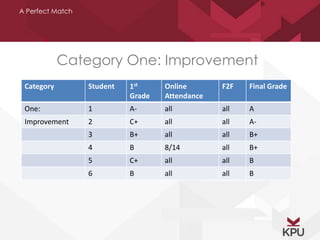
Category One: Improvement 
Category Student 1st 
Grade 
Online 
Attendance 
F2F Final Grade 
One: 1 A- all all A 
Improvement 2 C+ all all A- 
3 B+ all all B+ 
4 B 8/14 all B+ 
5 C+ all all B 
6 B all all B
A Perfect Match 
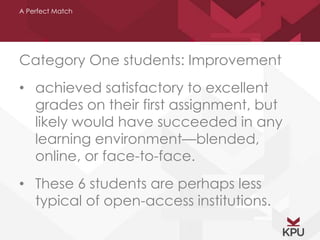
Category One students: Improvement 
• achieved satisfactory to excellent 
grades on their first assignment, but 
likely would have succeeded in any 
learning environment—blended, 
online, or face-to-face. 
• These 6 students are perhaps less 
typical of open-access institutions.
A Perfect Match 
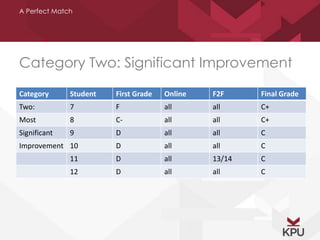
Category Two: Significant Improvement 
Category Student First Grade Online F2F Final Grade 
Two: 7 F all all C+ 
Most 8 C- all all C+ 
Significant 9 D all all C 
Improvement 10 D all all C 
11 D all 13/14 C 
12 D all all C
A Perfect Match 
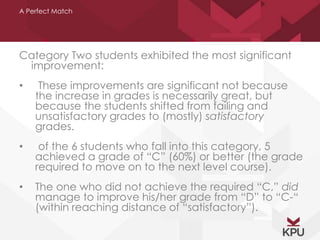
Category Two students exhibited the most significant 
improvement: 
• These improvements are significant not because 
the increase in grades is necessarily great, but 
because the students shifted from failing and 
unsatisfactory grades to (mostly) satisfactory 
grades. 
• of the 6 students who fall into this category, 5 
achieved a grade of “C” (60%) or better (the grade 
required to move on to the next level course). 
• The one who did not achieve the required “C,” did 
manage to improve his/her grade from “D” to “C-“ 
(within reaching distance of “satisfactory”).
A Perfect Match 
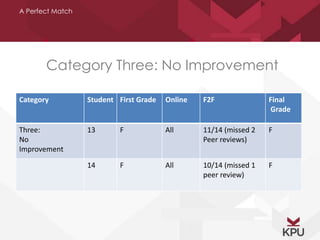
Category Three: No Improvement 
Category Student First Grade Online F2F Final 
Grade 
Three: 
No 
Improvement 
13 F All 11/14 (missed 2 
Peer reviews) 
F 
14 F All 10/14 (missed 1 
peer review) 
F
A Perfect Match 
Category Three students exhibited no 
improvement: 
2 students in this category failed their first 
writing assignment and ultimately failed 
the course as well 
Both students viewed all the online 
lectures, but both missed three to four 
weeks of face-to-face classes and 
peer-review workshops
A Perfect Match 
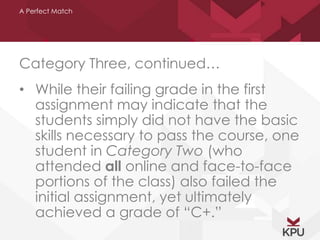
Category Three, continued… 
• While their failing grade in the first 
assignment may indicate that the 
students simply did not have the basic 
skills necessary to pass the course, one 
student in Category Two (who 
attended all online and face-to-face 
portions of the class) also failed the 
initial assignment, yet ultimately 
achieved a grade of “C+.”
A Perfect Match 
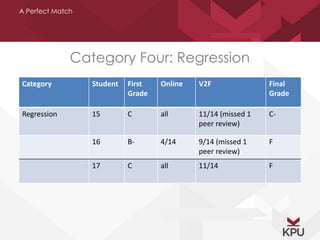
Category Four: Regression 
Category Student First 
Grade 
Online V2F Final 
Grade 
Regression 15 C all 11/14 (missed 1 
peer review) 
C- 
16 B- 4/14 9/14 (missed 1 
peer review) 
F 
17 C all 11/14 F
A Perfe;ct Match 
Category Four: Significant lack of improvement: 
• The 3 students in this category achieved 
“satisfactory” or “good” (C/B-) grades on their first 
writing assignment indicating that they possessed 
the essential skills for passing the course. 
• Ultimately, however, each of these students 
received unsatisfactory or failing grades (C-/F). 
• Significantly, these students missed between three 
and five weeks of face-to-face classes and 
workshops, and one missed a great deal of the 
online portion of the class as well.
A Perfect Match 
• The eleven students in Categories Two, Three, 
and Four reflect characteristics perhaps more 
typical of first-year students in open-admission 
institutions—students who may not be 
prepared for the rigour of university studies. 
• The attendance patterns and results of these 
eleven students indicate the essential 
importance of both portions of the blended 
course—the “knowledge” and “the 
knowing”…the fullness of “the generative 
dance” (Cook and Brown, 1999).
Conclusions 
• The results of this research suggest that 
because of its emphasis on reading and 
writing, a blended learning environment—“the 
thoughtful integration of face-to-face and 
online learning (Mathios, 2011)—may help 
students in writing courses achieve success. 
• Of greater importance, the results seem to 
indicate that the success is most evident with 
students who fully engage with the blended 
learning environment, but who may be 
struggling, unprepared, or under-prepared 
(students more typical of open-admission, as 
opposed to selective-admission, institutions).
Implications 
• The implications of this finding may be 
of interest to KPU and other open-access 
institutions since a central 
concern must invariably be helping 
(frequently under-prepared) students 
succeed at the post-secondary level.
A Perfect Match 
While the student survey responses for this case 
study do not endorse the blended learning 
environment as a central contributor to their 
learning as overwhelmingly as the students in the 
earlier iteration of this study, the majority did 
endorse the blended environment as helping 
them learn. 
In spite of some of KPU’s institutional research which 
suggest that students will not take blended 
courses (KPU, 2010), the students indicated a clear 
desire to take future classes in a blended format. 
Responses were more positive than expected, 
especially considering that they had enrolled in a 
course they expected to be conducted in a fully 
face-to-face format.
A Perfect Match 
A further conclusion is that students quickly 
accept the blended format as equal to a 
fully face-to-face environment, and value 
not repetition of online material, but rather, 
different—“value-added”—material in the 
classroom. 
This is supported by the fact that the one 
optional class in ENGL 1100 which was of a 
“value-added” nature (individual 
consultations) experienced a spike in 
attendance.
A Perfect Match 
Please send me an e-mail if 
you have any questions, or 
wish to read the entire 
study: 
sheila.hancock@kpu.ca
References 
Bassey, M. (1999). Case study research in educational settings. Buckingham [England: Open University Press. 
Brunner, D. (2006). The potential of the hybrid course vis-a-vis online and traditional courses. Teaching Theology & Religion, 9(4), 229-235. 
Cohen, L., Manion, L., & Morrison, K. (2000). Research methods in education. London: Routledge Falmer. 
Gay, L. R., Mills, G. E., & Airasian, P. W. (2012). Educational research: Competencies for analysis and applications. Boston: Pearson. 
Cook, S. N., & Brown, J. S. (1999). Bridging Epistemologies: The Generative Dance Between Organizational Knowledge and Organizational Knowing. Organization Science, 10(4), 
381-400. 
Gouge, C. (2009). Conversation at a crucial moment: hybrid courses and the future of writing programs. College English, 71(4), 338-362. 
Kim, K., & Bonk, C. (2006). The future of online teaching and learning in higher education: the survey says…. EDUCAUSE Quarterly, 29(4), 22-30. 
KPU (2010). Fall 2010 Applicant Survey: Report--Joint Overview of Results: Capilano University, KPU, Langara College, Douglas College. 
Matheos, K. (2011). Innovative Practices Research Project COHERE Report on Blended Learning (Rep.). Retrieved from http://cohere.ca/wp-content/uploads/2011/11/REPORT-ON- 
BLENDED-LEARNING-FINAL1.pdf 
Mertler, C. A. (2013). Action research: Improving schools and empowering educators. [S.l.]: Sage Publications. 
Mills, G. E. (2011). Action research: A guide for the teacher researcher. Boston: Pearson. 
Osguthorpe, R., & Graham, C. (2003). Blended learning environments: definitions and directions. Quarterly Review of Distance Education, 4(3), 227-33. Retrieved from ERIC 
database. 
Schön, D. (1987). Preparing professionals for the demands of practice. In Educating the Reflective Practitioner (pp. 3-21). San Francisco: Jossey Bass. 
Stine, L.J. (2010). Teaching basic writing in a web-enhanced environment. Journal of Basic Writing (CUNY), 29(1). 33-55. 
Waddoups, G., Hatch, G., & Butterworth, S. (2003). Case 5: blended teaching and learning in a first-year composition course. Quarterly Review of Distance Education, 4(3), 271-78. 
Retrieved from ERIC database.

A perfect match blended learning and student engagement

  • 1.
    A Perfect Match:Blended Learning and Student Engagement A Case Study on the Importance of Student Engagment in a Blended, First-Year Composition Class
  • 2.
    A Perfect Match… Background Kwantlen Polytechnic Institution is… • Open admission* • Teaching intensive • Actively recruiting international students** *Students are accepted based on completion of a high-school diploma, GED, or mature-student status, as opposed to being accepted based on academic achievement. Students attending open-admission institutions are sometimes unprepared for the rigour of university study, as opposed to students attending selective-entry institutions. **BC Ministry of Advanced Education has made international recruitment part of mandate for post-secondary institutions, which compounds the issue of catering to students perhaps unprepared for the rigour of university in courses such as Academic Writing, where communication in English is essential.
  • 3.
    A Perfect Match… Background Focus of case study is ENGL 1100… • a first-year composition course • required by most degree programs in the institution • articulated with all equivalent composition courses in BC, which also tend to be required courses
  • 4.
    A Perfect Match Issues… • ENGL 1100 often seen as a “problem course” • Required course = learners often reluctant • Appropriate placement (a variety of prerequisites = lack of consistency) • Failure rate usually 30-40% (failure = below 60% or “C”) • Many students retake course (sometimes two and three times) • Active recruitment of international students compounds challenge (particularly in a course where communication in English is essential) • Can create a bottleneck for students (4th-year students still taking 1st year requirements)
  • 5.
    A Perfect Match Previous Research…. Informal Research: • Surveys administered over several years indicate students find the blended environment more engaging than either fully face-to-face or fully online courses. Formal research: • Results of an action research study surveyed successful students from four sections of ENGL 1100 indicated 91.5% of surveyed students believed the blended environment contributed to their success in the course
  • 6.
    A Perfect Match Two Central Reasons for failure in ENGL 1100: • Inappropriate placement (students do not have language skills appropriate for university-level writing) • Students simply do not submit assignments
  • 7.
    A Perfect Match Student reluctance to enroll in blended courses.. • Because KPU offers so few courses in blended format that students are unfamiliar with learning environment; • Courses are labeled “partially online” and institutional research reports KPU students tend to avoid any course with “online” label; • Negative experience with high school online courses, which are self-paced.
  • 8.
    A Perfect Match Subject of case study was an ENGL 1100 course not labeled “partially online”; Student expectation would have been for a fully face-to- face class.
  • 9.
    RESEARCH QUESTION Towhat extent can a blended environment help students typical of open-admission universities succeed in a required, first-year composition course?
  • 10.
    Methodological Approach MixedMethods study employing Case Study/Action Research approach: • 16 students responded to a nine-question survey • Attendance patterns for face-to-face classes (both optional and mandatory) collected • Online activity reports collected • Student success rates collected and collated.
  • 11.
    A Perfect Match This case study was a second iteration of an Action Research project completed in June, 2013. The focus of this iteration was a specific group of students in one anomalous section of the course over a fourteen-week semester.
  • 12.
    A Perfect Match Regular classes at KPU meet twice a week for eighty minutes; blended classes meet once a week for eighty minutes. Students in this section were offered the following choice: they could learn the material online or they could attend an optional face-to-face class each week where they would be taught the same material in a classroom.
  • 13.
    A Perfect Match In other words, students had access to a fully blended course, but had the option of attending additional face-to-face classes to review material offered online.
  • 14.
    A Perfect Match Student attendance patterns were observed in both the optional and mandatory classes over a fourteen-week semester. Initial enrolment was 23, but 6 withdrew over the course of the semester, so enrollment dropped to seventeen students.
  • 15.
    ATTENDANCE PATTTERNS FOROPTIONAL AND MANDATORY FACE-TO-FACE CLASSES • 10 (of 23 original) students attended the first three optional classes; • Attendance of the optional class dropped off sharply after week 3 as students became more confident with the online portion of the class; • Attendance for the optional classes was 2 or 3 students each week.
  • 16.
    Student Survey Responses (administered in week ten) Of 16 students who responded, half indicated that they would not have enrolled had they known the course was blended. All 16 responded that they were now comfortable with the blended format. The sharp drop-off of attendance in week four indicates that their comfort with the format occurred early in the semester.
  • 17.
    Student Survey Responses 12/16 indicated they now preferred the blended format over fully face-to-face delivery; 11/16 indicated that the blended environment was helping them succeed in the course.
  • 18.
    Student Survey Responses Most student responses indicated the blended environment was positive in terms of the values of… • Routine • Organization • Repetition • Control • Flexibility • Convenience • Access to faculty • Engagement • Enlightenment
  • 19.
    Student Survey Responses Negative responses to the blended environment related to… • Motivation problems • “too much reading” • One second-language student suggested that more in-class time is helpful for ESL students
  • 20.
    A Perfect Match Final Student Grades
  • 21.
    A/B: EXCELLENT/GOOD: 6STUDENTS • All attended every mandatory class; • 5/6 viewed online lessons, most several times • 1/6 viewed online lessons sporadically for the first half of the semester, but consistently in last half (as concepts became more challenging) • For first writing assignment, 6/6 received “satisfactory,” “good,” or “excellent” grades (C+/B/B+/A-)
  • 22.
    C/C+: SATISFACTORY: 5STUDENTS 4/5 attended every mandatory class 5/5 viewed every online lesson, most several times Significantly, though all 5 students ultimately succeeded in the course, each received “unsatisfactory” and “failing” grades (C-/D/F) on their first writing assignment
  • 23.
    C-/D: UNSATISFACTORY: 2STUDENTS • 1 /2 attended all mandatory classes and viewed all online lessons • 1 /2 missed 3 weeks of mandatory face-to-face classes, but viewed all online lessons.
  • 24.
    F: FAILURE: 4STUDENTS • 4/4 missed between 3 and 5 weeks of mandatory face-to-face classes • 3 /4 viewed all online lessons • 1 /3 viewed less than thirty percent of online material
  • 25.
    A Perfect Match STUDENT RESULTS CATEGORIZED BY IMPROVEMENT
  • 26.
    A Perfect Match Category One: Improvement Category Student 1st Grade Online Attendance F2F Final Grade One: 1 A- all all A Improvement 2 C+ all all A- 3 B+ all all B+ 4 B 8/14 all B+ 5 C+ all all B 6 B all all B
  • 27.
    A Perfect Match Category One students: Improvement • achieved satisfactory to excellent grades on their first assignment, but likely would have succeeded in any learning environment—blended, online, or face-to-face. • These 6 students are perhaps less typical of open-access institutions.
  • 28.
    A Perfect Match Category Two: Significant Improvement Category Student First Grade Online F2F Final Grade Two: 7 F all all C+ Most 8 C- all all C+ Significant 9 D all all C Improvement 10 D all all C 11 D all 13/14 C 12 D all all C
  • 29.
    A Perfect Match Category Two students exhibited the most significant improvement: • These improvements are significant not because the increase in grades is necessarily great, but because the students shifted from failing and unsatisfactory grades to (mostly) satisfactory grades. • of the 6 students who fall into this category, 5 achieved a grade of “C” (60%) or better (the grade required to move on to the next level course). • The one who did not achieve the required “C,” did manage to improve his/her grade from “D” to “C-“ (within reaching distance of “satisfactory”).
  • 30.
    A Perfect Match Category Three: No Improvement Category Student First Grade Online F2F Final Grade Three: No Improvement 13 F All 11/14 (missed 2 Peer reviews) F 14 F All 10/14 (missed 1 peer review) F
  • 31.
    A Perfect Match Category Three students exhibited no improvement: 2 students in this category failed their first writing assignment and ultimately failed the course as well Both students viewed all the online lectures, but both missed three to four weeks of face-to-face classes and peer-review workshops
  • 32.
    A Perfect Match Category Three, continued… • While their failing grade in the first assignment may indicate that the students simply did not have the basic skills necessary to pass the course, one student in Category Two (who attended all online and face-to-face portions of the class) also failed the initial assignment, yet ultimately achieved a grade of “C+.”
  • 33.
    A Perfect Match Category Four: Regression Category Student First Grade Online V2F Final Grade Regression 15 C all 11/14 (missed 1 peer review) C- 16 B- 4/14 9/14 (missed 1 peer review) F 17 C all 11/14 F
  • 34.
    A Perfe;ct Match Category Four: Significant lack of improvement: • The 3 students in this category achieved “satisfactory” or “good” (C/B-) grades on their first writing assignment indicating that they possessed the essential skills for passing the course. • Ultimately, however, each of these students received unsatisfactory or failing grades (C-/F). • Significantly, these students missed between three and five weeks of face-to-face classes and workshops, and one missed a great deal of the online portion of the class as well.
  • 35.
    A Perfect Match • The eleven students in Categories Two, Three, and Four reflect characteristics perhaps more typical of first-year students in open-admission institutions—students who may not be prepared for the rigour of university studies. • The attendance patterns and results of these eleven students indicate the essential importance of both portions of the blended course—the “knowledge” and “the knowing”…the fullness of “the generative dance” (Cook and Brown, 1999).
  • 36.
    Conclusions • Theresults of this research suggest that because of its emphasis on reading and writing, a blended learning environment—“the thoughtful integration of face-to-face and online learning (Mathios, 2011)—may help students in writing courses achieve success. • Of greater importance, the results seem to indicate that the success is most evident with students who fully engage with the blended learning environment, but who may be struggling, unprepared, or under-prepared (students more typical of open-admission, as opposed to selective-admission, institutions).
  • 37.
    Implications • Theimplications of this finding may be of interest to KPU and other open-access institutions since a central concern must invariably be helping (frequently under-prepared) students succeed at the post-secondary level.
  • 38.
    A Perfect Match While the student survey responses for this case study do not endorse the blended learning environment as a central contributor to their learning as overwhelmingly as the students in the earlier iteration of this study, the majority did endorse the blended environment as helping them learn. In spite of some of KPU’s institutional research which suggest that students will not take blended courses (KPU, 2010), the students indicated a clear desire to take future classes in a blended format. Responses were more positive than expected, especially considering that they had enrolled in a course they expected to be conducted in a fully face-to-face format.
  • 39.
    A Perfect Match A further conclusion is that students quickly accept the blended format as equal to a fully face-to-face environment, and value not repetition of online material, but rather, different—“value-added”—material in the classroom. This is supported by the fact that the one optional class in ENGL 1100 which was of a “value-added” nature (individual consultations) experienced a spike in attendance.
  • 40.
    A Perfect Match Please send me an e-mail if you have any questions, or wish to read the entire study: sheila.hancock@kpu.ca
  • 41.
    References Bassey, M.(1999). Case study research in educational settings. Buckingham [England: Open University Press. Brunner, D. (2006). The potential of the hybrid course vis-a-vis online and traditional courses. Teaching Theology & Religion, 9(4), 229-235. Cohen, L., Manion, L., & Morrison, K. (2000). Research methods in education. London: Routledge Falmer. Gay, L. R., Mills, G. E., & Airasian, P. W. (2012). Educational research: Competencies for analysis and applications. Boston: Pearson. Cook, S. N., & Brown, J. S. (1999). Bridging Epistemologies: The Generative Dance Between Organizational Knowledge and Organizational Knowing. Organization Science, 10(4), 381-400. Gouge, C. (2009). Conversation at a crucial moment: hybrid courses and the future of writing programs. College English, 71(4), 338-362. Kim, K., & Bonk, C. (2006). The future of online teaching and learning in higher education: the survey says…. EDUCAUSE Quarterly, 29(4), 22-30. KPU (2010). Fall 2010 Applicant Survey: Report--Joint Overview of Results: Capilano University, KPU, Langara College, Douglas College. Matheos, K. (2011). Innovative Practices Research Project COHERE Report on Blended Learning (Rep.). Retrieved from http://cohere.ca/wp-content/uploads/2011/11/REPORT-ON- BLENDED-LEARNING-FINAL1.pdf Mertler, C. A. (2013). Action research: Improving schools and empowering educators. [S.l.]: Sage Publications. Mills, G. E. (2011). Action research: A guide for the teacher researcher. Boston: Pearson. Osguthorpe, R., & Graham, C. (2003). Blended learning environments: definitions and directions. Quarterly Review of Distance Education, 4(3), 227-33. Retrieved from ERIC database. Schön, D. (1987). Preparing professionals for the demands of practice. In Educating the Reflective Practitioner (pp. 3-21). San Francisco: Jossey Bass. Stine, L.J. (2010). Teaching basic writing in a web-enhanced environment. Journal of Basic Writing (CUNY), 29(1). 33-55. Waddoups, G., Hatch, G., & Butterworth, S. (2003). Case 5: blended teaching and learning in a first-year composition course. Quarterly Review of Distance Education, 4(3), 271-78. Retrieved from ERIC database.