Cognitivism
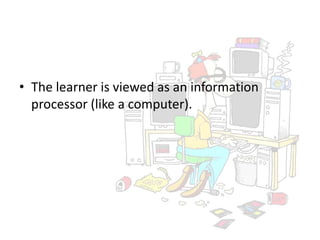
The learner is viewed as an information processor (like a computer).
Merrill -Component Display Theory (CDT)Reigeluth (Elaboration Theory) Gagne, Briggs, Wager, Bruner (moving toward cognitive constructivism).Schank (scripts), Scandura (structural learning)
KEYWORDSSchema, schemata, information processing, symbol manipulation, information mapping, mental models
Piaget’s Stage Theory of Cognitive DevelopmentSensorimotor stage (Birth to 2 years old). The infant builds an understanding of himself or herself and reality (and how things work) through interactions with the environment.
Piaget’s Stage Theory of Cognitive DevelopmentPreoperational stage (ages 2 to 4). The child is not yet able to conceptualize abstractly and needs concrete physical situation
Piaget’s Stage Theory of Cognitive DevelopmentConcrete operations (ages 7 to 11). As physical experience accumulates, accomodation is increased. The child begins to think abstractly and conceptualize, creating logical structures that explain his or her physical experiences.
Piaget’s Stage Theory of Cognitive DevelopmentFormal operations (beginning at ages 11 to 15). 	Cognition reaches its final form. By this stage, the person no longer requires concrete objects to make rational judgements.
DeweyLearning to thinkNot just doing something, but reflecting and learning from it.
BrunerKnowledge is a process, not a product.Taughthow to analyse problems
AusubelRelating new learning to thing that they already know.Bridging.
	In order to learn, understandingis necessary.
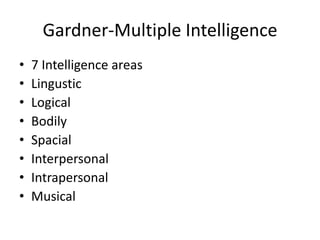
Gardner-Multiple Intelligence7 Intelligence areasLingusticLogicalBodilySpacialInterpersonalIntrapersonalMusical

Cognitivism

  • 1.
  • 2.
    The learner isviewed as an information processor (like a computer).
  • 3.
    Merrill -Component DisplayTheory (CDT)Reigeluth (Elaboration Theory) Gagne, Briggs, Wager, Bruner (moving toward cognitive constructivism).Schank (scripts), Scandura (structural learning)
  • 4.
    KEYWORDSSchema, schemata, informationprocessing, symbol manipulation, information mapping, mental models
  • 5.
    Piaget’s Stage Theoryof Cognitive DevelopmentSensorimotor stage (Birth to 2 years old). The infant builds an understanding of himself or herself and reality (and how things work) through interactions with the environment.
  • 6.
    Piaget’s Stage Theoryof Cognitive DevelopmentPreoperational stage (ages 2 to 4). The child is not yet able to conceptualize abstractly and needs concrete physical situation
  • 7.
    Piaget’s Stage Theoryof Cognitive DevelopmentConcrete operations (ages 7 to 11). As physical experience accumulates, accomodation is increased. The child begins to think abstractly and conceptualize, creating logical structures that explain his or her physical experiences.
  • 8.
    Piaget’s Stage Theoryof Cognitive DevelopmentFormal operations (beginning at ages 11 to 15). Cognition reaches its final form. By this stage, the person no longer requires concrete objects to make rational judgements.
  • 9.
    DeweyLearning to thinkNotjust doing something, but reflecting and learning from it.
  • 10.
    BrunerKnowledge is aprocess, not a product.Taughthow to analyse problems
  • 11.
    AusubelRelating new learningto thing that they already know.Bridging.
  • 12.
    In order tolearn, understandingis necessary.
  • 13.
    Gardner-Multiple Intelligence7 IntelligenceareasLingusticLogicalBodilySpacialInterpersonalIntrapersonalMusical