Four Stages of Cognitive
Development
agenda
INTRODUCTION
WHO WAS JEAN PIAGET IN
PSYCHOLOGY?
PIAGET’S COGNITIVE
DEVELOPMENT THEORY
4 – 5
1. THE SENSORIMOTOR STAGE
8 – 10
2. THE PRE-OPERATIONAL STAGE
11
3. THE CONCRETE OPERATIONAL
STAGE
12
4. THE FORMAL OPERATIONAL
STAGE
13
SUMMARY
introduction
Have you ever experienced the following?
You’re trying to explain something to a child, and even
though it seems so obvious to you, the child just doesn’t
seem to understand.
They repeat the same mistake, over and over, and you
become increasingly frustrated.
Well, guess what?
•The child is not naughty.
•They’re also not stupid.
•But their lack of understanding is not your fault
either.
Their cognitive development limits their ability to
understand certain concepts. Specifically, they’re not
capable right now of understanding what you’re trying
to explain.
In this lesson, we’ll learn more about Jean Piaget, a
famous psychologist whose ideas about cognitive
development in children were extremely influential.
3
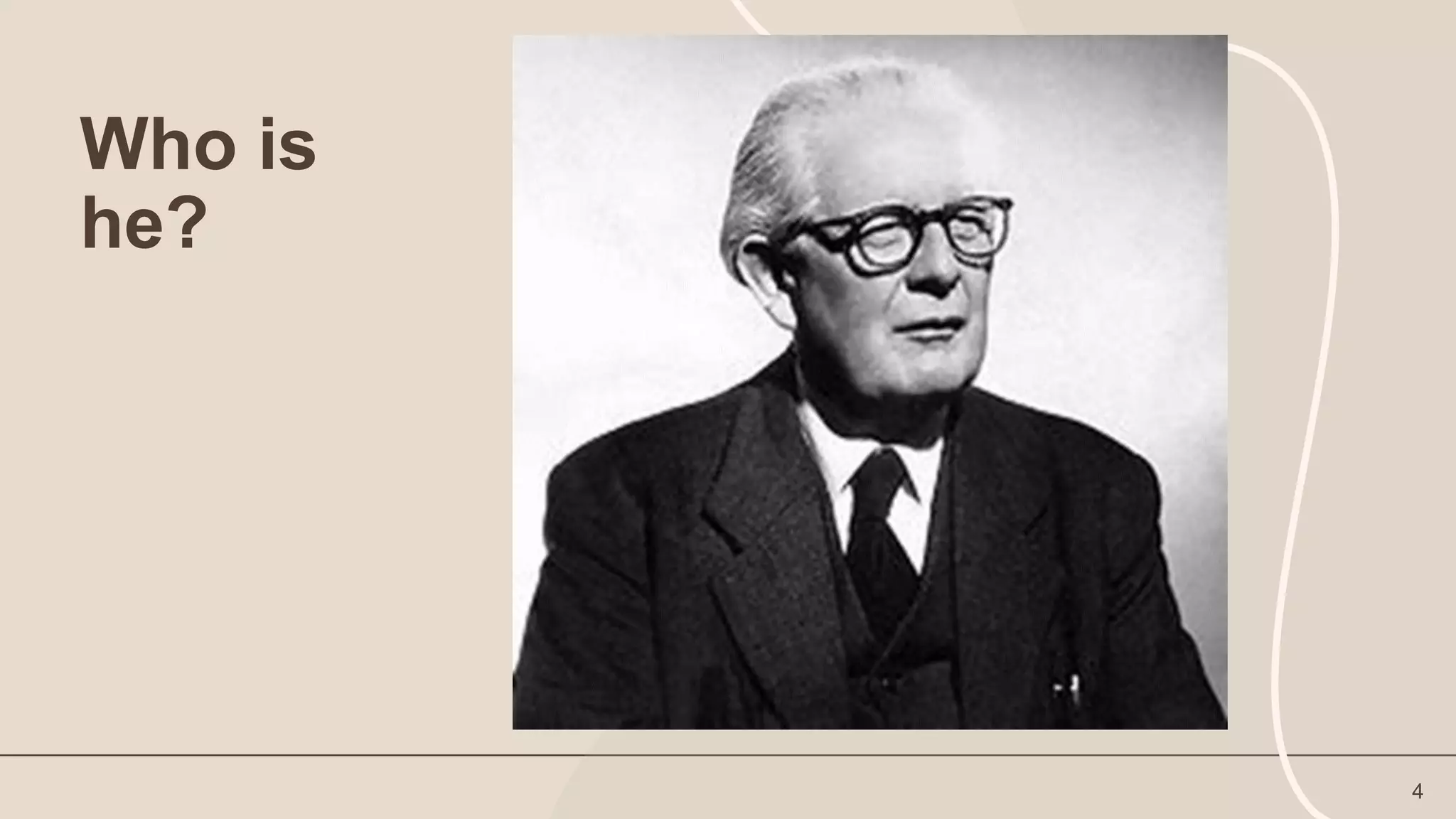
Who is
he?
4
JEAN PIAGET
(1896 – 1980)
1896-1913: Early Years
1914-1918: Formal Education
1918-1921: From Scientist to
Psychologist
5
Who was Jean Piaget in
Psychology?
Jean Piaget was a Swiss psychologist who contributed
greatly to the understanding of children’s cognitive
development (Papalia & Feldman, 2011; Waite-
Stupiansky, 2017).
Piaget’s contribution to psychology was mainly through
his observations of children’s cognitive development
(Papalia & Feldman, 2011). Early in his career, Piaget
scored the IQ tests that Alfred Binet administered to
children.
One of the most important implications of his work is that
children are not born with the same cognitive processes
as adults (Papalia & Feldman, 2011). Instead, children’s
cognitive processes:
• Develop over time,
• Develop in response to their environment, and
• Are updated with exposure to new information.
7
What is PIAGET’S THEORY OF
COGNITIVE DEVELOPMENT?
Cognitive development is all about learning and reasoning,
including the development of memory, symbolic thought, and
problem-solving skills.
Developmental psychologist Jean Piaget provides a theory of
cognitive development which explains how a child develops an
understanding of the world. He describes development as a process
that occurs due to interactions with the environment. According to
Piaget, there are four stages of cognitive development. All children
progress through the stages in the same order, however the age at
which they progress through each stage may vary.
1. Sensorimotor (birth to age 2)
2. Preoperational (from age 2 to age 7)
3. Concrete (from age 7 to age 11)
4. Formal Operational (from age 11 through adulthood)
8
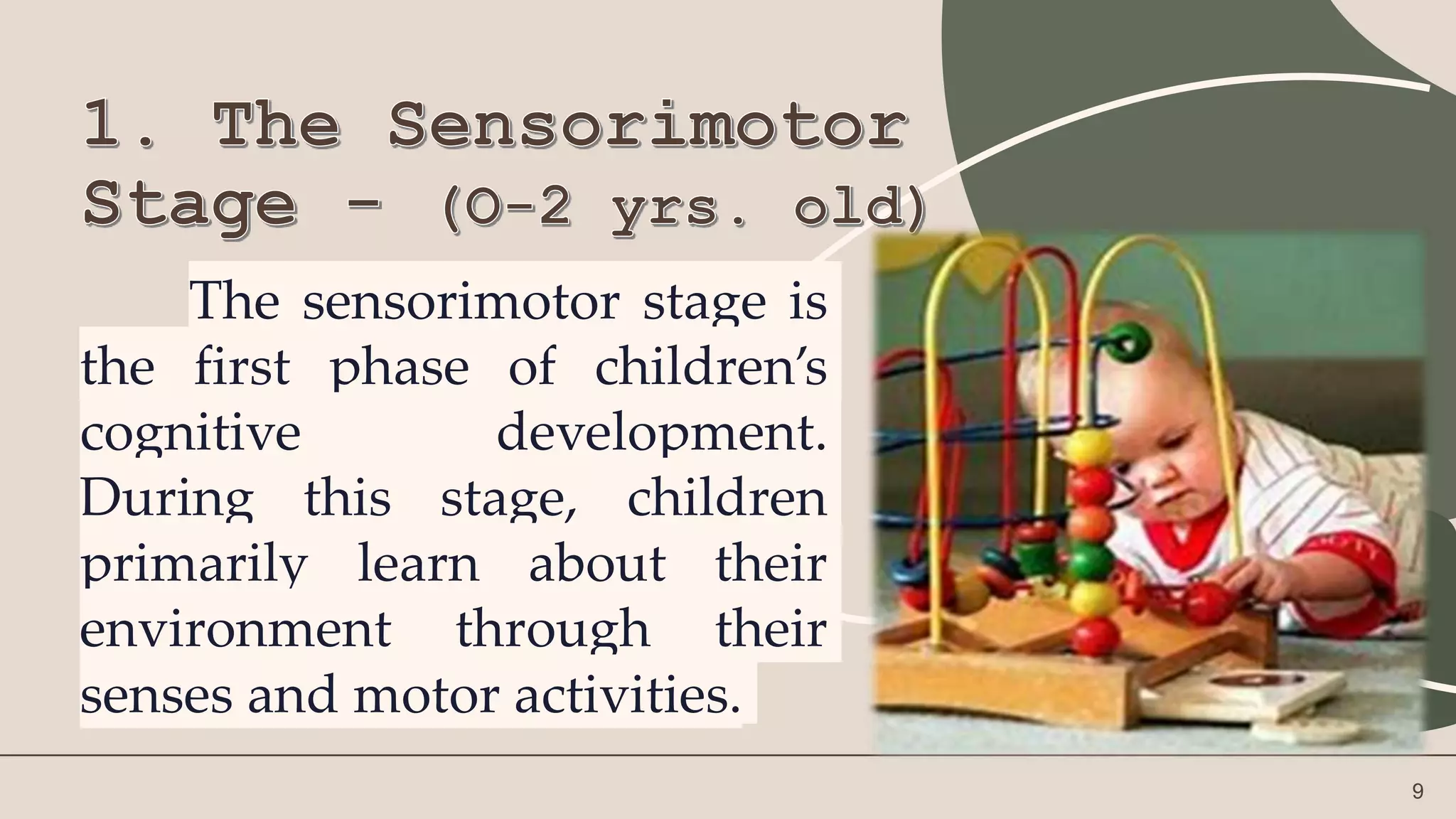
The sensorimotor stage is
the first phase of children’s
cognitive development.
During this stage, children
primarily learn about their
environment through their
senses and motor activities.
9
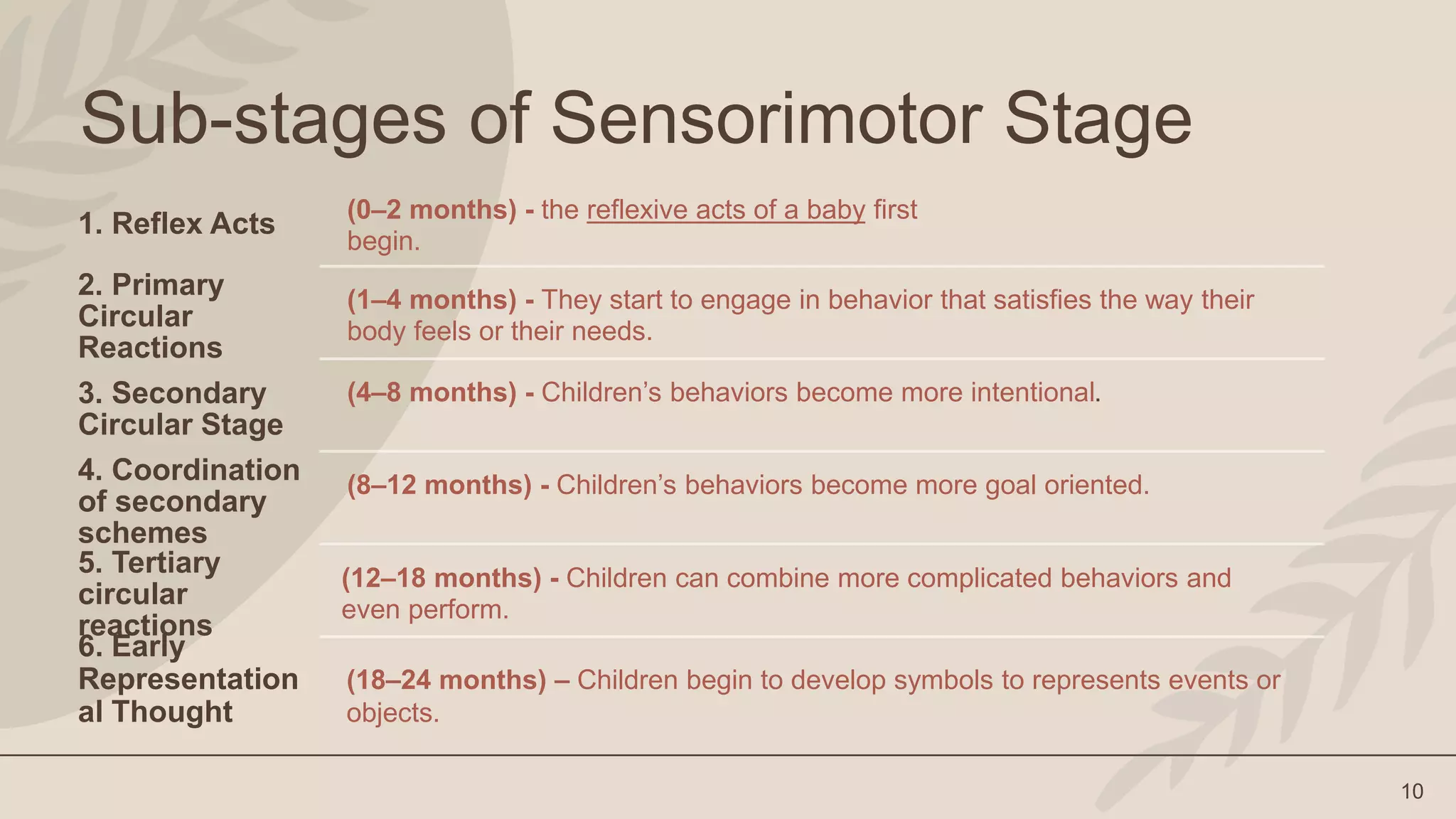
Sub-stages of Sensorimotor Stage
1. Reflex Acts (0–2 months) - the reflexive acts of a baby first
begin.
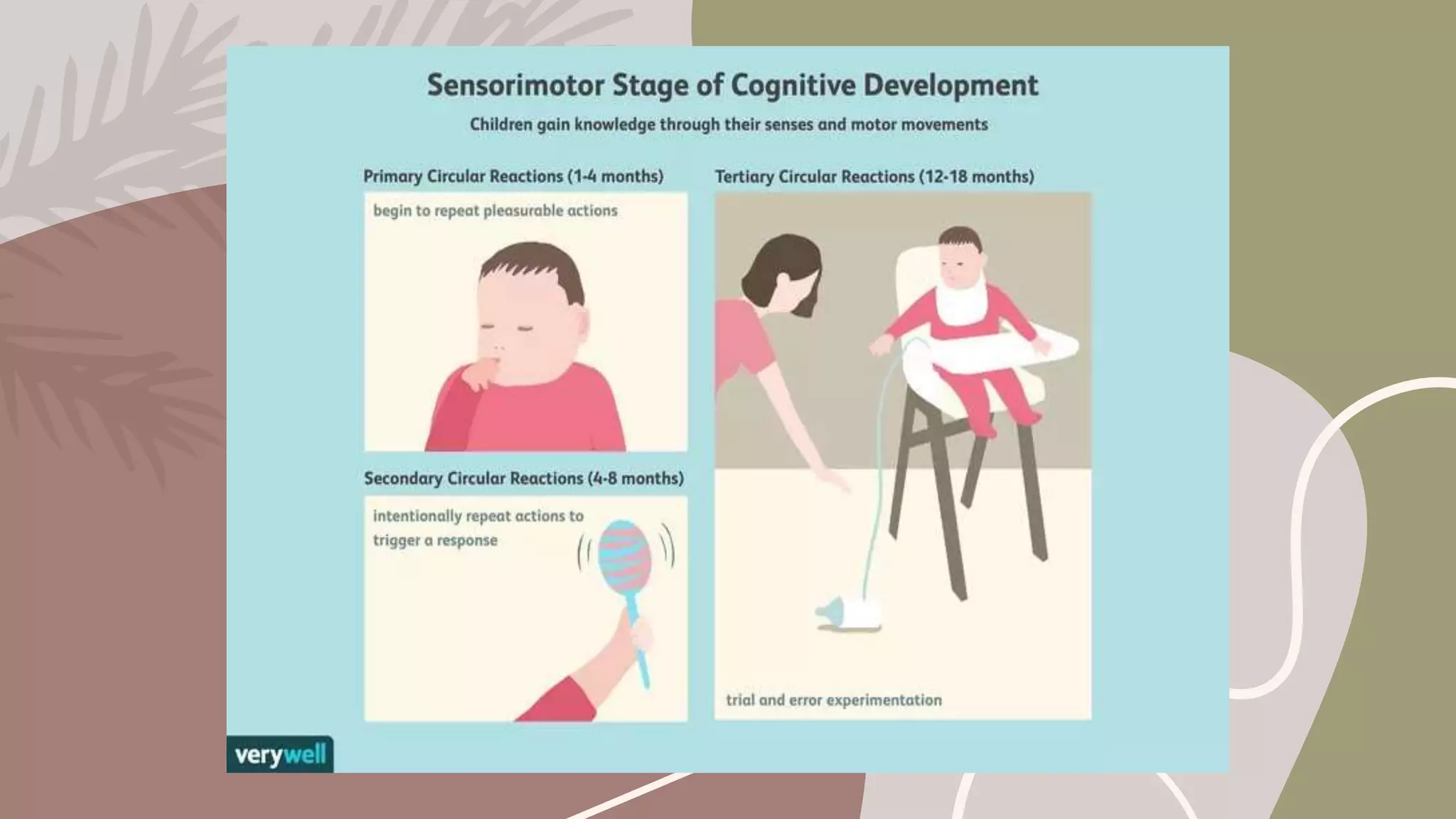
2. Primary
Circular
Reactions
(1–4 months) - They start to engage in behavior that satisfies the way their
body feels or their needs.
3. Secondary
Circular Stage
(4–8 months) - Children’s behaviors become more intentional.
4. Coordination
of secondary
schemes
(8–12 months) - Children’s behaviors become more goal oriented.
5. Tertiary
circular
reactions
(12–18 months) - Children can combine more complicated behaviors and
even perform.
10
6. Early
Representation
al Thought
(18–24 months) – Children begin to develop symbols to represents events or
objects.
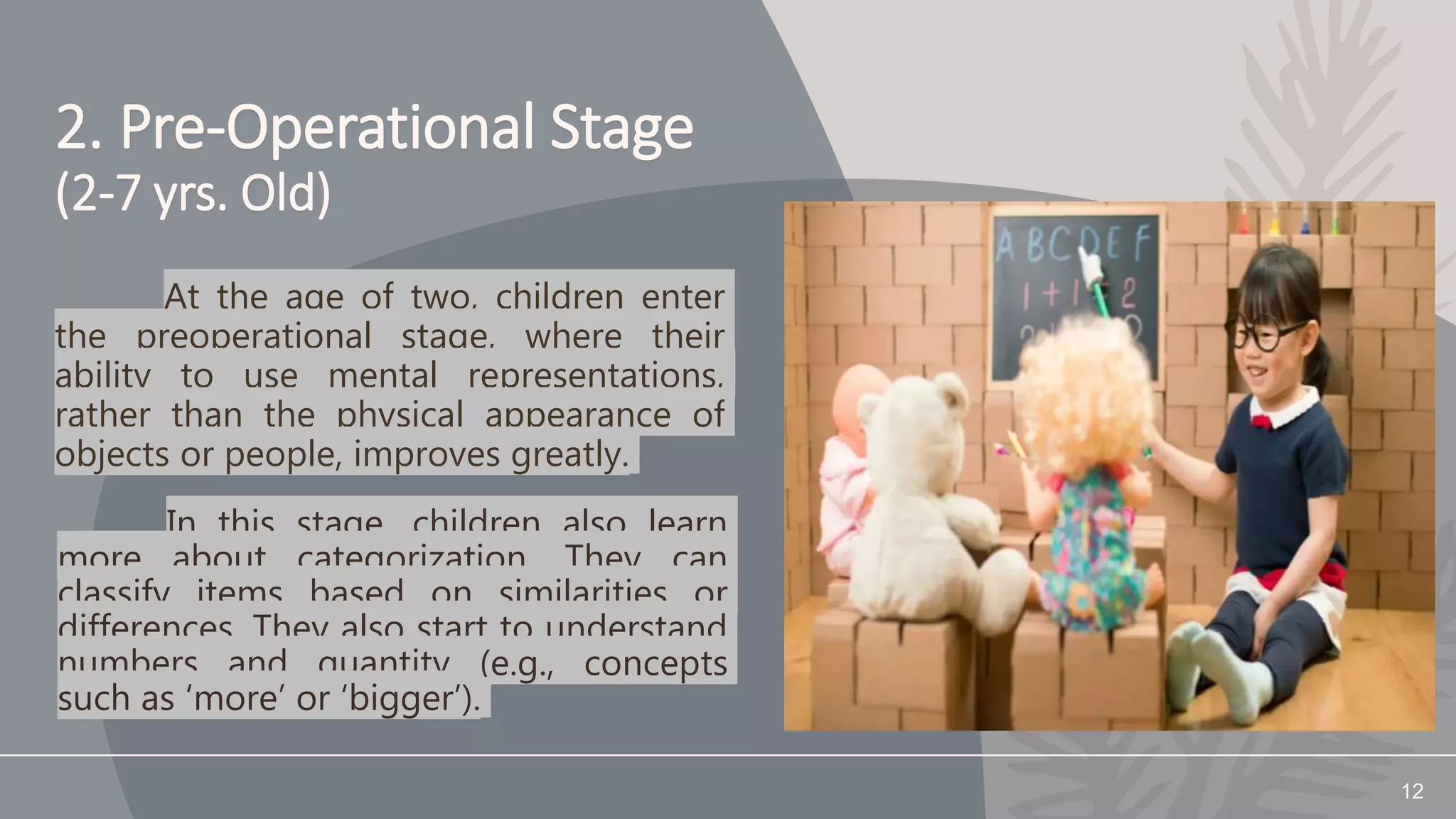
2. Pre-Operational Stage
(2-7 yrs. Old)
In this stage, children also learn
more about categorization. They can
classify items based on similarities or
differences. They also start to understand
numbers and quantity (e.g., concepts
such as ‘more’ or ‘bigger’).
12
At the age of two, children enter
the preoperational stage, where their
ability to use mental representations,
rather than the physical appearance of
objects or people, improves greatly.
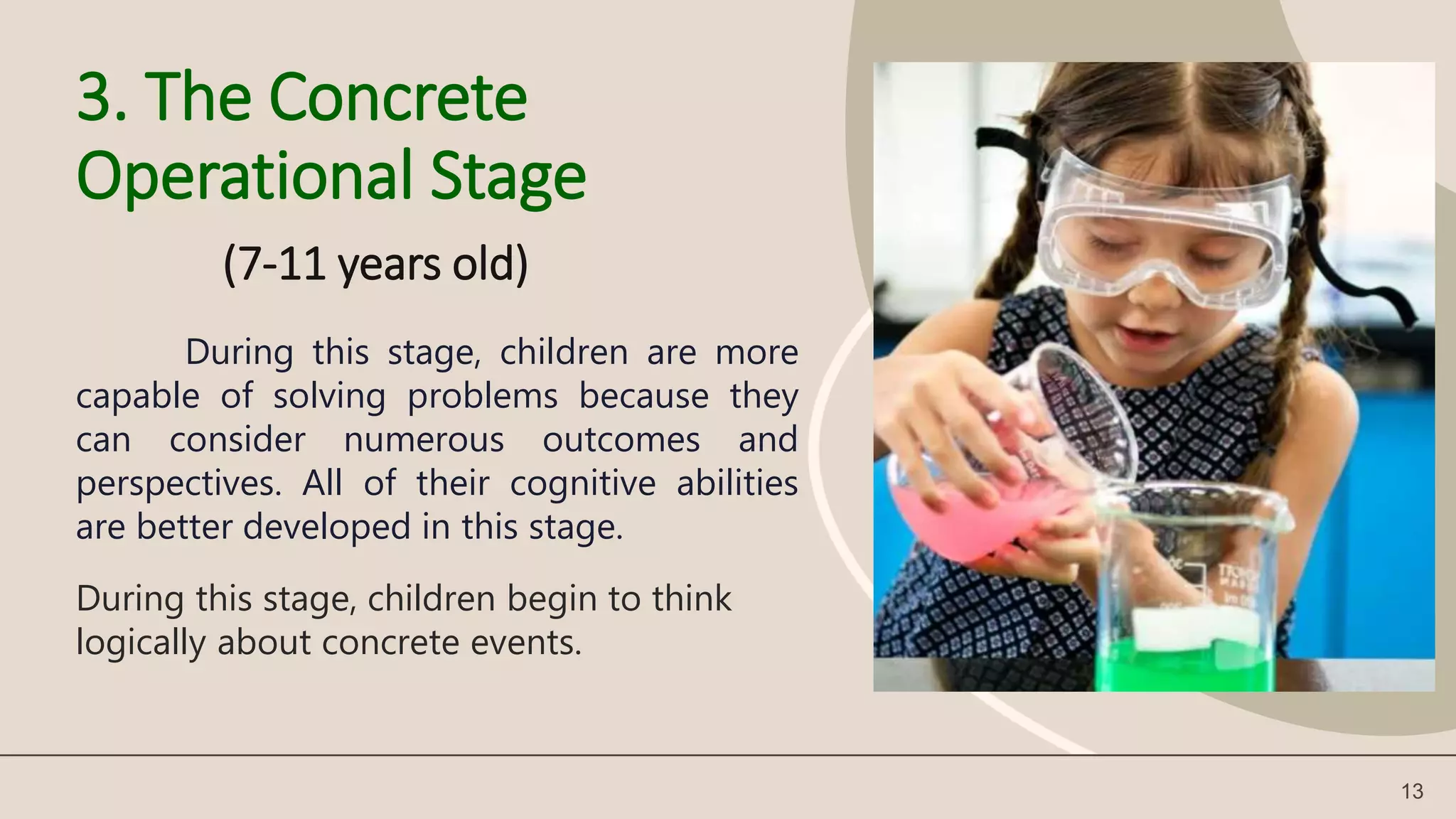
3. The Concrete
Operational Stage
(7-11 years old)
13
During this stage, children are more
capable of solving problems because they
can consider numerous outcomes and
perspectives. All of their cognitive abilities
are better developed in this stage.
During this stage, children begin to think
logically about concrete events.
4. The Formal Operational Stage
14
(12-ADULTHOOD)
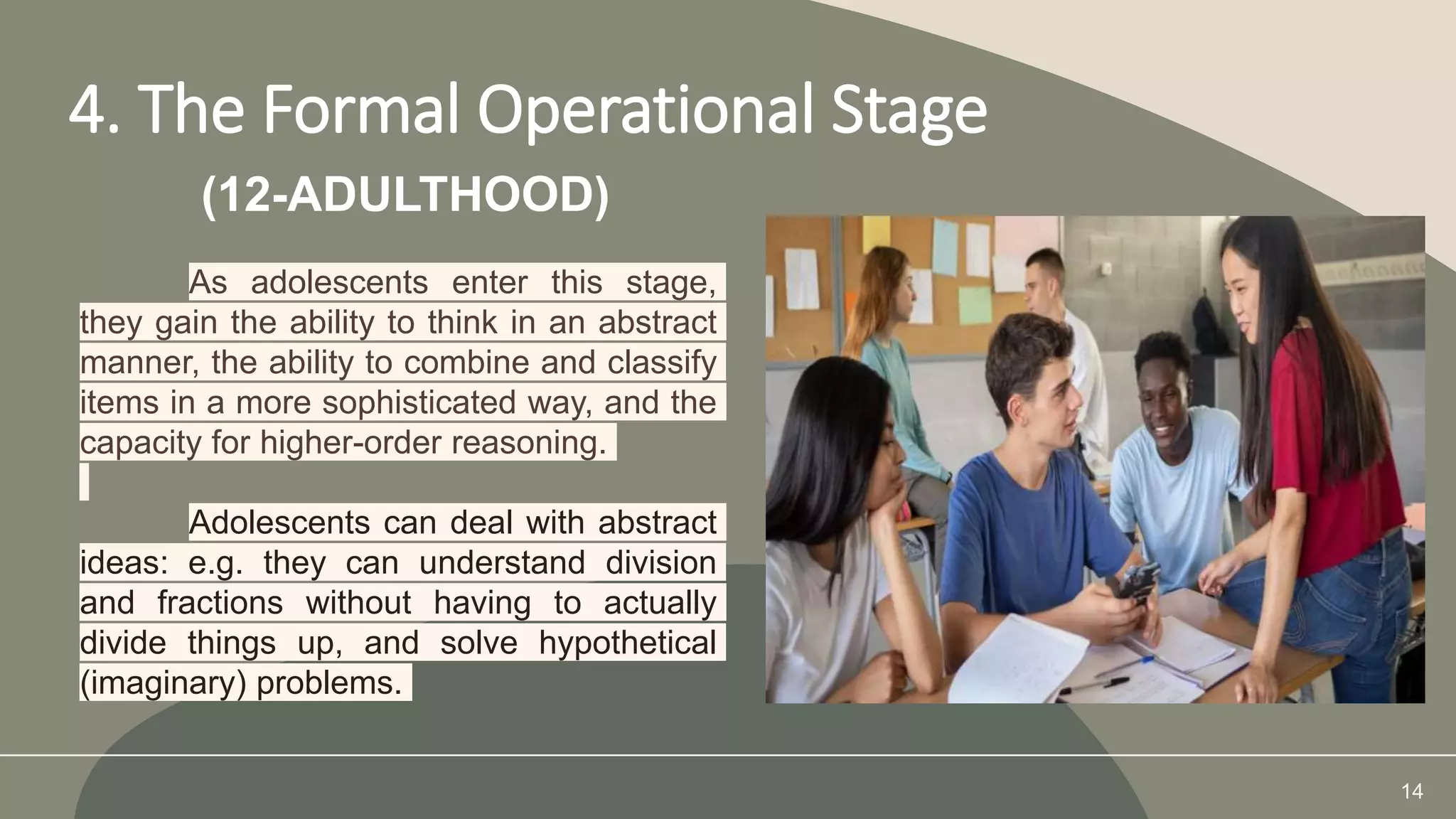
As adolescents enter this stage,
they gain the ability to think in an abstract
manner, the ability to combine and classify
items in a more sophisticated way, and the
capacity for higher-order reasoning.
Adolescents can deal with abstract
ideas: e.g. they can understand division
and fractions without having to actually
divide things up, and solve hypothetical
(imaginary) problems.
summary
Children’s ability to understand, think
about and solve problems in the world develops
in a stop-start, discontinuous manner (rather
than gradual changes over time).
The goal of the theory is to explain the
mechanisms and processes by which the infant,
and then the child, develops into an individual
who can reason and think using hypotheses.
To Piaget, cognitive development was a
progressive reorganization of mental processes
as a result of biological maturation and
environmental experience.
15
thank you <3

Four-Stages-of-Cognitive-Development.pptx

  • 1.
    Four Stages ofCognitive Development
  • 2.
    agenda INTRODUCTION WHO WAS JEANPIAGET IN PSYCHOLOGY? PIAGET’S COGNITIVE DEVELOPMENT THEORY 4 – 5 1. THE SENSORIMOTOR STAGE 8 – 10 2. THE PRE-OPERATIONAL STAGE 11 3. THE CONCRETE OPERATIONAL STAGE 12 4. THE FORMAL OPERATIONAL STAGE 13 SUMMARY
  • 3.
    introduction Have you everexperienced the following? You’re trying to explain something to a child, and even though it seems so obvious to you, the child just doesn’t seem to understand. They repeat the same mistake, over and over, and you become increasingly frustrated. Well, guess what? •The child is not naughty. •They’re also not stupid. •But their lack of understanding is not your fault either. Their cognitive development limits their ability to understand certain concepts. Specifically, they’re not capable right now of understanding what you’re trying to explain. In this lesson, we’ll learn more about Jean Piaget, a famous psychologist whose ideas about cognitive development in children were extremely influential. 3
  • 4.
  • 5.
    JEAN PIAGET (1896 –1980) 1896-1913: Early Years 1914-1918: Formal Education 1918-1921: From Scientist to Psychologist 5
  • 6.
    Who was JeanPiaget in Psychology?
  • 7.
    Jean Piaget wasa Swiss psychologist who contributed greatly to the understanding of children’s cognitive development (Papalia & Feldman, 2011; Waite- Stupiansky, 2017). Piaget’s contribution to psychology was mainly through his observations of children’s cognitive development (Papalia & Feldman, 2011). Early in his career, Piaget scored the IQ tests that Alfred Binet administered to children. One of the most important implications of his work is that children are not born with the same cognitive processes as adults (Papalia & Feldman, 2011). Instead, children’s cognitive processes: • Develop over time, • Develop in response to their environment, and • Are updated with exposure to new information. 7
  • 8.
    What is PIAGET’STHEORY OF COGNITIVE DEVELOPMENT? Cognitive development is all about learning and reasoning, including the development of memory, symbolic thought, and problem-solving skills. Developmental psychologist Jean Piaget provides a theory of cognitive development which explains how a child develops an understanding of the world. He describes development as a process that occurs due to interactions with the environment. According to Piaget, there are four stages of cognitive development. All children progress through the stages in the same order, however the age at which they progress through each stage may vary. 1. Sensorimotor (birth to age 2) 2. Preoperational (from age 2 to age 7) 3. Concrete (from age 7 to age 11) 4. Formal Operational (from age 11 through adulthood) 8
  • 9.
    The sensorimotor stageis the first phase of children’s cognitive development. During this stage, children primarily learn about their environment through their senses and motor activities. 9
  • 10.
    Sub-stages of SensorimotorStage 1. Reflex Acts (0–2 months) - the reflexive acts of a baby first begin. 2. Primary Circular Reactions (1–4 months) - They start to engage in behavior that satisfies the way their body feels or their needs. 3. Secondary Circular Stage (4–8 months) - Children’s behaviors become more intentional. 4. Coordination of secondary schemes (8–12 months) - Children’s behaviors become more goal oriented. 5. Tertiary circular reactions (12–18 months) - Children can combine more complicated behaviors and even perform. 10 6. Early Representation al Thought (18–24 months) – Children begin to develop symbols to represents events or objects.
  • 12.
    2. Pre-Operational Stage (2-7yrs. Old) In this stage, children also learn more about categorization. They can classify items based on similarities or differences. They also start to understand numbers and quantity (e.g., concepts such as ‘more’ or ‘bigger’). 12 At the age of two, children enter the preoperational stage, where their ability to use mental representations, rather than the physical appearance of objects or people, improves greatly.
  • 13.
    3. The Concrete OperationalStage (7-11 years old) 13 During this stage, children are more capable of solving problems because they can consider numerous outcomes and perspectives. All of their cognitive abilities are better developed in this stage. During this stage, children begin to think logically about concrete events.
  • 14.
    4. The FormalOperational Stage 14 (12-ADULTHOOD) As adolescents enter this stage, they gain the ability to think in an abstract manner, the ability to combine and classify items in a more sophisticated way, and the capacity for higher-order reasoning. Adolescents can deal with abstract ideas: e.g. they can understand division and fractions without having to actually divide things up, and solve hypothetical (imaginary) problems.
  • 15.
    summary Children’s ability tounderstand, think about and solve problems in the world develops in a stop-start, discontinuous manner (rather than gradual changes over time). The goal of the theory is to explain the mechanisms and processes by which the infant, and then the child, develops into an individual who can reason and think using hypotheses. To Piaget, cognitive development was a progressive reorganization of mental processes as a result of biological maturation and environmental experience. 15
  • 16.