Topic: Application of cognitive
theory in classroom
Submitted to: Shahzad Mughal
Submitted By: Rida Amajad(2016-
1813)
• Cognitive Theory: stems from traditional
psychological concepts of thinking.
Cognitivists view activities such as thinking,
deciding, and remembering in terms of how
they underlie behavior.
Background Information
• Cognitive theory came about as a reaction to
behaviorism.
• Congnitivists and Behaviorists have conflicting
views.
• A cognitive revolution took place in the 1950’s
which led to a collection of cognitive sciences
studied present day.
Key cognitive Theory Concepts
• Cognitive psychology focuses on how people
think, understand and know.
• Emphasis on learning how people
comprehend and represent the world around
them.
• Focus on conscious thinking.
• Emphasis on individual's active construction of
understanding.
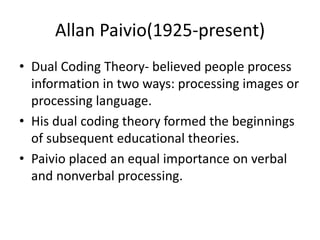
Allan Paivio(1925-present)
• Dual Coding Theory- believed people process
information in two ways: processing images or
processing language.
• His dual coding theory formed the beginnings
of subsequent educational theories.
• Paivio placed an equal importance on verbal
and nonverbal processing.
Howard Gardner(1943-present)
• Focused on understanding and defining
intelligence.
• Developed a theory of multiple
intelligences(there are eleven in all).
• Professor at Harvard University where he
conducted research on his regular, gifted, and
adult students.
• Believed educators need to take into account the
students' multiple intelligences and use them to
guide themselves while instructing.
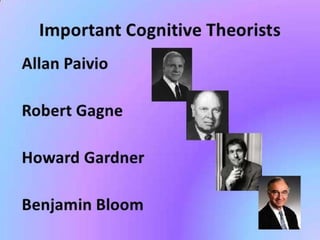
Benjamin Bloom(1913-1999)
• Educational Psychologists who focused on
students learning domains.
• Classified learning into three domains(
cognitive, affective, and psychomotor)
• Created Bloom’s Taxonomy which is made up
of six levels that can be used to acquire
knowledge.
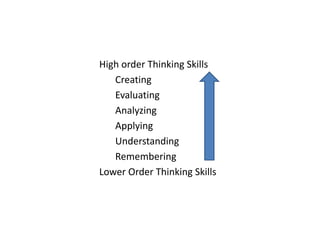
High order Thinking Skills
Creating
Evaluating
Analyzing
Applying
Understanding
Remembering
Lower Order Thinking Skills
Teachers Applying Cognitive Theory
• Expository Teaching:
– Teacher gives students the tools to organize
information for easier encoding, storage and
retrieval.
– Teacher exposes students to underlying and
selective interrelationships in cognitive learning to
help students come up with the correct
conclusions.
• Meaningful learning method- when
presenting new information the teacher uses
old information to introduce new information
and make connections.
• Dual coding:
– Using both text and picture or sound while
instructing gives students a better chance of
remembering and encoding the information.
– Technology can easily be used to enhance a lesson
and a dual coding method.
Students Applying Cognitive Theory
• Students use sensory, short term and long term
memory to store information learning in class.
• Students come up with mnemonic devices to
remember facts with ease.
• Using existing schemas to connect new
information to help students retain information.
• Technology can be used to organize information
into charts, graphs, concepts maps, etc.
Cognitive Theory In Classroom
• In my opinion, cognitive theory provides an
effective way to teach students. Cognitive
theory enables the learners to develop the
ability to analyze the language, make
generalizations about rules, take risks in trying
out the language, and to learn from errors. It
enhances the meaningfulness of new material
to increase the chances of its being anchored
to what is already known.

Cognitive theory in classroom

  • 1.
    Topic: Application ofcognitive theory in classroom Submitted to: Shahzad Mughal Submitted By: Rida Amajad(2016- 1813)
  • 3.
    • Cognitive Theory:stems from traditional psychological concepts of thinking. Cognitivists view activities such as thinking, deciding, and remembering in terms of how they underlie behavior.
  • 4.
    Background Information • Cognitivetheory came about as a reaction to behaviorism. • Congnitivists and Behaviorists have conflicting views. • A cognitive revolution took place in the 1950’s which led to a collection of cognitive sciences studied present day.
  • 5.
    Key cognitive TheoryConcepts • Cognitive psychology focuses on how people think, understand and know. • Emphasis on learning how people comprehend and represent the world around them. • Focus on conscious thinking. • Emphasis on individual's active construction of understanding.
  • 7.
    Allan Paivio(1925-present) • DualCoding Theory- believed people process information in two ways: processing images or processing language. • His dual coding theory formed the beginnings of subsequent educational theories. • Paivio placed an equal importance on verbal and nonverbal processing.
  • 9.
    Howard Gardner(1943-present) • Focusedon understanding and defining intelligence. • Developed a theory of multiple intelligences(there are eleven in all). • Professor at Harvard University where he conducted research on his regular, gifted, and adult students. • Believed educators need to take into account the students' multiple intelligences and use them to guide themselves while instructing.
  • 10.
    Benjamin Bloom(1913-1999) • EducationalPsychologists who focused on students learning domains. • Classified learning into three domains( cognitive, affective, and psychomotor) • Created Bloom’s Taxonomy which is made up of six levels that can be used to acquire knowledge.
  • 11.
    High order ThinkingSkills Creating Evaluating Analyzing Applying Understanding Remembering Lower Order Thinking Skills
  • 12.
    Teachers Applying CognitiveTheory • Expository Teaching: – Teacher gives students the tools to organize information for easier encoding, storage and retrieval. – Teacher exposes students to underlying and selective interrelationships in cognitive learning to help students come up with the correct conclusions.
  • 13.
    • Meaningful learningmethod- when presenting new information the teacher uses old information to introduce new information and make connections. • Dual coding: – Using both text and picture or sound while instructing gives students a better chance of remembering and encoding the information. – Technology can easily be used to enhance a lesson and a dual coding method.
  • 14.
    Students Applying CognitiveTheory • Students use sensory, short term and long term memory to store information learning in class. • Students come up with mnemonic devices to remember facts with ease. • Using existing schemas to connect new information to help students retain information. • Technology can be used to organize information into charts, graphs, concepts maps, etc.
  • 15.
    Cognitive Theory InClassroom • In my opinion, cognitive theory provides an effective way to teach students. Cognitive theory enables the learners to develop the ability to analyze the language, make generalizations about rules, take risks in trying out the language, and to learn from errors. It enhances the meaningfulness of new material to increase the chances of its being anchored to what is already known.