The document discusses several techniques for modeling cognitive processes, including:
1) Goal and task hierarchies which break down tasks into subgoals and subtasks.
2) Production rules and transition networks which model mental processing and user actions.
3) Linguistic models like BNF and TAG which use formal grammars to represent dialog between user and system.
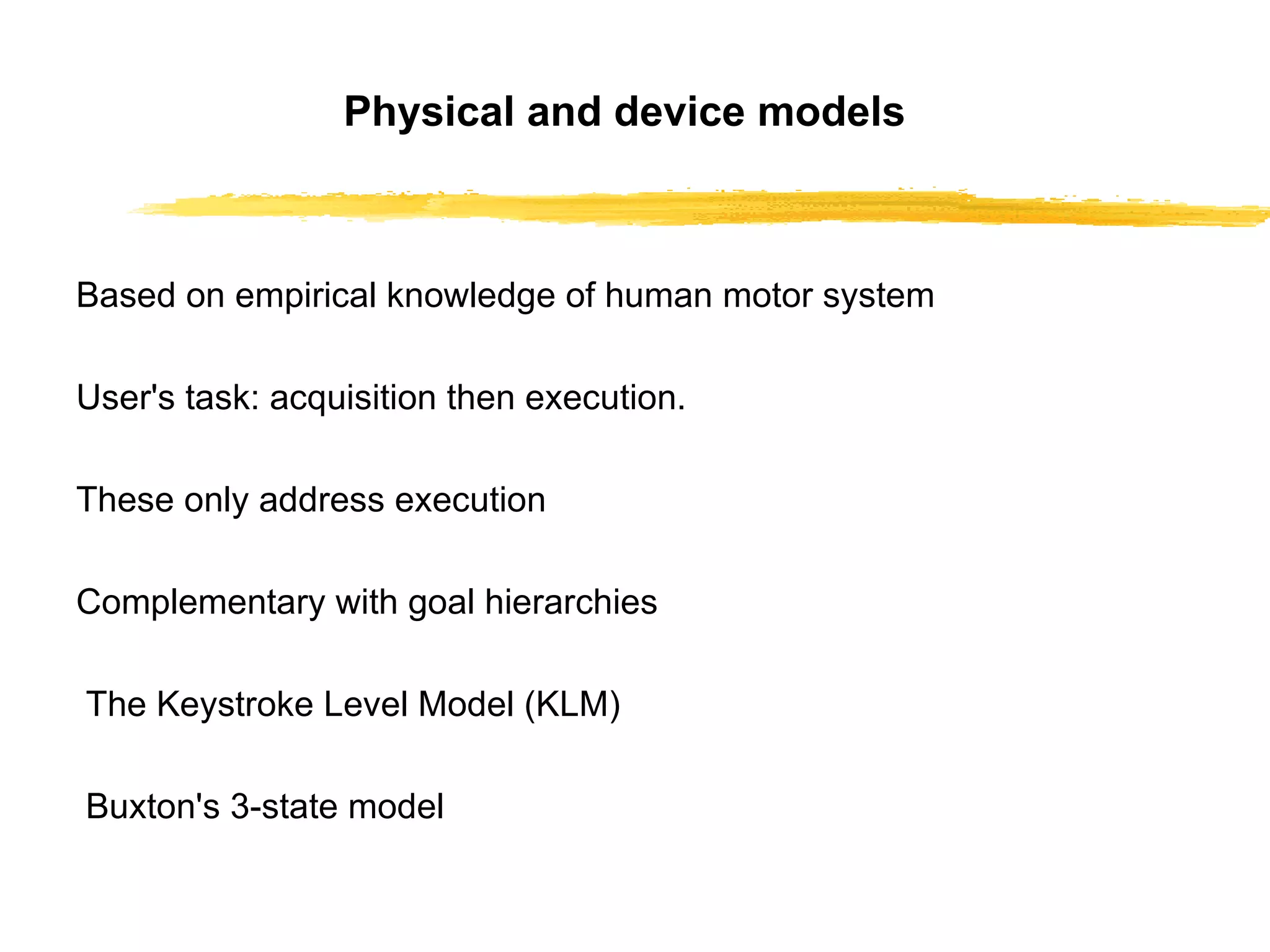
4) Physical and device models like KLM which model execution times of motor actions.
All of these aim to represent and understand the user's cognitive processes and difficulties when interacting with a system.
Introduction to cognitive models, highlighting their role in understanding user knowledge, intentions, and processing.
Explanation of goal hierarchies in mental processing with examples of sub-goals and addressing issues such as granularity and error.
Introduction to analytical techniques like GOMS and CCT, essential for cognitive complexity analysis.
Detailed explanation of GOMS components with a practical example illustrating user actions in a task. Look into CCT with user production rules, error behavior, and the differences in novice and expert actions.
Examines linguistic notations such as BNF, focusing on user behavior analysis and syntax in dialogues.
Discussing BNF's shortcomings and introducing TAG for improved consistency in user command models.
Explaining how TAG addresses consistency in command operations and utilizes existing user knowledge.
Overview of physical and device models like KLM that relate to human motor execution in task performance.
Practical example illustrating KLM execution phases for specific user goals in system interactions.
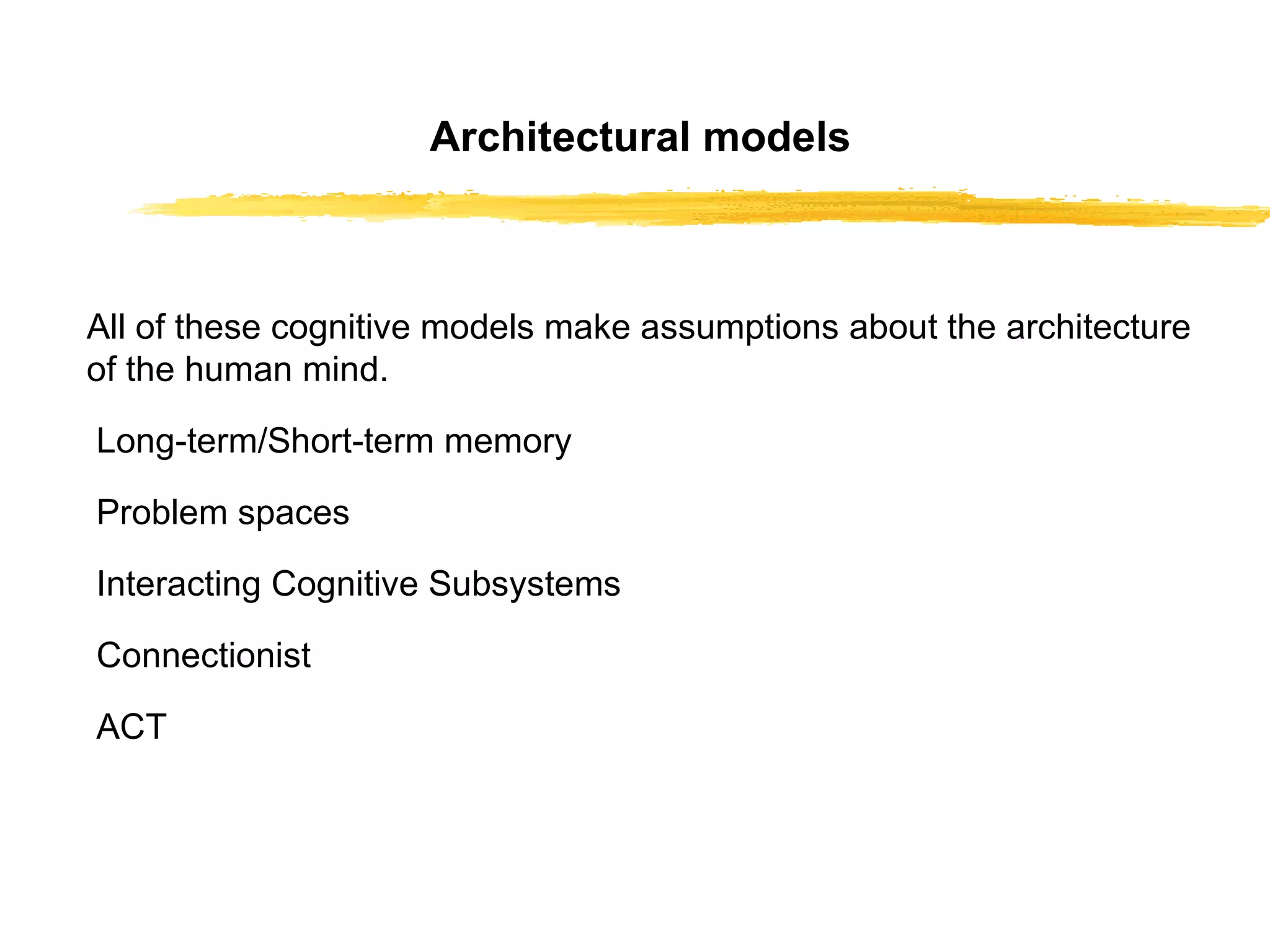
Overview of assumptions made in various cognitive models regarding human cognitive architecture.
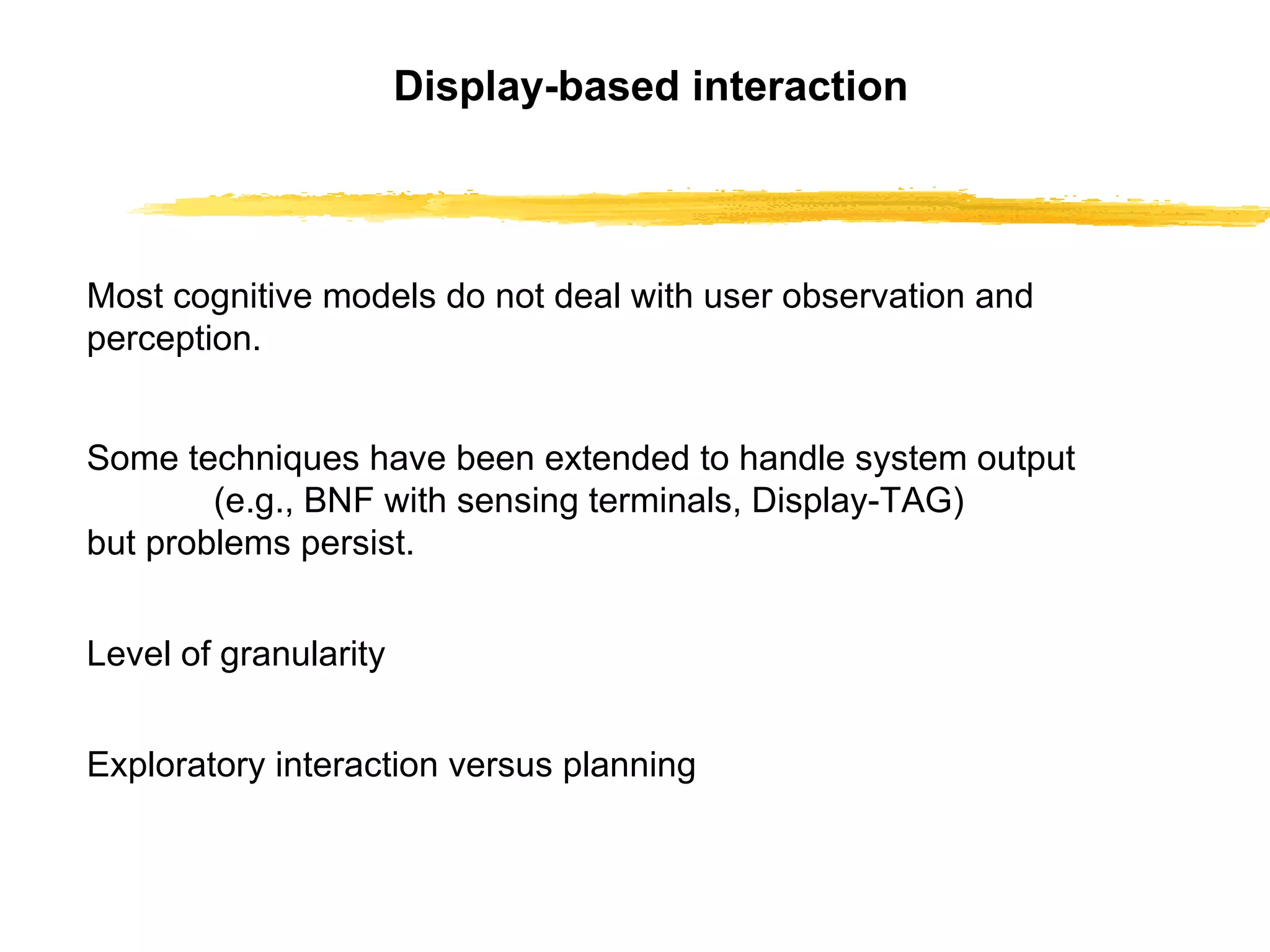
Discussion on display-based interaction and challenges in managing granularity in cognitive models.
goal and taskhierarchies linguistic physical and device architectural Cognitive models
2.
Cognitive models Theymodel aspects of user: understanding knowledge intentions processing Common categorisation: Competence Performance Computational flavour No clear divide
3.
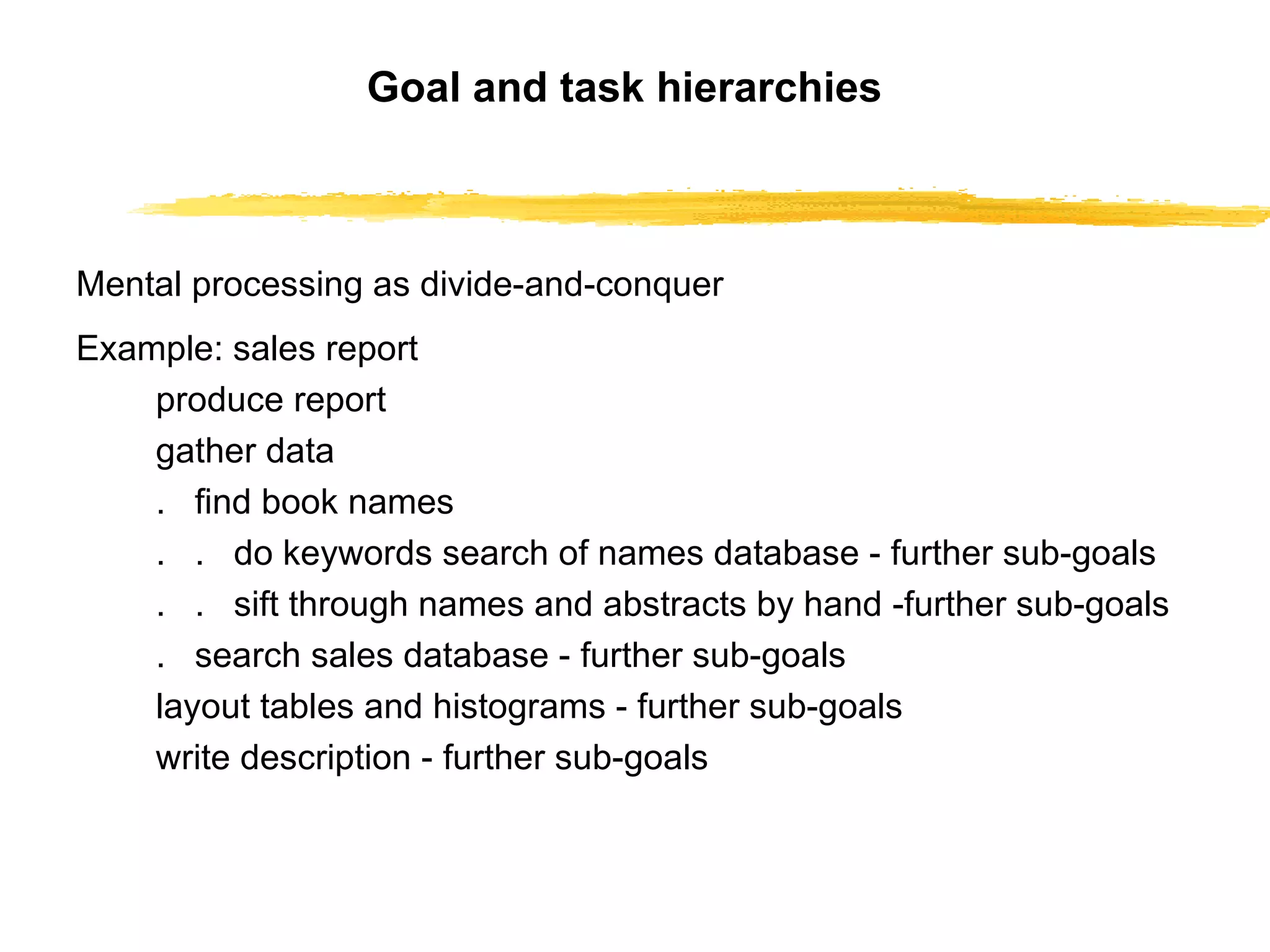
Goal and taskhierarchies Mental processing as divide-and-conquer Example: sales report produce report gather data . find book names . . do keywords search of names database - further sub-goals . . sift through names and abstracts by hand - further sub-goals . search sales database - further sub-goals layout tables and histograms - further sub-goals write description - further sub-goals
4.
Issues for goalhierarchies Granularity Where do we start? Where do we stop? Routine learned behaviour, not problem solving The unit task Conflict More than one way to achieve a goal Error
5.
Techniques Goals, Operators,Methods and Selection (GOMS) Cognitive Complexity Theory (CCT) Hierarchical Task Analysis (HTA) - Chapter 7
6.
GOMS Goals whatthe user wants to achieve Operators basic actions user performs Methods decomposition of a goal into subgoals/operators Selection means of choosing between competing methods
7.
GOAL: ICONISE-WINDOW . [select GOAL: USE-CLOSE-METHOD . MOVE-MOUSE-TO-WINDOW-HEADER . POP-UP-MENU . CLICK-OVER-CLOSE-OPTION GOAL: USE-L7-METHOD . PRESS-L7-KEY] For a particular user: Rule 1: Select USE-CLOSE-METHOD unless another rule applies Rule 2: If the application is GAME, select L7-METHOD GOMS example
8.
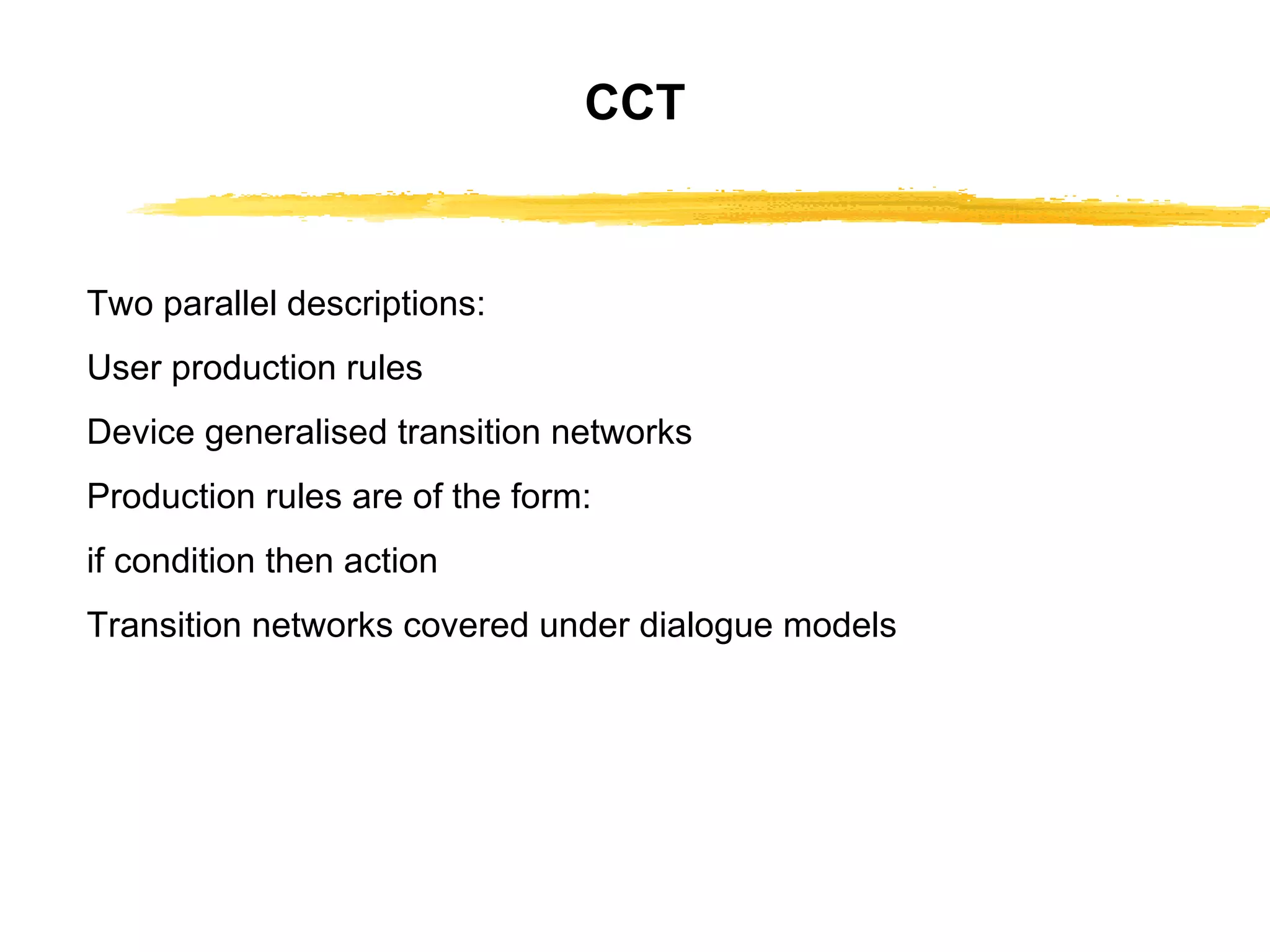
CCT Two paralleldescriptions: User production rules Device generalised transition networks Production rules are of the form: if condition then action Transition networks covered under dialogue models
9.
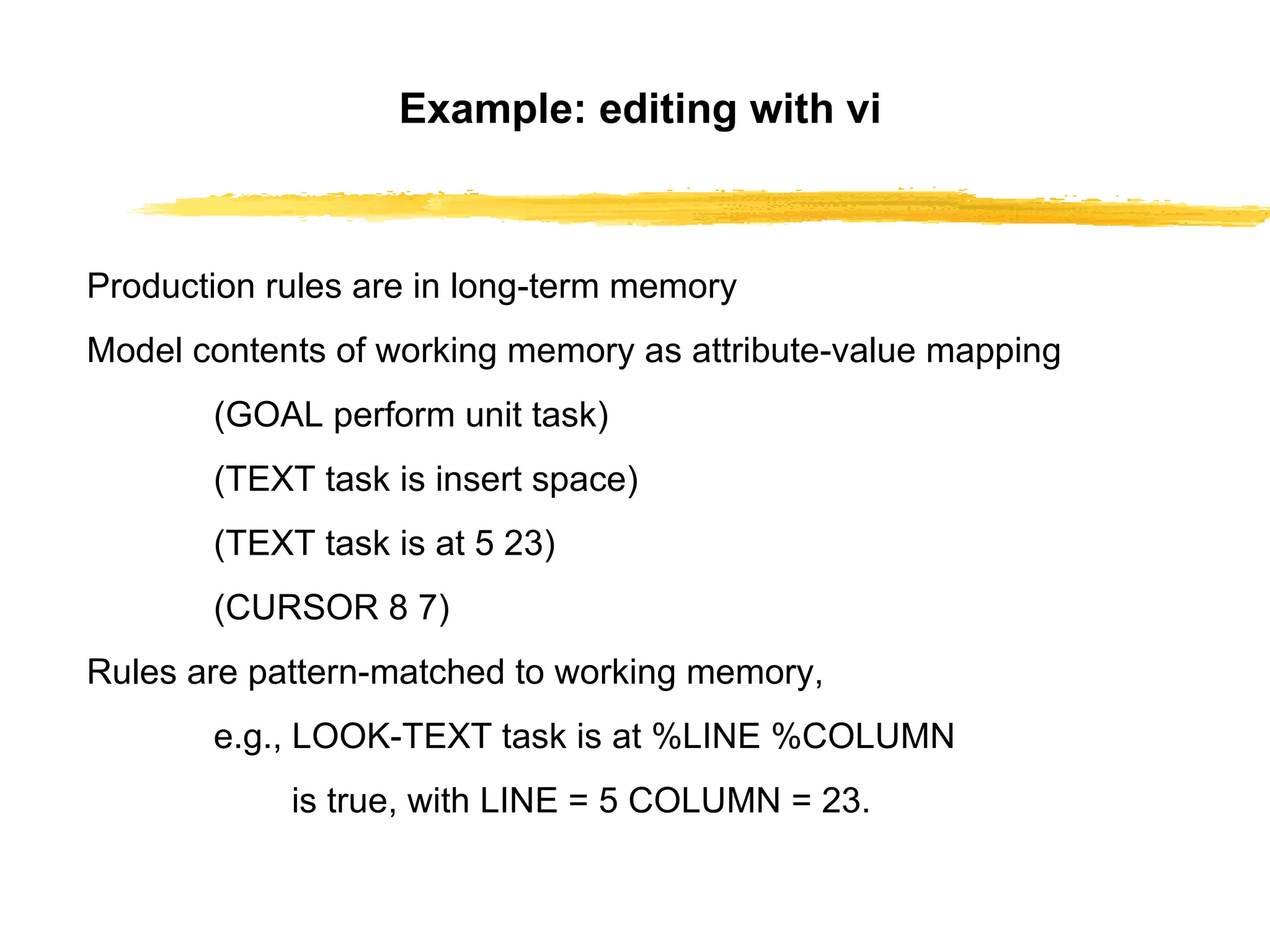
Example: editing withvi Production rules are in long-term memory Model contents of working memory as attribute-value mapping (GOAL perform unit task) (TEXT task is insert space) (TEXT task is at 5 23) (CURSOR 8 7) Rules are pattern-matched to working memory, e.g., LOOK-TEXT task is at %LINE %COLUMN is true, with LINE = 5 COLUMN = 23.
10.
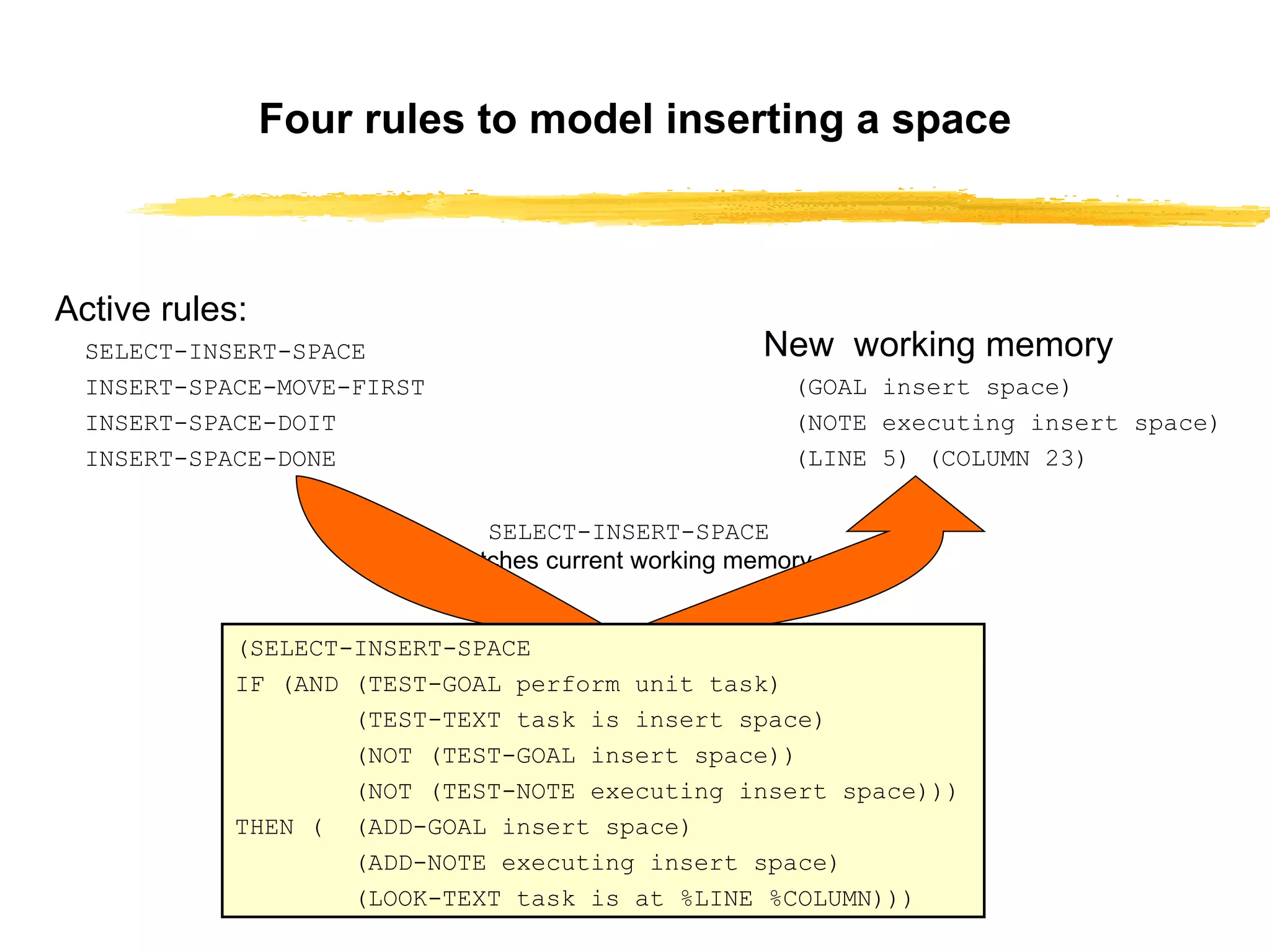
Four rules tomodel inserting a space Active rules: SELECT-INSERT-SPACE INSERT-SPACE-MOVE-FIRST INSERT-SPACE-DOIT INSERT-SPACE-DONE New working memory (GOAL insert space) (NOTE executing insert space) (LINE 5) (COLUMN 23) SELECT-INSERT-SPACE matches current working memory (SELECT-INSERT-SPACE IF (AND (TEST-GOAL perform unit task) (TEST-TEXT task is insert space) (NOT (TEST-GOAL insert space)) (NOT (TEST-NOTE executing insert space))) THEN ( (ADD-GOAL insert space) (ADD-NOTE executing insert space) (LOOK-TEXT task is at %LINE %COLUMN)))
11.
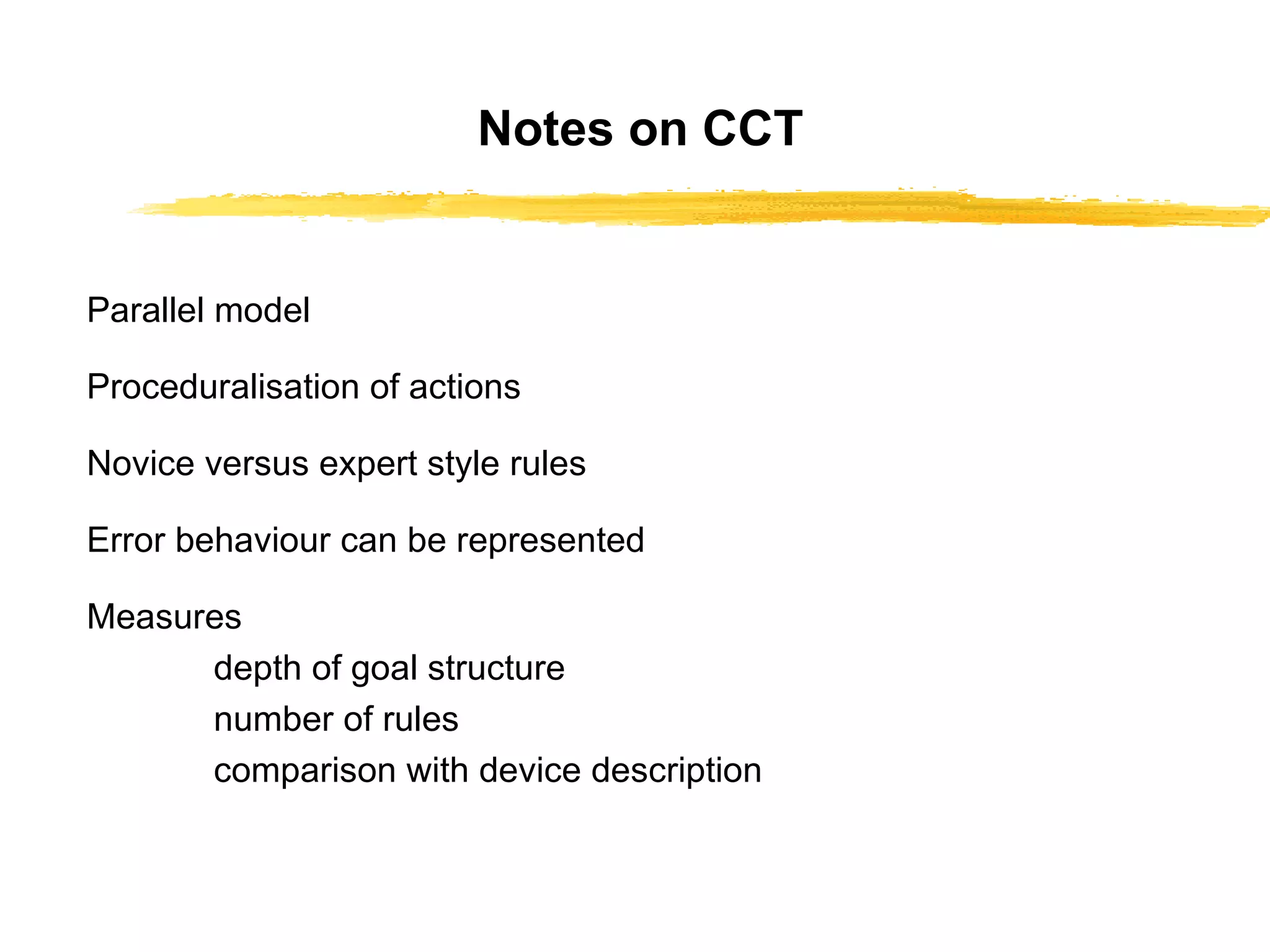
Notes on CCTParallel model Proceduralisation of actions Novice versus expert style rules Error behaviour can be represented Measures depth of goal structure number of rules comparison with device description
12.
Problems with goalhierarchies a post hoc technique expert versus novice How cognitive are they?
13.
Linguistic notations Understandingthe user's behaviour and cognitive difficulty based on analysis of language between user and system. Similar in emphasis to dialogue models Backus-Naur Form (BNF) Task-Action Grammar (TAG)
14.
BNF Very commonnotation from computer science A purely syntactic view of the dialogue Terminals lowest level of user behaviour e.g. CLICK-MOUSE, MOVE-MOUSE Nonterminals ordering of terminals higher level of abstraction e.g. select-menu, position-mouse
15.
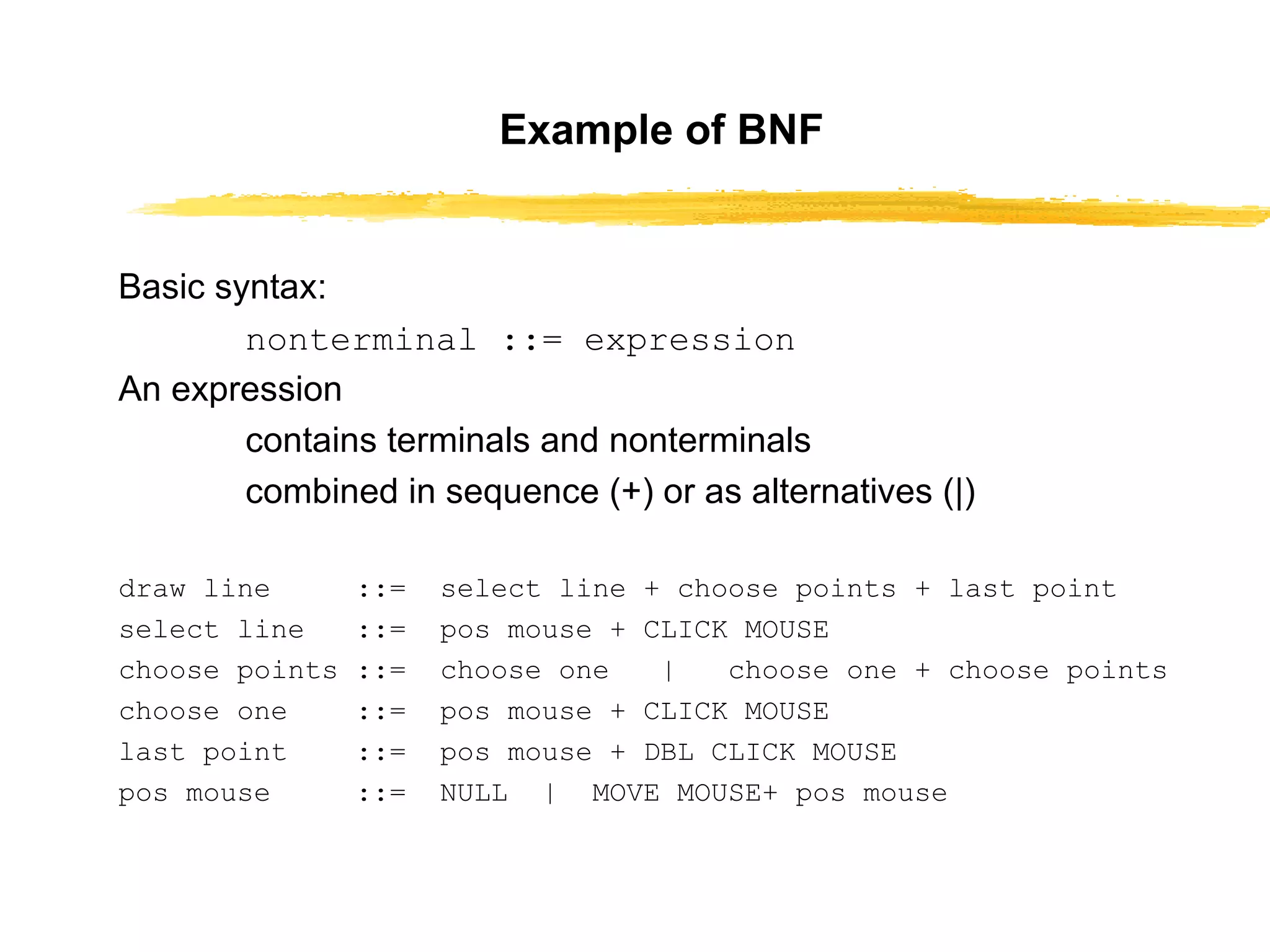
Example of BNFBasic syntax: nonterminal ::= expression An expression contains terminals and nonterminals combined in sequence (+) or as alternatives (|) draw line ::= select line + choose points + last point select line ::= pos mouse + CLICK MOUSE choose points ::= choose one | choose one + choose points choose one ::= pos mouse + CLICK MOUSE last point ::= pos mouse + DBL CLICK MOUSE pos mouse ::= NULL | MOVE MOUSE+ pos mouse
16.
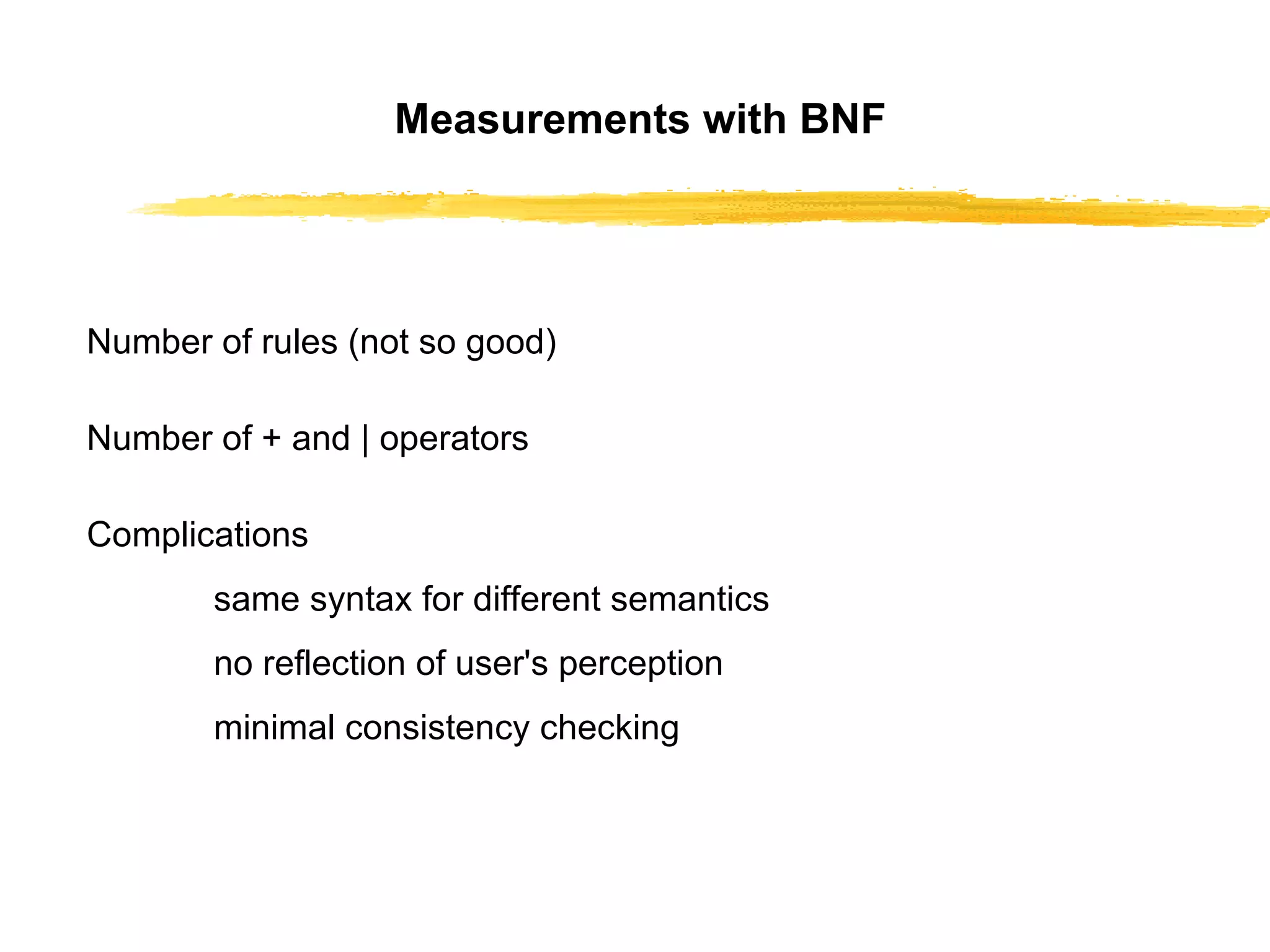
Measurements with BNFNumber of rules (not so good) Number of + and | operators Complications same syntax for different semantics no reflection of user's perception minimal consistency checking
17.
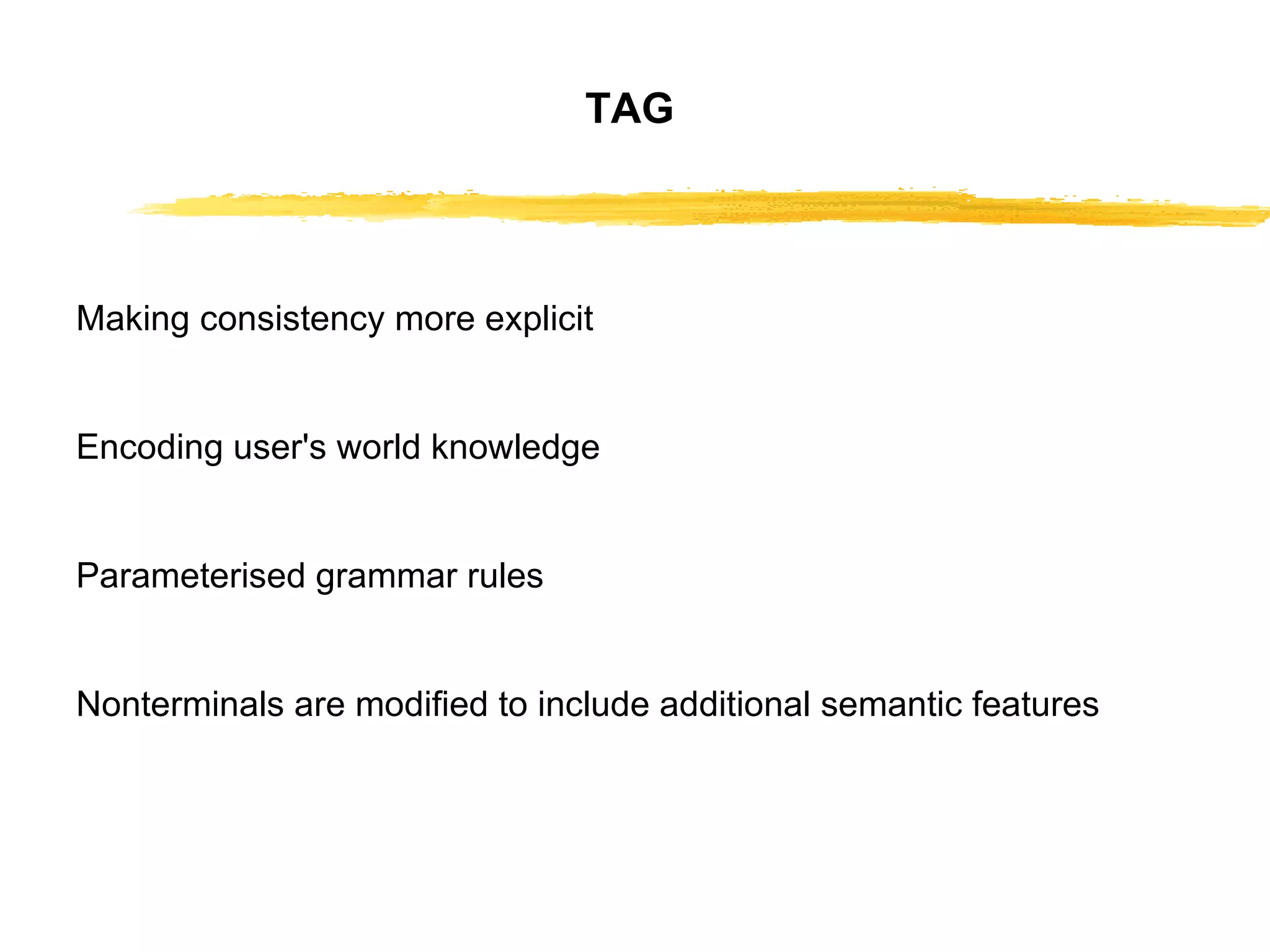
TAG Making consistencymore explicit Encoding user's world knowledge Parameterised grammar rules Nonterminals are modified to include additional semantic features
18.
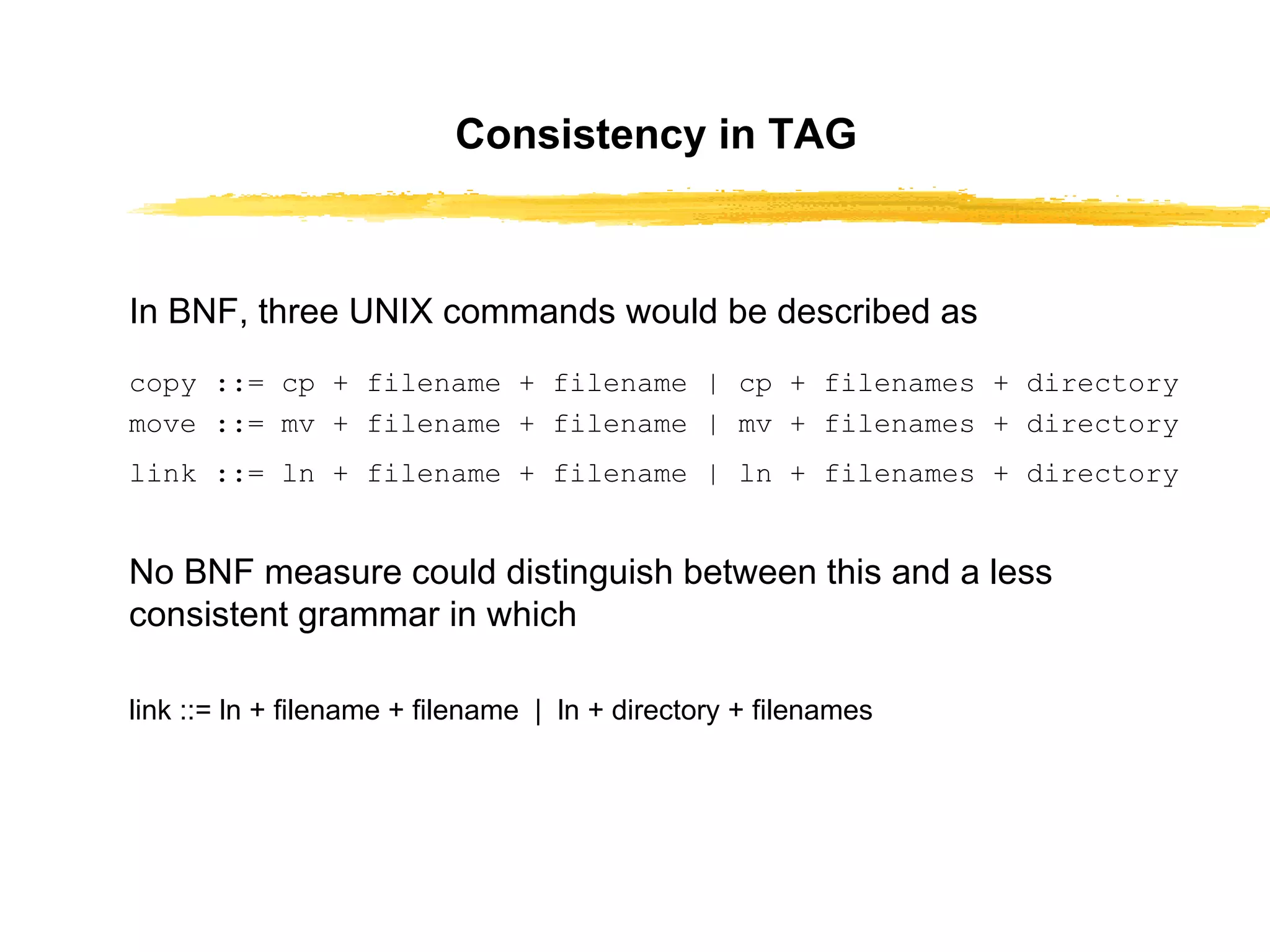
Consistency in TAGIn BNF, three UNIX commands would be described as copy ::= cp + filename + filename | cp + filenames + directory move ::= mv + filename + filename | mv + filenames + directory link ::= ln + filename + filename | ln + filenames + directory No BNF measure could distinguish between this and a less consistent grammar in which link ::= ln + filename + filename | ln + directory + filenames
19.
Consistency in TAG(cont'd) consistency of argument order made explicit using a parameter, or semantic feature for file operations Feature Possible values Op = copy; move; link Rules file-op[Op] ::= command[Op] + filename + filename | command[Op] + filenames + directory command[Op = copy] ::= cp command[Op = move] ::= mv command[Op = link] ::= ln
20.
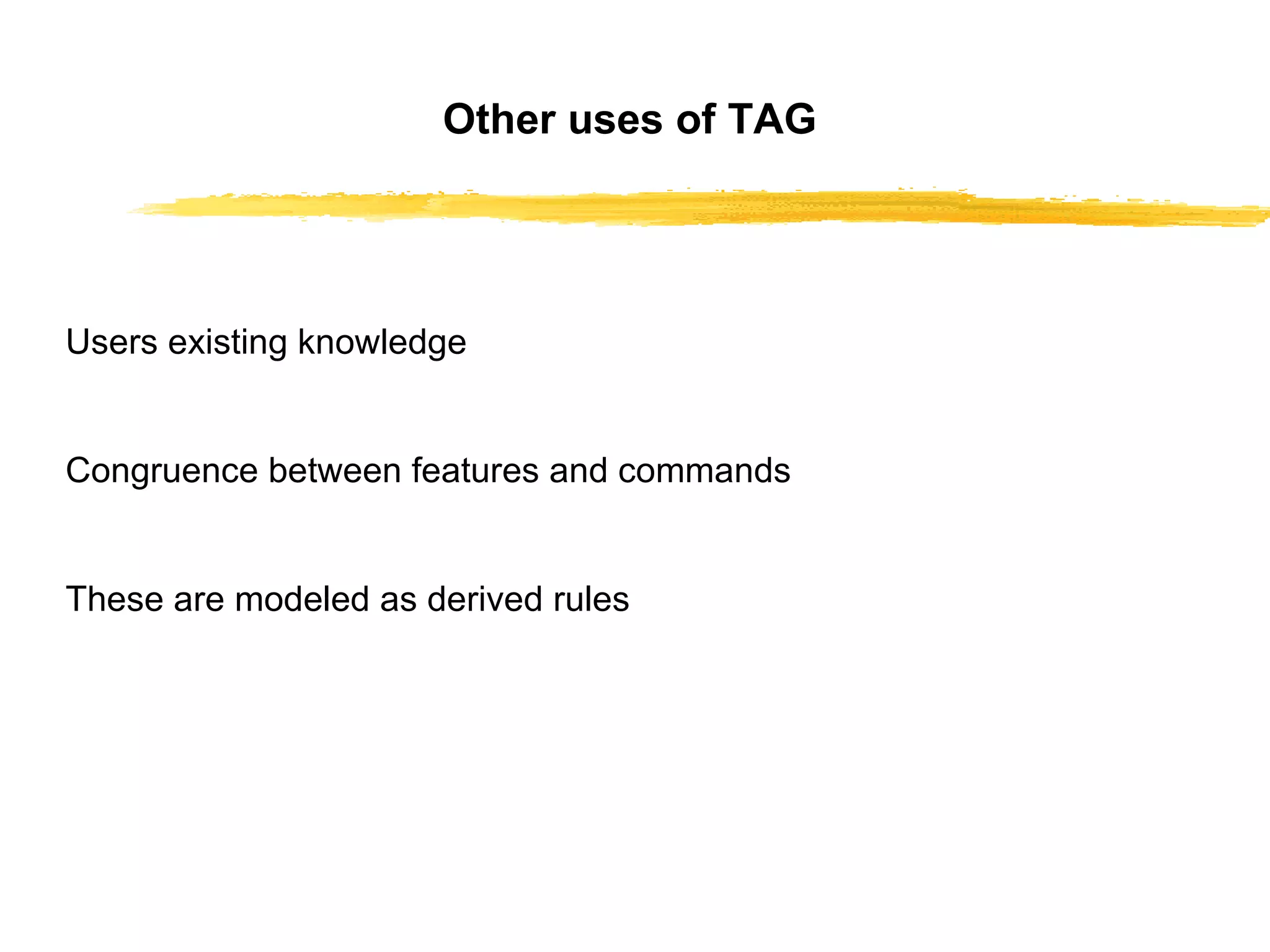
Other uses ofTAG Users existing knowledge Congruence between features and commands These are modeled as derived rules
21.
Physical and devicemodels Based on empirical knowledge of human motor system User's task: acquisition then execution. These only address execution Complementary with goal hierarchies The Keystroke Level Model (KLM) Buxton's 3-state model
22.
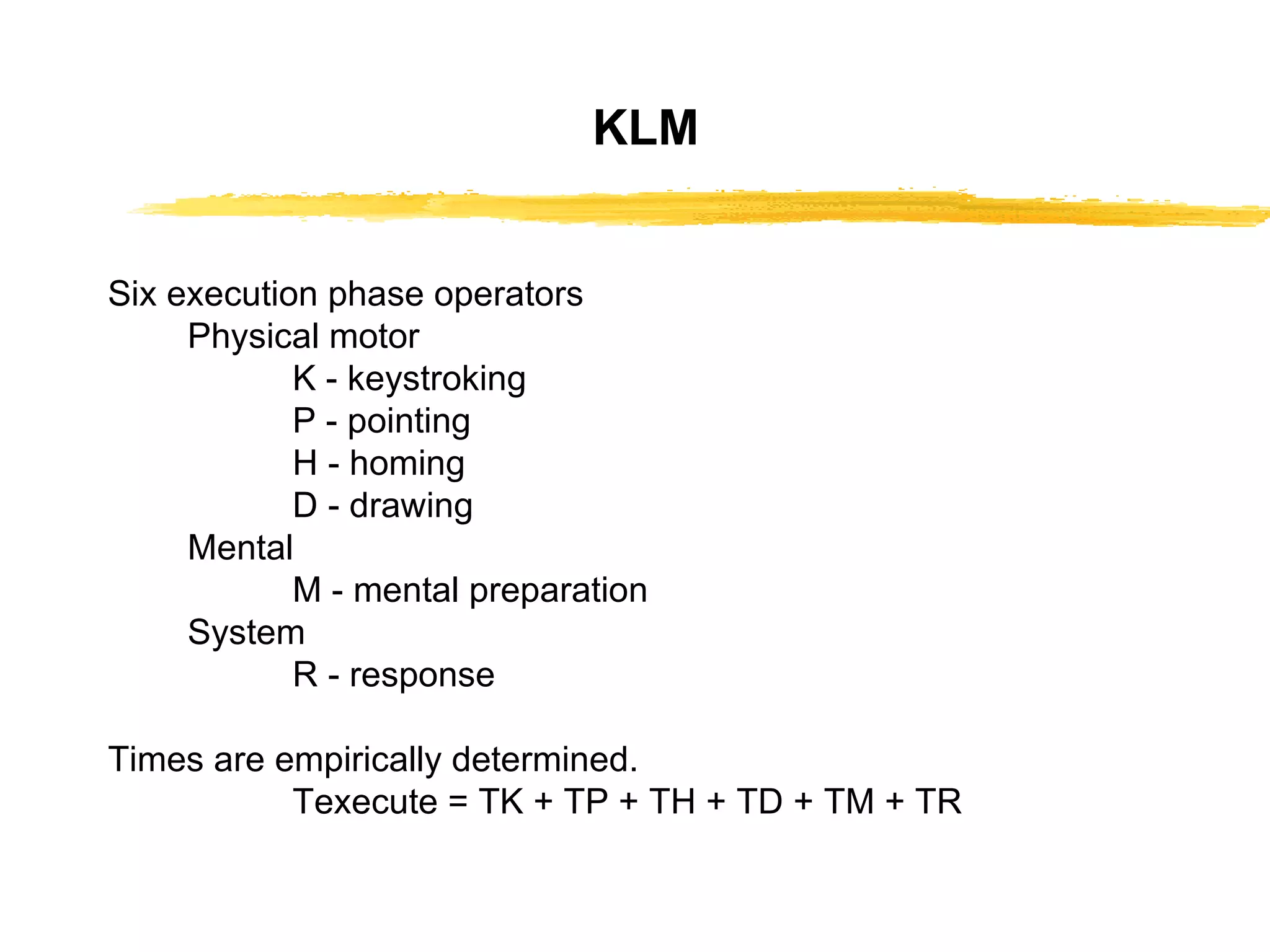
KLM Six executionphase operators Physical motor K - keystroking P - pointing H - homing D - drawing Mental M - mental preparation System R - response Times are empirically determined. Texecute = TK + TP + TH + TD + TM + TR
23.
Example GOAL: ICONISE-WINDOW[select GOAL: USE-CLOSE-METHOD . MOVE-MOUSE-TO-WINDOW-HEADER . POP-UP-MENU . CLICK-OVER-CLOSE-OPTION GOAL: USE-L7-METHOD PRESS-L7-KEY] assume hand starts on mouse USE-CLOSE-METHOD P[to menu] 1.1 B[LEFT down] 0.1 M 1.35 P[to option] 1.1 B[LEFT up] 0.1 Total 3.75 secs USE-L7-METHOD H[to kbd] 0.40 M 1.35 K[L7 key] 0.28 Total 2.03 secs
24.
Architectural models Allof these cognitive models make assumptions about the architecture of the human mind. Long-term/Short-term memory Problem spaces Interacting Cognitive Subsystems Connectionist ACT
25.
Display-based interaction Mostcognitive models do not deal with user observation and perception. Some techniques have been extended to handle system output (e.g., BNF with sensing terminals, Display-TAG) but problems persist. Level of granularity Exploratory interaction versus planning