CONSTRUCTIVISM
B Y : J E R I C O E D U L A N
CONSTRUCTIVISMKNOWLEDGE IS
CONSTRUCTED
CONSTRUCTIVISMKNOWLEDGE IS
CONSTRUCTED
Learning is an active
process in which learners
construct new ideas or
concepts based upon their
current/past knowledge.
The learner selects and
transforms information,
constructs hypotheses, and
makes decisions, relying on
a cognitive structure to do so.
EXAMPLE:
An elementary school teacher presents a
class problem to measure the length of the
"Mayflower." Rather than starting the problem by
introducing the ruler, the teacher allows students
to reflect and to construct their own methods of
measurement. One student offers the knowledge
that a doctor said he is four feet tall. Another says
she knows horses are measured in "hands." The
students discuss these and other methods they
have heard about, and decide on one to apply to
the problem.
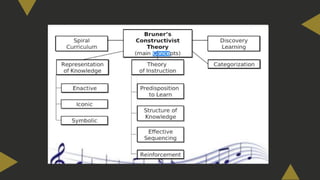
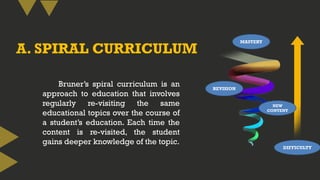
A. SPIRAL CURRICULUM
Bruner’s spiral curriculum is an
approach to education that involves
regularly re-visiting the same
educational topics over the course of
a student’s education. Each time the
content is re-visited, the student
gains deeper knowledge of the topic.
MASTERY
REVISION
NEW
CONTENT
DIFFICULTY
B. REPRESENTATION OF KNOWLEDGE
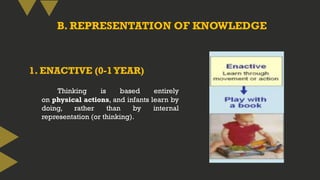
Thinking is based entirely
on physical actions, and infants learn by
doing, rather than by internal
representation (or thinking).
1. ENACTIVE (0-1YEAR)
B. REPRESENTATION OF KNOWLEDGE
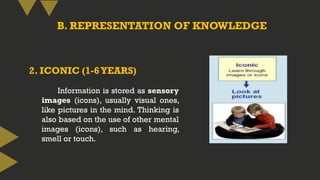
Information is stored as sensory
images (icons), usually visual ones,
like pictures in the mind. Thinking is
also based on the use of other mental
images (icons), such as hearing,
smell or touch.
2. ICONIC (1-6YEARS)
B. REPRESENTATION OF KNOWLEDGE
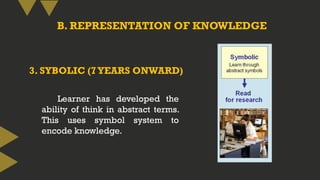
Learner has developed the
ability of think in abstract terms.
This uses symbol system to
encode knowledge.
3. SYBOLIC (7YEARS ONWARD)
C.THEORY OF INSTRUCTION
Introduced the idea of
“Readiness for learning”. According
to this idea, the teacher would design
discrepant event activities that would
pique the students' curiosity.
1. PREDISPOSITION TO LEARN
C.THEORY OF INSTRUCTION
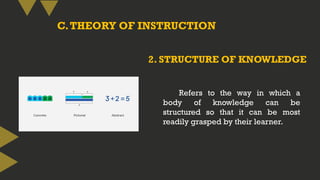
Refers to the way in which a
body of knowledge can be
structured so that it can be most
readily grasped by their learner.
2. STRUCTURE OF KNOWLEDGE
C.THEORY OF INSTRUCTION
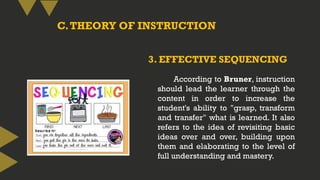
According to Bruner, instruction
should lead the learner through the
content in order to increase the
student's ability to "grasp, transform
and transfer" what is learned. It also
refers to the idea of revisiting basic
ideas over and over, building upon
them and elaborating to the level of
full understanding and mastery.
3. EFFECTIVE SEQUENCING
C.THEORY OF INSTRUCTION
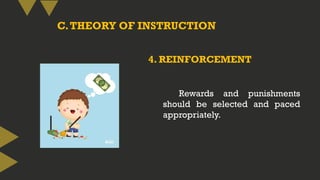
Rewards and punishments
should be selected and paced
appropriately.
4. REINFORCEMENT
D. DISCOVERY LEARNING
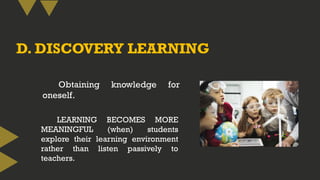
Obtaining knowledge for
oneself.
LEARNING BECOMES MORE
MEANINGFUL (when) students
explore their learning environment
rather than listen passively to
teachers.
E. CATEGORIZATION
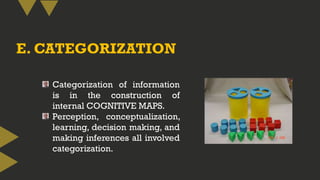
Categorization of information
is in the construction of
internal COGNITIVE MAPS.
Perception, conceptualization,
learning, decision making, and
making inferences all involved
categorization.
E. CATEGORIZATION
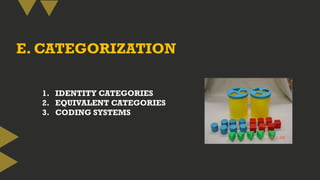
1. IDENTITY CATEGORIES
2. EQUIVALENT CATEGORIES
3. CODING SYSTEMS
THE END!!

Jerome Bruner's Theory of Constructivism

  • 1.
    CONSTRUCTIVISM B Y :J E R I C O E D U L A N
  • 2.
  • 3.
  • 4.
    Learning is anactive process in which learners construct new ideas or concepts based upon their current/past knowledge. The learner selects and transforms information, constructs hypotheses, and makes decisions, relying on a cognitive structure to do so.
  • 5.
    EXAMPLE: An elementary schoolteacher presents a class problem to measure the length of the "Mayflower." Rather than starting the problem by introducing the ruler, the teacher allows students to reflect and to construct their own methods of measurement. One student offers the knowledge that a doctor said he is four feet tall. Another says she knows horses are measured in "hands." The students discuss these and other methods they have heard about, and decide on one to apply to the problem.
  • 7.
    A. SPIRAL CURRICULUM Bruner’sspiral curriculum is an approach to education that involves regularly re-visiting the same educational topics over the course of a student’s education. Each time the content is re-visited, the student gains deeper knowledge of the topic. MASTERY REVISION NEW CONTENT DIFFICULTY
  • 8.
    B. REPRESENTATION OFKNOWLEDGE Thinking is based entirely on physical actions, and infants learn by doing, rather than by internal representation (or thinking). 1. ENACTIVE (0-1YEAR)
  • 9.
    B. REPRESENTATION OFKNOWLEDGE Information is stored as sensory images (icons), usually visual ones, like pictures in the mind. Thinking is also based on the use of other mental images (icons), such as hearing, smell or touch. 2. ICONIC (1-6YEARS)
  • 10.
    B. REPRESENTATION OFKNOWLEDGE Learner has developed the ability of think in abstract terms. This uses symbol system to encode knowledge. 3. SYBOLIC (7YEARS ONWARD)
  • 11.
    C.THEORY OF INSTRUCTION Introducedthe idea of “Readiness for learning”. According to this idea, the teacher would design discrepant event activities that would pique the students' curiosity. 1. PREDISPOSITION TO LEARN
  • 12.
    C.THEORY OF INSTRUCTION Refersto the way in which a body of knowledge can be structured so that it can be most readily grasped by their learner. 2. STRUCTURE OF KNOWLEDGE
  • 13.
    C.THEORY OF INSTRUCTION Accordingto Bruner, instruction should lead the learner through the content in order to increase the student's ability to "grasp, transform and transfer" what is learned. It also refers to the idea of revisiting basic ideas over and over, building upon them and elaborating to the level of full understanding and mastery. 3. EFFECTIVE SEQUENCING
  • 14.
    C.THEORY OF INSTRUCTION Rewardsand punishments should be selected and paced appropriately. 4. REINFORCEMENT
  • 15.
    D. DISCOVERY LEARNING Obtainingknowledge for oneself. LEARNING BECOMES MORE MEANINGFUL (when) students explore their learning environment rather than listen passively to teachers.
  • 16.
    E. CATEGORIZATION Categorization ofinformation is in the construction of internal COGNITIVE MAPS. Perception, conceptualization, learning, decision making, and making inferences all involved categorization.
  • 17.
    E. CATEGORIZATION 1. IDENTITYCATEGORIES 2. EQUIVALENT CATEGORIES 3. CODING SYSTEMS
  • 18.