NUTRITION
Capt. Htet Ko
PG II, ORL-HNS
INTRODUCTION
• Malnutrition is common and it occurs in about 30% of surgical patients with
gastrointestinal disease and up to 60% in prolonged hospital stay because of
postoperative complications.
• Who suffer starvation or have signs of malnutrition have a higher risk of
complications and death in comparison with patients with adequate nutritional
reserves.
• Long-standing protein–calorie malnutrition as seen in cachexia or general frailty is
easy to recognise.
• Short-term undernutrition, although less easily recognised, frequently occurs in
association with critical illness, major trauma, burns or surgery, and also impacts
on patient recovery.
• The aim of nutritional support is to identify those patients at risk of malnutrition
and to ensure that their nutritional requirements are met by the most appropriate
route and in a way that minimises complications.
NUTRITIONAL ASSESSMENT
Clinical
• A clinical assessment of nutritional status involves a focused history and physical
examination, an assessment of risk of malabsorption or inadequate dietary intake
and selected laboratory tests aimed at detecting specific nutrient deficiencies
• This is termed ‘subjective global assessment’ and encompasses historical,
symptomatic and physical parameters.
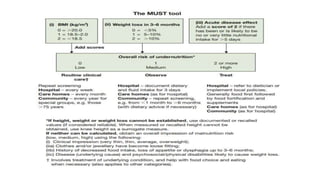
• Recently, the British Association of Parenteral and Enteral Nutrition introduced a
malnutrition universal screening tool (MUST), which is a five-step screening tool
to identify adults who are malnourished or at risk of undernutrition.
Laboratory techniques
• There is no single biochemical measurement that reliably identifies malnutrition.
Albumin is not a measure of nutritional status, particularly in the acute setting.
• Although a low serum albumin level (<30 g/L) is an indicator of poor prognosis,
hypoalbuminemia invariably occurs because of alterations in body fluid composition
and because of increased capillary permeability related to ongoing sepsis.
• Malnutrition is associated with defective immune function, and measurement of
lymphocyte count and skin testing for delayed hypersensitivity frequently reveal
abnormalities in malnourished patients.
• Immunity is not, however, a precise or reliable indicator of nutritional status, nor is it
a practical method in routine clinical practice.
Body weight and anthropometry
• A simple method of assessing nutritional status is to estimate weight loss.
• Measured body weight is compared with ideal body weight obtained from tables
or from the patient’s usual or premorbid weight.
• Unintentional weight loss of more than 10% of a patient’s weight in the preceding
6 months is a good prognostic indicator of poor outcome.
• Body weight is frequently corrected for height, allowing calculation of the body
mass index (BMI, defined as body weight in kilograms divided by height in
meters squared).
• A BMI of less than 18.5 indicates nutritional impairment and a BMI below 15 is
associated with significant hospital mortality.
• Major changes in fluid balance, which are common in critically ill patients, may
make body weight and BMI unreliable indicators of nutritional status.
• Anthropometric techniques incorporating measurements of skinfold thicknesses and mid-
arm circumference permit estimations of body fat and muscle mass, and these are indirect
measures of energy and protein stores.
• These measurements are, however, insufficiently accurate in individual patients to permit
planning of nutritional support regimens.
• Similarly, use of bioelectrical impedance analysis (BIA) permits estimation of intra- and
extracellular fluid volumes.
• These techniques are only useful if performed frequently on a sequential basis in
individual patients; in this respect, trends are much more important than absolute
impedance figures.
• All of these techniques are significantly impaired by the presence of oedema
FLUID AND ELECTROLYTES
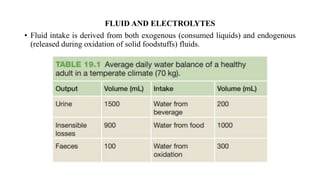
• Fluid intake is derived from both exogenous (consumed liquids) and endogenous
(released during oxidation of solid foodstuffs) fluids.
Fluid losses occur by four routes:
1. Lungs. About 400 mL of water is lost in expired air each 24 hours. This is
increased in dry atmospheres or in patients with a tracheostomy, emphasizing the
importance of humidification of inspired air.
2. Skin. In a temperate climate, skin (i.e. sweat) losses are between 600 and 1000
mL/day.
3. Faeces. Between 60 and 150 mL of water are lost daily in patients with normal
bowel function.
4. Urine. The normal urine output is approximately 1500 mL/day and, provided
that the kidneys are healthy, the specific gravity of urine bears a direct
relationship to volume. A minimum urine output of 400 mL/day is required to
excrete the end products of protein metabolism.
• Maintenance fluid requirements are calculated approximately from an estimation
of insensible and obligatory losses.
• Various formulae are available for calculating fluid replacement based on a
patient’s weight or surface area.
• For example, 30–40 mL/kg gives an estimate of daily requirements.
• The following are the approximate daily requirements of some electrolytes in
adults:
● sodium: 50–90 mM/day;
● potassium: 50 mM/day;
● calcium: 5 mM/day;
● magnesium: 1 mM/day.
• A careful assessment of the patient including pulse, blood pressure and central
venous pressure, if available. Clinical examination to assess hydration status
(peripheries, skin turgor, urine output and specific gravity of urine), urine and
serum electrolytes and haematocrit.
• Estimation of losses already incurred and their nature: for example, vomiting,
ileus, diarrhoea, excessive sweating or fluid losses from burns or other serious
inflammatory conditions.
• Estimation of supplemental fluids likely to be required in view of anticipated
future losses from drains, fistulae, nasogastric tubes or abnormal urine or faecal
losses.
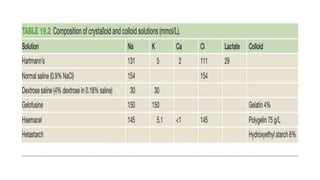
• When an estimate of the volumes required has been made, the appropriate
replacement fluid can be determined from a consideration of the electrolyte
composition of gastrointestinal secretions. Most intestinal losses are adequately
replaced with normal saline containing supplemental potassium.
NUTRITIONAL REQUIREMENTS
• Total enteral or parenteral nutrition necessitates the provision of the macronutrients,
carbohydrate, fat and protein, together with vitamins, trace elements, electrolytes and
water.
• When planning a feeding regime, the patient should be weighed and an assessment made
of daily energy and protein requirements.
• Standard tables are available to permit these calculations.
• Daily needs may change depending on the patient’s condition.
• Overfeeding is the most common cause of complications, regardless of whether nutrition
is provided enterally or parenterally.
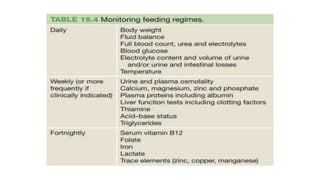
• It is essential to monitor daily intake to provide an assessment of tolerance.
Macronutrient requirements
Energy
• The total energy requirement of a stable patient with a normal or moderately
increased need is approximately 20–30 kcal/kg per day.
• Very few patients require energy intakes in excess of 2000 kcal/day.
• Thus, in the majority of hospitalised patients in whom energy demands from
activity are minimal, total energy requirements are approximately 1300–1800
kcal/day.
Carbohydrate
• There is an obligatory glucose requirement to meet the needs of the central
nervous system and certain haematopoietic cells, which is equivalent to about 2
g/kg per day.
• In addition, there is a physiological maximum to the amount of glucose that can be
oxidised, which is approximately 4 mg/kg per minute (equivalent to about 1500
kcal/day in a 70-kg person), with the nonoxidised glucose being primarily
converted to fat.
• However, optimal utilisation of energy during nutritional support is ensured by
avoiding the infusion of glucose at rates approximating physiological maximums.
• Plasma glucose levels provide an indication of tolerance. Avoid hyperglycaemia.
• Provide energy as mixtures of glucose and fat. Glucose is the preferred
carbohydrate source.
Fat
• Dietary fat is composed of triglycerides of predominantly four long-chain fatty
acids.
• There are two saturated fatty acids (palmitic (C16) and stearic (C18)) and two
unsaturated fatty acids (oleic (C18 with one double bond) and linoleic (C18 with
two double bonds).
• The unsaturated fatty acids, linoleic and linolenic acid, are considered essential
because they cannot be synthesised in vivo from non-dietary sources.
• Both soybean and sunflower oil emulsions are rich sources of linoleic acid and
provision of only 1 litre of emulsion per week avoids deficiency.
• Safe and non-toxic fat emulsions based upon long-chain triglycerides (LCTs) have
been commercially available for over 30 years.
• These emulsions provide a calorically dense product (9 kcal/g) and are now
routinely used to supplement the provision of non-protein calories during
parenteral nutrition.
Protein
• The basic requirement for nitrogen in patients without pre-existing malnutrition
and without metabolic stress is 0.10–0.15 g/kg per day.
• In hypermetabolic patients the nitrogen requirements increase to 0.20–0.25 g/kg
per day.
• Although there may be a minority of patients in whom the requirements are
higher, such as after acute weight loss when the objective of therapy is long-term
repletion of lean body mass, there is little evidence that the provision of nitrogen
in excess of 14 g/day is beneficial.
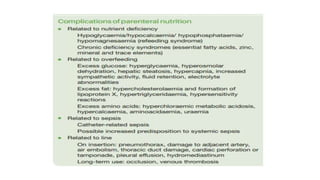
Vitamins, minerals and trace elements
• Whatever the method of feeding, these are all essential components of nutritional
regimes.
• The water-soluble vitamins B and C act as coenzymes in collagen formation and
wound healing.
• Postoperatively, the vitamin C requirement increases to 60–80 mg/day.
• Supplemental vitamin B12 is often indicated in patients who have undergone
intestinal resection or gastric surgery and in those with a history of alcohol
dependence.
• Absorption of the fat-soluble vitamins A, D, E and K is reduced in steatorrhoea
and the absence of bile.
• Sodium, potassium and phosphate are all subject to significant losses, particularly
in patients with diarrhoeal illness.
• Their levels need daily monitoring and appropriate replacement.
• Trace elements may also act as cofactors for metabolic processes.
• Normally, trace element requirements are met by the delivery of food to the gut
and so patients on long-term parenteral nutrition are at particular risk of depletion.
• Magnesium, zinc and iron levels may all be decreased as part of the inflammatory
response.
• Supplementation is necessary to optimize utilization of amino acids and to avoid
refeeding syndrome.
ARTIFICIAL NUTRITIONALSUPPORT
• Any patient who has sustained 5 days of inadequate intake or who is anticipated to
have no or inadequate intake for this period should be considered for nutritional
support.
• The periods may be less in patients with pre-existing malnutrition.
• This concept is important because it emphasizes that the provision of nutritional
support is not specific to certain conditions or diseases.
Enteral nutrition
• The term ‘enteral feeding’ means delivery of nutrients into the gastrointestinal
tract. The alimentary tract should be used whenever possible.
• This can be achieved with normal food, oral supplements (sip feeding) or with a
variety of tubefeeding techniques delivering food into the stomach, duodenum or
jejunum.
• A variety of nutrient formulations are available for enteral feeding.
• These vary with respect to energy content, osmolarity, fat and nitrogen content and
nutrient complexity; most contain up to 1–2 kcal/mL and up to 0.6 g/mL of
protein.
• Polymeric feeds contain intact protein and hence require digestion, whereas
monomeric/elemental feeds contain nitrogen in the form of either free amino acids
or, in some cases, peptides.
• Newer feeding formulations are available that include glutamine and fibre to
optimize intestinal nutrition, or immunonutrients such as arginine and fish oils, but
these are expensive and their use is controversial.
Sip feeding
• Commercially available supplementary sip feeds are used in patients who can
drink but whose appetites are impaired or in whom adequate intakes cannot be
maintained with ad libitum intakes.
• These feeds typically provide 200 kcal and 2 g of nitrogen per 200 mL carton.
• There is good evidence to demonstrate that these sip-feeding techniques are
associated with a significant overall increase in calorie and nitrogen intakes
without detriment to spontaneous nutrition.
• The evidence that these techniques improve patient outcomes is less convincing.
Tube-feeding techniques
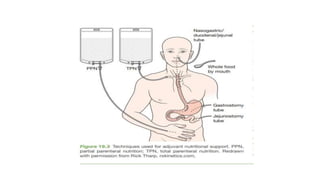
• Enteral nutrition can be achieved using conventional nasogastric tubes (Ryle’s),
fine-bore feeding tubes inserted into the stomach, surgical or percutaneous
endoscopic gastrostomy (PEG) or, finally, postpyloric feeding utilizing nasojejunal
tubes or various types of jejunostomy.
• The choice of method will be determined by local circumstances and preference in
many patients.
• Whichever method is adopted, it is important that tube feeding is supervised by an
experienced dietician who will calculate the patient’s requirements and aim to
achieve these within 2–3 days of the instigation of feeds.
• Conventionally, 20–30 mL are administered per hour initially, gradually increasing
to goal rates within 48–72 hours.
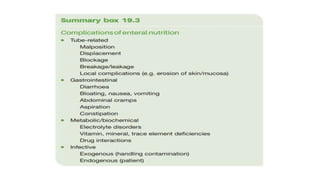
• Tube blockage is common. All tubes should be flushed with water at least twice
daily.
• If a buildup of solidified diet occurs, instillation into the tube of agents such as
chymotrypsin may salvage a partially obstructed tube.
• Guidewires should not be used to clear blockages as these may perforate the tube
and cause contiguous damage.
• Nasogastric tubes are appropriate in a majority of patients.
• If feeding is maintained for more than a week or so, a fine-bore feeding tube is
preferable and is likely to cause fewer gastric and oesophageal erosions.
Parenteral nutrition
• Total parenteral nutrition (TPN) is defined as the provision of all nutritional
requirements by means of the intravenous route and without the use of the
gastrointestinal tract.
• Parenteral nutrition is indicated when energy and protein needs cannot be met by
the enteral administration of these substrates.
• The most frequent clinical indications relate to those patients who have undergone
massive resection of the small intestine, who have intestinal fistula or who have
prolonged intestinal failure for other reasons.
Route of delivery: peripheral or central venous access
• TPN can be administered either by a catheter inserted in the central vein or via a
peripheral line.
• In the early days of parenteral nutrition, the only energy source available was
hypertonic glucose, which, being hypertonic, had to be given into a central vein to
avoid thrombophlebitis.
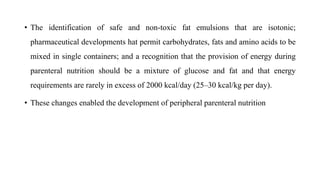
• The identification of safe and non-toxic fat emulsions that are isotonic;
pharmaceutical developments hat permit carbohydrates, fats and amino acids to be
mixed in single containers; and a recognition that the provision of energy during
parenteral nutrition should be a mixture of glucose and fat and that energy
requirements are rarely in excess of 2000 kcal/day (25–30 kcal/kg per day).
• These changes enabled the development of peripheral parenteral nutrition
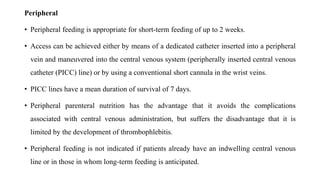
Peripheral
• Peripheral feeding is appropriate for short-term feeding of up to 2 weeks.
• Access can be achieved either by means of a dedicated catheter inserted into a peripheral
vein and maneuvered into the central venous system (peripherally inserted central venous
catheter (PICC) line) or by using a conventional short cannula in the wrist veins.
• PICC lines have a mean duration of survival of 7 days.
• Peripheral parenteral nutrition has the advantage that it avoids the complications
associated with central venous administration, but suffers the disadvantage that it is
limited by the development of thrombophlebitis.
• Peripheral feeding is not indicated if patients already have an indwelling central venous
line or in those in whom long-term feeding is anticipated.
Central
• When the central venous route is chosen, the catheter can be inserted via the
subclavian or internal or external jugular vein.
• There is good evidence to show that the safest means of establishing central
venous access is by insertion of lines under ultrasound guidance.
• Most intensive care physicians and anaesthetists favour cannulation of internal or
external jugular veins as these vessels are easily accessible.
• They suffer the disadvantage that the exit site is situated inconveniently on the
side of the neck, where repeated movements result in disruption of the dressing
with the attendant risk of sepsis.
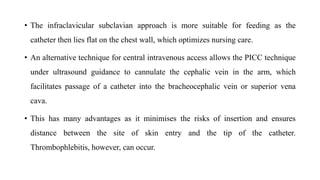
• The infraclavicular subclavian approach is more suitable for feeding as the
catheter then lies flat on the chest wall, which optimizes nursing care.
• An alternative technique for central intravenous access allows the PICC technique
under ultrasound guidance to cannulate the cephalic vein in the arm, which
facilitates passage of a catheter into the bracheocephalic vein or superior vena
cava.
• This has many advantages as it minimises the risks of insertion and ensures
distance between the site of skin entry and the tip of the catheter.
Thrombophlebitis, however, can occur.
THANK YOU !

NUTRITION.pptx

  • 1.
  • 2.
    INTRODUCTION • Malnutrition iscommon and it occurs in about 30% of surgical patients with gastrointestinal disease and up to 60% in prolonged hospital stay because of postoperative complications. • Who suffer starvation or have signs of malnutrition have a higher risk of complications and death in comparison with patients with adequate nutritional reserves. • Long-standing protein–calorie malnutrition as seen in cachexia or general frailty is easy to recognise.
  • 3.
    • Short-term undernutrition,although less easily recognised, frequently occurs in association with critical illness, major trauma, burns or surgery, and also impacts on patient recovery. • The aim of nutritional support is to identify those patients at risk of malnutrition and to ensure that their nutritional requirements are met by the most appropriate route and in a way that minimises complications.
  • 4.
    NUTRITIONAL ASSESSMENT Clinical • Aclinical assessment of nutritional status involves a focused history and physical examination, an assessment of risk of malabsorption or inadequate dietary intake and selected laboratory tests aimed at detecting specific nutrient deficiencies
  • 5.
    • This istermed ‘subjective global assessment’ and encompasses historical, symptomatic and physical parameters. • Recently, the British Association of Parenteral and Enteral Nutrition introduced a malnutrition universal screening tool (MUST), which is a five-step screening tool to identify adults who are malnourished or at risk of undernutrition.
  • 7.
    Laboratory techniques • Thereis no single biochemical measurement that reliably identifies malnutrition. Albumin is not a measure of nutritional status, particularly in the acute setting. • Although a low serum albumin level (<30 g/L) is an indicator of poor prognosis, hypoalbuminemia invariably occurs because of alterations in body fluid composition and because of increased capillary permeability related to ongoing sepsis.
  • 8.
    • Malnutrition isassociated with defective immune function, and measurement of lymphocyte count and skin testing for delayed hypersensitivity frequently reveal abnormalities in malnourished patients. • Immunity is not, however, a precise or reliable indicator of nutritional status, nor is it a practical method in routine clinical practice.
  • 9.
    Body weight andanthropometry • A simple method of assessing nutritional status is to estimate weight loss. • Measured body weight is compared with ideal body weight obtained from tables or from the patient’s usual or premorbid weight. • Unintentional weight loss of more than 10% of a patient’s weight in the preceding 6 months is a good prognostic indicator of poor outcome.
  • 10.
    • Body weightis frequently corrected for height, allowing calculation of the body mass index (BMI, defined as body weight in kilograms divided by height in meters squared). • A BMI of less than 18.5 indicates nutritional impairment and a BMI below 15 is associated with significant hospital mortality. • Major changes in fluid balance, which are common in critically ill patients, may make body weight and BMI unreliable indicators of nutritional status.
  • 11.
    • Anthropometric techniquesincorporating measurements of skinfold thicknesses and mid- arm circumference permit estimations of body fat and muscle mass, and these are indirect measures of energy and protein stores. • These measurements are, however, insufficiently accurate in individual patients to permit planning of nutritional support regimens. • Similarly, use of bioelectrical impedance analysis (BIA) permits estimation of intra- and extracellular fluid volumes. • These techniques are only useful if performed frequently on a sequential basis in individual patients; in this respect, trends are much more important than absolute impedance figures. • All of these techniques are significantly impaired by the presence of oedema
  • 12.
    FLUID AND ELECTROLYTES •Fluid intake is derived from both exogenous (consumed liquids) and endogenous (released during oxidation of solid foodstuffs) fluids.
  • 13.
    Fluid losses occurby four routes: 1. Lungs. About 400 mL of water is lost in expired air each 24 hours. This is increased in dry atmospheres or in patients with a tracheostomy, emphasizing the importance of humidification of inspired air. 2. Skin. In a temperate climate, skin (i.e. sweat) losses are between 600 and 1000 mL/day. 3. Faeces. Between 60 and 150 mL of water are lost daily in patients with normal bowel function. 4. Urine. The normal urine output is approximately 1500 mL/day and, provided that the kidneys are healthy, the specific gravity of urine bears a direct relationship to volume. A minimum urine output of 400 mL/day is required to excrete the end products of protein metabolism.
  • 14.
    • Maintenance fluidrequirements are calculated approximately from an estimation of insensible and obligatory losses. • Various formulae are available for calculating fluid replacement based on a patient’s weight or surface area. • For example, 30–40 mL/kg gives an estimate of daily requirements. • The following are the approximate daily requirements of some electrolytes in adults: ● sodium: 50–90 mM/day; ● potassium: 50 mM/day; ● calcium: 5 mM/day; ● magnesium: 1 mM/day.
  • 15.
    • A carefulassessment of the patient including pulse, blood pressure and central venous pressure, if available. Clinical examination to assess hydration status (peripheries, skin turgor, urine output and specific gravity of urine), urine and serum electrolytes and haematocrit. • Estimation of losses already incurred and their nature: for example, vomiting, ileus, diarrhoea, excessive sweating or fluid losses from burns or other serious inflammatory conditions.
  • 16.
    • Estimation ofsupplemental fluids likely to be required in view of anticipated future losses from drains, fistulae, nasogastric tubes or abnormal urine or faecal losses. • When an estimate of the volumes required has been made, the appropriate replacement fluid can be determined from a consideration of the electrolyte composition of gastrointestinal secretions. Most intestinal losses are adequately replaced with normal saline containing supplemental potassium.
  • 18.
    NUTRITIONAL REQUIREMENTS • Totalenteral or parenteral nutrition necessitates the provision of the macronutrients, carbohydrate, fat and protein, together with vitamins, trace elements, electrolytes and water. • When planning a feeding regime, the patient should be weighed and an assessment made of daily energy and protein requirements. • Standard tables are available to permit these calculations. • Daily needs may change depending on the patient’s condition. • Overfeeding is the most common cause of complications, regardless of whether nutrition is provided enterally or parenterally. • It is essential to monitor daily intake to provide an assessment of tolerance.
  • 20.
    Macronutrient requirements Energy • Thetotal energy requirement of a stable patient with a normal or moderately increased need is approximately 20–30 kcal/kg per day. • Very few patients require energy intakes in excess of 2000 kcal/day. • Thus, in the majority of hospitalised patients in whom energy demands from activity are minimal, total energy requirements are approximately 1300–1800 kcal/day.
  • 21.
    Carbohydrate • There isan obligatory glucose requirement to meet the needs of the central nervous system and certain haematopoietic cells, which is equivalent to about 2 g/kg per day. • In addition, there is a physiological maximum to the amount of glucose that can be oxidised, which is approximately 4 mg/kg per minute (equivalent to about 1500 kcal/day in a 70-kg person), with the nonoxidised glucose being primarily converted to fat.
  • 22.
    • However, optimalutilisation of energy during nutritional support is ensured by avoiding the infusion of glucose at rates approximating physiological maximums. • Plasma glucose levels provide an indication of tolerance. Avoid hyperglycaemia. • Provide energy as mixtures of glucose and fat. Glucose is the preferred carbohydrate source.
  • 23.
    Fat • Dietary fatis composed of triglycerides of predominantly four long-chain fatty acids. • There are two saturated fatty acids (palmitic (C16) and stearic (C18)) and two unsaturated fatty acids (oleic (C18 with one double bond) and linoleic (C18 with two double bonds). • The unsaturated fatty acids, linoleic and linolenic acid, are considered essential because they cannot be synthesised in vivo from non-dietary sources.
  • 24.
    • Both soybeanand sunflower oil emulsions are rich sources of linoleic acid and provision of only 1 litre of emulsion per week avoids deficiency. • Safe and non-toxic fat emulsions based upon long-chain triglycerides (LCTs) have been commercially available for over 30 years. • These emulsions provide a calorically dense product (9 kcal/g) and are now routinely used to supplement the provision of non-protein calories during parenteral nutrition.
  • 25.
    Protein • The basicrequirement for nitrogen in patients without pre-existing malnutrition and without metabolic stress is 0.10–0.15 g/kg per day. • In hypermetabolic patients the nitrogen requirements increase to 0.20–0.25 g/kg per day. • Although there may be a minority of patients in whom the requirements are higher, such as after acute weight loss when the objective of therapy is long-term repletion of lean body mass, there is little evidence that the provision of nitrogen in excess of 14 g/day is beneficial.
  • 26.
    Vitamins, minerals andtrace elements • Whatever the method of feeding, these are all essential components of nutritional regimes. • The water-soluble vitamins B and C act as coenzymes in collagen formation and wound healing. • Postoperatively, the vitamin C requirement increases to 60–80 mg/day. • Supplemental vitamin B12 is often indicated in patients who have undergone intestinal resection or gastric surgery and in those with a history of alcohol dependence. • Absorption of the fat-soluble vitamins A, D, E and K is reduced in steatorrhoea and the absence of bile.
  • 27.
    • Sodium, potassiumand phosphate are all subject to significant losses, particularly in patients with diarrhoeal illness. • Their levels need daily monitoring and appropriate replacement. • Trace elements may also act as cofactors for metabolic processes. • Normally, trace element requirements are met by the delivery of food to the gut and so patients on long-term parenteral nutrition are at particular risk of depletion. • Magnesium, zinc and iron levels may all be decreased as part of the inflammatory response. • Supplementation is necessary to optimize utilization of amino acids and to avoid refeeding syndrome.
  • 28.
    ARTIFICIAL NUTRITIONALSUPPORT • Anypatient who has sustained 5 days of inadequate intake or who is anticipated to have no or inadequate intake for this period should be considered for nutritional support. • The periods may be less in patients with pre-existing malnutrition. • This concept is important because it emphasizes that the provision of nutritional support is not specific to certain conditions or diseases. Enteral nutrition • The term ‘enteral feeding’ means delivery of nutrients into the gastrointestinal tract. The alimentary tract should be used whenever possible. • This can be achieved with normal food, oral supplements (sip feeding) or with a variety of tubefeeding techniques delivering food into the stomach, duodenum or jejunum.
  • 29.
    • A varietyof nutrient formulations are available for enteral feeding. • These vary with respect to energy content, osmolarity, fat and nitrogen content and nutrient complexity; most contain up to 1–2 kcal/mL and up to 0.6 g/mL of protein. • Polymeric feeds contain intact protein and hence require digestion, whereas monomeric/elemental feeds contain nitrogen in the form of either free amino acids or, in some cases, peptides. • Newer feeding formulations are available that include glutamine and fibre to optimize intestinal nutrition, or immunonutrients such as arginine and fish oils, but these are expensive and their use is controversial.
  • 30.
    Sip feeding • Commerciallyavailable supplementary sip feeds are used in patients who can drink but whose appetites are impaired or in whom adequate intakes cannot be maintained with ad libitum intakes. • These feeds typically provide 200 kcal and 2 g of nitrogen per 200 mL carton. • There is good evidence to demonstrate that these sip-feeding techniques are associated with a significant overall increase in calorie and nitrogen intakes without detriment to spontaneous nutrition. • The evidence that these techniques improve patient outcomes is less convincing.
  • 31.
    Tube-feeding techniques • Enteralnutrition can be achieved using conventional nasogastric tubes (Ryle’s), fine-bore feeding tubes inserted into the stomach, surgical or percutaneous endoscopic gastrostomy (PEG) or, finally, postpyloric feeding utilizing nasojejunal tubes or various types of jejunostomy. • The choice of method will be determined by local circumstances and preference in many patients.
  • 32.
    • Whichever methodis adopted, it is important that tube feeding is supervised by an experienced dietician who will calculate the patient’s requirements and aim to achieve these within 2–3 days of the instigation of feeds. • Conventionally, 20–30 mL are administered per hour initially, gradually increasing to goal rates within 48–72 hours.
  • 33.
    • Tube blockageis common. All tubes should be flushed with water at least twice daily. • If a buildup of solidified diet occurs, instillation into the tube of agents such as chymotrypsin may salvage a partially obstructed tube. • Guidewires should not be used to clear blockages as these may perforate the tube and cause contiguous damage. • Nasogastric tubes are appropriate in a majority of patients. • If feeding is maintained for more than a week or so, a fine-bore feeding tube is preferable and is likely to cause fewer gastric and oesophageal erosions.
  • 36.
    Parenteral nutrition • Totalparenteral nutrition (TPN) is defined as the provision of all nutritional requirements by means of the intravenous route and without the use of the gastrointestinal tract. • Parenteral nutrition is indicated when energy and protein needs cannot be met by the enteral administration of these substrates. • The most frequent clinical indications relate to those patients who have undergone massive resection of the small intestine, who have intestinal fistula or who have prolonged intestinal failure for other reasons.
  • 37.
    Route of delivery:peripheral or central venous access • TPN can be administered either by a catheter inserted in the central vein or via a peripheral line. • In the early days of parenteral nutrition, the only energy source available was hypertonic glucose, which, being hypertonic, had to be given into a central vein to avoid thrombophlebitis.
  • 38.
    • The identificationof safe and non-toxic fat emulsions that are isotonic; pharmaceutical developments hat permit carbohydrates, fats and amino acids to be mixed in single containers; and a recognition that the provision of energy during parenteral nutrition should be a mixture of glucose and fat and that energy requirements are rarely in excess of 2000 kcal/day (25–30 kcal/kg per day). • These changes enabled the development of peripheral parenteral nutrition
  • 39.
    Peripheral • Peripheral feedingis appropriate for short-term feeding of up to 2 weeks. • Access can be achieved either by means of a dedicated catheter inserted into a peripheral vein and maneuvered into the central venous system (peripherally inserted central venous catheter (PICC) line) or by using a conventional short cannula in the wrist veins. • PICC lines have a mean duration of survival of 7 days. • Peripheral parenteral nutrition has the advantage that it avoids the complications associated with central venous administration, but suffers the disadvantage that it is limited by the development of thrombophlebitis. • Peripheral feeding is not indicated if patients already have an indwelling central venous line or in those in whom long-term feeding is anticipated.
  • 40.
    Central • When thecentral venous route is chosen, the catheter can be inserted via the subclavian or internal or external jugular vein. • There is good evidence to show that the safest means of establishing central venous access is by insertion of lines under ultrasound guidance. • Most intensive care physicians and anaesthetists favour cannulation of internal or external jugular veins as these vessels are easily accessible. • They suffer the disadvantage that the exit site is situated inconveniently on the side of the neck, where repeated movements result in disruption of the dressing with the attendant risk of sepsis.
  • 41.
    • The infraclavicularsubclavian approach is more suitable for feeding as the catheter then lies flat on the chest wall, which optimizes nursing care. • An alternative technique for central intravenous access allows the PICC technique under ultrasound guidance to cannulate the cephalic vein in the arm, which facilitates passage of a catheter into the bracheocephalic vein or superior vena cava. • This has many advantages as it minimises the risks of insertion and ensures distance between the site of skin entry and the tip of the catheter. Thrombophlebitis, however, can occur.
  • 43.