ADVANCED STATISTICS


                           Cochran’s Q Test
 Kristine Joey Palencia
MP-Industrial Psychology
Definition
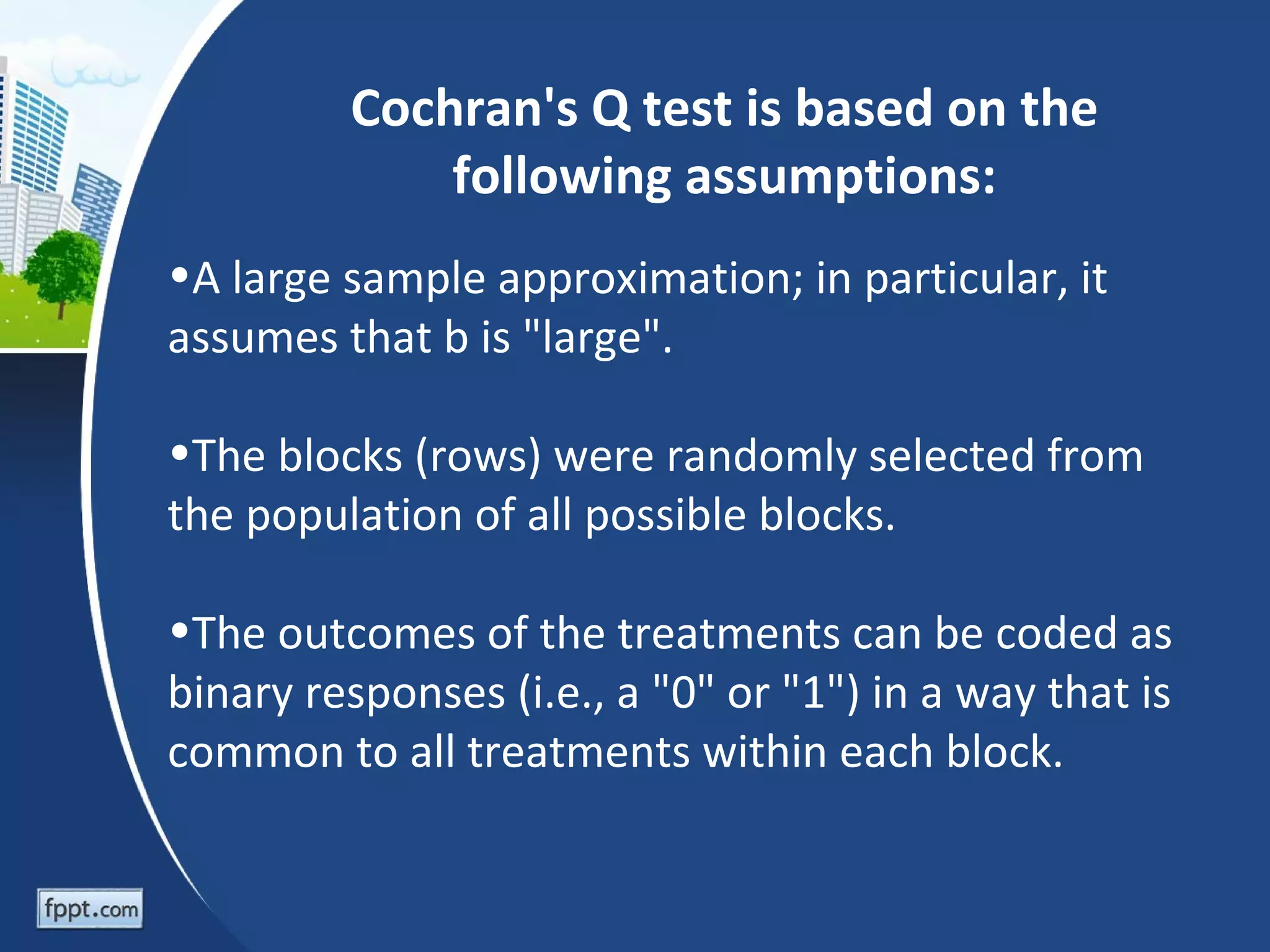
• A nonparametric procedure for categorical data employed in a
  hypothesis testing situation involving a design with k=2 or
  more dependent samples

• Cochran's Q test is an extension to the McNemar test for
  related samples that provides a method for testing for
  differences between three or more matched sets of
  frequencies or proportions. The matching samples can be
  based on k characteristics of N individuals that are associated
  with the response. Alternatively N individuals may be
  observed under k different treatments or conditions.

• Cochran's Q tests whether the probability of a target response
  is equal across all conditions; verify if k treatments have
  identical effects
Cochran's Q test is

H0: The treatments are equally effective.
Ha: There is a difference in effectiveness
among treatments.

 Subject   Treatment   Treatment Treatment Treatment
  (case)       A           B         C         D
   1          1           1          0         0
   2          1           1          0         1
   3          1           0          0         0
   4          1           1          1         0
   5          1           1          0         1
   6          1           1          0         1
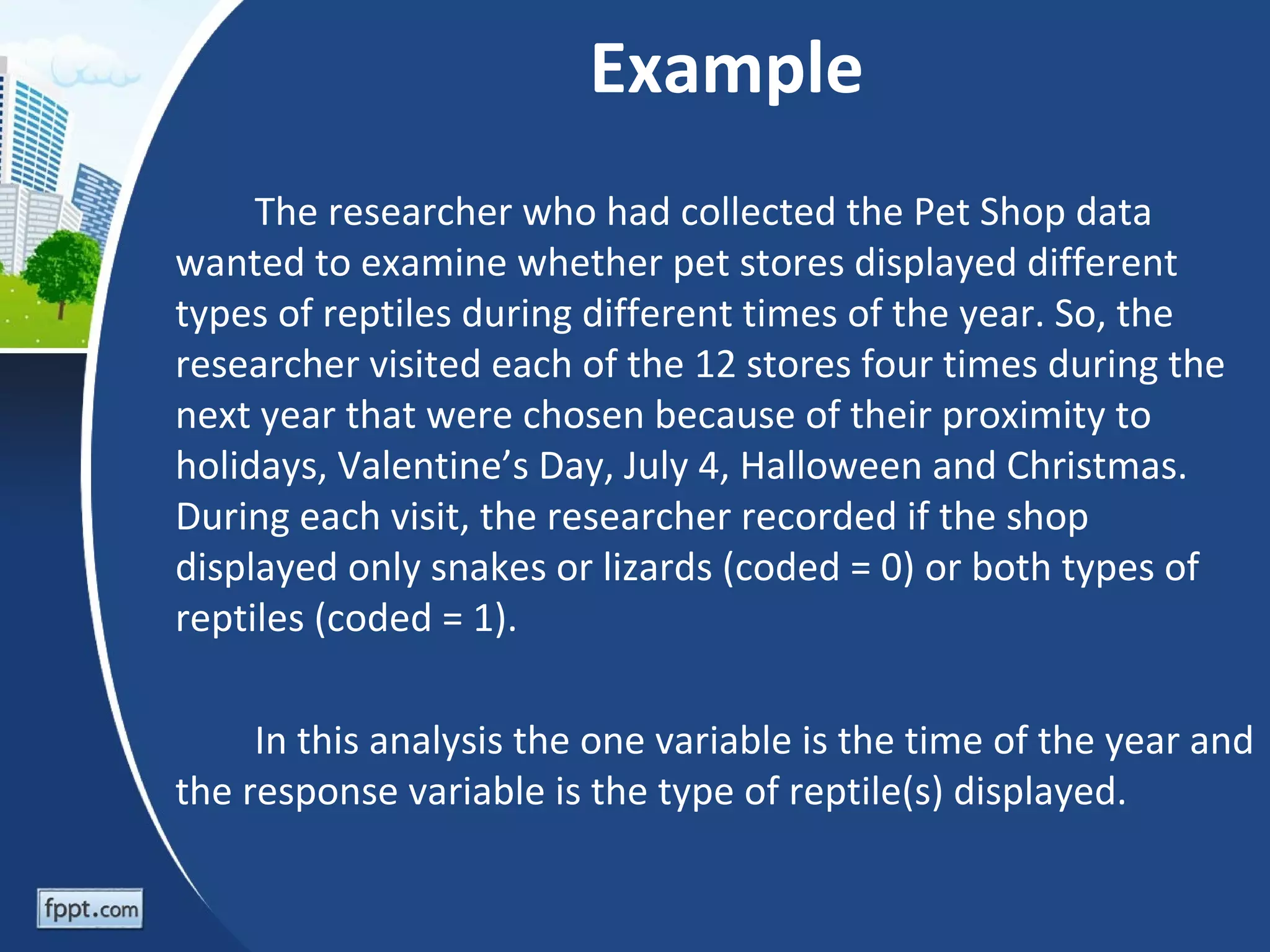
Cochran's Q test is based on the
             following assumptions:
•A large sample approximation; in particular, it
assumes that b is "large".

•The blocks (rows) were randomly selected from
the population of all possible blocks.

•The outcomes of the treatments can be coded as
binary responses (i.e., a "0" or "1") in a way that is
common to all treatments within each block.
Example
     The researcher who had collected the Pet Shop data
wanted to examine whether pet stores displayed different
types of reptiles during different times of the year. So, the
researcher visited each of the 12 stores four times during the
next year that were chosen because of their proximity to
holidays, Valentine’s Day, July 4, Halloween and Christmas.
During each visit, the researcher recorded if the shop
displayed only snakes or lizards (coded = 0) or both types of
reptiles (coded = 1).

     In this analysis the one variable is the time of the year and
the response variable is the type of reptile(s) displayed.
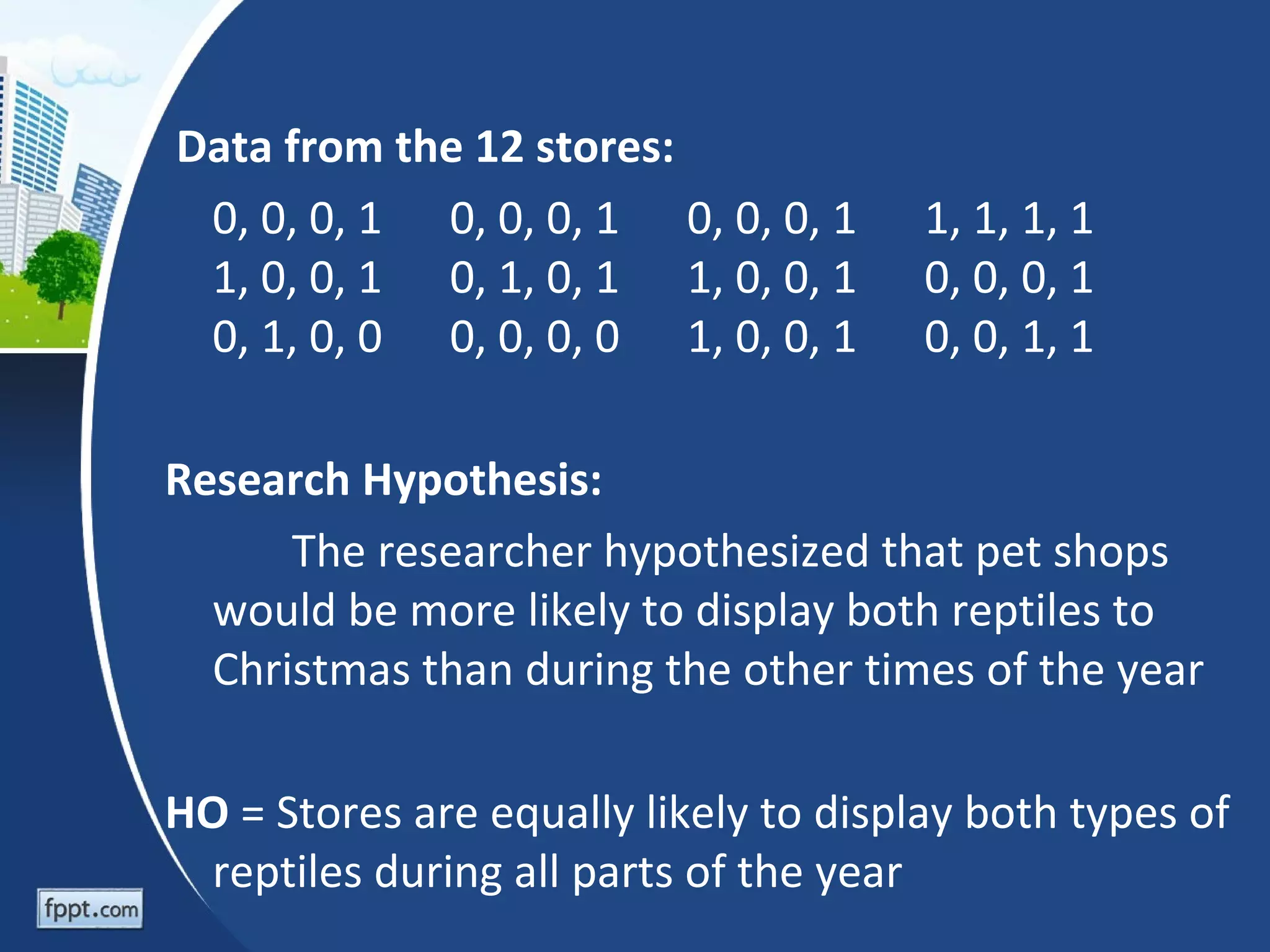
Data from the 12 stores:
 0, 0, 0, 1 0, 0, 0, 1 0, 0, 0, 1      1, 1, 1, 1
 1, 0, 0, 1 0, 1, 0, 1 1, 0, 0, 1      0, 0, 0, 1
 0, 1, 0, 0 0, 0, 0, 0 1, 0, 0, 1      0, 0, 1, 1

Research Hypothesis:
      The researcher hypothesized that pet shops
  would be more likely to display both reptiles to
  Christmas than during the other times of the year

HO = Stores are equally likely to display both types of
 reptiles during all parts of the year
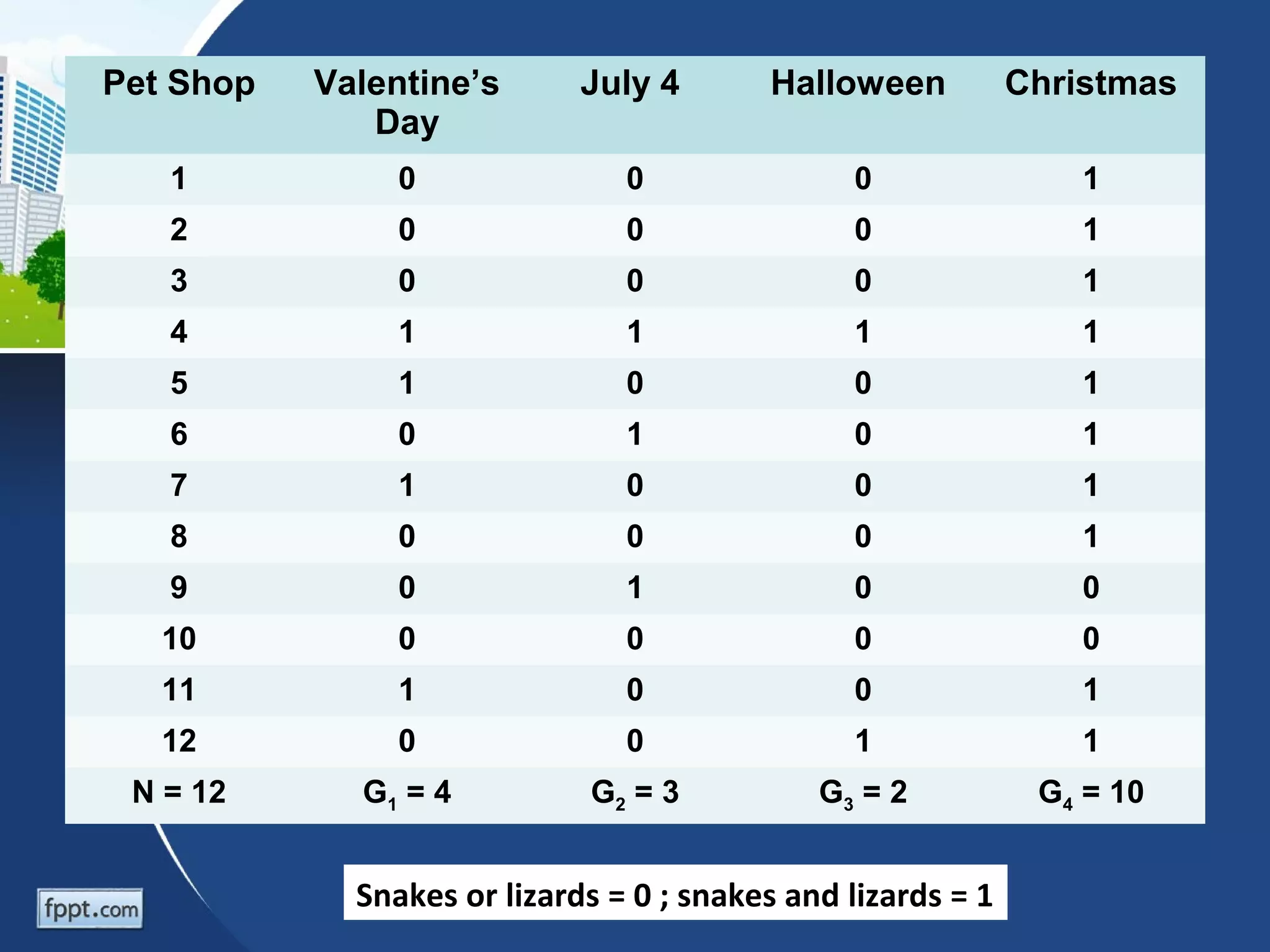
Pet Shop   Valentine’s       July 4       Halloween           Christmas
              Day
   1            0               0               0                 1
   2            0               0               0                 1
   3            0               0               0                 1
   4            1               1               1                 1
   5            1               0               0                 1
   6            0               1               0                 1
   7            1               0               0                 1
   8            0               0               0                 1
   9            0               1               0                 0
   10           0               0               0                 0
   11           1               0               0                 1
   12           0               0               1                 1
 N = 12      G1 = 4          G2 = 3           G3 = 2           G4 = 10


             Snakes or lizards = 0 ; snakes and lizards = 1
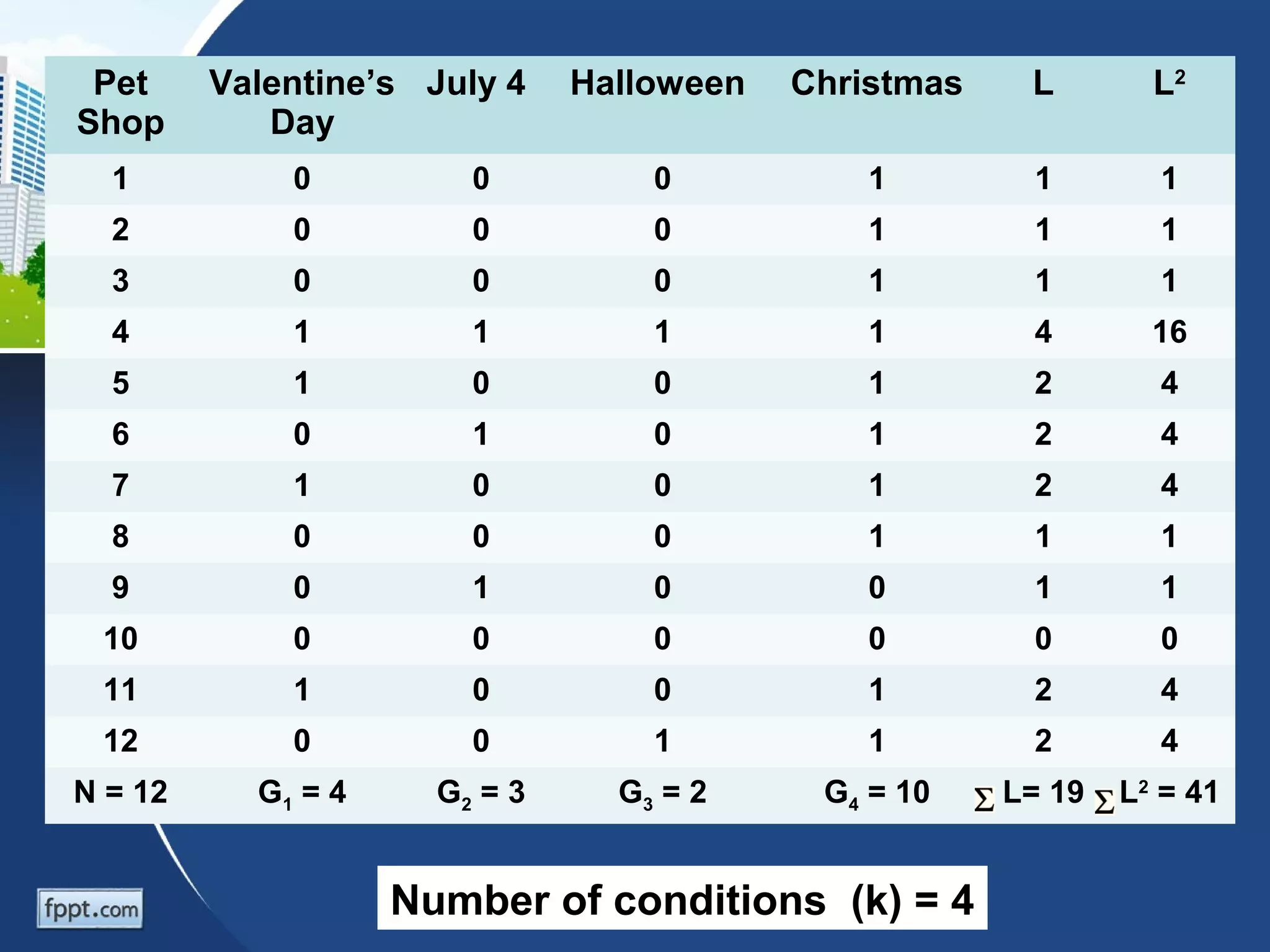
Pet     Valentine’s July 4    Halloween   Christmas    L        L2
Shop        Day
  1          0          0          0           1        1        1
  2          0          0          0           1        1        1
  3          0          0          0           1        1        1
  4          1          1          1           1        4        16
  5          1          0          0           1        2        4
  6          0          1          0           1        2        4
  7          1          0          0           1        2        4
  8          0          0          0           1        1        1
  9          0          1          0           0        1        1
 10          0          0          0           0        0        0
 11          1          0          0           1        2        4
 12          0          0          1           1        2        4
N = 12     G1 = 4     G2 = 3     G3 = 2     G4 = 10    L= 19   L2 = 41


                    Number of conditions (k) = 4
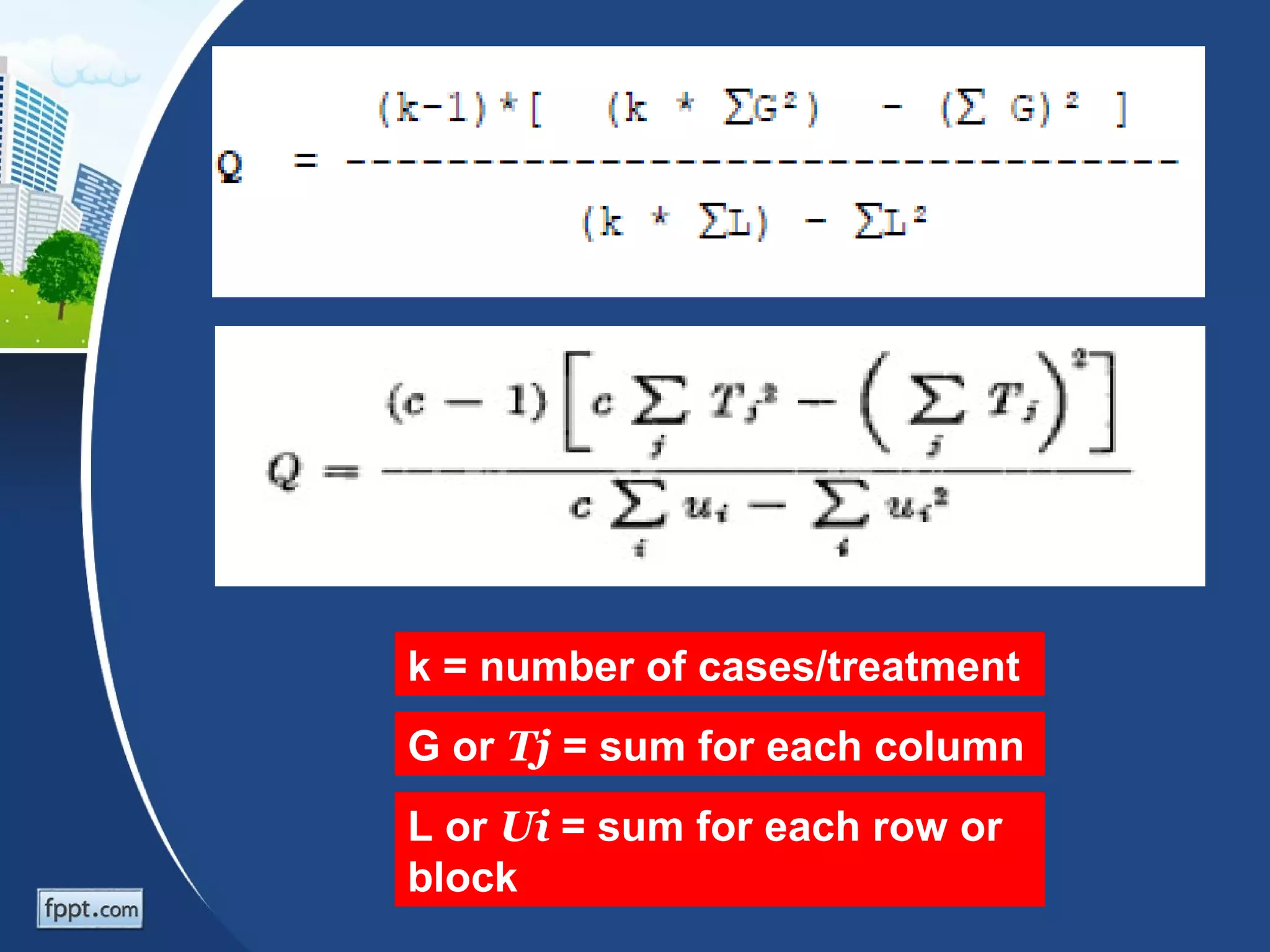
k = number of cases/treatment
G or Tj = sum for each column
L or Ui = sum for each row or
block
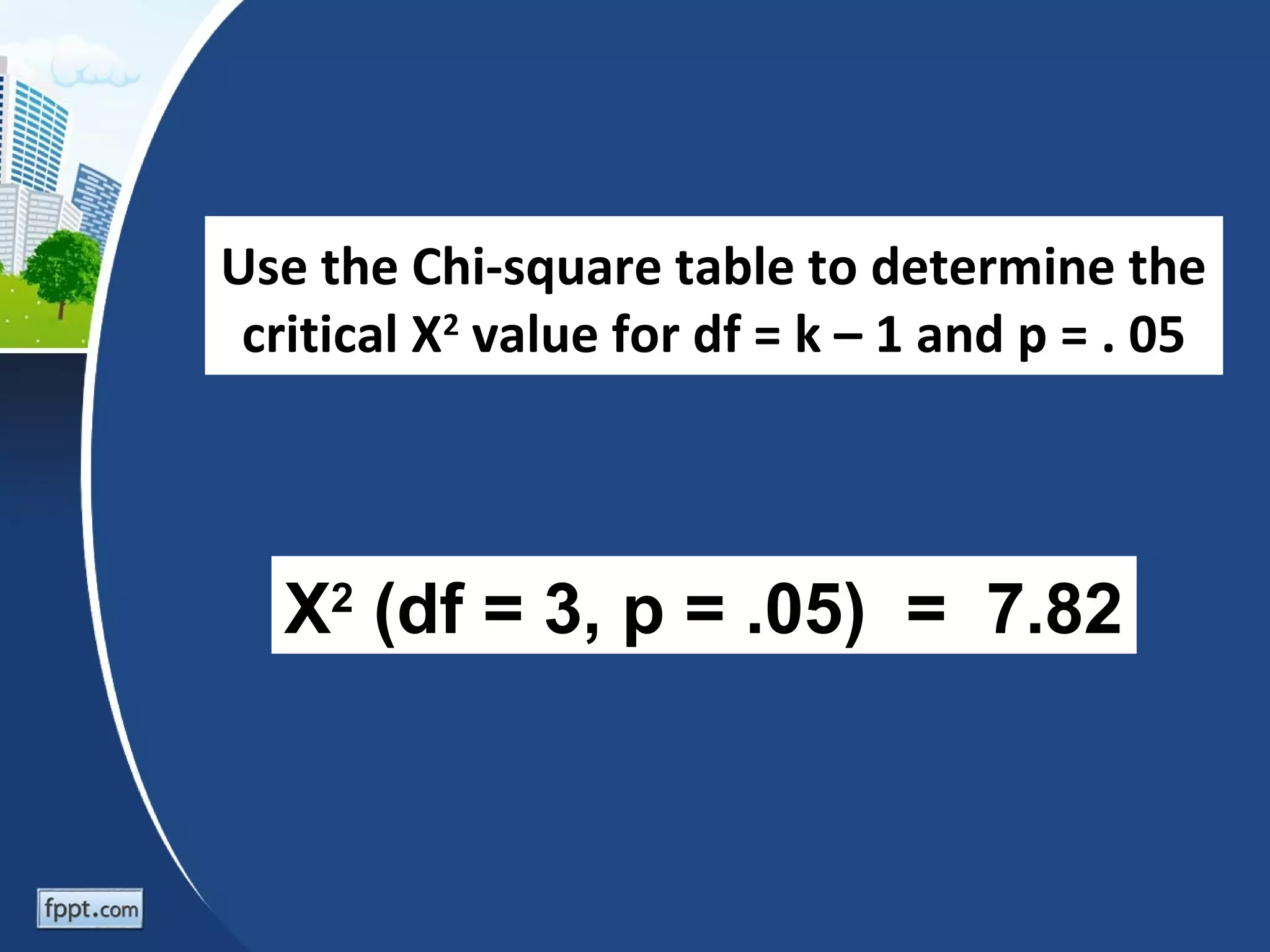
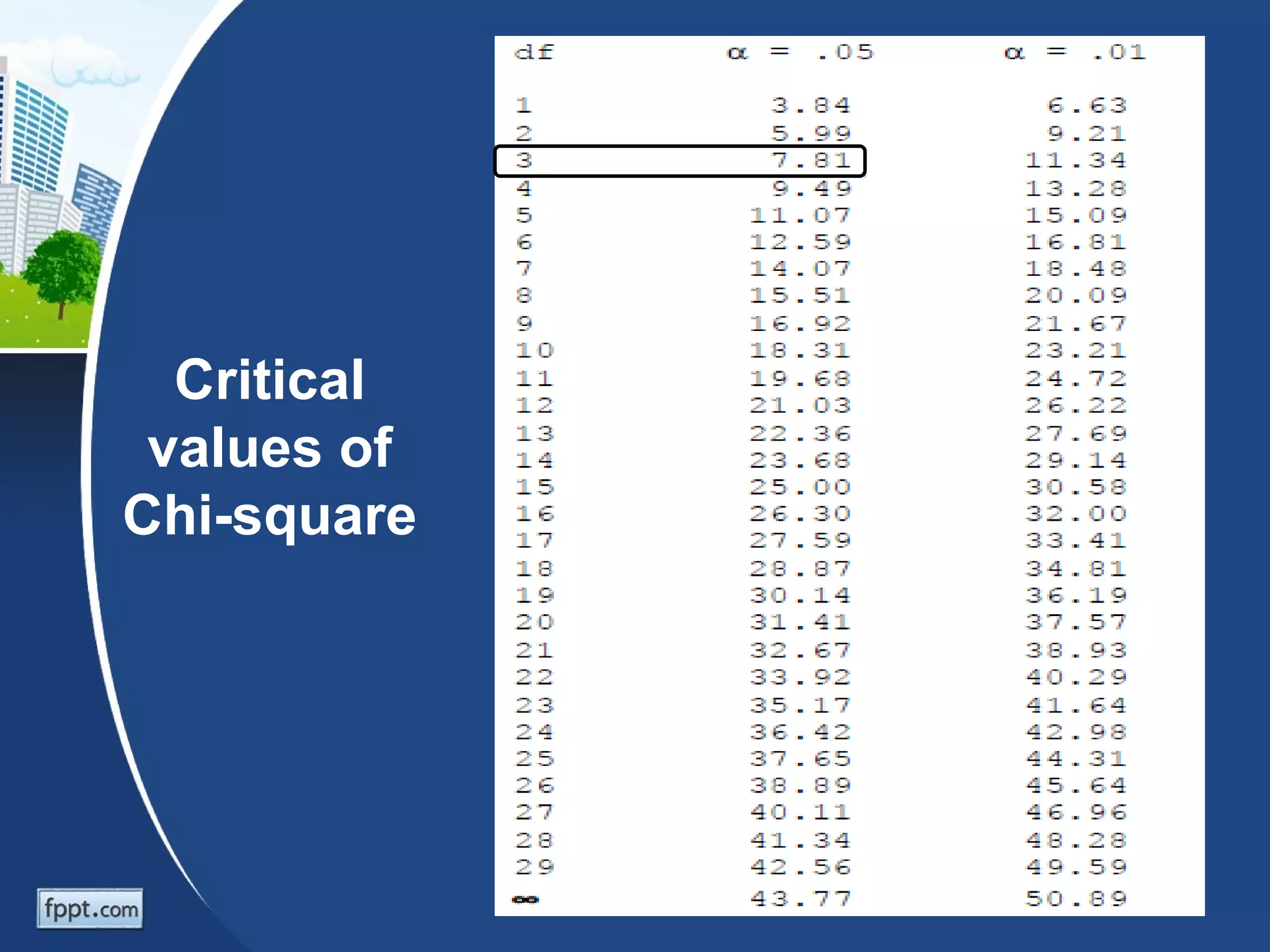
Use the Chi-square table to determine the
 critical X2 value for df = k – 1 and p = . 05


  X2 (df = 3, p = .05) = 7.82
Critical
 values of
Chi-square
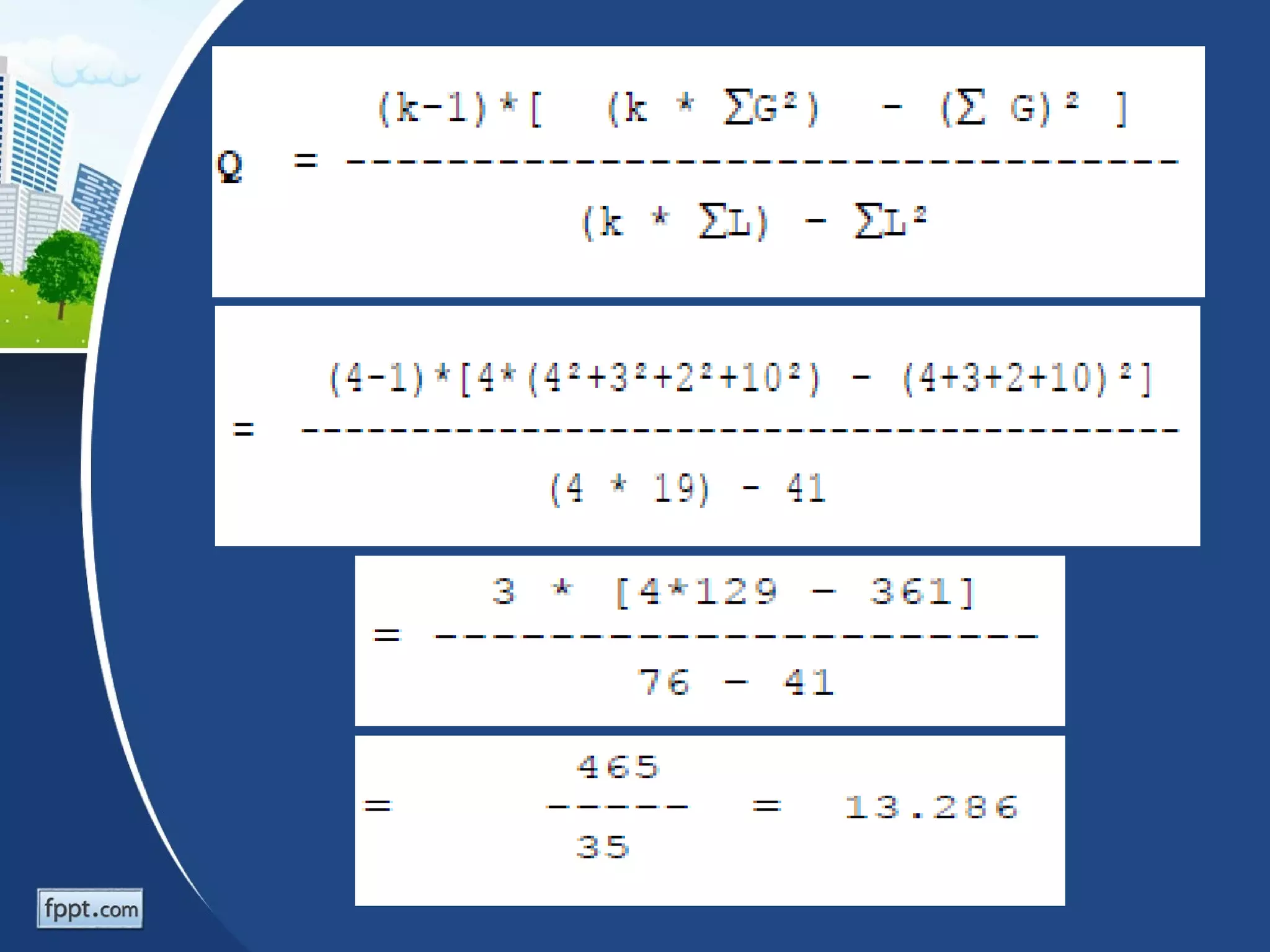
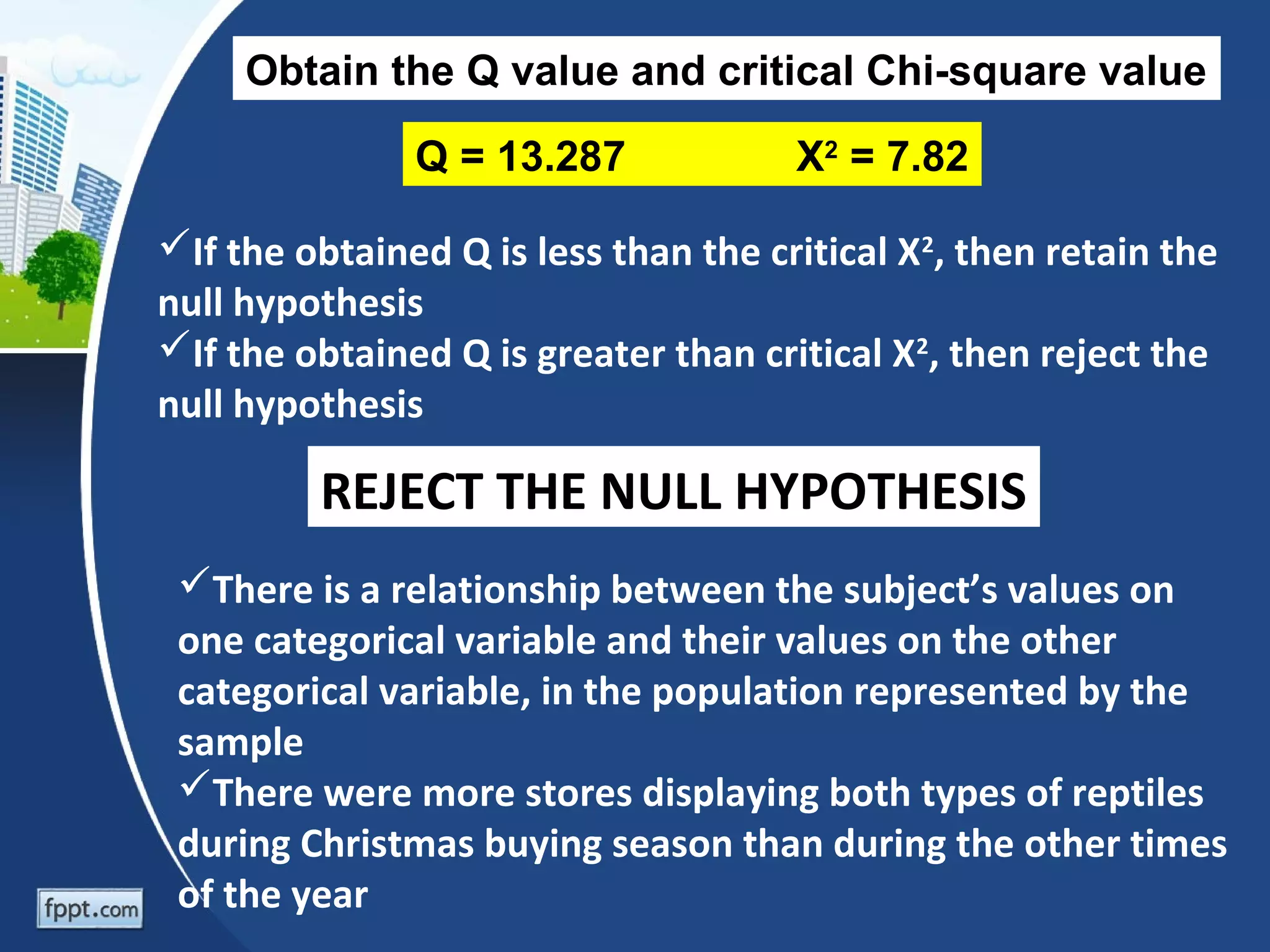
Obtain the Q value and critical Chi-square value

               Q = 13.287             X2 = 7.82

If the obtained Q is less than the critical X2, then retain the
null hypothesis
If the obtained Q is greater than critical X2, then reject the
null hypothesis

         REJECT THE NULL HYPOTHESIS
 There is a relationship between the subject’s values on
 one categorical variable and their values on the other
 categorical variable, in the population represented by the
 sample
 There were more stores displaying both types of reptiles
 during Christmas buying season than during the other times
 of the year
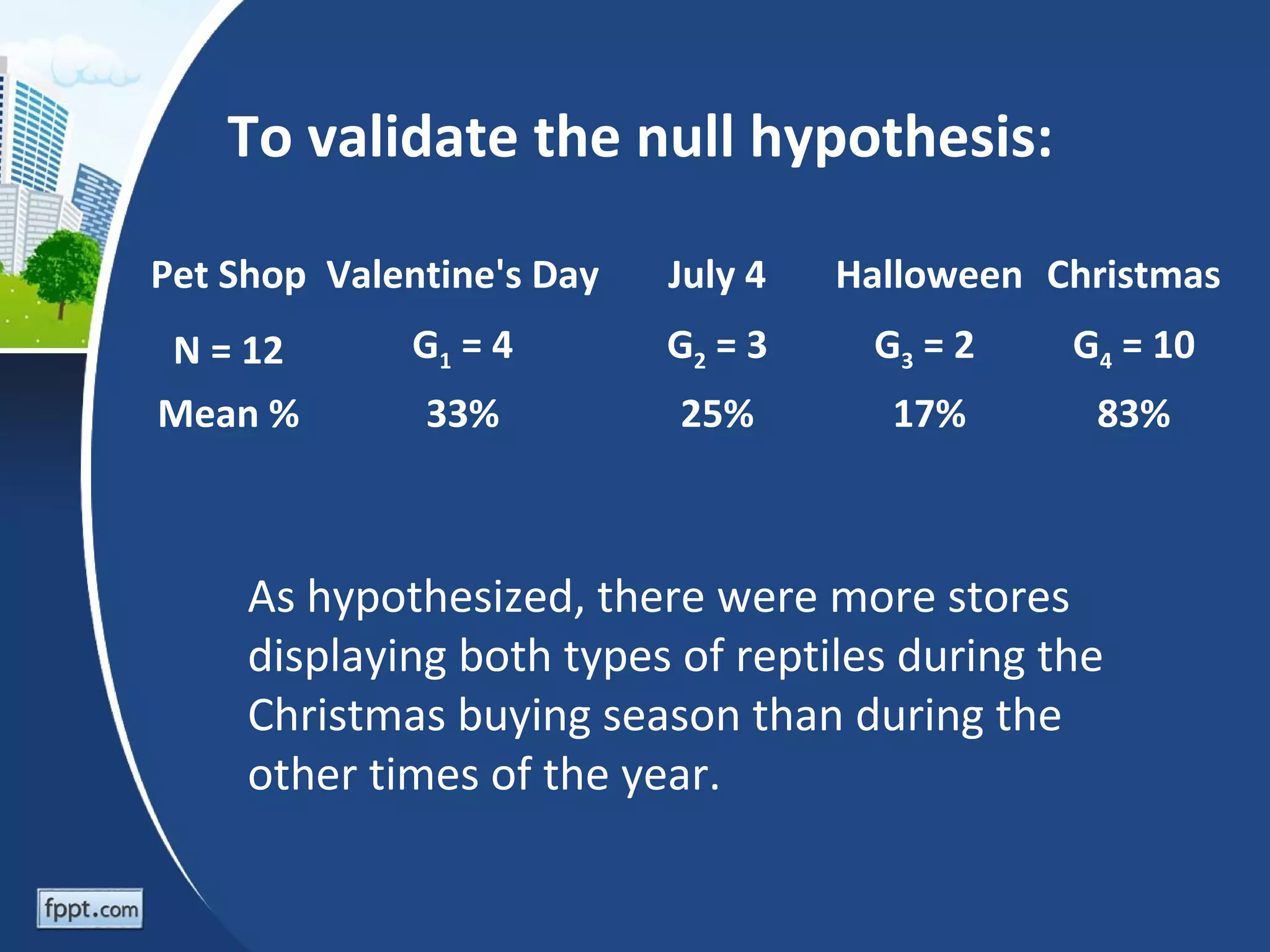
To validate the null hypothesis:

Pet Shop Valentine's Day   July 4   Halloween Christmas
N = 12        G1 = 4       G2 = 3    G3 = 2    G4 = 10
Mean %        33%          25%        17%       83%


     As hypothesized, there were more stores
     displaying both types of reptiles during the
     Christmas buying season than during the
     other times of the year.
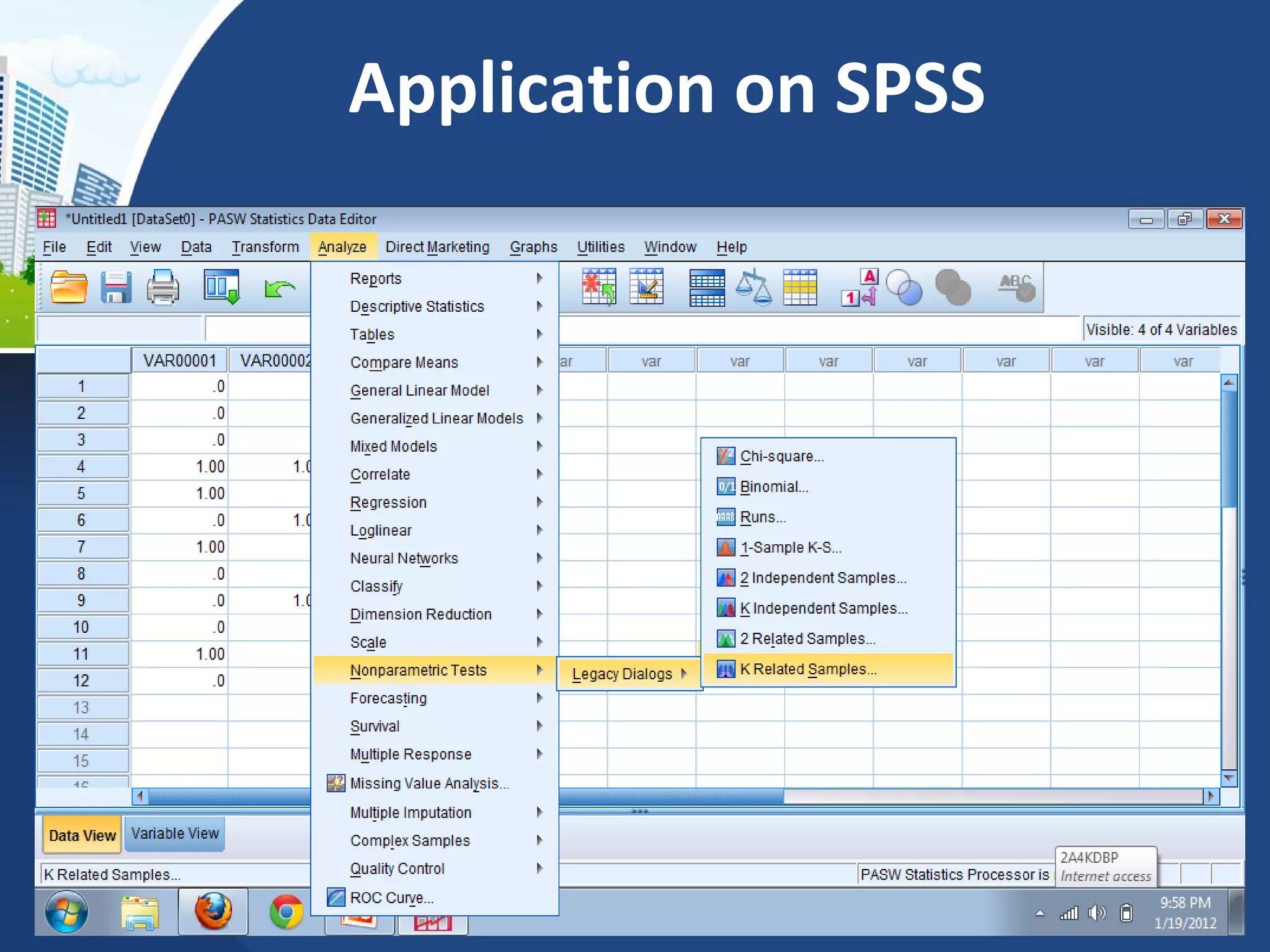
Application on SPSS
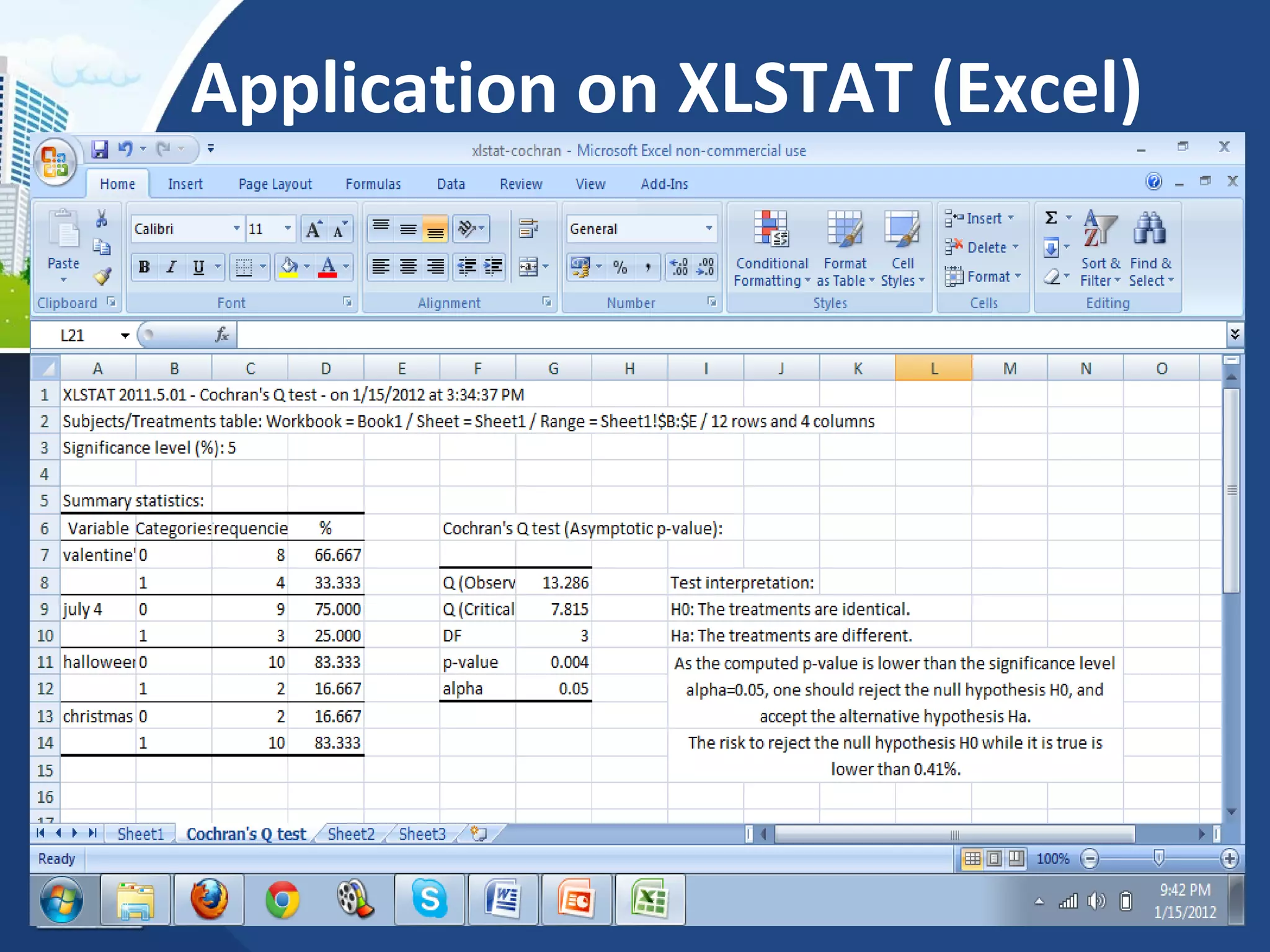
Application on XLSTAT (Excel)
End of Report


Thank you!

Cochran's q test report

  • 1.
    ADVANCED STATISTICS Cochran’s Q Test Kristine Joey Palencia MP-Industrial Psychology
  • 2.
    Definition • A nonparametricprocedure for categorical data employed in a hypothesis testing situation involving a design with k=2 or more dependent samples • Cochran's Q test is an extension to the McNemar test for related samples that provides a method for testing for differences between three or more matched sets of frequencies or proportions. The matching samples can be based on k characteristics of N individuals that are associated with the response. Alternatively N individuals may be observed under k different treatments or conditions. • Cochran's Q tests whether the probability of a target response is equal across all conditions; verify if k treatments have identical effects
  • 3.
    Cochran's Q testis H0: The treatments are equally effective. Ha: There is a difference in effectiveness among treatments. Subject Treatment Treatment Treatment Treatment (case) A B C D 1 1 1 0 0 2 1 1 0 1 3 1 0 0 0 4 1 1 1 0 5 1 1 0 1 6 1 1 0 1
  • 4.
    Cochran's Q testis based on the following assumptions: •A large sample approximation; in particular, it assumes that b is "large". •The blocks (rows) were randomly selected from the population of all possible blocks. •The outcomes of the treatments can be coded as binary responses (i.e., a "0" or "1") in a way that is common to all treatments within each block.
  • 5.
    Example The researcher who had collected the Pet Shop data wanted to examine whether pet stores displayed different types of reptiles during different times of the year. So, the researcher visited each of the 12 stores four times during the next year that were chosen because of their proximity to holidays, Valentine’s Day, July 4, Halloween and Christmas. During each visit, the researcher recorded if the shop displayed only snakes or lizards (coded = 0) or both types of reptiles (coded = 1). In this analysis the one variable is the time of the year and the response variable is the type of reptile(s) displayed.
  • 6.
    Data from the12 stores: 0, 0, 0, 1 0, 0, 0, 1 0, 0, 0, 1 1, 1, 1, 1 1, 0, 0, 1 0, 1, 0, 1 1, 0, 0, 1 0, 0, 0, 1 0, 1, 0, 0 0, 0, 0, 0 1, 0, 0, 1 0, 0, 1, 1 Research Hypothesis: The researcher hypothesized that pet shops would be more likely to display both reptiles to Christmas than during the other times of the year HO = Stores are equally likely to display both types of reptiles during all parts of the year
  • 7.
    Pet Shop Valentine’s July 4 Halloween Christmas Day 1 0 0 0 1 2 0 0 0 1 3 0 0 0 1 4 1 1 1 1 5 1 0 0 1 6 0 1 0 1 7 1 0 0 1 8 0 0 0 1 9 0 1 0 0 10 0 0 0 0 11 1 0 0 1 12 0 0 1 1 N = 12 G1 = 4 G2 = 3 G3 = 2 G4 = 10 Snakes or lizards = 0 ; snakes and lizards = 1
  • 8.
    Pet Valentine’s July 4 Halloween Christmas L L2 Shop Day 1 0 0 0 1 1 1 2 0 0 0 1 1 1 3 0 0 0 1 1 1 4 1 1 1 1 4 16 5 1 0 0 1 2 4 6 0 1 0 1 2 4 7 1 0 0 1 2 4 8 0 0 0 1 1 1 9 0 1 0 0 1 1 10 0 0 0 0 0 0 11 1 0 0 1 2 4 12 0 0 1 1 2 4 N = 12 G1 = 4 G2 = 3 G3 = 2 G4 = 10 L= 19 L2 = 41 Number of conditions (k) = 4
  • 9.
    k = numberof cases/treatment G or Tj = sum for each column L or Ui = sum for each row or block
  • 11.
    Use the Chi-squaretable to determine the critical X2 value for df = k – 1 and p = . 05 X2 (df = 3, p = .05) = 7.82
  • 12.
  • 13.
    Obtain the Qvalue and critical Chi-square value Q = 13.287 X2 = 7.82 If the obtained Q is less than the critical X2, then retain the null hypothesis If the obtained Q is greater than critical X2, then reject the null hypothesis REJECT THE NULL HYPOTHESIS There is a relationship between the subject’s values on one categorical variable and their values on the other categorical variable, in the population represented by the sample There were more stores displaying both types of reptiles during Christmas buying season than during the other times of the year
  • 14.
    To validate thenull hypothesis: Pet Shop Valentine's Day July 4 Halloween Christmas N = 12 G1 = 4 G2 = 3 G3 = 2 G4 = 10 Mean % 33% 25% 17% 83% As hypothesized, there were more stores displaying both types of reptiles during the Christmas buying season than during the other times of the year.
  • 15.
  • 16.
  • 17.