#TeamNoFrazzle
 NAZMUL AHSAN
151-15-4668

 SANZIDUL ISLAM
151-15-5223

 MAHBUBUR RAHMAN
151-15-4761

 FARHAN TAWSIF CHOWDHURY
151-15-4705

 SADIA SULTANA SHARMIN MOUSUMI 151-15-
5191
 Definition
 History
 Construction
 Working Process
 Categories
 Types
 Connectors
 USES
 Advantages
 Disadvantages



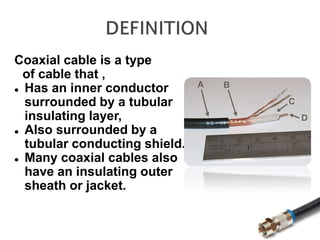
Coaxial cable is a type
of cable that ,
 Has an inner conductor
surrounded by a tubular
insulating layer,
 Also surrounded by a
tubular conducting shield.
 Many coaxial cables also
have an insulating outer
sheath or jacket.
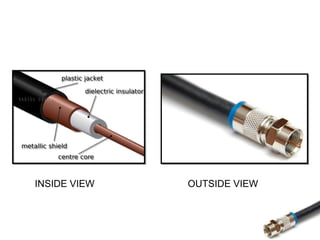
INSIDE VIEW OUTSIDE VIEW
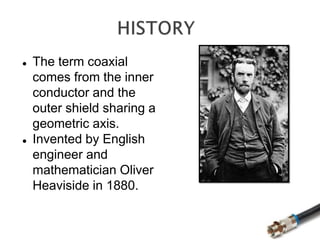
 The term coaxial
comes from the inner
conductor and the
outer shield sharing a
geometric axis.
 Invented by English
engineer and
mathematician Oliver
Heaviside in 1880.
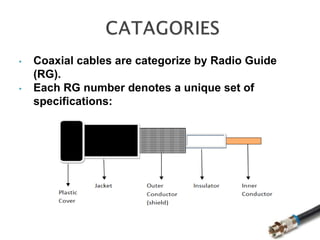
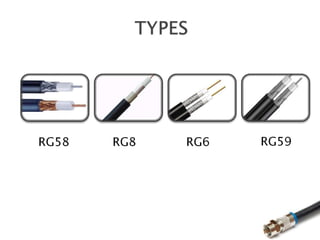
• Coaxial cables are categorize by Radio Guide
(RG).
• Each RG number denotes a unique set of
specifications:
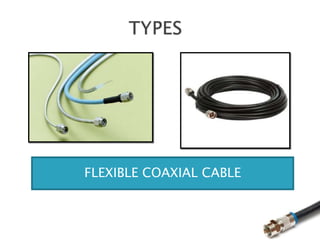
FLEXIBLE COAXIAL CABLE
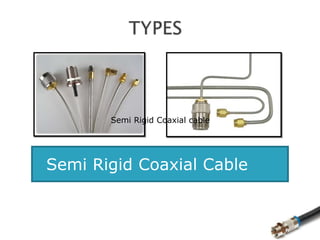
Semi Rigid Coaxial Cable
Semi Rigid Coaxial cable
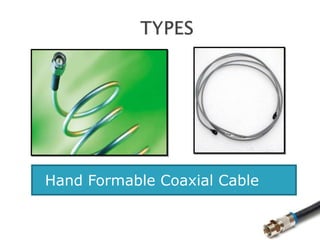
Hand Formable Coaxial Cable
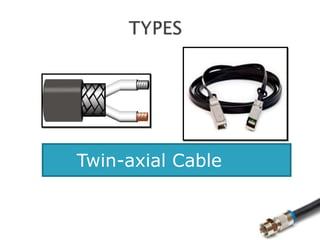
Twin-axial Cable
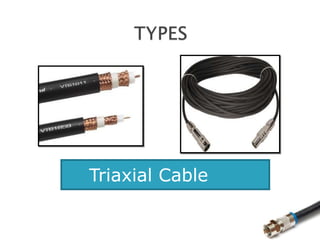
Triaxial Cable
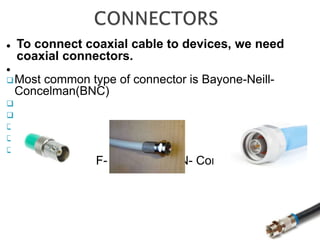
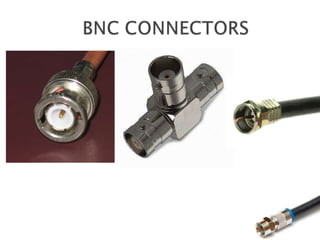
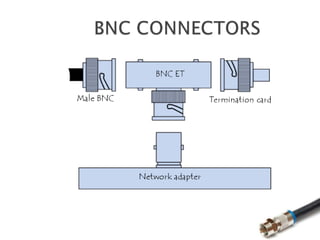
 To connect coaxial cable to devices, we need
coaxial connectors.

Most common type of connector is Bayone-Neill-
Concelman(BNC)





BNC F- Connector N- Connectors
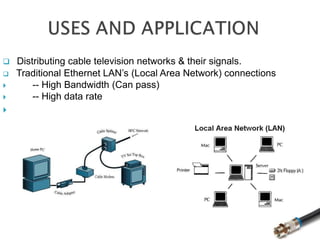
 Distributing cable television networks & their signals.
 Traditional Ethernet LAN’s (Local Area Network) connections
 -- High Bandwidth (Can pass)
 -- High data rate


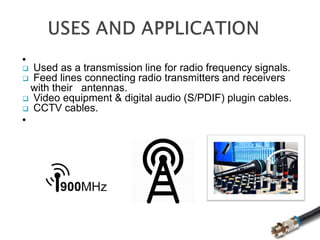
 Used as a transmission line for radio frequency signals.
 Feed lines connecting radio transmitters and receivers
with their antennas.
 Video equipment & digital audio (S/PDIF) plugin cables.
 CCTV cables.

 Cheap to make.
 Cheap to install.
 Easy to modify.
 Good bandwidth.
 Great channel capacity.
 Noise immunity.

 Unwanted noise and picture ghosting.
 More expensive.
 High attenuation.
 The thicker the cable , the more difficult to
work with.
 Effect of current flow.
Coaxial cable

Coaxial cable

  • 2.
  • 3.
     NAZMUL AHSAN 151-15-4668  SANZIDUL ISLAM 151-15-5223   MAHBUBUR RAHMAN 151-15-4761   FARHAN TAWSIF CHOWDHURY 151-15-4705   SADIA SULTANA SHARMIN MOUSUMI 151-15- 5191
  • 4.
     Definition  History Construction  Working Process  Categories  Types  Connectors  USES  Advantages  Disadvantages   
  • 5.
    Coaxial cable isa type of cable that ,  Has an inner conductor surrounded by a tubular insulating layer,  Also surrounded by a tubular conducting shield.  Many coaxial cables also have an insulating outer sheath or jacket.
  • 6.
  • 7.
     The termcoaxial comes from the inner conductor and the outer shield sharing a geometric axis.  Invented by English engineer and mathematician Oliver Heaviside in 1880.
  • 12.
    • Coaxial cablesare categorize by Radio Guide (RG). • Each RG number denotes a unique set of specifications:
  • 14.
  • 15.
    Semi Rigid CoaxialCable Semi Rigid Coaxial cable
  • 16.
  • 17.
  • 18.
  • 19.
     To connectcoaxial cable to devices, we need coaxial connectors.  Most common type of connector is Bayone-Neill- Concelman(BNC)      BNC F- Connector N- Connectors
  • 22.
     Distributing cabletelevision networks & their signals.  Traditional Ethernet LAN’s (Local Area Network) connections  -- High Bandwidth (Can pass)  -- High data rate 
  • 23.
      Used asa transmission line for radio frequency signals.  Feed lines connecting radio transmitters and receivers with their antennas.  Video equipment & digital audio (S/PDIF) plugin cables.  CCTV cables. 
  • 24.
     Cheap tomake.  Cheap to install.  Easy to modify.  Good bandwidth.  Great channel capacity.  Noise immunity. 
  • 25.
     Unwanted noiseand picture ghosting.  More expensive.  High attenuation.  The thicker the cable , the more difficult to work with.  Effect of current flow.