Twisted Pair CableCoaxial Cable Fiber OpticCable/Wired Media
Transmission media	The means through which data is transmitted from one place to another is called transmission or communication media. There are two categories of transmission media used in computer communications.
1. Bounded media/wired mediaBounded media are the physical links through which signals are confined to a narrow path. They are great for LABS because they offer high speed, good security and low cast. Three common types of bounded media are used of the data transmission. These are:Coaxial CableTwisted Pairs CableFiber optics cable
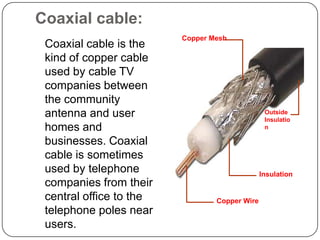
Coaxial cable:Copper Mesh	Coaxial cable is the kind of copper cable used by cable TV companies between the community antenna and user homes and businesses. Coaxial cable is sometimes used by telephone companies from their central office to the telephone poles near users.Outside InsulationInsulationCopper Wire
Coaxial Cable Advantages coaxial cableDisadvantage coaxial cableEasy to wireEasy to expandInexpensive Single cable failure can take down an entire network
Twisted Pair Cable	Twisted Pair Cable	The most popular network cabling is Twisted pair. It is light weight, easy to install, inexpensive and support many different types of network. There are two types of twisted pairs cabling: They are:1. Unshielded twisted pair (UTP)2. Shielded twisted pair (STP)
Unshielded twisted pair (UTP)	UTP is more common. UTP cables consist of 2 or 4 pairs of twisted cable. Twisted Pair Outer Jacket Colour coded plastic installation
UTPAdvantages of UTPDisadvantages of UTPEasy installationCapable of high speed for LAN Low costIt may be prone to radio and electrical frequency interference (it should not be too close to electric motors, fluorescent lights, etc.).
Shielded twisted pair (STP) 	It is similar to UTP but has a mesh shielding that’s protects it from EMI which allows for higher transmission rateTwisted Pair Outer JacketOverall ShieldPair shield
STPIf you must place cable in environments with lots of potential interference, or if you must place cable in extremely sensitive environments that may be susceptible to the electrical current in the UTP, shielded twisted pair may be the solution. Shielded cables can also help to extend the maximum distance of the cables.
Shielded Twisted Pair Advantages of STP:Disadvantages of STP:ShieldedFaster than UTP and coaxialMore expensive than UTP and coaxialMore difficult installation
Fiber Optic 	Fiber optic cabling consists of a center glass core surrounded by several layers of protective materials (See fig. 5). It transmits light rather than electronic signals eliminating the problem of electrical interference. This makes it ideal for certain environments that contain a large amount of electrical interference.
Fiber Optic Advantages Of Fiber OpticDisadvantages Fiber OpticsFast transmission of dataLow attenuationNo electromagnetic interferenceVery costlyHard to install
THE END NadineFarquharsonOona HindsDellis EvansDewayne Sherman

Networking

  • 1.
    Twisted Pair CableCoaxialCable Fiber OpticCable/Wired Media
  • 2.
    Transmission media The meansthrough which data is transmitted from one place to another is called transmission or communication media. There are two categories of transmission media used in computer communications.
  • 3.
    1. Bounded media/wiredmediaBounded media are the physical links through which signals are confined to a narrow path. They are great for LABS because they offer high speed, good security and low cast. Three common types of bounded media are used of the data transmission. These are:Coaxial CableTwisted Pairs CableFiber optics cable
  • 4.
    Coaxial cable:Copper Mesh Coaxialcable is the kind of copper cable used by cable TV companies between the community antenna and user homes and businesses. Coaxial cable is sometimes used by telephone companies from their central office to the telephone poles near users.Outside InsulationInsulationCopper Wire
  • 5.
    Coaxial Cable Advantagescoaxial cableDisadvantage coaxial cableEasy to wireEasy to expandInexpensive Single cable failure can take down an entire network
  • 6.
    Twisted Pair Cable TwistedPair Cable The most popular network cabling is Twisted pair. It is light weight, easy to install, inexpensive and support many different types of network. There are two types of twisted pairs cabling: They are:1. Unshielded twisted pair (UTP)2. Shielded twisted pair (STP)
  • 7.
    Unshielded twisted pair(UTP) UTP is more common. UTP cables consist of 2 or 4 pairs of twisted cable. Twisted Pair Outer Jacket Colour coded plastic installation
  • 8.
    UTPAdvantages of UTPDisadvantagesof UTPEasy installationCapable of high speed for LAN Low costIt may be prone to radio and electrical frequency interference (it should not be too close to electric motors, fluorescent lights, etc.).
  • 9.
    Shielded twisted pair(STP) It is similar to UTP but has a mesh shielding that’s protects it from EMI which allows for higher transmission rateTwisted Pair Outer JacketOverall ShieldPair shield
  • 10.
    STPIf you mustplace cable in environments with lots of potential interference, or if you must place cable in extremely sensitive environments that may be susceptible to the electrical current in the UTP, shielded twisted pair may be the solution. Shielded cables can also help to extend the maximum distance of the cables.
  • 11.
    Shielded Twisted PairAdvantages of STP:Disadvantages of STP:ShieldedFaster than UTP and coaxialMore expensive than UTP and coaxialMore difficult installation
  • 12.
    Fiber Optic Fiberoptic cabling consists of a center glass core surrounded by several layers of protective materials (See fig. 5). It transmits light rather than electronic signals eliminating the problem of electrical interference. This makes it ideal for certain environments that contain a large amount of electrical interference.
  • 13.
    Fiber Optic AdvantagesOf Fiber OpticDisadvantages Fiber OpticsFast transmission of dataLow attenuationNo electromagnetic interferenceVery costlyHard to install
  • 14.
    THE END NadineFarquharsonOonaHindsDellis EvansDewayne Sherman