1
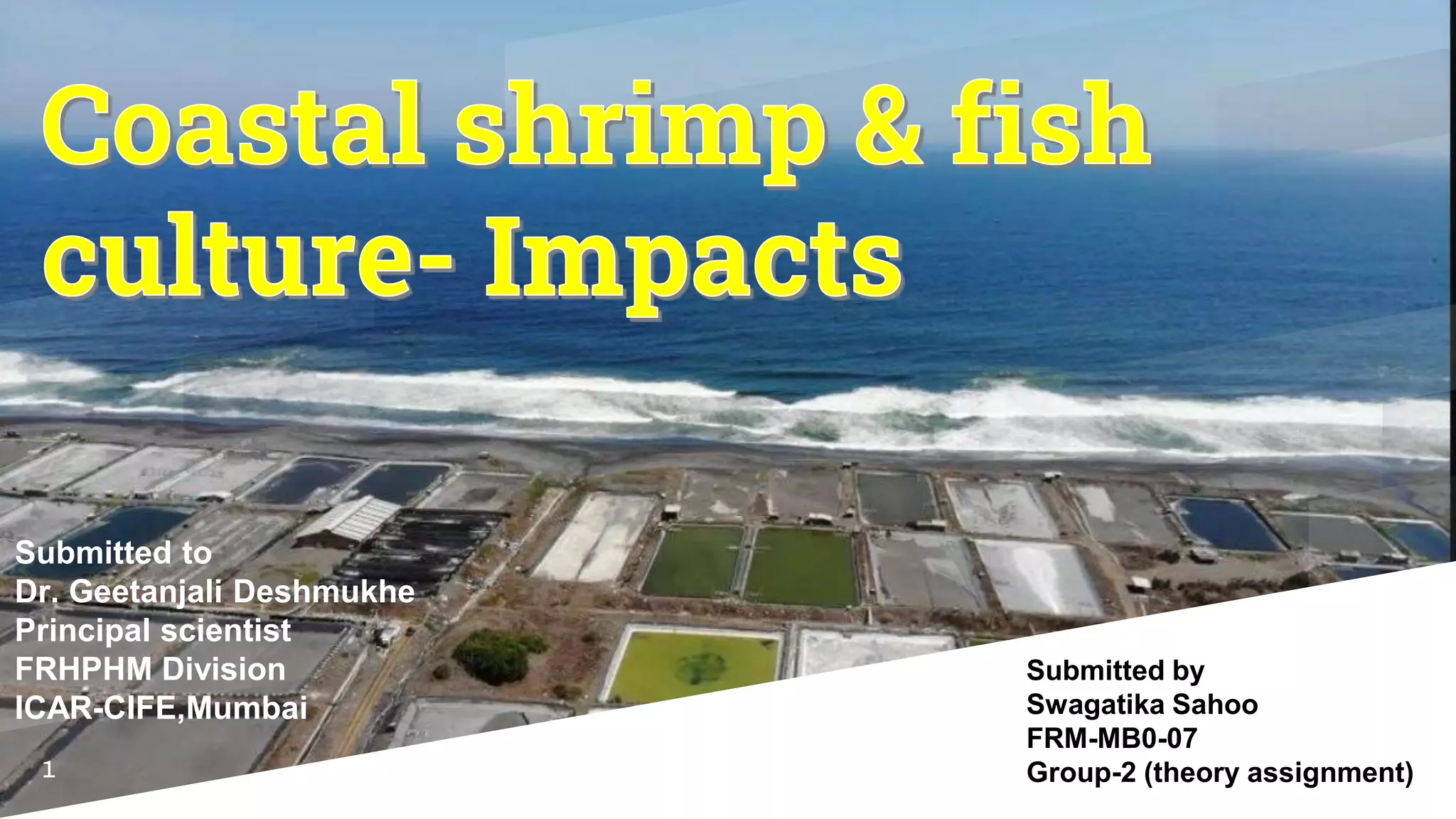
Submitted by
Swagatika Sahoo
FRM-MB0-07
Group-2 (theory assignment)
Submitted to
Dr. Geetanjali Deshmukhe
Principal scientist
FRHPHM Division
ICAR-CIFE,Mumbai
Environmental impact of fish & shrimp
farming
2
▰ The impact of shrimp culture on the environment
depends on the type of culture adopted.
▰ The traditional extensive and modified extensive
practices followed till the early 1990's have had no
adverse effect on the environment. But over the years
the yield intensifying practices like intensive and
super intensive cultures, stocking enormous number
of seed and dumping in huge amount of aqua feeds
into the water came into practice.
▰ Though this yielded heavily initially, heavy organic load
and environmental stress exposed the animal to
conditions leading to heavy out burst of diseases as
well as degraded the local coastal ecosystem.
▰ The coastal zone bears most of the ecological
consequences of aquaculture development.
Ecological links between intensive fish/shrimp aquaculture and capture fisheries.
Thick lines = main flows from aquatic production base through fisheries/aquaculture to human
consumption; thin lines = other production inputs, and hatched lines = negative feedbacks;
numbers refer to mmt of fish, shellfish and seaweeds in 1997
1. Destruction of mangroves
▰ Removal of mangroves for pond culture has ecological, economic, and social consequences.
3
• Coastal erosion
• Changes in the pattern of
sedimentation and
shoreline configuration
• storm erosion
• salinity intrusion
• loss of breeding and nursery grounds of fishes
and crustaceans
• decline of availability of larvae and post larvae,
decline in traditional fish catches
• reduction of fishery recruitment to sea
• loss of filtration capacity of soil
• changes in physico-chemical properties of water,
• reduction of biodiversity and disturbances in the
ecological balance.
Major effects
Vulnerability
4
Mangrove reclaimed ponds have
acid sulphate soils
Oxidation of pyrite(FeS2) produce
H2SO4,thereby acidifying pond
water as well as adjacent water
bodies
Long-term application of lime to
neutralize acid sulphate soils,
coupled with fertilization
practices, however, may harden
pond-bottom soils, rendering
them less suitable for shrimp
pond culture.
Serious problems of
sedimentation and siltation can
be expected when mangrove soil
in ponds is replaced with soil from
upland areas, and dumped into
nearby mangrove forests
Acidification
Unsuitability for
farming due to high
alkalinity
sedimentation
and siltation
2. Wild fry catch, imported fry and decline
in biodiversity
5
o Shrimp cultivation farms stock wild-caught juveniles instead of hatchery-reared post larvae that
result in loss of biodiversity.
o Trawl fishermen collect mother shrimps as brood stock from the deep ocean that performs a
principal function in the loss of fisheries .
o When the shrimp industry uses marine fish as trash fish to create fish meal, and eventually to
produce pellet feed, it diminishes the wild fishery resources.
o Catches of wild shrimp in both open sea and coastal ecosystems have declined because of
overexploitation and contamination in the coastal region.
3. Nutrient enrichment:
▰ Eutrophication of coastal waters due to nutrient rich effluent discharge often results in reduction of
oxygen, nuisance algal blooms, which reduces species diversity especially in ecologically sensitive
areas like the coral reefs.
▰ Nutrient loading also causes over accumulation of detritus at pond bottom and poor quality of
water leading to profusion of ciliates and other protozoan which cause respiratory and gill diseases in
shrimps.
▰ Phosphate enrichment of coastal reef waters may directly inhibit hard coral growth through
phosphate inhibition of calcium carbonate deposition, which is an essential process of healthy coral
reef growth.
▰ Sea grass and mangroves are less susceptible to such eutrophicated waters as they have a capacity
to absorb high levels of nutrients. Nevertheless, high organic loading in these systems may cause
anoxia and increase in turbidity levels where resilience and diversity of these systems is adversely
affected.
▰ The discharge from fishfarms contain dissolved inorganic nitrogen (ammonium, nitrate and nitrite),
and, in the case of brackishwater environments, phosphorus, may affect the standing stock, species
composition, or productivity of phytoplankton and macroalgae.
6
4. Pollution
 The untreated effluents discharged from shrimp farms directly or indirectly have polluted
coastal waters, estuaries, creeks and backwaters. Residual chemicals (organo phosphates),
drugs, antibiotics, decomposed and unused artificial feeds contributed to toxic nature of the
effluents.
 Construction of channels for water supply and drainage and pumping of brackishwaters to inland
results in hydrological changes, siltation and saltwater intrusion.
 Some construction materials release substances into the aquatic environment (e.g. heavy
metals, plastic additives).
 Plastics contain a wide variety of additives including stabilizers (fatty acid salts), pigments
(chromates, cadmium sulphate), antioxidants (e.g. hindered phenols), UV absorbers
(benzophenones), flame retardants (organophosphates), fungicides and disinfectants.
 Many of these compounds are toxic to aquatic life, although some protection is provided by
their low water-solubility, slow rate of leaching and dilution.
7
▰ While development of shrimp culture increased
the efficiency of utilization of coastal land But the
mass scale conversion of coastal lands
(unutilized agricultural lands, derelict salt pans,
deltaic regions, lake areas, mud flats ,traditional
shrimp farms etc) to shrimp farms lead to
salinization of soil and ground water leading
to the desertification of adjacent productive
lands.
▰ Pumping of ground water and to supply
freshwater to marine shrimp farms has resulted
in water shortage for coastal communities.
▰ Construction of pond lead to accelerated soil
erosion.
8
5. Impact on coastal land use
The area under shrimp culture and state-wise shrimp production in 2015 (MPEDA,
2016)
9
6. Indirect effects on biota
▰ 1 .Shading and night illumination
▰ 2. Introduction of exotic species
10
• Floating structures like pontoons, cages or aeration equipments can shade significant areas of
bottom, which may seriously affect the ecology of areas like coral reefs or sea grass beds because
Most of the corals and associated fishes have photosensitive feeding behaviour.
• In contrast to shading, shoreline night lighting or illuminated floating structures may influence the
movement of light sensitive species including fish, squid and hatchlings of turtles, resulting in an
inland movement rather than their natural movement towards sea.
• Introduction of exotic species for aquaculture may seriously affect the native fauna. The nuisance
created by the introduction of Clarius garipenaeus (African catfish) and tilapia is also causing concern
in the Indian waters.
• In addition to altering or improving the natural biodiversity of the ecosystem, through competition and
inbreeding, it may cause the transfer of a new disease causing agents to native waters.
▰ 3. Indiscriminate use of antibiotic drugs
11
• The recent out burst of many bacterial and viral diseases led to the indiscriminate
use of many broad-spectrum antibiotics. These are only therapeutic agents and are
not prophylactic in nature.
• The environmental changes associated with the use of chemotherapeutics in
aquaculture are as follows:
1. Quantitative and qualitative changes in the soil and water microflora.
2. Toxic effects on wild organisms living in a particular area.
3. Development of antibiotic resistance in fish pathogens (Antibiotic resistant strains)
4. Transfer of antibiotic resistance to human pathogens.
12
Shrimp
farming
Loss of
vegetation
Increase in
soil erosion
Increase in
sedimentation
Decrease in
soil fertility
Decrease in
crop yield
Decrease in
livestock
Destruction of local
ecosystem
Negative shrimp farming impacts on
ecosystem
13
• There is concern that large-scale mangrove conversion for shrimp and fish farming has affected rural
communities which traditionally depended on mangrove resources for their livelihood.
• According to Bailey (1988), "the expansion of shrimp mariculture into mangrove habitat generally
involves the transformation of a multi-use/multi-user coastal resource into a privately owned
single-purpose resource.”
• Moreover, the costs of coastal ecosystem disruption for society may include coastal erosion, saltwater
intrusion into groundwater and agricultural fields, and a reduction in supply of a wide range of valuable
goods and services produced from the resources available in mangrove forests or other coastal
wetlands.“
• large-scale aquaculture enterprises frequently displace small-scale fishermen and aquaculturists.
Unfortunately, competition for land and water resources also results in use conflicts.
Social impacts
14
• Consumption of raw and partially cooked shellfish grown in coastal waters
receiving high organic and microbial loadings from urban sewage effluents can result
in severe consequences for human health, including gastro-intestinal disorders,
gastro-enteritis, infectious hepatitis, cholera and typhoid fever.
• Heavy metal pollution originating mainly from industrial discharges carries the risk
of seafood contamination and human poisoning as experienced at Minamata Bay,
Japan, with industrial effluents containing methyl-mercury.
• Various forms of shellfish poisoning in humans such as PSP (paralytic shellfish
poisoning), NSP (neurotoxic shellfish poisoning), DSP (diarrhoeic shellfish
poisoning), ASP (amnesic shellfish poisoning) are occurring worldwide due to
consumption of shellfish which accumulated phycotoxins stemming from toxic algal
blooms. Effects of poisoning include gastro-intestinal disorders, respiratory paralysis,
memory loss and death (WHO, 1984)
Negative feedback effects
15
o Negative feedback is a type of regulation in biological systems in which the end product of a process
in turn reduces the stimulus of that same process.
o Aquaculture itself which is affected by ecological changes deriving from farming practices. For
example, water currents may be reduced significantly due to farm structures (cages, pens, rafts, etc.),
which may lead to increased deposition and accumulation of organic wastes underneath or around the
farming unit, increase in siltation and water quality deterioration (e.g., increase in turbidity due to high
content of suspended matter).
o In addition, oxygen supply may be reduced, and outgassing of hydrogen sulphide and methane from
bottom sediments may occur which will further affect growth performance and increase susceptibility to
disease.
o Chemicals used may also present a potential risk to cultured organisms and may result in
contamination of aquaculture products which reduces product quality and consumer acceptance.
16
o The development of drug-resistant pathogens, resident (and possibly dormant) both within and
around the farming unit, may have serious negative feedback effects on farm productivity. The over-
use of chemicals in hatcheries may result in reduced fitness, poor growth and decreased survival
rates during the grow-out phase. Pond soils may be rendered less suitable by excessive chemical
treatment.
o Abuse of formalin and malachite green is known to be harmful to algae and zooplankton, including
penaeid nauplii.
o Predators such as fish and birds are attracted to the cultured as well as natural population of fish in
the area and the ready supply of fish feed. There is the possibility not only that these predators
damage and consume valuable fish, but also enhance disease in the area by serving as
intermediate hosts in the life cycle of parasites.
o Predators as well as grazers on the epiphyton of farm structures can also damage netting or other
enclosure material, resulting in escapes.
17
o The magnitude of negative ecological feedback effects of coastal aquaculture practices
may increase with expansion and/or intensification. An increase in the acreage and
number of farming units (ponds, racks, rafts, cages, etc.) and farms may be followed by
deterioration of required environmental quality within and beyond the aquaculture area.
o As a result of expansion of farming systems relying on naturally available food and nutrients,
the natural productivity of waterbodies in coastal areas may be exhausted. Large-scale
coverage and degradation of tidal habitats, including mangrove areas, may also affect wild
seed supply. Clearly, aggregations of farms will exhibit cumulative effects of waste release
and increased oxygen demand.
o Even though stocking of hatchery-reared postlarvae is increasing, wild-caught postlarvae
are often preferred, which may lead to overfishing of postlarvae, and, to the discarding of
larvae and fry of other species.
The way forward…
1. Integrated coastal zone
management
a) Farm siting
b) Farm and effluent management
c) Mangrove friendly aquaculture
d) Disease control
e) Low trophic level species
f) Role of govt. market mechanisms and
self regulation
18
For aquaculture to fulfill the promises of food security and poverty alleviation without causing negative
environmental and socioeconomic effects, a more holistic approach is required. This must involve other
stakeholders to avoid a sectoral focus on aquafarms. The key issues to consider and address are
outlined below
2. Sustainable
aquaculture
Integrated coastal zone management
▰ The groups vulnerable to the negative effects of shrimp culture generally do not participate in the
formulation and implementation of public policies, e.g., determining location of ponds, pens and
cages, regulating farm activities, and environmental impact assessment preparation. Community
participation in coastal zone management is essential if questions of social equity are to be
satisfactorily addressed.
▰ In community based coastal resource management, fisherfolk and other local residents are the
day-to-day managers of resources. Coastal zones should be delineated for fisheries, aquaculture,
tourism and other uses through the process of integrated coastal zone management (ICZM).
▰ Allocation of activities to locations should be based on the carrying or assimilative capacity of the
environment for a given use, protection of community resources, rehabilitation of degraded
habitats, stakeholder needs and mechanisms for conflict resolution.
▰ ICZM is based on the concept of the ecological footprint which incorporates not only inputs such as
feed and seed, but also outputs, e.g., effluent treatment
19
References....
20
▰ UNDP/FAO manual.
▰ Handbook of aquaculture.
▰ Joint Group of Experts on the Scientific Aspects of Marine Pollution (GESAMP)
▰ Coastal ecosystem processes by Alongi
▰ Ecology and management of coastal waters by Gilbert barnabe
▰ Impact of shrimp aquaculture development on important ecosystems in India M.
Jayanthi⁎ , S. Thirumurthy, M. Muralidhar, P. Ravichandran ICAR- Central Institute of
Brackishwater Aquaculture, (Ministry of Agriculture and farmer’s welfare), Raja
Annamalipuram, 75, Santhome High Road, Chennai, 600028, India
▰ Overcoming the impacts of aquaculture on the coastal zone J.H. Primavera Aquaculture
Department, Southeast Asian Fisheries Development Center, Tigbauan, Iloilo, Philippines
21

coastal aquaculture impacts.pptx

  • 1.
    1 Submitted by Swagatika Sahoo FRM-MB0-07 Group-2(theory assignment) Submitted to Dr. Geetanjali Deshmukhe Principal scientist FRHPHM Division ICAR-CIFE,Mumbai
  • 2.
    Environmental impact offish & shrimp farming 2 ▰ The impact of shrimp culture on the environment depends on the type of culture adopted. ▰ The traditional extensive and modified extensive practices followed till the early 1990's have had no adverse effect on the environment. But over the years the yield intensifying practices like intensive and super intensive cultures, stocking enormous number of seed and dumping in huge amount of aqua feeds into the water came into practice. ▰ Though this yielded heavily initially, heavy organic load and environmental stress exposed the animal to conditions leading to heavy out burst of diseases as well as degraded the local coastal ecosystem. ▰ The coastal zone bears most of the ecological consequences of aquaculture development. Ecological links between intensive fish/shrimp aquaculture and capture fisheries. Thick lines = main flows from aquatic production base through fisheries/aquaculture to human consumption; thin lines = other production inputs, and hatched lines = negative feedbacks; numbers refer to mmt of fish, shellfish and seaweeds in 1997
  • 3.
    1. Destruction ofmangroves ▰ Removal of mangroves for pond culture has ecological, economic, and social consequences. 3 • Coastal erosion • Changes in the pattern of sedimentation and shoreline configuration • storm erosion • salinity intrusion • loss of breeding and nursery grounds of fishes and crustaceans • decline of availability of larvae and post larvae, decline in traditional fish catches • reduction of fishery recruitment to sea • loss of filtration capacity of soil • changes in physico-chemical properties of water, • reduction of biodiversity and disturbances in the ecological balance. Major effects Vulnerability
  • 4.
    4 Mangrove reclaimed pondshave acid sulphate soils Oxidation of pyrite(FeS2) produce H2SO4,thereby acidifying pond water as well as adjacent water bodies Long-term application of lime to neutralize acid sulphate soils, coupled with fertilization practices, however, may harden pond-bottom soils, rendering them less suitable for shrimp pond culture. Serious problems of sedimentation and siltation can be expected when mangrove soil in ponds is replaced with soil from upland areas, and dumped into nearby mangrove forests Acidification Unsuitability for farming due to high alkalinity sedimentation and siltation
  • 5.
    2. Wild frycatch, imported fry and decline in biodiversity 5 o Shrimp cultivation farms stock wild-caught juveniles instead of hatchery-reared post larvae that result in loss of biodiversity. o Trawl fishermen collect mother shrimps as brood stock from the deep ocean that performs a principal function in the loss of fisheries . o When the shrimp industry uses marine fish as trash fish to create fish meal, and eventually to produce pellet feed, it diminishes the wild fishery resources. o Catches of wild shrimp in both open sea and coastal ecosystems have declined because of overexploitation and contamination in the coastal region.
  • 6.
    3. Nutrient enrichment: ▰Eutrophication of coastal waters due to nutrient rich effluent discharge often results in reduction of oxygen, nuisance algal blooms, which reduces species diversity especially in ecologically sensitive areas like the coral reefs. ▰ Nutrient loading also causes over accumulation of detritus at pond bottom and poor quality of water leading to profusion of ciliates and other protozoan which cause respiratory and gill diseases in shrimps. ▰ Phosphate enrichment of coastal reef waters may directly inhibit hard coral growth through phosphate inhibition of calcium carbonate deposition, which is an essential process of healthy coral reef growth. ▰ Sea grass and mangroves are less susceptible to such eutrophicated waters as they have a capacity to absorb high levels of nutrients. Nevertheless, high organic loading in these systems may cause anoxia and increase in turbidity levels where resilience and diversity of these systems is adversely affected. ▰ The discharge from fishfarms contain dissolved inorganic nitrogen (ammonium, nitrate and nitrite), and, in the case of brackishwater environments, phosphorus, may affect the standing stock, species composition, or productivity of phytoplankton and macroalgae. 6
  • 7.
    4. Pollution  Theuntreated effluents discharged from shrimp farms directly or indirectly have polluted coastal waters, estuaries, creeks and backwaters. Residual chemicals (organo phosphates), drugs, antibiotics, decomposed and unused artificial feeds contributed to toxic nature of the effluents.  Construction of channels for water supply and drainage and pumping of brackishwaters to inland results in hydrological changes, siltation and saltwater intrusion.  Some construction materials release substances into the aquatic environment (e.g. heavy metals, plastic additives).  Plastics contain a wide variety of additives including stabilizers (fatty acid salts), pigments (chromates, cadmium sulphate), antioxidants (e.g. hindered phenols), UV absorbers (benzophenones), flame retardants (organophosphates), fungicides and disinfectants.  Many of these compounds are toxic to aquatic life, although some protection is provided by their low water-solubility, slow rate of leaching and dilution. 7
  • 8.
    ▰ While developmentof shrimp culture increased the efficiency of utilization of coastal land But the mass scale conversion of coastal lands (unutilized agricultural lands, derelict salt pans, deltaic regions, lake areas, mud flats ,traditional shrimp farms etc) to shrimp farms lead to salinization of soil and ground water leading to the desertification of adjacent productive lands. ▰ Pumping of ground water and to supply freshwater to marine shrimp farms has resulted in water shortage for coastal communities. ▰ Construction of pond lead to accelerated soil erosion. 8 5. Impact on coastal land use The area under shrimp culture and state-wise shrimp production in 2015 (MPEDA, 2016)
  • 9.
  • 10.
    6. Indirect effectson biota ▰ 1 .Shading and night illumination ▰ 2. Introduction of exotic species 10 • Floating structures like pontoons, cages or aeration equipments can shade significant areas of bottom, which may seriously affect the ecology of areas like coral reefs or sea grass beds because Most of the corals and associated fishes have photosensitive feeding behaviour. • In contrast to shading, shoreline night lighting or illuminated floating structures may influence the movement of light sensitive species including fish, squid and hatchlings of turtles, resulting in an inland movement rather than their natural movement towards sea. • Introduction of exotic species for aquaculture may seriously affect the native fauna. The nuisance created by the introduction of Clarius garipenaeus (African catfish) and tilapia is also causing concern in the Indian waters. • In addition to altering or improving the natural biodiversity of the ecosystem, through competition and inbreeding, it may cause the transfer of a new disease causing agents to native waters.
  • 11.
    ▰ 3. Indiscriminateuse of antibiotic drugs 11 • The recent out burst of many bacterial and viral diseases led to the indiscriminate use of many broad-spectrum antibiotics. These are only therapeutic agents and are not prophylactic in nature. • The environmental changes associated with the use of chemotherapeutics in aquaculture are as follows: 1. Quantitative and qualitative changes in the soil and water microflora. 2. Toxic effects on wild organisms living in a particular area. 3. Development of antibiotic resistance in fish pathogens (Antibiotic resistant strains) 4. Transfer of antibiotic resistance to human pathogens.
  • 12.
    12 Shrimp farming Loss of vegetation Increase in soilerosion Increase in sedimentation Decrease in soil fertility Decrease in crop yield Decrease in livestock Destruction of local ecosystem Negative shrimp farming impacts on ecosystem
  • 13.
    13 • There isconcern that large-scale mangrove conversion for shrimp and fish farming has affected rural communities which traditionally depended on mangrove resources for their livelihood. • According to Bailey (1988), "the expansion of shrimp mariculture into mangrove habitat generally involves the transformation of a multi-use/multi-user coastal resource into a privately owned single-purpose resource.” • Moreover, the costs of coastal ecosystem disruption for society may include coastal erosion, saltwater intrusion into groundwater and agricultural fields, and a reduction in supply of a wide range of valuable goods and services produced from the resources available in mangrove forests or other coastal wetlands.“ • large-scale aquaculture enterprises frequently displace small-scale fishermen and aquaculturists. Unfortunately, competition for land and water resources also results in use conflicts. Social impacts
  • 14.
    14 • Consumption ofraw and partially cooked shellfish grown in coastal waters receiving high organic and microbial loadings from urban sewage effluents can result in severe consequences for human health, including gastro-intestinal disorders, gastro-enteritis, infectious hepatitis, cholera and typhoid fever. • Heavy metal pollution originating mainly from industrial discharges carries the risk of seafood contamination and human poisoning as experienced at Minamata Bay, Japan, with industrial effluents containing methyl-mercury. • Various forms of shellfish poisoning in humans such as PSP (paralytic shellfish poisoning), NSP (neurotoxic shellfish poisoning), DSP (diarrhoeic shellfish poisoning), ASP (amnesic shellfish poisoning) are occurring worldwide due to consumption of shellfish which accumulated phycotoxins stemming from toxic algal blooms. Effects of poisoning include gastro-intestinal disorders, respiratory paralysis, memory loss and death (WHO, 1984)
  • 15.
    Negative feedback effects 15 oNegative feedback is a type of regulation in biological systems in which the end product of a process in turn reduces the stimulus of that same process. o Aquaculture itself which is affected by ecological changes deriving from farming practices. For example, water currents may be reduced significantly due to farm structures (cages, pens, rafts, etc.), which may lead to increased deposition and accumulation of organic wastes underneath or around the farming unit, increase in siltation and water quality deterioration (e.g., increase in turbidity due to high content of suspended matter). o In addition, oxygen supply may be reduced, and outgassing of hydrogen sulphide and methane from bottom sediments may occur which will further affect growth performance and increase susceptibility to disease. o Chemicals used may also present a potential risk to cultured organisms and may result in contamination of aquaculture products which reduces product quality and consumer acceptance.
  • 16.
    16 o The developmentof drug-resistant pathogens, resident (and possibly dormant) both within and around the farming unit, may have serious negative feedback effects on farm productivity. The over- use of chemicals in hatcheries may result in reduced fitness, poor growth and decreased survival rates during the grow-out phase. Pond soils may be rendered less suitable by excessive chemical treatment. o Abuse of formalin and malachite green is known to be harmful to algae and zooplankton, including penaeid nauplii. o Predators such as fish and birds are attracted to the cultured as well as natural population of fish in the area and the ready supply of fish feed. There is the possibility not only that these predators damage and consume valuable fish, but also enhance disease in the area by serving as intermediate hosts in the life cycle of parasites. o Predators as well as grazers on the epiphyton of farm structures can also damage netting or other enclosure material, resulting in escapes.
  • 17.
    17 o The magnitudeof negative ecological feedback effects of coastal aquaculture practices may increase with expansion and/or intensification. An increase in the acreage and number of farming units (ponds, racks, rafts, cages, etc.) and farms may be followed by deterioration of required environmental quality within and beyond the aquaculture area. o As a result of expansion of farming systems relying on naturally available food and nutrients, the natural productivity of waterbodies in coastal areas may be exhausted. Large-scale coverage and degradation of tidal habitats, including mangrove areas, may also affect wild seed supply. Clearly, aggregations of farms will exhibit cumulative effects of waste release and increased oxygen demand. o Even though stocking of hatchery-reared postlarvae is increasing, wild-caught postlarvae are often preferred, which may lead to overfishing of postlarvae, and, to the discarding of larvae and fry of other species.
  • 18.
    The way forward… 1.Integrated coastal zone management a) Farm siting b) Farm and effluent management c) Mangrove friendly aquaculture d) Disease control e) Low trophic level species f) Role of govt. market mechanisms and self regulation 18 For aquaculture to fulfill the promises of food security and poverty alleviation without causing negative environmental and socioeconomic effects, a more holistic approach is required. This must involve other stakeholders to avoid a sectoral focus on aquafarms. The key issues to consider and address are outlined below 2. Sustainable aquaculture
  • 19.
    Integrated coastal zonemanagement ▰ The groups vulnerable to the negative effects of shrimp culture generally do not participate in the formulation and implementation of public policies, e.g., determining location of ponds, pens and cages, regulating farm activities, and environmental impact assessment preparation. Community participation in coastal zone management is essential if questions of social equity are to be satisfactorily addressed. ▰ In community based coastal resource management, fisherfolk and other local residents are the day-to-day managers of resources. Coastal zones should be delineated for fisheries, aquaculture, tourism and other uses through the process of integrated coastal zone management (ICZM). ▰ Allocation of activities to locations should be based on the carrying or assimilative capacity of the environment for a given use, protection of community resources, rehabilitation of degraded habitats, stakeholder needs and mechanisms for conflict resolution. ▰ ICZM is based on the concept of the ecological footprint which incorporates not only inputs such as feed and seed, but also outputs, e.g., effluent treatment 19
  • 20.
    References.... 20 ▰ UNDP/FAO manual. ▰Handbook of aquaculture. ▰ Joint Group of Experts on the Scientific Aspects of Marine Pollution (GESAMP) ▰ Coastal ecosystem processes by Alongi ▰ Ecology and management of coastal waters by Gilbert barnabe ▰ Impact of shrimp aquaculture development on important ecosystems in India M. Jayanthi⁎ , S. Thirumurthy, M. Muralidhar, P. Ravichandran ICAR- Central Institute of Brackishwater Aquaculture, (Ministry of Agriculture and farmer’s welfare), Raja Annamalipuram, 75, Santhome High Road, Chennai, 600028, India ▰ Overcoming the impacts of aquaculture on the coastal zone J.H. Primavera Aquaculture Department, Southeast Asian Fisheries Development Center, Tigbauan, Iloilo, Philippines
  • 21.