What is ecosystem? Relation
between ecosystem and
aquaculture
Submitted by
Vala Foram D.
WHAT IS ECOSYSTEM?
 An ecosystem is any spatial or organizational unit that includes a community of living and non-living
parts.
 The term ‘ecosystem’ was coined by A. G. Tansley (1935)- its ‘eco’ means environment and ‘system’
implies, a complex of coordinated units.
 It may be as small as a puddle or as large as the entire earth (biosphere or ecosphere).
 Further, an ecosystem may be natural as a pond, lake, river, estuary, ocean, forest, etc., or it may be
man-made or artificial like an aquarium, a dam, a city, or a garden.
INTRODUCTION
 The relationship between ecosystems and aquaculture is complex and
interconnected.
 Aquaculture, also known as fish farming, involves the cultivation of aquatic
organisms such as fish, shellfish, and plants in controlled environments like
ponds, tanks, or cages.
 Ecosystems, on the other hand, are natural systems consisting of living organisms
(plants, animals, and microorganisms) interacting with each other and their
physical environment.
IMPACT OF ENVIRONMENT ON AQUACULTURE
WATER QUALITY:
 Water quality is crucial for the success of aquaculture operations. Parameters such as temperature, dissolved
oxygen, pH, salinity, and nutrient concentrations significantly impact the health and growth of aquatic species.
 Environmental factors, including weather patterns, water sources, and pollution inputs, can affect water quality and
create challenges for maintaining optimal conditions.
CLIMATE CHANGE:
 Climate change can impact aquaculture through alterations in water temperature, sea level rise, ocean acidification,
and changes in weather patterns.
 Shifts in temperature regimes can affect species performance, reproductive cycles, and disease susceptibility,
requiring adjustments in aquaculture practices.
CONT..
HARMFUL ALGAL BLOOMS (HABS):
 HABs can have detrimental effects on aquaculture, leading to fish kills, reduced water quality, and economic
losses.
 Environmental factors, such as nutrient loading, temperature, and hydrodynamics, can contribute to the occurrence
and intensity of HABs, necessitating proactive monitoring and management strategies.
COASTAL ECOSYSTEM INTERACTIONS:
 Aquaculture activities can interact with coastal ecosystems, both positively and negatively.
 Positive interactions include the provision of artificial habitats, which can enhance biodiversity and support
ecosystem functions. Negative interactions may involve habitat degradation, changes in water circulation, and the
introduction of non-native species.
OVERFISHING AND RESOURCE DEPLETION:
 Overfishing and depletion of wild fish stocks can drive the expansion of aquaculture as an alternative source of
seafood.
 Environmental factors influencing wild fish populations, such as changes in temperature, nutrient availability,
and habitat degradation, can indirectly impact the development and sustainability of aquaculture operations.
ENVIRONMENTAL REGULATIONS AND GOVERNANCE
 Environmental regulations and governance frameworks play a crucial role in mitigating the environmental
impacts of aquaculture.
 Effective regulations, such as site selection criteria, water quality standards, and waste management
requirements, can help minimize negative environmental effects.
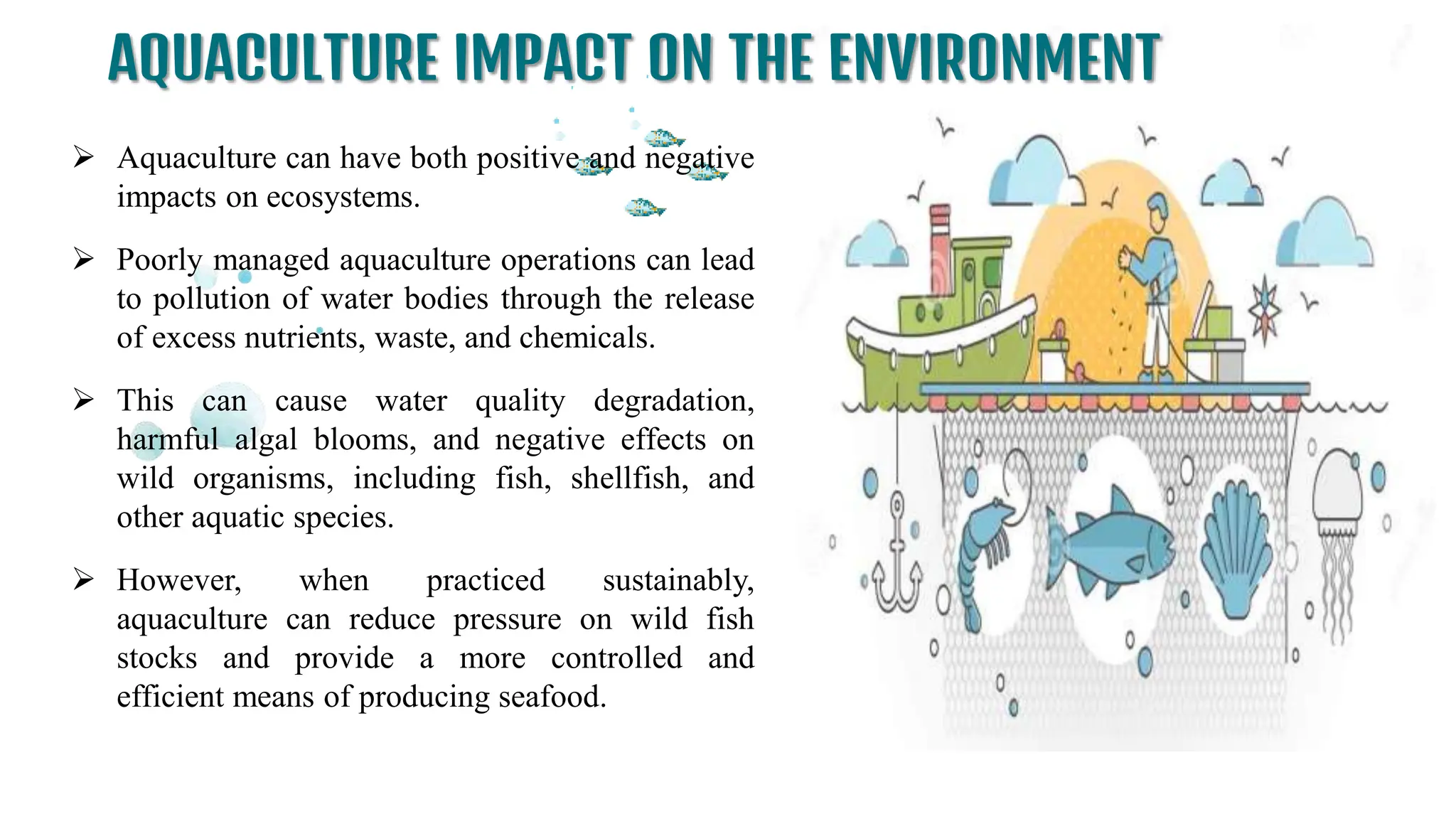
 Aquaculture can have both positive and negative
impacts on ecosystems.
 Poorly managed aquaculture operations can lead
to pollution of water bodies through the release
of excess nutrients, waste, and chemicals.
 This can cause water quality degradation,
harmful algal blooms, and negative effects on
wild organisms, including fish, shellfish, and
other aquatic species.
 However, when practiced sustainably,
aquaculture can reduce pressure on wild fish
stocks and provide a more controlled and
efficient means of producing seafood.
AQUACULTURE IMPACT ON THE ENVIRONMENT
CONT..
Positive Negative
Food
Income
Livelihood development
Over fishing of wild fish
Eutrophication
Unsustainable demand of wild seed
Biodiversity loss
Water deterioration
Disease transmission
Habitat degradation
Excessive use of Chemicals
POSITIVE IMPACT
 Aquaculture provides a sustainable protein-rich food source.
 It can be used to help restore or enhance habitats or species that are struggling or facing
extinction.
 Aquaculture can be used to counteract the negative impacts of overfishing and climate
change to accelerate the recovery of these damaged ecosystems.
 Aquaculture creates year-round jobs
AQUACULTURAL IMPACT ON THE AQUATIC ENVIRONMENT
 Alteration of inland and coastal habitat for the construction of ponds and aquaculture system.
 For example, the construction of fish ponds or the installation of artificial reefs can provide
suitable environments for fish or shellfish growth.
 However, it's important to carefully assess and minimize the potential negative impacts on
natural habitats and biodiversity during such habitat modifications.
 The creation of ponds for marine shrimp aquaculture has led to the destruction of thousands of
hectares of mangroves and coastal wetlands.
 Mangroves provide nursery grounds for many species, including commercially important fish,
and destruction may lead to substantial losses there for commercial fisheries.
COLLECTING WILD JUVENILES AS STOCK
 Unsustainable demand for wild seed or juvenile for fattening (e.g. shrimp and tuna)
 Aquaculture of some species relies on juvenile fish or shellfish being caught from the
wild to supply stock, rather than using hatcheries to rear them.
 Shrimp farms in many areas rely on wild-caught juveniles.
 Requirement of fishmeal for feed formulation also leads to exploitation of natural source.
 This has led to over-exploitation and shortages of wild stocks.
 The main environmental impact of crab culture is the procurement of larvae from wild
brood stock, and the on-growing of wild crablets.
INTRODUCTION OF UNWANTED
NON-NATIVE SPECIES TO NATURAL
ECOSYSTEM
 Alter species composition
 Reduce biodiversity
 Introduce disease and parasites
POOR RESEARCH IN FISH DISEASES AND ABUSE
OF MEDICINES
Novel fish diseases
cannot be treated, and
diagnosis of aquatic
diseases in the third
world involves
undeveloped instruments
and weak technical
power
Once the disease
comes on, the
abuse of medicines
is unavoidable.
Hence the inability
to distinguish
bacterial and
nutritional diseases,
directly influences
correct medication.
INFLUENCE ON SUBSTRATE OF AQUACULTURE
FACILITIES
 On the bottom of facilities used in aquaculture, the contents of C, N, and P are
higher than those used for other purposes, and the oxygen consumption is also
higher.
 When the organic matters accumulated on the mud bottom are too much, the
physiochemical index of the bottom will be changed, and the decomposing
function of microorganisms results in bloom, and the dissolved oxygen in the
bottom is depleted, as a result of numerous sulfates in the water, hydrogen-
sulfide (H2S) build up in the environment.
RESIDUAL FEEDS AND EXCREMENTS
Feeds are the basic
material of
aquaculture and the
source of main
nutritional matters
Most feeds of
aquaculture are
outside source foods
and are given to
aquatic animals
directly
Large amounts of
residual feeds and the
excrements of aquatic
animals all impact the
water environment
WEAK ENVIRONMENT PROTECTION
CONSCIOUSNESS
Fishing and environment
protection consciousness is
still deficient, and the random
discharge of aquaculture
waste waters without any
treatment has deteriorated the
whole aquaculture
environment, and blocked the
sustainable development of
this industry.
Though various high-
yielding aquaculture
methods such as industrial
fish farming, cage fish
culture, and raceway
culture are developed to
some extent
Farmed salmon have a
lower genetic variability
than wild salmon
Experiments show that
the offspring are less fit
than wild salmon and a
high proportion die
Interbreeding of farms
with wild salmon could
therefore drive already
vulnerable populations of
wild salmon toward
extinction
Farmed Atlantic
salmons have escaped
in vast numbers and are
successfully breeding
with their wild
counterparts
ESCAPING SALMON AND THEIR THREAT TO WILD
FISH
INFLUENCE ON PHYSIOCHEMICAL PARAMETERS
OF WATER
• The main influence of aquaculture on water quality is to increase the suspended substances and
the nutritional salts in water.
• Cages used in aquaculture can Inhibition of water flow and can have dramatic effects on both the
supply of dissolved oxygen to the fish within the enclosure as well as to the biota in the
environment around the culture operation.
• It can also affect the flushing of waste products from both the fish (organic) and the physical site
• The wastes of cage aquaculture increased the total concentration of water nutrients and the
water’s turbidity
EUTROPHICATION AND NITRIFICATION OF
EFFLUENT-RECEIVING ECOSYSTEMS
 From the total nitrogen Supplemented to the cultured organisms, only 20 to 50% is
retained as biomass by the farmed organisms, while the rest is incorporated into the
water column or sediment, and eventually discharged in the effluents toward the
receiving ecosystems
 causing diverse impacts such as phytoplankton blooms (sometimes of toxic
microalgae’s, such as red Tides), burring, and death of benthic organisms, as well
As undesirable odors and the presence of pathogens in the discharge sites
 The eutrophication or organic enrichment of the water column is mainly
produced by non-consumed feed, lixiviation of aquaculture feedstuffs,
decomposition of dead organisms, and over-fertilization
 The input of outside-source materials and organic matter can increase the
productivity of the plankton.
 It make the nutrient matter in waters gradually increase, and the phytoplankton
propagated largely at the beginning, but as time goes on and the continual
expansion of aquaculture is still on a large scale, the nutrient matters input
increases to a point the water quality deteriorates, so the number of phytoplankton
will begin to reduce.
INFLUENCE ON PLANKTONS
THE INFLUENCE ON THE ECOLOGICAL ENVIRONMENT
 In recent years, because of the development of aquaculture, the seductive profit of aquaculture
has raised in the world, and most lakes, rivers, swamps, coastal lowlands, and mudflats are
changed into shrimp culture ponds and fish culture ponds.
 Aquaculture relies on various resources such as water, feed, energy, and land.
 The sustainable management of these resources is crucial to minimize the environmental
footprint of aquaculture operations.
 Integrated approaches that consider resource efficiency, waste reduction, and the use of
alternative feed ingredients can help improve the sustainability of aquaculture while reducing its
impact on ecosystems
 These lowlands were mangroves, saline soils, and agricultural lands, and some of them were
inhabiting, spawning, and refuge places for many fishes and shellfish. Unreasonable
development will destroy the ecological environment of shells and the natural resource.
SELF-POLLUTION
 Wastewater from land-based aquaculture is routinely discharged to
rivers and streams supplying other aquaculture operations downstream,
whilst waste discharged from pen and cage farms may be conveyed to
other farms by currents and tides.
 Moreover, for pen and cage aquaculture facilities there is a danger that
discharged waste that may contaminate water intended to supply the
farm
RECOMMENDATIONS AND CONCLUSION
 Most aquatic wastes come from feeds, to reduce these wastes, limit the percentage of un-
consumed feed in the culture facility.
 To reduce nutrient wastes, Aquaculture effluents should be monitored and managed, to
avoid any negative environmental impacts.
 In feeding fishes, the proper feed quantity should be confirmed, this will reduce the
amount of feeds scattered and lost during feeding.
 Using fishery chemicals correctly: the chemical dosage must the strictly controlled, and
the performance and method of fishery chemical administration must be correctly known.
 Enhance management level of aquaculture: implementing rules about aquaculture resource
development, and comprehensively utilizing the regulations of fisheries resource
management.
 By integrating ecological principles into aquaculture practices, it is possible to achieve a
balance between the production of seafood and the preservation of healthy ecosystems.
THANKS!

What is ecosystem? Relation between ecosystem and aquaculture

  • 1.
    What is ecosystem?Relation between ecosystem and aquaculture Submitted by Vala Foram D.
  • 2.
    WHAT IS ECOSYSTEM? An ecosystem is any spatial or organizational unit that includes a community of living and non-living parts.  The term ‘ecosystem’ was coined by A. G. Tansley (1935)- its ‘eco’ means environment and ‘system’ implies, a complex of coordinated units.  It may be as small as a puddle or as large as the entire earth (biosphere or ecosphere).  Further, an ecosystem may be natural as a pond, lake, river, estuary, ocean, forest, etc., or it may be man-made or artificial like an aquarium, a dam, a city, or a garden.
  • 3.
    INTRODUCTION  The relationshipbetween ecosystems and aquaculture is complex and interconnected.  Aquaculture, also known as fish farming, involves the cultivation of aquatic organisms such as fish, shellfish, and plants in controlled environments like ponds, tanks, or cages.  Ecosystems, on the other hand, are natural systems consisting of living organisms (plants, animals, and microorganisms) interacting with each other and their physical environment.
  • 4.
    IMPACT OF ENVIRONMENTON AQUACULTURE WATER QUALITY:  Water quality is crucial for the success of aquaculture operations. Parameters such as temperature, dissolved oxygen, pH, salinity, and nutrient concentrations significantly impact the health and growth of aquatic species.  Environmental factors, including weather patterns, water sources, and pollution inputs, can affect water quality and create challenges for maintaining optimal conditions. CLIMATE CHANGE:  Climate change can impact aquaculture through alterations in water temperature, sea level rise, ocean acidification, and changes in weather patterns.  Shifts in temperature regimes can affect species performance, reproductive cycles, and disease susceptibility, requiring adjustments in aquaculture practices.
  • 5.
    CONT.. HARMFUL ALGAL BLOOMS(HABS):  HABs can have detrimental effects on aquaculture, leading to fish kills, reduced water quality, and economic losses.  Environmental factors, such as nutrient loading, temperature, and hydrodynamics, can contribute to the occurrence and intensity of HABs, necessitating proactive monitoring and management strategies. COASTAL ECOSYSTEM INTERACTIONS:  Aquaculture activities can interact with coastal ecosystems, both positively and negatively.  Positive interactions include the provision of artificial habitats, which can enhance biodiversity and support ecosystem functions. Negative interactions may involve habitat degradation, changes in water circulation, and the introduction of non-native species.
  • 6.
    OVERFISHING AND RESOURCEDEPLETION:  Overfishing and depletion of wild fish stocks can drive the expansion of aquaculture as an alternative source of seafood.  Environmental factors influencing wild fish populations, such as changes in temperature, nutrient availability, and habitat degradation, can indirectly impact the development and sustainability of aquaculture operations. ENVIRONMENTAL REGULATIONS AND GOVERNANCE  Environmental regulations and governance frameworks play a crucial role in mitigating the environmental impacts of aquaculture.  Effective regulations, such as site selection criteria, water quality standards, and waste management requirements, can help minimize negative environmental effects.
  • 7.
     Aquaculture canhave both positive and negative impacts on ecosystems.  Poorly managed aquaculture operations can lead to pollution of water bodies through the release of excess nutrients, waste, and chemicals.  This can cause water quality degradation, harmful algal blooms, and negative effects on wild organisms, including fish, shellfish, and other aquatic species.  However, when practiced sustainably, aquaculture can reduce pressure on wild fish stocks and provide a more controlled and efficient means of producing seafood. AQUACULTURE IMPACT ON THE ENVIRONMENT
  • 8.
    CONT.. Positive Negative Food Income Livelihood development Overfishing of wild fish Eutrophication Unsustainable demand of wild seed Biodiversity loss Water deterioration Disease transmission Habitat degradation Excessive use of Chemicals
  • 9.
    POSITIVE IMPACT  Aquacultureprovides a sustainable protein-rich food source.  It can be used to help restore or enhance habitats or species that are struggling or facing extinction.  Aquaculture can be used to counteract the negative impacts of overfishing and climate change to accelerate the recovery of these damaged ecosystems.  Aquaculture creates year-round jobs
  • 10.
    AQUACULTURAL IMPACT ONTHE AQUATIC ENVIRONMENT  Alteration of inland and coastal habitat for the construction of ponds and aquaculture system.  For example, the construction of fish ponds or the installation of artificial reefs can provide suitable environments for fish or shellfish growth.  However, it's important to carefully assess and minimize the potential negative impacts on natural habitats and biodiversity during such habitat modifications.  The creation of ponds for marine shrimp aquaculture has led to the destruction of thousands of hectares of mangroves and coastal wetlands.  Mangroves provide nursery grounds for many species, including commercially important fish, and destruction may lead to substantial losses there for commercial fisheries.
  • 11.
    COLLECTING WILD JUVENILESAS STOCK  Unsustainable demand for wild seed or juvenile for fattening (e.g. shrimp and tuna)  Aquaculture of some species relies on juvenile fish or shellfish being caught from the wild to supply stock, rather than using hatcheries to rear them.  Shrimp farms in many areas rely on wild-caught juveniles.  Requirement of fishmeal for feed formulation also leads to exploitation of natural source.  This has led to over-exploitation and shortages of wild stocks.  The main environmental impact of crab culture is the procurement of larvae from wild brood stock, and the on-growing of wild crablets.
  • 12.
    INTRODUCTION OF UNWANTED NON-NATIVESPECIES TO NATURAL ECOSYSTEM  Alter species composition  Reduce biodiversity  Introduce disease and parasites
  • 13.
    POOR RESEARCH INFISH DISEASES AND ABUSE OF MEDICINES Novel fish diseases cannot be treated, and diagnosis of aquatic diseases in the third world involves undeveloped instruments and weak technical power Once the disease comes on, the abuse of medicines is unavoidable. Hence the inability to distinguish bacterial and nutritional diseases, directly influences correct medication.
  • 14.
    INFLUENCE ON SUBSTRATEOF AQUACULTURE FACILITIES  On the bottom of facilities used in aquaculture, the contents of C, N, and P are higher than those used for other purposes, and the oxygen consumption is also higher.  When the organic matters accumulated on the mud bottom are too much, the physiochemical index of the bottom will be changed, and the decomposing function of microorganisms results in bloom, and the dissolved oxygen in the bottom is depleted, as a result of numerous sulfates in the water, hydrogen- sulfide (H2S) build up in the environment.
  • 15.
    RESIDUAL FEEDS ANDEXCREMENTS Feeds are the basic material of aquaculture and the source of main nutritional matters Most feeds of aquaculture are outside source foods and are given to aquatic animals directly Large amounts of residual feeds and the excrements of aquatic animals all impact the water environment
  • 16.
    WEAK ENVIRONMENT PROTECTION CONSCIOUSNESS Fishingand environment protection consciousness is still deficient, and the random discharge of aquaculture waste waters without any treatment has deteriorated the whole aquaculture environment, and blocked the sustainable development of this industry. Though various high- yielding aquaculture methods such as industrial fish farming, cage fish culture, and raceway culture are developed to some extent
  • 17.
    Farmed salmon havea lower genetic variability than wild salmon Experiments show that the offspring are less fit than wild salmon and a high proportion die Interbreeding of farms with wild salmon could therefore drive already vulnerable populations of wild salmon toward extinction Farmed Atlantic salmons have escaped in vast numbers and are successfully breeding with their wild counterparts ESCAPING SALMON AND THEIR THREAT TO WILD FISH
  • 18.
    INFLUENCE ON PHYSIOCHEMICALPARAMETERS OF WATER • The main influence of aquaculture on water quality is to increase the suspended substances and the nutritional salts in water. • Cages used in aquaculture can Inhibition of water flow and can have dramatic effects on both the supply of dissolved oxygen to the fish within the enclosure as well as to the biota in the environment around the culture operation. • It can also affect the flushing of waste products from both the fish (organic) and the physical site • The wastes of cage aquaculture increased the total concentration of water nutrients and the water’s turbidity
  • 19.
    EUTROPHICATION AND NITRIFICATIONOF EFFLUENT-RECEIVING ECOSYSTEMS  From the total nitrogen Supplemented to the cultured organisms, only 20 to 50% is retained as biomass by the farmed organisms, while the rest is incorporated into the water column or sediment, and eventually discharged in the effluents toward the receiving ecosystems  causing diverse impacts such as phytoplankton blooms (sometimes of toxic microalgae’s, such as red Tides), burring, and death of benthic organisms, as well As undesirable odors and the presence of pathogens in the discharge sites  The eutrophication or organic enrichment of the water column is mainly produced by non-consumed feed, lixiviation of aquaculture feedstuffs, decomposition of dead organisms, and over-fertilization
  • 20.
     The inputof outside-source materials and organic matter can increase the productivity of the plankton.  It make the nutrient matter in waters gradually increase, and the phytoplankton propagated largely at the beginning, but as time goes on and the continual expansion of aquaculture is still on a large scale, the nutrient matters input increases to a point the water quality deteriorates, so the number of phytoplankton will begin to reduce. INFLUENCE ON PLANKTONS
  • 21.
    THE INFLUENCE ONTHE ECOLOGICAL ENVIRONMENT  In recent years, because of the development of aquaculture, the seductive profit of aquaculture has raised in the world, and most lakes, rivers, swamps, coastal lowlands, and mudflats are changed into shrimp culture ponds and fish culture ponds.  Aquaculture relies on various resources such as water, feed, energy, and land.  The sustainable management of these resources is crucial to minimize the environmental footprint of aquaculture operations.  Integrated approaches that consider resource efficiency, waste reduction, and the use of alternative feed ingredients can help improve the sustainability of aquaculture while reducing its impact on ecosystems  These lowlands were mangroves, saline soils, and agricultural lands, and some of them were inhabiting, spawning, and refuge places for many fishes and shellfish. Unreasonable development will destroy the ecological environment of shells and the natural resource.
  • 22.
    SELF-POLLUTION  Wastewater fromland-based aquaculture is routinely discharged to rivers and streams supplying other aquaculture operations downstream, whilst waste discharged from pen and cage farms may be conveyed to other farms by currents and tides.  Moreover, for pen and cage aquaculture facilities there is a danger that discharged waste that may contaminate water intended to supply the farm
  • 23.
    RECOMMENDATIONS AND CONCLUSION Most aquatic wastes come from feeds, to reduce these wastes, limit the percentage of un- consumed feed in the culture facility.  To reduce nutrient wastes, Aquaculture effluents should be monitored and managed, to avoid any negative environmental impacts.  In feeding fishes, the proper feed quantity should be confirmed, this will reduce the amount of feeds scattered and lost during feeding.  Using fishery chemicals correctly: the chemical dosage must the strictly controlled, and the performance and method of fishery chemical administration must be correctly known.  Enhance management level of aquaculture: implementing rules about aquaculture resource development, and comprehensively utilizing the regulations of fisheries resource management.  By integrating ecological principles into aquaculture practices, it is possible to achieve a balance between the production of seafood and the preservation of healthy ecosystems.
  • 24.