By Thomas K. Dasaklis
Responding to Predictable Variability in a Supply Chain
 Predictable variability is change in demand that can be
forecasted
 Can cause increased costs and decreased responsiveness in
the supply chain
 Two broad approaches
1. Manage supply using capacity, inventory, subcontracting
and backlogs
2. Manage demand using short-term price discounts and
trade promotions
University of Piraeus
Department of Industrial Management and Technology
Managing Supply
 Managing capacity
 Time flexibility for workforce
 Use of seasonal workforce
 Use of subcontracting
 Use of dual facilities – specialized and flexible
 Designing product flexibility into production processes
 Managing inventory
 Using common components across multiple products
 Build inventory of high demand or predictable demand
products
University of Piraeus
Department of Industrial Management and Technology
Inventory/Capacity Trade-off
 Leveling capacity forces inventory to build up in
anticipation of seasonal variation in demand
 Carrying low levels of inventory requires capacity
to vary with seasonal variation in demand or
enough capacity to cover peak demand during
season
University of Piraeus
Department of Industrial Management and Technology
The Timing of a Promotion
 Impact of the promotion on demand
 Cost of holding inventory
 Cost of changing the level of capacity
 Product margins
 Increase in demand from
 Market growth
 Gaining share
 Forward buying
University of Piraeus
Department of Industrial Management and Technology
When to Promote
 Is it more effective to promote during the peak
period or off-peak?
 Analyze the impact of a promotion on demand
and the resulting optimal aggregate plan
University of Piraeus
Department of Industrial Management and Technology
Conclusions on Promotion
1. Average inventory increases if a promotion is
run during the peak period and decreases if the
promotion is run during the off-peak period
2. Promoting during a peak-demand month may
decrease overall profitability if there is a small
increase in consumption and a significant
fraction of the demand increase results from a
forward buy
University of Piraeus
Department of Industrial Management and Technology
Conclusions on Promotion
3. As consumption increase from discounting
grows and forward buying becomes a smaller
fraction of the demand increase from a
promotion, it is more profitable to promote
during the peak period
4. As the product margin declines, promoting
during the peak-demand period becomes less
profitable
University of Piraeus
Department of Industrial Management and Technology
University of Piraeus
Department of Industrial Management and Technology
The bullwhip effect is used to describe the amplification of
demand variance that occurs along a supply chain from
manufacturer to retailer as a result of coordination failures and
nonstationary demand.
Strategies to manage volatile demand efficiently include:
 Supply Buffer Management — Inventory Buffers — Capacity
Buffers
 Cycle Time Reduction Strategies
 Postponement Strategies
 Collaborative Processes
Demand volatility
University of Piraeus
Department of Industrial Management and Technology
Managing risk in global supply chain networks: postponement
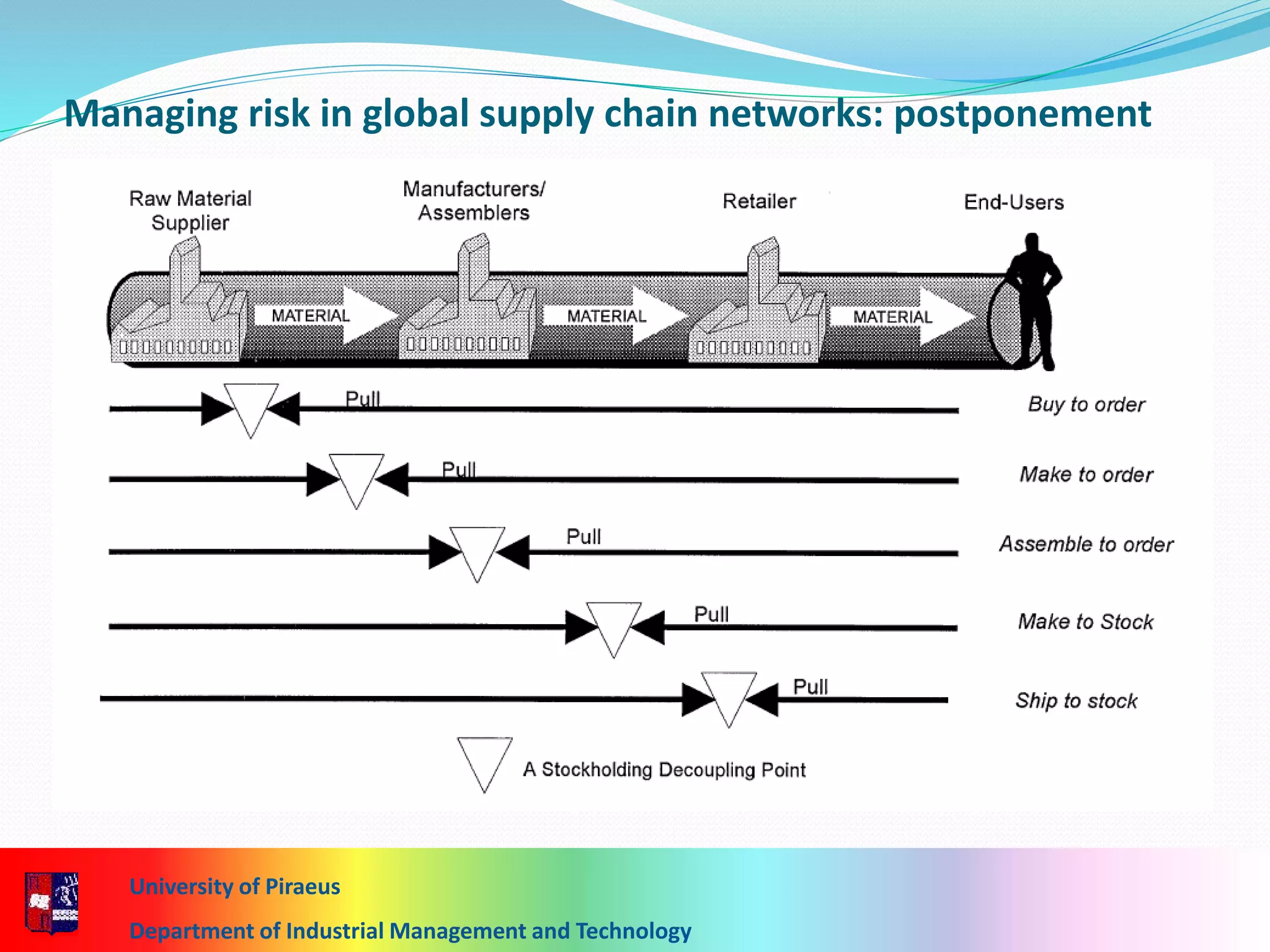
Postponement is defined as a strategy that intentionally delays the execution of a task,
instead of starting it with incomplete or unreliable information input.
The aim of postponement is to increase the efficiency of the supply chain by moving
product differentiation (at the decoupling point) closer to the end user.
Postponing the decoupling point reduces the risk of being out of stock for long periods at
the retailer and of holding too much stock of products that are not required.
The well-known Benetton example demonstrates the use of postponement in the
fashion trade. Benetton delayed the dyeing of their jumpers, which is the point at which
the jumpers are differentiated, until the end of the process. Postponement is also
essential where products have, or are likely to have, a short life cycle as in the Benetton
example or for PC manufacturers.
University of Piraeus
Department of Industrial Management and Technology
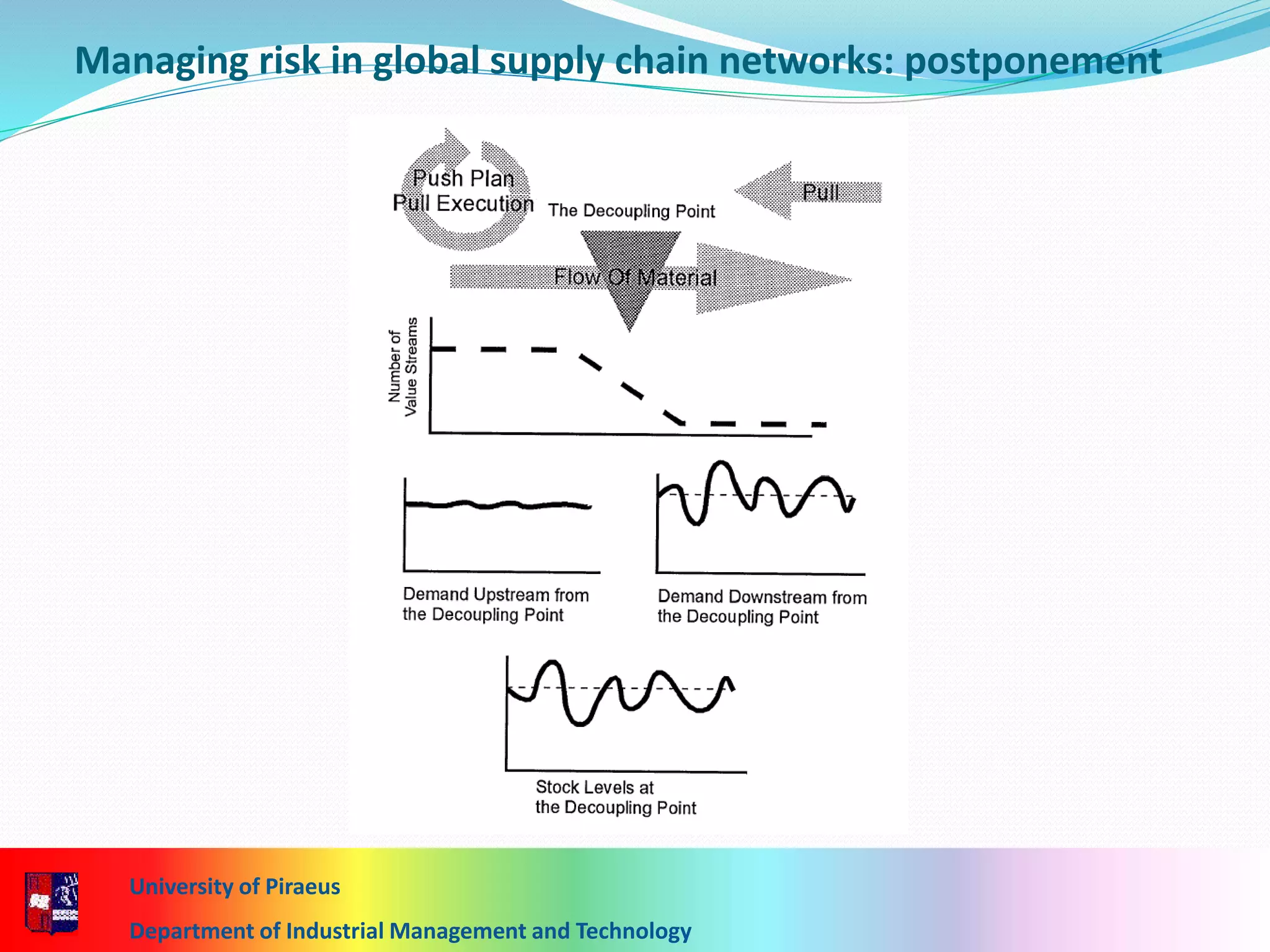
The decoupling point separates the part of the organization [supply chain]
oriented towards customer orders from the part of the organization [supply chain]
based on planning.
Managing risk in global supply chain networks: postponement
University of Piraeus
Department of Industrial Management and Technology
Managing risk in global supply chain networks: postponement
University of Piraeus
Department of Industrial Management and Technology
Managing risk in global supply chain networks: postponement
7-14
Role of Forecasting in a Supply Chain
 The basis for all strategic and planning decisions in a
supply chain
 Used for both push and pull processes
 Examples:
 Production: scheduling, inventory, aggregate planning
 Marketing: sales force allocation, promotions, new
production introduction
 Finance: plant/equipment investment, budgetary planning
 Personnel: workforce planning, hiring, layoffs
 All of these decisions are interrelated
University of Piraeus
Department of Industrial Management and Technology
7-15
Characteristics of Forecasts
 Forecasts are always inaccurate. They should include
expected values and measures of error
 Long-term forecasts are less accurate than short-term
forecasts (forecast horizon is important)
 Aggregate forecasts are more accurate than
disaggregate forecasts.
University of Piraeus
Department of Industrial Management and Technology
7-16
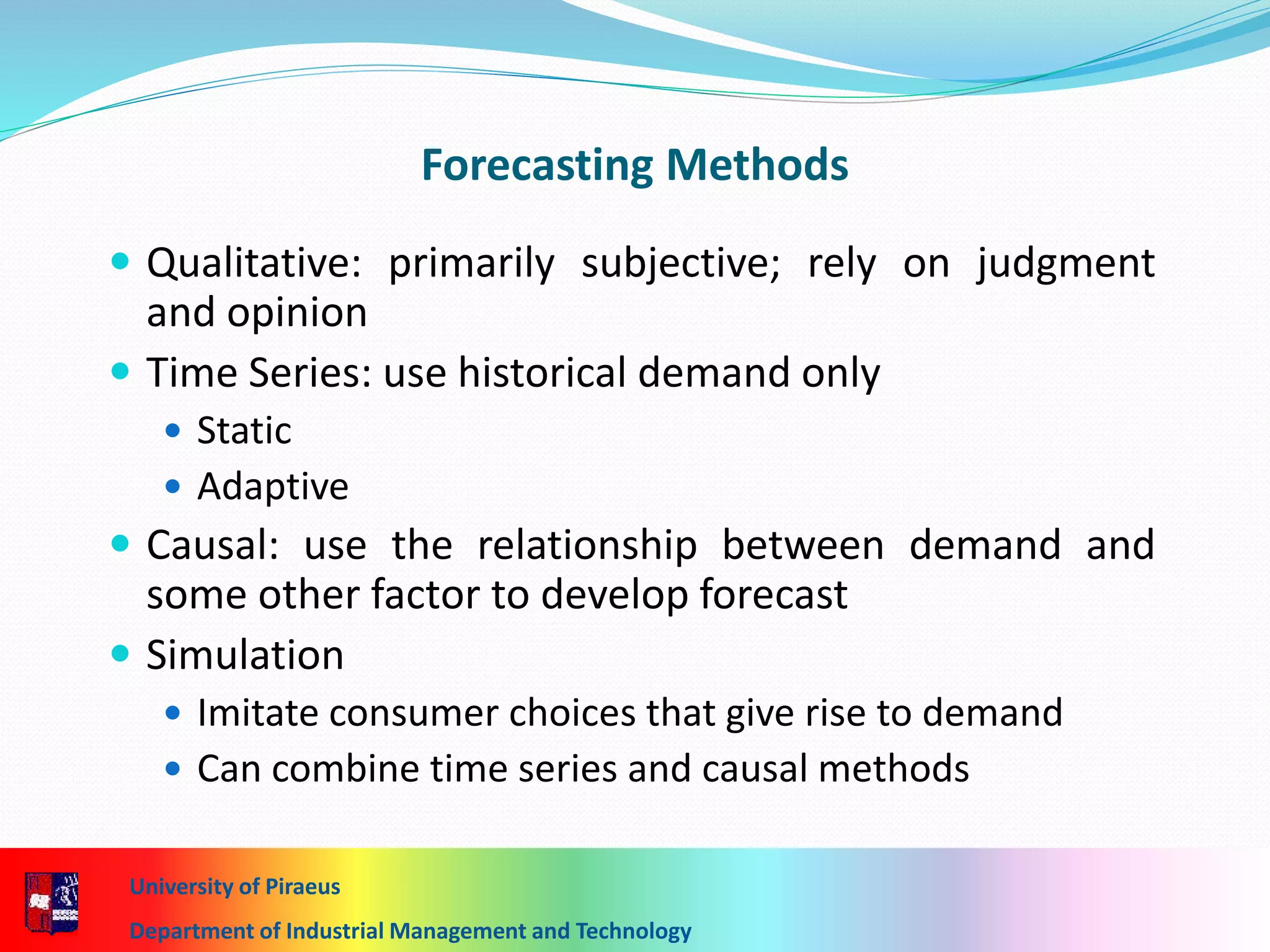
Forecasting Methods
 Qualitative: primarily subjective; rely on judgment
and opinion
 Time Series: use historical demand only
 Static
 Adaptive
 Causal: use the relationship between demand and
some other factor to develop forecast
 Simulation
 Imitate consumer choices that give rise to demand
 Can combine time series and causal methods
University of Piraeus
Department of Industrial Management and Technology
7-17
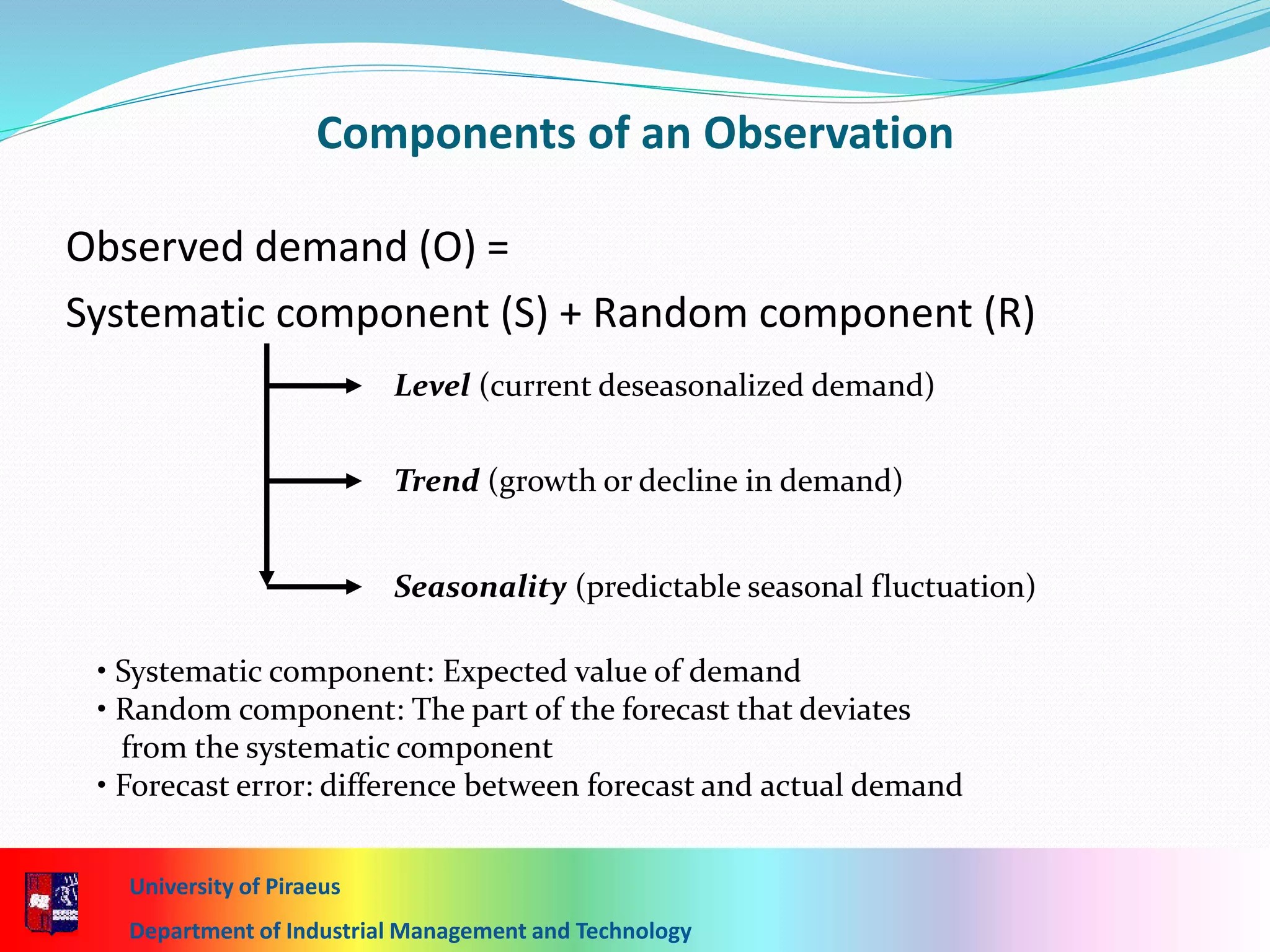
Components of an Observation
Observed demand (O) =
Systematic component (S) + Random component (R)
Level (current deseasonalized demand)
Trend (growth or decline in demand)
Seasonality (predictable seasonal fluctuation)
• Systematic component: Expected value of demand
• Random component: The part of the forecast that deviates
from the systematic component
• Forecast error: difference between forecast and actual demand
University of Piraeus
Department of Industrial Management and Technology

RMPS_Forecasting.pdf

  • 1.
    By Thomas K.Dasaklis
  • 2.
    Responding to PredictableVariability in a Supply Chain  Predictable variability is change in demand that can be forecasted  Can cause increased costs and decreased responsiveness in the supply chain  Two broad approaches 1. Manage supply using capacity, inventory, subcontracting and backlogs 2. Manage demand using short-term price discounts and trade promotions University of Piraeus Department of Industrial Management and Technology
  • 3.
    Managing Supply  Managingcapacity  Time flexibility for workforce  Use of seasonal workforce  Use of subcontracting  Use of dual facilities – specialized and flexible  Designing product flexibility into production processes  Managing inventory  Using common components across multiple products  Build inventory of high demand or predictable demand products University of Piraeus Department of Industrial Management and Technology
  • 4.
    Inventory/Capacity Trade-off  Levelingcapacity forces inventory to build up in anticipation of seasonal variation in demand  Carrying low levels of inventory requires capacity to vary with seasonal variation in demand or enough capacity to cover peak demand during season University of Piraeus Department of Industrial Management and Technology
  • 5.
    The Timing ofa Promotion  Impact of the promotion on demand  Cost of holding inventory  Cost of changing the level of capacity  Product margins  Increase in demand from  Market growth  Gaining share  Forward buying University of Piraeus Department of Industrial Management and Technology
  • 6.
    When to Promote Is it more effective to promote during the peak period or off-peak?  Analyze the impact of a promotion on demand and the resulting optimal aggregate plan University of Piraeus Department of Industrial Management and Technology
  • 7.
    Conclusions on Promotion 1.Average inventory increases if a promotion is run during the peak period and decreases if the promotion is run during the off-peak period 2. Promoting during a peak-demand month may decrease overall profitability if there is a small increase in consumption and a significant fraction of the demand increase results from a forward buy University of Piraeus Department of Industrial Management and Technology
  • 8.
    Conclusions on Promotion 3.As consumption increase from discounting grows and forward buying becomes a smaller fraction of the demand increase from a promotion, it is more profitable to promote during the peak period 4. As the product margin declines, promoting during the peak-demand period becomes less profitable University of Piraeus Department of Industrial Management and Technology
  • 9.
    University of Piraeus Departmentof Industrial Management and Technology The bullwhip effect is used to describe the amplification of demand variance that occurs along a supply chain from manufacturer to retailer as a result of coordination failures and nonstationary demand. Strategies to manage volatile demand efficiently include:  Supply Buffer Management — Inventory Buffers — Capacity Buffers  Cycle Time Reduction Strategies  Postponement Strategies  Collaborative Processes Demand volatility
  • 10.
    University of Piraeus Departmentof Industrial Management and Technology Managing risk in global supply chain networks: postponement Postponement is defined as a strategy that intentionally delays the execution of a task, instead of starting it with incomplete or unreliable information input. The aim of postponement is to increase the efficiency of the supply chain by moving product differentiation (at the decoupling point) closer to the end user. Postponing the decoupling point reduces the risk of being out of stock for long periods at the retailer and of holding too much stock of products that are not required. The well-known Benetton example demonstrates the use of postponement in the fashion trade. Benetton delayed the dyeing of their jumpers, which is the point at which the jumpers are differentiated, until the end of the process. Postponement is also essential where products have, or are likely to have, a short life cycle as in the Benetton example or for PC manufacturers.
  • 11.
    University of Piraeus Departmentof Industrial Management and Technology The decoupling point separates the part of the organization [supply chain] oriented towards customer orders from the part of the organization [supply chain] based on planning. Managing risk in global supply chain networks: postponement
  • 12.
    University of Piraeus Departmentof Industrial Management and Technology Managing risk in global supply chain networks: postponement
  • 13.
    University of Piraeus Departmentof Industrial Management and Technology Managing risk in global supply chain networks: postponement
  • 14.
    7-14 Role of Forecastingin a Supply Chain  The basis for all strategic and planning decisions in a supply chain  Used for both push and pull processes  Examples:  Production: scheduling, inventory, aggregate planning  Marketing: sales force allocation, promotions, new production introduction  Finance: plant/equipment investment, budgetary planning  Personnel: workforce planning, hiring, layoffs  All of these decisions are interrelated University of Piraeus Department of Industrial Management and Technology
  • 15.
    7-15 Characteristics of Forecasts Forecasts are always inaccurate. They should include expected values and measures of error  Long-term forecasts are less accurate than short-term forecasts (forecast horizon is important)  Aggregate forecasts are more accurate than disaggregate forecasts. University of Piraeus Department of Industrial Management and Technology
  • 16.
    7-16 Forecasting Methods  Qualitative:primarily subjective; rely on judgment and opinion  Time Series: use historical demand only  Static  Adaptive  Causal: use the relationship between demand and some other factor to develop forecast  Simulation  Imitate consumer choices that give rise to demand  Can combine time series and causal methods University of Piraeus Department of Industrial Management and Technology
  • 17.
    7-17 Components of anObservation Observed demand (O) = Systematic component (S) + Random component (R) Level (current deseasonalized demand) Trend (growth or decline in demand) Seasonality (predictable seasonal fluctuation) • Systematic component: Expected value of demand • Random component: The part of the forecast that deviates from the systematic component • Forecast error: difference between forecast and actual demand University of Piraeus Department of Industrial Management and Technology