Managing Third Party Risk Effectively
How to Conduct a 3rd Party Vendor Risk Assessment
Prior to Signing your Cloud Hosting Contract
Evan Francen, CEO & Founder of FRSecure
evan@frsecure.com
(877) 960-1814
Thank you to our sponsor!
Sponsor logo
Speaker Bio: Evan Francen
CONFIDENTIAL | ©2019 CSA MN Chapter 2
• Speaker: CEO & Founder of FRSecure
and SecurityStudio
(https://www.linkedin.com/in/evanfrancen/)
• Co-inventor of SecurityStudio®, FISA™, FISASCORE® and
Vendefense®
• 25+ years of “practical” information security experience
(started as a Cisco Engineer in the early 90s) Author of
UNSECURITY
• Developed the FRSecure Mentor Program; six students in
2010/497 in 2019
• Dozens of television and radio appearances; numerous topics
• Advised legal counsel in very public breaches (Target, Blue
Cross/Blue Shield, etc.)
• Why should you care about your vendors?
• Four approaches to VRM
• Standardize
• Defensible
• Learning Takeaways:
• Driven by Risk Management Program
• Part of Contracts & Administration
• Use SIG LITE or Equivalent
• Review the MSA Contract for Liabilities
• Align Risk Accordingly
CONFIDENTIAL | ©2019 CSA MN Chapter 3
Agenda
NOTE: I’m a literal person.
If you are too, you might
notice “VRM”. Vendor Risk
Management (VRM) is not the
same as third-party
information security risk
management (TPISRM).
One sort of fits into the
other. We’re talking about
TPISRM, but for the sake of
brevity, we sometimes use VRM
and TPISRM synonymously.
CONFIDENTIAL | ©2019 CSA MN Chapter 4
BEFORE WEGO MUCH FURTHER…
Why should you care about your vendors?
CONFIDENTIAL | ©2019 CSA MN Chapter 5
Most of us have seen the stats…
• 69% of respondents say they definitely or possibly suffered a security breach
resulting from vendor access within the last year.
• On average, organizations spent $10 million responding to third-party breaches
over a 12-month period in 2016.
• 63% of all cyber attacks could be traced either directly or indirectly to third
parties.
• Nearly 97% of respondents said that cyber risk affecting third parties is a major
issue.
• Nearly 80% of respondents said they have terminated or would decline a
business relationship due to a vendor's cyber security performance.
Sources: Bomgar survey, PwC, Soha Systems, CSO Online
CONFIDENTIAL | ©2019 CSA MN Chapter 6
But…
• Only 35% of enterprise security professionals are very confident in knowing the
actual number of vendors accessing their systems.
• Only 52% of companies have security standards for third-parties.
• Just 34% know the number of individual log-ins that can be attributed to
vendors.
• 1 in 10 organizations has a role specifically dedicated to vendor, third-party or
supplier risk
• No sector reported more than 50% of respondents at a mature level with
regard to managing vendor risk
Sources: Bomgar survey, PwC, Soha Systems, CSO Online
CONFIDENTIAL | ©2019 CSA MN Chapter 7
The reality is…
• We’re all tired of statistics and studies.
• Most statistics and studies are commissioned by someone who
wants to sell us something.
• There’s a thing called “confirmation bias”.
• We’ve all got 1,000 things on our plate.
• You won’t do anything (significant) about third-party security risk
management unless you want to or you’ve been told you have to.
• You might want to because you understand risk and this is your next
significant unacceptable risk. (could be other reasons)
• You have to because it’s the law (or the interpretation of the law).
You should care, right?
Yes, you should. You should care enough to understand the
problem (assuming you have one) and make an educated
decision on what, if anything you plan to do about it.
Figure out your “WHY”.
Doing nothing will imply risk acceptance.
CONFIDENTIAL | ©2019 CSA MN Chapter 8
FOUR APPROACHES TO VRM
Where do you fall?
CONFIDENTIAL | ©2019 CSA MN Chapter 9
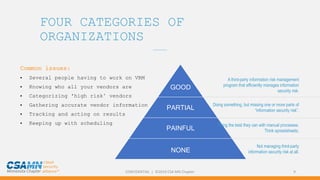
FOUR CATEGORIES OF
ORGANIZATIONS
Common issues:
• Several people having to work on VRM
• Knowing who all your vendors are
• Categorizing 'high risk’ vendors
• Gathering accurate vendor information
• Tracking and acting on results
• Keeping up with scheduling
_______
GOOD
PARTIAL
PAINFUL
NONE
A third-party information risk management
program that efficiently manages information
security risk.
Doing something, but missing one or more parts of
“information security risk”.
Doing the best they can with manual processes.
Think spreadsheets.
Not managing third-party
information security risk at all.
CONFIDENTIAL | ©2019 CSA MN Chapter 10
WHERE DO YOU FALL?
NONE
Several reasons, including:
• You just didn’t/don’t know any
better.
• You don’t know where to start.
• You’ve tried before and gave up due
to complexity or shifting
priorities.
• You don’t see the value in
establishing a good third-party
information security risk management
program.
• You don’t have the time or money
• Executive Leadership do not feel it
is
a priority
• Other?
_______
GOOD
PARTIAL
PAINFUL
NONE
CONFIDENTIAL | ©2019 CSA MN Chapter 11
WHERE DO YOU FALL?
_______
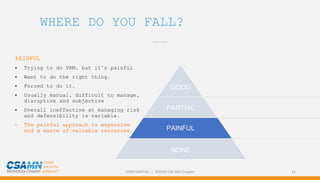
PAINFUL
• Trying to do VRM, but it’s painful
• Want to do the right thing.
• Forced to do it.
• Usually manual, difficult to manage,
disruptive and subjective
• Overall ineffective at managing risk
and defensibility is variable.
• The painful approach is expensive
and a waste of valuable resources.
GOOD
PARTIAL
PAINFUL
NONE
CONFIDENTIAL | ©2019 CSA MN Chapter 12
WHERE DO YOU FALL?
_______
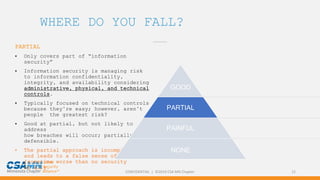
PARTIAL
• Only covers part of “information
security”
• Information security is managing risk
to information confidentiality,
integrity, and availability considering
administrative, physical, and technical
controls.
• Typically focused on technical controls
because they’re easy; however, aren’t
people the greatest risk?
• Good at partial, but not likely to
address
how breaches will occur; partially
defensible.
• The partial approach is incomplete
and leads to a false sense of security
(sometime worse than no security
at all).
GOOD
PARTIAL
PAINFUL
NONE
CONFIDENTIAL | ©2019 CSA MN Chapter 13
WHERE DO YOU FALL?
_______
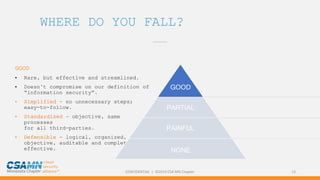
GOOD
• Rare, but effective and streamlined.
• Doesn’t compromise on our definition of
“information security”.
• Simplified – no unnecessary steps;
easy-to-follow.
• Standardized – objective, same
processes
for all third-parties.
• Defensible – logical, organized,
objective, auditable and completely
effective.
GOOD
PARTIAL
PAINFUL
NONE
CONFIDENTIAL | ©2019 CSA MN Chapter 14
SIMPLIFY
Don’t over-complicate the matter, there are only four
steps…
1. Inventory (and inventory management)
• You’re paying them; existing third-parties.
• You’re engaging them; new third-parties, procurement.
2. Classify (inherent risk)
• Risk without control.
• High, Medium, Low is fine. Don’t waste your time with the low-risk
vendors, just cycle them. If you’re doing it right, the ratios (with
exceptions) are typically 5/10/85.
3. Assess (residual risk)
4. Decide (risk decisions)
• Scores and thresholds work best
• Accept/Mitigate/Transfer(unlikely)/Avoid
CONFIDENTIAL | ©2019 CSA MN Chapter 15
SIMPLIFY
Inventory
Classify
Assess
Decide
Low
Medium
High
1 2
3 4
CONFIDENTIAL | ©2019 CSA MN Chapter 16
STANDARDIZE
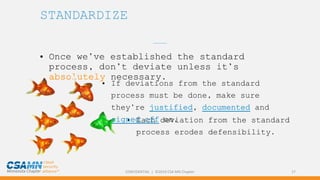
One-Offs Hurt
CONFIDENTIAL | ©2019 CSA MN Chapter 17
STANDARDIZE
• Once we’ve established the standard
process, don’t deviate unless it’s
absolutely necessary.
_______
• Each deviation from the standard
process erodes defensibility.
• If deviations from the standard
process must be done, make sure
they’re justified, documented and
signed off on.
CONFIDENTIAL | ©2019 CSA MN Chapter 18
STANDARDIZE
_______
• Big vendors (Microsoft, Google, Amazon, etc.)
may not participate in our process; these are
common deviations and are exceptions that can
easily be explained away should
something bad happen.
• Standardization comes through
documentation, training, and
automation. Every step in the
process that can be automated
should be automated.
CONFIDENTIAL | ©2019 CSA MN Chapter 19
DEFENSIBLE
The True Motivator
Full Transparency: This would be my
motivator.
CONFIDENTIAL | ©2019 CSA MN Chapter 20
The True Motivation:
Defensibility
_______
• Defensibility in your VRM practices
is arguably the most significant
“why” for doing it in the first
place.
• If/when something bad happens,
attackers become customers,
regulators, opposing counsel, etc.
CONFIDENTIAL | ©2019 CSA MN Chapter 21
The True Motivation:
Defensibility
_______
• If defensibility is your “why”, ensure
that it’s carried out in your “how”
and “what”.
Do you have answers to these questions?
• How many vendors do we have? Defensible?
• How many high-risk vendors do we have? Defensible?
• Have you vetted all high-risk vendors? Defensible?
• Non-definitive answers (assumptions,
guesses, etc.) are more likely to be
indefensible.
CONFIDENTIAL | ©2019 CSA MN Chapter 22
Learning Takeways
Driven by the Risk Management Program.
• You have a risk management program, right?
• Where does third-party information security risk management fit into risk
management?
• No two risk management programs are the same, but in general:
• Third-party information security risk is a subset of:
• Third-party risk management (in procurement or other), which is a
subset of:
• Supply chain, operational, and/or financial risk management.
• Information security risk management, which is a subset of:
• Corporate risk management
Information Security Risk
CONFIDENTIAL | ©2019 CSA MN Chapter 23
Learning Takeways
Driven by the Risk Management Program.
Corporate Risk Management
Financial RiskStrategic RiskEconomic Risk
Technology
Risk
Regulatory
Risk
Operational
Risk
Third-Party Risk Management
Third-Party Information Security Risk Management
CONFIDENTIAL | ©2019 CSA MN Chapter 24
Learning Takeways
What about the assessing 3rd-party cloud providers?
• Inventory and inherent risk questions and ratings don’t change (usually).
• Residual risk is where things change, because it’s where controls change.
• The Cloud Security Alliance Consensus Assessments Initiative (CAI)
• Launched to perform research, create tools, and develop industry
partnerships
• Enable cloud computing assessments
• Developed the Consensus Assessments Initiative Questionnaire (CAIQ),
often pronounced “CAKE”.
• Do residual risk assessment and make decisions before signing contracts or
agreements (unless there are stipulation).
This is CSA after all?!
CONFIDENTIAL | ©2019 CSA MN Chapter 25
Learning Takeways
One way to assess cloud providers (High/Medium Risk)
• Check the STAR Registry (https://cloudsecurityalliance.org/star/registry)
• Based on CAIQv3.01
• Self-Assessment, Certification, or C-Star (a little more to it than this)
• Create a scoring methodology or review for KRIs.
• Not acceptable or not present…
• Use the CSA CAIQ as is or customize:
• https://cloudsecurityalliance.org/articles/consensus-assessments-initiative-
questionnaire-caiq-v-3-review/
• https://cloudsecurityalliance.org/artifacts/consensus-assessments-
initiative-questionnaire-v3-0-1/
• Develop scoring methodology and/or identify KRIs.
More information about STAR:
https://cloudsecurityalliance.org/star/#_overview
CONFIDENTIAL | ©2019 CSA MN Chapter 26
SIMPLIFY
Inventory
Classify
Assess
Decide
Low
Medium
High
1 2
3 4
What’s potentially different for a cloud provider?
CONFIDENTIAL | ©2019 CSA MN Chapter 27
SIMPLIFY
Inventory
Classify
Assess
Decide
Low
Medium
High
1 2
3 4
Cloud
Cloud
CONFIDENTIAL | ©2019 CSA MN Chapter 28
SIMPLIFY
Classify
Assess
Low
Medium
High
2
3
STAR
Registry
Cloud
Cloud
CAIQ
or
Custom
SCORING
CONFIDENTIAL | ©2019 CSA MN Chapter 29
Learning Takeways
Part of Contracts & Administration
• How will you enforce/demand/request that a third-party comply with your
requirements?
• No third-party access/use until contract negotiation is complete.
• Must haves:
• Risk assessment
• Right to audit (try exercising it sometime, build the process 1st)
• Incident notification and process
CONFIDENTIAL | ©2019 CSA MN Chapter 30
Learning Takeaways
Use SIG LITE or Equivalent
• For assessing residual risk.
• 71% of organizations use a custom risk assessment methodology and/or
assessment.
• SIG – Shared Assessments - https://sharedassessments.org/sig-faq/
• Not free.
Designed to provide a broad but high-level understanding about an Assessee’s
internal information security controls. This level is for Assessees that need a basic
level of due diligence. It can also be used as a preliminary assessment before a
more detailed review. – Santa Fe Group
CONFIDENTIAL | ©2019 CSA MN Chapter 31
Learning Takeways
Use SIG LITE or Equivalent
• For assessing residual risk.
• 71% of organizations use a custom risk assessment methodology and/or
assessment.
• SIG – Shared Assessments - https://sharedassessments.org/sig-faq/
• Not free.
Designed to provide a broad but high-level understanding about an Assessee’s
internal information security controls. This level is for Assessees that need a basic
level of due diligence. It can also be used as a preliminary assessment before a
more detailed review. – Santa Fe Group
CONFIDENTIAL | ©2019 CSA MN Chapter 32
Learning Takeaways
Use SIG LITE or Equivalent
• 1000’s of different methodologies and questionnaires.
• Choose one that fits with:
• Your understanding of risk
• Your organization’s understanding of risk (risk management program)
• Efficiency goals
• Your own due diligence requirements
• Your regulators requirements.
• ISO Certification, SOC 2, HITRUST, etc. are all common.
• We use the FISASCORE®, now used by more than 1,000 organizations.
• Security Trust Assurance and Risk (STAR) Program
https://cloudsecurityalliance.org/star/#_overview
CONFIDENTIAL | ©2019 CSA MN Chapter 33
Learning Takeaways
Use SIG LITE or Equivalent
• 1000’s of different methodologies and questionnaires.
• Choose one that fits with:
• Your understanding of risk
• Your organization’s understanding of risk (risk management program)
• Efficiency goals
• Your own due diligence requirements
• Your regulators requirements.
• ISO Certification, SOC 2, HITRUST, etc. are all common.
• Security Trust Assurance and Risk (STAR) Program
https://cloudsecurityalliance.org/star/#_overview
CONFIDENTIAL | ©2019 CSA MN Chapter 34
Learning Takeaways
Review the MSA Contract for Liabilities
• Your Master Service Agreement must be reviewed and squared away prior to
using a third-party.
• If you don’t review, make sure someone who’s qualified does. Someone in
Legal/Legal Counsel.
CONFIDENTIAL | ©2019 CSA MN Chapter 35
Download the Presentation
For a copy of these slides, visit:
https://info.frsecure.com/csa2019
CONFIDENTIAL | ©2019 CSA MN Chapter 36
Quick Recap
Covered a lot, but it was all simple.
1. Figure out your WHY. – If you don’t have one, then don’t do anything.
2. Figure out the WHAT.
• The type of program you build depends on your WHY; Painful, Partial, or
Good.
• Make it SIMPLE.
• Make it STANDARD.
• Make it DEFENSIBLE.
3. Figure out the HOW.
• Details like the specific contract language, questionnaires, scoring, etc.
• This is also a feedback into #2 and #1 above.
Thank you!
@evanfrancen
https://www.linkedin.com/in/evanfrancen/
CONFIDENTIAL | ©2019 CSA MN Chapter 37
Thank You for Participating in Today’s Event!
Sponsor Logo
CONFIDENTIAL | ©2019 CSA MN Chapter 38
Heads Up! Next Month’s Event is on…
Solving the Data at Rest Confidentiality
Problem:
Encryption vs. Block-Chain
for Cloud Solutions
Next Month’s Curriculum Topic – Provided by CSA Board Member
Learning objectives from Curriculum – Provided by CSA Board Member

Managing Third-Party Risk Effectively

  • 1.
    Managing Third PartyRisk Effectively How to Conduct a 3rd Party Vendor Risk Assessment Prior to Signing your Cloud Hosting Contract Evan Francen, CEO & Founder of FRSecure evan@frsecure.com (877) 960-1814 Thank you to our sponsor! Sponsor logo
  • 2.
    Speaker Bio: EvanFrancen CONFIDENTIAL | ©2019 CSA MN Chapter 2 • Speaker: CEO & Founder of FRSecure and SecurityStudio (https://www.linkedin.com/in/evanfrancen/) • Co-inventor of SecurityStudio®, FISA™, FISASCORE® and Vendefense® • 25+ years of “practical” information security experience (started as a Cisco Engineer in the early 90s) Author of UNSECURITY • Developed the FRSecure Mentor Program; six students in 2010/497 in 2019 • Dozens of television and radio appearances; numerous topics • Advised legal counsel in very public breaches (Target, Blue Cross/Blue Shield, etc.)
  • 3.
    • Why shouldyou care about your vendors? • Four approaches to VRM • Standardize • Defensible • Learning Takeaways: • Driven by Risk Management Program • Part of Contracts & Administration • Use SIG LITE or Equivalent • Review the MSA Contract for Liabilities • Align Risk Accordingly CONFIDENTIAL | ©2019 CSA MN Chapter 3 Agenda NOTE: I’m a literal person. If you are too, you might notice “VRM”. Vendor Risk Management (VRM) is not the same as third-party information security risk management (TPISRM). One sort of fits into the other. We’re talking about TPISRM, but for the sake of brevity, we sometimes use VRM and TPISRM synonymously.
  • 4.
    CONFIDENTIAL | ©2019CSA MN Chapter 4 BEFORE WEGO MUCH FURTHER… Why should you care about your vendors?
  • 5.
    CONFIDENTIAL | ©2019CSA MN Chapter 5 Most of us have seen the stats… • 69% of respondents say they definitely or possibly suffered a security breach resulting from vendor access within the last year. • On average, organizations spent $10 million responding to third-party breaches over a 12-month period in 2016. • 63% of all cyber attacks could be traced either directly or indirectly to third parties. • Nearly 97% of respondents said that cyber risk affecting third parties is a major issue. • Nearly 80% of respondents said they have terminated or would decline a business relationship due to a vendor's cyber security performance. Sources: Bomgar survey, PwC, Soha Systems, CSO Online
  • 6.
    CONFIDENTIAL | ©2019CSA MN Chapter 6 But… • Only 35% of enterprise security professionals are very confident in knowing the actual number of vendors accessing their systems. • Only 52% of companies have security standards for third-parties. • Just 34% know the number of individual log-ins that can be attributed to vendors. • 1 in 10 organizations has a role specifically dedicated to vendor, third-party or supplier risk • No sector reported more than 50% of respondents at a mature level with regard to managing vendor risk Sources: Bomgar survey, PwC, Soha Systems, CSO Online
  • 7.
    CONFIDENTIAL | ©2019CSA MN Chapter 7 The reality is… • We’re all tired of statistics and studies. • Most statistics and studies are commissioned by someone who wants to sell us something. • There’s a thing called “confirmation bias”. • We’ve all got 1,000 things on our plate. • You won’t do anything (significant) about third-party security risk management unless you want to or you’ve been told you have to. • You might want to because you understand risk and this is your next significant unacceptable risk. (could be other reasons) • You have to because it’s the law (or the interpretation of the law). You should care, right? Yes, you should. You should care enough to understand the problem (assuming you have one) and make an educated decision on what, if anything you plan to do about it. Figure out your “WHY”. Doing nothing will imply risk acceptance.
  • 8.
    CONFIDENTIAL | ©2019CSA MN Chapter 8 FOUR APPROACHES TO VRM Where do you fall?
  • 9.
    CONFIDENTIAL | ©2019CSA MN Chapter 9 FOUR CATEGORIES OF ORGANIZATIONS Common issues: • Several people having to work on VRM • Knowing who all your vendors are • Categorizing 'high risk’ vendors • Gathering accurate vendor information • Tracking and acting on results • Keeping up with scheduling _______ GOOD PARTIAL PAINFUL NONE A third-party information risk management program that efficiently manages information security risk. Doing something, but missing one or more parts of “information security risk”. Doing the best they can with manual processes. Think spreadsheets. Not managing third-party information security risk at all.
  • 10.
    CONFIDENTIAL | ©2019CSA MN Chapter 10 WHERE DO YOU FALL? NONE Several reasons, including: • You just didn’t/don’t know any better. • You don’t know where to start. • You’ve tried before and gave up due to complexity or shifting priorities. • You don’t see the value in establishing a good third-party information security risk management program. • You don’t have the time or money • Executive Leadership do not feel it is a priority • Other? _______ GOOD PARTIAL PAINFUL NONE
  • 11.
    CONFIDENTIAL | ©2019CSA MN Chapter 11 WHERE DO YOU FALL? _______ PAINFUL • Trying to do VRM, but it’s painful • Want to do the right thing. • Forced to do it. • Usually manual, difficult to manage, disruptive and subjective • Overall ineffective at managing risk and defensibility is variable. • The painful approach is expensive and a waste of valuable resources. GOOD PARTIAL PAINFUL NONE
  • 12.
    CONFIDENTIAL | ©2019CSA MN Chapter 12 WHERE DO YOU FALL? _______ PARTIAL • Only covers part of “information security” • Information security is managing risk to information confidentiality, integrity, and availability considering administrative, physical, and technical controls. • Typically focused on technical controls because they’re easy; however, aren’t people the greatest risk? • Good at partial, but not likely to address how breaches will occur; partially defensible. • The partial approach is incomplete and leads to a false sense of security (sometime worse than no security at all). GOOD PARTIAL PAINFUL NONE
  • 13.
    CONFIDENTIAL | ©2019CSA MN Chapter 13 WHERE DO YOU FALL? _______ GOOD • Rare, but effective and streamlined. • Doesn’t compromise on our definition of “information security”. • Simplified – no unnecessary steps; easy-to-follow. • Standardized – objective, same processes for all third-parties. • Defensible – logical, organized, objective, auditable and completely effective. GOOD PARTIAL PAINFUL NONE
  • 14.
    CONFIDENTIAL | ©2019CSA MN Chapter 14 SIMPLIFY Don’t over-complicate the matter, there are only four steps… 1. Inventory (and inventory management) • You’re paying them; existing third-parties. • You’re engaging them; new third-parties, procurement. 2. Classify (inherent risk) • Risk without control. • High, Medium, Low is fine. Don’t waste your time with the low-risk vendors, just cycle them. If you’re doing it right, the ratios (with exceptions) are typically 5/10/85. 3. Assess (residual risk) 4. Decide (risk decisions) • Scores and thresholds work best • Accept/Mitigate/Transfer(unlikely)/Avoid
  • 15.
    CONFIDENTIAL | ©2019CSA MN Chapter 15 SIMPLIFY Inventory Classify Assess Decide Low Medium High 1 2 3 4
  • 16.
    CONFIDENTIAL | ©2019CSA MN Chapter 16 STANDARDIZE One-Offs Hurt
  • 17.
    CONFIDENTIAL | ©2019CSA MN Chapter 17 STANDARDIZE • Once we’ve established the standard process, don’t deviate unless it’s absolutely necessary. _______ • Each deviation from the standard process erodes defensibility. • If deviations from the standard process must be done, make sure they’re justified, documented and signed off on.
  • 18.
    CONFIDENTIAL | ©2019CSA MN Chapter 18 STANDARDIZE _______ • Big vendors (Microsoft, Google, Amazon, etc.) may not participate in our process; these are common deviations and are exceptions that can easily be explained away should something bad happen. • Standardization comes through documentation, training, and automation. Every step in the process that can be automated should be automated.
  • 19.
    CONFIDENTIAL | ©2019CSA MN Chapter 19 DEFENSIBLE The True Motivator Full Transparency: This would be my motivator.
  • 20.
    CONFIDENTIAL | ©2019CSA MN Chapter 20 The True Motivation: Defensibility _______ • Defensibility in your VRM practices is arguably the most significant “why” for doing it in the first place. • If/when something bad happens, attackers become customers, regulators, opposing counsel, etc.
  • 21.
    CONFIDENTIAL | ©2019CSA MN Chapter 21 The True Motivation: Defensibility _______ • If defensibility is your “why”, ensure that it’s carried out in your “how” and “what”. Do you have answers to these questions? • How many vendors do we have? Defensible? • How many high-risk vendors do we have? Defensible? • Have you vetted all high-risk vendors? Defensible? • Non-definitive answers (assumptions, guesses, etc.) are more likely to be indefensible.
  • 22.
    CONFIDENTIAL | ©2019CSA MN Chapter 22 Learning Takeways Driven by the Risk Management Program. • You have a risk management program, right? • Where does third-party information security risk management fit into risk management? • No two risk management programs are the same, but in general: • Third-party information security risk is a subset of: • Third-party risk management (in procurement or other), which is a subset of: • Supply chain, operational, and/or financial risk management. • Information security risk management, which is a subset of: • Corporate risk management
  • 23.
    Information Security Risk CONFIDENTIAL| ©2019 CSA MN Chapter 23 Learning Takeways Driven by the Risk Management Program. Corporate Risk Management Financial RiskStrategic RiskEconomic Risk Technology Risk Regulatory Risk Operational Risk Third-Party Risk Management Third-Party Information Security Risk Management
  • 24.
    CONFIDENTIAL | ©2019CSA MN Chapter 24 Learning Takeways What about the assessing 3rd-party cloud providers? • Inventory and inherent risk questions and ratings don’t change (usually). • Residual risk is where things change, because it’s where controls change. • The Cloud Security Alliance Consensus Assessments Initiative (CAI) • Launched to perform research, create tools, and develop industry partnerships • Enable cloud computing assessments • Developed the Consensus Assessments Initiative Questionnaire (CAIQ), often pronounced “CAKE”. • Do residual risk assessment and make decisions before signing contracts or agreements (unless there are stipulation). This is CSA after all?!
  • 25.
    CONFIDENTIAL | ©2019CSA MN Chapter 25 Learning Takeways One way to assess cloud providers (High/Medium Risk) • Check the STAR Registry (https://cloudsecurityalliance.org/star/registry) • Based on CAIQv3.01 • Self-Assessment, Certification, or C-Star (a little more to it than this) • Create a scoring methodology or review for KRIs. • Not acceptable or not present… • Use the CSA CAIQ as is or customize: • https://cloudsecurityalliance.org/articles/consensus-assessments-initiative- questionnaire-caiq-v-3-review/ • https://cloudsecurityalliance.org/artifacts/consensus-assessments- initiative-questionnaire-v3-0-1/ • Develop scoring methodology and/or identify KRIs. More information about STAR: https://cloudsecurityalliance.org/star/#_overview
  • 26.
    CONFIDENTIAL | ©2019CSA MN Chapter 26 SIMPLIFY Inventory Classify Assess Decide Low Medium High 1 2 3 4 What’s potentially different for a cloud provider?
  • 27.
    CONFIDENTIAL | ©2019CSA MN Chapter 27 SIMPLIFY Inventory Classify Assess Decide Low Medium High 1 2 3 4 Cloud Cloud
  • 28.
    CONFIDENTIAL | ©2019CSA MN Chapter 28 SIMPLIFY Classify Assess Low Medium High 2 3 STAR Registry Cloud Cloud CAIQ or Custom SCORING
  • 29.
    CONFIDENTIAL | ©2019CSA MN Chapter 29 Learning Takeways Part of Contracts & Administration • How will you enforce/demand/request that a third-party comply with your requirements? • No third-party access/use until contract negotiation is complete. • Must haves: • Risk assessment • Right to audit (try exercising it sometime, build the process 1st) • Incident notification and process
  • 30.
    CONFIDENTIAL | ©2019CSA MN Chapter 30 Learning Takeaways Use SIG LITE or Equivalent • For assessing residual risk. • 71% of organizations use a custom risk assessment methodology and/or assessment. • SIG – Shared Assessments - https://sharedassessments.org/sig-faq/ • Not free. Designed to provide a broad but high-level understanding about an Assessee’s internal information security controls. This level is for Assessees that need a basic level of due diligence. It can also be used as a preliminary assessment before a more detailed review. – Santa Fe Group
  • 31.
    CONFIDENTIAL | ©2019CSA MN Chapter 31 Learning Takeways Use SIG LITE or Equivalent • For assessing residual risk. • 71% of organizations use a custom risk assessment methodology and/or assessment. • SIG – Shared Assessments - https://sharedassessments.org/sig-faq/ • Not free. Designed to provide a broad but high-level understanding about an Assessee’s internal information security controls. This level is for Assessees that need a basic level of due diligence. It can also be used as a preliminary assessment before a more detailed review. – Santa Fe Group
  • 32.
    CONFIDENTIAL | ©2019CSA MN Chapter 32 Learning Takeaways Use SIG LITE or Equivalent • 1000’s of different methodologies and questionnaires. • Choose one that fits with: • Your understanding of risk • Your organization’s understanding of risk (risk management program) • Efficiency goals • Your own due diligence requirements • Your regulators requirements. • ISO Certification, SOC 2, HITRUST, etc. are all common. • We use the FISASCORE®, now used by more than 1,000 organizations. • Security Trust Assurance and Risk (STAR) Program https://cloudsecurityalliance.org/star/#_overview
  • 33.
    CONFIDENTIAL | ©2019CSA MN Chapter 33 Learning Takeaways Use SIG LITE or Equivalent • 1000’s of different methodologies and questionnaires. • Choose one that fits with: • Your understanding of risk • Your organization’s understanding of risk (risk management program) • Efficiency goals • Your own due diligence requirements • Your regulators requirements. • ISO Certification, SOC 2, HITRUST, etc. are all common. • Security Trust Assurance and Risk (STAR) Program https://cloudsecurityalliance.org/star/#_overview
  • 34.
    CONFIDENTIAL | ©2019CSA MN Chapter 34 Learning Takeaways Review the MSA Contract for Liabilities • Your Master Service Agreement must be reviewed and squared away prior to using a third-party. • If you don’t review, make sure someone who’s qualified does. Someone in Legal/Legal Counsel.
  • 35.
    CONFIDENTIAL | ©2019CSA MN Chapter 35 Download the Presentation For a copy of these slides, visit: https://info.frsecure.com/csa2019
  • 36.
    CONFIDENTIAL | ©2019CSA MN Chapter 36 Quick Recap Covered a lot, but it was all simple. 1. Figure out your WHY. – If you don’t have one, then don’t do anything. 2. Figure out the WHAT. • The type of program you build depends on your WHY; Painful, Partial, or Good. • Make it SIMPLE. • Make it STANDARD. • Make it DEFENSIBLE. 3. Figure out the HOW. • Details like the specific contract language, questionnaires, scoring, etc. • This is also a feedback into #2 and #1 above. Thank you! @evanfrancen https://www.linkedin.com/in/evanfrancen/
  • 37.
    CONFIDENTIAL | ©2019CSA MN Chapter 37 Thank You for Participating in Today’s Event! Sponsor Logo
  • 38.
    CONFIDENTIAL | ©2019CSA MN Chapter 38 Heads Up! Next Month’s Event is on… Solving the Data at Rest Confidentiality Problem: Encryption vs. Block-Chain for Cloud Solutions Next Month’s Curriculum Topic – Provided by CSA Board Member Learning objectives from Curriculum – Provided by CSA Board Member