Risk Management
Key to Security Certifications
Risk Management Summit
jorge.sebastiao@its.ws
Standards
ISO 27000 – principles and vocabulary
ISO 27001 – ISMS requirements (BS7799 – Part 2)
ISO 27002 – (ISO/ IEC 17799:2005)
ISO 27003 – ISMS Implementation guidelines
ISO 27004 – ISMS Metrics and measurement
ISO 27005 – ISMS Risk Management
ISO 27031 - ICT readiness for business continuity
BS25999 – Business Continuity Management
Certification Objective
British Standard BS25999
The BCM Lifecycle: BS 25999-1 2006
BCM
Programme
Management
Understanding
the organization
Determining
BCM
strategy
Developing &
implementing
BCM response
Exercising,
maintaining
& reviewing
High level BC &
Security policy
management
technical risk
assets
threats
vulnerability
influence
Possibility of
occurence
Non-technical
Risk
management
Implement of
plan
Policy Driven Process
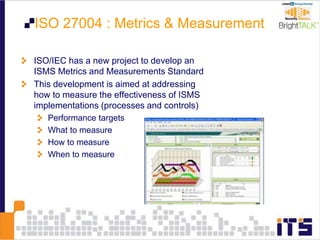
ISO 27004 : Metrics & Measurement
ISO/IEC has a new project to develop an
ISMS Metrics and Measurements Standard
This development is aimed at addressing
how to measure the effectiveness of ISMS
implementations (processes and controls)
Performance targets
What to measure
How to measure
When to measure
ISO 27005: ISMS Risk Management
A new standard on ‘Information Security Risk
Management’
This standard is being drawn up by the DTI/Cabinet
Office – with significant input from CSIA (central
Sponsor for Information Assurance)
Will be linked to MITS-2 - a new management standard
for ICT risk management
Leverages ISO13335-4
Organizational
Operational
1. Security
policy
2. Organizating
security
3. Asset
Management
7. Access
control
4. HR security
5. Physical and
environmental
security
8. Systems
development
and
maintenance
6.
Communicati
ons and
operations
management
9. Business
continuity
management
10.
Compliance
11.
Incidence
Managment
11 Key contexts ISO27001
Asset Identification
and Valuation
Identification of
Vulnerabilities Identification of
Threats
Evaluation of Impacts
Business Risks
Review of existing
security controls
Risk Assessment
Rating/ranking of Risks
Risk Management
Identification of
new security
controls
Policy and
Procedures
Implementation and
Risk Reduction
Risk Acceptance
(Residual risk)
Gap analysis
Degree of Assurance
Risk Assessment & Mgmt Process
Quantitative Risk Analysis
2 fundamental elements
probability of event
likely loss
Annual Loss Expectancy, ALE’ or ‘Estimated Annual
Cost, EAC’
ALE or EAC calculated by multiplying the potential
loss by the probability
Rank events in order of risk & make priorities
Problem with risk analysis:
associated with the unreliability & inaccuracy of the data
Probability not precise
Controls and countermeasures often tackle interrelated events
Qualitative Risk Analysis
Most widely used approach to risk analysis
Probability data NOT required
Make use of the following interrelated elements:
Threats: things that can go wrong or can ‘attack’ the system.
E.g. fire or fraud
Vulnerabilities: make a system more prone to attack
E.g. a vulnerability for fire would be the presence of inflammable
materials (e.g. paper)
Impact: loss as a result of threats.
E.g. loss of reputation and interruption of business activity.
Process
Asset
Register
Project
evaluation
Process
Mapping
Evaluating
System
Risk
Assessment
Applying
Controls
Writing
Statement
Initial
Assessment
Pre-
Assessment
Awareness
Client timeline
Implementation Process
Gap Analyses
Threats
Environmental
Natural
Disasters
Unexpected
(“OOPS” factor)
Cyber terrorism Viruses
Threats
Industrial
Espionage
Business Risks
Employee &
customer
privacy
Legislative
violations
Financial
loss
Intellectual
capital
Litigation
Public
Image/Trust
Business
Risks
Threats and Risk
16
Complexity: Increased Risk
“The Future of digital systems is
complexity, and complexity is the
worst enemy of security.”
Bruce Schneier
Crypto-Gram Newsletter, March 2000
17
More complexity more Security Flaws
Complexity & Reliability Risk
1 – 10 Simple procedure, little risk
11- 20 More Complex, moderate risk
21 – 50 Complex , high risk
>50 Untestable, VERY HIGH RISK
Complexity & Bad Fix Probability
Essential Complexity (Un-structuredness) &
Maintainability (future Reliability) Risk
1 – 4 Structured, little risk
> 4 Unstructured, High Risk
Structural Analysis … Providing Actionable Metrics
Complexity and Risk
Examples - 1
Examples - 2
Can you afford it?
eBay
12 June 1999 outage: 22 hrs.
Operating System failure
Cost: $3 million to $5 million
revenue hit
26% decline in stock price
AT&T
13 April 1998 outage: 6 to 26 hrs.
Software Upgrade
Cost: $40 million in rebates
Forced to file SLAs with the FCC
(frame relay)
MCI
August 1999 frame relay outage:
10 days
Software Upgrade
Cost: Up to 20 days free service
to 3,000 enterprises
Hershey Foods
September 1999 system failures
Application Rollout
Cost: delayed shipments; 12%
decrease in 3Q99 sales; 19%
drop in net income from 3Q98
Dev. Bank of Singapore
1 July 1999 to August 1999:
Processing Errors
Incorrect debiting of POS due
to a system overload
Cost: Embarrassment/loss of
integrity; interest charges
Charles Schwab & Co.
24 February 1999 through 21 April
1999: 4 outages of at least 4 hrs.
Upgrades/Operator Errors
Cost: ???; Announced that it had
made a $70 million new
infrastructure investment.
Causes of Unplanned
Application Downtime
Operator
Errors
40%
Application
Failures
40%
Technology
Failures
20%
Sources of Disaster
Survey of Disasters
Impact of Disaster
22
Productivity:
Number of employees x
impacted x hours out x
burdened hours = ?
productivity/
employees
$millions
minutes daystime
$impact$billions
Revenue:
Direct loss, compensatory
payment, lost future
revenues, billing losses and
investment losses
direct financial/
customer
Damaged reputation:
Customers, competitors gain
advantage, suppliers,
financial markets, business
partners
damaged
reputation
Governance &
performance:
Revenue recognition, cash
flow, credit rating, stock
price, regulatory fines
Governance
Performance
constant
increase
Indirect impact of downtime can be
far more severe and unpredictable
exponential
increase
Importance of Critical Infrastructures
Business Continuity Management
Business Impact Analysis
Risk Analysis
Recovery Strategy
Group Plans
and Procedures
Business Continuity Planning Initiation
Risk
Reduction
Implement
Standby Facilities
Create Planning Organization
Testing
PROCESS
Change Management Education Testing Review
Policy ScopeResourcesOrganization
BCM
Ongoing
Process
BCM
Project
Business Continuity timeline
Active
Business
A successful
recovery
Processes - Business Continuity Mgmt
Business Continuity
Assessments / Audits
Risk Analysis
Business Impact
Analysis
Continuity Strategies
Business Continuity
Testing
Awareness and
Training
Processes - Workflow
Risk and PDCA Model
Plan
Act
Check
Do
Test BCP
BCP
Residual Risks
Implement
Training
Plan
Risk Assessment
Risk Analysis provides focus
High
Medium
Low
Low Medium High
Area of
Major
Concern
Risk = Application Prioritization
Application
Priority
Rating
Recovery RequirementsRecovery Time Objective
AAA 0–6 Hours
Disaster Recovery needed: Restoration
at a geographically remote data center.
Local Fail over should also be considered
AA 6–12 Hours
Disaster Recovery needed: Restoration
at a geographically remote data center.
Local Fail over should also be considered.
A 12–24 Hours
Disaster Recovery needed: Restoration
at a geographically remote data center.
Local Fail over should also be considered.
B 24-48 Hours
Fail over Local,
Disaster Recovery
C 48–96 Hours Scheduled/Delayed Recovery
D Recovery in 1 Week Scheduled/Delayed Recovery
E
Recovery when
Resources Permit
Scheduled/Delayed Recovery
Metrics and Risk
Risk Management
Elimination
Reduction/Controls
Transfer/Outsource
Insurance
Residual
Not all risk can be
eliminated via
controls
DR Strategies Options
Immediate,
High-Impact
Strategies
Weekly Backup and
Off-site Storage
Daily Backup and
Off-site Storage
Weekly Mirroring &
Electronic Vaulting
Daily Mirroring &
Electronic Vaulting
Real-time Mirroring &
Electronic Vaulting
Vendor
Agreements
Quick Ship
Agreements
Owned
Cold Site
Owned
Hot Site
External
Cold Site
External
Hot Site
Decision Tree contains
5 x 2 x 4 = 40 strategic options
Strategy Optimization
Recovery strategy must be optimized to business requirements
Time
CostofStrategy
Mitigation
LostRevenue
Optimum Mitigation
Strategy
Response and Risk approach
Risk Management and Business Controls
Events
Incidents
Crises
Impact Monitor & resolve the
“critical few” with crisis
management team
Assess impact of events &
implement appropriate controls
Monitor & resolve at
appropriate level using
processesIncident Management
Process
Crisis Management
Process
New Technologies, New Risks
Laptops
Mobiles
Bluetooth
PDA
Smart Card
Social Engineering Risk
… 70 percent of those asked said they would
reveal their computer passwords for a …
Schrage, Michael. 2005. Retrieved from
http://www.technologyreview.com/articles/05/03/issue/review_password.asp?p=1
Bar of chocolate
Framework must address Risk
Threats Vulnerabilities
Controls Risks Assets
Security
Requirements
Business
Impact
exploit
exposeincreaseincrease
increase have
protect against
met by indicate
reduce
39
0 5 10 15 20 25 30
Number of Responses (n=35)
Unauthorized manipulation of components, switches,
breakers, etc. from the SCADA system
Denial of service to SCADA system
Disaster Recovery
Software / patch management
Operating system vulnerabilities
Vandalism or sabotage (electronic)
Computer viruses, worms, Trojan horses, zero day attacks
Remote access/VPN
SCADA Security Survey – May 2005
Example: Top SCADA Risks
Integration of Logical and Physical
Business Security Management
Physical
Security
Management
ICT
Security
Management
Leveraging Standards
ICT & Business Continuity
Risk Key Performance Indicators
CoBiT, Metrics
ITIL
ISO20000
( & BS15000)
ISO27001
ISO27031
BS25999
Risk Provides Focus
High Medium Low
High
A B C
Medium
B B C
Low
C C D
Business Impact
Vulnerability
Part of Defense in depth
Risk Trade Offs
Secure Low Risk
Fast/EasyCheap
In Risk Management there are
trade-offs
Risk
Management
ISO27001
SOA
Risk
Assessment
Risk Mitigation
Controls
ISO27031
BS25999
Risk Analysis
Risk Management/Security Certifications
Questions

Risk mgmt key to security certifications v2

  • 1.
    Risk Management Key toSecurity Certifications Risk Management Summit jorge.sebastiao@its.ws
  • 2.
    Standards ISO 27000 –principles and vocabulary ISO 27001 – ISMS requirements (BS7799 – Part 2) ISO 27002 – (ISO/ IEC 17799:2005) ISO 27003 – ISMS Implementation guidelines ISO 27004 – ISMS Metrics and measurement ISO 27005 – ISMS Risk Management ISO 27031 - ICT readiness for business continuity BS25999 – Business Continuity Management
  • 3.
  • 4.
    British Standard BS25999 TheBCM Lifecycle: BS 25999-1 2006 BCM Programme Management Understanding the organization Determining BCM strategy Developing & implementing BCM response Exercising, maintaining & reviewing
  • 5.
    High level BC& Security policy management technical risk assets threats vulnerability influence Possibility of occurence Non-technical Risk management Implement of plan Policy Driven Process
  • 6.
    ISO 27004 :Metrics & Measurement ISO/IEC has a new project to develop an ISMS Metrics and Measurements Standard This development is aimed at addressing how to measure the effectiveness of ISMS implementations (processes and controls) Performance targets What to measure How to measure When to measure
  • 7.
    ISO 27005: ISMSRisk Management A new standard on ‘Information Security Risk Management’ This standard is being drawn up by the DTI/Cabinet Office – with significant input from CSIA (central Sponsor for Information Assurance) Will be linked to MITS-2 - a new management standard for ICT risk management Leverages ISO13335-4
  • 8.
    Organizational Operational 1. Security policy 2. Organizating security 3.Asset Management 7. Access control 4. HR security 5. Physical and environmental security 8. Systems development and maintenance 6. Communicati ons and operations management 9. Business continuity management 10. Compliance 11. Incidence Managment 11 Key contexts ISO27001
  • 9.
    Asset Identification and Valuation Identificationof Vulnerabilities Identification of Threats Evaluation of Impacts Business Risks Review of existing security controls Risk Assessment Rating/ranking of Risks Risk Management Identification of new security controls Policy and Procedures Implementation and Risk Reduction Risk Acceptance (Residual risk) Gap analysis Degree of Assurance Risk Assessment & Mgmt Process
  • 10.
    Quantitative Risk Analysis 2fundamental elements probability of event likely loss Annual Loss Expectancy, ALE’ or ‘Estimated Annual Cost, EAC’ ALE or EAC calculated by multiplying the potential loss by the probability Rank events in order of risk & make priorities Problem with risk analysis: associated with the unreliability & inaccuracy of the data Probability not precise Controls and countermeasures often tackle interrelated events
  • 11.
    Qualitative Risk Analysis Mostwidely used approach to risk analysis Probability data NOT required Make use of the following interrelated elements: Threats: things that can go wrong or can ‘attack’ the system. E.g. fire or fraud Vulnerabilities: make a system more prone to attack E.g. a vulnerability for fire would be the presence of inflammable materials (e.g. paper) Impact: loss as a result of threats. E.g. loss of reputation and interruption of business activity.
  • 12.
  • 13.
  • 14.
  • 15.
  • 16.
    16 Complexity: Increased Risk “TheFuture of digital systems is complexity, and complexity is the worst enemy of security.” Bruce Schneier Crypto-Gram Newsletter, March 2000
  • 17.
    17 More complexity moreSecurity Flaws Complexity & Reliability Risk 1 – 10 Simple procedure, little risk 11- 20 More Complex, moderate risk 21 – 50 Complex , high risk >50 Untestable, VERY HIGH RISK Complexity & Bad Fix Probability Essential Complexity (Un-structuredness) & Maintainability (future Reliability) Risk 1 – 4 Structured, little risk > 4 Unstructured, High Risk Structural Analysis … Providing Actionable Metrics Complexity and Risk
  • 18.
  • 19.
  • 20.
    Can you affordit? eBay 12 June 1999 outage: 22 hrs. Operating System failure Cost: $3 million to $5 million revenue hit 26% decline in stock price AT&T 13 April 1998 outage: 6 to 26 hrs. Software Upgrade Cost: $40 million in rebates Forced to file SLAs with the FCC (frame relay) MCI August 1999 frame relay outage: 10 days Software Upgrade Cost: Up to 20 days free service to 3,000 enterprises Hershey Foods September 1999 system failures Application Rollout Cost: delayed shipments; 12% decrease in 3Q99 sales; 19% drop in net income from 3Q98 Dev. Bank of Singapore 1 July 1999 to August 1999: Processing Errors Incorrect debiting of POS due to a system overload Cost: Embarrassment/loss of integrity; interest charges Charles Schwab & Co. 24 February 1999 through 21 April 1999: 4 outages of at least 4 hrs. Upgrades/Operator Errors Cost: ???; Announced that it had made a $70 million new infrastructure investment. Causes of Unplanned Application Downtime Operator Errors 40% Application Failures 40% Technology Failures 20%
  • 21.
  • 22.
    Impact of Disaster 22 Productivity: Numberof employees x impacted x hours out x burdened hours = ? productivity/ employees $millions minutes daystime $impact$billions Revenue: Direct loss, compensatory payment, lost future revenues, billing losses and investment losses direct financial/ customer Damaged reputation: Customers, competitors gain advantage, suppliers, financial markets, business partners damaged reputation Governance & performance: Revenue recognition, cash flow, credit rating, stock price, regulatory fines Governance Performance constant increase Indirect impact of downtime can be far more severe and unpredictable exponential increase
  • 23.
    Importance of CriticalInfrastructures
  • 24.
    Business Continuity Management BusinessImpact Analysis Risk Analysis Recovery Strategy Group Plans and Procedures Business Continuity Planning Initiation Risk Reduction Implement Standby Facilities Create Planning Organization Testing PROCESS Change Management Education Testing Review Policy ScopeResourcesOrganization BCM Ongoing Process BCM Project
  • 25.
  • 26.
    Processes - BusinessContinuity Mgmt Business Continuity Assessments / Audits Risk Analysis Business Impact Analysis Continuity Strategies Business Continuity Testing Awareness and Training
  • 27.
  • 28.
    Risk and PDCAModel Plan Act Check Do Test BCP BCP Residual Risks Implement Training Plan Risk Assessment
  • 29.
    Risk Analysis providesfocus High Medium Low Low Medium High Area of Major Concern
  • 30.
    Risk = ApplicationPrioritization Application Priority Rating Recovery RequirementsRecovery Time Objective AAA 0–6 Hours Disaster Recovery needed: Restoration at a geographically remote data center. Local Fail over should also be considered AA 6–12 Hours Disaster Recovery needed: Restoration at a geographically remote data center. Local Fail over should also be considered. A 12–24 Hours Disaster Recovery needed: Restoration at a geographically remote data center. Local Fail over should also be considered. B 24-48 Hours Fail over Local, Disaster Recovery C 48–96 Hours Scheduled/Delayed Recovery D Recovery in 1 Week Scheduled/Delayed Recovery E Recovery when Resources Permit Scheduled/Delayed Recovery
  • 31.
  • 32.
  • 33.
    DR Strategies Options Immediate, High-Impact Strategies WeeklyBackup and Off-site Storage Daily Backup and Off-site Storage Weekly Mirroring & Electronic Vaulting Daily Mirroring & Electronic Vaulting Real-time Mirroring & Electronic Vaulting Vendor Agreements Quick Ship Agreements Owned Cold Site Owned Hot Site External Cold Site External Hot Site Decision Tree contains 5 x 2 x 4 = 40 strategic options
  • 34.
    Strategy Optimization Recovery strategymust be optimized to business requirements Time CostofStrategy Mitigation LostRevenue Optimum Mitigation Strategy
  • 35.
    Response and Riskapproach Risk Management and Business Controls Events Incidents Crises Impact Monitor & resolve the “critical few” with crisis management team Assess impact of events & implement appropriate controls Monitor & resolve at appropriate level using processesIncident Management Process Crisis Management Process
  • 36.
    New Technologies, NewRisks Laptops Mobiles Bluetooth PDA Smart Card
  • 37.
    Social Engineering Risk …70 percent of those asked said they would reveal their computer passwords for a … Schrage, Michael. 2005. Retrieved from http://www.technologyreview.com/articles/05/03/issue/review_password.asp?p=1 Bar of chocolate
  • 38.
    Framework must addressRisk Threats Vulnerabilities Controls Risks Assets Security Requirements Business Impact exploit exposeincreaseincrease increase have protect against met by indicate reduce
  • 39.
    39 0 5 1015 20 25 30 Number of Responses (n=35) Unauthorized manipulation of components, switches, breakers, etc. from the SCADA system Denial of service to SCADA system Disaster Recovery Software / patch management Operating system vulnerabilities Vandalism or sabotage (electronic) Computer viruses, worms, Trojan horses, zero day attacks Remote access/VPN SCADA Security Survey – May 2005 Example: Top SCADA Risks
  • 40.
    Integration of Logicaland Physical Business Security Management Physical Security Management ICT Security Management
  • 41.
    Leveraging Standards ICT &Business Continuity Risk Key Performance Indicators CoBiT, Metrics ITIL ISO20000 ( & BS15000) ISO27001 ISO27031 BS25999
  • 42.
    Risk Provides Focus HighMedium Low High A B C Medium B B C Low C C D Business Impact Vulnerability
  • 43.
  • 44.
    Risk Trade Offs SecureLow Risk Fast/EasyCheap In Risk Management there are trade-offs
  • 45.
  • 46.