CMMI and Agile
Joining Principles With Practice To Produce A Single
Integrated Software Development System
Glen B. Alleman
Program Planning and Controls
June 23, 2011
Profession Develop Day (PDD)
Grapevine Convention Center
1209 South Main Street
Grapevine, TX 76051
Learning Outcomes for Today
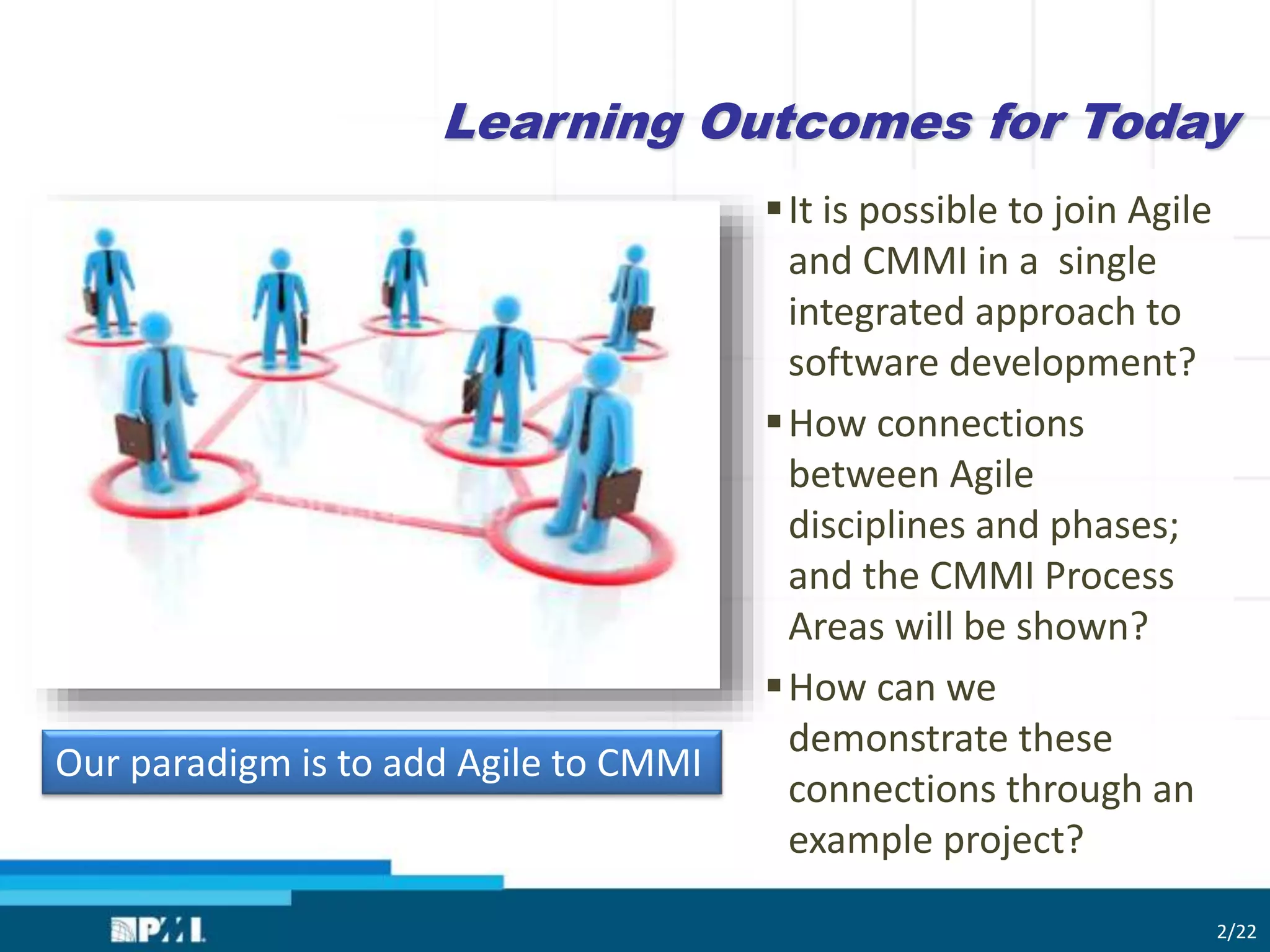
It is possible to join Agile
and CMMI in a single
integrated approach to
software development?
How connections
between Agile
disciplines and phases;
and the CMMI Process
Areas will be shown?
How can we
demonstrate these
connections through an
example project?
2/22
Our paradigm is to add Agile to CMMI
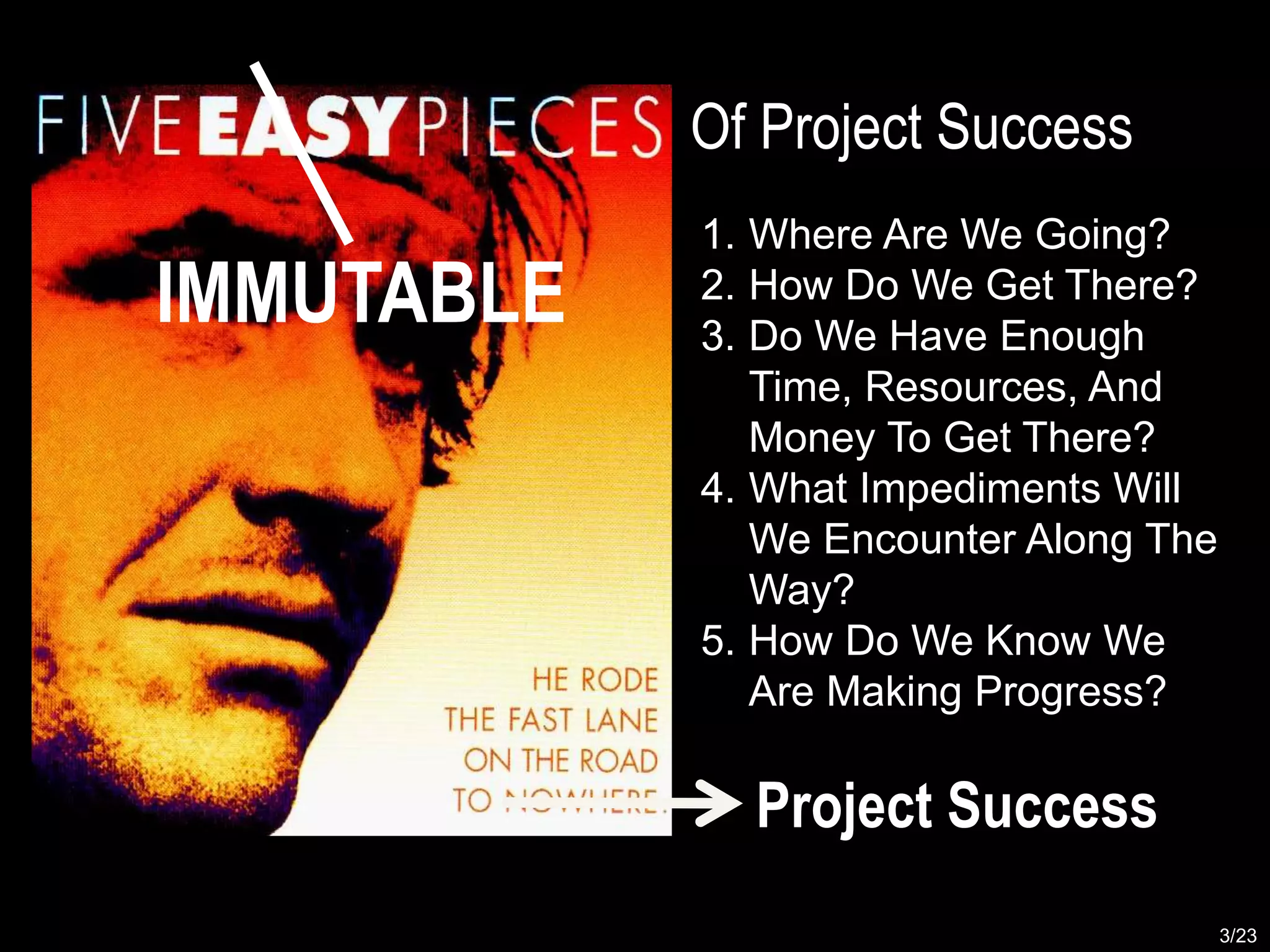
1. Where Are We Going?
2. How Do We Get There?
3. Do We Have Enough
Time, Resources, And
Money To Get There?
4. What Impediments Will
We Encounter Along The
Way?
5. How Do We Know We
Are Making Progress?
IMMUTABLE
Of Project Success
Project Success
3/23
CMMI provides guidance on general
systems development practices and
institutionalization of process practices
across the project, program, or
organization.
CMMI is a process model, not a process
description.
CMMI is a set of principles for
process improvement
4/22
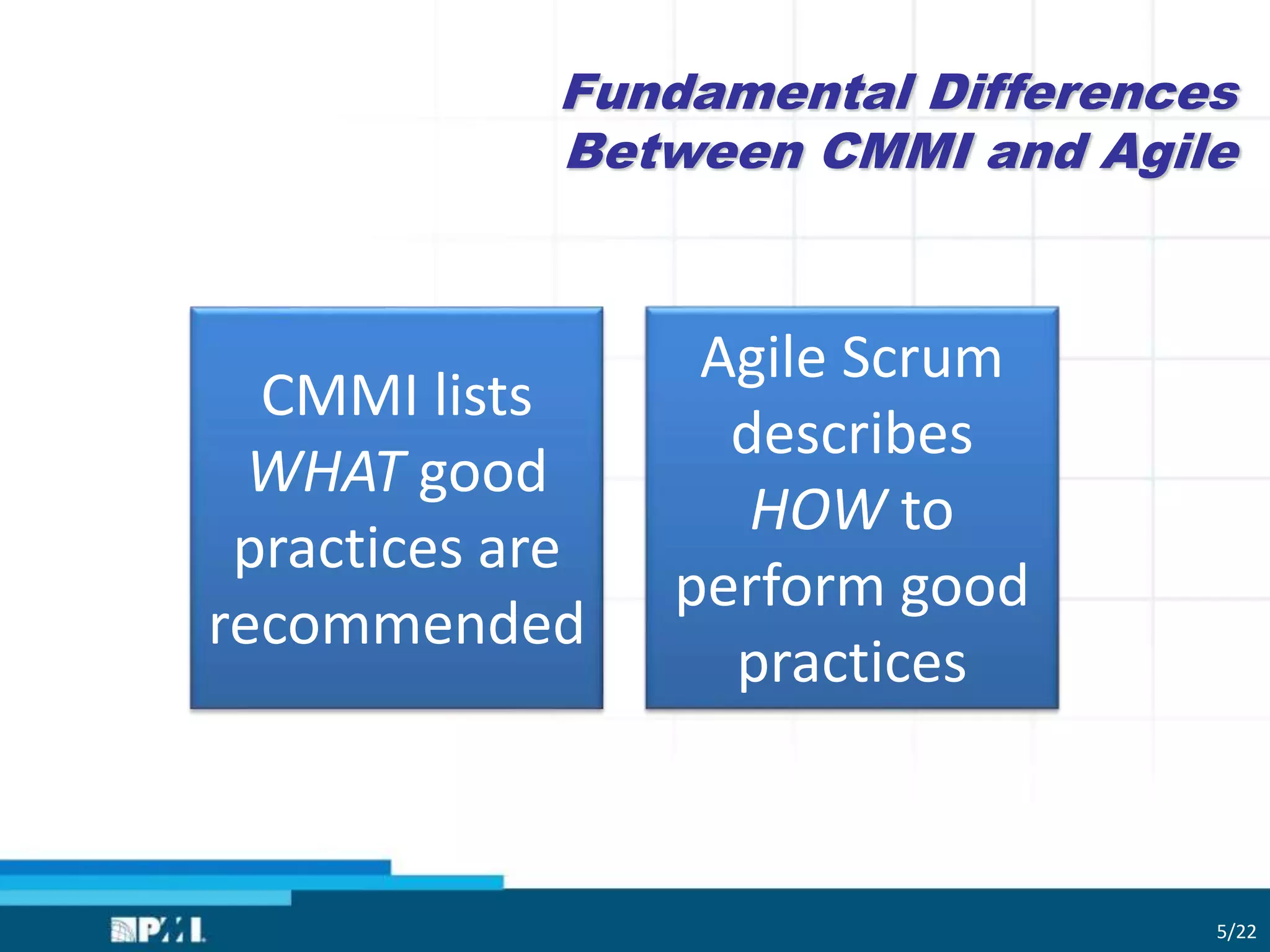
Fundamental Differences
Between CMMI and Agile
5/22
CMMI lists
WHAT good
practices are
recommended
Agile Scrum
describes
HOW to
perform good
practices
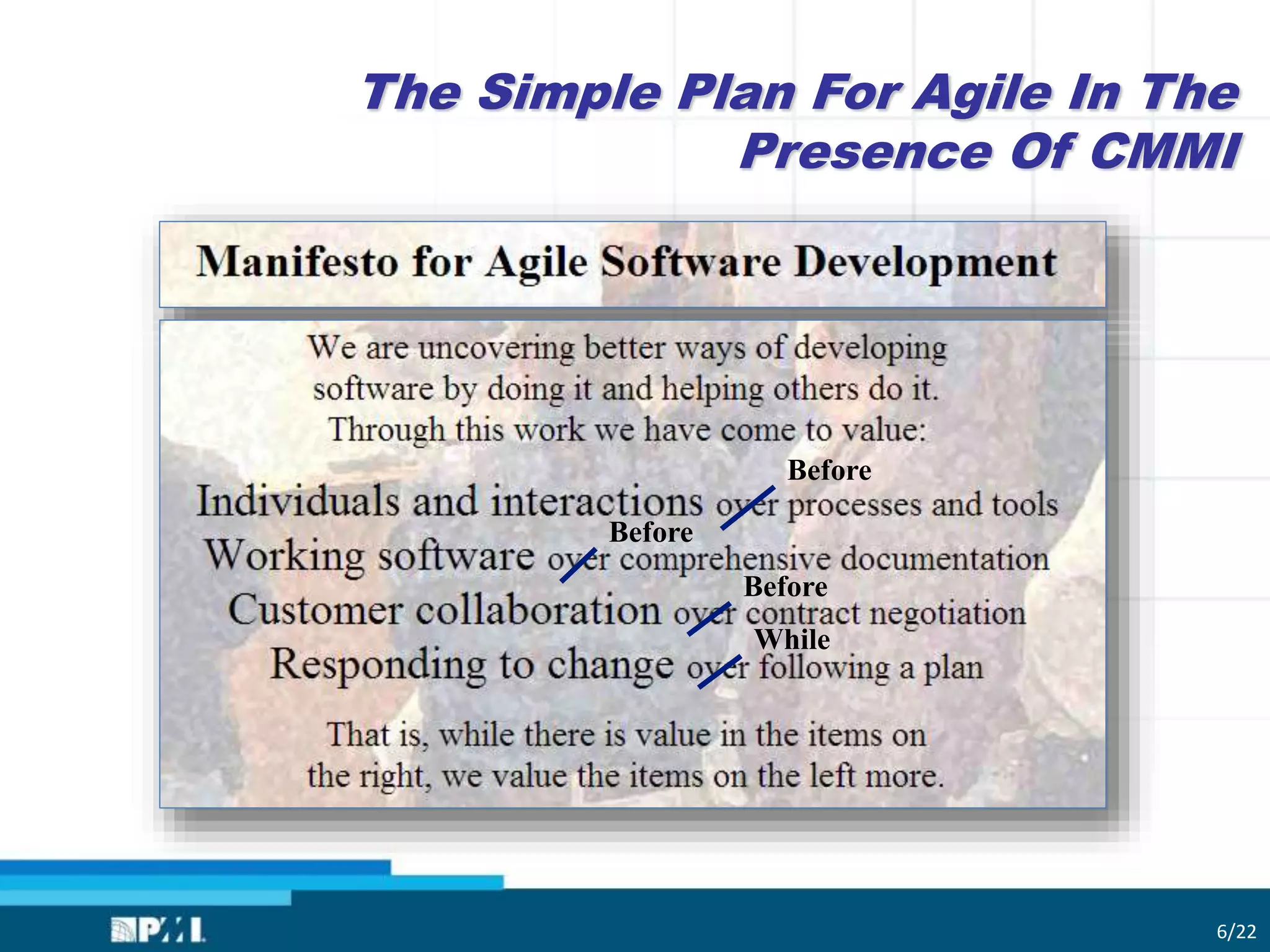
The Simple Plan For Agile In The
Presence Of CMMI
Before
Before
Before
While
6/22
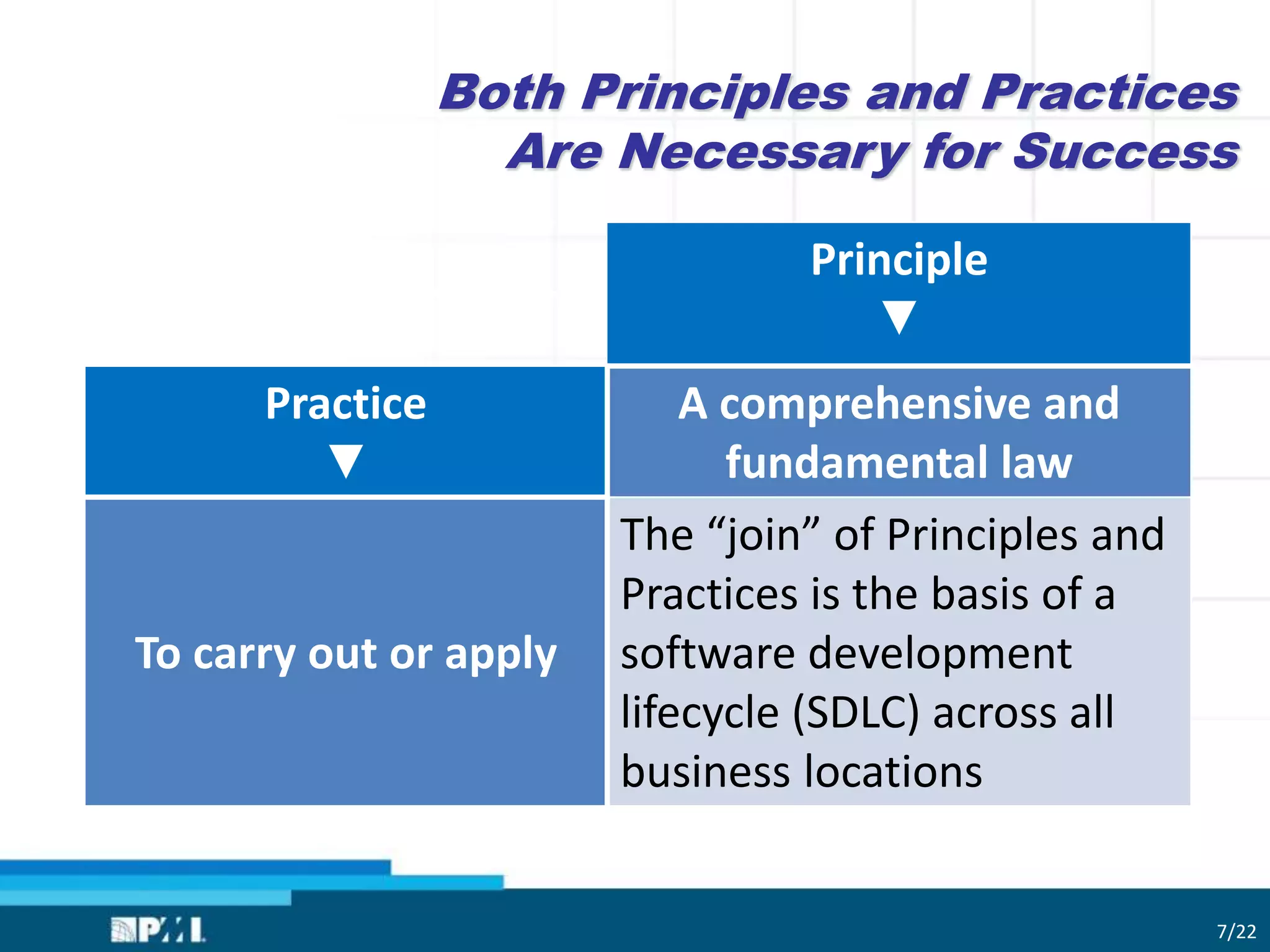
Both Principles and Practices
Are Necessary for Success
Principle
▼
Practice
▼
A comprehensive and
fundamental law
To carry out or apply
The “join” of Principles and
Practices is the basis of a
software development
lifecycle (SDLC) across all
business locations
7/22
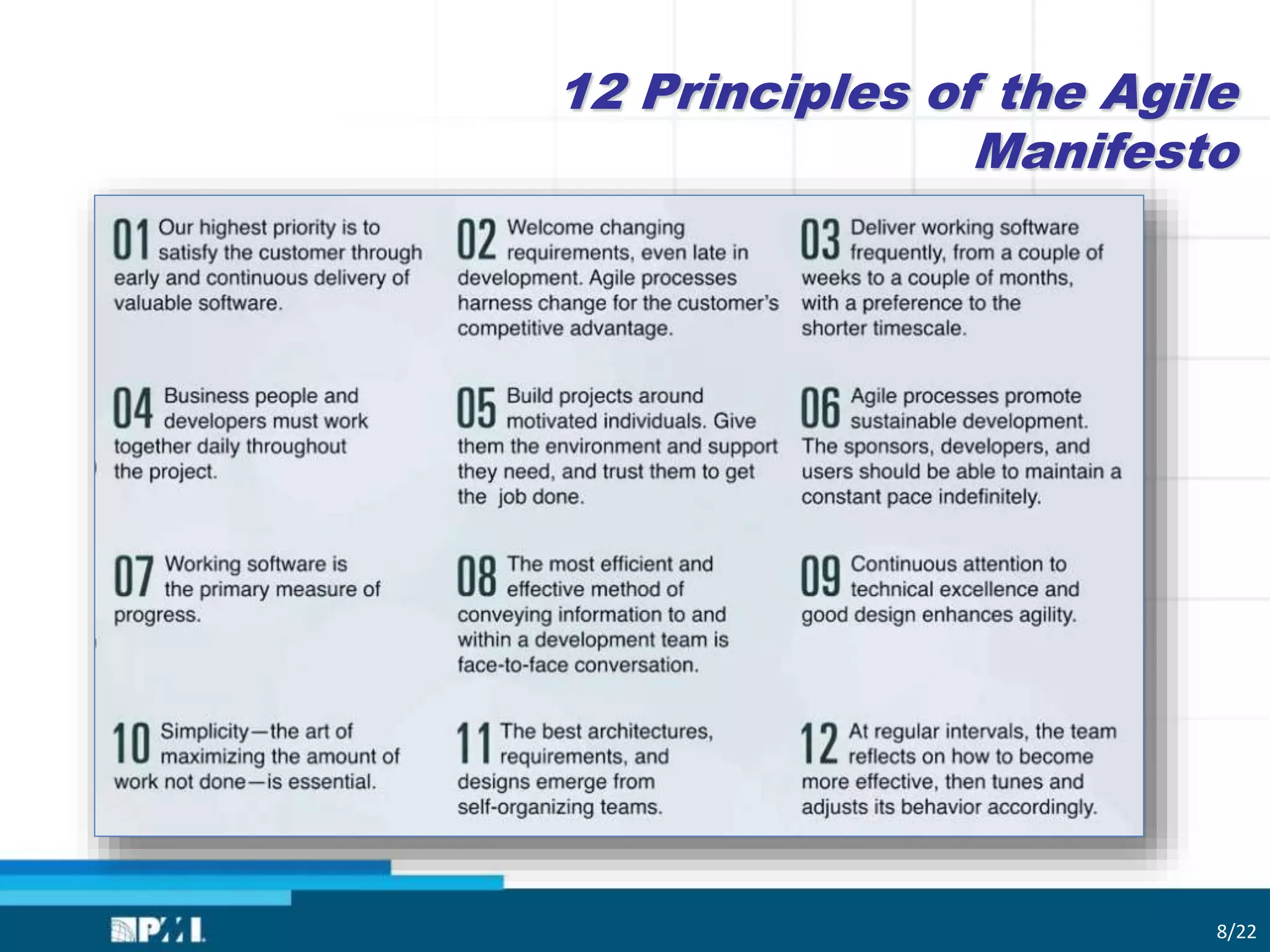
12 Principles of the Agile
Manifesto
8/22
Work is required to integrate Principles of
CMMI with Practices of Agile Software
Development
 Establish a bi–direction connection between CMMI and Agile
 Identify Maturity Level 2 & 3 Process Area Disciplines in Agile
 Develop a roadmap for applying Agile to a variety of project
types within CMMI Maturity Level 3
9/22
Principles of CMMI include …
 Process discipline leads to predictable performance
– Say what you do, do what you say
 Conscience choices lead to better processes
– Identify relevant stakeholders
– Identify work products
– Define validation procedures
 Organizational learning improves project performance
– Capture what works and doesn’t work
– Have rules guide projects
– Define expected processes and let project tailor them to fit
– Capture work products and measures and learn from them
10/22
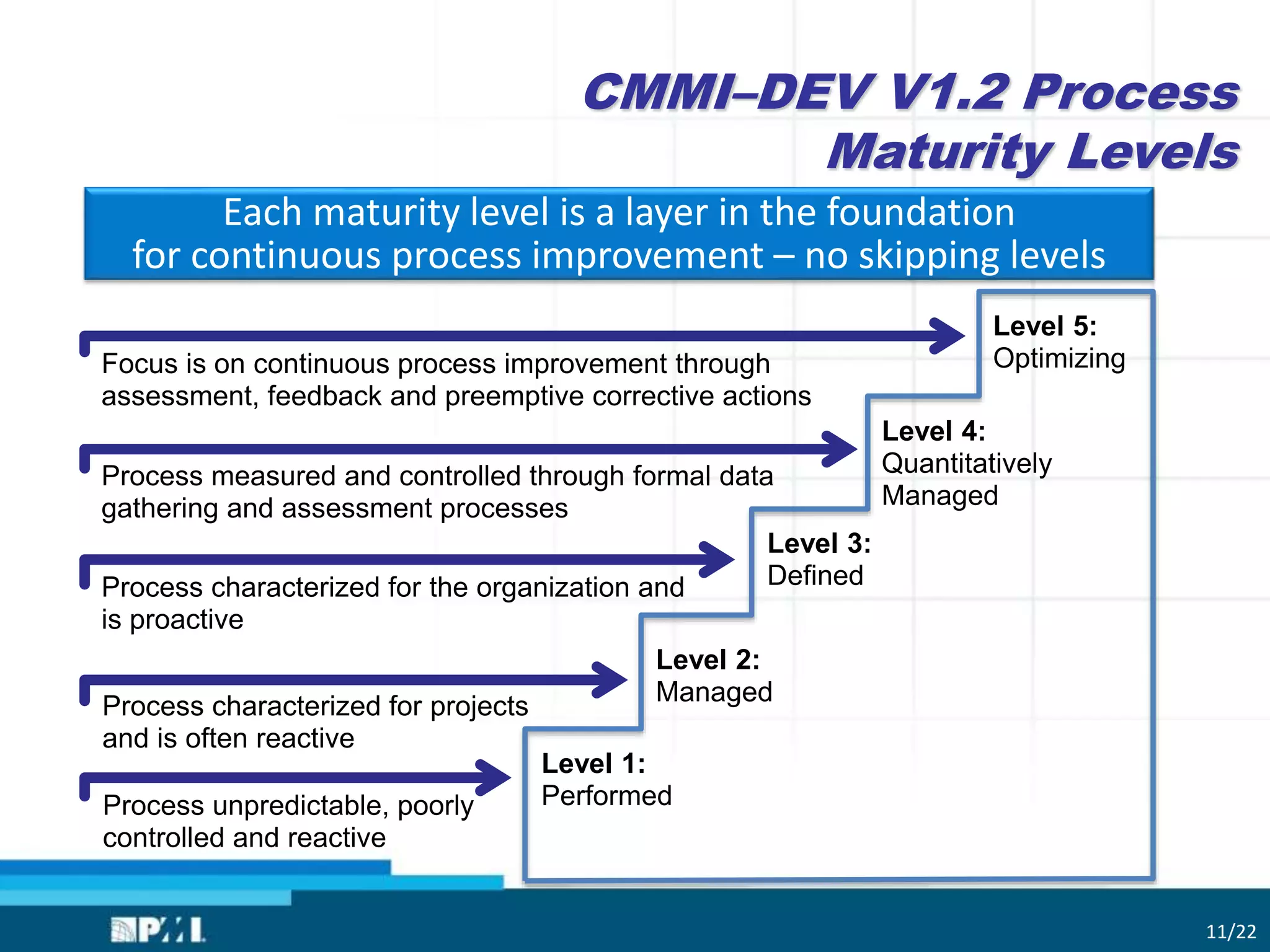
CMMI–DEV V1.2 Process
Maturity Levels
Process characterized for projects
and is often reactive
Process characterized for the organization and
is proactive
Process measured and controlled through formal data
gathering and assessment processes
Focus is on continuous process improvement through
assessment, feedback and preemptive corrective actions
Level 4:
Quantitatively
Managed
Level 1:
Performed
Level 2:
Managed
Level 5:
Optimizing
Level 3:
Defined
Each maturity level is a layer in the foundation
for continuous process improvement – no skipping levels
Process unpredictable, poorly
controlled and reactive
11/22
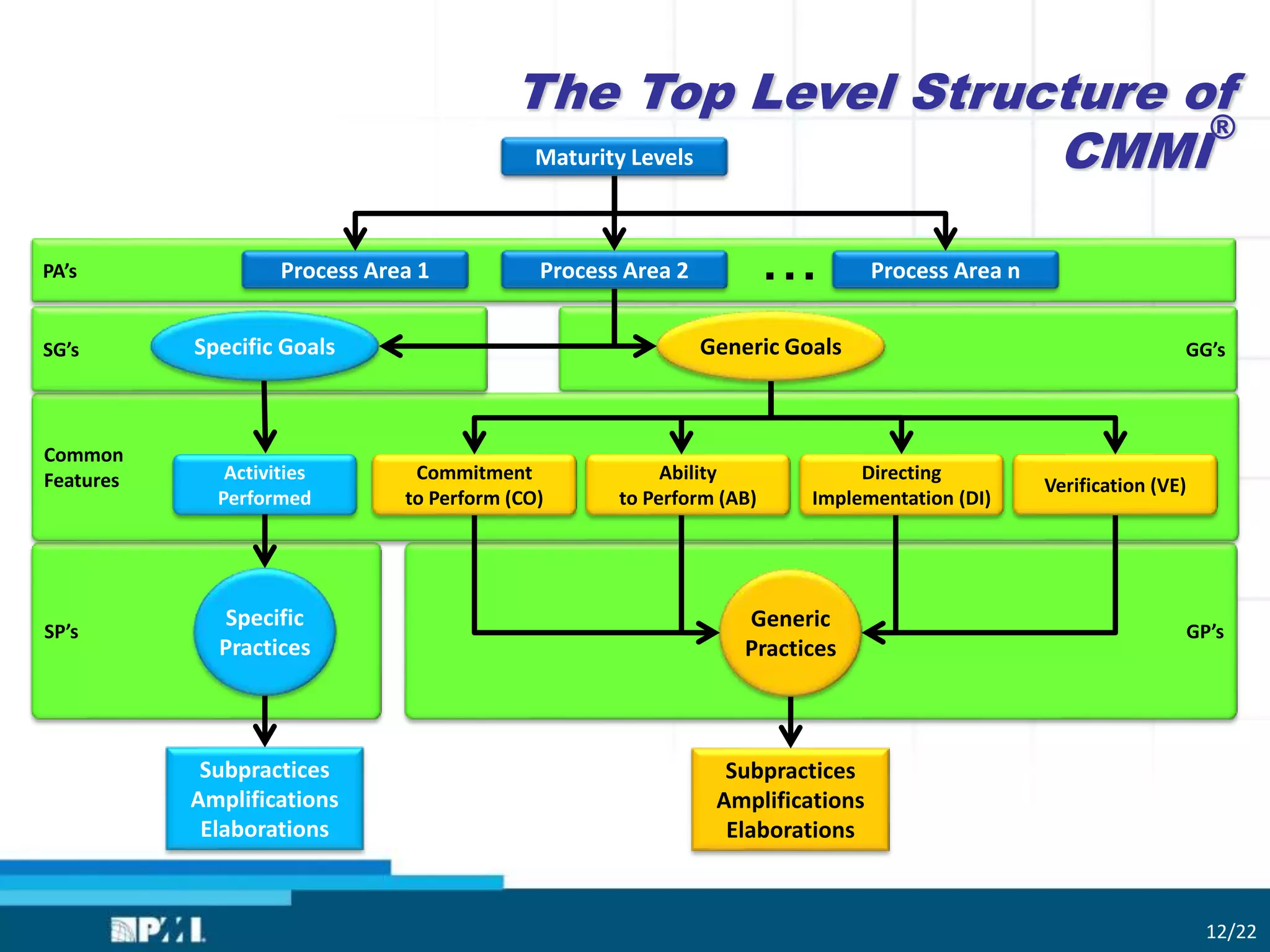
GG’s
GP’sSP’s
Common
Features
SG’s
PA’s
The Top Level Structure of
CMMI
®
Commitment
to Perform (CO)
Maturity Levels
Specific Goals
Process Area 2Process Area 1 Process Area n
Ability
to Perform (AB)
Directing
Implementation (DI)
Verification (VE)
Activities
Performed
Generic Goals
...
Subpractices
Amplifications
Elaborations
Specific
Practices
Subpractices
Amplifications
Elaborations
Generic
Practices
12/22
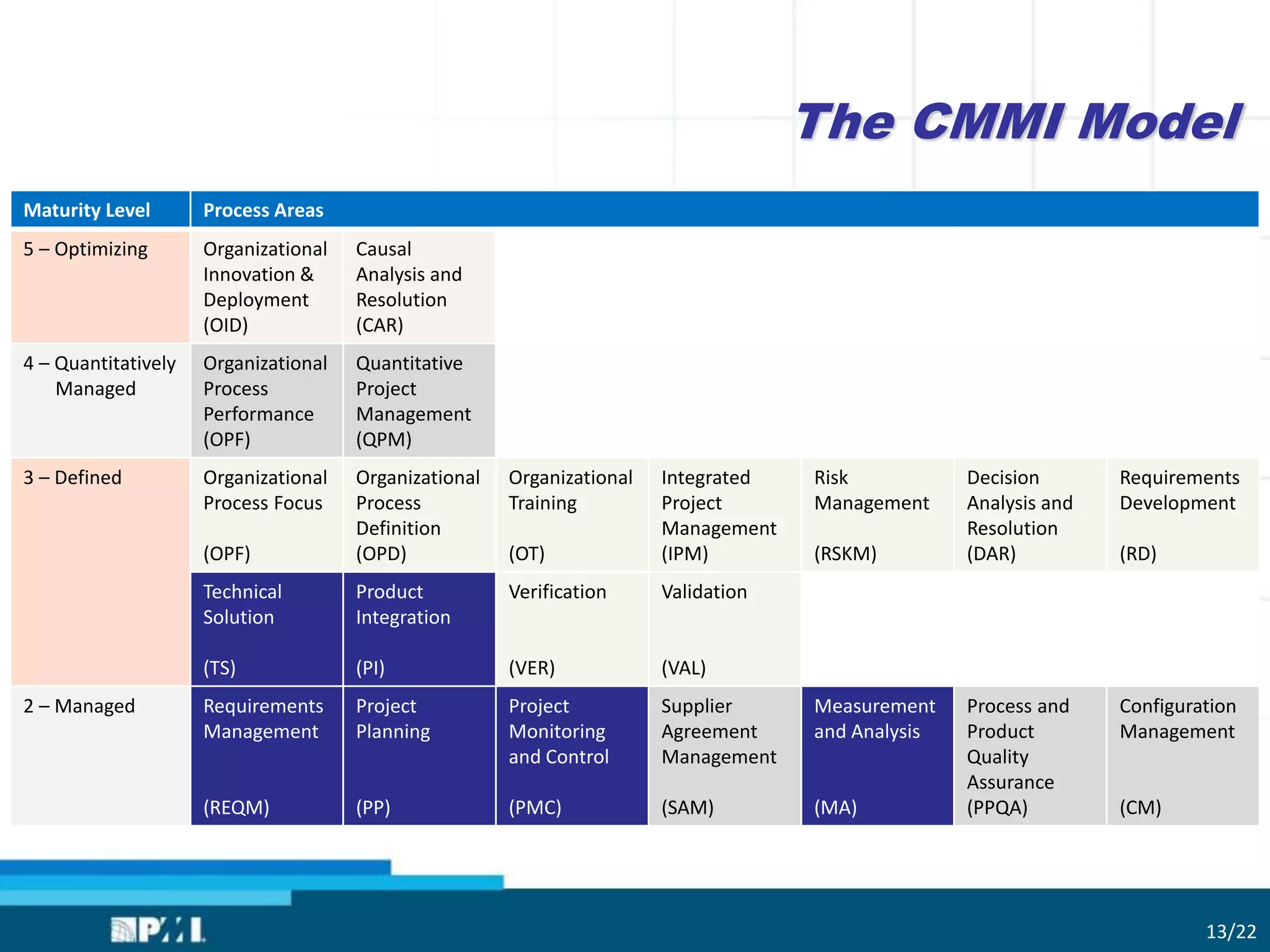
The CMMI Model
Maturity Level Process Areas
5 – Optimizing Organizational
Innovation &
Deployment
(OID)
Causal
Analysis and
Resolution
(CAR)
4 – Quantitatively
Managed
Organizational
Process
Performance
(OPF)
Quantitative
Project
Management
(QPM)
3 – Defined Organizational
Process Focus
(OPF)
Organizational
Process
Definition
(OPD)
Organizational
Training
(OT)
Integrated
Project
Management
(IPM)
Risk
Management
(RSKM)
Decision
Analysis and
Resolution
(DAR)
Requirements
Development
(RD)
Technical
Solution
(TS)
Product
Integration
(PI)
Verification
(VER)
Validation
(VAL)
2 – Managed Requirements
Management
(REQM)
Project
Planning
(PP)
Project
Monitoring
and Control
(PMC)
Supplier
Agreement
Management
(SAM)
Measurement
and Analysis
(MA)
Process and
Product
Quality
Assurance
(PPQA)
Configuration
Management
(CM)
13/22
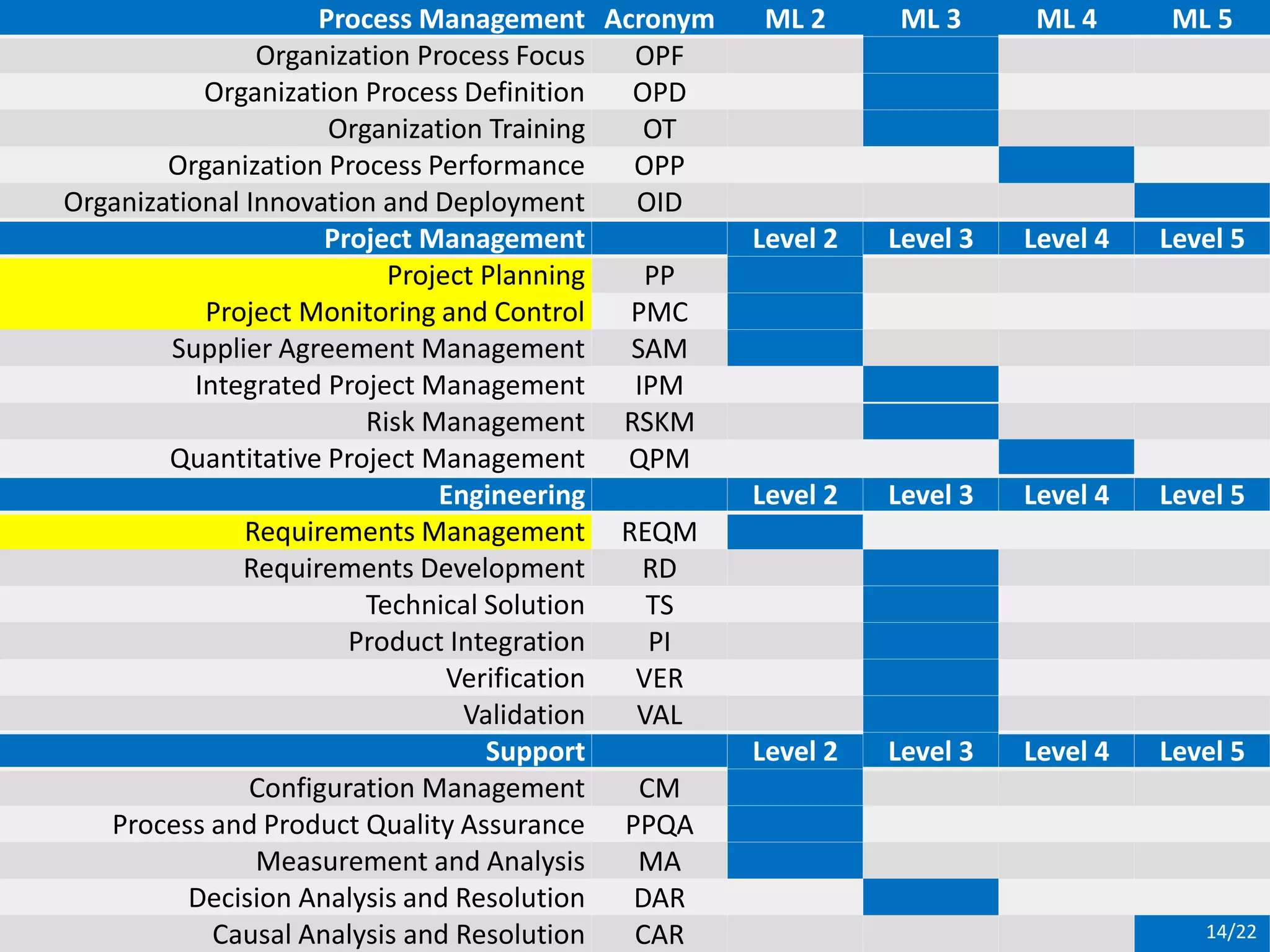
Process Management Acronym ML 2 ML 3 ML 4 ML 5
Organization Process Focus OPF
Organization Process Definition OPD
Organization Training OT
Organization Process Performance OPP
Organizational Innovation and Deployment OID
Project Management Level 2 Level 3 Level 4 Level 5
Project Planning PP
Project Monitoring and Control PMC
Supplier Agreement Management SAM
Integrated Project Management IPM
Risk Management RSKM
Quantitative Project Management QPM
Engineering Level 2 Level 3 Level 4 Level 5
Requirements Management REQM
Requirements Development RD
Technical Solution TS
Product Integration PI
Verification VER
Validation VAL
Support Level 2 Level 3 Level 4 Level 5
Configuration Management CM
Process and Product Quality Assurance PPQA
Measurement and Analysis MA
Decision Analysis and Resolution DAR
Causal Analysis and Resolution CAR 14/22
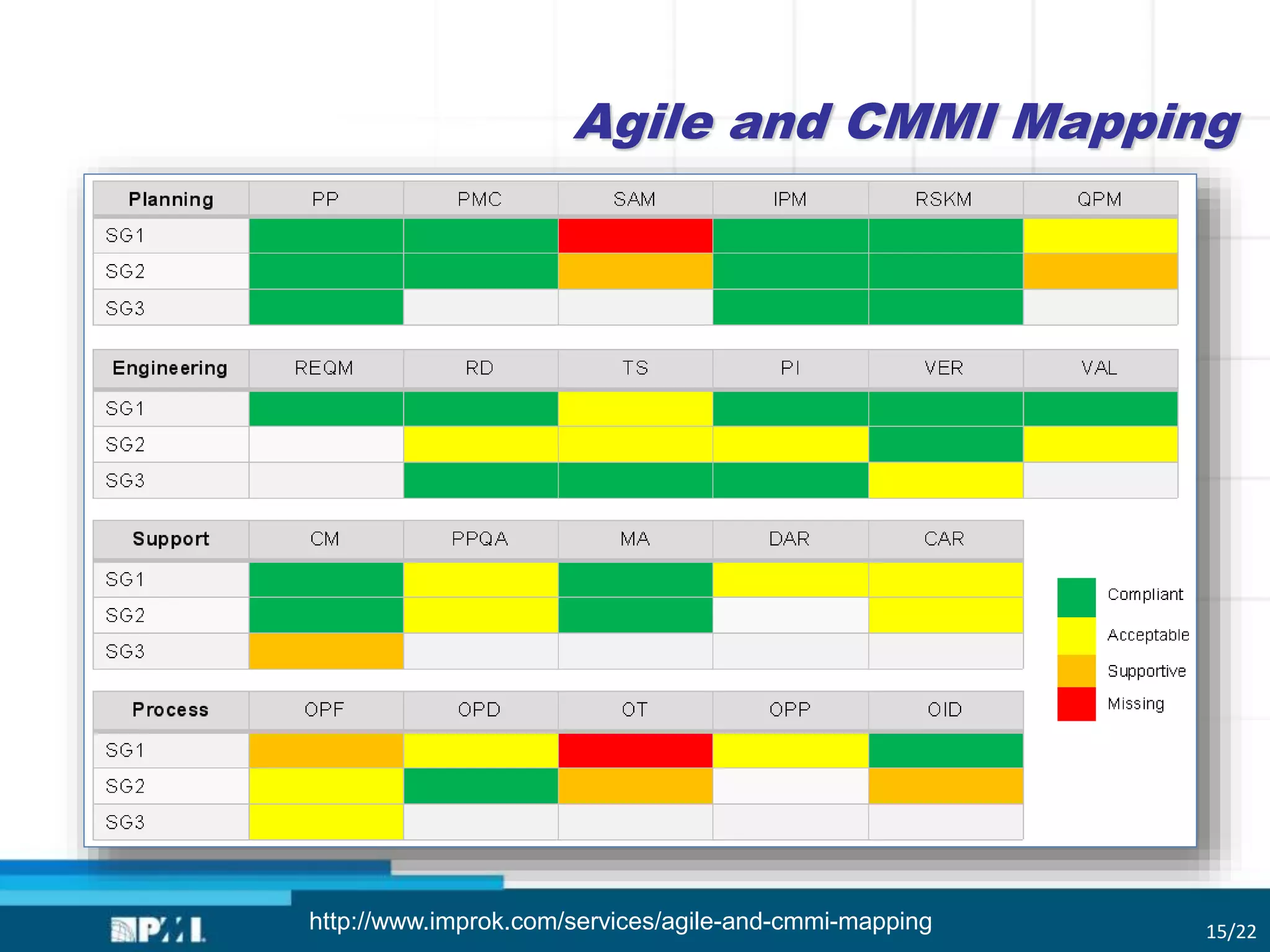
Agile and CMMI Mapping
http://www.improk.com/services/agile-and-cmmi-mapping 15/22
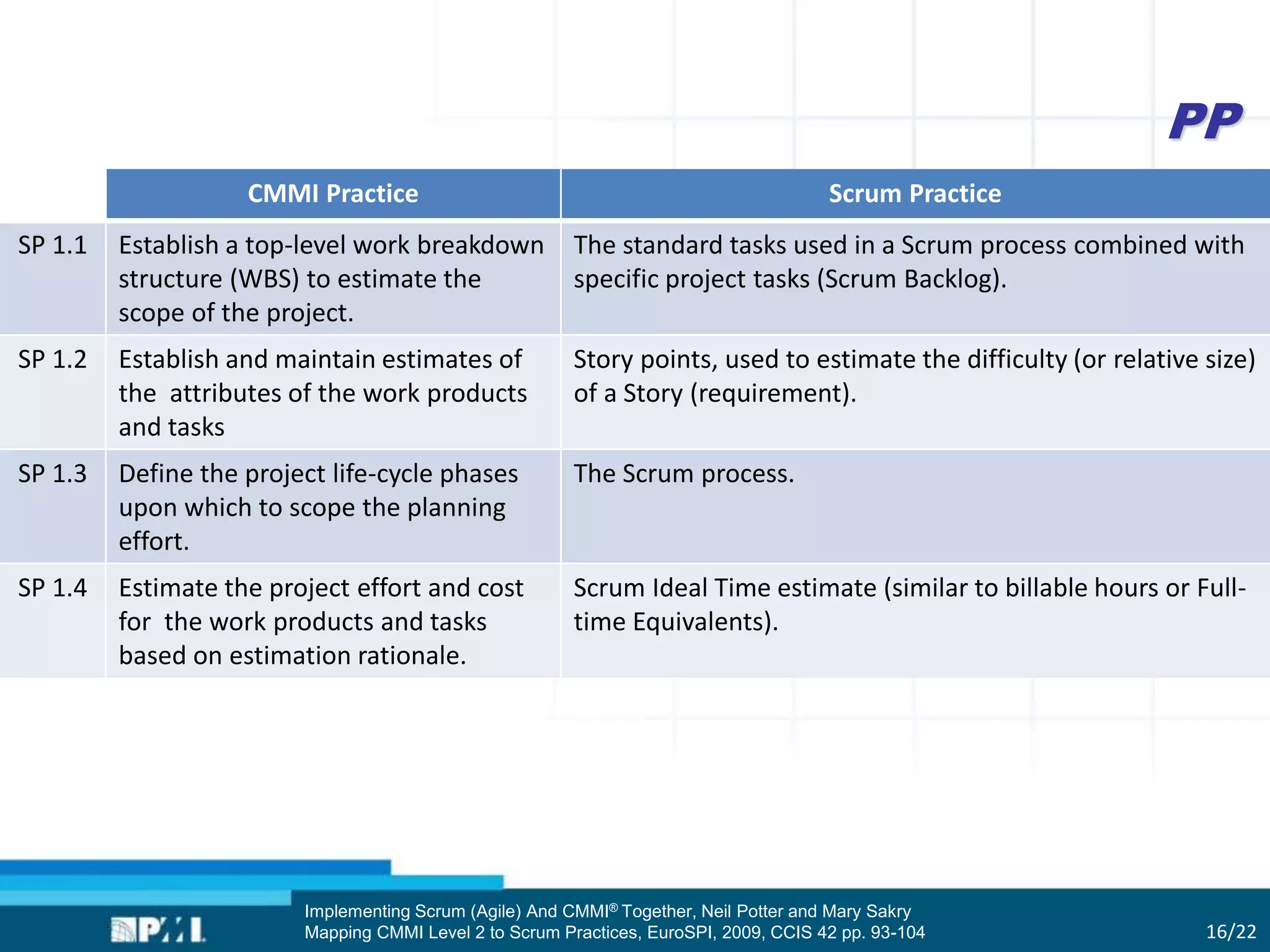
PP
16/22
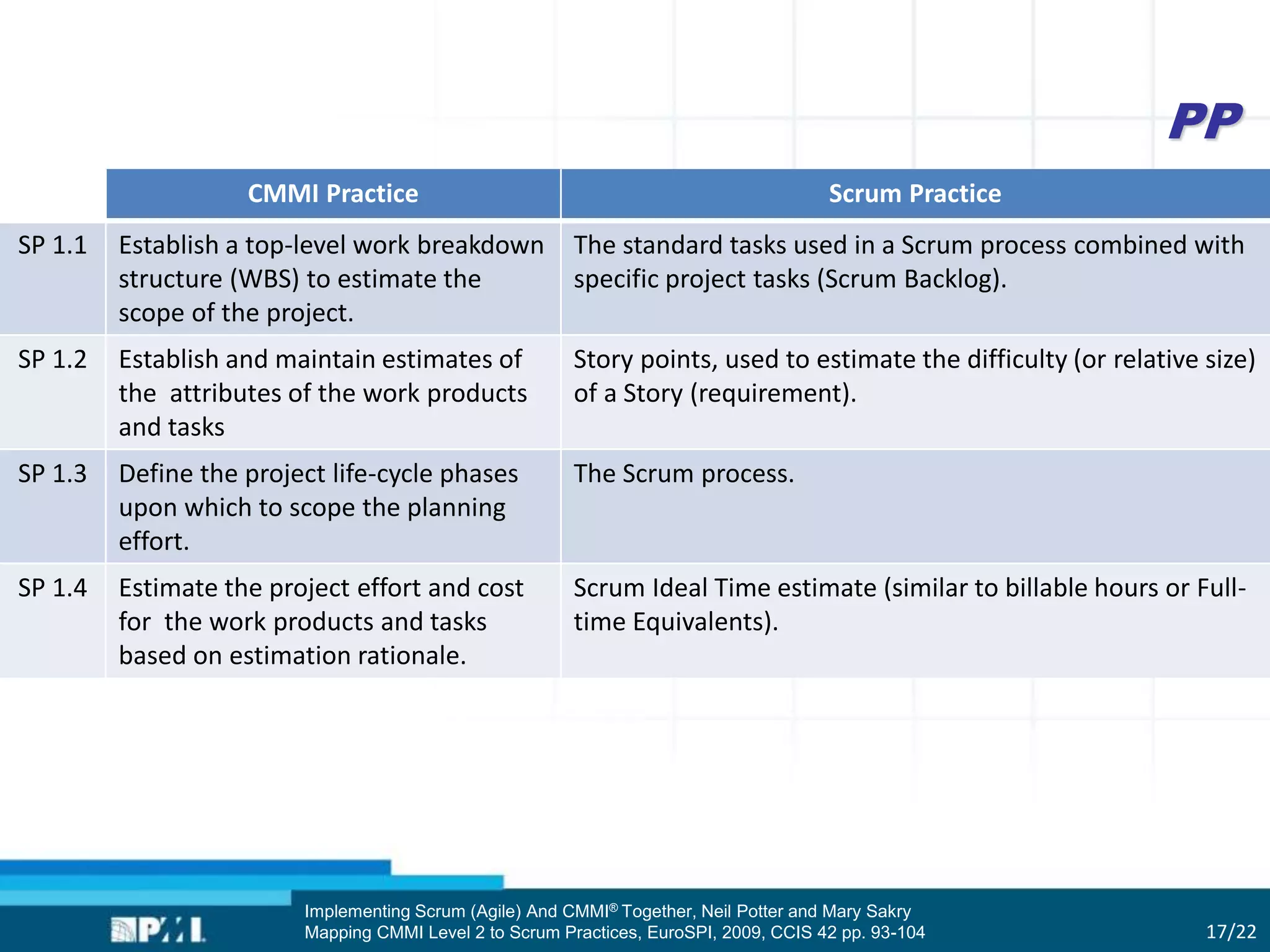
CMMI Practice Scrum Practice
SP 1.1 Establish a top-level work breakdown
structure (WBS) to estimate the
scope of the project.
The standard tasks used in a Scrum process combined with
specific project tasks (Scrum Backlog).
SP 1.2 Establish and maintain estimates of
the attributes of the work products
and tasks
Story points, used to estimate the difficulty (or relative size)
of a Story (requirement).
SP 1.3 Define the project life-cycle phases
upon which to scope the planning
effort.
The Scrum process.
SP 1.4 Estimate the project effort and cost
for the work products and tasks
based on estimation rationale.
Scrum Ideal Time estimate (similar to billable hours or Full-
time Equivalents).
Implementing Scrum (Agile) And CMMI® Together, Neil Potter and Mary Sakry
Mapping CMMI Level 2 to Scrum Practices, EuroSPI, 2009, CCIS 42 pp. 93-104
PP
17/22
CMMI Practice Scrum Practice
SP 1.1 Establish a top-level work breakdown
structure (WBS) to estimate the
scope of the project.
The standard tasks used in a Scrum process combined with
specific project tasks (Scrum Backlog).
SP 1.2 Establish and maintain estimates of
the attributes of the work products
and tasks
Story points, used to estimate the difficulty (or relative size)
of a Story (requirement).
SP 1.3 Define the project life-cycle phases
upon which to scope the planning
effort.
The Scrum process.
SP 1.4 Estimate the project effort and cost
for the work products and tasks
based on estimation rationale.
Scrum Ideal Time estimate (similar to billable hours or Full-
time Equivalents).
Implementing Scrum (Agile) And CMMI® Together, Neil Potter and Mary Sakry
Mapping CMMI Level 2 to Scrum Practices, EuroSPI, 2009, CCIS 42 pp. 93-104
PP
18/22
CMMI Practice Scrum Practice
SP 2.1 Establish and maintain the project’s
budget and schedule.
 Scrum estimates (in Ideal Time).
 Estimates of what work will be in each release.
 Sprint Backlog.
 Project Taskboard.
SP 2.4 Plan for necessary resources to
perform the project.
 Scrum estimates in Ideal Time
 Release plan, Sprint Backlog and assignments.
SP 2.6 Plan the involvement of identified
stakeholders.
 Scrum process roles (including team, Scrum Master,
Product Owner).
 [Note: The stakeholders listed in Scrum might not be the
complete list of stakeholders for the project, e.g.,
customers, other impacted teams.]
SP 2.7 Establish and maintain the overall
project plan content.
 Scrum release plan.
 Sprint Backlog.
 Project Taskboard.
 [Note: The term “plan” in CMMI refers to additional plan
components (such as risks and data management) that
are not called out specifically in Scrum.]
Implementing Scrum (Agile) And CMMI® Together, Neil Potter and Mary Sakry
Mapping CMMI Level 2 to Scrum Practices, EuroSPI, 2009, CCIS 42 pp. 93-104
PP
19/22
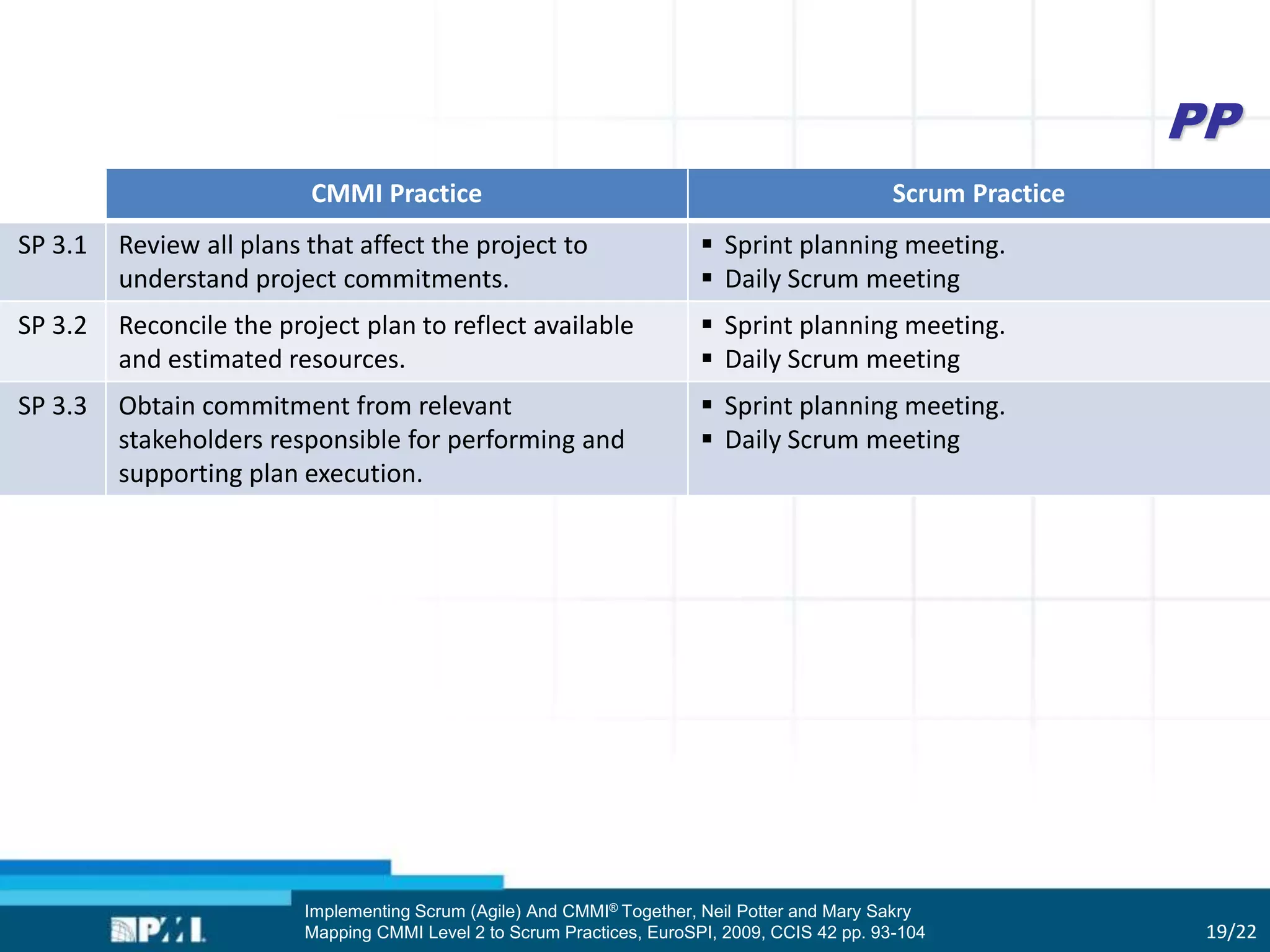
CMMI Practice Scrum Practice
SP 3.1 Review all plans that affect the project to
understand project commitments.
 Sprint planning meeting.
 Daily Scrum meeting
SP 3.2 Reconcile the project plan to reflect available
and estimated resources.
 Sprint planning meeting.
 Daily Scrum meeting
SP 3.3 Obtain commitment from relevant
stakeholders responsible for performing and
supporting plan execution.
 Sprint planning meeting.
 Daily Scrum meeting
Implementing Scrum (Agile) And CMMI® Together, Neil Potter and Mary Sakry
Mapping CMMI Level 2 to Scrum Practices, EuroSPI, 2009, CCIS 42 pp. 93-104
PMC
20/22
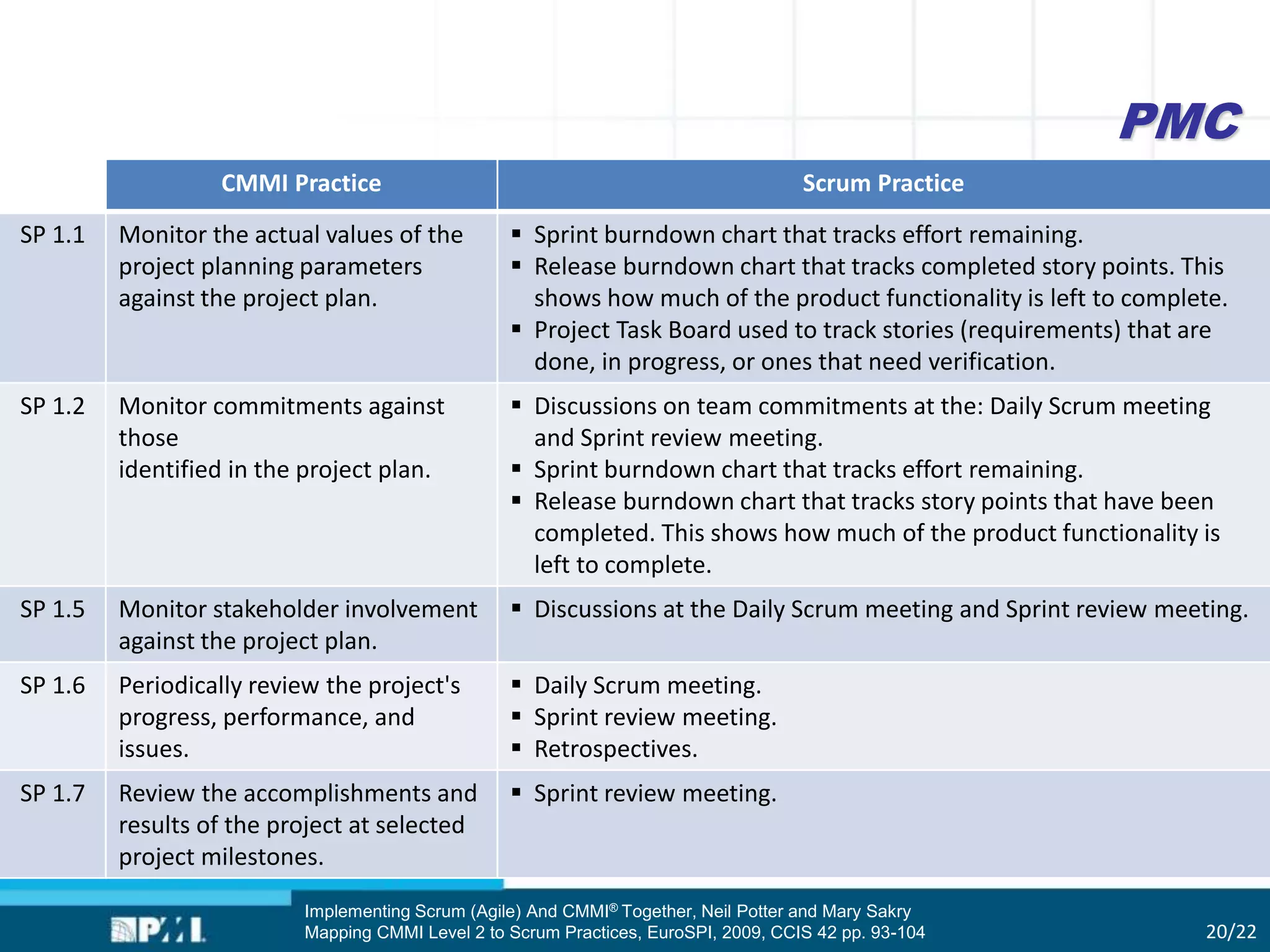
CMMI Practice Scrum Practice
SP 1.1 Monitor the actual values of the
project planning parameters
against the project plan.
 Sprint burndown chart that tracks effort remaining.
 Release burndown chart that tracks completed story points. This
shows how much of the product functionality is left to complete.
 Project Task Board used to track stories (requirements) that are
done, in progress, or ones that need verification.
SP 1.2 Monitor commitments against
those
identified in the project plan.
 Discussions on team commitments at the: Daily Scrum meeting
and Sprint review meeting.
 Sprint burndown chart that tracks effort remaining.
 Release burndown chart that tracks story points that have been
completed. This shows how much of the product functionality is
left to complete.
SP 1.5 Monitor stakeholder involvement
against the project plan.
 Discussions at the Daily Scrum meeting and Sprint review meeting.
SP 1.6 Periodically review the project's
progress, performance, and
issues.
 Daily Scrum meeting.
 Sprint review meeting.
 Retrospectives.
SP 1.7 Review the accomplishments and
results of the project at selected
project milestones.
 Sprint review meeting.
Implementing Scrum (Agile) And CMMI® Together, Neil Potter and Mary Sakry
Mapping CMMI Level 2 to Scrum Practices, EuroSPI, 2009, CCIS 42 pp. 93-104
PMC
21/22
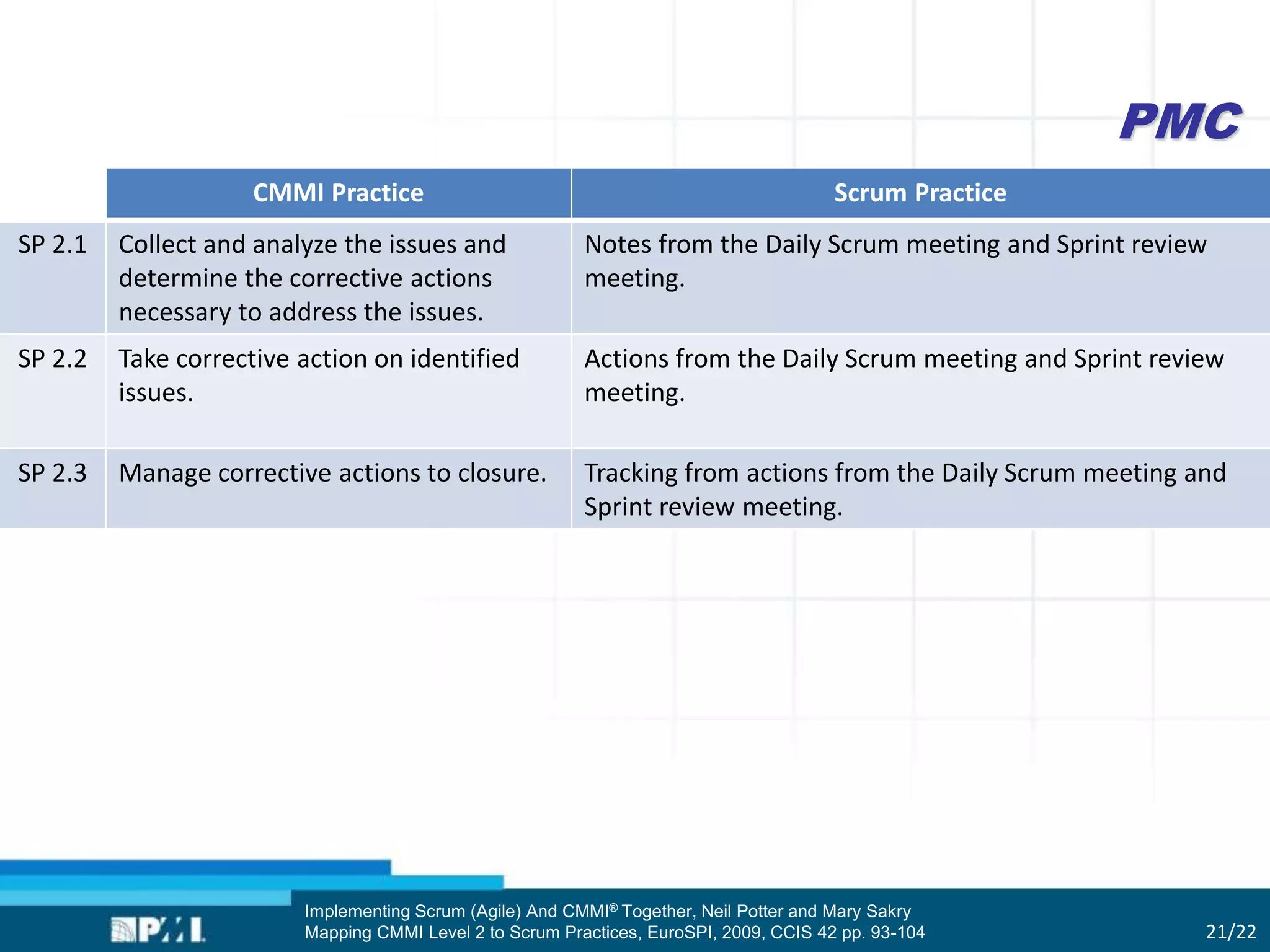
CMMI Practice Scrum Practice
SP 2.1 Collect and analyze the issues and
determine the corrective actions
necessary to address the issues.
Notes from the Daily Scrum meeting and Sprint review
meeting.
SP 2.2 Take corrective action on identified
issues.
Actions from the Daily Scrum meeting and Sprint review
meeting.
SP 2.3 Manage corrective actions to closure. Tracking from actions from the Daily Scrum meeting and
Sprint review meeting.
Implementing Scrum (Agile) And CMMI® Together, Neil Potter and Mary Sakry
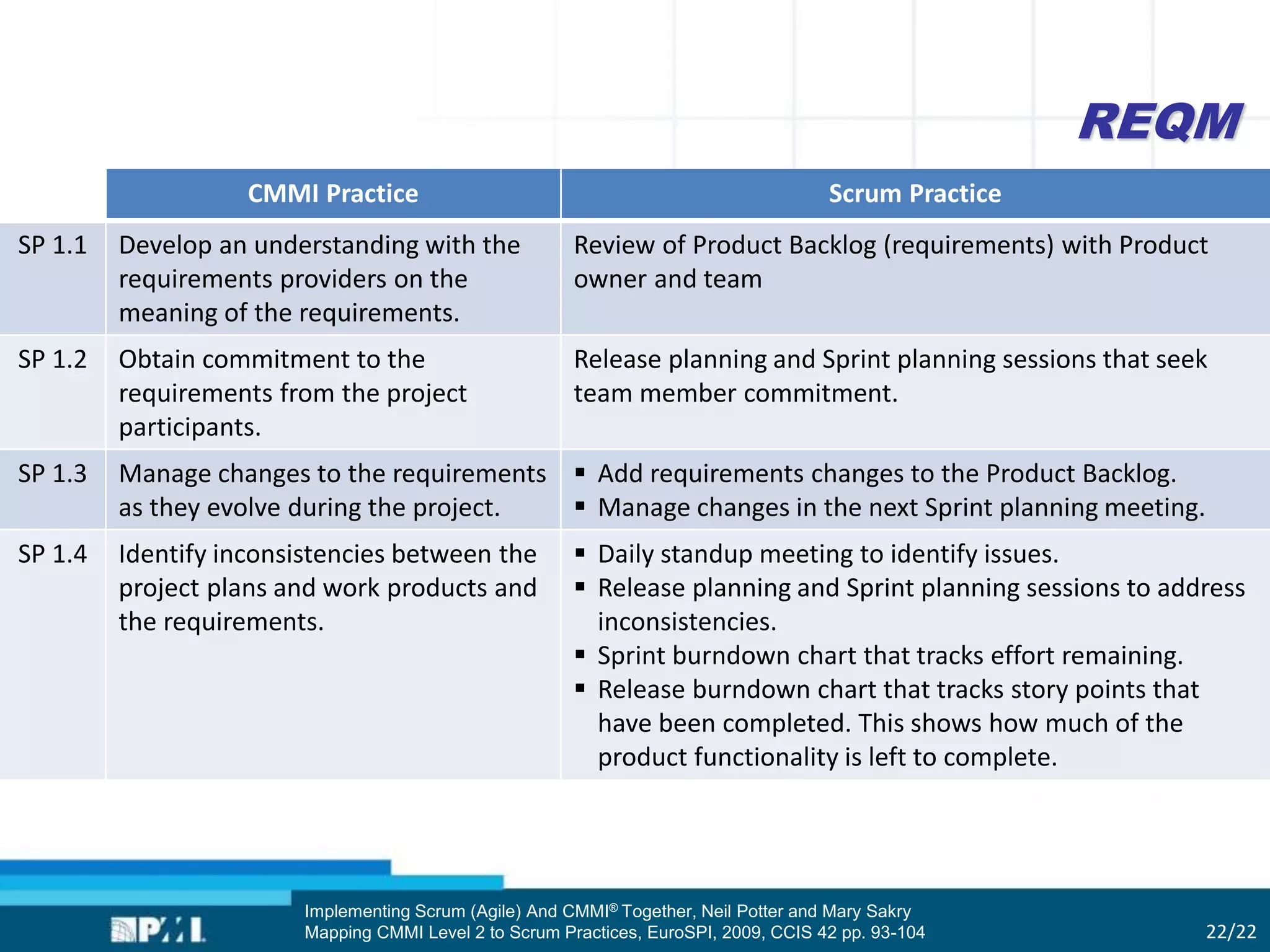
Mapping CMMI Level 2 to Scrum Practices, EuroSPI, 2009, CCIS 42 pp. 93-104
REQM
22/22
CMMI Practice Scrum Practice
SP 1.1 Develop an understanding with the
requirements providers on the
meaning of the requirements.
Review of Product Backlog (requirements) with Product
owner and team
SP 1.2 Obtain commitment to the
requirements from the project
participants.
Release planning and Sprint planning sessions that seek
team member commitment.
SP 1.3 Manage changes to the requirements
as they evolve during the project.
 Add requirements changes to the Product Backlog.
 Manage changes in the next Sprint planning meeting.
SP 1.4 Identify inconsistencies between the
project plans and work products and
the requirements.
 Daily standup meeting to identify issues.
 Release planning and Sprint planning sessions to address
inconsistencies.
 Sprint burndown chart that tracks effort remaining.
 Release burndown chart that tracks story points that
have been completed. This shows how much of the
product functionality is left to complete.
Implementing Scrum (Agile) And CMMI® Together, Neil Potter and Mary Sakry
Mapping CMMI Level 2 to Scrum Practices, EuroSPI, 2009, CCIS 42 pp. 93-104
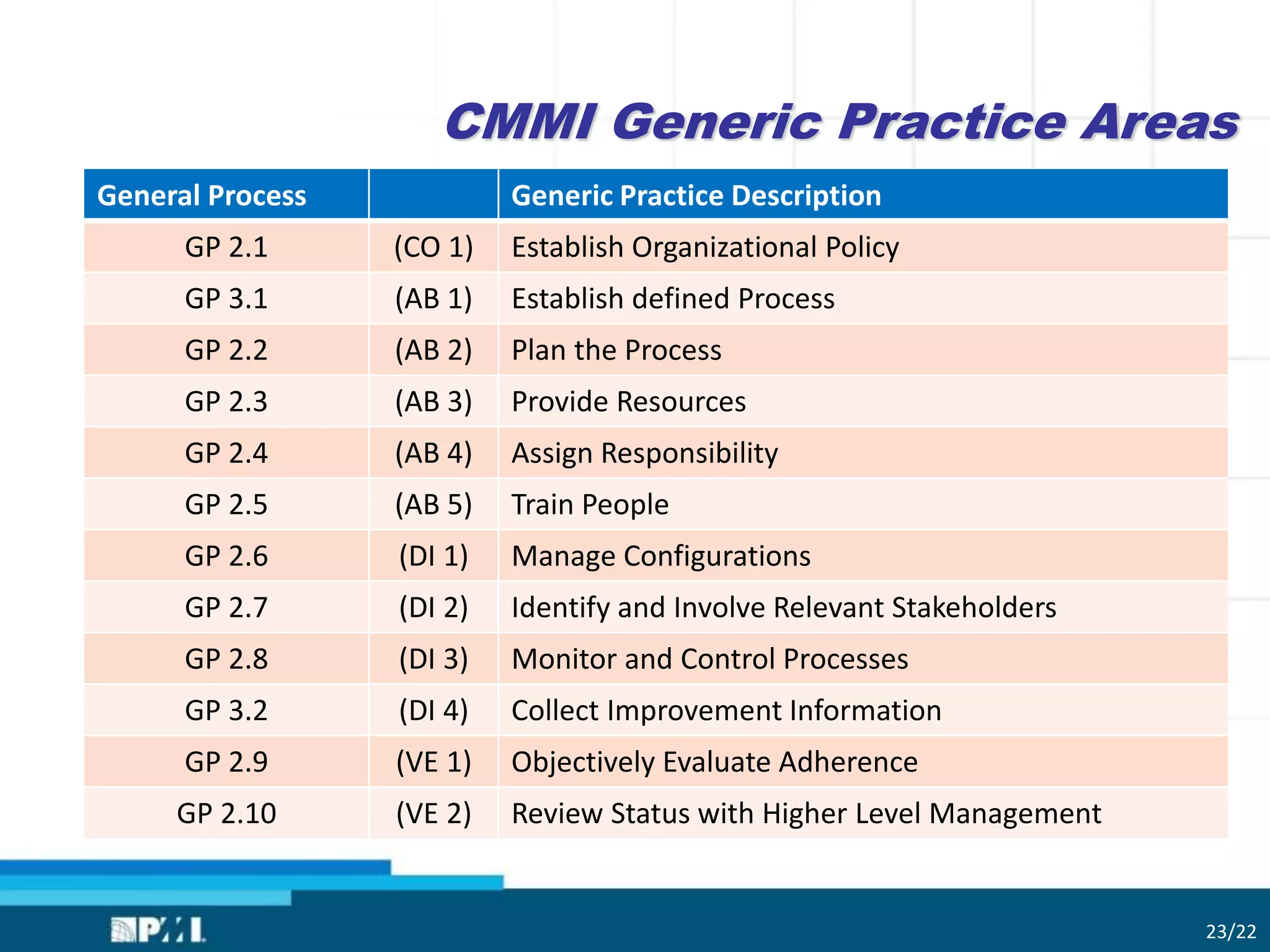
CMMI Generic Practice Areas
General Process Generic Practice Description
GP 2.1 (CO 1) Establish Organizational Policy
GP 3.1 (AB 1) Establish defined Process
GP 2.2 (AB 2) Plan the Process
GP 2.3 (AB 3) Provide Resources
GP 2.4 (AB 4) Assign Responsibility
GP 2.5 (AB 5) Train People
GP 2.6 (DI 1) Manage Configurations
GP 2.7 (DI 2) Identify and Involve Relevant Stakeholders
GP 2.8 (DI 3) Monitor and Control Processes
GP 3.2 (DI 4) Collect Improvement Information
GP 2.9 (VE 1) Objectively Evaluate Adherence
GP 2.10 (VE 2) Review Status with Higher Level Management
23/22
24

CMMI and Agile

  • 1.
    CMMI and Agile JoiningPrinciples With Practice To Produce A Single Integrated Software Development System Glen B. Alleman Program Planning and Controls June 23, 2011 Profession Develop Day (PDD) Grapevine Convention Center 1209 South Main Street Grapevine, TX 76051
  • 2.
    Learning Outcomes forToday It is possible to join Agile and CMMI in a single integrated approach to software development? How connections between Agile disciplines and phases; and the CMMI Process Areas will be shown? How can we demonstrate these connections through an example project? 2/22 Our paradigm is to add Agile to CMMI
  • 3.
    1. Where AreWe Going? 2. How Do We Get There? 3. Do We Have Enough Time, Resources, And Money To Get There? 4. What Impediments Will We Encounter Along The Way? 5. How Do We Know We Are Making Progress? IMMUTABLE Of Project Success Project Success 3/23
  • 4.
    CMMI provides guidanceon general systems development practices and institutionalization of process practices across the project, program, or organization. CMMI is a process model, not a process description. CMMI is a set of principles for process improvement 4/22
  • 5.
    Fundamental Differences Between CMMIand Agile 5/22 CMMI lists WHAT good practices are recommended Agile Scrum describes HOW to perform good practices
  • 6.
    The Simple PlanFor Agile In The Presence Of CMMI Before Before Before While 6/22
  • 7.
    Both Principles andPractices Are Necessary for Success Principle ▼ Practice ▼ A comprehensive and fundamental law To carry out or apply The “join” of Principles and Practices is the basis of a software development lifecycle (SDLC) across all business locations 7/22
  • 8.
    12 Principles ofthe Agile Manifesto 8/22
  • 9.
    Work is requiredto integrate Principles of CMMI with Practices of Agile Software Development  Establish a bi–direction connection between CMMI and Agile  Identify Maturity Level 2 & 3 Process Area Disciplines in Agile  Develop a roadmap for applying Agile to a variety of project types within CMMI Maturity Level 3 9/22
  • 10.
    Principles of CMMIinclude …  Process discipline leads to predictable performance – Say what you do, do what you say  Conscience choices lead to better processes – Identify relevant stakeholders – Identify work products – Define validation procedures  Organizational learning improves project performance – Capture what works and doesn’t work – Have rules guide projects – Define expected processes and let project tailor them to fit – Capture work products and measures and learn from them 10/22
  • 11.
    CMMI–DEV V1.2 Process MaturityLevels Process characterized for projects and is often reactive Process characterized for the organization and is proactive Process measured and controlled through formal data gathering and assessment processes Focus is on continuous process improvement through assessment, feedback and preemptive corrective actions Level 4: Quantitatively Managed Level 1: Performed Level 2: Managed Level 5: Optimizing Level 3: Defined Each maturity level is a layer in the foundation for continuous process improvement – no skipping levels Process unpredictable, poorly controlled and reactive 11/22
  • 12.
    GG’s GP’sSP’s Common Features SG’s PA’s The Top LevelStructure of CMMI ® Commitment to Perform (CO) Maturity Levels Specific Goals Process Area 2Process Area 1 Process Area n Ability to Perform (AB) Directing Implementation (DI) Verification (VE) Activities Performed Generic Goals ... Subpractices Amplifications Elaborations Specific Practices Subpractices Amplifications Elaborations Generic Practices 12/22
  • 13.
    The CMMI Model MaturityLevel Process Areas 5 – Optimizing Organizational Innovation & Deployment (OID) Causal Analysis and Resolution (CAR) 4 – Quantitatively Managed Organizational Process Performance (OPF) Quantitative Project Management (QPM) 3 – Defined Organizational Process Focus (OPF) Organizational Process Definition (OPD) Organizational Training (OT) Integrated Project Management (IPM) Risk Management (RSKM) Decision Analysis and Resolution (DAR) Requirements Development (RD) Technical Solution (TS) Product Integration (PI) Verification (VER) Validation (VAL) 2 – Managed Requirements Management (REQM) Project Planning (PP) Project Monitoring and Control (PMC) Supplier Agreement Management (SAM) Measurement and Analysis (MA) Process and Product Quality Assurance (PPQA) Configuration Management (CM) 13/22
  • 14.
    Process Management AcronymML 2 ML 3 ML 4 ML 5 Organization Process Focus OPF Organization Process Definition OPD Organization Training OT Organization Process Performance OPP Organizational Innovation and Deployment OID Project Management Level 2 Level 3 Level 4 Level 5 Project Planning PP Project Monitoring and Control PMC Supplier Agreement Management SAM Integrated Project Management IPM Risk Management RSKM Quantitative Project Management QPM Engineering Level 2 Level 3 Level 4 Level 5 Requirements Management REQM Requirements Development RD Technical Solution TS Product Integration PI Verification VER Validation VAL Support Level 2 Level 3 Level 4 Level 5 Configuration Management CM Process and Product Quality Assurance PPQA Measurement and Analysis MA Decision Analysis and Resolution DAR Causal Analysis and Resolution CAR 14/22
  • 15.
    Agile and CMMIMapping http://www.improk.com/services/agile-and-cmmi-mapping 15/22
  • 16.
    PP 16/22 CMMI Practice ScrumPractice SP 1.1 Establish a top-level work breakdown structure (WBS) to estimate the scope of the project. The standard tasks used in a Scrum process combined with specific project tasks (Scrum Backlog). SP 1.2 Establish and maintain estimates of the attributes of the work products and tasks Story points, used to estimate the difficulty (or relative size) of a Story (requirement). SP 1.3 Define the project life-cycle phases upon which to scope the planning effort. The Scrum process. SP 1.4 Estimate the project effort and cost for the work products and tasks based on estimation rationale. Scrum Ideal Time estimate (similar to billable hours or Full- time Equivalents). Implementing Scrum (Agile) And CMMI® Together, Neil Potter and Mary Sakry Mapping CMMI Level 2 to Scrum Practices, EuroSPI, 2009, CCIS 42 pp. 93-104
  • 17.
    PP 17/22 CMMI Practice ScrumPractice SP 1.1 Establish a top-level work breakdown structure (WBS) to estimate the scope of the project. The standard tasks used in a Scrum process combined with specific project tasks (Scrum Backlog). SP 1.2 Establish and maintain estimates of the attributes of the work products and tasks Story points, used to estimate the difficulty (or relative size) of a Story (requirement). SP 1.3 Define the project life-cycle phases upon which to scope the planning effort. The Scrum process. SP 1.4 Estimate the project effort and cost for the work products and tasks based on estimation rationale. Scrum Ideal Time estimate (similar to billable hours or Full- time Equivalents). Implementing Scrum (Agile) And CMMI® Together, Neil Potter and Mary Sakry Mapping CMMI Level 2 to Scrum Practices, EuroSPI, 2009, CCIS 42 pp. 93-104
  • 18.
    PP 18/22 CMMI Practice ScrumPractice SP 2.1 Establish and maintain the project’s budget and schedule.  Scrum estimates (in Ideal Time).  Estimates of what work will be in each release.  Sprint Backlog.  Project Taskboard. SP 2.4 Plan for necessary resources to perform the project.  Scrum estimates in Ideal Time  Release plan, Sprint Backlog and assignments. SP 2.6 Plan the involvement of identified stakeholders.  Scrum process roles (including team, Scrum Master, Product Owner).  [Note: The stakeholders listed in Scrum might not be the complete list of stakeholders for the project, e.g., customers, other impacted teams.] SP 2.7 Establish and maintain the overall project plan content.  Scrum release plan.  Sprint Backlog.  Project Taskboard.  [Note: The term “plan” in CMMI refers to additional plan components (such as risks and data management) that are not called out specifically in Scrum.] Implementing Scrum (Agile) And CMMI® Together, Neil Potter and Mary Sakry Mapping CMMI Level 2 to Scrum Practices, EuroSPI, 2009, CCIS 42 pp. 93-104
  • 19.
    PP 19/22 CMMI Practice ScrumPractice SP 3.1 Review all plans that affect the project to understand project commitments.  Sprint planning meeting.  Daily Scrum meeting SP 3.2 Reconcile the project plan to reflect available and estimated resources.  Sprint planning meeting.  Daily Scrum meeting SP 3.3 Obtain commitment from relevant stakeholders responsible for performing and supporting plan execution.  Sprint planning meeting.  Daily Scrum meeting Implementing Scrum (Agile) And CMMI® Together, Neil Potter and Mary Sakry Mapping CMMI Level 2 to Scrum Practices, EuroSPI, 2009, CCIS 42 pp. 93-104
  • 20.
    PMC 20/22 CMMI Practice ScrumPractice SP 1.1 Monitor the actual values of the project planning parameters against the project plan.  Sprint burndown chart that tracks effort remaining.  Release burndown chart that tracks completed story points. This shows how much of the product functionality is left to complete.  Project Task Board used to track stories (requirements) that are done, in progress, or ones that need verification. SP 1.2 Monitor commitments against those identified in the project plan.  Discussions on team commitments at the: Daily Scrum meeting and Sprint review meeting.  Sprint burndown chart that tracks effort remaining.  Release burndown chart that tracks story points that have been completed. This shows how much of the product functionality is left to complete. SP 1.5 Monitor stakeholder involvement against the project plan.  Discussions at the Daily Scrum meeting and Sprint review meeting. SP 1.6 Periodically review the project's progress, performance, and issues.  Daily Scrum meeting.  Sprint review meeting.  Retrospectives. SP 1.7 Review the accomplishments and results of the project at selected project milestones.  Sprint review meeting. Implementing Scrum (Agile) And CMMI® Together, Neil Potter and Mary Sakry Mapping CMMI Level 2 to Scrum Practices, EuroSPI, 2009, CCIS 42 pp. 93-104
  • 21.
    PMC 21/22 CMMI Practice ScrumPractice SP 2.1 Collect and analyze the issues and determine the corrective actions necessary to address the issues. Notes from the Daily Scrum meeting and Sprint review meeting. SP 2.2 Take corrective action on identified issues. Actions from the Daily Scrum meeting and Sprint review meeting. SP 2.3 Manage corrective actions to closure. Tracking from actions from the Daily Scrum meeting and Sprint review meeting. Implementing Scrum (Agile) And CMMI® Together, Neil Potter and Mary Sakry Mapping CMMI Level 2 to Scrum Practices, EuroSPI, 2009, CCIS 42 pp. 93-104
  • 22.
    REQM 22/22 CMMI Practice ScrumPractice SP 1.1 Develop an understanding with the requirements providers on the meaning of the requirements. Review of Product Backlog (requirements) with Product owner and team SP 1.2 Obtain commitment to the requirements from the project participants. Release planning and Sprint planning sessions that seek team member commitment. SP 1.3 Manage changes to the requirements as they evolve during the project.  Add requirements changes to the Product Backlog.  Manage changes in the next Sprint planning meeting. SP 1.4 Identify inconsistencies between the project plans and work products and the requirements.  Daily standup meeting to identify issues.  Release planning and Sprint planning sessions to address inconsistencies.  Sprint burndown chart that tracks effort remaining.  Release burndown chart that tracks story points that have been completed. This shows how much of the product functionality is left to complete. Implementing Scrum (Agile) And CMMI® Together, Neil Potter and Mary Sakry Mapping CMMI Level 2 to Scrum Practices, EuroSPI, 2009, CCIS 42 pp. 93-104
  • 23.
    CMMI Generic PracticeAreas General Process Generic Practice Description GP 2.1 (CO 1) Establish Organizational Policy GP 3.1 (AB 1) Establish defined Process GP 2.2 (AB 2) Plan the Process GP 2.3 (AB 3) Provide Resources GP 2.4 (AB 4) Assign Responsibility GP 2.5 (AB 5) Train People GP 2.6 (DI 1) Manage Configurations GP 2.7 (DI 2) Identify and Involve Relevant Stakeholders GP 2.8 (DI 3) Monitor and Control Processes GP 3.2 (DI 4) Collect Improvement Information GP 2.9 (VE 1) Objectively Evaluate Adherence GP 2.10 (VE 2) Review Status with Higher Level Management 23/22
  • 24.

Editor's Notes

  • #2 This presentation is intended for the starting segment: project management practitioners who don’t know much about PMI, and/or beginners, students, and others considering a career or specialization in project management. PMI members already know (or should know!) most of what’s in it. It provides a basic look at what PMI is, what it does, and why membership and PMI credentials are smart moves for practitioners. It should take about 20 minutes at a conversational pace. Component leaders who are addressing organizations – businesses, government bodies, or non-profits -- should use “The Value of Project Management,” which concentrates on organizational rather than personal benefits. Obviously every audience is different, and there’s a lot of information that won’t fit into the slides and speaker notes. Learn as much as you can about the audience in advance and use your judgment: feel free to delete a slide, skip past it quickly – or to expand on the speaker notes if there’s a topic of special interest to this group. Some slides have action buttons in the top right corner. If you’re online during the presentation, and want to dig a little deeper, those buttons will open the relevant page at the PMI website. The corresponding URLs are found in the speaker notes (and are also live links when you’re using PowerPoint’s “notes page” view). LAST UPDATED February 2009
  • #4 The five irreducible principles of project management are: Know where you are going by defining “done” at some point inf the future. This point may be far in the future – months or years from now. Or closer in the future days or weeks from now. Have some kind of plan to get to where you are going. This plan can be simple or it can be complex. The fidelity of the plan depends on the tolerance for risk by the users of the plan. Understand the resources needed to execute the plan. How much time and money is needed to reach the destination. This can be fixed or it can be variable. Identify the impediments to progress along the way to the destination. Have some means of removing, avoiding, or ignoring these impediments. Have some way to measure your planned progress, not just your progress. Progress to Plan must be measured in units of physical percent complete.
  • #5 CMMI is a process improvement framework for engineering and software development organizations. CMMI is not a product development method, but is a framework for assessing the maturity of a development method. The assumption of CMMI is that higher the maturity of the development processes, the higher the quality of the products or services produced by method
  • #8 Our first step is to separate Principle from Practice. This step is important for several reasons: Without principles, practices become ad hoc and localized Without practices, the principles have not reason for existing
  • #9 One of the difficulties with the Agile Manifesto besides the term “over,” is it is not directly actionable. If we look at these 12 “principles” and remove the term “agile” there is not one of them that we would not want on any project. How would not want… To satisfy the customer with early and continuous delivery of value To have business and developers work together. To frequently deliver working products. To have continuous attention to technical excellence