CLUSTER C
PERSONALITY
DISORDERS
DR. M. RAMYA MAHESWARI
ASST PROF & HEAD
DEPARTMENT OF PSYCHOLOGY
ETHIRAJ COLLEGE FOR WOMEN
AVOIDANT PERSONALITY DISORDER
 A pervasive pattern of social inhibition, feelings of inadequacy, hypersensitivity to negative evaluation beginning by early
adulthood and present in a variety of contexts
 Views self as socially inept, personally unappealing or inferior to others
 Because of their hypersensitivity and fear of criticism they do not seek other people, yet they desire affection and are often lonely
and depressed.
 Their inability to relate comfortably to other people, causes acute anxiety and is accompanied by low self esteem and excessive self
consciousness, which in turn leads to depression
 Avoids occupational activities that involve significant interpersonal contact.
 Shows restraint within intimate relationships for the fear of being ridiculed. They show generalized timidity and avoidance of
many novel situations and emotions and show deficits in the experience of pleasure.
 The loner in avoidant personality is different from loner in schizoid personality in that the former is shy and hypersensitive to
criticism, while the latter is cold, aloof and indifferent to criticism.
CAUSES OF AVOIDANT PERSONALITY DISORDER
 May have its origin in innate inhibited temperament that leaves the child shy to novel and
ambiguous situation.
 A large study in Norway has shown that the traits prominent in APD show a modest genetic
influence and the genetic vulnerability is partially shared with social phobia
 ‘Evidence shows that the fear of being negatively evaluated is moderately heritable.
 This inhibited temperament can serve as a diathesis, to some children who experience
emotional abuse ,rejection from parents who are not personally affectionate etc.
 This abuse is likely to lead to anxious and fearful attachment patterns
CASE PRESENTATION OF AVOIDANT PERSONALITY DISORDER
DEPENDENT PERSONALITY DISORDER
 A pervasive and excessive need to be taken care of and clinging behaviour and fears of separation, beginning by
early adulthood and present in a variety of contexts.
 They usually build their lives around others and subordinate their own needs and views to keep people involved
with them. Urgently seeks another relationship when one ends.
 Show acute fear of separation or sometimes simply having to be alone because they see themselves as inept
 Decisions are not taken without advice, Has difficulty expressing disagreement with others because of the fear
of losing their support. They tend to be indiscriminate in their selection of mates.
 Needs others to assume responsibility for most areas of his life as they feel incompetent even when they
actually have developed good skills
DEPENDENT PERSONALITY DISORDER
 Estimates are that dependent personality disorder occurs in 1 -2 % of the population & is more common in woman
than in men .
 Comorbid with borderline, histrionic and avoidant personality disorders
 Both dependent and borderline personalities fear abandonment but borderline personality reacts with feelings of
emptiness or rage if abandonment occurs, while dependent personality react with submissiveness and appeasement
 Both histrionic and dependent require approval, however histrionic actively demand attention, while dependents are
very docile and self effacing
 Co-occurs with avoidant personality disorder frequently. In avoidant personality disorder they have trouble initiating
relationships while in dependently personality disorder people have trouble with separation. This means that their
dependent personality charcteristics are focussed on one or two whom they do not avoid.
CAUSES OF DEPENDENT PERSONALITY DISORDER
 Personality traits such as neuroticism and agreeableness that are prominent in dependent personality
disorder have a genetic component (Widger & Bomstein, 2001).
 Those with this genetic predisposition for dependence and submissiveness may be prone to the
adverse effects of parents who are authoritarian and overprotective . This leads children to believe
that they are incompetent and that they need to rely on others
 Maladaptive schemas include core beliefs about weakness and competence and needing others to
survive
A COMPREHENSIVE OVERVIEW OF DPD
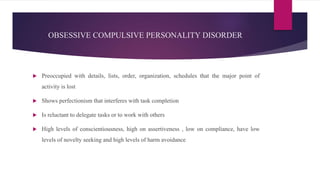
OBSESSIVE COMPULSIVE PERSONALITY DISORDER
 Preoccupied with details, lists, order, organization, schedules that the major point of
activity is lost
 Shows perfectionism that interferes with task completion
 Is reluctant to delegate tasks or to work with others
 High levels of conscientiousness, high on assertiveness , low on compliance, have low
levels of novelty seeking and high levels of harm avoidance
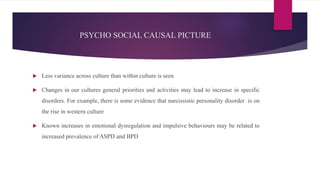
PSYCHO SOCIAL CAUSAL PICTURE
 Less variance across culture than within culture is seen
 Changes in our cultures general priorities and activities may lead to increase in specific
disorders. For example, there is some evidence that narcissistic personality disorder is on
the rise in western culture
 Known increases in emotional dysregulation and impulsive behaviours may be related to
increased prevalence of ASPD and BPD
OCPD EXPLAINED ….
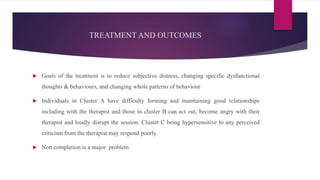
TREATMENT AND OUTCOMES
 Goals of the treatment is to reduce subjective distress, changing specific dysfunctional
thoughts & behaviours, and changing whole patterns of behaviour
 Individuals in Cluster A have difficulty forming and maintaining good relationships
including with the therapist and those in cluster B can act out, become angry with their
therapist and loudly disrupt the session. Cluster C being hypersensitive to any perceived
criticism from the therapist may respond poorly
 Non completion is a major problem
TREATING BORDERLINE PERSONALITY DISORDER
 Antidepressants - treating rapid mood shifts and control impulsivity symptom.
 Antipsychotic Medications show improvement in suicidality, depression, anxiety, rejection sensitivity
and transient psychotic symptoms.
 Mood Stabilising drugs - Reduces irritability, affective instability and impulsive aggressive
behaviours
 Dialectical Behaviour therapy – the primary goal is to make patients accepts strong states of negative
effect without engaging in self destructive behaviours
 Problem focussed treatment based on clear hierarchy of goals ,which prioritises decreasing suicidal
& self harming behaviour and increasing coping skills
 In a group setting, patients learn interpersonal effectiveness, emotion regulation and tolerance skills.
Individual therapy sessions and phone coaching to help the patient identify and change problematic
behaviour patterns and apply new skills .
TREATING BORDERLINE PERSONALITY DISORDER
 Psychodynamic psychotherapy – the goal is to strengthen the weak egos of these
individuals, with the particular focus on their primary defense mechanism of splitting
which leads them to black or white thinking about self and others.
 Mentalization (Bateman and Fonagy,2010): Uses therapeutic relationship develop skills
they need to accurately understand their own feelings and emotions of others
TREATING OTHER PERSONALITY DISORDERS
 Treatment for Cluster A and Cluster B – Not so promising
 Cluster C – Promising results seen with short term psychotherapy that is active and
confrontational
 CBT with avoidant personality disorder has shown gains
THANK YOU

CLUSTER C PERSONALITY DISORDERS.pptx

  • 1.
    CLUSTER C PERSONALITY DISORDERS DR. M.RAMYA MAHESWARI ASST PROF & HEAD DEPARTMENT OF PSYCHOLOGY ETHIRAJ COLLEGE FOR WOMEN
  • 2.
    AVOIDANT PERSONALITY DISORDER A pervasive pattern of social inhibition, feelings of inadequacy, hypersensitivity to negative evaluation beginning by early adulthood and present in a variety of contexts  Views self as socially inept, personally unappealing or inferior to others  Because of their hypersensitivity and fear of criticism they do not seek other people, yet they desire affection and are often lonely and depressed.  Their inability to relate comfortably to other people, causes acute anxiety and is accompanied by low self esteem and excessive self consciousness, which in turn leads to depression  Avoids occupational activities that involve significant interpersonal contact.  Shows restraint within intimate relationships for the fear of being ridiculed. They show generalized timidity and avoidance of many novel situations and emotions and show deficits in the experience of pleasure.  The loner in avoidant personality is different from loner in schizoid personality in that the former is shy and hypersensitive to criticism, while the latter is cold, aloof and indifferent to criticism.
  • 3.
    CAUSES OF AVOIDANTPERSONALITY DISORDER  May have its origin in innate inhibited temperament that leaves the child shy to novel and ambiguous situation.  A large study in Norway has shown that the traits prominent in APD show a modest genetic influence and the genetic vulnerability is partially shared with social phobia  ‘Evidence shows that the fear of being negatively evaluated is moderately heritable.  This inhibited temperament can serve as a diathesis, to some children who experience emotional abuse ,rejection from parents who are not personally affectionate etc.  This abuse is likely to lead to anxious and fearful attachment patterns
  • 4.
    CASE PRESENTATION OFAVOIDANT PERSONALITY DISORDER
  • 5.
    DEPENDENT PERSONALITY DISORDER A pervasive and excessive need to be taken care of and clinging behaviour and fears of separation, beginning by early adulthood and present in a variety of contexts.  They usually build their lives around others and subordinate their own needs and views to keep people involved with them. Urgently seeks another relationship when one ends.  Show acute fear of separation or sometimes simply having to be alone because they see themselves as inept  Decisions are not taken without advice, Has difficulty expressing disagreement with others because of the fear of losing their support. They tend to be indiscriminate in their selection of mates.  Needs others to assume responsibility for most areas of his life as they feel incompetent even when they actually have developed good skills
  • 6.
    DEPENDENT PERSONALITY DISORDER Estimates are that dependent personality disorder occurs in 1 -2 % of the population & is more common in woman than in men .  Comorbid with borderline, histrionic and avoidant personality disorders  Both dependent and borderline personalities fear abandonment but borderline personality reacts with feelings of emptiness or rage if abandonment occurs, while dependent personality react with submissiveness and appeasement  Both histrionic and dependent require approval, however histrionic actively demand attention, while dependents are very docile and self effacing  Co-occurs with avoidant personality disorder frequently. In avoidant personality disorder they have trouble initiating relationships while in dependently personality disorder people have trouble with separation. This means that their dependent personality charcteristics are focussed on one or two whom they do not avoid.
  • 7.
    CAUSES OF DEPENDENTPERSONALITY DISORDER  Personality traits such as neuroticism and agreeableness that are prominent in dependent personality disorder have a genetic component (Widger & Bomstein, 2001).  Those with this genetic predisposition for dependence and submissiveness may be prone to the adverse effects of parents who are authoritarian and overprotective . This leads children to believe that they are incompetent and that they need to rely on others  Maladaptive schemas include core beliefs about weakness and competence and needing others to survive
  • 8.
  • 9.
    OBSESSIVE COMPULSIVE PERSONALITYDISORDER  Preoccupied with details, lists, order, organization, schedules that the major point of activity is lost  Shows perfectionism that interferes with task completion  Is reluctant to delegate tasks or to work with others  High levels of conscientiousness, high on assertiveness , low on compliance, have low levels of novelty seeking and high levels of harm avoidance
  • 10.
    PSYCHO SOCIAL CAUSALPICTURE  Less variance across culture than within culture is seen  Changes in our cultures general priorities and activities may lead to increase in specific disorders. For example, there is some evidence that narcissistic personality disorder is on the rise in western culture  Known increases in emotional dysregulation and impulsive behaviours may be related to increased prevalence of ASPD and BPD
  • 12.
  • 13.
    TREATMENT AND OUTCOMES Goals of the treatment is to reduce subjective distress, changing specific dysfunctional thoughts & behaviours, and changing whole patterns of behaviour  Individuals in Cluster A have difficulty forming and maintaining good relationships including with the therapist and those in cluster B can act out, become angry with their therapist and loudly disrupt the session. Cluster C being hypersensitive to any perceived criticism from the therapist may respond poorly  Non completion is a major problem
  • 14.
    TREATING BORDERLINE PERSONALITYDISORDER  Antidepressants - treating rapid mood shifts and control impulsivity symptom.  Antipsychotic Medications show improvement in suicidality, depression, anxiety, rejection sensitivity and transient psychotic symptoms.  Mood Stabilising drugs - Reduces irritability, affective instability and impulsive aggressive behaviours  Dialectical Behaviour therapy – the primary goal is to make patients accepts strong states of negative effect without engaging in self destructive behaviours  Problem focussed treatment based on clear hierarchy of goals ,which prioritises decreasing suicidal & self harming behaviour and increasing coping skills  In a group setting, patients learn interpersonal effectiveness, emotion regulation and tolerance skills. Individual therapy sessions and phone coaching to help the patient identify and change problematic behaviour patterns and apply new skills .
  • 15.
    TREATING BORDERLINE PERSONALITYDISORDER  Psychodynamic psychotherapy – the goal is to strengthen the weak egos of these individuals, with the particular focus on their primary defense mechanism of splitting which leads them to black or white thinking about self and others.  Mentalization (Bateman and Fonagy,2010): Uses therapeutic relationship develop skills they need to accurately understand their own feelings and emotions of others
  • 16.
    TREATING OTHER PERSONALITYDISORDERS  Treatment for Cluster A and Cluster B – Not so promising  Cluster C – Promising results seen with short term psychotherapy that is active and confrontational  CBT with avoidant personality disorder has shown gains
  • 17.