FINGER CLUBBING, GCS &
MUSCLE POWER
GRADING PRESENTATION
BY;
-Davias.M
-Joyce……
-Deborah
FINGER CLUBBING
ANATOMY OF THE NAIL
CONT…
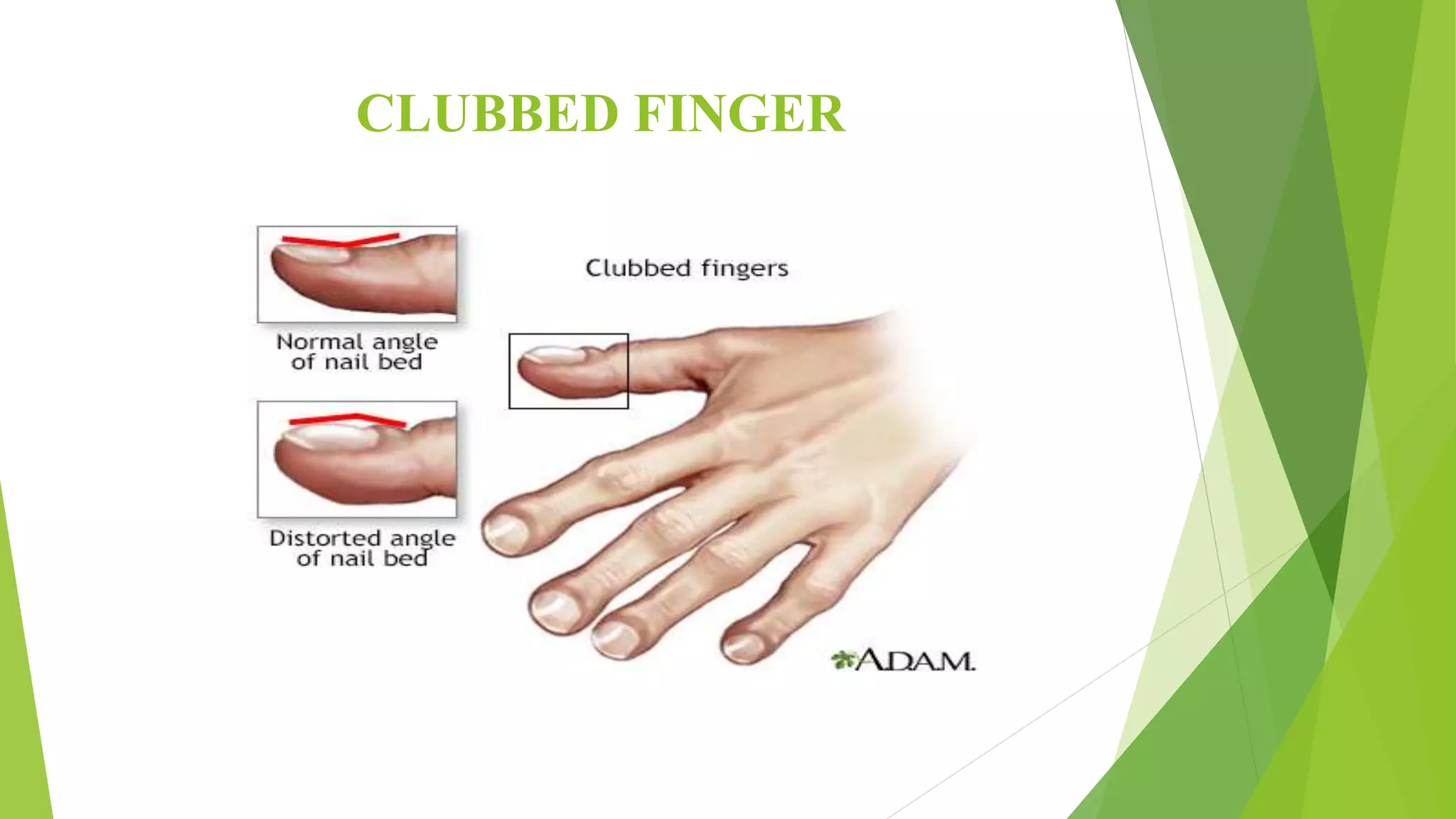
CLUBBED FINGER
CONT….
PHILOSOPHY
 As stated best by Samuel West in 1897, "Clubbing is one of those
phenomena with which we are all so familiar that we appear to know
more about it than we really do."
EPIDEMIOLOGY
 Primary digital clubbing has been reported to occur in 89% of patients diagnosed with
pachydermoperiostosis. This syndrome most often occurs in young males.
 Of patients with idiopathic pulmonary fibrosis, 65% have clinical digital clubbing. In these
patients,
 Clubbing has been reported in 29% of patients with lung cancer and is observed more
commonly in patients with non–small cell lung carcinoma (35%) than in patients with small
cell lung carcinoma (4%).
 Digital clubbing was reported in 38% of patients with Crohn disease, 15% of patients with
ulcerative colitis, and 8% of patients with proctitis.
WHAT IS FINGER CLUBBING..?
 Selective bullous enlargement of the distal segments of the fingers and toes
due to proliferation of connective tissue, particularly on the dorsal surface.
 Bulbous uniform swelling of the soft tissue of the terminal phalanx of a distal
with subsequently loss of the normal angle btn the nail and the nail bed.
PATHOPHYSIOLOGY
 The specific pathophysiologic mechanism of digital clubbing remains unknown. Many
theories have been proposed,
 Alterations in size and configuration of the clubbed digit result from changes in the nail bed,
beginning with;
 increased interstitial edema early in the process.
 As clubbing progresses, the volume of the terminal portion of the digit may increase because
of an increase in the vascular connective tissue and change in quality of the vascular
connective tissue, although some cases have been associated with spurs of bone on the
terminal phalanx.
CONT…..
 Distal digital vasodilation, which results in increased blood flow to the
distal portion of the digits cause change in vascular CT under the nail;
 vasodilation results from a circulating or local vasodilator, neural
mechanism, response to hypoxemia, genetic predisposition, or a
combination of these or other mediators
CONT…..
A) CIRCULATING VASODILATOR
 Clubbing with cyanotic congenital heart disease.
 Ductus arteriosus
 Patients with tetralogy of fallot
 Bypass the inactivation process in patients with right-to-left shunts.
 Proposed vasodilatory factors include ferritin, prostaglandins, bradykinin,
adenine nucleotides, and 5-hydroxytryptamine.
CONT…..
B) NEURAL MECHANISM
 An increased incidence of digital clubbing has been associated with
the pathology and disease of vagally innervated organs.
 Especially clubbing occurring with hypertrophic osteoarthropathy
CONT…..
C) GENETIC INHERITANCE AND PREDISPOSITION
 Hereditary clubbing is observed in 2 forms, including idiopathic
hereditary clubbing and clubbing associated with
pachydermoperiostosis.
CONT…..
D) HYPOXIA
 Cyanotic heart disease and pulmonary diseases.
 Increase in hypoxia may activate local vasodilators,
CONT…..
E) PLATELET-DERIVED GROWTH FACTOR
 Released from fragments of platelet clumps or megakaryocytes
 Shunts, IE, aneurysim
 Shown to have general growth-promoting activity and causes
increased capillary permeability and connective tissue hypertrophy.
CONT…..
F) VASCULAR ENDOTHELIAL GROWTH FACTOR ( VEGF)
 Macrophages
 Platelets
 Tumor cells
 etc
CAUSES
Clubbing can be idiopathic or secondary to many underlying pathologies in various
organ systems.
 Causes of idiopathic or primary clubbing include
 Pachydermoperiostosis, familial clubbing, and hypertrophic osteoarthropathy.
 Causes of secondary clubbing include the following;
CONT…..
CARDIAC DISEASE –
 Cyanotic congenital heart disease,
 right-to-left shunting, and
 bacterial endocarditis
CONT…..
GASTROINTESTINAL DISEASE –
 Ulcerative colitis, Crohn disease,
 primary biliary cirrhosis, cirrhosis of the liver, hepatopulmonary
syndrome
 leiomyoma of the esophagus, achalasia, and peptic ulceration of the
esophagus
CONT…..
Pulmonary disease –
 Lung cancer, cystic fibrosis, interstitial lung disease,
 Idiopathic pulmonary fibrosis, sarcoidosis, lipoid pneumonia,
 Empyema, pleural mesothelioma, pulmonary artery sarcoma,
 Lung hydatid cysts, eisenmenger syndrome (a severe form of pulmonary
arterial hypertension),and pulmonary metastases
CONT…..
SKIN DISEASE –
 Pachydermoperiostosis
 Bureau-Barrière-Thomas syndrome
 Fischer syndrome
 palmoplantar keratoderma
 Volavsek syndrome
CONT…..
MALIGNANCIES –
 Thyroid cancer, thymus cancer
 Hodgkin disease and disseminated chronic myeloid leukemia
(POEMS [polyneuropathy
 Organomegaly, endocrinopathy,
 Monoclonal gammopathy,
CONT…..
OTHERS
 Hypertrophic pulmonary osteoarthropathy
 Arterial Aneurysn of major extremity
CLINICAL PRESENTATION
 Swelling of the distal portion of the digits
 Which may be bilateral or unilateral or may involve a single digit.
 Typically is painless, it rarely may present with pain in the
fingertips.
 Softening of the nail
PHYSICAL EXAMINATION
 Bulbous fusiform enlargement of the distal portion of a digit
 Lovibond angle
 Typically is less than or equal to 160°.
 Schamroth sign
 Schamroth window sign test
 Obliteration in clubbed fingers of the diamond-shaped window
CONT…..
 The nail moves more freely in patients with clubbing;
 spongy sensation as the nail is pressed toward the nail plate.
 The sponginess results from increased fibrovascular tissue
between the nail and the phalanx
 The skin at the base of the nail may be smooth and shiny.
GRADING OF FINGER CLUBBING
1) Fluctuation and softening of the nail bed
2) Obliteration onychodermal angle
3) Increased anterioposterior curvature or Biconvex nail growth
(Parrot beaking)
4) Drumstick nail
5) Hypertrophic osteoarthropathy
Mx
 No treatment for finger clubbing
 Treat the symptoms eg pain wt NSAIDS
 Treat the cause to achieve maximum Tx
END
.
GLASGROW COMA SCALE
GCS
 Is a neurological scale aiming to provide reliable objective way of
recording the conscious state of a person
 GCS is used to asses a patient’s level of consciousness on how alert and
responsive a patient’s is to their environment and stimuli around them
GCS Scoring
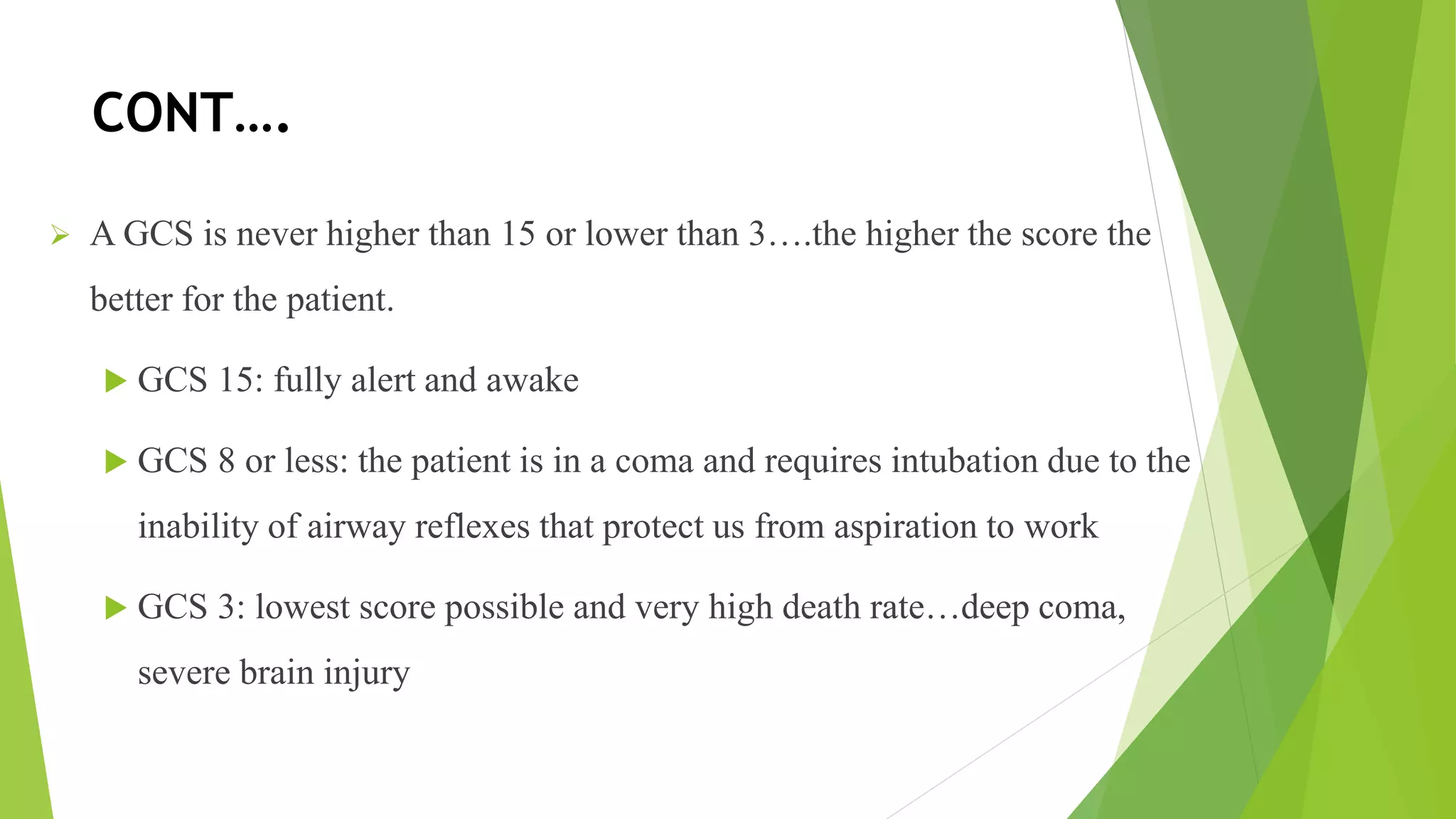
 Glasgow Coma Scale scores can range from 3 to 15.
 As pointed out above this scale is useful with patient’s who’ve sustained a
head/brain injury. The score can be used to describe the injury.
3-8: severe brain injury
9-12: moderate brain injury
13-15: mild brain injury
CONT….
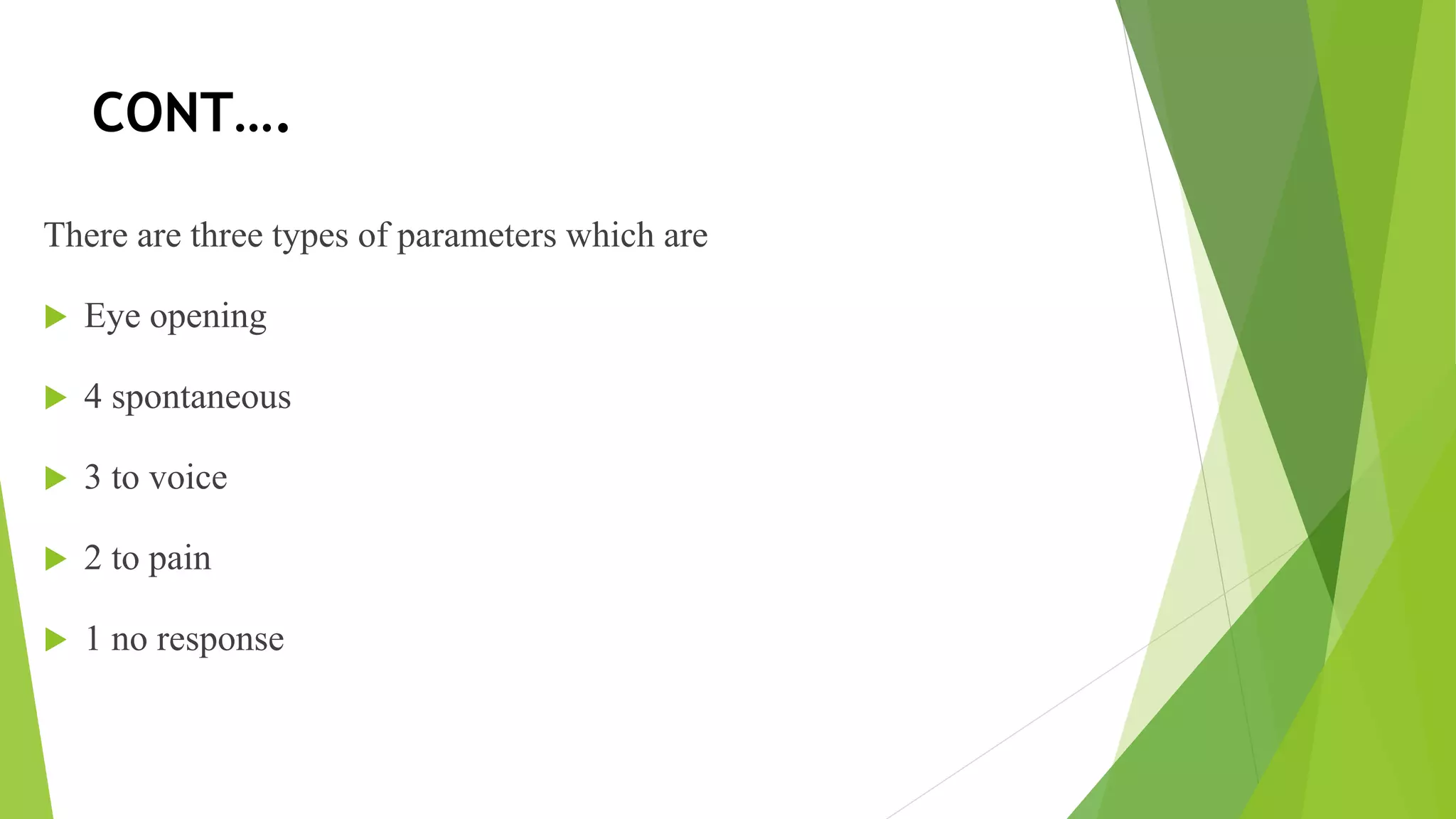
 A GCS is never higher than 15 or lower than 3….the higher the score the
better for the patient.
 GCS 15: fully alert and awake
 GCS 8 or less: the patient is in a coma and requires intubation due to the
inability of airway reflexes that protect us from aspiration to work
 GCS 3: lowest score possible and very high death rate…deep coma,
severe brain injury
FACTORS INFLUENCING GCS
Scores can be influenced by :
-baseline
-sedation
-injury
 There are two types of pain that can be used to
achieve the response of the pt. These types
include;
Central and peripheral stimuli
CENTRAL STIMULI
Central stimuli: pressure or pain is applied to the center of the body
(hence its core) to create pain. This tests the brain’s response to it.
Trapezius squeeze
 use the index finger and thumb and squeeze 1 ½ to 2 inches of this
trapezius muscle.
 Start with slight pressure and then increase the pressure for up to 10
seconds… note patient’s motor movement
supraorbital pressure
CONT….
 Find the notch under the inner part of the eyebrow
 Apply pressure to this notch with the thumb and gradually
increase pressure for up to 10 seconds…. note patient’s motor
movement
PERIPHERAL STIMULI
 Pressure or pain is applied to a peripheral extremity like the
fingernail bed to create pain. This tests the spinal cord response to
pain.
CONT….
There are three types of parameters which are
 Eye opening
 4 spontaneous
 3 to voice
 2 to pain
 1 no response
CONT….
 Verbal response
 5 oriented
 4 confused
 3 inappropriate words
 2 sounds
 1 no response
CONT….
 Motor response
 6 obeying commands
 5 localized to pain
 4 flexion to pain/ withdrawing from the pressure stimulus
 3 Abnormal (arm) flexion to pain
 2 Abnormal (arm ) extension to pain
 1 no response
CONT….
 Note : sometimes a patient won’t give motor response, cause they
may be intubated therefore just take for Eye and Motor
 E-3
 V-1(intubated)
 M-3
 =7 (T)
MUSCLE GRADING
• This is an assessment of muscle
strength,perfomed as part of the
pts physical examination.
WHY IS MUSCLE GRANDING ESSENTIAL?
TIYANKENI
KAILI……
ESSENTIALITY
 Assess muscle performance/weakness, inclusive of strength,
power and endurance.
 Used to assess pts with neurological disease or deficits which can
be as a result of brain injury, spinal cord injury, neuropathy and
even strokes.
 After fractures and joint replacements. i.e TKR
 Also used in falls
Commonly tested muscles include the
 Shoulder abductor,shoulder flexor and extensor
 Elbow flexors and extensor
 Wrist extensors and flexors
 Hip flexors and extensors
 Knee extensors and flexors
The mostly used test is the MANUAL MUSCLE
TEST aka OXFORD SCALE and rages from 0-5
Muscle grade
0 (zero) There is no visible movement or palpable muscle contraction
1 (Trace) No visible muscle movement but a slight contraction can be palpated
(flicker of movement)
2 (Poor) Movement but with gravity eliminated
3 (fair) Movement against gravity but not against resistance
4 (Good) Complete full range of motion against gravity with moderate
resistance
5 (Normal) Complete full range of motion against gravity with max resistance
Tips you can jote down
 Make sure the pt is dressed in loose clothings and has full
range of movement
 Place a pt in an adequate supported position
 If muscles are weak to function against gravity you can test
them in a horizintal plane
 Resistance needs to applied directly opposite the line of pull
 Always test both sides in order to compare the strength
TWALUMBA KAPATI

Finger clubbing, GCS Muscle Power Grading.pptx

  • 1.
    FINGER CLUBBING, GCS& MUSCLE POWER GRADING PRESENTATION BY; -Davias.M -Joyce…… -Deborah
  • 2.
  • 3.
  • 4.
  • 5.
  • 6.
  • 7.
    PHILOSOPHY  As statedbest by Samuel West in 1897, "Clubbing is one of those phenomena with which we are all so familiar that we appear to know more about it than we really do."
  • 8.
    EPIDEMIOLOGY  Primary digitalclubbing has been reported to occur in 89% of patients diagnosed with pachydermoperiostosis. This syndrome most often occurs in young males.  Of patients with idiopathic pulmonary fibrosis, 65% have clinical digital clubbing. In these patients,  Clubbing has been reported in 29% of patients with lung cancer and is observed more commonly in patients with non–small cell lung carcinoma (35%) than in patients with small cell lung carcinoma (4%).  Digital clubbing was reported in 38% of patients with Crohn disease, 15% of patients with ulcerative colitis, and 8% of patients with proctitis.
  • 9.
    WHAT IS FINGERCLUBBING..?  Selective bullous enlargement of the distal segments of the fingers and toes due to proliferation of connective tissue, particularly on the dorsal surface.  Bulbous uniform swelling of the soft tissue of the terminal phalanx of a distal with subsequently loss of the normal angle btn the nail and the nail bed.
  • 10.
    PATHOPHYSIOLOGY  The specificpathophysiologic mechanism of digital clubbing remains unknown. Many theories have been proposed,  Alterations in size and configuration of the clubbed digit result from changes in the nail bed, beginning with;  increased interstitial edema early in the process.  As clubbing progresses, the volume of the terminal portion of the digit may increase because of an increase in the vascular connective tissue and change in quality of the vascular connective tissue, although some cases have been associated with spurs of bone on the terminal phalanx.
  • 11.
    CONT…..  Distal digitalvasodilation, which results in increased blood flow to the distal portion of the digits cause change in vascular CT under the nail;  vasodilation results from a circulating or local vasodilator, neural mechanism, response to hypoxemia, genetic predisposition, or a combination of these or other mediators
  • 12.
    CONT….. A) CIRCULATING VASODILATOR Clubbing with cyanotic congenital heart disease.  Ductus arteriosus  Patients with tetralogy of fallot  Bypass the inactivation process in patients with right-to-left shunts.  Proposed vasodilatory factors include ferritin, prostaglandins, bradykinin, adenine nucleotides, and 5-hydroxytryptamine.
  • 13.
    CONT….. B) NEURAL MECHANISM An increased incidence of digital clubbing has been associated with the pathology and disease of vagally innervated organs.  Especially clubbing occurring with hypertrophic osteoarthropathy
  • 14.
    CONT….. C) GENETIC INHERITANCEAND PREDISPOSITION  Hereditary clubbing is observed in 2 forms, including idiopathic hereditary clubbing and clubbing associated with pachydermoperiostosis.
  • 15.
    CONT….. D) HYPOXIA  Cyanoticheart disease and pulmonary diseases.  Increase in hypoxia may activate local vasodilators,
  • 16.
    CONT….. E) PLATELET-DERIVED GROWTHFACTOR  Released from fragments of platelet clumps or megakaryocytes  Shunts, IE, aneurysim  Shown to have general growth-promoting activity and causes increased capillary permeability and connective tissue hypertrophy.
  • 17.
    CONT….. F) VASCULAR ENDOTHELIALGROWTH FACTOR ( VEGF)  Macrophages  Platelets  Tumor cells  etc
  • 18.
    CAUSES Clubbing can beidiopathic or secondary to many underlying pathologies in various organ systems.  Causes of idiopathic or primary clubbing include  Pachydermoperiostosis, familial clubbing, and hypertrophic osteoarthropathy.  Causes of secondary clubbing include the following;
  • 19.
    CONT….. CARDIAC DISEASE – Cyanotic congenital heart disease,  right-to-left shunting, and  bacterial endocarditis
  • 20.
    CONT….. GASTROINTESTINAL DISEASE – Ulcerative colitis, Crohn disease,  primary biliary cirrhosis, cirrhosis of the liver, hepatopulmonary syndrome  leiomyoma of the esophagus, achalasia, and peptic ulceration of the esophagus
  • 21.
    CONT….. Pulmonary disease – Lung cancer, cystic fibrosis, interstitial lung disease,  Idiopathic pulmonary fibrosis, sarcoidosis, lipoid pneumonia,  Empyema, pleural mesothelioma, pulmonary artery sarcoma,  Lung hydatid cysts, eisenmenger syndrome (a severe form of pulmonary arterial hypertension),and pulmonary metastases
  • 22.
    CONT….. SKIN DISEASE – Pachydermoperiostosis  Bureau-Barrière-Thomas syndrome  Fischer syndrome  palmoplantar keratoderma  Volavsek syndrome
  • 23.
    CONT….. MALIGNANCIES –  Thyroidcancer, thymus cancer  Hodgkin disease and disseminated chronic myeloid leukemia (POEMS [polyneuropathy  Organomegaly, endocrinopathy,  Monoclonal gammopathy,
  • 24.
    CONT….. OTHERS  Hypertrophic pulmonaryosteoarthropathy  Arterial Aneurysn of major extremity
  • 25.
    CLINICAL PRESENTATION  Swellingof the distal portion of the digits  Which may be bilateral or unilateral or may involve a single digit.  Typically is painless, it rarely may present with pain in the fingertips.  Softening of the nail
  • 26.
    PHYSICAL EXAMINATION  Bulbousfusiform enlargement of the distal portion of a digit  Lovibond angle  Typically is less than or equal to 160°.  Schamroth sign  Schamroth window sign test  Obliteration in clubbed fingers of the diamond-shaped window
  • 27.
    CONT…..  The nailmoves more freely in patients with clubbing;  spongy sensation as the nail is pressed toward the nail plate.  The sponginess results from increased fibrovascular tissue between the nail and the phalanx  The skin at the base of the nail may be smooth and shiny.
  • 28.
    GRADING OF FINGERCLUBBING 1) Fluctuation and softening of the nail bed 2) Obliteration onychodermal angle 3) Increased anterioposterior curvature or Biconvex nail growth (Parrot beaking) 4) Drumstick nail 5) Hypertrophic osteoarthropathy
  • 29.
    Mx  No treatmentfor finger clubbing  Treat the symptoms eg pain wt NSAIDS  Treat the cause to achieve maximum Tx
  • 30.
  • 31.
  • 32.
    GCS  Is aneurological scale aiming to provide reliable objective way of recording the conscious state of a person  GCS is used to asses a patient’s level of consciousness on how alert and responsive a patient’s is to their environment and stimuli around them
  • 33.
    GCS Scoring  GlasgowComa Scale scores can range from 3 to 15.  As pointed out above this scale is useful with patient’s who’ve sustained a head/brain injury. The score can be used to describe the injury. 3-8: severe brain injury 9-12: moderate brain injury 13-15: mild brain injury
  • 34.
    CONT….  A GCSis never higher than 15 or lower than 3….the higher the score the better for the patient.  GCS 15: fully alert and awake  GCS 8 or less: the patient is in a coma and requires intubation due to the inability of airway reflexes that protect us from aspiration to work  GCS 3: lowest score possible and very high death rate…deep coma, severe brain injury
  • 35.
    FACTORS INFLUENCING GCS Scorescan be influenced by : -baseline -sedation -injury
  • 36.
     There aretwo types of pain that can be used to achieve the response of the pt. These types include; Central and peripheral stimuli
  • 37.
    CENTRAL STIMULI Central stimuli:pressure or pain is applied to the center of the body (hence its core) to create pain. This tests the brain’s response to it. Trapezius squeeze  use the index finger and thumb and squeeze 1 ½ to 2 inches of this trapezius muscle.  Start with slight pressure and then increase the pressure for up to 10 seconds… note patient’s motor movement supraorbital pressure
  • 38.
    CONT….  Find thenotch under the inner part of the eyebrow  Apply pressure to this notch with the thumb and gradually increase pressure for up to 10 seconds…. note patient’s motor movement
  • 39.
    PERIPHERAL STIMULI  Pressureor pain is applied to a peripheral extremity like the fingernail bed to create pain. This tests the spinal cord response to pain.
  • 40.
    CONT…. There are threetypes of parameters which are  Eye opening  4 spontaneous  3 to voice  2 to pain  1 no response
  • 41.
    CONT….  Verbal response 5 oriented  4 confused  3 inappropriate words  2 sounds  1 no response
  • 42.
    CONT….  Motor response 6 obeying commands  5 localized to pain  4 flexion to pain/ withdrawing from the pressure stimulus  3 Abnormal (arm) flexion to pain  2 Abnormal (arm ) extension to pain  1 no response
  • 43.
    CONT….  Note :sometimes a patient won’t give motor response, cause they may be intubated therefore just take for Eye and Motor  E-3  V-1(intubated)  M-3  =7 (T)
  • 44.
    MUSCLE GRADING • Thisis an assessment of muscle strength,perfomed as part of the pts physical examination.
  • 45.
    WHY IS MUSCLEGRANDING ESSENTIAL? TIYANKENI KAILI……
  • 46.
    ESSENTIALITY  Assess muscleperformance/weakness, inclusive of strength, power and endurance.  Used to assess pts with neurological disease or deficits which can be as a result of brain injury, spinal cord injury, neuropathy and even strokes.  After fractures and joint replacements. i.e TKR  Also used in falls
  • 47.
    Commonly tested musclesinclude the  Shoulder abductor,shoulder flexor and extensor  Elbow flexors and extensor  Wrist extensors and flexors  Hip flexors and extensors  Knee extensors and flexors
  • 48.
    The mostly usedtest is the MANUAL MUSCLE TEST aka OXFORD SCALE and rages from 0-5 Muscle grade 0 (zero) There is no visible movement or palpable muscle contraction 1 (Trace) No visible muscle movement but a slight contraction can be palpated (flicker of movement) 2 (Poor) Movement but with gravity eliminated 3 (fair) Movement against gravity but not against resistance 4 (Good) Complete full range of motion against gravity with moderate resistance 5 (Normal) Complete full range of motion against gravity with max resistance
  • 49.
    Tips you canjote down  Make sure the pt is dressed in loose clothings and has full range of movement  Place a pt in an adequate supported position  If muscles are weak to function against gravity you can test them in a horizintal plane  Resistance needs to applied directly opposite the line of pull  Always test both sides in order to compare the strength
  • 50.