Clouds By Lynsey Wilkie
Experience The children I had at Delaware Elementary School over the summer looked up into the sky one day and asked many questions about clouds.  In school I had learned some of the basics about clouds but I was unable to answer their questions. I became curious about clouds and wanted to find out more about them.
Questions I asked myself: What are their names and what classifies them? How are they produced? Do they vary in color? What type of precipitation do they produce? How do they produce precipitation? What happens?
Standards 5.3.4  Investigate that when liquid water disappears it turns into a gas (vapor) mixed into the air and can reappear as a liquid when cooled or as a solid if cooled below the freezing point of water. (Core Standard)  5.3.6  Demonstrate that things on or near the Earth are pulled toward it by the Earth's gravity.  5.3.8  Investigate, observe, and describe that heating and cooling cause changes in the properties of materials, such as water turning into steam by boiling and water turning into ice by freezing. Notice that many kinds of changes occur faster at higher temperatures 5.3.9  Investigate, observe, and describe that when warmer things are put with cooler ones, the warm ones lose heat and the cool ones gain it until they are all at the same temperature. Demonstrate that a warmer object can warm a cooler one by contact or at a distance.
Types of Clouds Cumulus “ Puffy” Look like cotton Produce Thunderstorms Stratus “ Spread out” Low level Thin  Layer the sky  Cirrus “ Feathery” High level Whispy and thin Nimbus- means rain Cumulonimbus and Nimbostratus http://schoolscience.rice.edu/duker/weatypeclouds.html
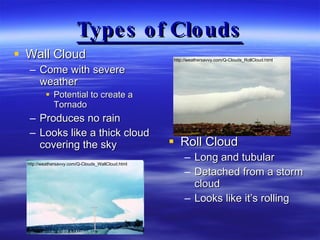
Types of Clouds Wall Cloud Come with severe weather Potential to create a Tornado Produces no rain Looks like a thick cloud covering the sky Roll Cloud Long and tubular Detached from a storm cloud Looks like it’s rolling http://weathersavvy.com/Q-Clouds_WallCloud.html http://weathersavvy.com/Q-Clouds_RollCloud.html
Types of Clouds Shelf Cloud Low and horizontal Broken off from a storm cloud Looks like a shelf Anvil  The top part of a cumulonimbus cloud The top is flattened giving it the look of an anvil http://weathersavvy.com/Q-Clouds_Anvil.html http://weathersavvy.com/Q-Clouds_ShelfCloud.html
Making a Cloud Air contains water or is in the form of water vapor Warm air rises, expands, and cools Cool air cannot hold as much water vapor as warm air Some of the vapor turns into small droplets Billions of droplets come together and form a cloud
http://www.cbs6albany.com/images/research/Hydrologic_Cycle.JPG
Colors of Clouds Caused by sunlight Gray-  sun shines through the top instead of the bottom Dark Gray-  the cloud is thick and sunlight gets blocked White-  the cloud is thin and doesn’t block as much sunlight Sometimes clouds take the color of the environment such as near sunrise of sunset Clouds are not actually these colors they just appear to be
Clouds & Precipitation Rain Vapor droplets become too heavy for a cloud to hold and fall Ice crystals combine and make snow flakes and fall but warmer air melts them into liquid droplets Hail Large frozen rain drop made during a thunderstorm Snow flakes fall and liquid freezes on to them which makes ice pellets The more droplets the freeze on to the snow the greater the size of the hail
Clouds & Precipitation Snow Water vapor freezes into ice crystals The ice crystals attract cool droplets and take different shapes Snowflakes Freezing rain Rain gets extremely cold and freezes once it hits a cold surface Sleet Frozen raindrops  Surface temperature decreases and causes freezing rain to change to sleet
References http://teacher.scholastic.com/lessonrepro/lessonplans/profbooks/cloudsmade.pdf   http://schoolscience.rice.edu/duker/weatypeclouds.html http://www.weatherpictures.nl/stratus.html http://www.cbs6albany.com/images/research/Hydrologic_Cycle.JPG

Cloud Inquiry Project

  • 1.
  • 2.
    Experience The childrenI had at Delaware Elementary School over the summer looked up into the sky one day and asked many questions about clouds. In school I had learned some of the basics about clouds but I was unable to answer their questions. I became curious about clouds and wanted to find out more about them.
  • 3.
    Questions I askedmyself: What are their names and what classifies them? How are they produced? Do they vary in color? What type of precipitation do they produce? How do they produce precipitation? What happens?
  • 4.
    Standards 5.3.4 Investigate that when liquid water disappears it turns into a gas (vapor) mixed into the air and can reappear as a liquid when cooled or as a solid if cooled below the freezing point of water. (Core Standard) 5.3.6 Demonstrate that things on or near the Earth are pulled toward it by the Earth's gravity. 5.3.8 Investigate, observe, and describe that heating and cooling cause changes in the properties of materials, such as water turning into steam by boiling and water turning into ice by freezing. Notice that many kinds of changes occur faster at higher temperatures 5.3.9 Investigate, observe, and describe that when warmer things are put with cooler ones, the warm ones lose heat and the cool ones gain it until they are all at the same temperature. Demonstrate that a warmer object can warm a cooler one by contact or at a distance.
  • 5.
    Types of CloudsCumulus “ Puffy” Look like cotton Produce Thunderstorms Stratus “ Spread out” Low level Thin Layer the sky Cirrus “ Feathery” High level Whispy and thin Nimbus- means rain Cumulonimbus and Nimbostratus http://schoolscience.rice.edu/duker/weatypeclouds.html
  • 6.
    Types of CloudsWall Cloud Come with severe weather Potential to create a Tornado Produces no rain Looks like a thick cloud covering the sky Roll Cloud Long and tubular Detached from a storm cloud Looks like it’s rolling http://weathersavvy.com/Q-Clouds_WallCloud.html http://weathersavvy.com/Q-Clouds_RollCloud.html
  • 7.
    Types of CloudsShelf Cloud Low and horizontal Broken off from a storm cloud Looks like a shelf Anvil The top part of a cumulonimbus cloud The top is flattened giving it the look of an anvil http://weathersavvy.com/Q-Clouds_Anvil.html http://weathersavvy.com/Q-Clouds_ShelfCloud.html
  • 8.
    Making a CloudAir contains water or is in the form of water vapor Warm air rises, expands, and cools Cool air cannot hold as much water vapor as warm air Some of the vapor turns into small droplets Billions of droplets come together and form a cloud
  • 9.
  • 10.
    Colors of CloudsCaused by sunlight Gray- sun shines through the top instead of the bottom Dark Gray- the cloud is thick and sunlight gets blocked White- the cloud is thin and doesn’t block as much sunlight Sometimes clouds take the color of the environment such as near sunrise of sunset Clouds are not actually these colors they just appear to be
  • 11.
    Clouds & PrecipitationRain Vapor droplets become too heavy for a cloud to hold and fall Ice crystals combine and make snow flakes and fall but warmer air melts them into liquid droplets Hail Large frozen rain drop made during a thunderstorm Snow flakes fall and liquid freezes on to them which makes ice pellets The more droplets the freeze on to the snow the greater the size of the hail
  • 12.
    Clouds & PrecipitationSnow Water vapor freezes into ice crystals The ice crystals attract cool droplets and take different shapes Snowflakes Freezing rain Rain gets extremely cold and freezes once it hits a cold surface Sleet Frozen raindrops Surface temperature decreases and causes freezing rain to change to sleet
  • 13.
    References http://teacher.scholastic.com/lessonrepro/lessonplans/profbooks/cloudsmade.pdf http://schoolscience.rice.edu/duker/weatypeclouds.html http://www.weatherpictures.nl/stratus.html http://www.cbs6albany.com/images/research/Hydrologic_Cycle.JPG