

Cloud computing for authoring process automation MalinkaIvanova, Technical University - SofiaGeorge Ivanov, Mathematical School, BlagoevgradWCES 2010 , 04-08 February, Istanbul, Turkey
Aim	Exploring and analyzing the possibilities for automation of the authoring process in the Web 2.0 cloud and prototyping a model
OutlineThe concept of cloud computing in the educational sectorPresent Web specification and Authoring 2.0Automated authoring process in the Web 2.0 CloudUtilized Web 2.0 Applications for Authoring in Edu2.0 and beyondConclusion
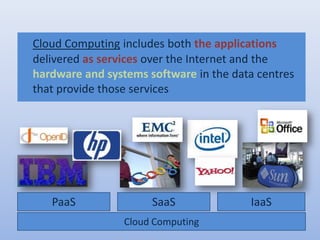
Cloud Computingincludes both the applications delivered as services over the Internet and the hardware and systems softwarein the data centres that provide those servicesPaaSSaaSIaaSCloud Computing
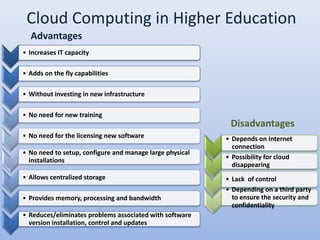
Cloud Computing in Higher EducationAdvantagesDisadvantages
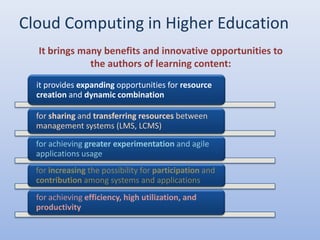
Cloud Computing in Higher EducationIt brings many benefits and innovative opportunities tothe authors of learning content:
Authoring 2.0: Aprocessofcontent creationinaninteractiveandcollaborativewayutilizingWeb 2.0applications and services and their remixingfrom various sources forbuildingalearning/teaching environment
Web SpecificationRead/write webFrom a static to a more dynamic, interactive, and socialWeb applications -  Wikis, Blogs, Forums, CMS - with friendly GUI, inviting educators to add content directly From one information source where information is consumed to many sources that can be remixedEducators and students are active content contributorsIt is a cause for social interactions and discourses that arebases for an iterative collaborative authoring process
Web SpecificationNetworked webAn authoring process is more than an individual possess - the behaviour of an individual is affected by the kinds of relations and technical tiesNetwork effect benefits: the number of contributions grows, the quality of information on the website improves, the authoring process is transparentA wide range of social networks are formed building online communities of educators, researchers, students whoshare and examine the common interests and/or activities The networked web influences on the performance of authoring tasks of both educators and students
Web SpecificationWeb personalization - a strategy that requires implicitly or explicitly collecting user informationPersonalized WebThe implicit personalization – services utilize: presentation agents, tracking and profiling, notificationPersonalization involves technologies to accommodate the differences between individualsThe explicit personalization - the web page is changed by the author using the features provided by the systemPersonalizationtechnologies put the studentin the center of an interaction, application or service ensuringrich learning experiences acrossactivities, devices,  services,locations and networks Hybrid personalization – implicit +explicitThe author can personalize (1) the content, (2) the services, (3) the student's  interactions to enhance his/her experiences with applications and services
Web SpecificationMashable webMashUps – a combinationof  separate, stand-alone technologies  into a novel application or serviceNew authoring tools are developed that enable non-technical authors to create sophisticated products without programmingEducators develop custom mashupsto illustrate concepts as they teachStudents include them in artefacts, reports and assignmentsThe power of mashups for education lies in the way they help new conclusions reaching or new relationships discerning by uniting large amounts of data in a manageable way
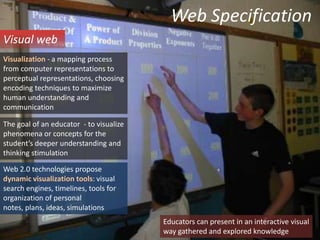
Web SpecificationVisual webVisualization - a mapping process from computer representations to perceptual representations, choosing encoding techniques to maximize human understanding and communicationThe goal of an educator  - to visualize phenomena or concepts for the student’s deeper understanding and thinking stimulationWeb 2.0 technologies propose dynamic visualization tools: visual search engines, timelines, tools for organization of personal notes, plans, ideas, simulationsEducators can present in an interactive visual  way gathered and explored knowledge
Web SpecificationSemantic webSemantic Web offers complicated well-developed logic based technologies for knowledge processing Three views of the term semantic web: the vision, the program and the technologyThe vision - an extension of the current Web in which information is given well-defined meaning, better enabling computers and people to work in cooperation (Matthews, 2005) Several applications of which authors can take advantage: from web browsing to research, blogging, and collaboration
Web SpecificationRSS syndicated webRSS technology allows an aggregator to check the subscribed feeds and to collect all the new content from many sitesThe educator - create feeds about any topic, can make a syndicated feed of search resultsStudents - arrange individualized, syndicated web pages creating large repositories of knowledgeRSS - a powerful research tool aiding educators and students in performing in depthresearch both individually and collaboratively by sharing and combining feeds acrossvarious sources
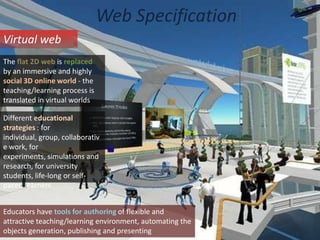
Web SpecificationVirtual webThe flat 2D web is replaced by an immersive and highly social 3D online world - the teaching/learning process is translated in virtual worldsDifferent educational strategies : for individual, group, collaborative work, for experiments, simulations and research, for university students, life-long or self-paced learnersEducators have tools for authoring of flexible and attractive teaching/learning environment, automating the objects generation, publishing and presenting
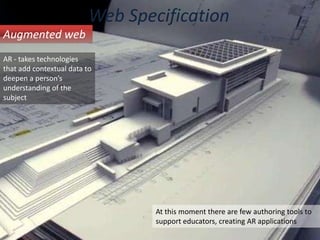
Web SpecificationAugmented webAR - takes technologies that add contextual data to deepen a person’s understanding of the subjectAt this moment there are few authoring tools to support educators, creating AR applications
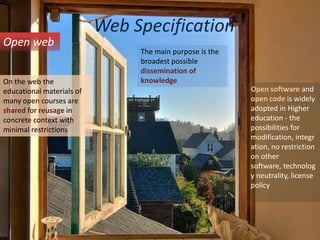
Web SpecificationOpen webThe main purpose is the broadest possible dissemination of knowledgeOn the web the educational materials of many open courses are shared for reusage in concrete context with minimal restrictionsOpen software and open code is widely adopted in Higher education - the possibilities for modification, integration, no restriction on other software, technology neutrality, license policy
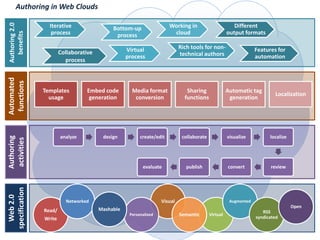
Automated authoring process - the sequence of actions that the author performs utilizing applications and services in order to build a complete teaching/learning environment
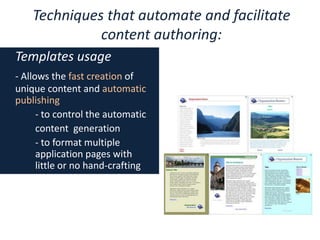
Techniques that automate and facilitate content authoring:Templates usage- Allows the fast creation of unique content and automatic publishing		- to control the automatic 		content  generation 		- to format multiple 	application pages with 	little or no hand-crafting
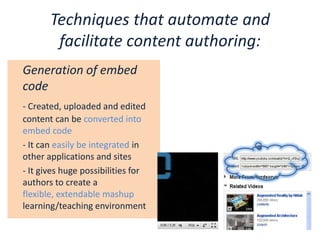
Techniques that automate and facilitate content authoring:Generation of embed code- Created, uploaded and edited content can be converted into embed code	- It can easily be integrated in other applications and sites	- It gives huge possibilities for authors to create a flexible, extendable mashuplearning/teaching environment
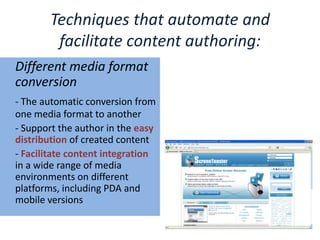
Techniques that automate and facilitate content authoring:	Different media format conversion- The automatic conversion from one media format to another 	- Support the author in the easy distribution of created content 	- Facilitate content integration in a wide range of media environments on different platforms, including PDA and mobile versions
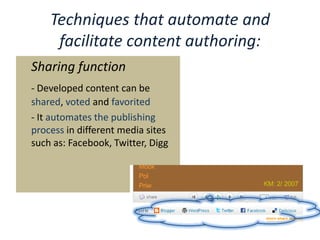
Techniques that automate and facilitate content authoring:	Sharing function- Developed content can be shared, voted and favorited	- It automates the publishing process in different media sites such as: Facebook, Twitter, Digg
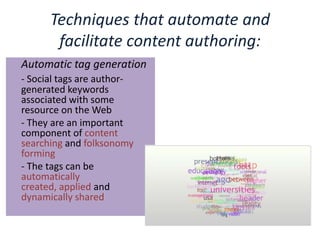
Techniques that automate and facilitate content authoring:	Automatic tag generation- Social tags are author-generated keywords associated with some resource on the Web 	- They are an important component of content searching and folksonomy forming	- The tags can be automatically created, applied and dynamically shared
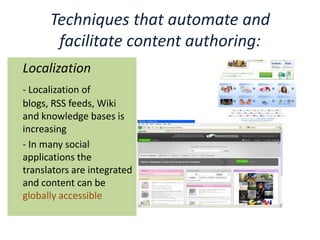
Techniques that automate and facilitate content authoring:	Localization- Localization of blogs, RSS feeds, Wiki and knowledge bases is increasing 	- In many social applications the translators are integrated and content can be globally accessible
Authoring in Web CloudsAuthoring 2.0 benefitsAutomated functionsAuthoring activitiesWeb 2.0 specification
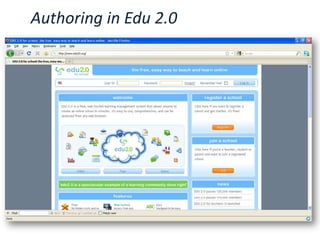
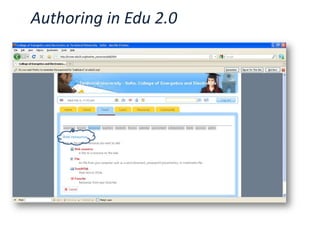
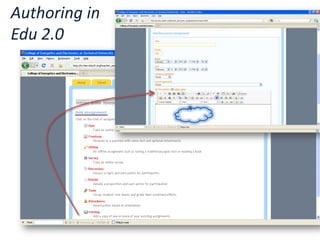
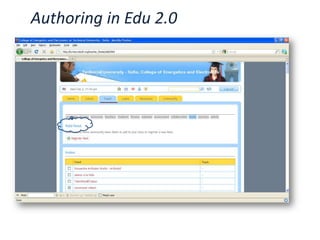
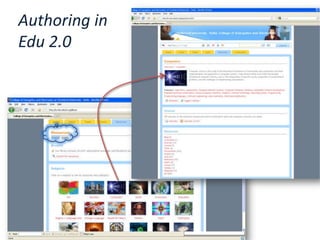
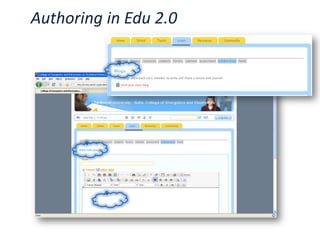
Authoring in Edu 2.0
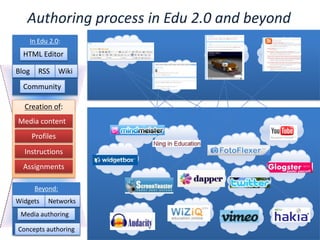
Authoring process in Edu 2.0 and beyondCreation of:Media contentProfilesInstructionsCommunityIn Edu 2.0:HTML EditorBlogWikiRSSAssignmentsBeyond:WidgetsNetworksMedia authoring Concepts authoring
ConclusionThe authoring process in the clouds of the contemporary Web : It is an individual, but not a stand-alone processIt is a collaborative, creative, iterative, virtual process Gives authors powerful functions for automation of content production, remixing, conversion and publishingThe IT automationIncreases productivity and tasks performance
The images from the clouds:http://a.images.blip.tv/KerryJ-NotYetThreeInSecondLife974.jpghttp://tecnofreaks.com/wp-content/uploads/2008/12/bluecloud_400.jpghttp://novini24.files.wordpress.com/2009/05/google.jpghttp://www.jumpingbean.co.za/files/files/sun_microsystems_banner.jpghttp://blogmines.com/blog/images/upload/2006/09/WindowsLiveWriter/7754c173b35c_1261A/Microsoft%20Office%5B5%5D.jpghttp://www.sandia.gov/news-center/news-releases/2005/images/future-participants.jpghttp://www.brianmicklethwait.com/images/uploads/ChicagoBridges.jpghttp://www.hemmy.net/images/arts2/upsidedownhouse01.jpghttp://www.duxburyeducationfoundation.org/mediac/400_0/media/IMG_2498.JPGhttp://lifeboat.com/images/semantic.pnghttp://nanobugle.files.wordpress.com/2008/12/second_life-nanobugle.jpghttp://wits.files.wordpress.com/2009/03/magic-window-by-oldvidhead.jpghttp://earth.google.com/intl/en_uk/outreach/images/balloon_all_templates.jpghttp://upload.wikimedia.org/wikipedia/commons/a/ae/DecollageDeltaPlaneDuMontStJoseph.JPGhttp://www.philosophyofinformation.net/blog/uploaded_images/ontology-758072.jpghttp://whollysblog.com/wordpress/wp-content/uploads/2009/09/flashing-lights-wallpaper2.jpg
Thank you for your attention!… and let’s start the automated authoring process journey in the clouds!For contacts:m_ivanova@tu-sofia.bg

Cloud computing for authoring process automation

  • 1.
    Cloud computing forauthoring process automation MalinkaIvanova, Technical University - SofiaGeorge Ivanov, Mathematical School, BlagoevgradWCES 2010 , 04-08 February, Istanbul, Turkey
  • 2.
    Aim Exploring and analyzingthe possibilities for automation of the authoring process in the Web 2.0 cloud and prototyping a model
  • 3.
    OutlineThe concept ofcloud computing in the educational sectorPresent Web specification and Authoring 2.0Automated authoring process in the Web 2.0 CloudUtilized Web 2.0 Applications for Authoring in Edu2.0 and beyondConclusion
  • 4.
    Cloud Computingincludes boththe applications delivered as services over the Internet and the hardware and systems softwarein the data centres that provide those servicesPaaSSaaSIaaSCloud Computing
  • 5.
    Cloud Computing inHigher EducationAdvantagesDisadvantages
  • 6.
    Cloud Computing inHigher EducationIt brings many benefits and innovative opportunities tothe authors of learning content:
  • 7.
    Authoring 2.0: AprocessofcontentcreationinaninteractiveandcollaborativewayutilizingWeb 2.0applications and services and their remixingfrom various sources forbuildingalearning/teaching environment
  • 8.
    Web SpecificationRead/write webFroma static to a more dynamic, interactive, and socialWeb applications - Wikis, Blogs, Forums, CMS - with friendly GUI, inviting educators to add content directly From one information source where information is consumed to many sources that can be remixedEducators and students are active content contributorsIt is a cause for social interactions and discourses that arebases for an iterative collaborative authoring process
  • 9.
    Web SpecificationNetworked webAnauthoring process is more than an individual possess - the behaviour of an individual is affected by the kinds of relations and technical tiesNetwork effect benefits: the number of contributions grows, the quality of information on the website improves, the authoring process is transparentA wide range of social networks are formed building online communities of educators, researchers, students whoshare and examine the common interests and/or activities The networked web influences on the performance of authoring tasks of both educators and students
  • 10.
    Web SpecificationWeb personalization- a strategy that requires implicitly or explicitly collecting user informationPersonalized WebThe implicit personalization – services utilize: presentation agents, tracking and profiling, notificationPersonalization involves technologies to accommodate the differences between individualsThe explicit personalization - the web page is changed by the author using the features provided by the systemPersonalizationtechnologies put the studentin the center of an interaction, application or service ensuringrich learning experiences acrossactivities, devices, services,locations and networks Hybrid personalization – implicit +explicitThe author can personalize (1) the content, (2) the services, (3) the student's interactions to enhance his/her experiences with applications and services
  • 11.
    Web SpecificationMashable webMashUps– a combinationof separate, stand-alone technologies into a novel application or serviceNew authoring tools are developed that enable non-technical authors to create sophisticated products without programmingEducators develop custom mashupsto illustrate concepts as they teachStudents include them in artefacts, reports and assignmentsThe power of mashups for education lies in the way they help new conclusions reaching or new relationships discerning by uniting large amounts of data in a manageable way
  • 12.
    Web SpecificationVisual webVisualization- a mapping process from computer representations to perceptual representations, choosing encoding techniques to maximize human understanding and communicationThe goal of an educator - to visualize phenomena or concepts for the student’s deeper understanding and thinking stimulationWeb 2.0 technologies propose dynamic visualization tools: visual search engines, timelines, tools for organization of personal notes, plans, ideas, simulationsEducators can present in an interactive visual way gathered and explored knowledge
  • 13.
    Web SpecificationSemantic webSemanticWeb offers complicated well-developed logic based technologies for knowledge processing Three views of the term semantic web: the vision, the program and the technologyThe vision - an extension of the current Web in which information is given well-defined meaning, better enabling computers and people to work in cooperation (Matthews, 2005) Several applications of which authors can take advantage: from web browsing to research, blogging, and collaboration
  • 14.
    Web SpecificationRSS syndicatedwebRSS technology allows an aggregator to check the subscribed feeds and to collect all the new content from many sitesThe educator - create feeds about any topic, can make a syndicated feed of search resultsStudents - arrange individualized, syndicated web pages creating large repositories of knowledgeRSS - a powerful research tool aiding educators and students in performing in depthresearch both individually and collaboratively by sharing and combining feeds acrossvarious sources
  • 15.
    Web SpecificationVirtual webTheflat 2D web is replaced by an immersive and highly social 3D online world - the teaching/learning process is translated in virtual worldsDifferent educational strategies : for individual, group, collaborative work, for experiments, simulations and research, for university students, life-long or self-paced learnersEducators have tools for authoring of flexible and attractive teaching/learning environment, automating the objects generation, publishing and presenting
  • 16.
    Web SpecificationAugmented webAR- takes technologies that add contextual data to deepen a person’s understanding of the subjectAt this moment there are few authoring tools to support educators, creating AR applications
  • 17.
    Web SpecificationOpen webThemain purpose is the broadest possible dissemination of knowledgeOn the web the educational materials of many open courses are shared for reusage in concrete context with minimal restrictionsOpen software and open code is widely adopted in Higher education - the possibilities for modification, integration, no restriction on other software, technology neutrality, license policy
  • 18.
    Automated authoring process- the sequence of actions that the author performs utilizing applications and services in order to build a complete teaching/learning environment
  • 19.
    Techniques that automateand facilitate content authoring:Templates usage- Allows the fast creation of unique content and automatic publishing - to control the automatic content generation - to format multiple application pages with little or no hand-crafting
  • 20.
    Techniques that automateand facilitate content authoring:Generation of embed code- Created, uploaded and edited content can be converted into embed code - It can easily be integrated in other applications and sites - It gives huge possibilities for authors to create a flexible, extendable mashuplearning/teaching environment
  • 21.
    Techniques that automateand facilitate content authoring: Different media format conversion- The automatic conversion from one media format to another - Support the author in the easy distribution of created content - Facilitate content integration in a wide range of media environments on different platforms, including PDA and mobile versions
  • 22.
    Techniques that automateand facilitate content authoring: Sharing function- Developed content can be shared, voted and favorited - It automates the publishing process in different media sites such as: Facebook, Twitter, Digg
  • 23.
    Techniques that automateand facilitate content authoring: Automatic tag generation- Social tags are author-generated keywords associated with some resource on the Web - They are an important component of content searching and folksonomy forming - The tags can be automatically created, applied and dynamically shared
  • 24.
    Techniques that automateand facilitate content authoring: Localization- Localization of blogs, RSS feeds, Wiki and knowledge bases is increasing - In many social applications the translators are integrated and content can be globally accessible
  • 25.
    Authoring in WebCloudsAuthoring 2.0 benefitsAutomated functionsAuthoring activitiesWeb 2.0 specification
  • 26.
  • 27.
  • 28.
  • 29.
  • 30.
  • 31.
  • 32.
    Authoring process inEdu 2.0 and beyondCreation of:Media contentProfilesInstructionsCommunityIn Edu 2.0:HTML EditorBlogWikiRSSAssignmentsBeyond:WidgetsNetworksMedia authoring Concepts authoring
  • 33.
    ConclusionThe authoring processin the clouds of the contemporary Web : It is an individual, but not a stand-alone processIt is a collaborative, creative, iterative, virtual process Gives authors powerful functions for automation of content production, remixing, conversion and publishingThe IT automationIncreases productivity and tasks performance
  • 34.
    The images fromthe clouds:http://a.images.blip.tv/KerryJ-NotYetThreeInSecondLife974.jpghttp://tecnofreaks.com/wp-content/uploads/2008/12/bluecloud_400.jpghttp://novini24.files.wordpress.com/2009/05/google.jpghttp://www.jumpingbean.co.za/files/files/sun_microsystems_banner.jpghttp://blogmines.com/blog/images/upload/2006/09/WindowsLiveWriter/7754c173b35c_1261A/Microsoft%20Office%5B5%5D.jpghttp://www.sandia.gov/news-center/news-releases/2005/images/future-participants.jpghttp://www.brianmicklethwait.com/images/uploads/ChicagoBridges.jpghttp://www.hemmy.net/images/arts2/upsidedownhouse01.jpghttp://www.duxburyeducationfoundation.org/mediac/400_0/media/IMG_2498.JPGhttp://lifeboat.com/images/semantic.pnghttp://nanobugle.files.wordpress.com/2008/12/second_life-nanobugle.jpghttp://wits.files.wordpress.com/2009/03/magic-window-by-oldvidhead.jpghttp://earth.google.com/intl/en_uk/outreach/images/balloon_all_templates.jpghttp://upload.wikimedia.org/wikipedia/commons/a/ae/DecollageDeltaPlaneDuMontStJoseph.JPGhttp://www.philosophyofinformation.net/blog/uploaded_images/ontology-758072.jpghttp://whollysblog.com/wordpress/wp-content/uploads/2009/09/flashing-lights-wallpaper2.jpg
  • 35.
    Thank you foryour attention!… and let’s start the automated authoring process journey in the clouds!For contacts:m_ivanova@tu-sofia.bg