
CLOUD COMPUTING: A BOON FOR
        LIBRARY SERVICES
                            Presented by

       Deepshikha Sen                   Nilratan Bhattacharjee
         Library Trainee            Master in Library and Information Science
National Institute of Technology             Assam University

                                   &
                           Dr. Mukut Sarmah
                       Assistant Professor
           Department of Library and Information Science
                        Assam University
INTRODUCTION
Cloud computing has evolved through a number of phases which include
automatic computing, client-server model, mainframe computing, grid utility
computing and application service provision (ASP).

But the overarching concept of delivering computing resources through a global
network is rooted in the sixties. The idea of an "intergalactic computer
network" was introduced in the sixties by J. C. R. Licklider, who was responsible
for enabling the development of ARPANET (Advanced Research Projects Agency
Network) in 1969.

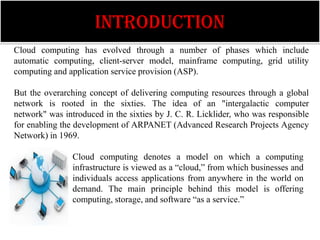
                Cloud computing denotes a model on which a computing
                infrastructure is viewed as a “cloud,” from which businesses and
                individuals access applications from anywhere in the world on
                demand. The main principle behind this model is offering
                computing, storage, and software “as a service.”
MEANING OF CLOUD COMPUTING

According to the National Institute of Standards and Technology (NIST)
definition (2009), Cloud computing is a model for enabling
ubiquitous, convenient on-demand network access to a shared pool of
configurable                           computing                         resources
(e.g., networks, servers, storage, applications, and services) that can be rapidly
provisioned and released with minimal management effort or service provider
interaction.
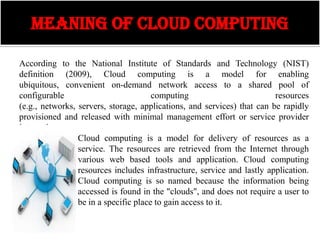
                 Cloud computing is a model for delivery of resources as a
                 service. The resources are retrieved from the Internet through
                 various web based tools and application. Cloud computing
                 resources includes infrastructure, service and lastly application.
                 Cloud computing is so named because the information being
                 accessed is found in the "clouds", and does not require a user to
                 be in a specific place to gain access to it.
SERVICE MODELS OF CLOUD COMPUTING
Software as a Service (SaaS): It is the most familiar and widely used form of
cloud technology service. In this model the consumer use an application of the
service provider but does not control the OS and other hardware and software on
which it is running. Google's Gmail and Apps, instant messaging from
AOL, Yahoo and Google, are common examples of this.

Infrastructure as a Service (IaaS): Here Cloud Computing provides
grids, servers, networks, storage and systems software on need basis. It provides
full control over the OS and all the resources. Ex. Amazon Elastic Compute
Cloud (Amazon EC2), Amazon Simple Storage Service (S3)
                 Platform as a Service (PaaS): In this model service provider
                 delivers virtualized servers on which customers can run existing
                 applications or develop new ones without having to worry about
                 maintaining the operating systems, server hardware, load
                 balancing or computing capacity.
                 Ex. Microsoft's Azure, Force.com, Google Maps, ADP Payroll
                 processing.
TYPES OF CLOUD COMPUTING
Cloud computing can be divided into four types which are public, private, hybrid
and community cloud and each one has its own characteristics.

Public cloud: In this model the vendor or service provider controls the whole
cloud system and offers service on demand over Internet on pay-per-use basis. It
is also known as provider cloud.
Examples of Public Cloud:          Google App Engine, Microsoft Windows
Azure, IBM Smart Cloud, Amazon EC2
                Private cloud
                Private clouds are generally built within an organization for the
                benefit of the particular organisation. Private cloud is also known
                as “internal cloud”.
                Examples of Private Cloud: Eucalyptus, Amazon VPC (Virtual
                Private Cloud), VMware Cloud Infrastructure Suite, Microsoft ECI
                data centre.
TYPES OF CLOUD COMPUTING
Hybrid cloud
Hybrid cloud means the compilations of two cloud technology i.e. private and
public cloud or internal and external cloud. It is also known as combined cloud.
Examples of Hybrid Cloud:             Windows Azure (capable of Hybrid
Cloud), VMware vCloud (Hybrid Cloud Services)

               Community cloud
               Community cloud infrastructure is shared by some organizations
               and supports a specific community that shares concerns (e.g.
               mission, education and compliance considerations).It may either
               be managed by the organizations or a third party and may exist
               on premise or off premise.
               Examples of Community Cloud: Google Apps for
               Government, Microsoft Government Community Cloud.
benefits of cloud computing approach in
               libraries
Cloud computing helps in increased visibility and accessibility of collections.

Cloud computing helps in reducing duplication of effort from network technical
services and collection management.

Make libraries greener by sharing computing power thus reducing carbon
footprints. For patrons, web-based cloud services can be accessed remotely at a
convenient time and also help to save transportation costs.

It helps to create an illusion of availability of infinite computer resources on
demand.

It helps to create an on-demand self sufficient service, thereby eliminating the
need for cloud user to plan ahead.
benefits of cloud computing approach in
               libraries
 Cloud technology is paid incrementally (you-pay-only-for-what-you-need)
  saving libraries’ money in the short run and then this money saved can be used
  for other important resources.

 Increased storage capacity helps libraries to store more data than on private
  computer systems.

 Highly automated atmosphere of cloud computing helps the libraries to keep a
  bay on IT personnel’s help for keeping software up-to-date, as maintenance is
  the job of the service provider on the cloud.

 With Cloud computing, services of libraries will have a new leap in the future.
  In fact, services provided by the libraries will become more user-centric, more
  professional and more effective. This will in turn help the libraries to create
  more knowledge benefits for the country .
Application of Cloud computing in
                 libraries
Libraries can build their computer system on web technology with cloud technologies so
that user can integrate more easily the system.

Libraries can build digital library, content management system, institutional
repository, Inter Library Loan (IIL) system and Integrated Library System (ILS) from
locally-managed to vendor-hosted environment, of their own with the help of cloud
technology.

With the help of cloud computing technology libraries can host their website. The
District of Columbia Public Library is using Amazon’s EC2 (Elastic Computing Cloud)
service to host their website.

Libraries can use cloud technology like Google Docs to collect responses to web
forms, Google Calendar for instruction and meeting rooms, and Google Analytics to
collect statistics about their website, catalogue and blogs.

Cloud technology can be applied for backing up of media collections and storing and
accessing of bibliographic data. Libraries can also store and maintain much of the same
data hundreds and thousands of times.
Service providers of Cloud computing for
               libraries

 • Polaris Library Systems- Library Automation System, it provides
   standard acquisition and processing system. The systems uses number
   of well know standards like MARC 21 for bibliographic
   data, XML, Z39.50 for information retrieval, Unicode etc.

 • Dura Cloud: Digital library services, Its concern of the Duraspace
   which is a collaboration of the Dspace digital library software and
   Fedora Commons, It is available for all type of libraries and also for
   consortia, It offers complete solution for digital library with standard
   software and hardware solution, It also provides open source code
   and the code needs to be installed on your machine.
CONCLUSION
Cloud computing is a new and promising paradigm delivering IT
services as computing utilities. Cloud computing bring several
benefits for libraries and give them a different future.

Cloud computing encourages libraries and their users to participate
in a network and community of libraries by enabling them to reuse
information and socialize around information. It also creates a
powerful, unified presence for libraries on the web and gives users a
local, group and global reach. Some problems such as platform
security, technical standards, regulatory and other services are not
well resolved yet in practice.
THANK YOU

Cloud computing a boon for library services

  • 1.
    CLOUD COMPUTING: ABOON FOR LIBRARY SERVICES Presented by Deepshikha Sen Nilratan Bhattacharjee Library Trainee Master in Library and Information Science National Institute of Technology Assam University & Dr. Mukut Sarmah Assistant Professor Department of Library and Information Science Assam University
  • 2.
    INTRODUCTION Cloud computing hasevolved through a number of phases which include automatic computing, client-server model, mainframe computing, grid utility computing and application service provision (ASP). But the overarching concept of delivering computing resources through a global network is rooted in the sixties. The idea of an "intergalactic computer network" was introduced in the sixties by J. C. R. Licklider, who was responsible for enabling the development of ARPANET (Advanced Research Projects Agency Network) in 1969. Cloud computing denotes a model on which a computing infrastructure is viewed as a “cloud,” from which businesses and individuals access applications from anywhere in the world on demand. The main principle behind this model is offering computing, storage, and software “as a service.”
  • 3.
    MEANING OF CLOUDCOMPUTING According to the National Institute of Standards and Technology (NIST) definition (2009), Cloud computing is a model for enabling ubiquitous, convenient on-demand network access to a shared pool of configurable computing resources (e.g., networks, servers, storage, applications, and services) that can be rapidly provisioned and released with minimal management effort or service provider interaction. Cloud computing is a model for delivery of resources as a service. The resources are retrieved from the Internet through various web based tools and application. Cloud computing resources includes infrastructure, service and lastly application. Cloud computing is so named because the information being accessed is found in the "clouds", and does not require a user to be in a specific place to gain access to it.
  • 4.
    SERVICE MODELS OFCLOUD COMPUTING Software as a Service (SaaS): It is the most familiar and widely used form of cloud technology service. In this model the consumer use an application of the service provider but does not control the OS and other hardware and software on which it is running. Google's Gmail and Apps, instant messaging from AOL, Yahoo and Google, are common examples of this. Infrastructure as a Service (IaaS): Here Cloud Computing provides grids, servers, networks, storage and systems software on need basis. It provides full control over the OS and all the resources. Ex. Amazon Elastic Compute Cloud (Amazon EC2), Amazon Simple Storage Service (S3) Platform as a Service (PaaS): In this model service provider delivers virtualized servers on which customers can run existing applications or develop new ones without having to worry about maintaining the operating systems, server hardware, load balancing or computing capacity. Ex. Microsoft's Azure, Force.com, Google Maps, ADP Payroll processing.
  • 5.
    TYPES OF CLOUDCOMPUTING Cloud computing can be divided into four types which are public, private, hybrid and community cloud and each one has its own characteristics. Public cloud: In this model the vendor or service provider controls the whole cloud system and offers service on demand over Internet on pay-per-use basis. It is also known as provider cloud. Examples of Public Cloud: Google App Engine, Microsoft Windows Azure, IBM Smart Cloud, Amazon EC2 Private cloud Private clouds are generally built within an organization for the benefit of the particular organisation. Private cloud is also known as “internal cloud”. Examples of Private Cloud: Eucalyptus, Amazon VPC (Virtual Private Cloud), VMware Cloud Infrastructure Suite, Microsoft ECI data centre.
  • 6.
    TYPES OF CLOUDCOMPUTING Hybrid cloud Hybrid cloud means the compilations of two cloud technology i.e. private and public cloud or internal and external cloud. It is also known as combined cloud. Examples of Hybrid Cloud: Windows Azure (capable of Hybrid Cloud), VMware vCloud (Hybrid Cloud Services) Community cloud Community cloud infrastructure is shared by some organizations and supports a specific community that shares concerns (e.g. mission, education and compliance considerations).It may either be managed by the organizations or a third party and may exist on premise or off premise. Examples of Community Cloud: Google Apps for Government, Microsoft Government Community Cloud.
  • 7.
    benefits of cloudcomputing approach in libraries Cloud computing helps in increased visibility and accessibility of collections. Cloud computing helps in reducing duplication of effort from network technical services and collection management. Make libraries greener by sharing computing power thus reducing carbon footprints. For patrons, web-based cloud services can be accessed remotely at a convenient time and also help to save transportation costs. It helps to create an illusion of availability of infinite computer resources on demand. It helps to create an on-demand self sufficient service, thereby eliminating the need for cloud user to plan ahead.
  • 8.
    benefits of cloudcomputing approach in libraries  Cloud technology is paid incrementally (you-pay-only-for-what-you-need) saving libraries’ money in the short run and then this money saved can be used for other important resources.  Increased storage capacity helps libraries to store more data than on private computer systems.  Highly automated atmosphere of cloud computing helps the libraries to keep a bay on IT personnel’s help for keeping software up-to-date, as maintenance is the job of the service provider on the cloud.  With Cloud computing, services of libraries will have a new leap in the future. In fact, services provided by the libraries will become more user-centric, more professional and more effective. This will in turn help the libraries to create more knowledge benefits for the country .
  • 9.
    Application of Cloudcomputing in libraries Libraries can build their computer system on web technology with cloud technologies so that user can integrate more easily the system. Libraries can build digital library, content management system, institutional repository, Inter Library Loan (IIL) system and Integrated Library System (ILS) from locally-managed to vendor-hosted environment, of their own with the help of cloud technology. With the help of cloud computing technology libraries can host their website. The District of Columbia Public Library is using Amazon’s EC2 (Elastic Computing Cloud) service to host their website. Libraries can use cloud technology like Google Docs to collect responses to web forms, Google Calendar for instruction and meeting rooms, and Google Analytics to collect statistics about their website, catalogue and blogs. Cloud technology can be applied for backing up of media collections and storing and accessing of bibliographic data. Libraries can also store and maintain much of the same data hundreds and thousands of times.
  • 10.
    Service providers ofCloud computing for libraries • Polaris Library Systems- Library Automation System, it provides standard acquisition and processing system. The systems uses number of well know standards like MARC 21 for bibliographic data, XML, Z39.50 for information retrieval, Unicode etc. • Dura Cloud: Digital library services, Its concern of the Duraspace which is a collaboration of the Dspace digital library software and Fedora Commons, It is available for all type of libraries and also for consortia, It offers complete solution for digital library with standard software and hardware solution, It also provides open source code and the code needs to be installed on your machine.
  • 11.
    CONCLUSION Cloud computing isa new and promising paradigm delivering IT services as computing utilities. Cloud computing bring several benefits for libraries and give them a different future. Cloud computing encourages libraries and their users to participate in a network and community of libraries by enabling them to reuse information and socialize around information. It also creates a powerful, unified presence for libraries on the web and gives users a local, group and global reach. Some problems such as platform security, technical standards, regulatory and other services are not well resolved yet in practice.
  • 12.