Cloud building
Profile
 Nama :Wahidudin
 Umur : 31 thn
 Alamat : Jl.GunungAnyar Lor no.74
 Pekerjaan : Research Develover di Ailinuxsolusion
 E-mail : ailinuxsolusion@gmail.com
 fb
Cloud = awan
Building= bangun
What Cloud building
human
Software
Hardware
Komponen Cloud building
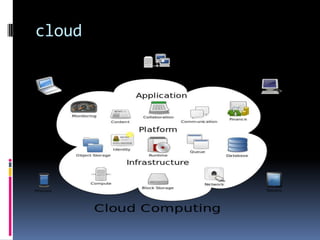
cloud
Essential Characteristics Cloud
 On-demand self-service.A consumer can unilaterally provision computing
capabilities, such as server time and network storage, as needed automatically
without requiring human interaction with each service provider.Broad network
access. Capabilities are available over the network and accessed through standard
mechanisms that promote use by heterogeneous thin or thick client platforms
(e.g., mobile phones, tablets, laptops, and workstations).
 Resource pooling.The provider's computing resources are pooled to serve multiple
consumers using a multi-tenant model, with different physical and virtual
resources dynamically assigned and reassigned according to consumer
demand. ...
 Rapid elasticity. Capabilities can be elastically provisioned and released, in some
cases automatically, to scale rapidly outward and inward commensurate with
demand.To the consumer, the capabilities available for provisioning often appear
unlimited and can be appropriated in any quantity at any time.
 Measured service. Cloud systems automatically control and optimize resource use
by leveraging a metering capability at some level of abstraction appropriate to
the type of service (e.g., storage, processing, bandwidth, and active user
accounts). Resource usage can be monitored, controlled, and reported, providing
transparency for both the provider and consumer of the utilized service.
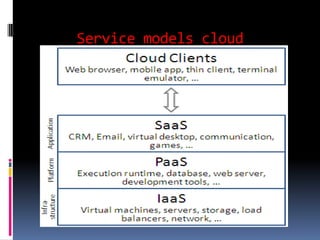
Service models cloud
 Infrastructure as a service (IaaS)
 Platform as a service (PaaS)
 Software as a service (SaaS)
 Network as a service (NaaS)
Infrastructure as a service (IaaS)
 In the most basic cloud-service model, providers of IaaS offer computers - physical or (more
often) virtual machines - and other resources. (A hypervisor, such as Xen or KVM, runs the
virtual machines as guests. Pools of hypervisors within the cloud operational support-
system can support large numbers of virtual machines and the ability to scale services up
and down according to customers' varying requirements.) IaaS clouds often offer
additional resources such as a virtual-machine disk image library, raw (block) and file-based
storage, firewalls, load balancers, IP addresses, virtual local area networks (VLANs), and
software bundles.[52] IaaS-cloud providers supply these resources on-demand from their
large pools installed in data centers. For wide-area connectivity, customers can use either
the Internet or carrier clouds (dedicated virtual private networks).
 To deploy their applications, cloud users install operating-system images and their
application software on the cloud infrastructure. In this model, the cloud user patches and
maintains the operating systems and the application software. Cloud providers typically bill
IaaS services on a utility computing basis[citation needed]: cost reflects the amount of resources
allocated and consumed.
 Examples of IaaS providers include: Amazon EC2, AirVM, Azure Services
Platform, DynDNS, Google Compute Engine, HP
Cloud,iland, Joyent, LeaseWeb, Linode, NaviSite, Oracle Infrastructure as a
Service, Rackspace, ReadySpace Cloud Services, ReliaCloud,SAVVIS, SingleHop,
andTerremark
 Cloud communications and cloud telephony, rather than replacing local computing
infrastructure, replace local telecommunications infrastructure withVoice over IP and other
off-site Internet services.
In the PaaS model, cloud providers deliver a computing platform typically
including operating system, programming language execution environment,
database, and web server. Application developers can develop and run their
software solutions on a cloud platform without the cost and complexity of
buying and managing the underlying hardware and software layers.With
some PaaS offers, the underlying computer and storage resources scale
automatically to match application demand such that cloud user does not
have to allocate resources manually.
Examples of PaaS include: AWS Elastic Beanstalk,Cloud
Foundry, Heroku, Force.com, EngineYard, Mendix, OpenShift,GoogleApp
Engine,Windows Azure Cloud Services and OrangeScape.
Platform as a service (PaaS)
[In the SaaS model, cloud providers install and operate application software in the
cloud and cloud users access the software from cloud clients. Cloud users do not
manage the cloud infrastructure and platform where the application runs.This
eliminates the need to install and run the application on the cloud user's own
computers, which simplifies maintenance and support. Cloud applications are
different from other applications in their scalability—which can be achieved by cloning
tasks onto multiple virtual machines at run-time to meet changing work
demand.[53]Load balancers distribute the work over the set of virtual machines.This
process is transparent to the cloud user, who sees only a single access point.To
accommodate a large number of cloud users, cloud applications can
be multitenant, that is, any machine serves more than one cloud user organization. It
is common to refer to special types of cloud based application software with a similar
naming convention: desktop as a service, business process as a service, test
environment as a service, communication as a service.
The pricing model for SaaS applications is typically a monthly or yearly flat fee per
user,[54] so price is scalable and adjustable if users are added or removed at any
point.[55]
Examples of SaaS include: Google Apps, Microsoft Office 365, Onlive, GT
Nexus, Marketo, Casengo andTradeCard.
Software as a service (SaaS)
[A category of cloud services where the capability provided to the cloud service
user is to use network/transport connectivity services and/or inter-cloud
network connectivity services.NaaS involves the optimization of resource
allocations by considering network and computing resources as a unified
whole.
Traditional NaaS services include flexible and extendedVPN, and bandwidth on
demand. NaaS concept materialization also includes the provision of a virtual
network service by the owners of the network infrastructure to a third party
(VNP –VNO).
Network as a service (NaaS)
Service models cloud
Cloud Computing Type
DEPLOYMENT MODELS CLOUD
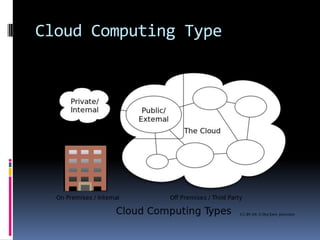
1. Private cloud
2.Public cloud
3. Hybrid cloud
4. Community cloud
Private cloud
 Private cloud is cloud infrastructure operated solely for a
single organization, whether managed internally or by a
third-party and hosted internally or externally. Undertaking
a private cloud project requires a significant level and
degree of engagement to virtualize the business
environment, and requires the organization to reevaluate
decisions about existing resources.When done right, it can
improve business, but every step in the project raises
security issues that must be addressed to prevent serious
vulnerabilities.
 They have attracted criticism because users "still have to
buy, build, and manage them" and thus do not benefit from
less hands-on management, essentially "[lacking] the
economic model that makes cloud computing such an
intriguing concept"
Public cloud
 Public cloud applications, storage, and other
resources are made available to the general
public by a service provider.These services
are free or offered on a pay-per-use model.
Generally, public cloud service providers like
Amazon AWS, Microsoft and Google own and
operate the infrastructure and offer access
only via Internet (direct connectivity is not
offered)
Hybrid cloud
 Hybrid cloud is a composition of two or more clouds (private, community or
public) that remain unique entities but are bound together, offering the benefits
of multiple deployment models.Such composition expands deployment options
for cloud services, allowing IT organizations to use public cloud computing
resources to meet temporary needs.This capability enables hybrid clouds to
employ cloud bursting for scaling across clouds.
 Cloud bursting is an application deployment model in which an application runs
in a private cloud or data center and "bursts" to a public cloud when the demand
for computing capacity increases. A primary advantage of cloud bursting and a
hybrid cloud model is that an organization only pays for extra compute
resources when they are needed.
 Cloud bursting enables data centers to create an in-house IT infrastructure that
supports average workloads, and use cloud resources from public or private
clouds, during spikes in processing demands.
 By utilizing "hybrid cloud" architecture, companies and individuals are able to
obtain degrees of fault tolerance combined with locally immediate usability
without dependency on internet connectivity. Hybrid cloud architecture
requires both on-premises resources and off-site (remote) server-based cloud
infrastructure.
 Hybrid clouds lack the flexibility, security and certainty of in-house
applications. Hybrid cloud provides the flexibility of in house applications with
the fault tolerance and scalability of cloud based services.
Community cloud
 Community cloud shares infrastructure
between several organizations from a specific
community with common concerns (security,
compliance, jurisdiction, etc.), whether
managed internally or by a third-party and
hosted internally or externally.The costs are
spread over fewer users than a public cloud
(but more than a private cloud), so only some
of the cost savings potential of cloud
computing are realized.
Software
OS SERVER
OPENSTACK
HADOOP
VMWARE
OS SERVER
 Ubuntu server
 Redhat
 Centos
 ORACLE
Cloud building

Cloud building

  • 1.
  • 2.
    Profile  Nama :Wahidudin Umur : 31 thn  Alamat : Jl.GunungAnyar Lor no.74  Pekerjaan : Research Develover di Ailinuxsolusion  E-mail : ailinuxsolusion@gmail.com  fb
  • 3.
    Cloud = awan Building=bangun What Cloud building
  • 4.
  • 5.
  • 6.
    Essential Characteristics Cloud On-demand self-service.A consumer can unilaterally provision computing capabilities, such as server time and network storage, as needed automatically without requiring human interaction with each service provider.Broad network access. Capabilities are available over the network and accessed through standard mechanisms that promote use by heterogeneous thin or thick client platforms (e.g., mobile phones, tablets, laptops, and workstations).  Resource pooling.The provider's computing resources are pooled to serve multiple consumers using a multi-tenant model, with different physical and virtual resources dynamically assigned and reassigned according to consumer demand. ...  Rapid elasticity. Capabilities can be elastically provisioned and released, in some cases automatically, to scale rapidly outward and inward commensurate with demand.To the consumer, the capabilities available for provisioning often appear unlimited and can be appropriated in any quantity at any time.  Measured service. Cloud systems automatically control and optimize resource use by leveraging a metering capability at some level of abstraction appropriate to the type of service (e.g., storage, processing, bandwidth, and active user accounts). Resource usage can be monitored, controlled, and reported, providing transparency for both the provider and consumer of the utilized service.
  • 7.
    Service models cloud Infrastructure as a service (IaaS)  Platform as a service (PaaS)  Software as a service (SaaS)  Network as a service (NaaS)
  • 8.
    Infrastructure as aservice (IaaS)  In the most basic cloud-service model, providers of IaaS offer computers - physical or (more often) virtual machines - and other resources. (A hypervisor, such as Xen or KVM, runs the virtual machines as guests. Pools of hypervisors within the cloud operational support- system can support large numbers of virtual machines and the ability to scale services up and down according to customers' varying requirements.) IaaS clouds often offer additional resources such as a virtual-machine disk image library, raw (block) and file-based storage, firewalls, load balancers, IP addresses, virtual local area networks (VLANs), and software bundles.[52] IaaS-cloud providers supply these resources on-demand from their large pools installed in data centers. For wide-area connectivity, customers can use either the Internet or carrier clouds (dedicated virtual private networks).  To deploy their applications, cloud users install operating-system images and their application software on the cloud infrastructure. In this model, the cloud user patches and maintains the operating systems and the application software. Cloud providers typically bill IaaS services on a utility computing basis[citation needed]: cost reflects the amount of resources allocated and consumed.  Examples of IaaS providers include: Amazon EC2, AirVM, Azure Services Platform, DynDNS, Google Compute Engine, HP Cloud,iland, Joyent, LeaseWeb, Linode, NaviSite, Oracle Infrastructure as a Service, Rackspace, ReadySpace Cloud Services, ReliaCloud,SAVVIS, SingleHop, andTerremark  Cloud communications and cloud telephony, rather than replacing local computing infrastructure, replace local telecommunications infrastructure withVoice over IP and other off-site Internet services.
  • 9.
    In the PaaSmodel, cloud providers deliver a computing platform typically including operating system, programming language execution environment, database, and web server. Application developers can develop and run their software solutions on a cloud platform without the cost and complexity of buying and managing the underlying hardware and software layers.With some PaaS offers, the underlying computer and storage resources scale automatically to match application demand such that cloud user does not have to allocate resources manually. Examples of PaaS include: AWS Elastic Beanstalk,Cloud Foundry, Heroku, Force.com, EngineYard, Mendix, OpenShift,GoogleApp Engine,Windows Azure Cloud Services and OrangeScape. Platform as a service (PaaS)
  • 10.
    [In the SaaSmodel, cloud providers install and operate application software in the cloud and cloud users access the software from cloud clients. Cloud users do not manage the cloud infrastructure and platform where the application runs.This eliminates the need to install and run the application on the cloud user's own computers, which simplifies maintenance and support. Cloud applications are different from other applications in their scalability—which can be achieved by cloning tasks onto multiple virtual machines at run-time to meet changing work demand.[53]Load balancers distribute the work over the set of virtual machines.This process is transparent to the cloud user, who sees only a single access point.To accommodate a large number of cloud users, cloud applications can be multitenant, that is, any machine serves more than one cloud user organization. It is common to refer to special types of cloud based application software with a similar naming convention: desktop as a service, business process as a service, test environment as a service, communication as a service. The pricing model for SaaS applications is typically a monthly or yearly flat fee per user,[54] so price is scalable and adjustable if users are added or removed at any point.[55] Examples of SaaS include: Google Apps, Microsoft Office 365, Onlive, GT Nexus, Marketo, Casengo andTradeCard. Software as a service (SaaS)
  • 11.
    [A category ofcloud services where the capability provided to the cloud service user is to use network/transport connectivity services and/or inter-cloud network connectivity services.NaaS involves the optimization of resource allocations by considering network and computing resources as a unified whole. Traditional NaaS services include flexible and extendedVPN, and bandwidth on demand. NaaS concept materialization also includes the provision of a virtual network service by the owners of the network infrastructure to a third party (VNP –VNO). Network as a service (NaaS)
  • 12.
  • 13.
  • 14.
    DEPLOYMENT MODELS CLOUD 1.Private cloud 2.Public cloud 3. Hybrid cloud 4. Community cloud
  • 15.
    Private cloud  Privatecloud is cloud infrastructure operated solely for a single organization, whether managed internally or by a third-party and hosted internally or externally. Undertaking a private cloud project requires a significant level and degree of engagement to virtualize the business environment, and requires the organization to reevaluate decisions about existing resources.When done right, it can improve business, but every step in the project raises security issues that must be addressed to prevent serious vulnerabilities.  They have attracted criticism because users "still have to buy, build, and manage them" and thus do not benefit from less hands-on management, essentially "[lacking] the economic model that makes cloud computing such an intriguing concept"
  • 16.
    Public cloud  Publiccloud applications, storage, and other resources are made available to the general public by a service provider.These services are free or offered on a pay-per-use model. Generally, public cloud service providers like Amazon AWS, Microsoft and Google own and operate the infrastructure and offer access only via Internet (direct connectivity is not offered)
  • 17.
    Hybrid cloud  Hybridcloud is a composition of two or more clouds (private, community or public) that remain unique entities but are bound together, offering the benefits of multiple deployment models.Such composition expands deployment options for cloud services, allowing IT organizations to use public cloud computing resources to meet temporary needs.This capability enables hybrid clouds to employ cloud bursting for scaling across clouds.  Cloud bursting is an application deployment model in which an application runs in a private cloud or data center and "bursts" to a public cloud when the demand for computing capacity increases. A primary advantage of cloud bursting and a hybrid cloud model is that an organization only pays for extra compute resources when they are needed.  Cloud bursting enables data centers to create an in-house IT infrastructure that supports average workloads, and use cloud resources from public or private clouds, during spikes in processing demands.  By utilizing "hybrid cloud" architecture, companies and individuals are able to obtain degrees of fault tolerance combined with locally immediate usability without dependency on internet connectivity. Hybrid cloud architecture requires both on-premises resources and off-site (remote) server-based cloud infrastructure.  Hybrid clouds lack the flexibility, security and certainty of in-house applications. Hybrid cloud provides the flexibility of in house applications with the fault tolerance and scalability of cloud based services.
  • 18.
    Community cloud  Communitycloud shares infrastructure between several organizations from a specific community with common concerns (security, compliance, jurisdiction, etc.), whether managed internally or by a third-party and hosted internally or externally.The costs are spread over fewer users than a public cloud (but more than a private cloud), so only some of the cost savings potential of cloud computing are realized.
  • 19.
  • 20.
    OS SERVER  Ubuntuserver  Redhat  Centos  ORACLE