Cloud Computing Phani Kumar 30 Jan 2009
Cloud Computing Agenda Introduction What is the cloud? Why all of a sudden? What runs the cloud? Layers of Cloud Computing Cloud Providers Why Adopt Cloud? Drawbacks of Cloud 3 Reasons why cloud is becoming popular Conclusion
Cloud Computing Introduction Cloud computing is Internet (“cloud”) based development and use of computer technology.  It is a business information style of computing in which typical real-time scalable resources are provided as a service over the internet to users who need not have knowledge of, expertise in, or control over the technology infrastructure (“in the cloud”) that supports them. It is a general concept that incorporates software as a service (SaaS), Web 2.0 and other recent, well known technology trends, in which the common theme is reliance on the internet for satisfying the computing needs of the users. From Wikipedia
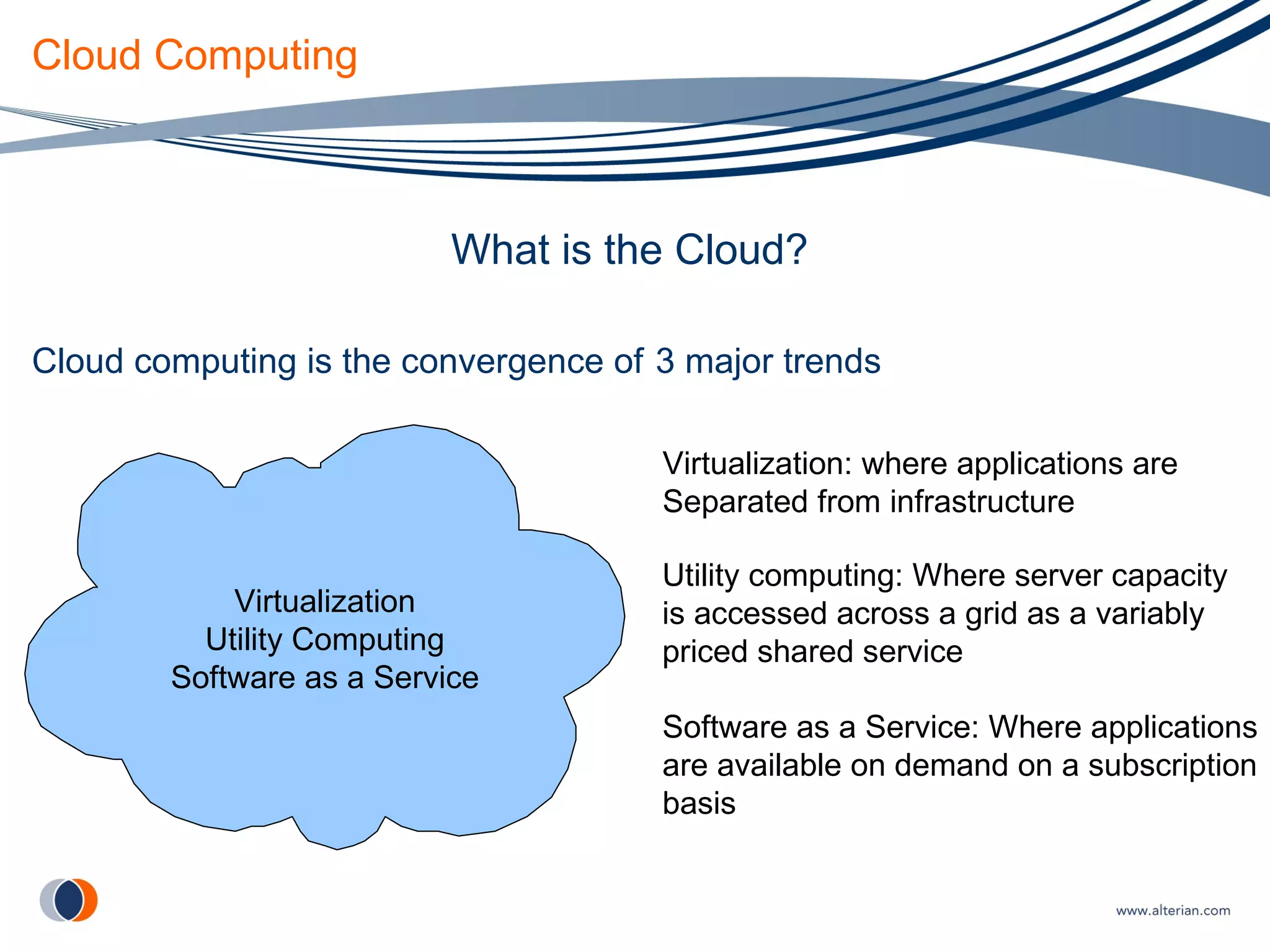
Cloud Computing What is the Cloud? Cloud computing is the convergence of  3 major trends Virtualization Utility Computing Software as a Service Virtualization: where applications are Separated from infrastructure Utility computing: Where server capacity is accessed across a grid as a variably priced shared service Software as a Service: Where applications are available on demand on a subscription basis
Cloud Computing Why all of sudden? Cloud is not new Standard apps such as email (Gmail, Yahoo mail, etc.) has always been there in the cloud. Lots of companies are moving away from in-house/Lotus notes servers to mail hosting companies. Slowly the paradigm shifting from desktop apps to internet hosted apps to SaaS Third party apps such as time tracking, project management, office, CRM, e-commerce became subscription based services. In other words, you don't have to install and manage these apps in-house, instead the service provider will manage these for you for a subscription fee.
Cloud Computing Now the paradigm shift is, moving the custom apps into third party infrastructure for a subscription fee. The “Cloud” buzz started when Amazon introduced EC2 and picked up there after by Google's App Engine and Microsoft's Azure. Since these companies use the high end sophisticated infrastructure with the help of virtualization software to run their apps and with the promise of running your app in the same infrastructure, boosted lots of companies to move their apps to the cloud.
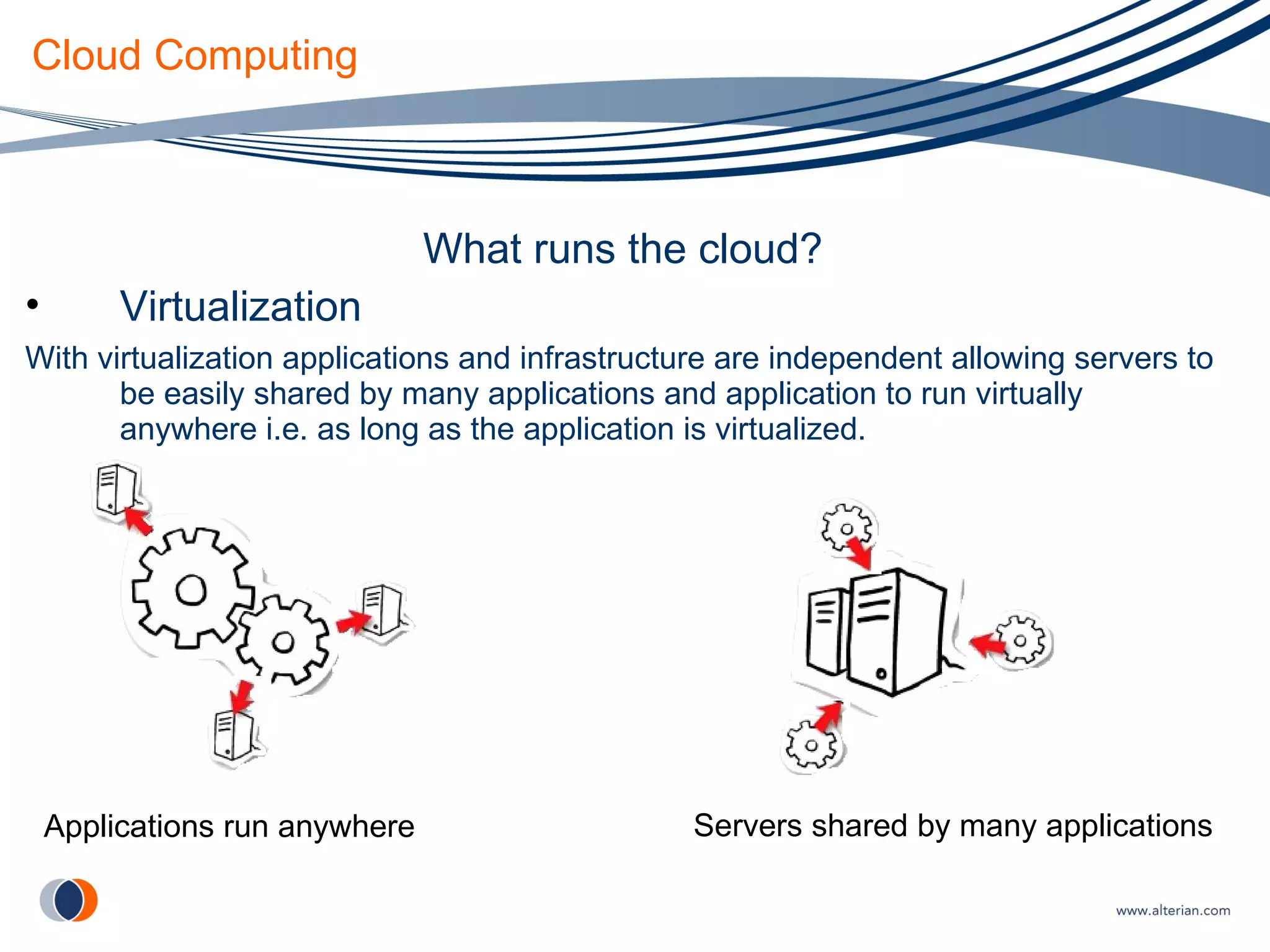
Cloud Computing What runs the cloud? Virtualization With virtualization applications and infrastructure are independent allowing servers to be easily shared by many applications and application to run virtually anywhere i.e. as long as the application is virtualized. Servers shared by many applications Applications run anywhere
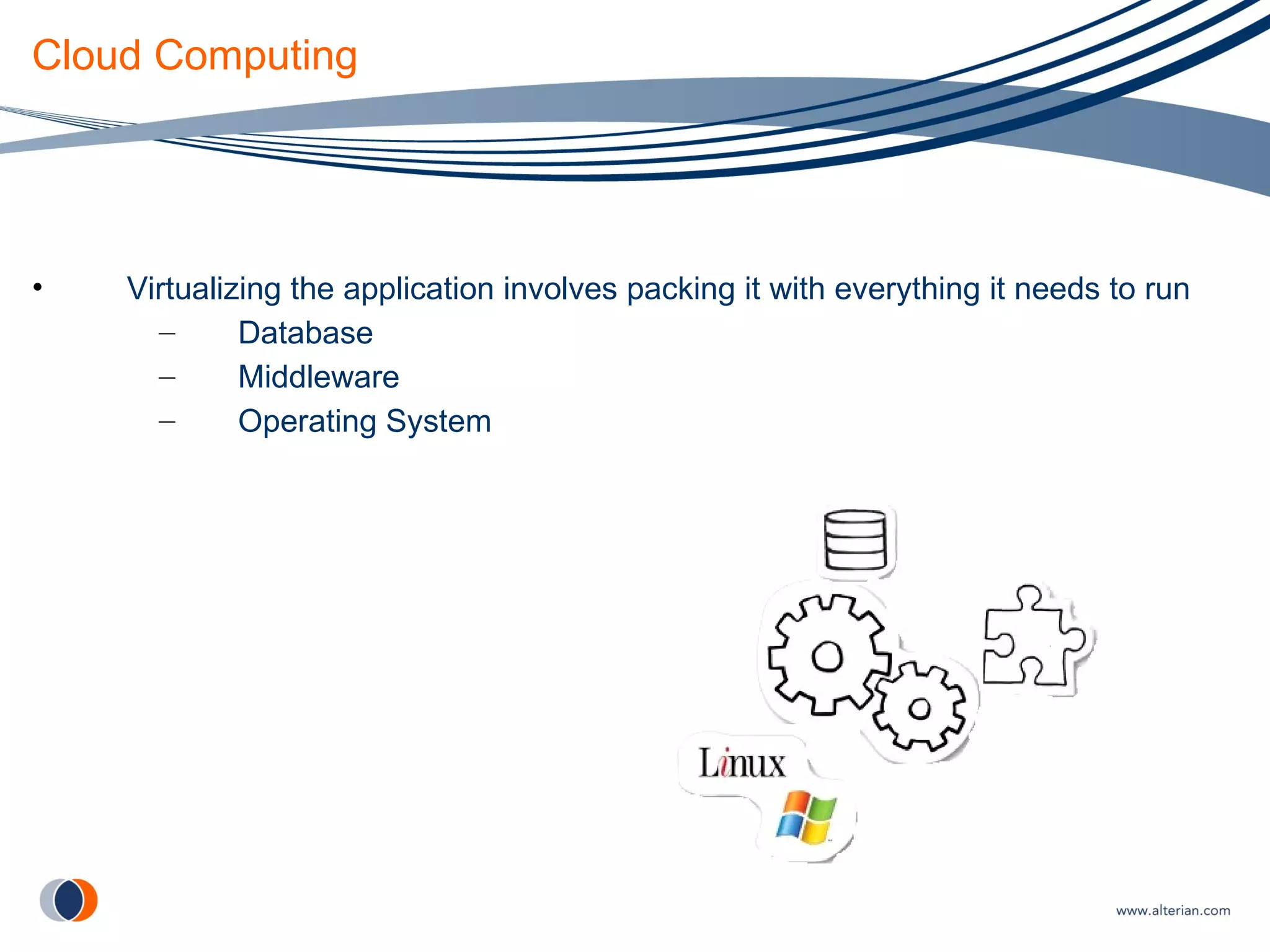
Cloud Computing Virtualizing the application involves packing it with everything it needs to run Database Middleware Operating System
Cloud Computing This self contained unit of virtualized application can run pretty much anywhere If it can run anywhere then It doesn't have to run in your data centre  Or the application providers data centre It can run in the Cloud
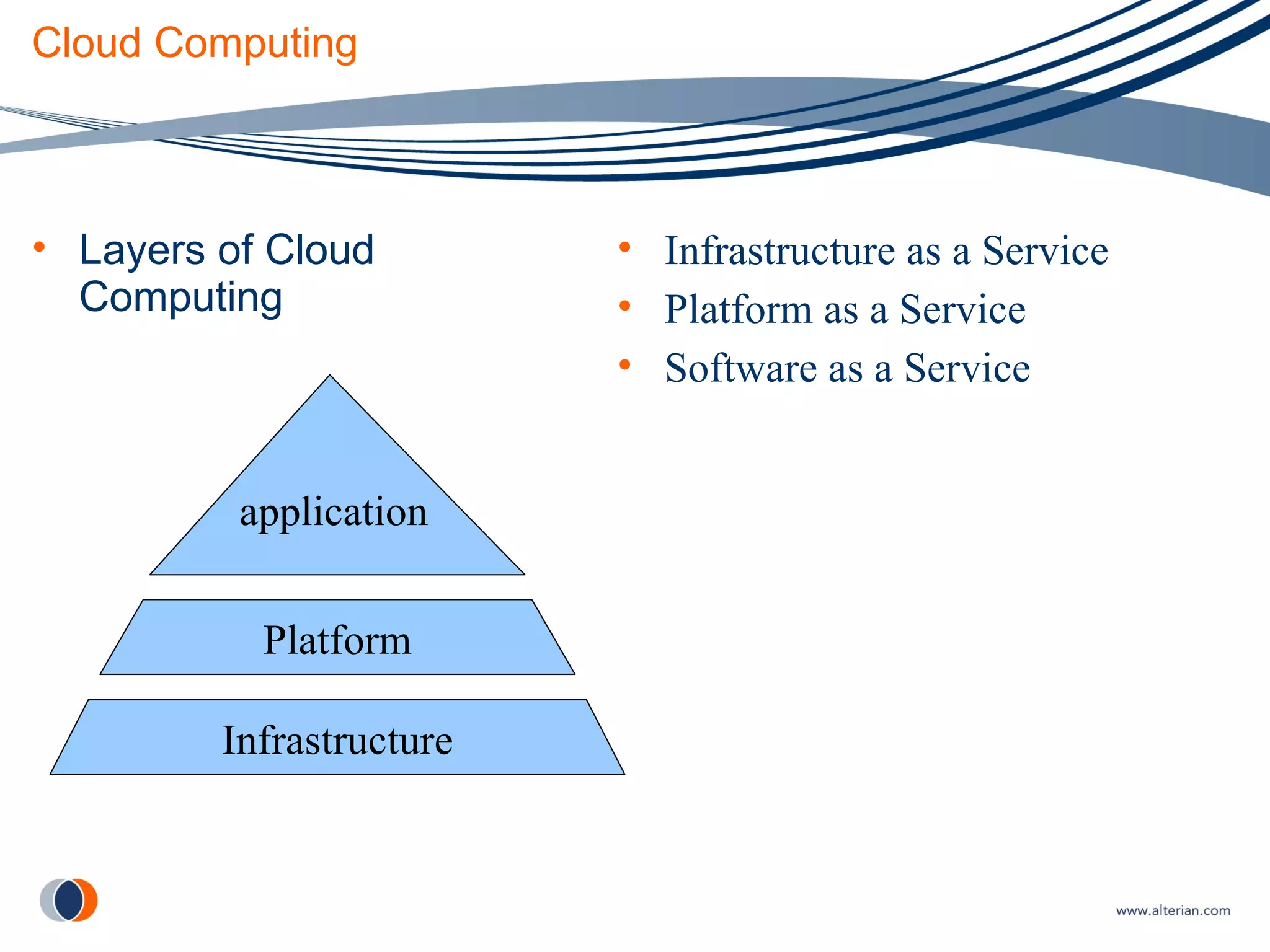
Cloud Computing Layers of Cloud Computing application Infrastructure as a Service Platform as a Service Software as a Service Infrastructure Platform
Cloud Computing Infrastructure as a Service IaaS is the delivery of computer infrastructure typically a platform virtualization environment as a service Rather than purchasing servers, software, data center space or network equipment, clients instead buy those resources as a fully outsourced services. The service is typically billed on a utility computing basis and amount of resources consumed and therefore the cost will typically reflect the level of activity. It is an evolution of web hosting and virtual private server offerings.
Cloud Computing Platform as a Service PaaS is an outgrowth of the software as a service application deliver model. The PaaS model makes all of the facilities required to support the complete life cycle of building and delivering web applications and services entirely available from the internet With no software downloads Installation for developers IT managers or end users. It's also known as cloudware
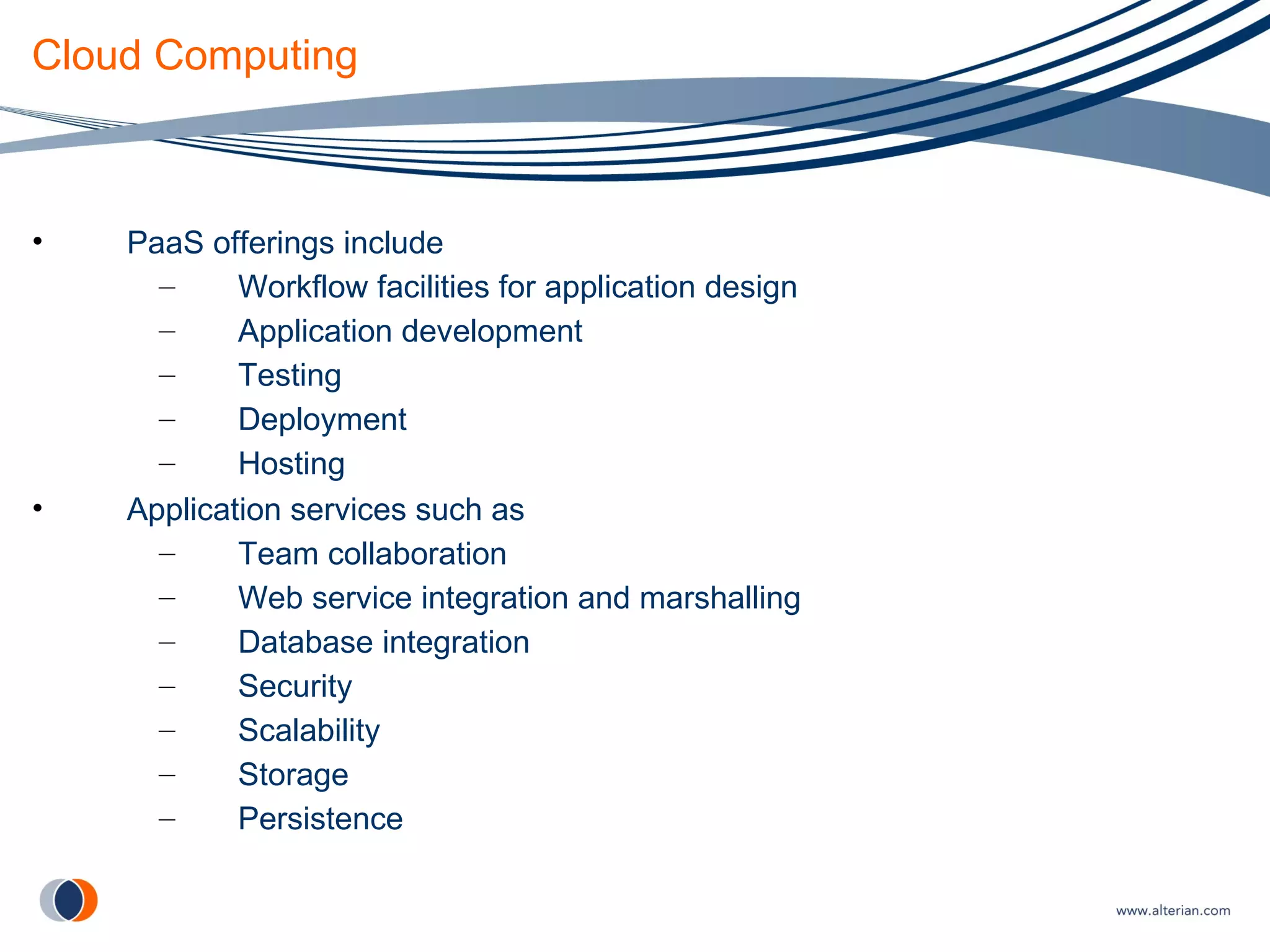
Cloud Computing PaaS offerings include Workflow facilities for application design Application development Testing Deployment Hosting Application services such as  Team collaboration Web service integration and marshalling Database integration Security Scalability Storage Persistence
Cloud Computing PaaS State management Application versioning Application instrumentation Developer community facilitation These services are provisioned as an integrated solution over the web.
Cloud Computing Software as a Service SaaS is a model of software deployment where an application is hosted as a service provided to customers across the internet SaaS eleminates the need to install and run applications on the customer's own computers SaaS alleviates the customers burden of software maintenace, ongoing operation and support. SaaS lets software vendors control and limit use, prohibits copies and distribution, and control all derivative versions of their software. This centralized control often allows the vendor to establish an ongoing revenue stream.
Cloud Computing The SaaS software vendor may host the application on its own web server, or this function may be handled by a third-party application service provider (ASP). This way, end users may reduce their investment on server hardware too.
Cloud Computing Cloud Providers Amazon EC2 Amazon EC2 -  you can install anything you want in your virtual machines. EC2 gives you lots of control, but you still need to install OS, web server, web or application container, Database and the whole nine yards that you do today for application deployment. EC2 provides a virtual machine, and you are responsible for managing everything inside the VM. This is very flexible along with the risk of managing everything.
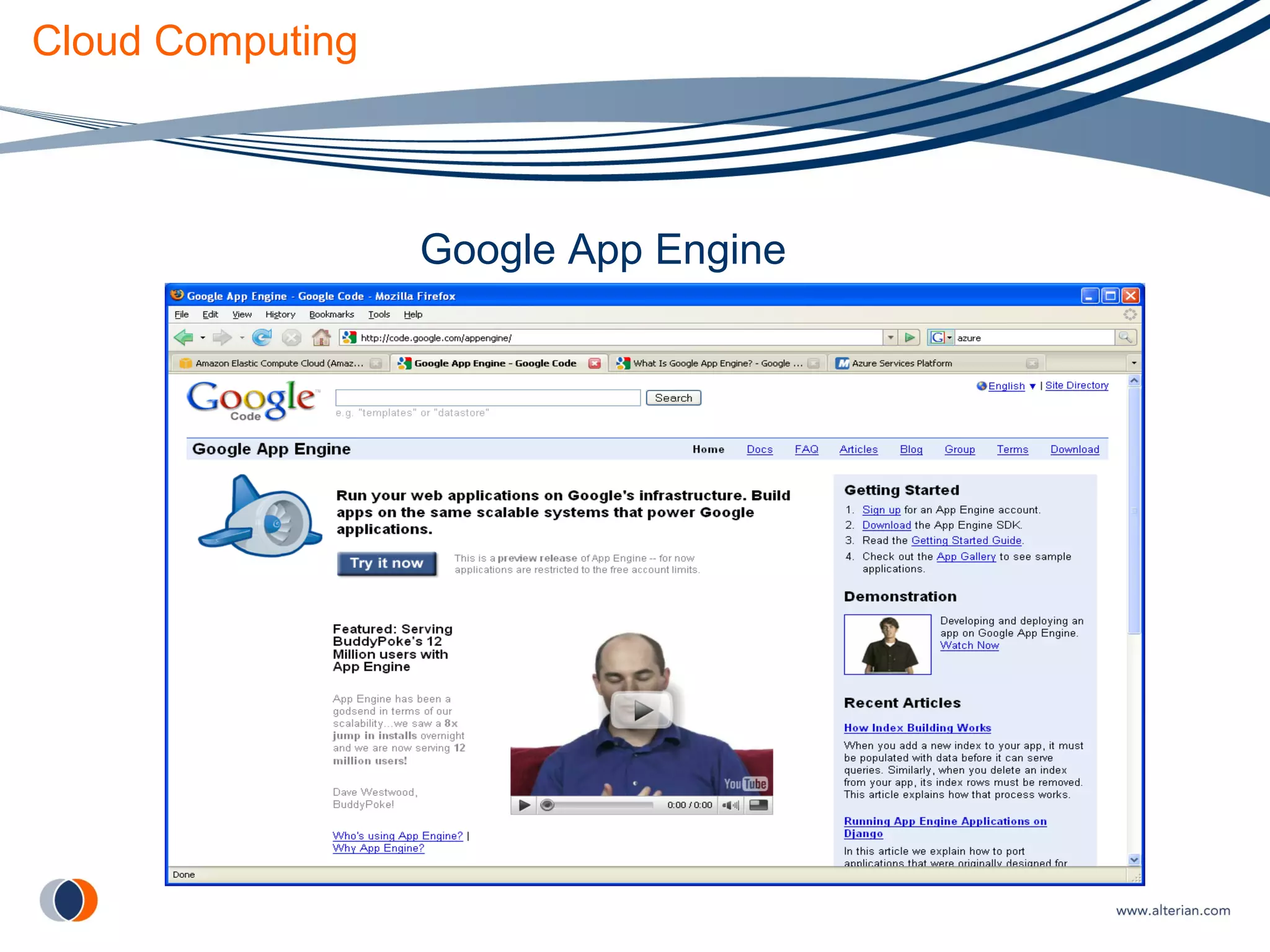
Cloud Computing Google App Engine You don't have any virtual machine and you are not responsible for installing/managing OS, software, database. Right now you are restricted to use python to code the app and you need to use DataStore to get/put the data. You are responsible for developing and deploying the application. No OS, Server, Database headaches with the disadvantage of being restricted to Python and DataStore.
Cloud Computing Google App Engine
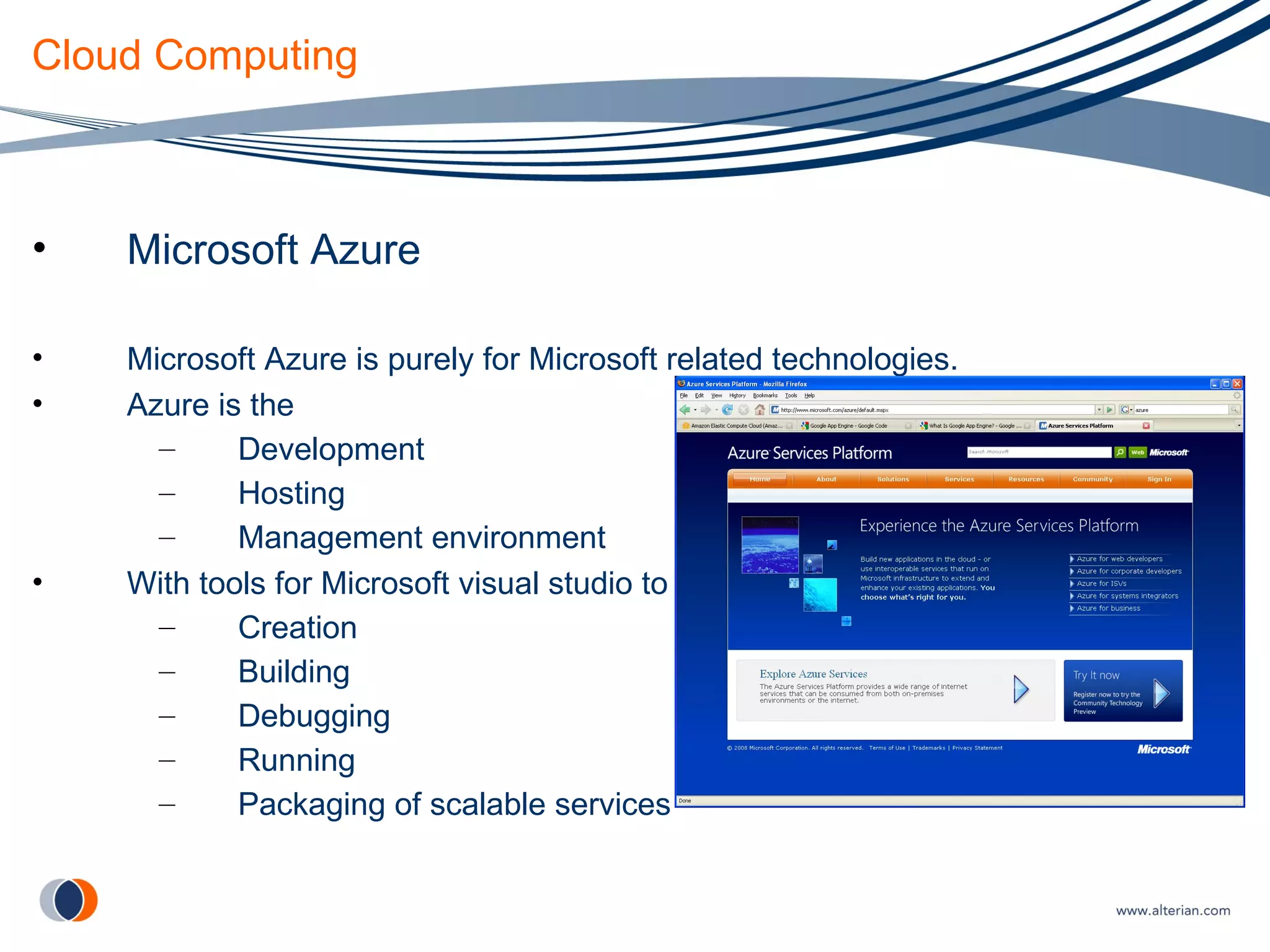
Cloud Computing Microsoft Azure Microsoft Azure is purely for Microsoft related technologies. Azure is the  Development Hosting Management environment With tools for Microsoft visual studio to enable Creation Building Debugging Running Packaging of scalable services
Cloud Computing Force.com  is for salesforce.com   CRM applications and restricted to proprietary Apex language and visualforce Salesforce.com is a software as a Service (SaaS) Force.com is a PaaS for saleforce.com Heroku  is restricted to Ruby on Rails backed by Amazon EC2
Cloud Computing Why adopt Cloud? In a turbulent economy cloud computing is more attractive Why pay for more computing than you need when you can pay for what you use. With cloud computing you have access to computing power instantly when you need it Put your website on a cloud server just like you put it on a dedicated server If you need more computing power you can scale up as much as you need almost instantly You get you computing power as you need it from the cloud – on demand When the need goes down you can release the servers back into the cloud The key to cloud computing is not to focus on hardware you just focus on you're website or your software or code or whatever you put on the cloud.
Cloud Computing Why adopt Cloud? Customers minimize capital expenditure – more customers This lowers barriers to entry, as infrastructure is owned by the provider Services are typically available to or specifically targetted to retail consumers and small businesses. Device and location independence enable users to access systems regardless of their location or what device they are using e.g., PC, mobile... Multi-tenancy enables sharing of resources and costs among a large pool of users Centralization of infrastructure in areas with lower costs Peak load capacity increases Utilisation and efficiency improvements On-demand allocation and de-allocation of CPU, storage and network bandwidth
Cloud Computing Drawbacks Data is transferred at Internet, rather than local Ethernet speeds. The provider may go bankrupt and the firewall may not permit integration with back end systems. Widespread implementation of SaaS requires that the services be well defined. Various forms of weaknesses, such as vendor lock-in, as the industry lacks portability and interoperability between vendors. Change from one vendor to another will take a considerable amount of effort and time. This situation is resolvable by the introduction of open sourced standards and the development of markets based upon such standards.
Cloud Computing 3 Reasons why cloud is becoming popular Scalability Its easy to grow and shrink to match your demand Instant The computing power is there when you need it, you just turn it on whey you need Save money You only pay for what you use and not for having equipment sit around just in case you might need it With cloud hosting you stop worrying on your hardware instead you can work on building your business instead.
Cloud Computing Thank You Resources Wikipedia Tim & Michel - GoGrid.com Java in the cloud by Hari K. Gottipati rPath.com

Cloud Computing

  • 1.
    Cloud Computing PhaniKumar 30 Jan 2009
  • 2.
    Cloud Computing AgendaIntroduction What is the cloud? Why all of a sudden? What runs the cloud? Layers of Cloud Computing Cloud Providers Why Adopt Cloud? Drawbacks of Cloud 3 Reasons why cloud is becoming popular Conclusion
  • 3.
    Cloud Computing IntroductionCloud computing is Internet (“cloud”) based development and use of computer technology. It is a business information style of computing in which typical real-time scalable resources are provided as a service over the internet to users who need not have knowledge of, expertise in, or control over the technology infrastructure (“in the cloud”) that supports them. It is a general concept that incorporates software as a service (SaaS), Web 2.0 and other recent, well known technology trends, in which the common theme is reliance on the internet for satisfying the computing needs of the users. From Wikipedia
  • 4.
    Cloud Computing Whatis the Cloud? Cloud computing is the convergence of 3 major trends Virtualization Utility Computing Software as a Service Virtualization: where applications are Separated from infrastructure Utility computing: Where server capacity is accessed across a grid as a variably priced shared service Software as a Service: Where applications are available on demand on a subscription basis
  • 5.
    Cloud Computing Whyall of sudden? Cloud is not new Standard apps such as email (Gmail, Yahoo mail, etc.) has always been there in the cloud. Lots of companies are moving away from in-house/Lotus notes servers to mail hosting companies. Slowly the paradigm shifting from desktop apps to internet hosted apps to SaaS Third party apps such as time tracking, project management, office, CRM, e-commerce became subscription based services. In other words, you don't have to install and manage these apps in-house, instead the service provider will manage these for you for a subscription fee.
  • 6.
    Cloud Computing Nowthe paradigm shift is, moving the custom apps into third party infrastructure for a subscription fee. The “Cloud” buzz started when Amazon introduced EC2 and picked up there after by Google's App Engine and Microsoft's Azure. Since these companies use the high end sophisticated infrastructure with the help of virtualization software to run their apps and with the promise of running your app in the same infrastructure, boosted lots of companies to move their apps to the cloud.
  • 7.
    Cloud Computing Whatruns the cloud? Virtualization With virtualization applications and infrastructure are independent allowing servers to be easily shared by many applications and application to run virtually anywhere i.e. as long as the application is virtualized. Servers shared by many applications Applications run anywhere
  • 8.
    Cloud Computing Virtualizingthe application involves packing it with everything it needs to run Database Middleware Operating System
  • 9.
    Cloud Computing Thisself contained unit of virtualized application can run pretty much anywhere If it can run anywhere then It doesn't have to run in your data centre Or the application providers data centre It can run in the Cloud
  • 10.
    Cloud Computing Layersof Cloud Computing application Infrastructure as a Service Platform as a Service Software as a Service Infrastructure Platform
  • 11.
    Cloud Computing Infrastructureas a Service IaaS is the delivery of computer infrastructure typically a platform virtualization environment as a service Rather than purchasing servers, software, data center space or network equipment, clients instead buy those resources as a fully outsourced services. The service is typically billed on a utility computing basis and amount of resources consumed and therefore the cost will typically reflect the level of activity. It is an evolution of web hosting and virtual private server offerings.
  • 12.
    Cloud Computing Platformas a Service PaaS is an outgrowth of the software as a service application deliver model. The PaaS model makes all of the facilities required to support the complete life cycle of building and delivering web applications and services entirely available from the internet With no software downloads Installation for developers IT managers or end users. It's also known as cloudware
  • 13.
    Cloud Computing PaaSofferings include Workflow facilities for application design Application development Testing Deployment Hosting Application services such as Team collaboration Web service integration and marshalling Database integration Security Scalability Storage Persistence
  • 14.
    Cloud Computing PaaSState management Application versioning Application instrumentation Developer community facilitation These services are provisioned as an integrated solution over the web.
  • 15.
    Cloud Computing Softwareas a Service SaaS is a model of software deployment where an application is hosted as a service provided to customers across the internet SaaS eleminates the need to install and run applications on the customer's own computers SaaS alleviates the customers burden of software maintenace, ongoing operation and support. SaaS lets software vendors control and limit use, prohibits copies and distribution, and control all derivative versions of their software. This centralized control often allows the vendor to establish an ongoing revenue stream.
  • 16.
    Cloud Computing TheSaaS software vendor may host the application on its own web server, or this function may be handled by a third-party application service provider (ASP). This way, end users may reduce their investment on server hardware too.
  • 17.
    Cloud Computing CloudProviders Amazon EC2 Amazon EC2 - you can install anything you want in your virtual machines. EC2 gives you lots of control, but you still need to install OS, web server, web or application container, Database and the whole nine yards that you do today for application deployment. EC2 provides a virtual machine, and you are responsible for managing everything inside the VM. This is very flexible along with the risk of managing everything.
  • 18.
    Cloud Computing GoogleApp Engine You don't have any virtual machine and you are not responsible for installing/managing OS, software, database. Right now you are restricted to use python to code the app and you need to use DataStore to get/put the data. You are responsible for developing and deploying the application. No OS, Server, Database headaches with the disadvantage of being restricted to Python and DataStore.
  • 19.
  • 20.
    Cloud Computing MicrosoftAzure Microsoft Azure is purely for Microsoft related technologies. Azure is the Development Hosting Management environment With tools for Microsoft visual studio to enable Creation Building Debugging Running Packaging of scalable services
  • 21.
    Cloud Computing Force.com is for salesforce.com CRM applications and restricted to proprietary Apex language and visualforce Salesforce.com is a software as a Service (SaaS) Force.com is a PaaS for saleforce.com Heroku is restricted to Ruby on Rails backed by Amazon EC2
  • 22.
    Cloud Computing Whyadopt Cloud? In a turbulent economy cloud computing is more attractive Why pay for more computing than you need when you can pay for what you use. With cloud computing you have access to computing power instantly when you need it Put your website on a cloud server just like you put it on a dedicated server If you need more computing power you can scale up as much as you need almost instantly You get you computing power as you need it from the cloud – on demand When the need goes down you can release the servers back into the cloud The key to cloud computing is not to focus on hardware you just focus on you're website or your software or code or whatever you put on the cloud.
  • 23.
    Cloud Computing Whyadopt Cloud? Customers minimize capital expenditure – more customers This lowers barriers to entry, as infrastructure is owned by the provider Services are typically available to or specifically targetted to retail consumers and small businesses. Device and location independence enable users to access systems regardless of their location or what device they are using e.g., PC, mobile... Multi-tenancy enables sharing of resources and costs among a large pool of users Centralization of infrastructure in areas with lower costs Peak load capacity increases Utilisation and efficiency improvements On-demand allocation and de-allocation of CPU, storage and network bandwidth
  • 24.
    Cloud Computing DrawbacksData is transferred at Internet, rather than local Ethernet speeds. The provider may go bankrupt and the firewall may not permit integration with back end systems. Widespread implementation of SaaS requires that the services be well defined. Various forms of weaknesses, such as vendor lock-in, as the industry lacks portability and interoperability between vendors. Change from one vendor to another will take a considerable amount of effort and time. This situation is resolvable by the introduction of open sourced standards and the development of markets based upon such standards.
  • 25.
    Cloud Computing 3Reasons why cloud is becoming popular Scalability Its easy to grow and shrink to match your demand Instant The computing power is there when you need it, you just turn it on whey you need Save money You only pay for what you use and not for having equipment sit around just in case you might need it With cloud hosting you stop worrying on your hardware instead you can work on building your business instead.
  • 26.
    Cloud Computing ThankYou Resources Wikipedia Tim & Michel - GoGrid.com Java in the cloud by Hari K. Gottipati rPath.com