Cloud Computing
OutlinesOutlines
 What is Cloud?What is Cloud?
 What is Cloud Computing?What is Cloud Computing?
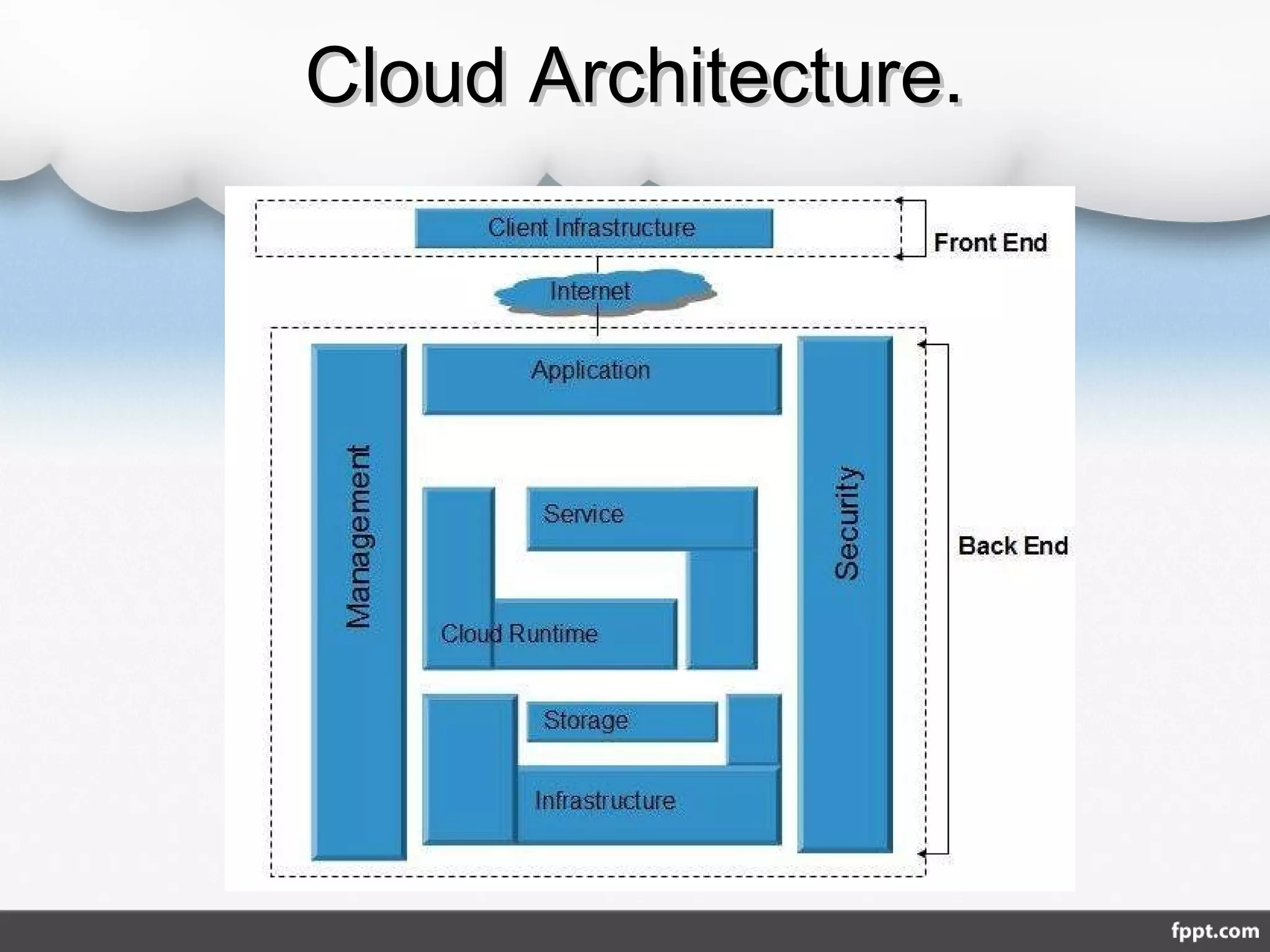
 Cloud Architecture.Cloud Architecture.
 Types of cloudsTypes of clouds
 Cloud Service ModelsCloud Service Models
 Cloud StorageCloud Storage
 Cloud ServerCloud Server
What is Cloud?
• The term Cloud refers to Network or Internet.
• Cloud is something, which is present at remote
location. Cloud can provide services over public
and private networks, i.e., WAN, LAN or VPN.
What Is Cloud Computing
• Cloud computing is a type of computing that
relies on sharing computing resources rather
than having local servers or personal devices to
handle applications.
•  Cloud computing means "a type of Internet-
based computing," where different services such
as servers, storage and applications are
delivered to an organization's computers and
devices through the Internet.
Cloud Architecture.Cloud Architecture.
Types of Cloud.Types of Cloud.
1. Public Cloud
2. Private Cloud
3. Hybrid Cloud
Public CloudPublic Cloud
Public Cloud allows systems and services to be easily
accessible to general public. Company offer cloud
services via Internet.
Features:
a. Flexibility
b. Location Independence
c. Cost Effective
d. Reliability
Private CloudPrivate Cloud
Private Cloud allows systems and services to be accessible
within an organization. The Private Cloud is operated only
within a single organization.
Features:
a. High Security and Privacy
b. More Control
Hybrid CloudHybrid Cloud
A combination of public cloud storage and private cloud storage
where some critical data resides in the enterprise's private cloud
while other data is stored and accessible from a public cloud storage
provider.
Features:
a. capability
b. Reliability
c. security
d. control
Cloud Service ModelsCloud Service Models
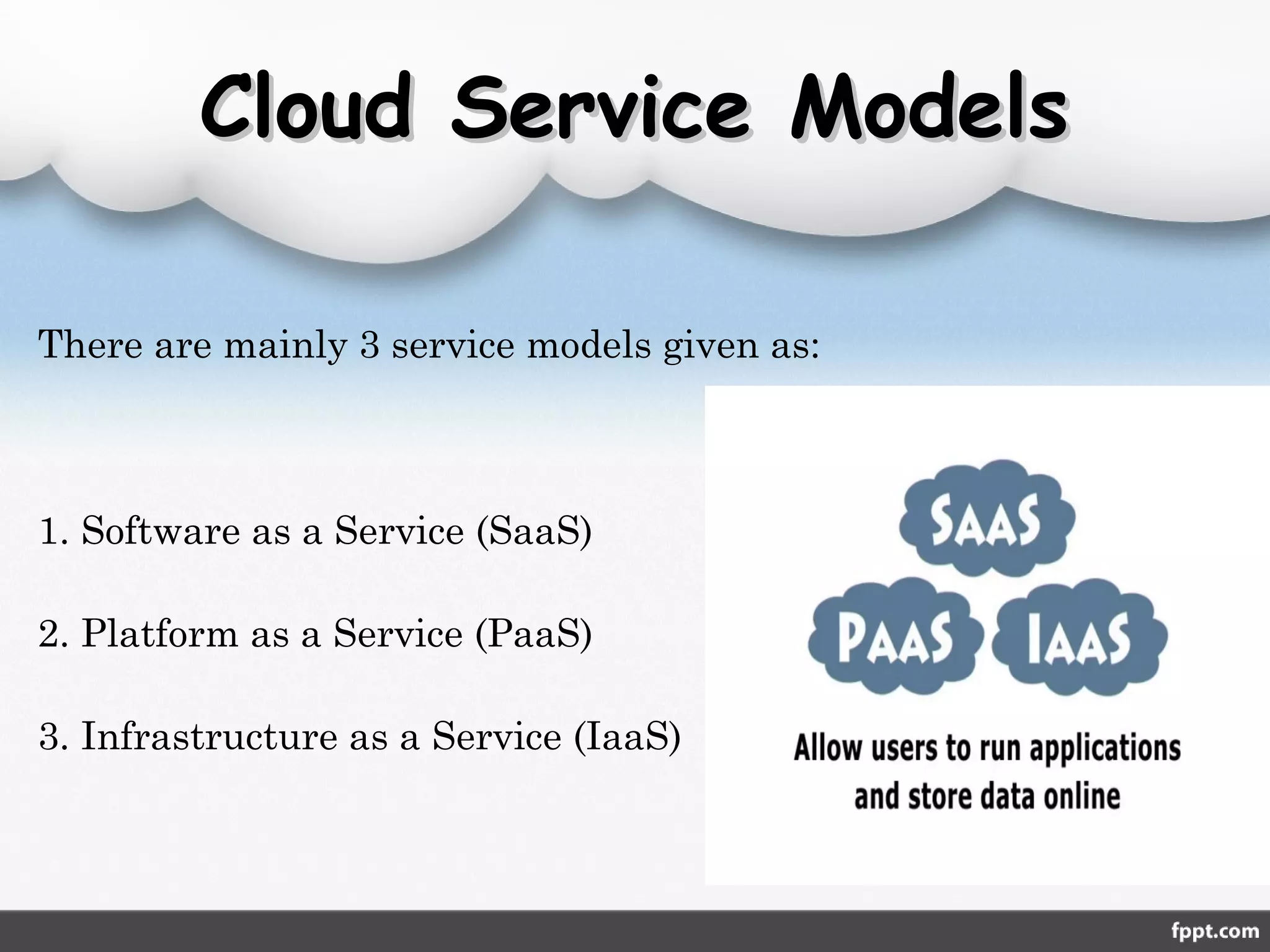
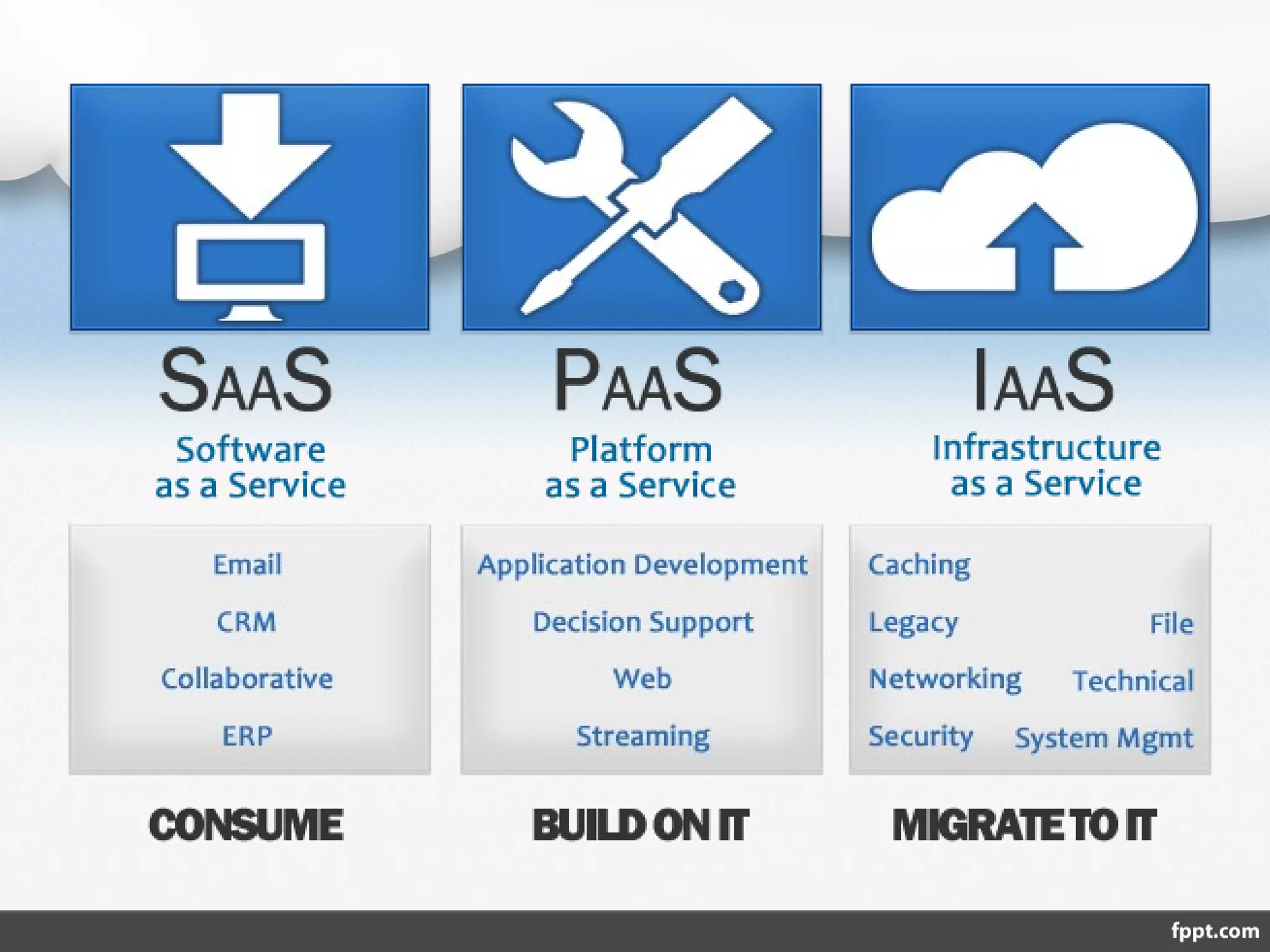
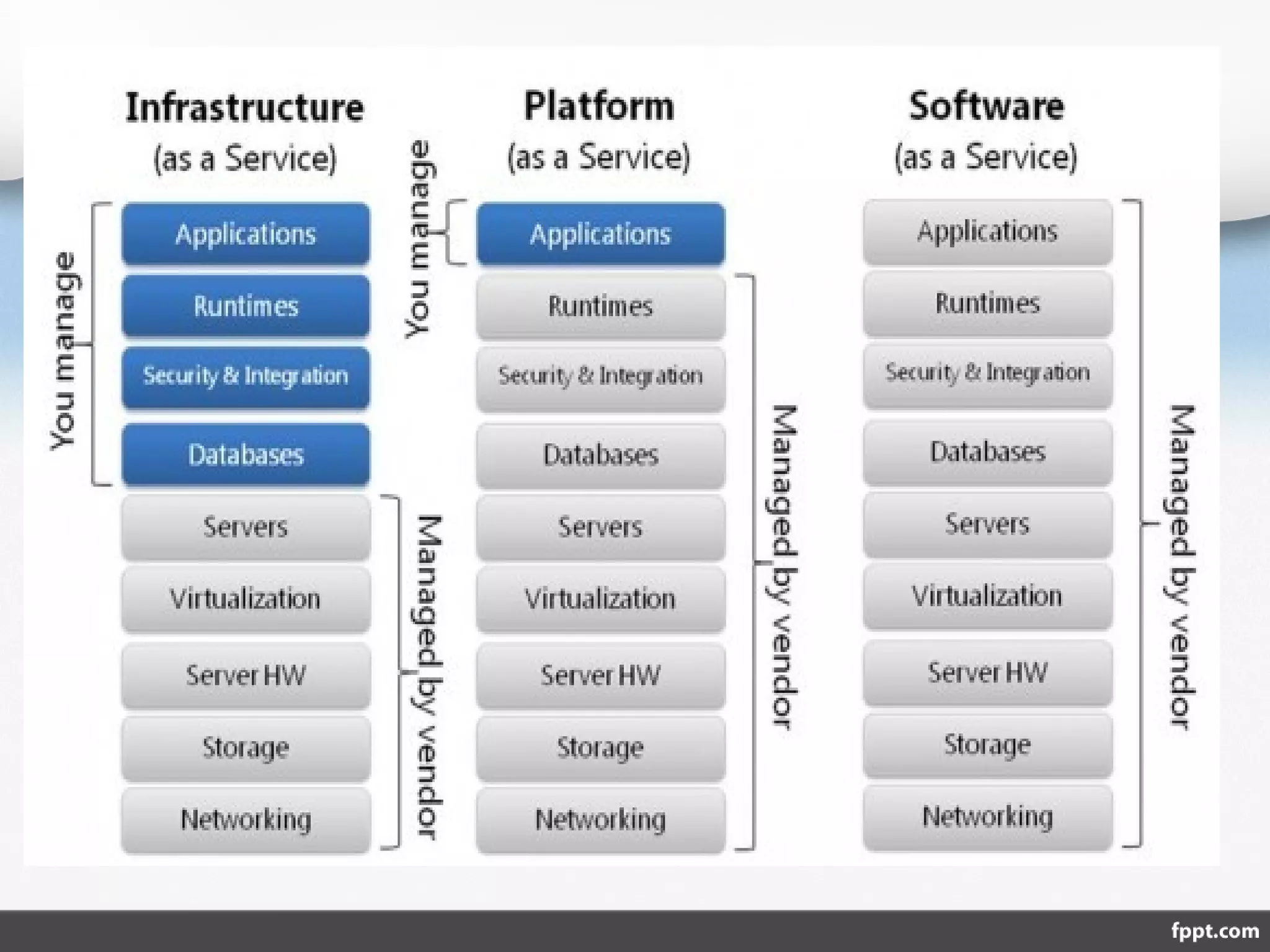
There are mainly 3 service models given as:
1. Software as a Service (SaaS)
2. Platform as a Service (PaaS)
3. Infrastructure as a Service (IaaS)
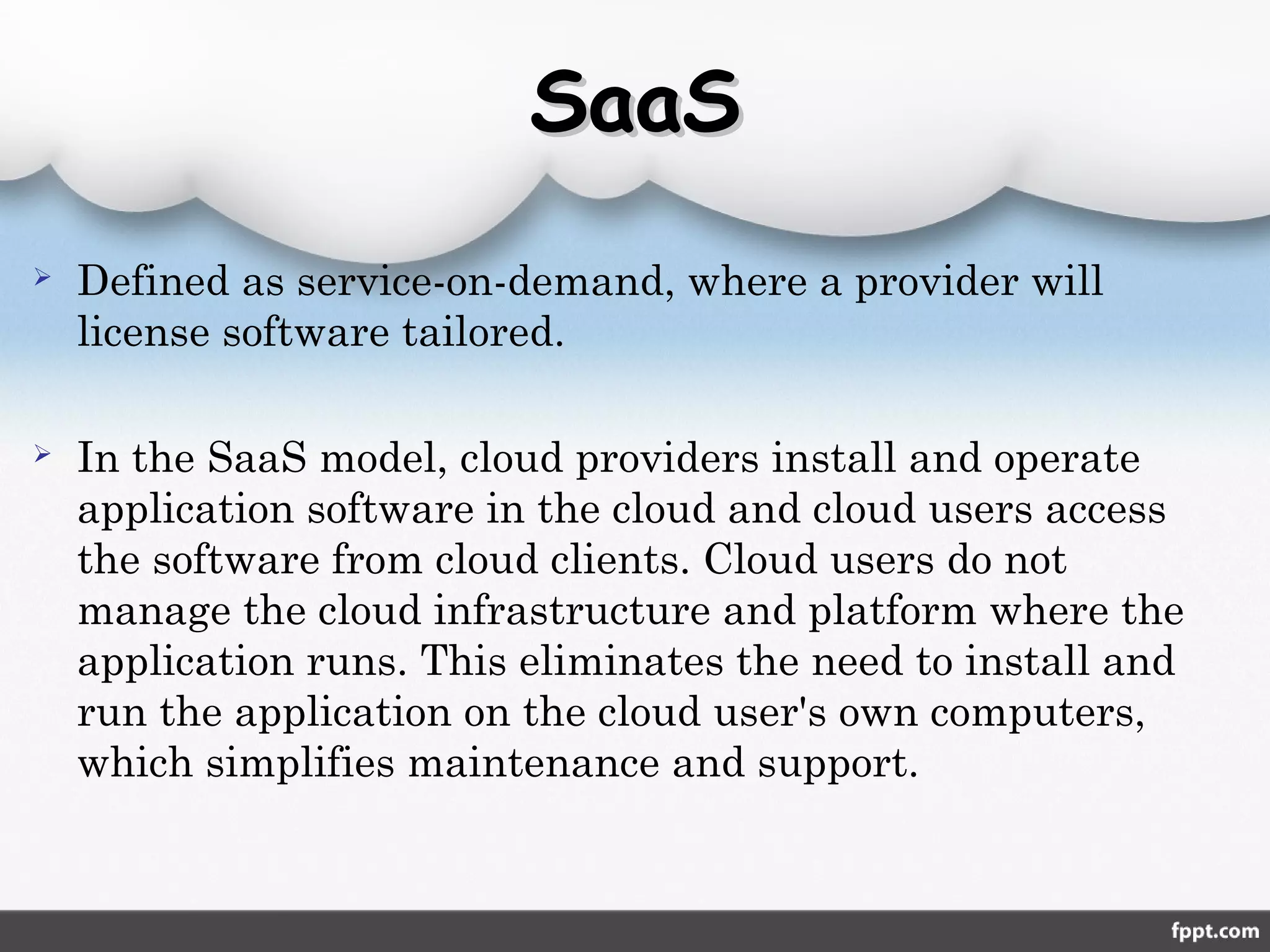
 Defined as service-on-demand, where a provider will
license software tailored.
 In the SaaS model, cloud providers install and operate
application software in the cloud and cloud users access
the software from cloud clients. Cloud users do not
manage the cloud infrastructure and platform where the
application runs. This eliminates the need to install and
run the application on the cloud user's own computers,
which simplifies maintenance and support.
SaaSSaaS
PaaSPaaS
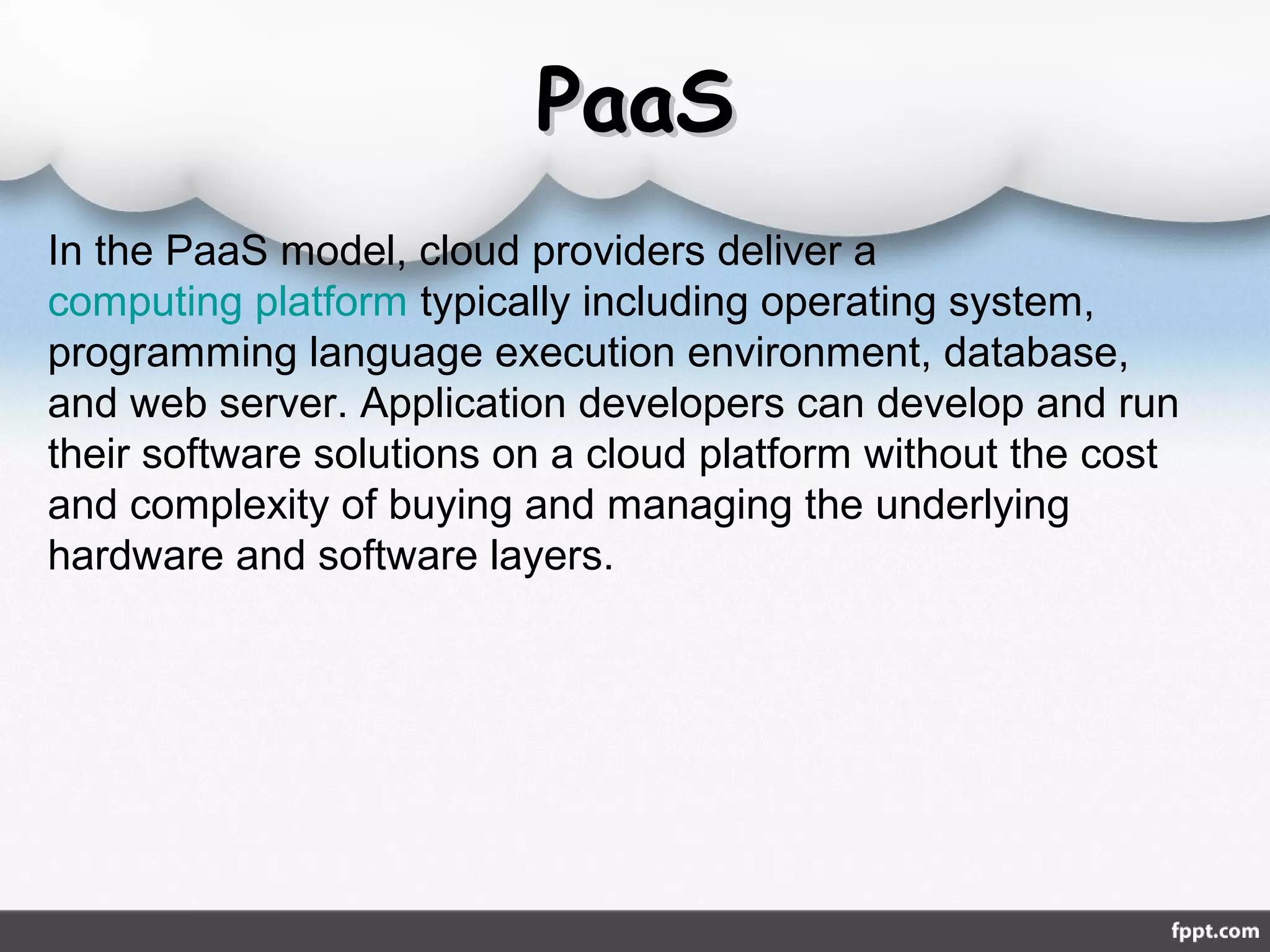
In the PaaS model, cloud providers deliver a
computing platform typically including operating system,
programming language execution environment, database,
and web server. Application developers can develop and run
their software solutions on a cloud platform without the cost
and complexity of buying and managing the underlying
hardware and software layers.
IaaSIaaS
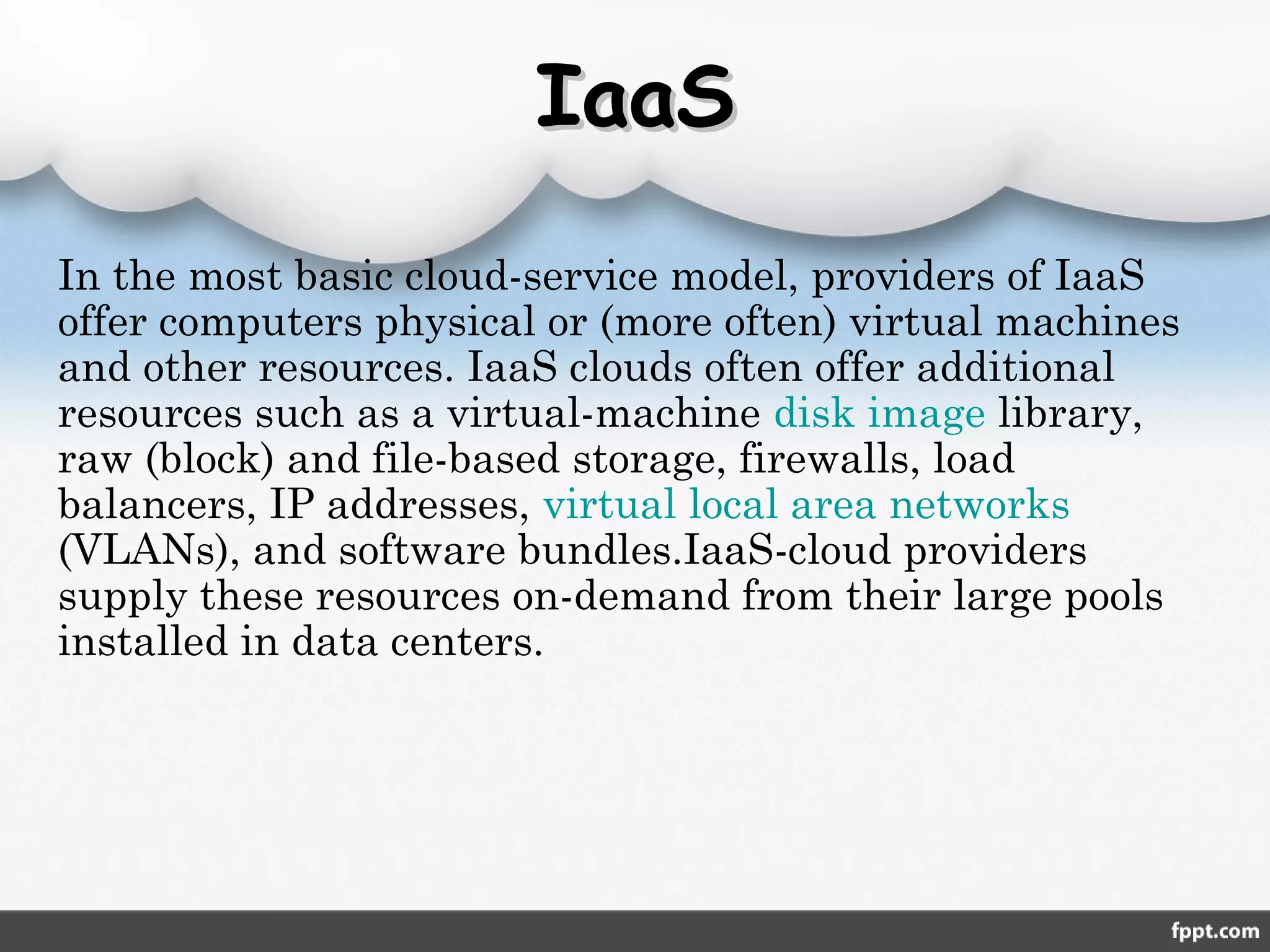
In the most basic cloud-service model, providers of IaaS
offer computers physical or (more often) virtual machines
and other resources. IaaS clouds often offer additional
resources such as a virtual-machine disk image library,
raw (block) and file-based storage, firewalls, load
balancers, IP addresses, virtual local area networks
(VLANs), and software bundles.IaaS-cloud providers
supply these resources on-demand from their large pools
installed in data centers.
Cloud StorageCloud Storage
Cloud storage means "the storage of data online in the cloud,"
wherein a company's data is stored in and accessible from
multiple distributed and connected resources that comprise a
cloud.
Cloud storage can provide following benefits
a) accessibility and reliability;
b) rapid deployment;
c) strong protection for data backup, archival and disaster.
Cloud Server
• A cloud server is a logical server that is built, hosted andA cloud server is a logical server that is built, hosted and
delivered through a cloud computing platform over thedelivered through a cloud computing platform over the
Internet. Cloud servers possess and exhibit similarInternet. Cloud servers possess and exhibit similar
capabilities and functionality to a typical server but arecapabilities and functionality to a typical server but are
accessed remotely from a cloud service provideraccessed remotely from a cloud service provider..
Types of server:
a) Dedicated server
b) Shared Server

Cloud computing technology

  • 1.
  • 2.
    OutlinesOutlines  What isCloud?What is Cloud?  What is Cloud Computing?What is Cloud Computing?  Cloud Architecture.Cloud Architecture.  Types of cloudsTypes of clouds  Cloud Service ModelsCloud Service Models  Cloud StorageCloud Storage  Cloud ServerCloud Server
  • 3.
    What is Cloud? •The term Cloud refers to Network or Internet. • Cloud is something, which is present at remote location. Cloud can provide services over public and private networks, i.e., WAN, LAN or VPN.
  • 4.
    What Is CloudComputing • Cloud computing is a type of computing that relies on sharing computing resources rather than having local servers or personal devices to handle applications. •  Cloud computing means "a type of Internet- based computing," where different services such as servers, storage and applications are delivered to an organization's computers and devices through the Internet.
  • 5.
  • 6.
    Types of Cloud.Typesof Cloud. 1. Public Cloud 2. Private Cloud 3. Hybrid Cloud
  • 7.
    Public CloudPublic Cloud PublicCloud allows systems and services to be easily accessible to general public. Company offer cloud services via Internet. Features: a. Flexibility b. Location Independence c. Cost Effective d. Reliability
  • 8.
    Private CloudPrivate Cloud PrivateCloud allows systems and services to be accessible within an organization. The Private Cloud is operated only within a single organization. Features: a. High Security and Privacy b. More Control
  • 9.
    Hybrid CloudHybrid Cloud Acombination of public cloud storage and private cloud storage where some critical data resides in the enterprise's private cloud while other data is stored and accessible from a public cloud storage provider. Features: a. capability b. Reliability c. security d. control
  • 10.
    Cloud Service ModelsCloudService Models There are mainly 3 service models given as: 1. Software as a Service (SaaS) 2. Platform as a Service (PaaS) 3. Infrastructure as a Service (IaaS)
  • 11.
     Defined asservice-on-demand, where a provider will license software tailored.  In the SaaS model, cloud providers install and operate application software in the cloud and cloud users access the software from cloud clients. Cloud users do not manage the cloud infrastructure and platform where the application runs. This eliminates the need to install and run the application on the cloud user's own computers, which simplifies maintenance and support. SaaSSaaS
  • 12.
    PaaSPaaS In the PaaSmodel, cloud providers deliver a computing platform typically including operating system, programming language execution environment, database, and web server. Application developers can develop and run their software solutions on a cloud platform without the cost and complexity of buying and managing the underlying hardware and software layers.
  • 13.
    IaaSIaaS In the mostbasic cloud-service model, providers of IaaS offer computers physical or (more often) virtual machines and other resources. IaaS clouds often offer additional resources such as a virtual-machine disk image library, raw (block) and file-based storage, firewalls, load balancers, IP addresses, virtual local area networks (VLANs), and software bundles.IaaS-cloud providers supply these resources on-demand from their large pools installed in data centers.
  • 16.
    Cloud StorageCloud Storage Cloudstorage means "the storage of data online in the cloud," wherein a company's data is stored in and accessible from multiple distributed and connected resources that comprise a cloud. Cloud storage can provide following benefits a) accessibility and reliability; b) rapid deployment; c) strong protection for data backup, archival and disaster.
  • 17.
    Cloud Server • Acloud server is a logical server that is built, hosted andA cloud server is a logical server that is built, hosted and delivered through a cloud computing platform over thedelivered through a cloud computing platform over the Internet. Cloud servers possess and exhibit similarInternet. Cloud servers possess and exhibit similar capabilities and functionality to a typical server but arecapabilities and functionality to a typical server but are accessed remotely from a cloud service provideraccessed remotely from a cloud service provider.. Types of server: a) Dedicated server b) Shared Server