

MODULE-1
Distributed System Models and Enabling
Technologies
Dr. PUSHPARANI MK AIET, MOODABIDRI
1. SCALABLE COMPUTING OVER THE INTERNET
2. TECHNOLOGIES FOR NETWORK-BASED SYSTEMS
3. SYSTEM MODELS FOR DISTRIBUTED AND CLOUD COMPUTING
4. SOFTWARE ENVIRONMENTS FOR DISTRIBUTED SYSTEMS AND
CLOUDS
5. PERFORMANCE, SECURITY, AND ENERGY EFFICIENCY
Dr. PUSHPARANI MK AIET, MOODABIDRI
• SCALABLE COMPUTING OVER THE INTERNET
A) The Age of Internet Computing
B) Scalable Computing Trends and New Paradigms
C) The Internet of Things and Cyber-Physical Systems
Dr. PUSHPARANI MK AIET, MOODABIDRI
1.a) The Age of Internet Computing
The Platform Evolution
• Computer technology has gone through five generations
• each generation lasting from 10 to 20 years
1. 1950 to 1970, a handful of mainframes, including the IBM 360 and CDC 6400,
were built to satisfy the demands of large businesses and government
organizations.
2. From 1960 to 1980, lower-cost minicomputers such as the DEC PDP 11 and VAX
Series became popular among small businesses and on college campuses
3. From 1970 to 1990, we saw widespread use of personal computers built with
VLSI microprocessors
4. From 1980 to 2000, portable computers and pervasive devices appeared in both
wired and wireless applications.
5. Since 1990, the use of both HPC and HTC
Dr. PUSHPARANI MK AIET, MOODABIDRI
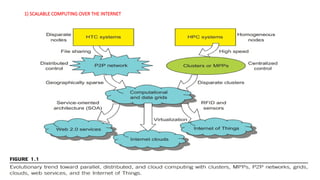
• Figure 1.1 illustrates the evolution of HPC and HTC systems. On the
HPC side, supercomputers (massively parallel processors or MPPs) are
gradually replaced by clusters of cooperative computers out of a
desire to share computing resources.
Dr. PUSHPARANI MK AIET, MOODABIDRI
1) SCALABLE COMPUTING OVER THE INTERNET
Dr. PUSHPARANI MK AIET, MOODABIDRI
Distributed System Families
• mid-1990s, technologies for building P2P networks and networks of clusters
have been consolidated into many national projects designed to establish
wide area computing infrastructures, known as computational grids or data
grids. Recently, we have witnessed a surge in interest in exploring Internet
cloud resources for data-intensive applications. Internet clouds are the result
of moving desktop computing to service-oriented computing using server
clusters and huge databases at data centers.
• In October 2010, the highest performing cluster machine was built in China
with 86016 CPU processor cores and 3,211,264 GPU cores in a Tianhe-1A
system. The largest computational grid connects up to hundreds of server
clusters. A typical P2P network may involve millions of client machines
working simultaneously. Experimental cloud computing clusters have been
built with thousands of processing nodes.
Dr. PUSHPARANI MK AIET, MOODABIDRI
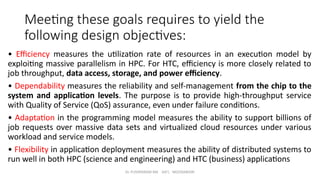
Meeting these goals requires to yield the
following design objectives:
• Efficiency measures the utilization rate of resources in an execution model by
exploiting massive parallelism in HPC. For HTC, efficiency is more closely related to
job throughput, data access, storage, and power efficiency.
• Dependability measures the reliability and self-management from the chip to the
system and application levels. The purpose is to provide high-throughput service
with Quality of Service (QoS) assurance, even under failure conditions.
• Adaptation in the programming model measures the ability to support billions of
job requests over massive data sets and virtualized cloud resources under various
workload and service models.
• Flexibility in application deployment measures the ability of distributed systems to
run well in both HPC (science and engineering) and HTC (business) applications
Dr. PUSHPARANI MK AIET, MOODABIDRI
b) Scalable Computing Trends and New Paradigms
• The tremendous price/performance ratio of commodity hardware
was driven by the desktop, notebook, and tablet computing markets.
This has also driven the adoption and use of commodity technologies
in large-scale computing.
Dr. PUSHPARANI MK AIET, MOODABIDRI
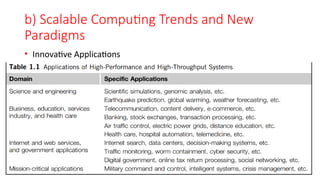
b) Scalable Computing Trends and New
Paradigms
• Innovative Applications
Dr. PUSHPARANI MK AIET, MOODABIDRI
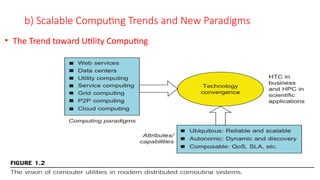
b) Scalable Computing Trends and New Paradigms
• The Trend toward Utility Computing
Dr. PUSHPARANI MK AIET, MOODABIDRI
b) Scalable Computing Trends and New
Paradigms
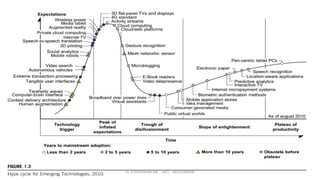
• The Hype Cycle of New Technologies
Dr. PUSHPARANI MK AIET, MOODABIDRI
c) The Internet of Things and Cyber-Physical
Systems
• The Internet of Things
The concept of the IoT was introduced in 1999 at MIT(Massachusetts
Institute of Technology
. The IoT refers to the networked interconnection of everyday objects,
tools, devices, or computers. The idea is to tag every object using RFID
or a related sensor or electronic technology such as GPS
Dr. PUSHPARANI MK AIET, MOODABIDRI
With the introduction of the IPv6 protocol, 2128 IP addresses are available
to distinguish all the objects on Earth, including all computers and
pervasive devices.
The IoT researchers have estimated that every human being will be
surrounded by 1,000 to 5,000 objects.
The IoT needs to be designed to track 100 trillion static or moving objects
simultaneously.
The IoT demands universal addressability of all of the objects or things. To
reduce the complexity of identification, search, and storage, one can set
the threshold to filter out fine-grain objects.
The IoT obviously extends the Internet and is more heavily developed in
Asia and European countries
Dr. PUSHPARANI MK AIET, MOODABIDRI
c) The Internet of Things and Cyber-Physical
Systems
• cyber-physical system (CPS)
A cyber-physical system (CPS) is the result of interaction between
computational processes and the physical world. A CPS integrates
“cyber” (heterogeneous, asynchronous) with “physical” (concurrent and
information-dense) objects. A CPS merges the “3C” technologies of
computation, communication, and control into an intelligent closed
feedback system between the physical world and the information world,
a concept which is actively explored in the United States. The IoT
emphasizes various networking connections among physical objects,
while the CPS emphasizes exploration of virtual reality (VR) applications
in the physical world
Dr. PUSHPARANI MK AIET, MOODABIDRI
1. SCALABLE COMPUTING OVER THE INTERNET
2. TECHNOLOGIES FOR NETWORK-BASED
SYSTEMS
3. SYSTEM MODELS FOR DISTRIBUTED AND CLOUD COMPUTING
4. SOFTWARE ENVIRONMENTS FOR DISTRIBUTED SYSTEMS AND
CLOUDS
5. PERFORMANCE, SECURITY, AND ENERGY EFFICIENCY
Dr. PUSHPARANI MK AIET, MOODABIDRI
2. TECHNOLOGIES FOR NETWORK-BASED
SYSTEMS
a) Multicore CPUs and Multithreading Technologies
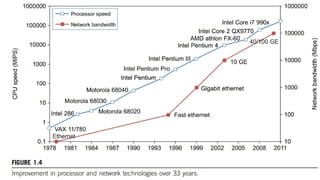
Advances in CPU Processors
(figure 1.4)
 Multicore CPU and Many-Core GPU Architectures
 Multithreading Technology
Dr. PUSHPARANI MK AIET, MOODABIDRI
b) Multicore CPU and Many-Core GPU
Architectures
IA-32 and IA-64 instruction set architectures
x-86 processors have been extended to serve HPC and HTC systems
Many RISC processors have been replaced with multicore x-86 processors
Dr. PUSHPARANI MK AIET, MOODABIDRI
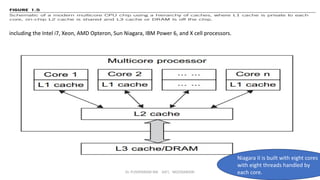
including the Intel i7, Xeon, AMD Opteron, Sun Niagara, IBM Power 6, and X cell processors.
Niagara II is built with eight cores
with eight threads handled by
each core.
Dr. PUSHPARANI MK AIET, MOODABIDRI
2. TECHNOLOGIES FOR NETWORK-BASED
SYSTEMS
a) Multicore CPUs and Multithreading Technologies
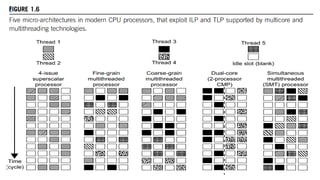
Multithreading Technology
Dr. PUSHPARANI MK AIET, MOODABIDRI
2. TECHNOLOGIES FOR NETWORK-BASED
SYSTEMS
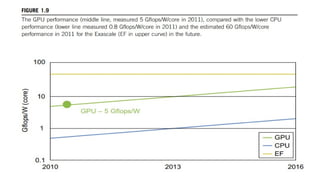
b) GPU Computing to Exascale and Beyond
 How GPUs Work
 GPU Programming Model
 Power Efficiency of the GPU
Dr. PUSHPARANI MK AIET, MOODABIDRI
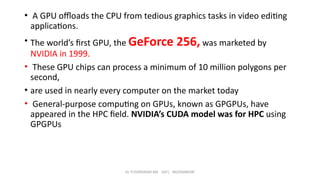
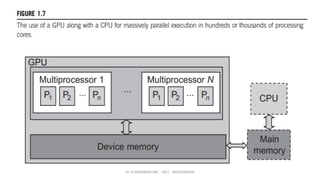
• A GPU offloads the CPU from tedious graphics tasks in video editing
applications.
• The world’s first GPU, the GeForce 256, was marketed by
NVIDIA in 1999.
• These GPU chips can process a minimum of 10 million polygons per
second,
• are used in nearly every computer on the market today
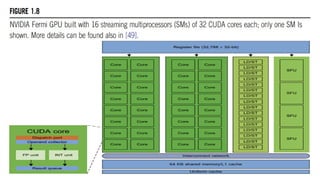
• General-purpose computing on GPUs, known as GPGPUs, have
appeared in the HPC field. NVIDIA’s CUDA model was for HPC using
GPGPUs
Dr. PUSHPARANI MK AIET, MOODABIDRI
2. TECHNOLOGIES FOR NETWORK-BASED SYSTEMS
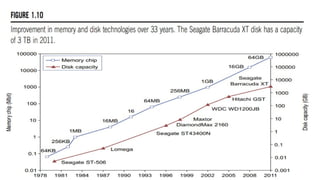
c) Memory, Storage, and Wide-Area Networking
Memory Technology
Disks and Storage Technology
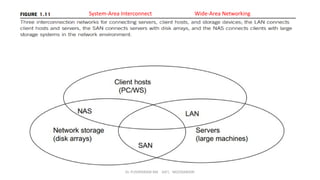
System-Area Interconnects
Wide-Area Networking
Dr. PUSHPARANI MK AIET, MOODABIDRI
System-Area Interconnect Wide-Area Networking
Dr. PUSHPARANI MK AIET, MOODABIDRI
2. TECHNOLOGIES FOR NETWORK-BASED
SYSTEMS
d) Virtual Machines and Virtualization Middleware
 Virtual Machines
 VM Primitive Operations
 Virtual Infrastructures
Dr. PUSHPARANI MK AIET, MOODABIDRI
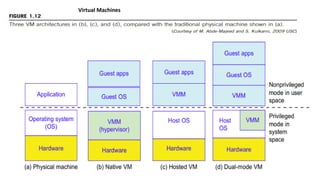
Virtual Machines
Dr. PUSHPARANI MK AIET, MOODABIDRI
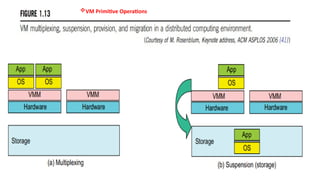
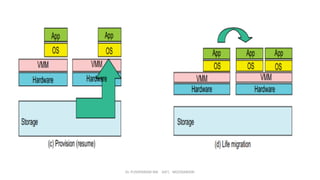
VM Primitive Operations
Dr. PUSHPARANI MK AIET, MOODABIDRI
2. TECHNOLOGIES FOR NETWORK-BASED
SYSTEMS
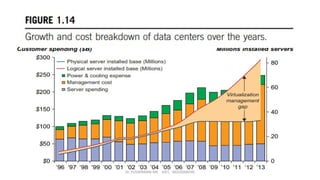
e) Data Center Virtualization for Cloud Computing
 Data Center Growth and Cost Breakdown
 Low-Cost Design Philosophy
 Convergence of Technologies
Dr. PUSHPARANI MK AIET, MOODABIDRI
3. SYSTEM MODELS FOR DISTRIBUTED AND CLOUD
COMPUTING
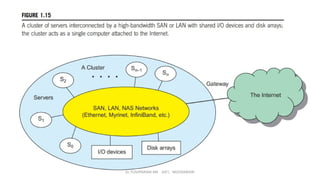
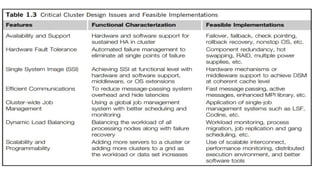
a) Clusters of Cooperative Computers
 Cluster Architecture
 Single-System Image
 Hardware, Software, and Middleware Support
 Major Cluster Design Issues
Dr. PUSHPARANI MK AIET, MOODABIDRI
3. SYSTEM MODELS FOR DISTRIBUTED AND CLOUD
COMPUTING
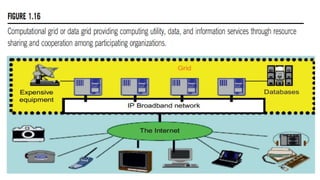
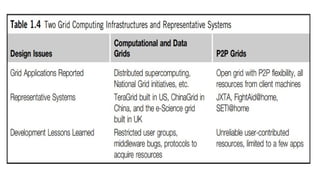
b) Grid Computing Infrastructures
 Computational Grids
 Grid Families
Dr. PUSHPARANI MK AIET, MOODABIDRI
3. SYSTEM MODELS FOR DISTRIBUTED AND CLOUD
COMPUTING
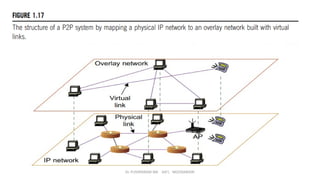
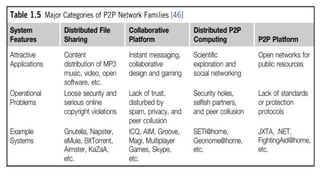
c) Peer-to-Peer Network Families
 P2P Systems
 Overlay Networks
 P2P Application Families
 P2P Computing Challenges
Dr. PUSHPARANI MK AIET, MOODABIDRI
3. SYSTEM MODELS FOR DISTRIBUTED AND CLOUD
COMPUTING
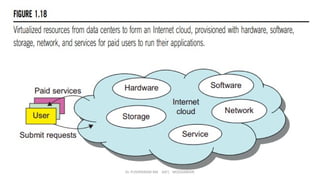
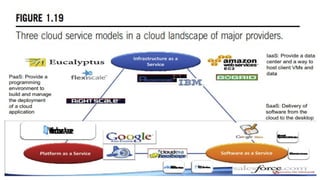
d) Cloud Computing over the Internet
 Internet Clouds
 The Cloud Landscape
Dr. PUSHPARANI MK AIET, MOODABIDRI
4. SOFTWARE ENVIRONMENTS FOR DISTRIBUTED SYSTEMS
AND CLOUDS
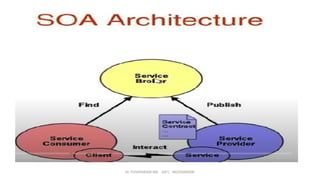
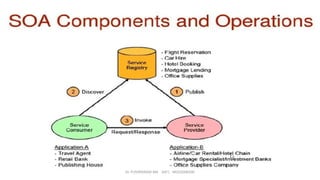
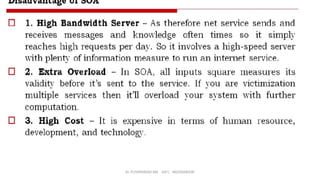
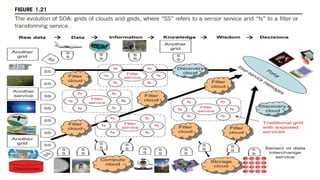
SOA Service-Oriented Architecture
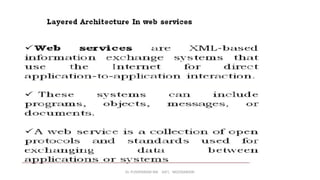
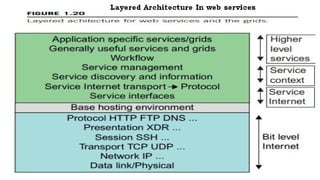
Layered Architecture for Web Services and Grids
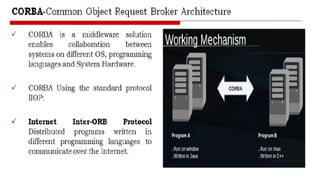
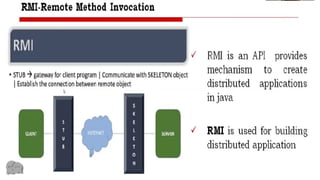
 CORBA AND RMI
Dr. PUSHPARANI MK AIET, MOODABIDRI
SOA
Dr. PUSHPARANI MK AIET, MOODABIDRI
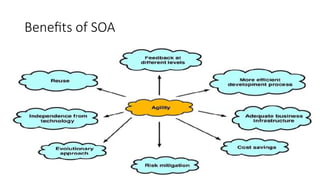
Benefits of SOA
Dr. PUSHPARANI MK AIET, MOODABIDRI
4. SOFTWARE ENVIRONMENTS FOR DISTRIBUTED SYSTEMS
AND CLOUDS
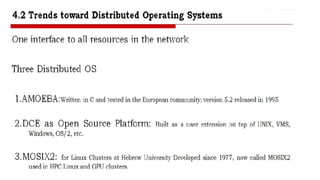
b) Trends toward Distributed Operating Systems
 Distributed Operating Systems
 Amoeba versus DCE
 MOSIX2 for Linux Clusters
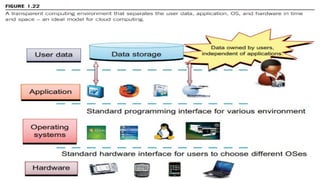
 Transparency in Programming Environments
Dr. PUSHPARANI MK AIET, MOODABIDRI
4. SOFTWARE ENVIRONMENTS FOR DISTRIBUTED SYSTEMS
AND CLOUDS
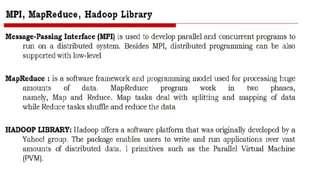
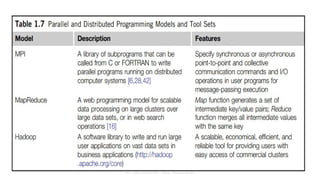
c) Parallel and Distributed Programming Models
 Message-Passing Interface (MPI)
 MapReduce
Hadoop Library
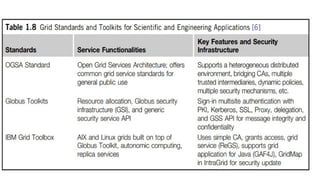
 Open Grid Services Architecture (OGSA)
 Globus Toolkits and Extensions
Dr. PUSHPARANI MK AIET, MOODABIDRI
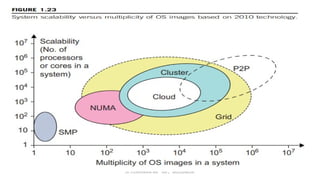
5. PERFORMANCE, SECURITY, AND ENERGY EFFICIENCY
a) Performance Metrics and Scalability Analysis
 Performance Metrics
 Dimensions of Scalability
 Scalability versus OS Image Count
 Amdahl’s Law
 Problem with Fixed Workload
 Gustafson’s Law
Dr. PUSHPARANI MK AIET, MOODABIDRI
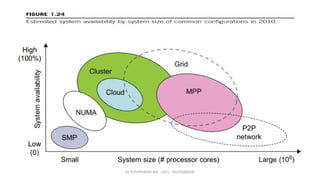
5. PERFORMANCE, SECURITY, AND ENERGY EFFICIENCY
b) Fault Tolerance and System Availability
 System Availability
Dr. PUSHPARANI MK AIET, MOODABIDRI
5. PERFORMANCE, SECURITY, AND ENERGY EFFICIENCY
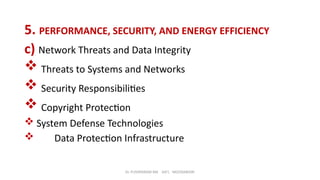
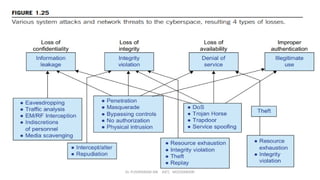
c) Network Threats and Data Integrity
 Threats to Systems and Networks
 Security Responsibilities
 Copyright Protection
 System Defense Technologies
 Data Protection Infrastructure
Dr. PUSHPARANI MK AIET, MOODABIDRI
5. PERFORMANCE, SECURITY, AND ENERGY EFFICIENCY
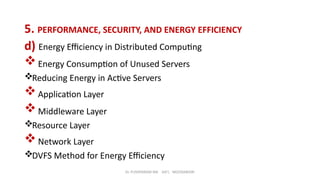
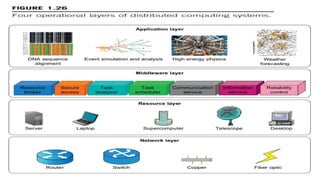
d) Energy Efficiency in Distributed Computing
Energy Consumption of Unused Servers
Reducing Energy in Active Servers
Application Layer
Middleware Layer
Resource Layer
Network Layer
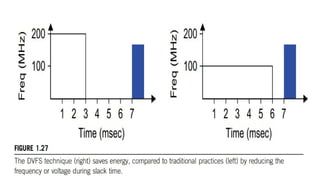
DVFS Method for Energy Efficiency
Dr. PUSHPARANI MK AIET, MOODABIDRI
Thank you

MODULE 01 - CLOUD COMPUTING [BIS 613D] .pptx

  • 1.
    MODULE-1 Distributed System Modelsand Enabling Technologies
  • 2.
    Dr. PUSHPARANI MKAIET, MOODABIDRI 1. SCALABLE COMPUTING OVER THE INTERNET 2. TECHNOLOGIES FOR NETWORK-BASED SYSTEMS 3. SYSTEM MODELS FOR DISTRIBUTED AND CLOUD COMPUTING 4. SOFTWARE ENVIRONMENTS FOR DISTRIBUTED SYSTEMS AND CLOUDS 5. PERFORMANCE, SECURITY, AND ENERGY EFFICIENCY
  • 3.
    Dr. PUSHPARANI MKAIET, MOODABIDRI • SCALABLE COMPUTING OVER THE INTERNET A) The Age of Internet Computing B) Scalable Computing Trends and New Paradigms C) The Internet of Things and Cyber-Physical Systems
  • 4.
    Dr. PUSHPARANI MKAIET, MOODABIDRI 1.a) The Age of Internet Computing The Platform Evolution • Computer technology has gone through five generations • each generation lasting from 10 to 20 years 1. 1950 to 1970, a handful of mainframes, including the IBM 360 and CDC 6400, were built to satisfy the demands of large businesses and government organizations. 2. From 1960 to 1980, lower-cost minicomputers such as the DEC PDP 11 and VAX Series became popular among small businesses and on college campuses 3. From 1970 to 1990, we saw widespread use of personal computers built with VLSI microprocessors 4. From 1980 to 2000, portable computers and pervasive devices appeared in both wired and wireless applications. 5. Since 1990, the use of both HPC and HTC
  • 5.
    Dr. PUSHPARANI MKAIET, MOODABIDRI • Figure 1.1 illustrates the evolution of HPC and HTC systems. On the HPC side, supercomputers (massively parallel processors or MPPs) are gradually replaced by clusters of cooperative computers out of a desire to share computing resources.
  • 6.
    Dr. PUSHPARANI MKAIET, MOODABIDRI 1) SCALABLE COMPUTING OVER THE INTERNET
  • 7.
    Dr. PUSHPARANI MKAIET, MOODABIDRI Distributed System Families • mid-1990s, technologies for building P2P networks and networks of clusters have been consolidated into many national projects designed to establish wide area computing infrastructures, known as computational grids or data grids. Recently, we have witnessed a surge in interest in exploring Internet cloud resources for data-intensive applications. Internet clouds are the result of moving desktop computing to service-oriented computing using server clusters and huge databases at data centers. • In October 2010, the highest performing cluster machine was built in China with 86016 CPU processor cores and 3,211,264 GPU cores in a Tianhe-1A system. The largest computational grid connects up to hundreds of server clusters. A typical P2P network may involve millions of client machines working simultaneously. Experimental cloud computing clusters have been built with thousands of processing nodes.
  • 8.
    Dr. PUSHPARANI MKAIET, MOODABIDRI Meeting these goals requires to yield the following design objectives: • Efficiency measures the utilization rate of resources in an execution model by exploiting massive parallelism in HPC. For HTC, efficiency is more closely related to job throughput, data access, storage, and power efficiency. • Dependability measures the reliability and self-management from the chip to the system and application levels. The purpose is to provide high-throughput service with Quality of Service (QoS) assurance, even under failure conditions. • Adaptation in the programming model measures the ability to support billions of job requests over massive data sets and virtualized cloud resources under various workload and service models. • Flexibility in application deployment measures the ability of distributed systems to run well in both HPC (science and engineering) and HTC (business) applications
  • 9.
    Dr. PUSHPARANI MKAIET, MOODABIDRI b) Scalable Computing Trends and New Paradigms • The tremendous price/performance ratio of commodity hardware was driven by the desktop, notebook, and tablet computing markets. This has also driven the adoption and use of commodity technologies in large-scale computing.
  • 10.
    Dr. PUSHPARANI MKAIET, MOODABIDRI b) Scalable Computing Trends and New Paradigms • Innovative Applications
  • 11.
    Dr. PUSHPARANI MKAIET, MOODABIDRI b) Scalable Computing Trends and New Paradigms • The Trend toward Utility Computing
  • 12.
    Dr. PUSHPARANI MKAIET, MOODABIDRI b) Scalable Computing Trends and New Paradigms • The Hype Cycle of New Technologies
  • 13.
    Dr. PUSHPARANI MKAIET, MOODABIDRI
  • 14.
    Dr. PUSHPARANI MKAIET, MOODABIDRI c) The Internet of Things and Cyber-Physical Systems • The Internet of Things The concept of the IoT was introduced in 1999 at MIT(Massachusetts Institute of Technology . The IoT refers to the networked interconnection of everyday objects, tools, devices, or computers. The idea is to tag every object using RFID or a related sensor or electronic technology such as GPS
  • 15.
    Dr. PUSHPARANI MKAIET, MOODABIDRI With the introduction of the IPv6 protocol, 2128 IP addresses are available to distinguish all the objects on Earth, including all computers and pervasive devices. The IoT researchers have estimated that every human being will be surrounded by 1,000 to 5,000 objects. The IoT needs to be designed to track 100 trillion static or moving objects simultaneously. The IoT demands universal addressability of all of the objects or things. To reduce the complexity of identification, search, and storage, one can set the threshold to filter out fine-grain objects. The IoT obviously extends the Internet and is more heavily developed in Asia and European countries
  • 16.
    Dr. PUSHPARANI MKAIET, MOODABIDRI c) The Internet of Things and Cyber-Physical Systems • cyber-physical system (CPS) A cyber-physical system (CPS) is the result of interaction between computational processes and the physical world. A CPS integrates “cyber” (heterogeneous, asynchronous) with “physical” (concurrent and information-dense) objects. A CPS merges the “3C” technologies of computation, communication, and control into an intelligent closed feedback system between the physical world and the information world, a concept which is actively explored in the United States. The IoT emphasizes various networking connections among physical objects, while the CPS emphasizes exploration of virtual reality (VR) applications in the physical world
  • 17.
    Dr. PUSHPARANI MKAIET, MOODABIDRI 1. SCALABLE COMPUTING OVER THE INTERNET 2. TECHNOLOGIES FOR NETWORK-BASED SYSTEMS 3. SYSTEM MODELS FOR DISTRIBUTED AND CLOUD COMPUTING 4. SOFTWARE ENVIRONMENTS FOR DISTRIBUTED SYSTEMS AND CLOUDS 5. PERFORMANCE, SECURITY, AND ENERGY EFFICIENCY
  • 18.
    Dr. PUSHPARANI MKAIET, MOODABIDRI 2. TECHNOLOGIES FOR NETWORK-BASED SYSTEMS a) Multicore CPUs and Multithreading Technologies Advances in CPU Processors (figure 1.4)  Multicore CPU and Many-Core GPU Architectures  Multithreading Technology
  • 19.
    Dr. PUSHPARANI MKAIET, MOODABIDRI
  • 20.
    Dr. PUSHPARANI MKAIET, MOODABIDRI
  • 21.
    Dr. PUSHPARANI MKAIET, MOODABIDRI b) Multicore CPU and Many-Core GPU Architectures IA-32 and IA-64 instruction set architectures x-86 processors have been extended to serve HPC and HTC systems Many RISC processors have been replaced with multicore x-86 processors
  • 22.
    Dr. PUSHPARANI MKAIET, MOODABIDRI including the Intel i7, Xeon, AMD Opteron, Sun Niagara, IBM Power 6, and X cell processors. Niagara II is built with eight cores with eight threads handled by each core.
  • 23.
    Dr. PUSHPARANI MKAIET, MOODABIDRI 2. TECHNOLOGIES FOR NETWORK-BASED SYSTEMS a) Multicore CPUs and Multithreading Technologies Multithreading Technology
  • 24.
    Dr. PUSHPARANI MKAIET, MOODABIDRI
  • 25.
    Dr. PUSHPARANI MKAIET, MOODABIDRI 2. TECHNOLOGIES FOR NETWORK-BASED SYSTEMS b) GPU Computing to Exascale and Beyond  How GPUs Work  GPU Programming Model  Power Efficiency of the GPU
  • 26.
    Dr. PUSHPARANI MKAIET, MOODABIDRI • A GPU offloads the CPU from tedious graphics tasks in video editing applications. • The world’s first GPU, the GeForce 256, was marketed by NVIDIA in 1999. • These GPU chips can process a minimum of 10 million polygons per second, • are used in nearly every computer on the market today • General-purpose computing on GPUs, known as GPGPUs, have appeared in the HPC field. NVIDIA’s CUDA model was for HPC using GPGPUs
  • 27.
    Dr. PUSHPARANI MKAIET, MOODABIDRI
  • 28.
    Dr. PUSHPARANI MKAIET, MOODABIDRI
  • 29.
    Dr. PUSHPARANI MKAIET, MOODABIDRI
  • 30.
    Dr. PUSHPARANI MKAIET, MOODABIDRI 2. TECHNOLOGIES FOR NETWORK-BASED SYSTEMS c) Memory, Storage, and Wide-Area Networking Memory Technology Disks and Storage Technology System-Area Interconnects Wide-Area Networking
  • 31.
    Dr. PUSHPARANI MKAIET, MOODABIDRI
  • 32.
    Dr. PUSHPARANI MKAIET, MOODABIDRI System-Area Interconnect Wide-Area Networking
  • 33.
    Dr. PUSHPARANI MKAIET, MOODABIDRI 2. TECHNOLOGIES FOR NETWORK-BASED SYSTEMS d) Virtual Machines and Virtualization Middleware  Virtual Machines  VM Primitive Operations  Virtual Infrastructures
  • 34.
    Dr. PUSHPARANI MKAIET, MOODABIDRI Virtual Machines
  • 35.
    Dr. PUSHPARANI MKAIET, MOODABIDRI VM Primitive Operations
  • 36.
    Dr. PUSHPARANI MKAIET, MOODABIDRI
  • 37.
    Dr. PUSHPARANI MKAIET, MOODABIDRI
  • 38.
    Dr. PUSHPARANI MKAIET, MOODABIDRI 2. TECHNOLOGIES FOR NETWORK-BASED SYSTEMS e) Data Center Virtualization for Cloud Computing  Data Center Growth and Cost Breakdown  Low-Cost Design Philosophy  Convergence of Technologies
  • 39.
    Dr. PUSHPARANI MKAIET, MOODABIDRI 3. SYSTEM MODELS FOR DISTRIBUTED AND CLOUD COMPUTING a) Clusters of Cooperative Computers  Cluster Architecture  Single-System Image  Hardware, Software, and Middleware Support  Major Cluster Design Issues
  • 40.
    Dr. PUSHPARANI MKAIET, MOODABIDRI
  • 41.
    Dr. PUSHPARANI MKAIET, MOODABIDRI
  • 42.
    Dr. PUSHPARANI MKAIET, MOODABIDRI
  • 43.
    Dr. PUSHPARANI MKAIET, MOODABIDRI 3. SYSTEM MODELS FOR DISTRIBUTED AND CLOUD COMPUTING b) Grid Computing Infrastructures  Computational Grids  Grid Families
  • 44.
    Dr. PUSHPARANI MKAIET, MOODABIDRI
  • 45.
    Dr. PUSHPARANI MKAIET, MOODABIDRI
  • 46.
    Dr. PUSHPARANI MKAIET, MOODABIDRI 3. SYSTEM MODELS FOR DISTRIBUTED AND CLOUD COMPUTING c) Peer-to-Peer Network Families  P2P Systems  Overlay Networks  P2P Application Families  P2P Computing Challenges
  • 47.
    Dr. PUSHPARANI MKAIET, MOODABIDRI
  • 48.
    Dr. PUSHPARANI MKAIET, MOODABIDRI
  • 49.
    Dr. PUSHPARANI MKAIET, MOODABIDRI 3. SYSTEM MODELS FOR DISTRIBUTED AND CLOUD COMPUTING d) Cloud Computing over the Internet  Internet Clouds  The Cloud Landscape
  • 50.
    Dr. PUSHPARANI MKAIET, MOODABIDRI
  • 51.
    Dr. PUSHPARANI MKAIET, MOODABIDRI
  • 52.
    Dr. PUSHPARANI MKAIET, MOODABIDRI 4. SOFTWARE ENVIRONMENTS FOR DISTRIBUTED SYSTEMS AND CLOUDS SOA Service-Oriented Architecture Layered Architecture for Web Services and Grids  CORBA AND RMI
  • 53.
    Dr. PUSHPARANI MKAIET, MOODABIDRI
  • 54.
    Dr. PUSHPARANI MKAIET, MOODABIDRI SOA
  • 55.
    Dr. PUSHPARANI MKAIET, MOODABIDRI
  • 56.
    Dr. PUSHPARANI MKAIET, MOODABIDRI
  • 57.
    Dr. PUSHPARANI MKAIET, MOODABIDRI
  • 58.
    Dr. PUSHPARANI MKAIET, MOODABIDRI
  • 59.
    Dr. PUSHPARANI MKAIET, MOODABIDRI Benefits of SOA
  • 60.
    Dr. PUSHPARANI MKAIET, MOODABIDRI
  • 61.
    Dr. PUSHPARANI MKAIET, MOODABIDRI
  • 62.
    Dr. PUSHPARANI MKAIET, MOODABIDRI
  • 63.
    Dr. PUSHPARANI MKAIET, MOODABIDRI
  • 64.
    Dr. PUSHPARANI MKAIET, MOODABIDRI
  • 65.
    Dr. PUSHPARANI MKAIET, MOODABIDRI
  • 66.
    Dr. PUSHPARANI MKAIET, MOODABIDRI 4. SOFTWARE ENVIRONMENTS FOR DISTRIBUTED SYSTEMS AND CLOUDS b) Trends toward Distributed Operating Systems  Distributed Operating Systems  Amoeba versus DCE  MOSIX2 for Linux Clusters  Transparency in Programming Environments
  • 67.
    Dr. PUSHPARANI MKAIET, MOODABIDRI
  • 68.
    Dr. PUSHPARANI MKAIET, MOODABIDRI
  • 69.
    Dr. PUSHPARANI MKAIET, MOODABIDRI
  • 70.
    Dr. PUSHPARANI MKAIET, MOODABIDRI 4. SOFTWARE ENVIRONMENTS FOR DISTRIBUTED SYSTEMS AND CLOUDS c) Parallel and Distributed Programming Models  Message-Passing Interface (MPI)  MapReduce Hadoop Library  Open Grid Services Architecture (OGSA)  Globus Toolkits and Extensions
  • 71.
    Dr. PUSHPARANI MKAIET, MOODABIDRI
  • 72.
    Dr. PUSHPARANI MKAIET, MOODABIDRI
  • 73.
    Dr. PUSHPARANI MKAIET, MOODABIDRI 5. PERFORMANCE, SECURITY, AND ENERGY EFFICIENCY a) Performance Metrics and Scalability Analysis  Performance Metrics  Dimensions of Scalability  Scalability versus OS Image Count  Amdahl’s Law  Problem with Fixed Workload  Gustafson’s Law
  • 74.
    Dr. PUSHPARANI MKAIET, MOODABIDRI
  • 75.
    Dr. PUSHPARANI MKAIET, MOODABIDRI 5. PERFORMANCE, SECURITY, AND ENERGY EFFICIENCY b) Fault Tolerance and System Availability  System Availability
  • 76.
    Dr. PUSHPARANI MKAIET, MOODABIDRI
  • 77.
    Dr. PUSHPARANI MKAIET, MOODABIDRI 5. PERFORMANCE, SECURITY, AND ENERGY EFFICIENCY c) Network Threats and Data Integrity  Threats to Systems and Networks  Security Responsibilities  Copyright Protection  System Defense Technologies  Data Protection Infrastructure
  • 78.
    Dr. PUSHPARANI MKAIET, MOODABIDRI
  • 79.
    Dr. PUSHPARANI MKAIET, MOODABIDRI 5. PERFORMANCE, SECURITY, AND ENERGY EFFICIENCY d) Energy Efficiency in Distributed Computing Energy Consumption of Unused Servers Reducing Energy in Active Servers Application Layer Middleware Layer Resource Layer Network Layer DVFS Method for Energy Efficiency
  • 80.
    Dr. PUSHPARANI MKAIET, MOODABIDRI
  • 81.
    Dr. PUSHPARANI MKAIET, MOODABIDRI
  • 82.
    Dr. PUSHPARANI MKAIET, MOODABIDRI Thank you