Cloud Computing
Dr.J.Kalavathi
Assistant Professor of Information Technology
V.V.Vanniaperumal College for Women
Benefits of Cloud Computing
 Utilities, over the internet
Manipulate and configure the applications
Does not require to install
Online development and deployment tools, programming environment through Platform as a
Service Model.
 available over the network and platform independent access.
 on-demand self-service
Highly cost effective
More reliable
Benefits of Cloud Computing
Technologies for Network –Based System
 scalable computing ,it’s time to explore hardware, software, and network
technologies for distributed computing system design and applications.
In particular, we will focus on viable approaches to building distributed operating
systems for handling massive parallelism in a distributed environment.
Multicore CPUs and Multithreadin
g Technologies
A multicore processor is a single computing component comprised of two
or more CPUs that read and execute the actual program instructions.
They are crucial to the development of HPC and HTC systems.
processor speed is measured in millions of instructions per second (MIPS) a
nd network bandwidth is measured in megabits per second (Mbps) or gigabits
per second (Gbps). The unit GE refers to 1 Gbps Ethernet bandwidth.
Advances in CPU Processors
advanced CPUs or microprocessor chips assume a multicore architecture with
dual, quad, six, or more processing cores.
Processor speed growth is plotted in the upper curve
CMOS-based chips due to power limitations.
 This limitation is attributed primarily to excessive heat generation with high fre
quency or high voltages. The ILP is highly exploited in modern CPU processors.
ILP mechanisms include multiple-issue superscalar architecture, dynamic bran
ch prediction, and speculative execution, among others.
These ILP techniques demand hardware and compiler support.
Both multi-core CPU and many-core GPU processors can handle multiple instr
uction threads at different magnitudes
Multicore CPU and Many-Core GP
U Architectures
Multicore CPUs may increase from the tens of cores to hundreds .
The CPU has reached its limit in terms of exploiting massive DLP due to the afore
mentioned memory wall problem.
Both IA-32 and IA-64 instruction set architectures are built into commercial CPUs
x-86 processors have been extended to serve HPC and HTC systems in some hi
gh-end server processors.
Many RISC processors have been replaced with multicore x-86 processors and m
any-core GPUs in the Top 500 systems
The processor industry is also keen to develop asymmetric or heterogeneous chip
mul-tiprocessors that can house both fat CPU cores and thin GPU cores on the sam
e chip.
Multithreading Technology
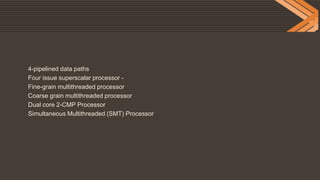
4-pipelined data paths
Four issue superscalar processor -
Fine-grain multithreaded processor
Coarse grain multithreaded processor
Dual core 2-CMP Processor
Simultaneous Multithreaded (SMT) Processor

Cloud computing 2.pptx

  • 1.
    Cloud Computing Dr.J.Kalavathi Assistant Professorof Information Technology V.V.Vanniaperumal College for Women
  • 2.
    Benefits of CloudComputing  Utilities, over the internet Manipulate and configure the applications Does not require to install Online development and deployment tools, programming environment through Platform as a Service Model.  available over the network and platform independent access.  on-demand self-service Highly cost effective More reliable
  • 3.
  • 4.
    Technologies for Network–Based System  scalable computing ,it’s time to explore hardware, software, and network technologies for distributed computing system design and applications. In particular, we will focus on viable approaches to building distributed operating systems for handling massive parallelism in a distributed environment.
  • 5.
    Multicore CPUs andMultithreadin g Technologies A multicore processor is a single computing component comprised of two or more CPUs that read and execute the actual program instructions. They are crucial to the development of HPC and HTC systems. processor speed is measured in millions of instructions per second (MIPS) a nd network bandwidth is measured in megabits per second (Mbps) or gigabits per second (Gbps). The unit GE refers to 1 Gbps Ethernet bandwidth.
  • 7.
    Advances in CPUProcessors advanced CPUs or microprocessor chips assume a multicore architecture with dual, quad, six, or more processing cores. Processor speed growth is plotted in the upper curve CMOS-based chips due to power limitations.  This limitation is attributed primarily to excessive heat generation with high fre quency or high voltages. The ILP is highly exploited in modern CPU processors. ILP mechanisms include multiple-issue superscalar architecture, dynamic bran ch prediction, and speculative execution, among others. These ILP techniques demand hardware and compiler support. Both multi-core CPU and many-core GPU processors can handle multiple instr uction threads at different magnitudes
  • 9.
    Multicore CPU andMany-Core GP U Architectures Multicore CPUs may increase from the tens of cores to hundreds . The CPU has reached its limit in terms of exploiting massive DLP due to the afore mentioned memory wall problem. Both IA-32 and IA-64 instruction set architectures are built into commercial CPUs x-86 processors have been extended to serve HPC and HTC systems in some hi gh-end server processors. Many RISC processors have been replaced with multicore x-86 processors and m any-core GPUs in the Top 500 systems The processor industry is also keen to develop asymmetric or heterogeneous chip mul-tiprocessors that can house both fat CPU cores and thin GPU cores on the sam e chip.
  • 10.
  • 12.
    4-pipelined data paths Fourissue superscalar processor - Fine-grain multithreaded processor Coarse grain multithreaded processor Dual core 2-CMP Processor Simultaneous Multithreaded (SMT) Processor